Articles | Volume 23, issue 16
https://doi.org/10.5194/bg-23-5685-2026
© Author(s) 2026. This work is distributed under
the Creative Commons Attribution 4.0 License.
https://doi.org/10.5194/bg-23-5685-2026
© Author(s) 2026. This work is distributed under
the Creative Commons Attribution 4.0 License.
Biogeochemical dichotomy and intra-order variability in Miliolid and Rotaliid foraminifera

Lin Hoober
Department of Earth and Environmental Sciences, Ben-Gurion University of the Negev, Beer Sheva 8410501, Israel
Barak Herut
Faculty of Marine Sciences, Ruppin Academic Center, Emek Hefer 4025000, Israel
National Institute of Oceanography, Israel Oceanographic and Limnological Research, Haifa 3108000, Israel
Nadya Teutsch
Division of Geochemistry and Environmental Geology, Geological Survey of Israel, Jerusalem 9692100, Israel
The Dr. Moses Strauss Department of Marine Geosciences, Leon H.Charney School of Marine Sciences, University of Haifa, Mt. Carmel, Haifa 31905, Israel
Sarit Ashckenazi-Polivoda
Dead Sea and Arava Science Center, Masada National Park, Mount Masada, Dead-Sea mobile post 86910, Israel
Ben-Gurion University of the Negev, Eilat Campus 8855630, Israel
Adi Torfstein
The Fredy and Nadine Herrmann Institute of Earth Sciences, The Hebrew University of Jerusalem, Jerusalem 9190401, Israel
Interuniversity Institute for Marine Sciences in Eilat, Eilat 8810302, Israel
Department of Earth and Environmental Sciences, Ben-Gurion University of the Negev, Beer Sheva 8410501, Israel
Related authors
No articles found.
Dotan Rotem, Yishai Weinstein, Yehudit Harlavan, Adi Torfstein, and Hanne Hvidtfeldt Christiansen
EGUsphere, https://doi.org/10.5194/egusphere-2025-6564, https://doi.org/10.5194/egusphere-2025-6564, 2026
Short summary
Short summary
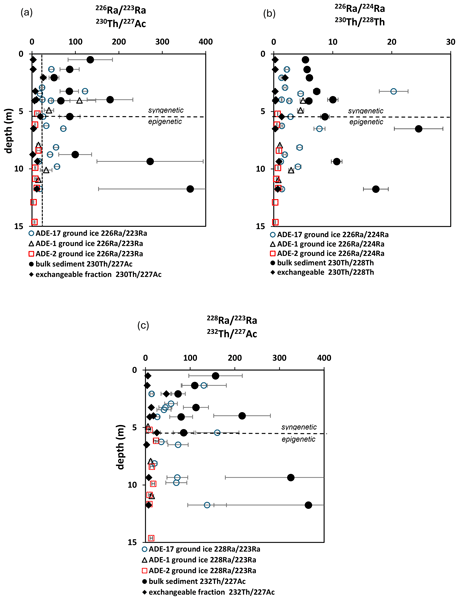
We investigated residence time of ground ice in Svalbard permafrost. Marked differences were found in salinity and the chemical composition of ice taken from three nearby cores. Radioactive isotopes of Ra and Th suggest that while some of the ice is almost 10,000 years old, the more saline ice has much lower ratios of long to short-lived Ra isotopes, which suggests it is much younger (<2,000 years). This should be due to within-permafrost flow, which highlights its resilience to global warming.
Efraim Bril, Adi Torfstein, Roy Yaniv, and Assaf Hochman
Clim. Past, 22, 339–355, https://doi.org/10.5194/cp-22-339-2026, https://doi.org/10.5194/cp-22-339-2026, 2026
Short summary
Short summary
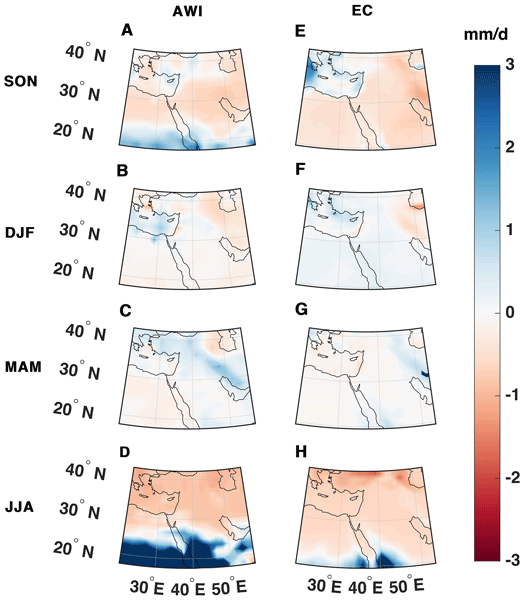
During a past warm period, we found that the eastern Mediterranean region experienced stronger but shorter rain events, especially in the south. The warming made the air wetter, which helped produce more intense rainfall. Using climate models and recent data, we show how this improves our understanding of future changes in dry regions.
Noy Levy, Adi Torfstein, Ralf Schiebel, Natalie Chernihovsky, Klaus Peter Jochum, Ulrike Weis, Brigitte Stoll, and Gerald H. Haug
Biogeosciences, 23, 1065–1088, https://doi.org/10.5194/bg-23-1065-2026, https://doi.org/10.5194/bg-23-1065-2026, 2026
Short summary
Short summary
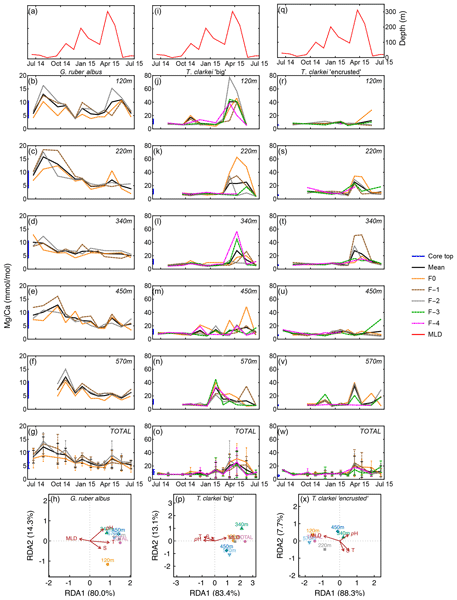
We investigated the shell chemistry of planktic organisms called foraminifera to understand how conditions in the Gulf of Aqaba (north of Red Sea), a relative warm and saline sea, are recorded. We analyzed shell parts, called chambers, and we found that shell chemistry varies significantly between both chambers and foraminifera species. These findings help better understand how deposited shells can be used to reconstruct past ocean temperatures and other conditions.
Natalie M. Mahowald, Longlei Li, Julius Vira, Marje Prank, Douglas S. Hamilton, Hitoshi Matsui, Ron L. Miller, P. Louis Lu, Ezgi Akyuz, Daphne Meidan, Peter Hess, Heikki Lihavainen, Christine Wiedinmyer, Jenny Hand, Maria Grazia Alaimo, Célia Alves, Andres Alastuey, Paulo Artaxo, Africa Barreto, Francisco Barraza, Silvia Becagli, Giulia Calzolai, Shankararaman Chellam, Ying Chen, Patrick Chuang, David D. Cohen, Cristina Colombi, Evangelia Diapouli, Gaetano Dongarra, Konstantinos Eleftheriadis, Johann Engelbrecht, Corinne Galy-Lacaux, Cassandra Gaston, Dario Gomez, Yenny González Ramos, Roy M. Harrison, Chris Heyes, Barak Herut, Philip Hopke, Christoph Hüglin, Maria Kanakidou, Zsofia Kertesz, Zbigniew Klimont, Katriina Kyllönen, Fabrice Lambert, Xiaohong Liu, Remi Losno, Franco Lucarelli, Willy Maenhaut, Beatrice Marticorena, Randall V. Martin, Nikolaos Mihalopoulos, Yasser Morera-Gómez, Adina Paytan, Joseph Prospero, Sergio Rodríguez, Patricia Smichowski, Daniela Varrica, Brenna Walsh, Crystal L. Weagle, and Xi Zhao
Atmos. Chem. Phys., 25, 4665–4702, https://doi.org/10.5194/acp-25-4665-2025, https://doi.org/10.5194/acp-25-4665-2025, 2025
Short summary
Short summary
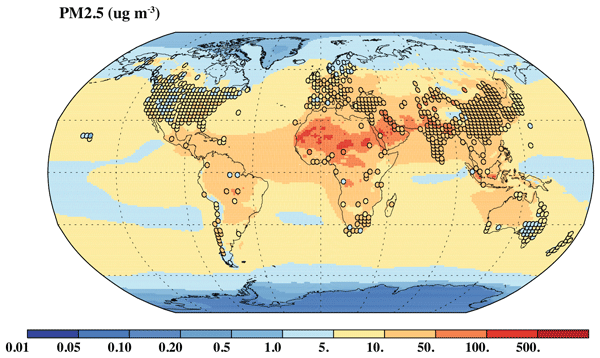
Aerosol particles are an important part of the Earth system, but their concentrations are spatially and temporally heterogeneous, as well as being variable in size and composition. Here, we present a new compilation of PM2.5 and PM10 aerosol observations, focusing on the spatial variability across different observational stations, including composition, and demonstrate a method for comparing the data sets to model output.
Maxim Rubin-Blum, Eyal Rahav, Guy Sisma-Ventura, Yana Yudkovski, Zoya Harbuzov, Or M. Bialik, Oded Ezra, Anneleen Foubert, Barak Herut, and Yizhaq Makovsky
Biogeosciences, 22, 1321–1340, https://doi.org/10.5194/bg-22-1321-2025, https://doi.org/10.5194/bg-22-1321-2025, 2025
Short summary
Short summary
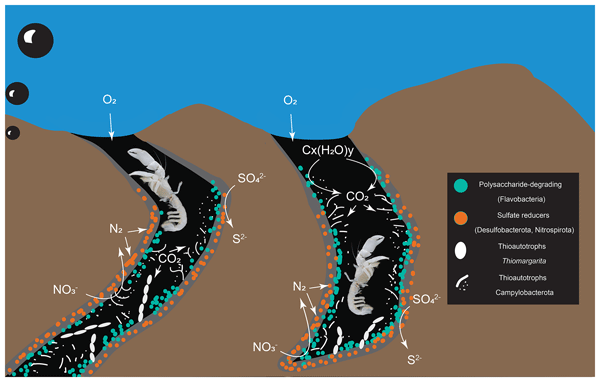
Chemotones, transition zones in chemosynthetic ecosystems, alter geochemical cycles and biodiversity. We studied seep chemotones, which are heavily burrowed by ghost shrimp. To investigate if burrowing affects habitat functionality, we surveyed the seafloor with deep-sea vehicles, analyzed sediment, and explored microbial communities in burrows. We found chemosynthetic biofilms, linking them to macromolecule turnover and nutrient cycling. This process may play a crucial role in deep-sea cycles.
Nir Haim, Vika Grigorieva, Rotem Soffer, Boaz Mayzel, Timor Katz, Ronen Alkalay, Eli Biton, Ayah Lazar, Hezi Gildor, Ilana Berman-Frank, Yishai Weinstein, Barak Herut, and Yaron Toledo
Earth Syst. Sci. Data, 16, 2659–2668, https://doi.org/10.5194/essd-16-2659-2024, https://doi.org/10.5194/essd-16-2659-2024, 2024
Short summary
Short summary
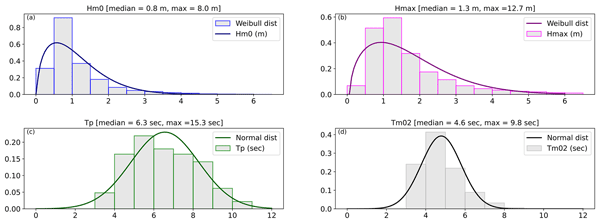
This paper outlines the process of creating an open-access surface wave dataset, drawing from deep-sea research station observations located 50 km off the coast of Israel. The discussion covers the wave monitoring procedure, from instrument configuration to wave field retrieval, and aspects of quality assurance. The dataset presented spans over 5 years, offering uncommon in situ wave measurements in the deep sea, and addresses the existing gap in wave information within the region.
Natalie M. Mahowald, Longlei Li, Julius Vira, Marje Prank, Douglas S. Hamilton, Hitoshi Matsui, Ron L. Miller, Louis Lu, Ezgi Akyuz, Daphne Meidan, Peter Hess, Heikki Lihavainen, Christine Wiedinmyer, Jenny Hand, Maria Grazia Alaimo, Célia Alves, Andres Alastuey, Paulo Artaxo, Africa Barreto, Francisco Barraza, Silvia Becagli, Giulia Calzolai, Shankarararman Chellam, Ying Chen, Patrick Chuang, David D. Cohen, Cristina Colombi, Evangelia Diapouli, Gaetano Dongarra, Konstantinos Eleftheriadis, Corinne Galy-Lacaux, Cassandra Gaston, Dario Gomez, Yenny González Ramos, Hannele Hakola, Roy M. Harrison, Chris Heyes, Barak Herut, Philip Hopke, Christoph Hüglin, Maria Kanakidou, Zsofia Kertesz, Zbiginiw Klimont, Katriina Kyllönen, Fabrice Lambert, Xiaohong Liu, Remi Losno, Franco Lucarelli, Willy Maenhaut, Beatrice Marticorena, Randall V. Martin, Nikolaos Mihalopoulos, Yasser Morera-Gomez, Adina Paytan, Joseph Prospero, Sergio Rodríguez, Patricia Smichowski, Daniela Varrica, Brenna Walsh, Crystal Weagle, and Xi Zhao
Earth Syst. Sci. Data Discuss., https://doi.org/10.5194/essd-2024-1, https://doi.org/10.5194/essd-2024-1, 2024
Preprint withdrawn
Short summary
Short summary
Aerosol particles can interact with incoming solar radiation and outgoing long wave radiation, change cloud properties, affect photochemistry, impact surface air quality, and when deposited impact surface albedo of snow and ice, and modulate carbon dioxide uptake by the land and ocean. Here we present a new compilation of aerosol observations including composition, a methodology for comparing the datasets to model output, and show the implications of these results using one model.
Natalia Belkin, Tamar Guy-Haim, Maxim Rubin-Blum, Ayah Lazar, Guy Sisma-Ventura, Rainer Kiko, Arseniy R. Morov, Tal Ozer, Isaac Gertman, Barak Herut, and Eyal Rahav
Ocean Sci., 18, 693–715, https://doi.org/10.5194/os-18-693-2022, https://doi.org/10.5194/os-18-693-2022, 2022
Short summary
Short summary
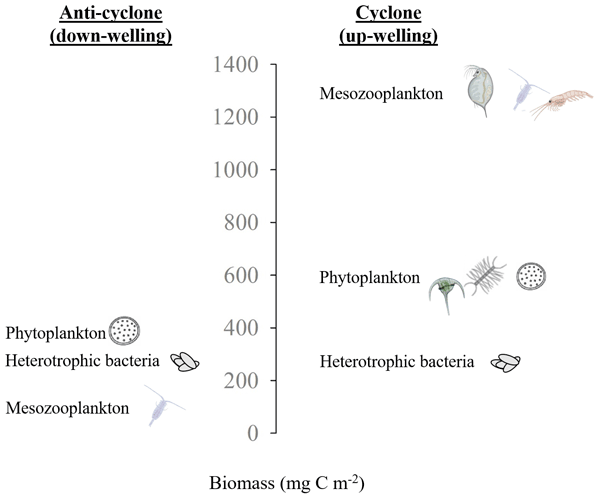
We studied how distinct water circulations that elevate (cyclone) or descend (anticyclone) water from the upper ocean affect the biomass, activity and diversity of planktonic microorganisms in the impoverished eastern Mediterranean. We show that cyclonic and anticyclonic eddies differ in their community composition and production. Moreover, the anticyclone may be a potential bio-invasion and dispersal vector, while the cyclone may serve as a thermal refugee for native species.
Cited articles
Anderson, O. R. and Faber, W. W.: An estimation of calcium carbonate deposition rate in a planktonic foraminifer Globigerinoides sacculifer using 45Ca as a tracer; a recommended procedure for improved accuracy, J. Foraminifer. Res., 14, 303–308, https://doi.org/10.2113/gsjfr.14.4.303, 1984.
Angell, R. W.: Test morphogenesis (chamber formation) in the foraminifer Spiroloculina hyalina Schulze, J. Foraminifer. Res., 10, 89–101, https://doi.org/10.2113/gsjfr.10.2.89, 1980.
Benaltabet, T., Gutner-Hoch, E., and Torfstein, A.: Heavy Metal, Rare Earth Element and Pb Isotope Dynamics in Mussels During a Depuration Experiment in the Gulf of Aqaba, Northern Red Sea, Front. Mar. Sci., 8, https://doi.org/10.3389/FMARS.2021.669329, 2021.
Bentov, S. and Erez, J.: Impact of biomineralization processes on the Mg content of foraminiferal shells: A biological perspective, Geochem. Geophys. Geosyst., 7, Q01P08, https://doi.org/10.1029/2005GC001015, 2006.
Bentov, S., Brownlee, C., and Erez, J.: The role of seawater endocytosis in the biomineralization process in calcareous foraminifera, P. Natl. Acad. Sci. USA, 106, 21500–21504, https://doi.org/10.1073/pnas.0906636106, 2009.
Boehnert, S., Birkelund, A. R., Schmiedl, G., Kuhnert, H., Kuhn, G., Hass, H. C., and Hebbeln, D.: Test deformation and chemistry of foraminifera as response to anthropogenic heavy metal input, Mar. Pollut. Bull., 155, 111112, https://doi.org/10.1016/j.marpolbul.2020.111112, 2020.
Branson, O. and de Nooijer, L. J.: Calcium Carbonate Biomineralisation: Insights from Trace Elements, Elements, 21, 105–111, https://doi.org/10.2138/gselements.21.2.105, 2025.
Charrieau, L. M., Rollion-Bard, C., Terbrueggen, A., Wilson, D. J., Pogge von Strandmann, P. A. E., Misra, S., and Bijma, J.: Controls on Lithium Incorporation and Isotopic Fractionation in Large Benthic Foraminifera, Miner., 13, 127, 127, https://doi.org/10.3390/MIN13010127, 2023.
Debenay, J. P., Guillou, J. J., and Lesourd, M.: Colloidal calcite in foraminiferal tests; crystallization and texture of the test, J. Foraminifer. Res., 26, 277–288, https://doi.org/10.2113/gsjfr.26.4.277, 1996.
de Goeyse, S., Webb, A. E., Reichart, G.-J., and de Nooijer, L. J.: Carbonic anhydrase is involved in calcification by the benthic foraminifer Amphistegina lessonii, Biogeosciences, 18, 393–401, https://doi.org/10.5194/bg-18-393-2021, 2021.
De Goeyse, S., Lesuis, C., Reichart, G. J., and de Nooijer, L.: The effect of carbonic anhydrase on foraminiferal Mg/Ca, PeerJ, 12, e18458, https://doi.org/10.7717/PEERJ.18458/SUPP-1, 2024
de Nooijer, L. J., Reichart, G. J., Dueñas-Bohórquez, A., Wolthers, M., Ernst, S. R., Mason, P. R. D., and van der Zwaan, G. J.: Copper incorporation in foraminiferal calcite: results from culturing experiments, Biogeosciences, 4, 493–504, https://doi.org/10.5194/bg-4-493-2007, 2007.
de Nooijer, L., Toyofuku, T., and Kitazato, H.: Foraminifera promote calcification by elevating their intracellular pH, P. Natl. Acad. Sci. USA, 106, 15374–15378, https://doi.org/10.1073/pnas.0904306106, 2009.
de Nooijer, L., Hathorne, E. C., Reichart, G. J., Langer, G., and Bijma, J.: Variability in calcitic and ratios in clones of the benthic foraminifer Ammonia tepida, Mar. Micropaleontol., 107, 32–43, https://doi.org/10.1016/j.marmicro.2014.02.002, 2014a.
de Nooijer, L., Spero, H. J., Erez, J., Bijma, J., and Reichart, G. J.: Biomineralization in perforate foraminifera, Earth-Sci. Rev., 135, 48–58, https://doi.org/10.1016/j.earscirev.2014.03.013, 2014b.
de Nooijer, L., van Dijk, I., Toyofuku, T., and Reichart, G. J.: The Impacts of Seawater and Temperature on Element Incorporation in Benthic Foraminiferal Calcite, Geochem., Geophys. Geosyst., 18, 3617–3630, https://doi.org/10.1002/2017GC007183, 2017a.
de Nooijer, L. J., Brombacher, A., Mewes, A., Langer, G., Nehrke, G., Bijma, J., and Reichart, G.-J.: Ba incorporation in benthic foraminifera, Biogeosciences, 14, 3387–3400, https://doi.org/10.5194/bg-14-3387-2017, 2017b.
de Nooijer, L., Pacho Sampedro, L., Jorissen, F. J., Pawlowski, J., Rosenthal, Y., Dissard, D., and Reichart, G. J.: 500 Million Years of Foraminiferal Calcification, Earth-Sci. Rev., 243, 104484, https://doi.org/10.1016/j.earscirev.2023.104484, 2023.
Dubicka, Z. and Gorzelak, P.: Unlocking the biomineralization style and affinity of Paleozoic fusulinid foraminifera, Sci. Rep., 7, 15218, https://doi.org/10.1038/s41598-017-15666-1, 2017.
Dubicka, Z., Owocki, K., and Gloc, M.: Micro-and nanostructures of calcareous foraminiferal tests: insight from representatives of miliolida, rotaliida and lagenida, J. Foraminifer. Res., 48, 142–155, https://doi.org/10.2113/gsjfr.48.2.142, 2018.
Dubicka, Z., Tyszka, J., Pałczyńska, A., Höhne, M., Bijma, J., Janse, M., Klerks, N., and Bickmeyer, U.: Biocalcification in porcelaneous foraminifera, eLife, 13, RP91568, https://doi.org/10.7554/eLife.91568, 2024.
Dueñas-Bohórquez, A., Raitzsch, M., de Nooijer, L., and Reichart, G.-J.: Independent impacts of calcium and carbonate ion concentration on Mg and Sr incorporation in cultured benthic foraminifera, Mar. Micropaleontol., 81, 122–130, https://doi.org/10.1016/j.marmicro.2011.08.002, 2011.
Elderfield, H., Bertram, C. J., and Erez, J.: A biomineralization model for the incorporation of trace elements into foraminiferal calcium carbonate, Earth Planet. Sc. Lett., 142, 409–423, https://doi.org/10.1016/0012-821X(96)00105-7, 1996.
Erez, J.: The Source of Ions for Biomineralization in Foraminifera and Their Implications for Paleoceanographic Proxies, Rev. Mineral. Geochemistry, 54, 115–149, https://doi.org/10.2113/0540115, 2003.
Evans, D., Erez, J., Oron, S., and Müller, W.: -temperature and seawater-test chemistry relationships in the shallow-dwelling large benthic foraminifera Operculina ammonoides, Geochim. Cosmochim. Ac., 148, 325–342, https://doi.org/10.1016/j.gca.2014.09.039, 2015.
Evans, D., Rosenthal, Y., Erez, J., Hauzer, H., Cotton, L. J., Zhou, X., Nambiar, R., Stassen, P., Pearson, P. N., Renema, W., Saraswati, P. K., Todd, J. A., Müller, W., and Affek, H. P.: The major ion chemistry of seawater was closely coupled to the long-term carbon cycle during the Cenozoic, P. Natl. Acad. Sci. USA, 123, e2511781122, https://doi.org/10.1073/PNAS.2511781122, 2026.
Fehrenbacher, J. S., Spero, H. J., Russell, A. D., Vetter, L., and Eggins, S.: Optimizing LA-ICP-MS analytical procedures for elemental depth profiling of foraminifera shells, Chem. Geol., 407–408, 2–9, https://doi.org/10.1016/j.chemgeo.2015.04.007, 2015.
Fehrenbacher, J. S., Russell, A. D., Davis, C. V, Gagnon, A. C., Spero, H. J., Cliff, J. B., Zhu, Z., and Martin, P.: Link between light-triggered Mg-banding and chamber formation in the planktic foraminifera Neogloboquadrina dutertrei, Nat. Commun., 8, 15441, https://doi.org/10.1038/ncomms15441, 2017.
Glock, N., Eisenhauer, A., Liebetrau, V., Wiedenbeck, M., Hensen, C., and Nehrke, G.: EMP and SIMS studies on Mn/Ca and Fe/Ca systematics in benthic foraminifera from the Peruvian OMZ: a contribution to the identification of potential redox proxies and the impact of cleaning protocols, Biogeosciences, 9, 341–359, https://doi.org/10.5194/bg-9-341-2012, 2012.
Groeneveld, J. and Filipsson, H. L.: and ratios in benthic foraminifera: the potential to reconstruct past variations in temperature and hypoxia in shelf regions, Biogeosciences, 10, 5125–5138, https://doi.org/10.5194/bg-10-5125-2013, 2013.
Hauzer, H., Evans, D., Müller, W., Rosenthal, Y., and Erez, J.: The effect of carbonate chemistry on trace element incorporation in high-Mg calcitic foraminifera, Geochim. Cosmochim. Ac., 390, 105–116, https://doi.org/10.1016/j.gca.2024.11.022, 2025.
Hemleben, C., Erson, O. R., Berthold, W., and Spindler, M.: Calcification and chamber formation in foraminifera – a brief overview, in: Biomineralization in Lower Plants and Animals, edited by: Leadbeater, B. S. C. and Riding, R., Clarendon Press, Oxford, https://doi.org/10.1111/j.1756-1051.1987.tb02029.x, 1986.
Holzmann, M., Hohenegger, J., Hallock, P., Piller, W. E., and Pawlowski, J.: Molecular phylogeny of large miliolid foraminifera (Soritacea Ehrenberg 1839), Mar. Micropaleontol., 43, 57–74, https://doi.org/10.1016/S0377-8398(01)00021-4, 2001.
Hoober, L., Titelboim, D., Abramovich, S., Herut, B., Teutsch, N., Benaltabet, T., and Torfstein, A.: Establishing Baseline Assessment Levels for Monitoring Coastal Heavy Metals Using Foraminiferal Shells: A Case Study from the Southeastern Mediterranean, Water, 14, 1532, https://doi.org/10.3390/w14101532, 2022.
Katz, M. E., Cramer, B. S., Franzese, A., Hönisch, B., Miller, K. G., Rosenthal, Y., and Wright, J. D.: Traditional and emerging geochemical proxies in foraminifera, J. Foraminifer. Res., 40, 165–192, https://doi.org/10.2113/gsjfr.40.2.165, 2010.
Koho, K. A., de Nooijer, L. J., Fontanier, C., Toyofuku, T., Oguri, K., Kitazato, H., and Reichart, G.-J.: Benthic foraminiferal Mn / Ca ratios reflect microhabitat preferences, Biogeosciences, 14, 3067–3082, https://doi.org/10.5194/bg-14-3067-2017, 2017.
Lapid, G. and Torfstein, A.: Uranium isotopes and trace element distributions in atmospheric dust mineral phases from the Sahara-Arabia Desert Belt, Chem. Geol., 695, 123059, https://doi.org/10.1016/J.CHEMGEO.2025.123059, 2025.
Lea, D. W.: Elemental and Isotopic Proxies of Past Ocean Temperatures, in: The Oceans and Marine Geochemistry, edited by: Elderfield, H., Elsevier, 365, ISBN 9780080451015, 2006.
Loeblich, A. R. and Tappan, H.: Foraminiferal Genera and Their Classification, Van Nostrand Reinhold, New York, https://doi.org/10.1007/978-1-4899-5760-3, 1987.
Manda, S., Herut, B., Rilov, G., Kucera, M., Morard, R., Abramovich, S., and Ashckenazi-Polivoda, S.: A dynamic subtropical coastal hotspot of benthic foraminifera in the Southeastern Mediterranean indicates early-stage tropicalization, Sci. Total Environ., 945, 173917, https://doi.org/10.1016/j.scitotenv.2024.173917, 2024.
Marchitto, T. M., Bryan, S. P., Doss, W., McCulloch, M. T., and Montagna, P.: A simple biomineralization model to explain Li, Mg, and Sr incorporation into aragonitic foraminifera and corals, Earth Planet. Sc. Lett., 481, 20–29, https://doi.org/10.1016/J.EPSL.2017.10.022, 2018.
Mewes, A., Langer, G., Reichart, G. J., de Nooijer, L., Nehrke, G., and Bijma, J.: The impact of Mg contents on Sr partitioning in benthic foraminifers, Chem. Geol., 412, 92–98, https://doi.org/10.1016/J.CHEMGEO.2015.06.026, 2015.
Nehrke, G., Keul, N., Langer, G., de Nooijer, L. J., Bijma, J., and Meibom, A.: A new model for biomineralization and trace-element signatures of Foraminifera tests, Biogeosciences, 10, 6759–6767, https://doi.org/10.5194/bg-10-6759-2013, 2013.
Oron, S., Sadekov, A., Katz, T., and Goodman-Tchernov, B.: Benthic foraminifera geochemistry as a monitoring tool for heavy metal and phosphorus pollution – A post fish-farm removal case study, Mar. Pollut. Bull., 168, 112443, https://doi.org/10.1016/j.marpolbul.2021.112443, 2021.
Ozer, T., Rahav, E., Gertman, I., Sisma-Ventura, G., Silverman, J., and Herut, B.: Relationship between thermohaline and biochemical patterns in the levantine upper and intermediate water masses, Southeastern Mediterranean Sea (2013–2021), Front. Mar. Sci., 9, 1–11, https://doi.org/10.3389/fmars.2022.958924, 2022.
Pacho, L., de Nooijer, L., and Reichart, G.-J.: Element ∕ Ca ratios in Nodosariida (Foraminifera) and their potential application for paleoenvironmental reconstructions, Biogeosciences, 20, 4043–4056, https://doi.org/10.5194/bg-20-4043-2023, 2023.
Pawlowski, J., Holzmann, M., and Tyszka, J.: New supraordinal classification of Foraminifera: Molecules meet morphology, Mar. Micropaleontol., 100, 1–10, https://doi.org/10.1016/j.marmicro.2013.04.002, 2013.
Sagar, N., Sadekov, A., Jenner, T., Chapuis, L., Scott, P., Choudhary, M., and McCulloch, M.: Heavy metal incorporation in foraminiferal calcite under variable environmental and acute level seawater pollution: multi-element culture experiments for Amphisorus hemprichii, Environ. Sci. Pollut. Res., 29, 3826–3839, https://doi.org/10.1007/s11356-021-15913-z, 2021a.
Sagar, N., Sadekov, A., Scott, P., Jenner, T., Vadiveloo, A., Moheimani, N. R., and McCulloch, M.: Geochemistry of large benthic foraminifera Amphisorus hemprichii as a high-resolution proxy for lead pollution in coastal environments, Mar. Pollut. Bull., 162, 111918, https://doi.org/10.1016/j.marpolbul.2020.111918, 2021b.
Segev, E. and Erez, J.: Effect of ratio in seawater on shell composition in shallow benthic foraminifera, Geochem. Geophys. Geosyst., 7, Q02P09, https://doi.org/10.1029/2005GC000969, 2006.
Sierra, R., Mauffrey, F., Cruz, J., Holzmann, M., Gooday, A. J., Maurer-Alcalá, X., Thakur, R., Greco, M., Weiner, A. K. M., Katz, L. A., and Pawlowski, J.: Taxon-rich transcriptomics supports higher-level phylogeny and major evolutionary trends in Foraminifera, Mol. Phylogenet. Evol., 174, 107546, https://doi.org/10.1016/j.ympev.2022.107546, 2022.
Smith, C. W., Fehrenbacher, J. S., and Goldstein, S. T.: Incorporation of heavy metals in experimentally grown foraminifera from Sapelo Island, Georgia and Little Duck Key, Florida, U.S.A., Mar. Micropaleontol., 156, 101854, https://doi.org/10.1016/j.marmicro.2020.101854, 2020.
Spero, H. J., Eggins, S. M., Russell, A. D., Vetter, L., Kilburn, M. R., and Hönisch, B.: Timing and mechanism for intratest variability in a living planktic foraminifer, Earth Planet. Sc. Lett., 409, 32–42, https://doi.org/10.1016/J.EPSL.2014.10.030, 2015.
ter Kuile, B., Erez, J., and Padan, E.: Mechanisms for the uptake of inorganic carbon by two species of symbiont-bearing foraminifera, Mar. Biol., 103, 241–251, https://doi.org/10.1007/BF00543354, 1989.
Titelboim, D., Sadekov, A., Almogi-Labin, A., Herut, B., Kucera, M., Schmidt, C., Hyams-Kaphzan, O., and Abramovich, S.: Geochemical signatures of benthic foraminiferal shells from a heat-polluted shallow marine environment provide field evidence for growth and calcification under extreme warmth, Glob. Chang. Biol., 23, 4346–4353, https://doi.org/10.1111/gcb.13729, 2017.
Titelboim, D., Sadekov, A., Hyams-Kaphzan, O., Almogi-Labin, A., Herut, B., Kucera, M., and Abramovich, S.: Foraminiferal single chamber analyses of heavy metals as a tool for monitoring permanent and short term anthropogenic footprints, Mar. Pollut. Bull., 128, 65–71, https://doi.org/10.1016/j.marpolbul.2018.01.002, 2018.
Toyofuku, T., Matsuo, M. Y., de Nooijer, L. J., Nagai, Y., Kawada, S., Fujita, K., Reichart, G. J., Nomaki, H., Tsuchiya, M., Sakaguchi, H., and Kitazato, H.: Proton pumping accompanies calcification in foraminifera, Nat. Commun., 8, 14145, https://doi.org/10.1038/ncomms14145, 2017.
Toyofuku, T., Kitazato, H., Kawahata, H., Tsuchiya, M., and Nohara, M.: Evaluation of thermometry in foraminifera: Comparison of experimental results and measurements in nature, Paleoceanography, 15, 456–464, https://doi.org/10.1029/1999PA000460, 2000.
van Dijk, I., de Nooijer, L., Wolthers, M., and Reichart, G.-J.: Impacts of pH and [CO32−] on the incorporation of Zn in foraminiferal calcite, Geochim. Cosmochim. Ac., 197, 263–277, https://doi.org/10.1016/j.gca.2016.10.031, 2017.
van Dijk, I., de Nooijer, L., Barras, C., Reichart, G., and Davis, C.: Mn Incorporation in Large Benthic Foraminifera: Differences Between Species and the Impact of pCO2, Front. Earth Sci., 8, 567701, https://doi.org/10.3389/feart.2020.567701, 2020.
Vigier, N., Rollion-Bard, C., Levenson, Y., and Erez, J.: Lithium isotopes in foraminifera shells as a novel proxy for the ocean dissolved inorganic carbon (DIC), Comptes Rendus – Geosci., 347, 43–51, https://doi.org/10.1016/J.CRTE.2014.12.001/, 2015.
Wit, J. C., de Nooijer, L. J., Barras, C., Jorissen, F. J., and Reichart, G. J.: A reappraisal of the vital effect in cultured benthic foraminifer Bulimina marginata on values: assessing temperature uncertainty relationships, Biogeosciences, 9, 3693–3704, https://doi.org/10.5194/bg-9-3693-2012, 2012.
Yehoshafat, O., Abramovich, S., Torfstein, A., and Ashckenazi-Polivoda, S.: Large benthic foraminifera as recorders of fine-scale coastal elemental variability, Mar. Pollut. Bull., 226, 119351, https://doi.org/10.1016/j.marpolbul.2026.119351, 2026.
Short summary
Foraminifera are tiny marine organisms that build shells and have evolved different ways of doing so over millions of years. By comparing two major groups living side by side in the Mediterranean Sea, this study shows that their shells record clear, systematic chemical differences. These contrasts reveal fundamentally different shell-building strategies shaped by evolution, not just by the surrounding environment.
Foraminifera are tiny marine organisms that build shells and have evolved different ways of...
Altmetrics
Final-revised paper
Preprint