
the Creative Commons Attribution 4.0 License.
the Creative Commons Attribution 4.0 License.
 | 18 Aug 2026
Biogeochemical dichotomy and intra-order variability in Miliolid and Rotaliid foraminifera
Lin Hoober
Barak Herut
Nadya Teutsch
Sarit Ashckenazi-Polivoda
Adi Torfstein
Foraminiferal geochemical records reflect both environmental and biological influences. Disentangling these factors is essential for improving their application in marine monitoring and contributing valuable insights into the evolution across major foraminiferal lineages. Calcifying foraminifera evolved independently, with miliolids and rotaliids representing the most widespread and ecologically dominant calcifying foraminiferal groups today. Most geochemical studies to date have focused on rotaliids, despite the importance of miliolids in ecological and environmental roles as prolific calcifiers. This study leverages the unique southeastern Mediterranean Israeli coastal waters, where dominant representatives of both groups co-occur in the same habitats, allowing for a direct comparison of element incorporation differences, known as the vital effect. This setting additionally enables assessment of within-group variability and the identification of biological and environmental elemental signatures characteristic of specific taxa. Elemental incorporation in tests of six co-occurring taxa was analyzed: three rotaliids and three miliolids, from an oligotrophic Mediterranean marine reserve using whole-test ICP-MS analyses. Results reveal a clear geochemical dichotomy, with miliolids exhibiting consistently higher element Ca than rotaliids for nearly all measured elements, except Li, which shows the opposite trend. The contrast is strongest for rare earth elements (REEs) with order of magnitude differences (up to 45 times), and moderate but systematic differences for other elements (e.g., Zn, Cd, Fe). This dichotomy likely reflects fundamental differences in biomineralization pathways between the two orders, potentially including differences in calcifying-fluid regulation, Rayleigh-type enrichment, Mg exclusion, and element-specific transport processes. Within each order, element Ca show distinct taxon-specific patterns: in some taxa, variability appears to be biologically controlled through biomineralization processes, while in others it appears to be partly environmentally driven, reflecting the chemical composition of the surrounding microhabitat.
- Article
(2534 KB) - Full-text XML
-
Supplement
(2555 KB) - BibTeX
- EndNote


Calcifying foraminifera, single-celled eukaryotes, have long served as key recorders of marine environmental conditions through their geochemical record (Erez, 2003; Katz et al., 2010; Lea, 2006). The direct coupling between ambient seawater chemistry, temperature and the biomineralization pathways that leads to the precipitation of their calcitic test allows for the incorporation of metals and non-metal elements in proportions that reflect both environmental concentrations and biological regulation (Boehnert et al., 2020; Hauzer et al., 2025; de Nooijer et al., 2007, 2017b; Sagar et al., 2021a, b; Smith et al., 2020; Titelboim et al., 2017).
However, elemental incorporation in foraminiferal tests does not solely mirror environmental conditions. It is strongly influenced by vital effects, intrinsic biological factors that cause deviations of test geochemistry (elemental ratios and stable isotopes) from values observed in inorganically precipitated calcite (e.g., Bentov and Erez, 2006; Elderfield et al., 1996; Nehrke et al., 2013). These vital effects vary widely among foraminiferal lineages, reflecting their distinct evolutionary and physiological pathways. Calcification in foraminifera evolved independently in at least 6 lineages, with miliolids and rotaliids presently representing the most widespread and ecologically dominant calcifying orders characterized by multichambered tests (de Nooijer et al., 2023; Pawlowski et al., 2013).
Recent molecular phylogenies confirm the monophyly of miliolids and rotaliids, each nested within one of the two main classes of multichambered foraminifera, Tubothalamea (miliolids) and Globothalamea (rotaliids). They differ substantially in morphology and calcification strategies, reflecting their deep evolutionary separation (Dubicka et al., 2018; Dubicka and Gorzelak, 2017; Pawlowski et al., 2013; Sierra et al., 2022). Rotaliids produce bi-lamellar hyaline calcite tests with crystallites precipitated extracellularly upon a primary organic sheet (Anderson and Faber, 1984; Erez, 2003; ter Kuile et al., 1989; de Nooijer et al., 2009, 2014b). In contrast, miliolids form porcelaneous tests composed of densely packed calcite needles embedded in an organic matrix. Their calcite crystallites are first precipitated intracellularly within cytoplasmic vesicles and subsequently assembled outside the cell to form the chamber wall (Angell, 1980; Debenay et al., 1996; Dubicka et al., 2024; Erez, 2003; Hemleben et al., 1986; Toyofuku et al., 2000).
The geochemical consequences of these differences are profound: miliolids typically exhibit higher element Ca () than rotaliids, as documented primarily for ratios (Bentov and Erez, 2006; Toyofuku et al., 2000). These group-specific signatures reflect intrinsic physiological controls linked to the evolutionary origin of their calcification pathways rather than environmental variation. In contrast, variation within each group is often driven by more specific biological factors such as photosymbiont presence, metabolic activity, or growth rate (e.g. Evans et al., 2015; Mewes et al., 2015; van Dijk et al., 2017; de Goeyse et al., 2024).
Despite the clear dichotomy between miliolid and rotaliid calcification, geochemical studies on foraminifera are heavily biased toward a small set of rotaliid species, while leaving miliolids comparatively understudied, and direct lineage-to-lineage comparisons are rare (Pacho et al., 2023). This gap limits our understanding of how fundamental differences in biomineralization influence elemental incorporation and, consequently, may complicate the calibration and inter-species comparability of geochemical proxies (de Nooijer et al., 2009, 2023; Pawlowski et al., 2013; Sierra et al., 2022).
The Southeastern Mediterranean marine coast of Israel offers an exceptional natural laboratory for deciphering the geochemical dichotomy between miliolid and rotaliid foraminifera and for exploring intra-order variability. This region is currently undergoing rapid tropicalization, resulting in the establishment of benthic foraminiferal hotspots characterized by high abundances of diverse miliolid and rotaliid species (Manda et al., 2024). The primary objective of this study is to quantify elemental ratios, including rare earth elements (REEs), in the tests of six representative rotaliid and miliolid taxa collected simultaneously from an oligotrophic nature reserve on the northern Israeli coast. This setting provides a unique opportunity to compare elemental incorporation under identical environmental conditions, thereby isolating biological (“vital”) effects from environmental influences.
By analyzing multiple taxa across the two major calcifying orders, we specifically aim to (1) evaluate the magnitude and consistency of the miliolid–rotaliid geochemical divergence and (2) assess intra-group variability that may reflect biological or microenvironmental factors. This comparative approach yields new insights into the evolutionary and physiological controls on trace-element incorporation in foraminifera. It strengthens their application as reliable geochemical recorders in both modern and ancient marine systems.
2.1 Field sampling and selected species
To establish species-specific geochemical records, we chose a protected national reserve site of Dor HaBonim beach (coordinates: 32°37′23.07′′ N, 34°55′12.18′′ E) that is not directly impacted by nearby coastal industries (Fig. 1A, B). This site has been referred to as Nachsholim in previous studies (e.g., Titelboim et al., 2018). Environmental conditions at Dor HaBonim were considered representative of the shallow Israeli Mediterranean coast. Regional monitoring of the Israeli shelf indicates typical near-surface temperatures of approximately 16–18 °C in winter and 28–30 °C in summer, salinity of ∼38.8–39.6, and slightly alkaline seawater pH of ∼8.1–8.2. These values are consistent with normal eastern Levantine coastal seawater (Ozer et al., 2022), characterized by strong seasonal temperature variability, persistently high salinity, and stable alkaline carbonate-system conditions. Samples hosting live benthic foraminifera were collected during October 2022 from the macroalgal mats covering the abrasion platforms where specimens of both groups are found in high densities (Fig. 1C). The samples were transferred to the lab, and live specimens were picked during the week of collection.
Six taxa were selected for geochemical analyses, representing miliolid (Sorites orbiculus, Peneroplis spp., and Lachlanella sp.) and rotaliid taxa (Amphistegina lobifera, Rosalina globularis, and Pararotalia calcariformata) (Fig. 1D). The specimens were isolated and picked from the macroalgae under a stereomicroscope. Their living status was validated by the distinctive coloration indicative of the presence of cytoplasm or symbionts and by active motility following picking.
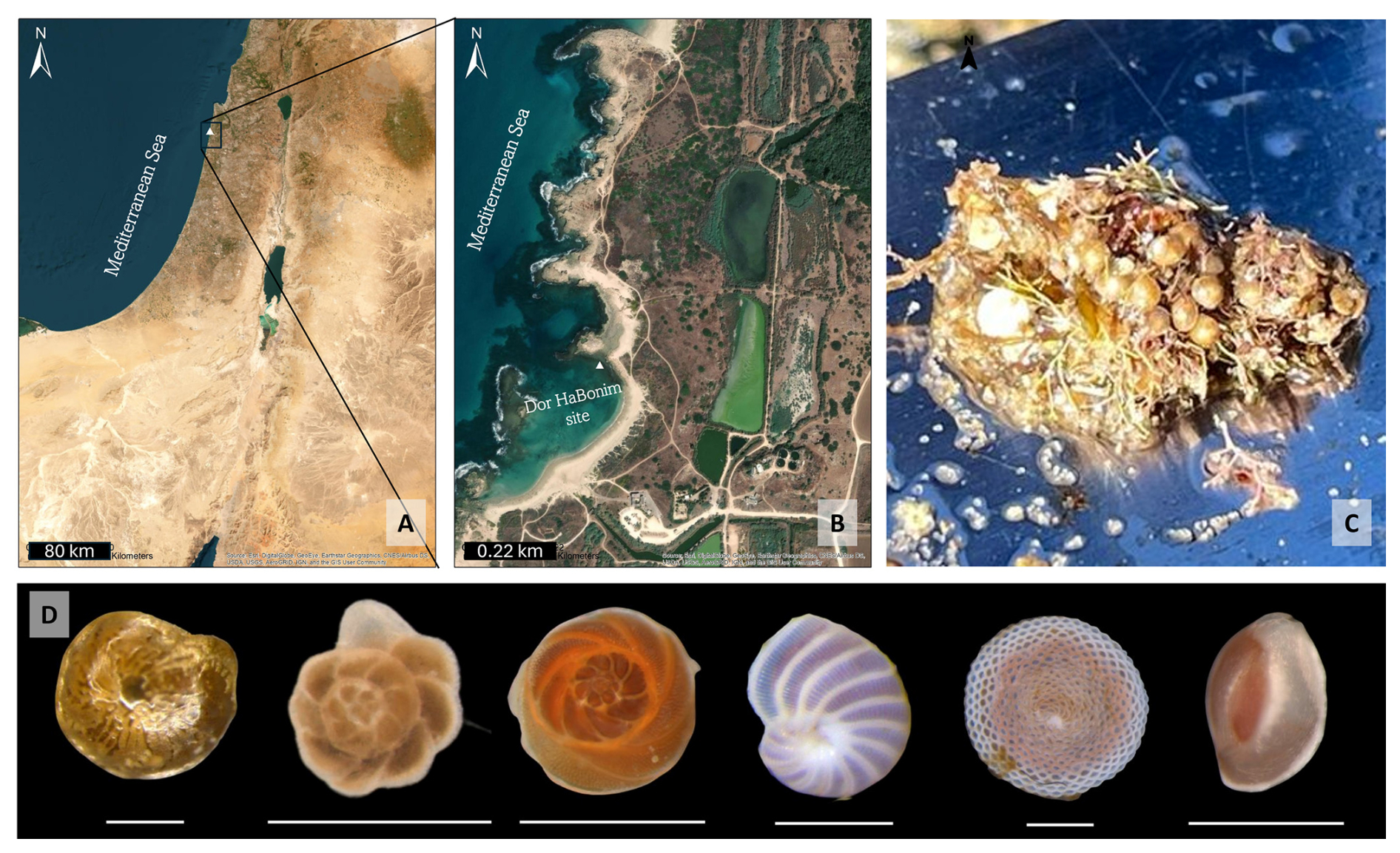
Figure 1(A, B) Location map (imagery© 2026 NASA, Map data© 2026 Google, Mapa GISrael) (B) Dor HaBonim study site. (C) Macroalgal mats from Dor HaBonim, showing high densities of the studied benthic foraminifera (mostly Amphistegina lobifera). (D) the 6 studied species. From left to right: the rotaliids: Amphistegina lobifera, Pararotalia calcariformata, Rosalina globularis, and the miliolids: Peneroplis spp., Sorites orbiculus, and Lachlanella sp. Scale bar = 500 µm.
2.2 Specimens cleaning and whole test ICP-MS analyses
Live specimens of each taxon were subdivided into replicate groups, each comprising between 3 and 50 individuals, depending on species sizes. For most taxa, 10 replicates were analyzed, although the number of specimens per replicate varied among species. This replicated design was implemented to ensure a robust statistical assessment of intra-taxon variation. Following the Fehrenbacher et al. (2015) cleaning protocol, the specimens were placed in Eppendorf tubes to thoroughly remove organic matter from the tests. Briefly, specimens were rinsed with Milli-Q water and methanol, oxidized with a mixture of H2O2 and NaOH, and finally dissolved in 3 mL of 3 % HNO3 solution, and centrifuged for 5 min to remove any residual solid particles.
The elemental abundances of 7Li, 24Mg, 43Ca, 51V, 55Mn, 57Fe, 63Cu, 66Zn, 75As, 88Sr, 111Cd, 139La, 146Nd, 147Sm, 208Pb and 238U, in whole tests were measured using a triple-quadrupole ICPMS (Agilent 8900; nebulizer flow rate 1 L min−1) at the Institute of Earth Sciences, Hebrew University of Jerusalem, following published procedures (e.g. Benaltabet et al., 2021; Hoober et al., 2022; Lapid and Torfstein, 2025; Yehoshafat et al., 2026). All solutions were spiked with internal standards (50 µg L−1 Sc, and 5 µg L−1 Re & Rh) and analyzed in He collision mode. The oxide formation rate (<1 % for Ce) was checked by using a 1 µg L−1 Ce tune solution and sensitivity was optimized before analyses. Accuracy and precision were monitored throughout the analyses sessions by bracketing the samples with two in-house standards: (1) a homogenized deep Red Sea sediment digestion (“Mix 16-8”), whose values have been confirmed by cross calibration against the geological standard BCR-2 (Lapid and Torfstein, 2025), and (2) Amphistegina lobifera tests, which were collected from the Mediterranean coast and dissolved to form a homogenized long term drift solution (Hoober et al., 2022; Yehoshafat et al., 2026) (Table S1a in the Supplement). Procedural blanks were processed similarly to the samples through the cleaning steps and analysis. The blanks, consisting of 3 % HNO3 digestion solution, were included with each analytical batch of approximately 10 samples. The average blank, standard deviation and limit of detection (LOD) signal for each element was subtracted from the sample measurements (Table S1b). Samples with blank-to-signal ratios exceeding 10 % were excluded to minimize analytical noise; only samples below this threshold were retained for analysis (Table S2). Elemental concentrations are reported normalized to calcium (Ca).
Statistical analyses were conducted in R. Data normality was assessed using the Shapiro–Wilk test, and homogeneity of variances was evaluated with Levene's test. Because most distributions deviated from normality and/or exhibited unequal variances, non-parametric tests were primarily applied. Differences between foraminiferal groups (rotaliids vs. miliolids) were evaluated using two-sided Mann–Whitney U tests (Table S3a). Comparisons among multiple species were assessed using Kruskal–Wallis tests, and when significant, followed by pairwise Wilcoxon rank-sum tests (Table S3b). P values were adjusted for multiple testing using the Benjamini–Hochberg False Discovery Rate (FDR) procedure. Elements with FDR-adjusted p values <0.05 were considered statistically significant. For the limited subset of elements that met assumptions of normality and homogeneity of variances after log10 transformation, independent two-sample t tests were additionally applied with FDR correction. Principal Component Analysis (PCA) was performed on values of individual foraminiferal samples using R (version 4.1.1). Elements with more than 50 % missing values were excluded prior to analysis. The remaining data were mean-centered and scaled to unit variance, and PCA was conducted using the correlation matrix.
3.1 Differences in elemental incorporation between miliolids and rotaliids
Elemental ratios were compared using boxplots that illustrate both the distribution and variability within each group (Fig. 2). Zinc was excluded from this comparison due to an insufficient number of reliable measurements in rotaliids.
The reveals a clear contrast between miliolids (M) and rotaliids (R), with miliolids generally exhibiting higher elemental incorporation across most measured elements (M > R; Fig. 2). This inter-order pattern is strongest for the rare earth elements (REEs), which are enriched by a factor of 33–45 in miliolids relative to rotaliids, and is also pronounced for Mn, Pb, and U, with miliolid 10–16 times higher (Table S4). More moderate miliolid enrichments, up to fourfold, are observed for Cd, Mg, Cu, and As.
Several elements deviate from this general pattern. Fe, V, and Sr show either no significant differences between groups or broadly overlapping values, whereas shows the opposite trend, with rotaliids displaying values approximately two times higher than those of miliolids (M < R; Fig. 2). Thus, while the overall dataset supports a strong miliolid enrichment for most , the exceptions indicate element-specific controls on incorporation.
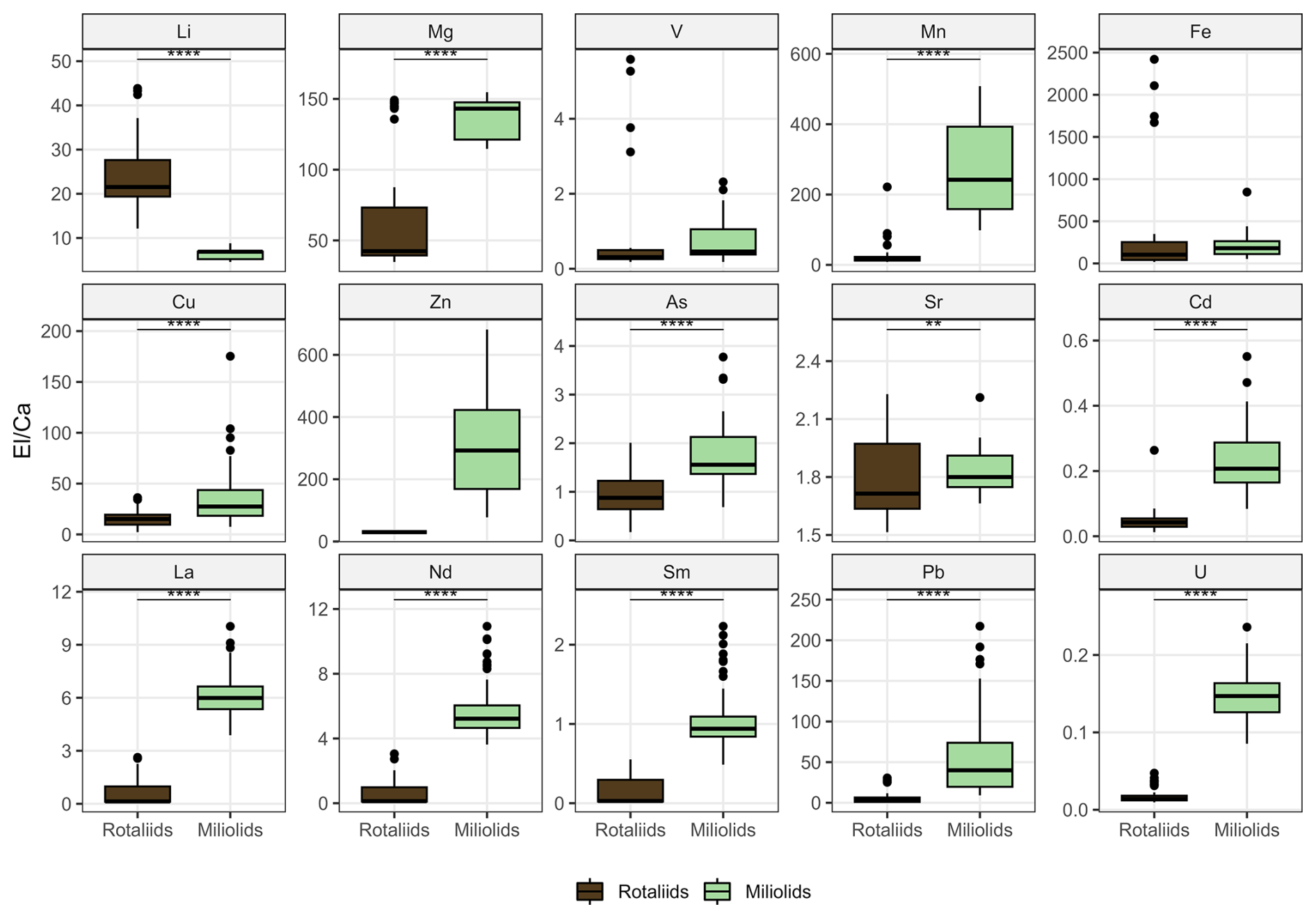
Figure 2Comparison of element Ca ratios in rotaliids and miliolids calcite tests. Values shown in µmol mol−1, except for and , which are expressed in mmol mol−1. Two asterisks indicate 0.95 and three indicate 0.99 p value based on Mann–Whitney U tests with FDR correction.
To further assess differences in the elemental distribution patterns between orders and their possible relationship to biomineralization, a principal component analysis (PCA) was performed on of the six taxa (Fig. 3). The PCA ordination reveals a distinct separation between miliolids and rotaliids along the first principal component (PC1), which explains 37.4 % of the total variance. The PC1 pattern is primarily driven by Mn, Pb, Zn, Cd, and the REEs, which showed elevated ratios in miliolids, particularly Lachlanella sp. and Peneroplis spp., reinforcing the overall M > R dichotomy. In contrast, rotaliids, especially A. lobifera and P. calcariformata, plot toward the opposite side of PC1, reflecting their generally lower incorporation of these elements. At the same time, the distribution of rotaliid taxa indicates species-level variability within the broader inter-order separation.
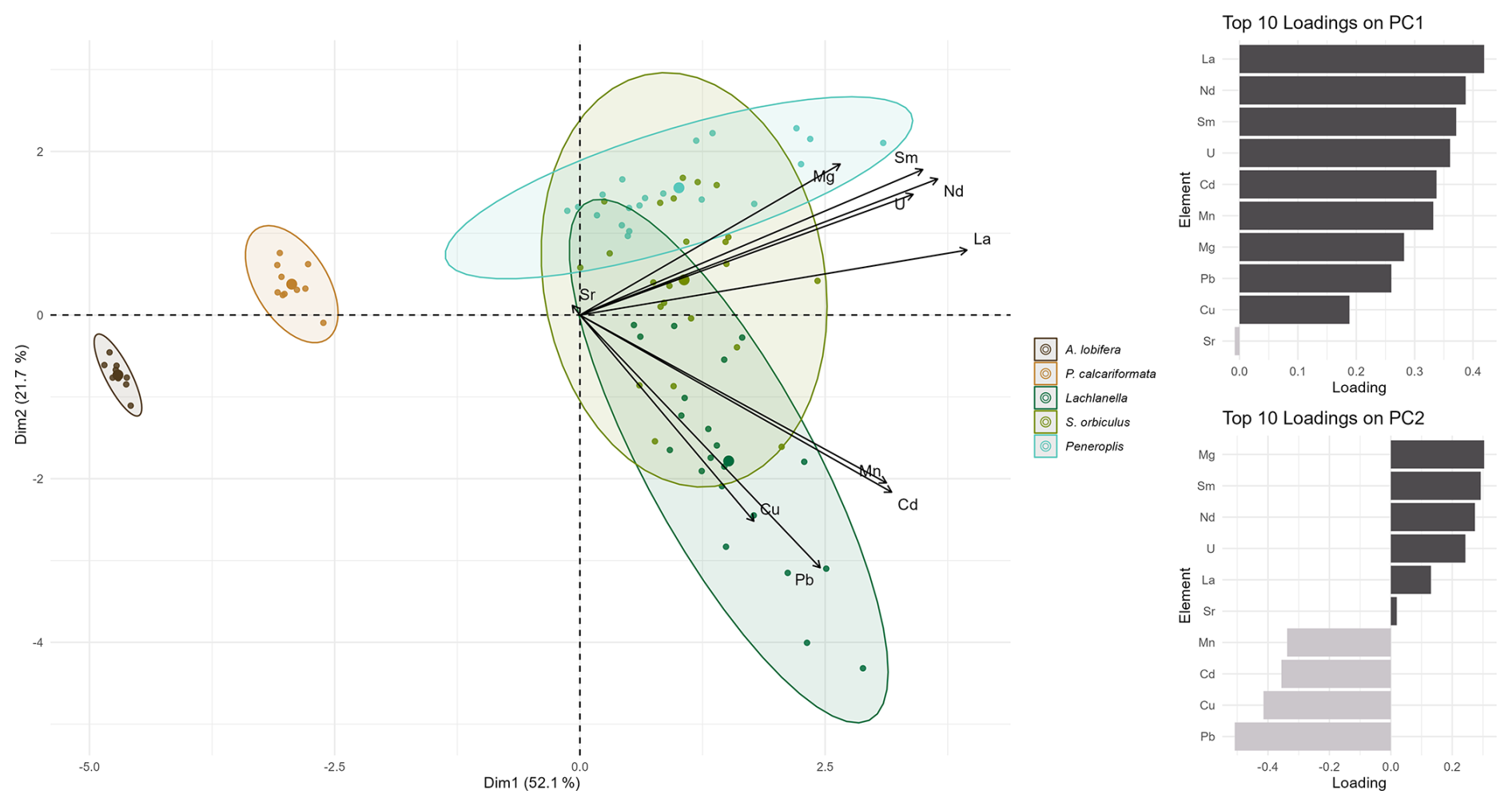
Figure 3PCA of standardized in foraminiferal species. Points represent individual samples colored by species, larger symbols indicate species centroids (multivariate means), and ellipses denote the 95 % confidence region. Bar plots show the top contributing elements to PC1 and PC2. Rosalina samples were excluded from the PCA due to insufficient elemental coverage after data filtering.
3.2 Intra-order variability
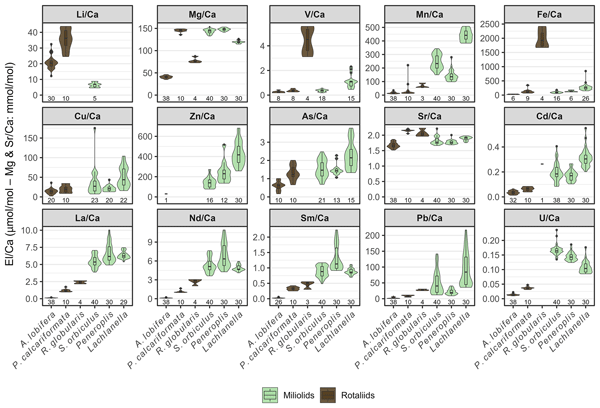
Superimposed on the overall M > R pattern, substantial intra-order variability is observed within both miliolids and rotaliids, as reflected by the distribution of values among taxa (Figs. 3, 4). Among the rotaliids, the values of A. lobifera are significantly lower than those of the two other rotaliid taxa, except for and , which overlap among rotaliids.
The records of R. globularis are limited due to analytical constraints (Table S2). Notably, R. globularis exhibits the highest and values among all taxa, and P. calcariformata stands out for its elevated ratios, which partly overlap with those of the miliolids. The three miliolid taxa generally exhibit broader distributions than rotaliids, although and are comparatively more constrained. Among the miliolids, Lachlanella sp. shows the highest , , , , and , but the lowest and values, indicating a distinct taxon-specific signature within the miliolids.
The second principal component (PC2; 19.8 % variance; Fig. 3) captures intra-group differences. Within the miliolids, PC2 separates Lachlanella sp. from the other taxa, mainly due to elevated , , and . Among the rotaliids, R. globularis and P. calcariformata also display distinct geochemical profiles. Together, these patterns indicate that species-specific elemental incorporation is superimposed on the broader inter-order separation. Thus, the PCA highlights both the first-order miliolid–rotaliid contrast and the taxon-specific variability within each order.
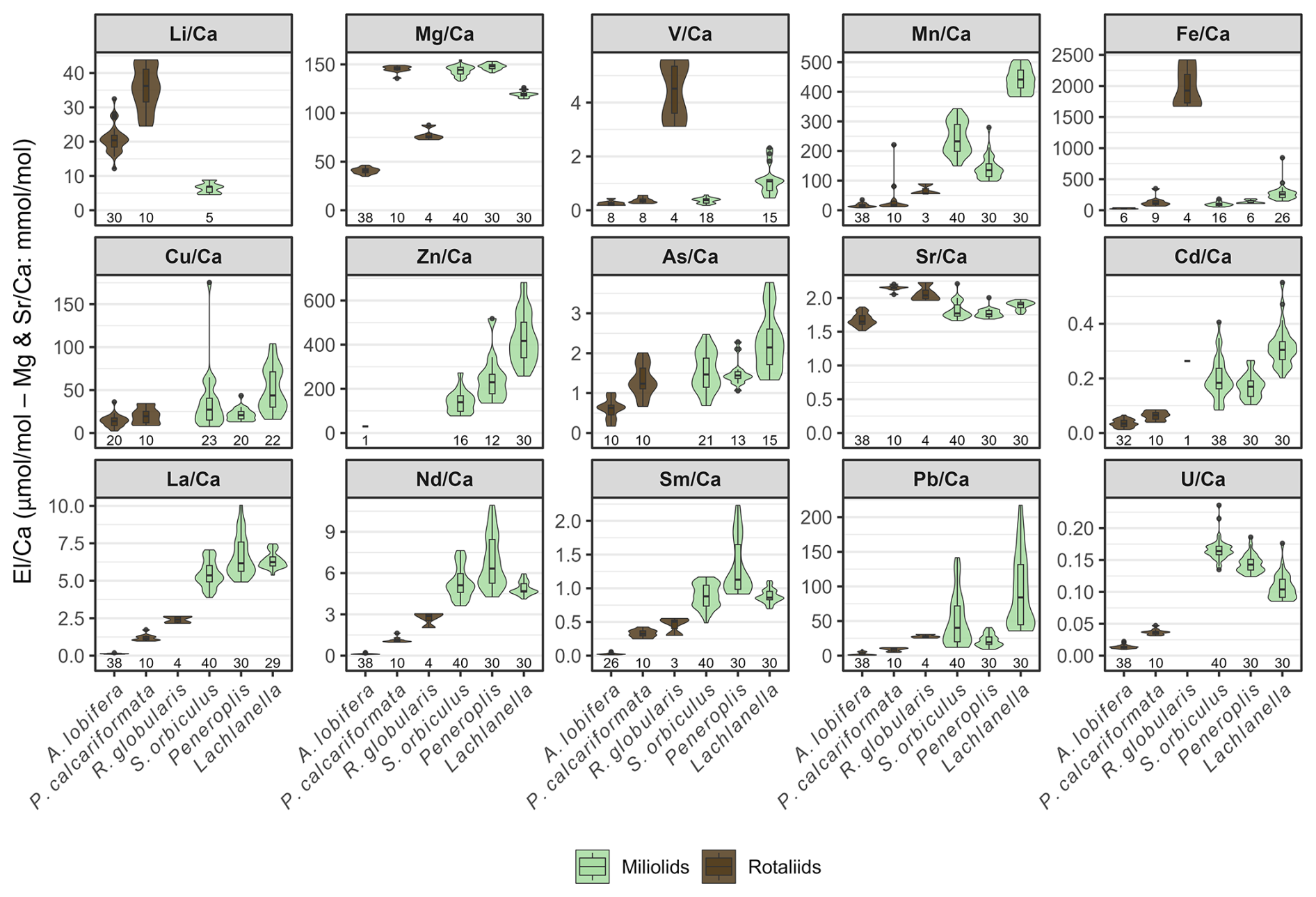
Figure 4Distribution of between different taxa. Values are expressed as µmol mol−1 except for and that are mmol mol−1. The colors separate the species into two orders; rotaliids (brown) and miliolid (green) foraminifera. Letters above each distribution indicate statistically significant differences between species in each order. Numbers at the x axes represents the number of replicate analyses. The arrow marks an outlier value (4063 µmol mol−1) that was excluded from the plot.
4.1 Elemental dichotomy between miliolids and rotaliids
Analysis of multiple, co-occurring rotaliid and miliolid taxa expands the comparative geochemical dataset for these two main calcifying orders of foraminifera, particularly for miliolids and for REEs, for which published data remain limited. The dataset reveals a hierarchical structure, with (1) a first-order inter-order contrast between miliolids and rotaliids, (2) consistent species-level ranking within each order, and (3) element and environment-specific deviations. To place our results in a broader context, we compiled available published data for each measured element and present these comparisons in the Supplement (Figs. S1–S15). Together, our results and the published datasets reveal a strong first-order inter-order pattern, with higher in miliolids relative to rotaliids for most measured elements (M > R; Figs. 2, S1–S15). This contrast is most pronounced for REEs, Mn, Pb, and U, which show order-of-magnitude differences, and is moderate but consistent for Cd, Mg, Cu, and As. Lithium is a notable exception (M < R), a trend not previously reported, indicating that the miliolid–rotaliid contrast is element-specific rather than universal.
Titelboim et al. (2018) reported a similar M > R pattern between Lachlanella sp. and P. calcariformata, sampled monthly from the eastern Mediterranean. Lachlanella sp. consistently exhibited higher , , , , and across all months, demonstrating a stable, taxon-dependent control on elemental incorporation. Together with the present co-occurrence dataset, these observations suggest that the miliolid-rotaliid contrast is not simply a local environmental signal, but reflects differences in biomineralization and ion regulation between the two orders. The elemental dichotomy between miliolids and rotaliids likely reflects fundamental differences in their biomineralization pathways. Miliolids originated at least 100 million years before rotaliids and probably evolved under different oceanic conditions (Loeblich and Tappan, 1987), possibly leading to calcification mechanisms adapted to distinct seawater chemistries and different ion-partitioning behaviours in the calcifying medium (de Nooijer et al., 2023). Although both groups elevate pH at the calcification site (de Nooijer et al., 2009), differences in the location and mode of crystal formation likely contribute to variation in elemental uptake.
Following the conceptual synthesis of Branson and de Nooijer (2025) and the biomineralization-reservoir models for foraminifera (Elderfield et al., 1996), the miliolid-rotaliid contrast can be viewed in terms of the balance between biological modification of the calcifying fluid and precipitation-driven evolution of that fluid. In this view, test reflect processes such as Ca addition, ion transport, pH regulation, and Rayleigh-type enrichment during calcite precipitation. For many trace elements (TE), apparent biogenic partition coefficients (DTE) exceed inorganic partition coefficients (KTE), suggesting enrichment relative to inorganic calcite. During calcification, progressive removal of Ca into CaCO3 can increase ratios in the residual calcifying fluid. If trace elements continue to partition into the precipitating calcite with finite partition coefficients, this evolution of the calcifying fluid may lead to progressively higher ratios in subsequently formed calcite, consistent with Rayleigh-type fractionation. In this context, the higher values observed in miliolids may reflect stronger Rayleigh-type enrichment of the calcifying fluid, potentially related to their porcelaneous calcification pathway, restricted crystal-forming microenvironments, longer residence time of the calcifying fluid, or lower renewal rates during needle formation. By contrast, the generally lower values of rotaliids may reflect differences in calcifying-fluid chemistry arising from Ca addition, fluid exchange, active ion regulation, precipitation kinetics, or combinations of these processes. Variations in crystal-growth kinetics may be particularly important because they can produce coupled changes in the incorporation of multiple trace elements, providing an alternative or complementary explanation to Rayleigh-type enrichment. This interpretation is consistent with models of foraminiferal calcification that involve biologically regulated calcifying reservoirs, seawater-derived vesicles or vacuoles, pH elevation, and active ion transport (Bentov et al., 2009; Bentov and Erez, 2006; de Nooijer et al., 2009, 2014b). requires a separate but related interpretation. Mg incorporation shows substantially greater variability among foraminiferal taxa than many other elemental ratios, suggesting that Mg may be subject to additional physiological regulation (Bentov and Erez, 2006). The relatively low values observed in many rotaliids are commonly interpreted as evidence for active Mg exclusion or removal from the calcifying fluid. In contrast, the elevated values of miliolids and some high- rotaliids may indicate weaker Mg regulation or the absence of mechanisms that suppress Mg incorporation in low-Mg species. Consequently, the observed inter-order differences in likely reflect varying degrees of biological Mg regulation alongside broader differences in calcification pathways. Structural differences in the tests may also account for the geochemical differences between the two orders by influencing interactions with interlocked organic matter, potentially involved in binding trace elements during or after calcification (Bentov et al., 2009; Bentov and Erez, 2006; Erez, 2003; de Nooijer et al., 2014b). Elevated element concentrations in miliolids may therefore, in some cases, reflect enhanced adsorption to organic substrates or mineral crystals, facilitated either by a greater abundance of interlocking organic material or by the higher surface area of calcitic needles.
The opposite behavior of further emphasizes that the miliolid-rotaliid pattern is element-specific. At present, we cannot assign this pattern to a single mechanism. Branson and de Nooijer (2025) noted that some elements may be enriched through specific transport pathways rather than by Rayleigh-type enrichment; for example, Li may be incidentally transported alongside HCO. In foraminifera, calcification is known to involve strong carbonate-system regulation, including pH modulation at the calcification site (de Nooijer et al., 2009), proton removal by V-type H+ ATPase during chamber formation (Toyofuku et al., 2017), carbonic anhydrase activity in Amphistegina lessonii biomineralization (de Goeyse et al., 2021), and DIC-sensitive Li incorporation in Amphistegina (Charrieau et al., 2023; Vigier et al., 2015). However, the direct pathway linking these processes to Li incorporation remains unresolved. In addition, because Li+ is a small monovalent ion, its incorporation into calcite requires charge compensation and may be more sensitive to crystal-surface, organic-matrix, or carbonate-system conditions than divalent or trivalent elements. The higher values observed in rotaliids may therefore reflect DIC-related regulation, pH modulation, charge-balance effects, or crystal-growth pathways rather than the Rayleigh-type enrichment that appears to dominate many other ratios in miliolids.
Thus, the M > R dichotomy represents a strong first-order taxonomic signal, reflecting divergent biomineralization pathways and ion-regulatory mechanisms between the two orders. At the same time, and the observed intra-order variability show that this signal is modified by element-specific and taxon-specific controls, including Ca addition, Mg exclusion, calcifying-fluid renewal, Rayleigh-type enrichment, organic-matrix interactions, and element-specific transport. Clarifying the relative contribution of these processes will require targeted physiological and experimental studies, but the co-occurrence comparison at Dor HaBonim demonstrates that taxonomy, both between and within orders, exerts a major control on foraminiferal signatures.
4.2 Variability within Foraminiferal Orders
Although the M > R pattern represents a strong first-order taxonomic signal, it does not imply uniform elemental incorporation within each order. Instead, substantial intra-order variability indicates that the broader miliolid-rotaliid dichotomy is modulated by species-specific physiological, phylogenetic, and ecological controls. The comparison with published data further shows that such variability is especially pronounced among rotaliids, whereas the available miliolid dataset remains comparatively limited for many elements, particularly REEs (Figs. S1–S15). In the context of the calcifying-fluid model discussed above, such variability may reflect differences in the balance between Ca addition, Mg exclusion, fluid renewal, Rayleigh-type enrichment, calcification kinetics, organic-matrix interactions, and microhabitat conditions.
4.2.1 Miliolids
Miliolids are generally known as high- foraminifera, with similar values displayed across taxa in the order (de Nooijer et al., 2017a). In this study, the two large benthic foraminifera miliolids taxa Peneroplis spp. and S. orbiculus show the highest degree of geochemical similarity across most elements, consistent with their close evolutionary relationship within the same subfamily, as supported by molecular phylogeny (Holzmann et al., 2001). This reinforces the idea that geochemical similarity is more likely among closely related lineages within the same family. Their similar patterns may therefore reflect a shared mode of porcelaneous calcification and comparable regulation of the calcifying fluid, including similar degrees of Mg exclusion and trace-element enrichment during calcite needle formation.
In contrast, Lachlanella sp. which is phylogenetically distant from the other two taxa and belongs to a highly diverse family of small miliolids, displays a partially distinctly different geochemical signature, with differences that are element-specific rather than systematic across all elements. This is also reflected in the PCA, where Lachlanella overlaps with other miliolids along the primary axis of variability (PC1), but is offset along PC2 (Fig. 3). This secondary separation is mainly driven by elements such as Mg, Mn, Cu, Cd and Pb versus REEs, indicating that differences are controlled by specific elemental groups rather than a uniform shift in overall chemistry. While most differences between Lachlanella sp. compared to the two large benthic foraminifera taxa are likely evolutionarily related, specific elemental patterns, including , may reflect environmental influences rather than purely vital effects. For example, the relatively low in Lachlanella sp. compared to other miliolids has previously been interpreted as a record of colder winter temperatures (Titelboim et al., 2017).
The ratio in Lachlanella sp. provides one of the clearest examples of an environmentally influenced elemental signal. Foraminiferal ratios are primarily controlled by redox conditions, which regulate the availability of dissolved Mn2+. Under oxic conditions, Mn exists as insoluble Mn (IV) oxides, whereas under reducing conditions, these oxides dissolve, releasing Mn2+ into porewaters or the water column. As a result, in benthic foraminifera typically reflects the redox state of the surrounding environment (Glock et al., 2012; Groeneveld and Filipsson, 2013; Koho et al., 2017). Published data from both rotaliids and some miliolids show a broad range of values, typically spanning from <1 to ∼300 µmol mol−1, with Lachlanella sp. representing a notable high-end outlier (van Dijk et al., 2020) and also in the current study (Fig. 4).
Although all miliolid specimens were collected from turf samples, Lachlanella sp. appears more frequently associated with the deeper, denser algal matrices within the turf, where microhabitats may experience periodic oxygen depletion. This habitat association likely explains its elevated values, as well as its significantly higher ratios of other redox elements, and , compared to the other miliolids. The co-enrichment of these elements supports the interpretation that Lachlanella sp. occupies more reducing microenvironments, and that its geochemical signature partially records environmental redox variability rather than purely taxon-specific biomineralization. Thus, Lachlanella sp. illustrates how the general miliolid enrichment pattern can be further amplified or modified by microhabitat conditions, particularly for redox-sensitive elements.
4.2.2 Rotaliids
The three rotaliid taxa exhibit substantial interspecific variation in most elemental ratios, yet the general M > R pattern remains evident. Importantly, this variability is not random, but follows a consistent species-level ranking across many elements: A. lobifera generally has the lowest , P. calcariformata shows higher values for several elements, including , and R. globularis is distinct in its enrichment of and (Fig. 4). This pattern suggests that rotaliid calcification should not be treated as a single uniform mechanism, but as a shared perforate biomineralization pathway modified by species-specific physiological controls.
The best-documented exception is of , which shows large differences among rotaliids, from low to high values that can overlap with those of miliolids (Dueñas-Bohórquez et al., 2011; Oron et al., 2021; Titelboim et al., 2018). Previous LA-ICPMS and NanoSIMS studies also reported strong intra-individual variability in , occasionally linked to the diurnal cycle (Fehrenbacher et al., 2017; Spero et al., 2015; Wit et al., 2012). Our approach, based on whole-test analyses of multiple specimens and numerous replicates, averages out such variability and highlights taxon-level trends consistent with earlier observations.
Extant planktonic foraminifera and small benthic taxa such as Ammonia typically have low (Dueñas-Bohórquez et al., 2011; de Nooijer et al., 2014a). In contrast, Pararotalia calcariformata displays unusually high values, comparable to those of miliolids, likely reflecting its high-Mg calcarinid ancestry (Titelboim et al., 2018, Fig. 5). Large benthic rotaliids range from mid-Mg (A. lobifera) to high-Mg (Heterostegina depressa) species, again overlapping with miliolids (Segev and Erez, 2006) (Fig. S2). The marked difference in between the diatom-bearing A. lobifera and P. calcariformata implies that endosymbionts are not a major factor in this vital effect.
Although has been proposed to reflect evolutionary adaptation to changing seawater composition (de Nooijer et al., 2023), our data suggest that species-specific biological regulation exerts a dominant control. For example, P. calcariformata, which evolved in the Quaternary, exhibits higher than Amphistegina, which originated earlier, during a period when seawater was lower than today, although the precise timing of its rise remains debated (Evans et al., 2026). Thus, Mg incorporation appears primarily governed by species-specific biological regulation rather than by ambient seawater chemistry.
Beyond Mg, the same species-level ordering is also observed for many other elements. Such inter-element correlation points to shared physiological controls on elemental incorporation, rather than independent behavior of each element. Similar correlations have been interpreted as evidence for common controls on calcifying-fluid chemistry and element partitioning, including Ca transport, precipitation dynamics, and Rayleigh-type evolution of the calcifying reservoir (Branson and de Nooijer, 2025; Marchitto et al., 2018).
A. lobifera consistently exhibits the lowest for most elements, indicating strong biological discrimination against elemental incorporation despite its thick, multilayered test that integrates multiple growth phases. Because A. lobifera and P. calcariformata occur in the same habitat and both host diatom symbionts, their contrasting signatures are unlikely to reflect ambient seawater chemistry or symbiosis alone. The low values in A. lobifera may instead reflect stronger or more persistent physiological regulation, such as more effective Ca addition, more frequent renewal of the calcifying medium, reduced precipitation-driven enrichment, or slower and more regulated calcification. Its thick test may further average numerous chamber-formation and secondary-calcification events toward a stable, species-specific low- signature.
By contrast, the higher values of P. calcariformata may indicate lower renewal, weaker trace-element exclusion, stronger precipitation-driven evolution of the calcifying fluid, or faster calcification kinetics. Faster precipitation from a semi-isolated calcifying fluid could enhance Rayleigh-type enrichment by rapidly removing Ca relative to many trace elements, while also reducing the time available for selective ion regulation during crystal growth. This interpretation is consistent with its unusually high values relative to many other rotaliids and with previous evidence for large variability among rotaliid taxa. Thus, intra-order variability in rotaliids appears to reflect lineage-specific modifications of a shared perforate calcification strategy.
Rosalina globularis shows markedly elevated and ratios. Although both elements are redox-sensitive and could, in principle, indicate episodic oxygen depletion, this interpretation is unlikely given the species' association with epiphytic macroalgal habitats, shared with P. calcariformata. Moreover, the lack of concomitant enrichment in R. globularis further argues against a purely environmental control. We therefore propose that the enrichment of Fe and V in R. globularis reflects an as-yet-unknown biological process related to calcification dynamics rather than redox conditions. This taxon-specific enrichment further supports the view that rotaliid intra-order variability is structured by species-level physiological controls, superimposed on the broader miliolid-rotaliid pattern.
4.3 Implications for biomonitoring of dissolved elements in seawater
The pronounced miliolid-rotaliid first-order pattern (M > R) highlights the critical importance of species selection when using benthic foraminifera as bioindicators. Miliolids, owing to their higher elemental uptake, may serve as more sensitive recorders of trace-element enrichment in seawater or microhabitats, particularly for Pb, Cd, Mn and Zn. However, their weaker ion-selectivity control means incorporation which could result in non-linear uptake at elevated concentrations as suggested by evidence for Rayleigh-type modification of the calcifying fluid during precipitation. Such processes may complicate quantitative reconstructions and calibration experiments. Rotaliids, by contrast, generally exhibit lower uptake for many elements and may therefore provide more conservative records, but their strong species-level variability means that they should not be treated as a single uniform biomonitoring group.
For environmental monitoring, this means that miliolids may be advantageous for detecting subtle enrichment trends but require careful calibration at the species and element level due to possible non-linear uptake. Rotaliids may provide more stable baselines, especially in long-term or low-variability studies, though they may miss minor perturbations or respond differently depending on the selected species. A dual-order, multi-species approach may therefore maximize detection sensitivity while providing cross-validation of environmental signals and helping to distinguish environmental enrichment from taxon-specific biomineralization effects.
Beyond monitoring, these results expand the benthic foraminiferal elemental-proxy toolkit by establishing baseline element ranges for both orders, including several understudied elements in miliolids. This taxonomically resolved framework can improve trace-metal reconstructions, refine species selection for biomonitoring, and guide future experimental work aimed at separating environmental signals from biomineralization controls on elemental incorporation.
All data underlying the results presented in this study are provided in the Supplement accompanying this article. This includes the raw elemental composition data, quality control data, and statistical outputs used in the analyses. No additional datasets were generated or analyzed beyond those included in the Supplement.
The supplement related to this article is available online at https://doi.org/10.5194/bg-23-5685-2026-supplement.
Conceptualization, SA, BH, NT, SAP, and AT; methodology, SA, and AT; validation, LH, SA, BH, NT, and AT; formal analysis, LH, SA, BH, NT, and AT; investigation, LH; resources, SA and AT; writing – original draft preparation, LH; writing-review and editing, LH, SA, BH, NT, SAP, and AT; visualization, LH; supervision, SA; project administration, SA and AT; funding acquisition, SA. All authors have read and agreed to the published version of the manuscript.
We thank Ofir Tirosh for his assistance with analyses at the Institute of Earth Sciences, HUJI. Sarit Ashckenazi-Polivoda thanks the Ministry of Innovation, Science, and Technology (MOST) for the continued support of ADSSC. During manuscript preparation, an AI-based language tool was used solely for linguistic editing and rephrasing. The authors take full responsibility for the content of the manuscript.
The contact author has declared that none of the authors has any competing interests.
Publisher's note: Copernicus Publications remains neutral with regard to jurisdictional claims made in the text, published maps, institutional affiliations, or any other geographical representation in this paper. The authors bear the ultimate responsibility for providing appropriate place names. Views expressed in the text are those of the authors and do not necessarily reflect the views of the publisher.
This work was supported by Israel Science Foundation (ISF) grant nos. 1267/21 (to Sigal Abramovich) and 809/24 (to Adi Torfstein).
This paper was edited by Chiara Borrelli and reviewed by Lennart de Nooijer and Ellen Thomas.
Anderson, O. R. and Faber, W. W.: An estimation of calcium carbonate deposition rate in a planktonic foraminifer Globigerinoides sacculifer using 45Ca as a tracer; a recommended procedure for improved accuracy, J. Foraminifer. Res., 14, 303–308, https://doi.org/10.2113/gsjfr.14.4.303, 1984.
Angell, R. W.: Test morphogenesis (chamber formation) in the foraminifer Spiroloculina hyalina Schulze, J. Foraminifer. Res., 10, 89–101, https://doi.org/10.2113/gsjfr.10.2.89, 1980.
Benaltabet, T., Gutner-Hoch, E., and Torfstein, A.: Heavy Metal, Rare Earth Element and Pb Isotope Dynamics in Mussels During a Depuration Experiment in the Gulf of Aqaba, Northern Red Sea, Front. Mar. Sci., 8, https://doi.org/10.3389/FMARS.2021.669329, 2021.
Bentov, S. and Erez, J.: Impact of biomineralization processes on the Mg content of foraminiferal shells: A biological perspective, Geochem. Geophys. Geosyst., 7, Q01P08, https://doi.org/10.1029/2005GC001015, 2006.
Bentov, S., Brownlee, C., and Erez, J.: The role of seawater endocytosis in the biomineralization process in calcareous foraminifera, P. Natl. Acad. Sci. USA, 106, 21500–21504, https://doi.org/10.1073/pnas.0906636106, 2009.
Boehnert, S., Birkelund, A. R., Schmiedl, G., Kuhnert, H., Kuhn, G., Hass, H. C., and Hebbeln, D.: Test deformation and chemistry of foraminifera as response to anthropogenic heavy metal input, Mar. Pollut. Bull., 155, 111112, https://doi.org/10.1016/j.marpolbul.2020.111112, 2020.
Branson, O. and de Nooijer, L. J.: Calcium Carbonate Biomineralisation: Insights from Trace Elements, Elements, 21, 105–111, https://doi.org/10.2138/gselements.21.2.105, 2025.
Charrieau, L. M., Rollion-Bard, C., Terbrueggen, A., Wilson, D. J., Pogge von Strandmann, P. A. E., Misra, S., and Bijma, J.: Controls on Lithium Incorporation and Isotopic Fractionation in Large Benthic Foraminifera, Miner., 13, 127, 127, https://doi.org/10.3390/MIN13010127, 2023.
Debenay, J. P., Guillou, J. J., and Lesourd, M.: Colloidal calcite in foraminiferal tests; crystallization and texture of the test, J. Foraminifer. Res., 26, 277–288, https://doi.org/10.2113/gsjfr.26.4.277, 1996.
de Goeyse, S., Webb, A. E., Reichart, G.-J., and de Nooijer, L. J.: Carbonic anhydrase is involved in calcification by the benthic foraminifer Amphistegina lessonii, Biogeosciences, 18, 393–401, https://doi.org/10.5194/bg-18-393-2021, 2021.
De Goeyse, S., Lesuis, C., Reichart, G. J., and de Nooijer, L.: The effect of carbonic anhydrase on foraminiferal Mg/Ca, PeerJ, 12, e18458, https://doi.org/10.7717/PEERJ.18458/SUPP-1, 2024
de Nooijer, L. J., Reichart, G. J., Dueñas-Bohórquez, A., Wolthers, M., Ernst, S. R., Mason, P. R. D., and van der Zwaan, G. J.: Copper incorporation in foraminiferal calcite: results from culturing experiments, Biogeosciences, 4, 493–504, https://doi.org/10.5194/bg-4-493-2007, 2007.
de Nooijer, L., Toyofuku, T., and Kitazato, H.: Foraminifera promote calcification by elevating their intracellular pH, P. Natl. Acad. Sci. USA, 106, 15374–15378, https://doi.org/10.1073/pnas.0904306106, 2009.
de Nooijer, L., Hathorne, E. C., Reichart, G. J., Langer, G., and Bijma, J.: Variability in calcitic and ratios in clones of the benthic foraminifer Ammonia tepida, Mar. Micropaleontol., 107, 32–43, https://doi.org/10.1016/j.marmicro.2014.02.002, 2014a.
de Nooijer, L., Spero, H. J., Erez, J., Bijma, J., and Reichart, G. J.: Biomineralization in perforate foraminifera, Earth-Sci. Rev., 135, 48–58, https://doi.org/10.1016/j.earscirev.2014.03.013, 2014b.
de Nooijer, L., van Dijk, I., Toyofuku, T., and Reichart, G. J.: The Impacts of Seawater and Temperature on Element Incorporation in Benthic Foraminiferal Calcite, Geochem., Geophys. Geosyst., 18, 3617–3630, https://doi.org/10.1002/2017GC007183, 2017a.
de Nooijer, L. J., Brombacher, A., Mewes, A., Langer, G., Nehrke, G., Bijma, J., and Reichart, G.-J.: Ba incorporation in benthic foraminifera, Biogeosciences, 14, 3387–3400, https://doi.org/10.5194/bg-14-3387-2017, 2017b.
de Nooijer, L., Pacho Sampedro, L., Jorissen, F. J., Pawlowski, J., Rosenthal, Y., Dissard, D., and Reichart, G. J.: 500 Million Years of Foraminiferal Calcification, Earth-Sci. Rev., 243, 104484, https://doi.org/10.1016/j.earscirev.2023.104484, 2023.
Dubicka, Z. and Gorzelak, P.: Unlocking the biomineralization style and affinity of Paleozoic fusulinid foraminifera, Sci. Rep., 7, 15218, https://doi.org/10.1038/s41598-017-15666-1, 2017.
Dubicka, Z., Owocki, K., and Gloc, M.: Micro-and nanostructures of calcareous foraminiferal tests: insight from representatives of miliolida, rotaliida and lagenida, J. Foraminifer. Res., 48, 142–155, https://doi.org/10.2113/gsjfr.48.2.142, 2018.
Dubicka, Z., Tyszka, J., Pałczyńska, A., Höhne, M., Bijma, J., Janse, M., Klerks, N., and Bickmeyer, U.: Biocalcification in porcelaneous foraminifera, eLife, 13, RP91568, https://doi.org/10.7554/eLife.91568, 2024.
Dueñas-Bohórquez, A., Raitzsch, M., de Nooijer, L., and Reichart, G.-J.: Independent impacts of calcium and carbonate ion concentration on Mg and Sr incorporation in cultured benthic foraminifera, Mar. Micropaleontol., 81, 122–130, https://doi.org/10.1016/j.marmicro.2011.08.002, 2011.
Elderfield, H., Bertram, C. J., and Erez, J.: A biomineralization model for the incorporation of trace elements into foraminiferal calcium carbonate, Earth Planet. Sc. Lett., 142, 409–423, https://doi.org/10.1016/0012-821X(96)00105-7, 1996.
Erez, J.: The Source of Ions for Biomineralization in Foraminifera and Their Implications for Paleoceanographic Proxies, Rev. Mineral. Geochemistry, 54, 115–149, https://doi.org/10.2113/0540115, 2003.
Evans, D., Erez, J., Oron, S., and Müller, W.: -temperature and seawater-test chemistry relationships in the shallow-dwelling large benthic foraminifera Operculina ammonoides, Geochim. Cosmochim. Ac., 148, 325–342, https://doi.org/10.1016/j.gca.2014.09.039, 2015.
Evans, D., Rosenthal, Y., Erez, J., Hauzer, H., Cotton, L. J., Zhou, X., Nambiar, R., Stassen, P., Pearson, P. N., Renema, W., Saraswati, P. K., Todd, J. A., Müller, W., and Affek, H. P.: The major ion chemistry of seawater was closely coupled to the long-term carbon cycle during the Cenozoic, P. Natl. Acad. Sci. USA, 123, e2511781122, https://doi.org/10.1073/PNAS.2511781122, 2026.
Fehrenbacher, J. S., Spero, H. J., Russell, A. D., Vetter, L., and Eggins, S.: Optimizing LA-ICP-MS analytical procedures for elemental depth profiling of foraminifera shells, Chem. Geol., 407–408, 2–9, https://doi.org/10.1016/j.chemgeo.2015.04.007, 2015.
Fehrenbacher, J. S., Russell, A. D., Davis, C. V, Gagnon, A. C., Spero, H. J., Cliff, J. B., Zhu, Z., and Martin, P.: Link between light-triggered Mg-banding and chamber formation in the planktic foraminifera Neogloboquadrina dutertrei, Nat. Commun., 8, 15441, https://doi.org/10.1038/ncomms15441, 2017.
Glock, N., Eisenhauer, A., Liebetrau, V., Wiedenbeck, M., Hensen, C., and Nehrke, G.: EMP and SIMS studies on Mn/Ca and Fe/Ca systematics in benthic foraminifera from the Peruvian OMZ: a contribution to the identification of potential redox proxies and the impact of cleaning protocols, Biogeosciences, 9, 341–359, https://doi.org/10.5194/bg-9-341-2012, 2012.
Groeneveld, J. and Filipsson, H. L.: and ratios in benthic foraminifera: the potential to reconstruct past variations in temperature and hypoxia in shelf regions, Biogeosciences, 10, 5125–5138, https://doi.org/10.5194/bg-10-5125-2013, 2013.
Hauzer, H., Evans, D., Müller, W., Rosenthal, Y., and Erez, J.: The effect of carbonate chemistry on trace element incorporation in high-Mg calcitic foraminifera, Geochim. Cosmochim. Ac., 390, 105–116, https://doi.org/10.1016/j.gca.2024.11.022, 2025.
Hemleben, C., Erson, O. R., Berthold, W., and Spindler, M.: Calcification and chamber formation in foraminifera – a brief overview, in: Biomineralization in Lower Plants and Animals, edited by: Leadbeater, B. S. C. and Riding, R., Clarendon Press, Oxford, https://doi.org/10.1111/j.1756-1051.1987.tb02029.x, 1986.
Holzmann, M., Hohenegger, J., Hallock, P., Piller, W. E., and Pawlowski, J.: Molecular phylogeny of large miliolid foraminifera (Soritacea Ehrenberg 1839), Mar. Micropaleontol., 43, 57–74, https://doi.org/10.1016/S0377-8398(01)00021-4, 2001.
Hoober, L., Titelboim, D., Abramovich, S., Herut, B., Teutsch, N., Benaltabet, T., and Torfstein, A.: Establishing Baseline Assessment Levels for Monitoring Coastal Heavy Metals Using Foraminiferal Shells: A Case Study from the Southeastern Mediterranean, Water, 14, 1532, https://doi.org/10.3390/w14101532, 2022.
Katz, M. E., Cramer, B. S., Franzese, A., Hönisch, B., Miller, K. G., Rosenthal, Y., and Wright, J. D.: Traditional and emerging geochemical proxies in foraminifera, J. Foraminifer. Res., 40, 165–192, https://doi.org/10.2113/gsjfr.40.2.165, 2010.
Koho, K. A., de Nooijer, L. J., Fontanier, C., Toyofuku, T., Oguri, K., Kitazato, H., and Reichart, G.-J.: Benthic foraminiferal Mn / Ca ratios reflect microhabitat preferences, Biogeosciences, 14, 3067–3082, https://doi.org/10.5194/bg-14-3067-2017, 2017.
Lapid, G. and Torfstein, A.: Uranium isotopes and trace element distributions in atmospheric dust mineral phases from the Sahara-Arabia Desert Belt, Chem. Geol., 695, 123059, https://doi.org/10.1016/J.CHEMGEO.2025.123059, 2025.
Lea, D. W.: Elemental and Isotopic Proxies of Past Ocean Temperatures, in: The Oceans and Marine Geochemistry, edited by: Elderfield, H., Elsevier, 365, ISBN 9780080451015, 2006.
Loeblich, A. R. and Tappan, H.: Foraminiferal Genera and Their Classification, Van Nostrand Reinhold, New York, https://doi.org/10.1007/978-1-4899-5760-3, 1987.
Manda, S., Herut, B., Rilov, G., Kucera, M., Morard, R., Abramovich, S., and Ashckenazi-Polivoda, S.: A dynamic subtropical coastal hotspot of benthic foraminifera in the Southeastern Mediterranean indicates early-stage tropicalization, Sci. Total Environ., 945, 173917, https://doi.org/10.1016/j.scitotenv.2024.173917, 2024.
Marchitto, T. M., Bryan, S. P., Doss, W., McCulloch, M. T., and Montagna, P.: A simple biomineralization model to explain Li, Mg, and Sr incorporation into aragonitic foraminifera and corals, Earth Planet. Sc. Lett., 481, 20–29, https://doi.org/10.1016/J.EPSL.2017.10.022, 2018.
Mewes, A., Langer, G., Reichart, G. J., de Nooijer, L., Nehrke, G., and Bijma, J.: The impact of Mg contents on Sr partitioning in benthic foraminifers, Chem. Geol., 412, 92–98, https://doi.org/10.1016/J.CHEMGEO.2015.06.026, 2015.
Nehrke, G., Keul, N., Langer, G., de Nooijer, L. J., Bijma, J., and Meibom, A.: A new model for biomineralization and trace-element signatures of Foraminifera tests, Biogeosciences, 10, 6759–6767, https://doi.org/10.5194/bg-10-6759-2013, 2013.
Oron, S., Sadekov, A., Katz, T., and Goodman-Tchernov, B.: Benthic foraminifera geochemistry as a monitoring tool for heavy metal and phosphorus pollution – A post fish-farm removal case study, Mar. Pollut. Bull., 168, 112443, https://doi.org/10.1016/j.marpolbul.2021.112443, 2021.
Ozer, T., Rahav, E., Gertman, I., Sisma-Ventura, G., Silverman, J., and Herut, B.: Relationship between thermohaline and biochemical patterns in the levantine upper and intermediate water masses, Southeastern Mediterranean Sea (2013–2021), Front. Mar. Sci., 9, 1–11, https://doi.org/10.3389/fmars.2022.958924, 2022.
Pacho, L., de Nooijer, L., and Reichart, G.-J.: Element ∕ Ca ratios in Nodosariida (Foraminifera) and their potential application for paleoenvironmental reconstructions, Biogeosciences, 20, 4043–4056, https://doi.org/10.5194/bg-20-4043-2023, 2023.
Pawlowski, J., Holzmann, M., and Tyszka, J.: New supraordinal classification of Foraminifera: Molecules meet morphology, Mar. Micropaleontol., 100, 1–10, https://doi.org/10.1016/j.marmicro.2013.04.002, 2013.
Sagar, N., Sadekov, A., Jenner, T., Chapuis, L., Scott, P., Choudhary, M., and McCulloch, M.: Heavy metal incorporation in foraminiferal calcite under variable environmental and acute level seawater pollution: multi-element culture experiments for Amphisorus hemprichii, Environ. Sci. Pollut. Res., 29, 3826–3839, https://doi.org/10.1007/s11356-021-15913-z, 2021a.
Sagar, N., Sadekov, A., Scott, P., Jenner, T., Vadiveloo, A., Moheimani, N. R., and McCulloch, M.: Geochemistry of large benthic foraminifera Amphisorus hemprichii as a high-resolution proxy for lead pollution in coastal environments, Mar. Pollut. Bull., 162, 111918, https://doi.org/10.1016/j.marpolbul.2020.111918, 2021b.
Segev, E. and Erez, J.: Effect of ratio in seawater on shell composition in shallow benthic foraminifera, Geochem. Geophys. Geosyst., 7, Q02P09, https://doi.org/10.1029/2005GC000969, 2006.
Sierra, R., Mauffrey, F., Cruz, J., Holzmann, M., Gooday, A. J., Maurer-Alcalá, X., Thakur, R., Greco, M., Weiner, A. K. M., Katz, L. A., and Pawlowski, J.: Taxon-rich transcriptomics supports higher-level phylogeny and major evolutionary trends in Foraminifera, Mol. Phylogenet. Evol., 174, 107546, https://doi.org/10.1016/j.ympev.2022.107546, 2022.
Smith, C. W., Fehrenbacher, J. S., and Goldstein, S. T.: Incorporation of heavy metals in experimentally grown foraminifera from Sapelo Island, Georgia and Little Duck Key, Florida, U.S.A., Mar. Micropaleontol., 156, 101854, https://doi.org/10.1016/j.marmicro.2020.101854, 2020.
Spero, H. J., Eggins, S. M., Russell, A. D., Vetter, L., Kilburn, M. R., and Hönisch, B.: Timing and mechanism for intratest variability in a living planktic foraminifer, Earth Planet. Sc. Lett., 409, 32–42, https://doi.org/10.1016/J.EPSL.2014.10.030, 2015.
ter Kuile, B., Erez, J., and Padan, E.: Mechanisms for the uptake of inorganic carbon by two species of symbiont-bearing foraminifera, Mar. Biol., 103, 241–251, https://doi.org/10.1007/BF00543354, 1989.
Titelboim, D., Sadekov, A., Almogi-Labin, A., Herut, B., Kucera, M., Schmidt, C., Hyams-Kaphzan, O., and Abramovich, S.: Geochemical signatures of benthic foraminiferal shells from a heat-polluted shallow marine environment provide field evidence for growth and calcification under extreme warmth, Glob. Chang. Biol., 23, 4346–4353, https://doi.org/10.1111/gcb.13729, 2017.
Titelboim, D., Sadekov, A., Hyams-Kaphzan, O., Almogi-Labin, A., Herut, B., Kucera, M., and Abramovich, S.: Foraminiferal single chamber analyses of heavy metals as a tool for monitoring permanent and short term anthropogenic footprints, Mar. Pollut. Bull., 128, 65–71, https://doi.org/10.1016/j.marpolbul.2018.01.002, 2018.
Toyofuku, T., Matsuo, M. Y., de Nooijer, L. J., Nagai, Y., Kawada, S., Fujita, K., Reichart, G. J., Nomaki, H., Tsuchiya, M., Sakaguchi, H., and Kitazato, H.: Proton pumping accompanies calcification in foraminifera, Nat. Commun., 8, 14145, https://doi.org/10.1038/ncomms14145, 2017.
Toyofuku, T., Kitazato, H., Kawahata, H., Tsuchiya, M., and Nohara, M.: Evaluation of thermometry in foraminifera: Comparison of experimental results and measurements in nature, Paleoceanography, 15, 456–464, https://doi.org/10.1029/1999PA000460, 2000.
van Dijk, I., de Nooijer, L., Wolthers, M., and Reichart, G.-J.: Impacts of pH and [CO32−] on the incorporation of Zn in foraminiferal calcite, Geochim. Cosmochim. Ac., 197, 263–277, https://doi.org/10.1016/j.gca.2016.10.031, 2017.
van Dijk, I., de Nooijer, L., Barras, C., Reichart, G., and Davis, C.: Mn Incorporation in Large Benthic Foraminifera: Differences Between Species and the Impact of pCO2, Front. Earth Sci., 8, 567701, https://doi.org/10.3389/feart.2020.567701, 2020.
Vigier, N., Rollion-Bard, C., Levenson, Y., and Erez, J.: Lithium isotopes in foraminifera shells as a novel proxy for the ocean dissolved inorganic carbon (DIC), Comptes Rendus – Geosci., 347, 43–51, https://doi.org/10.1016/J.CRTE.2014.12.001/, 2015.
Wit, J. C., de Nooijer, L. J., Barras, C., Jorissen, F. J., and Reichart, G. J.: A reappraisal of the vital effect in cultured benthic foraminifer Bulimina marginata on values: assessing temperature uncertainty relationships, Biogeosciences, 9, 3693–3704, https://doi.org/10.5194/bg-9-3693-2012, 2012.
Yehoshafat, O., Abramovich, S., Torfstein, A., and Ashckenazi-Polivoda, S.: Large benthic foraminifera as recorders of fine-scale coastal elemental variability, Mar. Pollut. Bull., 226, 119351, https://doi.org/10.1016/j.marpolbul.2026.119351, 2026.