
Articles | Volume 23, issue 16
https://doi.org/10.5194/bg-23-5759-2026
© Author(s) 2026. This work is distributed under
the Creative Commons Attribution 4.0 License.
the Creative Commons Attribution 4.0 License.
https://doi.org/10.5194/bg-23-5759-2026
© Author(s) 2026. This work is distributed under
the Creative Commons Attribution 4.0 License.
the Creative Commons Attribution 4.0 License.
Research article
| 
21 Aug 2026
Research article |
| 21 Aug 2026
| 21 Aug 2026
Oxygen minimum zones in the Indian Ocean and their response to changes in the Indian Ocean meridional circulation
Eugene Odion Oboh
CORRESPONDING AUTHOR
Leibniz Centre for Tropical Marine Research (ZMT), 28359 Bremen, Germany
University of Bremen, 28359 Bremen, Germany
Niko Lahajnar
University of Hamburg, Institute for Geology, 20146 Hamburg, Germany
Birgit Gaye
University of Hamburg, Institute for Geology, 20146 Hamburg, Germany
Avanti Shrikumar
University of Sydney, Charles Perkins Center, NSW 2006, Sydney, Australia
Tim Rixen
Leibniz Centre for Tropical Marine Research (ZMT), 28359 Bremen, Germany
Related authors
No articles found.
Anjaly Govindankutty Menon, Aaron L. Bieler, Hanna Firrincieli, Rachel Alcorn, Niko Lahajnar, Catherine V. Davis, Ralf Schiebel, Dirk Nürnberg, Gerhard Schmiedl, and Nicolaas Glock
Clim. Past, 21, 1853–1869, https://doi.org/10.5194/cp-21-1853-2025, https://doi.org/10.5194/cp-21-1853-2025, 2025
Short summary
Short summary
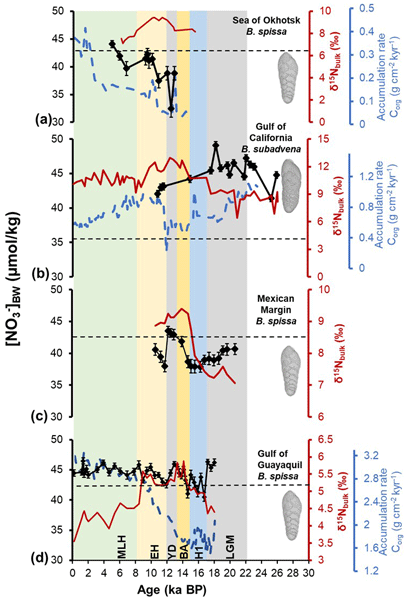
The pore density (number of pores per unit area) of unicellular eukaryotes is used to reconstruct past bottom-water nitrate at the Sea of Okhotsk, the Gulf of California, the Mexican Margin and the Gulf of Guayaquil. The reconstructed bottom-water nitrate at the Sea of Okhotsk, the Gulf of California and the Gulf of Guayaquil are influenced by the intermediate water masses, while the nitrate at the Mexican Margin is related to the deglacial NO3− variability in the Pacific Deep Water.
Gesa Schulz, Kirstin Dähnke, Tina Sanders, Jan Penopp, Hermann W. Bange, Rena Czeschel, and Birgit Gaye
Biogeosciences, 22, 5943–5959, https://doi.org/10.5194/bg-22-5943-2025, https://doi.org/10.5194/bg-22-5943-2025, 2025
Short summary
Short summary
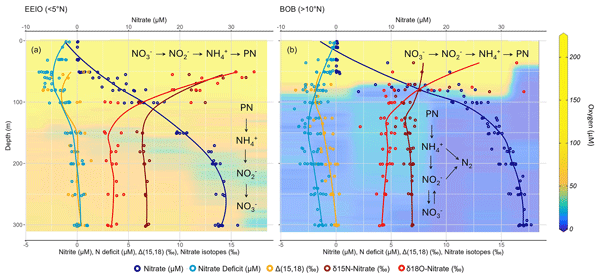
Oxygen-minimum zones (OMZs) are low-oxygen ocean areas that deplete nitrogen, a key marine nutrient. Understanding nitrogen cycling in OMZs is crucial for the global nitrogen cycle. This study examined nitrogen cycling in the OMZ of the Bay of Bengal and the East Equatorial Indian Ocean, revealing limited mixing between both regions. Surface phytoplankton consumes nitrate, while deeper nitrification recycles nitrogen. In the BoB’s OMZ (100–300 m), nitrogen loss likely occurs via anammox.
Jan Maier, Nicole Burdanowitz, Gerhard Schmiedl, and Birgit Gaye
Clim. Past, 21, 279–297, https://doi.org/10.5194/cp-21-279-2025, https://doi.org/10.5194/cp-21-279-2025, 2025
Short summary
Short summary
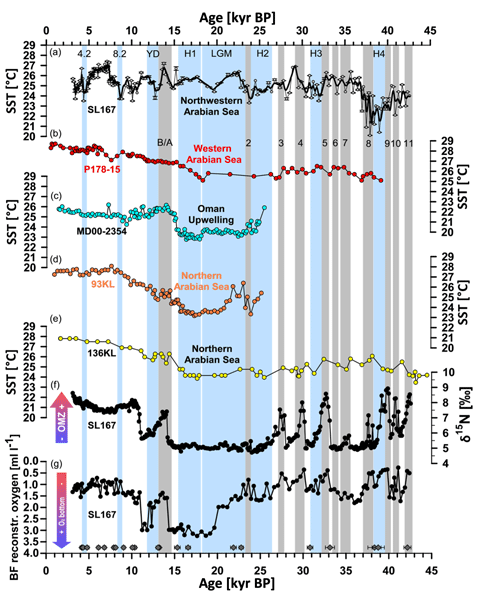
We reconstruct sea surface temperatures (SSTs) of the past 43 kyr in the Gulf of Oman. We find SST variations of up to 7 °C with lower SSTs during Heinrich events (HEs), especially HE4, and higher SSTs during Dansgaard–Oeschger events. Our record shows no profound cooling during the Last Glacial Maximum but abrupt variations during the Holocene. We surmise that SST variations are influenced by the southwest (northeast) monsoon during warmer (colder) periods.
Luisa Chiara Meiritz, Tim Rixen, Anja Karin van der Plas, Tarron Lamont, and Niko Lahajnar
Biogeosciences, 21, 5261–5276, https://doi.org/10.5194/bg-21-5261-2024, https://doi.org/10.5194/bg-21-5261-2024, 2024
Short summary
Short summary
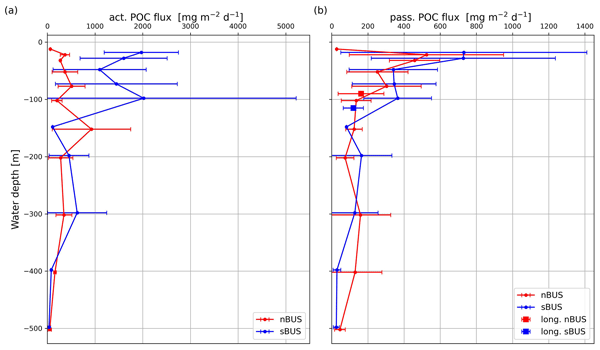
Moored and drifting sediment trap experiments in the northern (nBUS) and southern (sBUS) Benguela Upwelling System showed that active carbon fluxes by vertically migrating zooplankton were about 3 times higher in the sBUS than in the nBUS. Despite these large variabilities, the mean passive particulate organic carbon (POC) fluxes were almost equal in the two subsystems. The more intense near-bottom oxygen minimum layer seems to lead to higher POC fluxes and accumulation rates in the nBUS.
Medhavi Pandey, Haimanti Biswas, Daniel Birgel, Nicole Burdanowitz, and Birgit Gaye
Biogeosciences, 21, 4681–4698, https://doi.org/10.5194/bg-21-4681-2024, https://doi.org/10.5194/bg-21-4681-2024, 2024
Short summary
Short summary
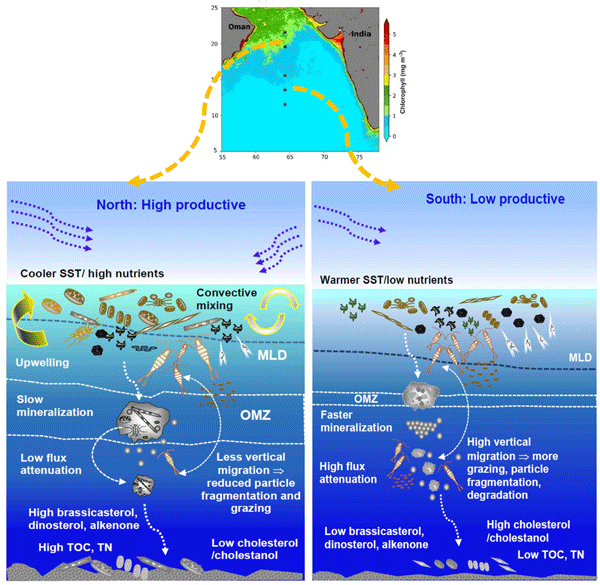
We analysed sea surface temperature (SST) proxy and plankton biomarkers in sediments that accumulate sinking material signatures from surface waters in the central Arabian Sea (21°–11° N, 64° E), a tropical basin impacted by monsoons. We saw a north–south SST gradient, and the biological proxies showed more organic matter from larger algae in the north. Smaller algae and zooplankton were more numerous in the south. These trends were related to ocean–atmospheric processes and oxygen availability.
Alexandra Klemme, Thorsten Warneke, Heinrich Bovensmann, Matthias Weigelt, Jürgen Müller, Tim Rixen, Justus Notholt, and Claus Lämmerzahl
Hydrol. Earth Syst. Sci., 28, 1527–1538, https://doi.org/10.5194/hess-28-1527-2024, https://doi.org/10.5194/hess-28-1527-2024, 2024
Short summary
Short summary
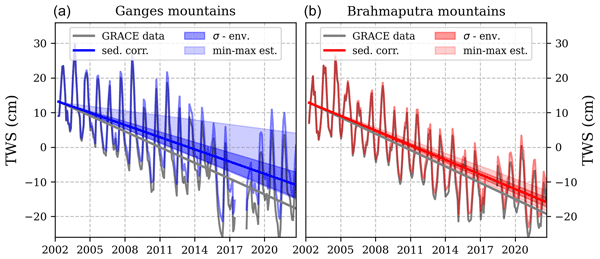
Satellite data help estimate groundwater depletion, but earlier assessments missed mass loss from river sediment. In the Ganges–Brahmaputra–Meghna (GBM) river system, sediment accounts for 4 % of the depletion. Correcting for sediment in the GBM mountains reduces estimated depletion by 14 %. It's important to note that the Himalayas' uplift may offset some sediment-induced mass loss. This understanding is vital for accurate water storage trend assessments and sustainable groundwater management.
Nicole Burdanowitz, Gerhard Schmiedl, Birgit Gaye, Philipp M. Munz, and Hartmut Schulz
Biogeosciences, 21, 1477–1499, https://doi.org/10.5194/bg-21-1477-2024, https://doi.org/10.5194/bg-21-1477-2024, 2024
Short summary
Short summary
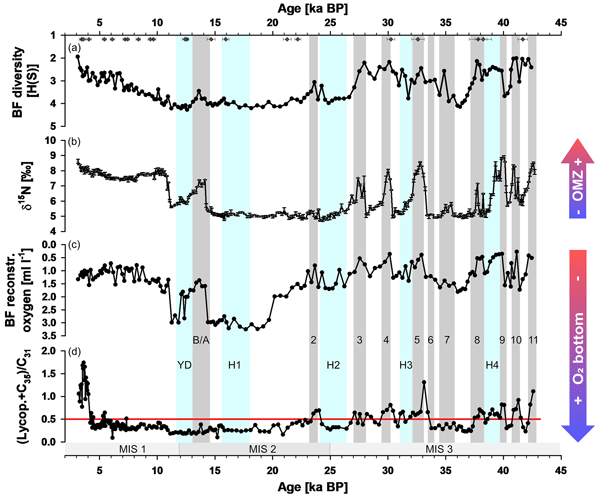
We analyse benthic foraminifera, nitrogen isotopes and lipids in a sediment core from the Gulf of Oman to investigate how the oxygen minimum zone (OMZ) and bottom water (BW) oxygenation have reacted to climatic changes since 43 ka. The OMZ and BW deoxygenation was strong during the Holocene, but the OMZ was well ventilated during the LGM period. We found an unstable mode of oscillating oxygenation states, from moderately oxygenated in cold stadials to deoxygenated in warm interstadials in MIS 3.
Maria-Elena Vorrath, Juliane Müller, Paola Cárdenas, Thomas Opel, Sebastian Mieruch, Oliver Esper, Lester Lembke-Jene, Johan Etourneau, Andrea Vieth-Hillebrand, Niko Lahajnar, Carina B. Lange, Amy Leventer, Dimitris Evangelinos, Carlota Escutia, and Gesine Mollenhauer
Clim. Past, 19, 1061–1079, https://doi.org/10.5194/cp-19-1061-2023, https://doi.org/10.5194/cp-19-1061-2023, 2023
Short summary
Short summary
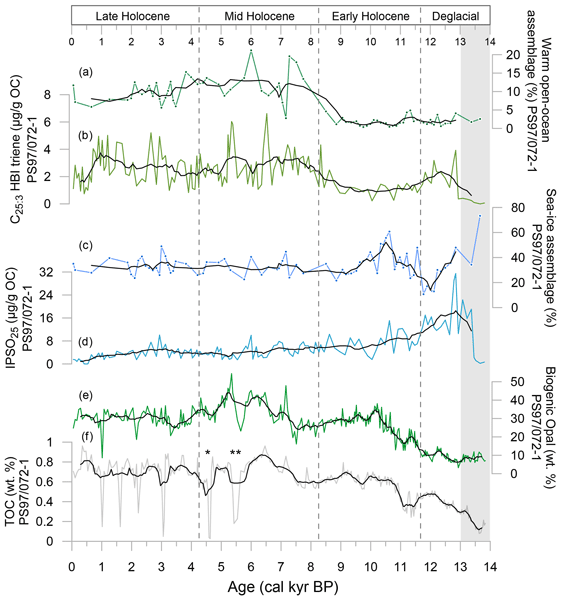
Sea ice is important to stabilize the ice sheet in Antarctica. To understand how the global climate and sea ice were related in the past we looked at ancient molecules (IPSO25) from sea-ice algae and other species whose dead cells accumulated on the ocean floor over time. With chemical analyses we could reconstruct the history of sea ice and ocean temperatures of the past 14 000 years. We found out that sea ice became less as the ocean warmed, and more phytoplankton grew towards today's level.
Alexandra Klemme, Tim Rixen, Denise Müller-Dum, Moritz Müller, Justus Notholt, and Thorsten Warneke
Biogeosciences, 19, 2855–2880, https://doi.org/10.5194/bg-19-2855-2022, https://doi.org/10.5194/bg-19-2855-2022, 2022
Short summary
Short summary
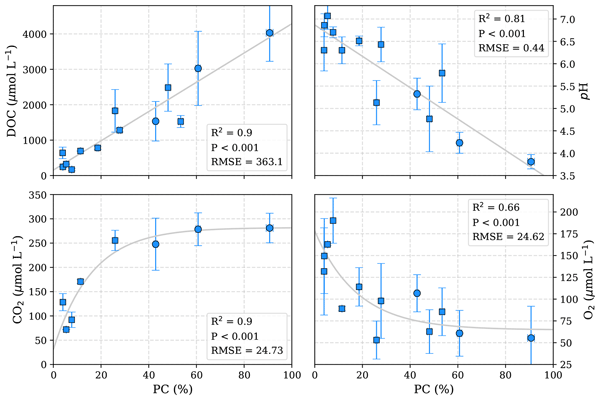
Tropical peat-draining rivers contain high amounts of carbon. Surprisingly, measured carbon dioxide (CO2) emissions from those rivers are comparatively moderate. We compiled data from 10 Southeast Asian rivers and found that CO2 production within these rivers is hampered by low water pH, providing a natural threshold for CO2 emissions. Furthermore, we find that enhanced carbonate input, e.g. caused by human activities, suspends this natural threshold and causes increased CO2 emissions.
Shichao Tian, Birgit Gaye, Jianhui Tang, Yongming Luo, Wenguo Li, Niko Lahajnar, Kirstin Dähnke, Tina Sanders, Tianqi Xiong, Weidong Zhai, and Kay-Christian Emeis
Biogeosciences, 19, 2397–2415, https://doi.org/10.5194/bg-19-2397-2022, https://doi.org/10.5194/bg-19-2397-2022, 2022
Short summary
Short summary
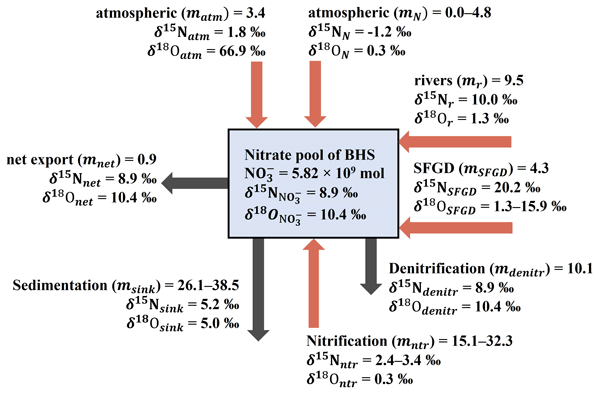
We constrain the nitrogen budget and in particular the internal sources and sinks of nitrate in the Bohai Sea by using a mass-based and dual stable isotope approach based on δ15N and δ18O of nitrate. Based on available mass fluxes and isotope data an updated nitrogen budget is proposed. Compared to previous estimates, it is more complete and includes the impact of the interior cycle (nitrification) on the nitrate pool. The main external nitrogen sources are rivers contributing 19.2 %–25.6 %.
Birgit Gaye, Niko Lahajnar, Natalie Harms, Sophie Anna Luise Paul, Tim Rixen, and Kay-Christian Emeis
Biogeosciences, 19, 807–830, https://doi.org/10.5194/bg-19-807-2022, https://doi.org/10.5194/bg-19-807-2022, 2022
Short summary
Short summary
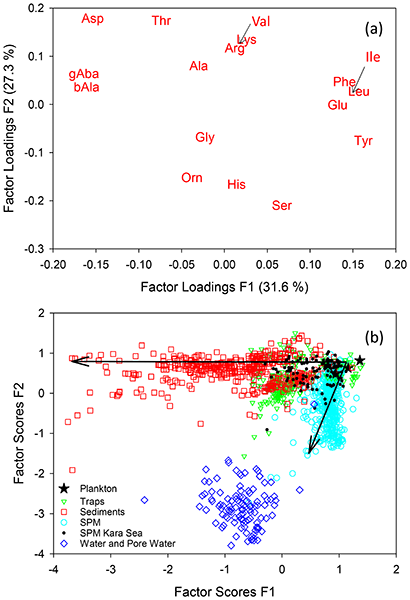
Amino acids were analyzed in a large number of samples of particulate and dissolved organic matter from coastal regions and the open ocean. A statistical analysis produced two new biogeochemical indicators. An indicator of sinking particle and sediment degradation (SDI) traces the degradation of organic matter from the surface waters into the sediments. A second indicator shows the residence time of suspended matter in the ocean (RTI).
Nicole Burdanowitz, Tim Rixen, Birgit Gaye, and Kay-Christian Emeis
Clim. Past, 17, 1735–1749, https://doi.org/10.5194/cp-17-1735-2021, https://doi.org/10.5194/cp-17-1735-2021, 2021
Short summary
Short summary
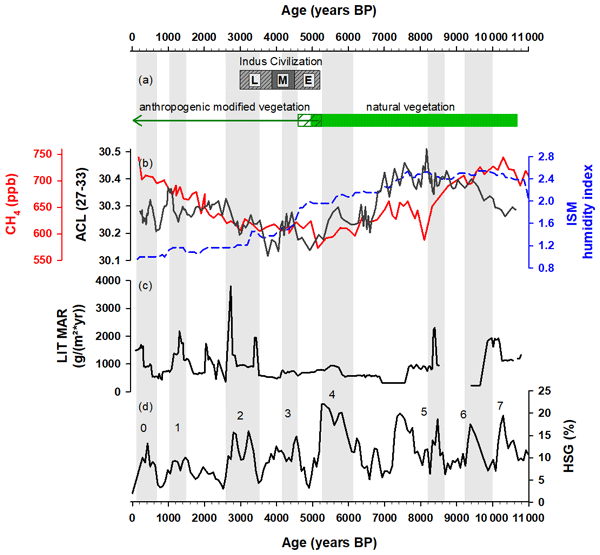
To study the interaction of the westerlies and Indian summer monsoon (ISM) during the Holocene, we used paleoenvironmental reconstructions using a sediment core from the northeast Arabian Sea. We found a climatic transition period between 4.6 and 3 ka BP during which the ISM shifted southwards and the influence of Westerlies became prominent. Our data indicate a stronger influence of agriculture activities and enhanced soil erosion, adding to Bond event impact after this transition period.
Cited articles
Abbott, K. and Mahadevan, A.: Why Is the Monsoon Coastal Upwelling Signal Subdued in the Bay of Bengal?, J. Geophys. Res.-Oceans, 129, e2024JC022023, https://doi.org/10.1029/2024JC022023, 2024.
Abram, N. J., Gagan, M. K., McCulloch, M. T., Chappell, J., and Hantoro, W. S.: Coral Reef Death During the 1997 Indian Ocean Dipole Linked to Indonesian Wildfires, Science, 301, 952–955, 2003.
Acharya, S. S. and Panigrahi, M. K.: Eastward shift and maintenance of Arabian Sea oxygen minimum zone: Understanding the paradox, Deep-Sea Res. Pt. I, 115, 240–252, https://doi.org/10.1016/j.dsr.2016.07.004, 2016.
Altabet, M. A., Murray, D. W., and Prell, W. L.: Climatically linked oscillations in Arabian Sea denitrification over the past 1 my: Implications for the marine N cycle, Paleoceanography, 14, 732–743, 1999.
Anderson, L. A. and Sarmiento, J. L.: Redfield ratios of remineralization determined by nutrient data analysis, Global Biogeochem. Cy., 8, 65–80, 1994.
Ayers, J. M., Strutton, P. G., Coles, V. J., Hood, R. R., and Matear, R. J.: Indonesian throughflow nutrient fluxes and their potential impact on Indian Ocean productivity, Geophys. Res. Lett., 41, 5060–5067, 2014.
Banse, K., Naqvi, S., Narvekar, P., Postel, J., and Jayakumar, D.: Oxygen minimum zone of the open Arabian Sea: variability of oxygen and nitrite from daily to decadal timescales, Biogeosciences, 11, 2237–2261, 2014.
Beal, L. M., Ffield, A., and Gordon, A. L.: Spreading of Red Sea overflow waters in the Indian Ocean, J. Geophys. Res.-Oceans, 105, 8549–8564, 2000.
Beal, L. M., Chereskin, T. K., Lenn, Y. D., and Elipot, S.: The sources and mixing characteristics of the Agulhas Current, J. Phys. Oceanogr., 36, 2060–2074, 2006.
Benson, B. B. and Krause Jr., D.: The concentration and isotopic fractionation of gases dissolved in freshwater in equilibrium with the atmosphere. 1. Oxygen, Limnol. Oceanogr., 25, 662–671, https://doi.org/10.4319/lo.1980.25.4.0662, 1980.
Benson, B. B. and Krause Jr., D.: The concentration and isotopic fractionation of oxygen dissolved in freshwater and seawater in equilibrium with the atmosphere 1, Limnol. Oceanogr., 29, 620–632, 1984.
Bhaskar, T., Sarma, V. V. S. S., and Kumar, J. P.: Potential Mechanisms Responsible for Spatial Variability in Intensity and Thickness of Oxygen Minimum Zone in the Bay of Bengal, J. Geophys. Res.-Biogeo., 126, https://doi.org/10.1029/2021jg006341, 2021.
Bjerknes, J.: A possible response of the atmospheric Hadley circulation to equatorial anomalies of ocean temperature, Tellus, 18, 820–829, https://doi.org/10.1111/j.2153-3490.1966.tb00303.x, 1966.
Bjerknes, J.: Atmospheric Teleconnections from the Equatorial Pacific, Mon. Weather Rev., 97, 163–172, 1969.
Bopp, L., Resplandy, L., Untersee, A., Le Mezo, P., and Kageyama, M.: Ocean (de)oxygenation from the Last Glacial Maximum to the twenty-first century: insights from Earth System models, Philos. T. R. Soc. A, 375, 20160323, https://doi.org/10.1098/rsta.2016.0323, 2017.
Bower, A. S., Hunt, H. D., and Price, J. F.: Character and dynamics of the Red Sea and Persian Gulf outflows, J. Geophys. Res.-Oceans, 105, 6387–6414, 2000.
Breitburg, D., Levin, L. A., Oschlies, A., Grégoire, M., Chavez, F. P., Conley, D. J., Garçon, V., Gilbert, D., Gutiérrez, D., Isensee, K., Jacinto, G. S., Limburg, K. E., Montes, I., Naqvi, S. W. A., Pitcher, G. C., Rabalais, N. N., Roman, M. R., Rose, K. A., Seibel, B. A., Telszewski, M., Yasuhara, M., and Zhang, J.: Declining oxygen in the global ocean and coastal waters, Science, 359, eaam7240, https://doi.org/10.1126/science.aam7240, 2018.
Brock, J. C., McClain, C. R., Luther, M. E., and Hay, W. W.: The Phytplankton Bloom in the Northwestern Arabian Sea During the Southwest Monsoon of 1979, J. Geophys. Res., 96, 20623–620642, 1991.
Brock, J. C., McClain, C. R., Anderson, D. M., Prell, W. L., and Hay, W. W.: Southwest Monsoon Circulation and Environments of Recent Planktonic Foraminifera in the Northwestern Arabian Sea, Paleoceanography, 7, 799–813, 1992.
Broecker, W. S.: The Great Ocean Conveyor, Oceanography, 4, 79–89, 1991.
Caesar, L., McCarthy, G., Thornalley, D., Cahill, N., and Rahmstorf, S.: Current Atlantic meridional overturning circulation weakest in last millennium, Nat. Geosci., 14, 118–120, https://doi.org/10.1038/s41561-021-00699-z, 2021.
Cavan, E. L., Trimmer, M., Shelley, F., and Sanders, R.: Remineralization of particulate organic carbon in an ocean oxygen minimum zone, Nat. Commun., 8, 14847, https://doi.org/10.1038/ncomms14847, 2017.
Chavez, F. P. and Messié, M.: A comparison of Eastern Boundary Upwelling Ecosystems, Prog. Oceanogr., 83, 80–96, 2009.
Chinni, V., Singh, S. K., Bhushan, R., Rengarajan, R., and Sarma, V.: Spatial variability in dissolved iron concentrations in the marginal and open waters of the Indian Ocean, Mar. Chem., 208, 11–28, 2019.
Coatanoan, C., Metzl, N., Fieux, M., and Coste, B.: Seasonal water mass distribution in the Indonesian throughflow entering the Indian Ocean, J. Geophys. Res.-Oceans, 104, 20801–20826, 1999.
de Brauwere, A., Jacquet, S. H., De Ridder, F., Dehairs, F., Pintelon, R., Schoukens, J., and Baeyens, W.: Water mass distributions in the Southern Ocean derived from a parametric analysis of mixing water masses, J. Geophys. Res.-Oceans, 112, https://doi.org/10.1029/2006JC003742, 2007.
de la Vara, A., Parras-Berrocal, I. M., Izquierdo, A., Sein, D. V., and Cabos, W.: Climate change signal in the ocean circulation of the Tyrrhenian Sea, Earth Syst. Dynam., 13, 303–319, https://doi.org/10.5194/esd-13-303-2022, 2022.
DiNezio, P. N. and Tierney, J. E.: The effect of sea level on glacial Indo-Pacific climate, Nat. Geosci., 6, 485–491, 2013.
Ditkovsky, S., Resplandy, L., and Busecke, J.: Unique ocean circulation pathways reshape the Indian Ocean oxygen minimum zone with warming, Biogeosciences, 20, 4711–4736, 2023.
Durgadoo, J. V., Rühs, S., Biastoch, A., and Böning, C. W. B.: Indian Ocean sources of Agulhas leakage, J. Geophys. Res.-Oceans, https://doi.org/10.1002/2016JC012676, 2017.
Duteil, O. and Oschlies, A.: Sensitivity of Simulated Extent and Future Evolution of Marine Suboxia to Mixing Intensity, Geophys. Res. Lett., 38, https://doi.org/10.1029/2011gl046877, 2011.
Ekau, W., Auel, H., Pörtner, H.-O., and Gilbert, D.: Impacts of hypoxia on the structure and processes in pelagic communities (zooplankton, macro-invertebrates and fish), Biogeosciences, 7, 1669–1699, https://doi.org/10.5194/bg-7-1669-2010, 2010.
Fine, R. A.: Circulation of Antarctic intermediate water in the South Indian Ocean, Deep-Sea Res. Pt. I, 40, 2021–2042, 1993.
Gadgil, S., Rajeevan, M., and Francis, P. A.: Monsoon variability: Links to major oscillations over the equatorial Pacific and Indian oceans, Curr. Sci., 93, 182–194, 2007.
Gaye, B., Andersch, T., Bartsch, P., Cosmus, H., Dähnke, K., Dasbach, D., Eisnecker, P., Gök, I., Harms, N., Hubert-Huard, R., Hüge, F., John, F., Keuter, S., Kretzschmann, L., Lahajnar, N., Lisitano, L., Lüdmann, T., Markfort, G., Meiritz, L., Oldhaver, M., Penopp, J., Prien, R. D., Rixen, T., Ruda, L., Sanders, T., Schulz, G., Schulz, H., Siccha, M., Sommer, M., Sorge, Y., and Waniek, J. J.: BIOGeochemistry in the equatorial INdian Ocean – BIOGIN-IIOE2, Cruise No. SO303, 23 January 2024–19 February 2024, La Réunion (France) – Colombo (Sri Lanka), Begutachtungspanel Forschungsschiffe, Bonn2510-764X, 1–81, https://doi.org/10.48433/cr_so303, 2024.
Godfrey, J. S.: The effect of the Indonesian throughflow on ocean circulation and heat exchange with the atmosphere: A review, J. Geophys. Res., 101, 12217–212237, 1996.
Goes, J., Tian, H., Gomes, H. d. R., Anderson, O., Al-Hashmi, K., deRada, S., Luo, H., Al-Kharusi, L., Al-Azri, A., and Martinson, D.: Ecosystem state change in the Arabian Sea fuelled by the recent loss of snow over the Himalayan-Tibetan Plateau region, Sci. Rep., 10, 7422, https://doi.org/10.1038/s41598-020-64360-2, 2020.
Gordon, A. L.: Interocean Exchange of Thermocline Water, J. Geophys. Res., 91, 5037–5046, https://doi.org/10.1029/JC091iC04p05037, 1986.
Gordon, A. L., Ma, S., Olson, D. B., Hacker, P., Ffield, A., Talley, L. D., Wilson, D., and Baringer, M.: Advection and diffusion of Indonesian throughflow water within the Indian Ocean South Equatorial Current, Geophys. Res. Lett., 24, 2573–2576, 1997.
Gordon, A. L., Susanto, R. D., and Vranes, K.: Cool Indonesian throughflow as a consequence of restricted surface layer flow, Nature, 425, 824–828, 2003.
Gordon, A. L., Sprintall, J., Van Aken, H. M., Susanto, D., Wijffels, S., Molcard, R., Ffield, A., Pranowo, W., and Wirasantosa, S.: The Indonesian throughflow during 2004–2006 as observed by the INSTANT program, Dynam. Atmos. Oceans, 50, 115–128, https://doi.org/10.1016/j.dynatmoce.2009.12.002, 2010.
Großelindemann, H., Castruccio, F. S., Danabasoglu, G., and Biastoch, A.: Long-term variability and trends in the Agulhas Leakage and its impacts on the global overturning, Ocean Sci., 21, 93–112, https://doi.org/10.5194/os-21-93-2025, 2025.
Gou, R., Lohmann, G., and Wu, L.: Atlantic meridional overturning circulation decline: Tipping small scales under global warming, Phys. Rev. Lett., 133, 034201, https://doi.org/10.1103/PhysRevLett.133.034201, 2024.
Haake, B., Ittekkot, V., Rixen, T., Ramaswamy, V., Nair, R. R., and Curry, W. B.: Seasonality and interannual variability of particle fluxes to the deep Arabian Sea, Deep-Sea Res. Pt. I, 40, 1323–1344, 1993.
Haine, T. W., Watson, A. J., Liddicoat, M. I., and Dickson, R. R.: The flow of Antarctic bottom water to the southwest Indian Ocean estimated using CFCs, J. Geophys. Res.-Oceans, 103, 27637–27653, 1998.
Harms, N. C., Lahajnar, N., Gaye, B., Rixen, T., Dähnke, K., Ankele, M., Schwarz-Schampera, U., and Emeis, K.-C.: Nutrient distribution and nitrogen and oxygen isotopic composition of nitrate in water masses of the subtropical southern Indian Ocean, Biogeosciences, 16, 2715–2732, 2019.
Hupe, A. and Karstensen, J.: Redfield stoichiometry in Arabian Sea subsurface waters, Global Biogeochem. Cy., 14, 357–372, 2000.
Jeansson, E., Steinfeldt, R., and Tanhua, T.: Water mass ages based on GLODAPv2 data product (NCEI Accession 0226793), NOAA National Centers for Environmental Information [data set], https://doi.org/10.25921/xp33-q351, 2021.
Johnson, G. C.: Quantifying Antarctic bottom water and North Atlantic deep water volumes, J. Geophys. Res.-Oceans, 113, https://doi.org/10.1029/2007JC004477, 2008.
Johnson, K. S., Riser, S. C., and Ravichandran, M.: Oxygen variability controls denitrification in the Bay of Bengal oxygen minimum zone, Geophys. Res. Lett., 46, 804–811, 2019.
Koch-Larrouy, A., Morrow, R., Penduff, T., and Juza, M.: Origin and mechanism of Subantarctic Mode Water formation and transformation in the Southern Indian Ocean, Ocean Dynam., 60, 563–583, 2010.
Kulk, G., Platt, T., Dingle, J., Jackson, T., Jönsson, B. F., Bouman, H. A., Babin, M., Brewin, R. J., Doblin, M., and Estrada, M.: Primary production, an index of climate change in the ocean: satellite-based estimates over two decades, Remote Sens., 12, 826, https://doi.org/10.3390/rs12050826, 2020.
Kumar, S. P. and Prasad, T.: Formation and spreading of Arabian Sea high‐salinity water mass, J. Geophys. Res.-Oceans, 104, 1455–1464, 1999.
Kwiatkowski, L., Torres, O., Bopp, L., Aumont, O., Chamberlain, M., Christian, J. R., Dunne, J. P., Gehlen, M., Ilyina, T., John, J. G., Lenton, A., Li, H., Lovenduski, N. S., Orr, J. C., Palmieri, J., Santana-Falcón, Y., Schwinger, J., Séférian, R., Stock, C. A., Tagliabue, A., Takano, Y., Tjiputra, J., Toyama, K., Tsujino, H., Watanabe, M., Yamamoto, A., Yool, A., and Ziehn, T.: Twenty-first century ocean warming, acidification, deoxygenation, and upper-ocean nutrient and primary production decline from CMIP6 model projections, Biogeosciences, 17, 3439–3470, https://doi.org/10.5194/bg-17-3439-2020, 2020.
Lachkar, Z., Lévy, M., and Smith, S.: Intensification and deepening of the Arabian Sea oxygen minimum zone in response to increase in Indian monsoon wind intensity, Biogeosciences, 15, 159–186, https://doi.org/10.5194/bg-15-159-2018, 2018.
Lachkar, Z., Lévy, M., and Smith, K. S.: Strong Intensification of the Arabian Sea Oxygen Minimum Zone in Response to Arabian Gulf Warming, Geophys. Res. Lett., 46, 5420–5429, https://doi.org/10.1029/2018GL081631, 2019.
Lauvset, S. K., Lange, N., Tanhua, T., Bittig, H. C., Olsen, A., Kozyr, A., Alin, S., Álvarez, M., Azetsu-Scott, K., Barbero, L., Becker, S., Brown, P. J., Carter, B. R., da Cunha, L. C., Feely, R. A., Hoppema, M., Humphreys, M. P., Ishii, M., Jeansson, E., Jiang, L.-Q., Jones, S. D., Lo Monaco, C., Murata, A., Müller, J. D., Pérez, F. F., Pfeil, B., Schirnick, C., Steinfeldt, R., Suzuki, T., Tilbrook, B., Ulfsbo, A., Velo, A., Woosley, R. J., and Key, R. M.: GLODAPv2.2022: the latest version of the global interior ocean biogeochemical data product, Earth Syst. Sci. Data, 14, 5543–5572, https://doi.org/10.5194/essd-14-5543-2022, 2022.
Lee, T., Fukumori, I., Menemenlis, D., Xing, Z., and Fu, L.-L.: Effects of the Indonesian throughflow on the Pacific and Indian Oceans, J. Phys. Oceanogr., 32, 1404–1429, 2002.
Liu, T., Qiu, Y., Lin, X., Ni, X., Wang, L., Li, H., and Jing, C.: Dissolved oxygen recovery in the oxygen minimum zone of the Arabian Sea in recent decade as observed by BGC-argo floats, Geophys. Res. Lett., 51, e2024GL108841, https://doi.org/10.1029/2024GL108841, 2024.
Malone, T., Azzaro, M., Bode, A., Brown, E., Duce, R., Kamykowski, D., Kang, S., Kedong, Y., Thorndyke, M., and Wang, J.: Primary Production, Cycling of Nutrients, Surface Layer and Plankton, Centro Oceanográfico de A Coruña, http://hdl.handle.net/10261/316293 (last access: 15 February 2026), 2015.
Mantyla, A. W. and Reid, J. L.: On the origins of deep and bottom waters of the Indian Ocean, J. Geophys. Res.-Oceans, 100, 2417–2439, 1995.
Menezes, V. V., Macdonald, A. M., and Schatzman, C.: Accelerated freshening of Antarctic Bottom Water over the last decade in the Southern Indian Ocean, Science Advances, 3, e1601426, https://doi.org/10.1126/sciadv.1601426, 2017.
Narvekar, J., Kesserkar, P., Sreejith, K., Fernandes, L., and Kumar, S. P.: Recent oxygenation of oxygen minimum zone in the Arabian Sea and possible causes, Prog. Oceanogr., 103600, https://doi.org/10.1016/j.pocean.2025.103600, 2025.
Nayak, A. A., Vinayachandran, P., and George, J. V.: Arabian Sea high salinity core supplies oxygen to Bay of Bengal oxygen minimum zone, arXiv [preprint], https://doi.org/10.48550/arXiv.2406.10571, 2024.
Oboh, E.: Oxygen minimum zones in the Indian Ocean and their response to changes in the Indian Ocean meridional circulation, Zenodo [data set and code], https://doi.org/10.5281/zenodo.21210975, 2026.
Olsen, A., Lange, N., Key, R. M., Tanhua, T., Álvarez, M., Becker, S., Bittig, H. C., Carter, B. R., Cotrim da Cunha, L., Feely, R. A., van Heuven, S., Hoppema, M., Ishii, M., Jeansson, E., Jones, S. D., Jutterström, S., Karlsen, M. K., Kozyr, A., Lauvset, S. K., Lo Monaco, C., Murata, A., Pérez, F. F., Pfeil, B., Schirnick, C., Steinfeldt, R., Suzuki, T., Telszewski, M., Tilbrook, B., Velo, A., and Wanninkhof, R.: GLODAPv2.2019 – an update of GLODAPv2, Earth Syst. Sci. Data, 11, 1437–1461, https://doi.org/10.5194/essd-11-1437-2019, 2019.
Oschlies, A., Duteil, O., Getzlaff, J., Koeve, W., Landolfi, A., and Schmidtko, S.: Patterns of deoxygenation: sensitivity to natural and anthropogenic drivers, Philos. T. R. Soc. A, 375, 20160325, https://doi.org/10.1098/rsta.2016.0325, 2017.
Oschlies, A., Brandt, P., Stramma, L., and Schmidtko, S.: Drivers and mechanisms of ocean deoxygenation, Nat. Geosci., 11, 467–473, https://doi.org/10.1038/s41561-018-0152-2, 2018.
Parvathi, V., Thadathil, P., Rajkumar, M., Prasannakumar, S., Muraleedharan, P., Ravichandran, M., Rao, R., and Gopalakrishna, V.: Quality of temperature and salinity data from Argo profiling floats in the Bay of Bengal, Indian J. Geo-Mar. Sci., 43, 1870–1878, https://drs.nio.res.in/drs/handle/2264/7631 (last access: 15 February 2026), 2014.
Peng, Q., Xie, S.-P., Huang, R. X., Wang, W., Zu, T., and Wang, D.: Indonesian throughflow slowdown under global warming: Remote AMOC effect versus regional surface forcing, J. Climate, 36, 1301–1318, 2023.
Phillips, H. E., Tandon, A., Furue, R., Hood, R., Ummenhofer, C. C., Benthuysen, J. A., Menezes, V., Hu, S., Webber, B., Sanchez-Franks, A., Cherian, D., Shroyer, E., Feng, M., Wijesekera, H., Chatterjee, A., Yu, L., Hermes, J., Murtugudde, R., Tozuka, T., Su, D., Singh, A., Centurioni, L., Prakash, S., and Wiggert, J.: Progress in understanding of Indian Ocean circulation, variability, air–sea exchange, and impacts on biogeochemistry, Ocean Sci., 17, 1677–1751, https://doi.org/10.5194/os-17-1677-2021, 2021.
Poole, R. and Tomczak, M.: Optimum multiparameter analysis of the water mass structure in the Atlantic Ocean thermocline, Deep-Sea Res. Pt. I, 46, 1895–1921, 1999.
Prasad, T., Ikeda, M., and Kumar, S. P.: Seasonal spreading of the Persian Gulf Water mass in the Arabian Sea, J. Geophys. Res.-Oceans, 106, 17059–17071, 2001.
Reichart, G. J., Nortier, J., Versteegh, G., and Zachariasse, W. J.: Periodical breakdown of the Arabian Sea oxygen minimum zone caused by deep convective mixing, Geological Society London Special Publications, 195, 407–419, https://doi.org/10.1144/GSL.SP.2002.195.01.22, 2002.
Rixen, T. and Ittekkot, V.: Nitrogen deficits in the Arabian Sea, implications from a three component mixing analysis, Deep-Sea Res. Pt II, 52, 1879–1891, 2005.
Rixen, T., Ittekkot, V., Herundi, B., Wetzel, P., Maier-Reimer, E., and Gaye-Haake, B.: ENSO-driven carbon see saw in the Indo-Pacific, Geophys. Res. Lett., 33, L07606, https://doi.org/10.1029/2005GL024965, 2006.
Rixen, T., Baum, A., Gaye, B., and Nagel, B.: Seasonal and interannual variations in the nitrogen cycle in the Arabian Sea, Biogeosciences, 11, 5733–5747, 2014.
Rixen, T., Gaye, B., and Emeis, K.-C.: The monsoon, carbon fluxes, and the organic carbon pump in the northern Indian Ocean, Prog. Oceanogr., 175, 24–39, https://doi.org/10.1016/j.pocean.2019.03.001, 2019.
Rixen, T., Cowie, G., Gaye, B., Goes, J., do Rosário Gomes, H., Hood, R. R., Lachkar, Z., Schmidt, H., Segschneider, J., and Singh, A.: Reviews and syntheses: Present, past, and future of the oxygen minimum zone in the northern Indian Ocean, Biogeosciences, 17, 6051–6080, 2020.
Rosenthal, Y., Oppo, D. W., and Linsley, B. K.: The amplitude and phasing of climate change during the last deglaciation in the Sulu Sea, western equatorial Pacific, Geophys. Res. Lett., 30, https://doi.org/10.1029/2002GL016612, 2003.
Roxy, M. K., Ritika, K., Terray, P., Murtugudde, R., Ashok, K., and Goswami, B.: Drying of Indian subcontinent by rapid Indian Ocean warming and a weakening land-sea thermal gradient, Nat. Commun., 6, 7423, https://doi.org/10.1038/ncomms8423, 2015.
Rudnickas, D., Palter, J. B., Hebert, D., and Rossby, T.: Isopycnal Mixing in the North Atlantic Oxygen Minimum Zone Revealed by RAFOS Floats, J. Geophys. Res.-Oceans, 124, 6478–6497, https://doi.org/10.1029/2019jc015148, 2019.
Sabu, P., George, J. V., Anilkumar, N., Chacko, R., Valsala, V., and Achuthankutty, C.: Observations of watermass modification by mesoscale eddies in the subtropical frontal region of the Indian Ocean sector of Southern Ocean, Deep-Sea Res. Pt. II, 118, 152–161, 2015.
Saji, N. H., Goswami, B. N., Vinayachandran, P. N., and Yamagata, T.: A dipole mode in the tropical Inian Ocean, Nature, 401, 360–363, 1999.
Sarmiento, J. L., Gruber, N., Brzezinski, M. A., and Dunne, J. P.: High-latitude controls of thermocline nutrients and low latitude biological productivity, Nature, 427, 56–60, 2004.
Sastry, J. S. and D'Souza, R. S.: Upwelling & Upward Mixing in the Arabian Sea, Indian J. Mar. Sci., 1, 17–27, 1972.
Schmidt, H., Czeschel, R., and Visbeck, M.: Seasonal variability of the Arabian Sea intermediate circulation and its impact on seasonal changes of the upper oxygen minimum zone, Ocean Sci., 16, 1459–1474, https://doi.org/10.5194/os-16-1459-2020, 2020.
Schmidt, H., Getzlaff, J., Löptien, U., and Oschlies, A.: Causes of uncertainties in the representation of the Arabian Sea oxygen minimum zone in CMIP5 models, Ocean Sci., 17, 1303–1320, https://doi.org/10.5194/os-17-1303-2021, 2021.
Schmidtko, S., Stramma, L., and Visbeck, M.: Decline in global oceanic oxygen content during the past five decades, Nature, 542, 335–339, 2017.
Schott, F. A. and McCreary Jr., J. P.: The monsoon circulation of the Indian Ocean, Prog. Oceanogr., 51, 1–123, 2001.
Schott, F. A., Xie, S.-P., and McCreary Jr., J. P.: Indian Ocean circulation and climate variability, Rev. Geophys., 47, https://doi.org/10.1029/2007RG000245, 2009.
Schulz, G., Dähnke, K., Sanders, T., Penopp, J., Bange, H. W., Czeschel, R., and Gaye, B.: Nitrogen dynamics and nitrate stable isotopes indicate nitrogen loss in the Bay of Bengal, EGUsphere [preprint], https://doi.org/10.5194/egusphere-2025-1660, 2025.
Schulz, H., Von Rad, U., Erlenkeuser, H., and von Rad, U.: Correlation between Arabian Sea and Greenland climate oscillations of the past 110,000 years, Nature, 393, 54–57, 1998.
Sengupta, S., Parekh, A., Chakraborty, S., Ravi Kumar, K., and Bose, T.: Vertical variation of oxygen isotope in Bay of Bengal and its relationships with water masses, J. Geophys. Res.-Oceans, 118, 6411–6424, 2013.
Sharma, G. S.: Upwelling Off the Soutwest Coast of India, Indian J. Mar. Sci., 7, 209–218, 1978.
Shee, A., Sil, S., and Gangopadhyay, A.: Recent changes in the upper oceanic water masses over the Indian Ocean using Argo data, Sci. Rep., 13, 20252, https://doi.org/10.1038/s41598-023-47658-9, 2023.
Shen, C., Moore, J. C., Kuswanto, H., and Zhao, L.: The Indonesian Throughflow circulation under solar geoengineering, Earth Syst. Dynam., 14, 1317–1332, 2023.
Shetye, S., Gouveia, A., Shankar, D., Shenoi, S., Vinayachandran, P., Sundar, D., Michael, G., and Nampoothiri, G.: Hydrography and circulation in the western Bay of Bengal during the northeast monsoon, J. Geophys. Res.-Oceans, 101, 14011–14025, 1996.
Shetye, S. R., Gouveia, A. D., Shenoi, S. S. C., Sundar, D., Michael, G. S., Almeida, A. M., and Santanam, K.: Hydrography and circulation off the west coast of India during the Southwest Monsoon 1987, J. Mar. Res., 48, 359–378, 1990.
Shrikumar, A., Lawrence, R., and Casciotti, K. L.: PYOMPA technical note, ESS Open Archive eprints, 105, 10507053, https://doi.org/10.1002/essoar.10507053.1, 2022.
Sigman, D. M. and Hain, M. P.: The Biological Productivity of the Ocean. In Nature Education Knowledge (Vol. 3, Issue 6, pp. 1–16). Nature Education, https://doi.org/10.5281/zenodo.13370237, 2012.
Singh, S. P., Singh, S. K., Goswami, V., Bhushan, R., and Rai, V. K.: Spatial distribution of dissolved neodymium and ϵNd in the Bay of Bengal: Role of particulate matter and mixing of water masses, Geochim. Cosmochim. Ac., 94, 38–56, 2012.
Sokolov, S. and Rintoul, S. R.: Structure of Southern Ocean fronts at 140 E, J. Marine Syst., 37, 151–184, 2002.
Song, Q., Gordon, A. L., and Visbeck, M.: Spreading of the Indonesian throughflow in the Indian Ocean, J. Phys. Oceanogr., 34, 772–792, 2004.
Sridevi, B. and Sarma, V.: A revisit to the regulation of oxygen minimum zone in the Bay of Bengal, J. Earth Syst. Sci., 129, 1–7, 2020.
Stramma, L., Brandt, P., Schott, F., Quadfasel, D., and Fischer, J.: Winter and summer monsoon water mass, heat and freshwater transport changes in the Arabian Sea near 8° N, Deep-Sea Res. Pt. II, 49, 1173–1195, 2002.
Stramma, L., Johnson, G. C., Sprintall, J., and Mohrholz, V.: Expanding oxygen-minimum zones in the tropical oceans, Science, 320, 655–658, https://doi.org/10.1126/science.1153847, 2008.
Stramma, L., Schmidtko, S., Levin, L. A., and Johnson, G. C.: Ocean oxygen minima expansions and their biological impacts, Deep -Sea Res. Pt. I, 57, 587–595, https://doi.org/10.1016/j.dsr.2010.01.005, 2010.
Susanto, R. D., Gordon, A. L., and Zengh, Q.: Upwelling along the coasts of Java and Sumatra and its relation to ENSO, Geophys. Res. Lett., 28, 1599–1602, 2001.
Suthhof, A., Ittekkot, V., and Gaye-Haake, B.: Millenial-scale oscillation of denitrification intensitiy in the Arabian Sea during the late Quaternary and its potential influence on atmospheric N2O and global climate, Global Biogeochem. Cy., 15, 637–650, 2001.
Sverdrup, H. U.: On the Explanation of the Oxygen Minima and Maxima in the Oceans1), ICES J. Mar. Sci., 13, 163–172, https://doi.org/10.1093/icesjms/13.2.163, 1938.
Talley, L. D.: Antarctic Intermediate Water in the South Atlantic, in: The South Atlantic: Present and Past Circulation, Springer Berlin Heidelberg, Berlin, Heidelberg, 219–238, https://doi.org/10.1007/978-3-642-80353-6_11, 1996.
Talley, L. D.: Closure of the global overturning circulation through the Indian, Pacific, and Southern Oceans: Schematics and transports, Oceanography, 26, 80–97, 2013.
Tchernia, P.: Descriptive Regional Oceanography, Pergamon Press, https://archive.org/details/descriptiveregio0000tche (last access: 15 February 2026), 1980.
Tomczak, M.: Some historical, theoretical and applied aspects of quantitative water mass analysis, J. Mar. Res., 57, 275–303, https://elischolar.library.yale.edu/journal_of_marine_research/2318 (last access: 15 February 2026), 1999.
Tomczak, M. and Large, D. G.: Optimum multiparameter analysis of mixing in the thermocline of the eastern Indian Ocean, J. Geophys. Res.-Oceans, 94, 16141–16149, 1989.
Vallivattathillam, P., Lachkar, Z., and Lévy, M.: Shrinking of the Arabian Sea oxygen minimum zone with climate change projected with a downscaled model, Frontiers in Marine Science, 10, 1123739, https://doi.org/10.3389/fmars.2023.1123739, 2023.
Vaquer-Sunyer, R. and Duarte, C. M.: Thresholds of hypoxia for marine biodiversity, P. Natl. Acad. Sci. USA, 105, 15452, https://doi.org/10.1073/pnas.0803833105, 2008.
Vianello, P., Ansorge, I., Rouault, M., and Ostrowski, M.: Transport and transformation of surface water masses across the Mascarene Plateau during the Northeast Monsoon season, Afr. J. Mar. Sci., 39, 453–466, 2017.
Webster, P. J., Moore, A. M., Loschnigg, J. P., and Leben, R. R.: Coupled ocean-atmosphere dynamics in the Indian Ocean during 1997–98, Nature, 401, 356–360, 1999.
Wyrtki, K.: Physical Oceanography of the Indian Ocean, in: The Biology of the Indian Ocean, edited by: Zeitschel, B., Springer Verlag, Berlin, Heidelberg, New York, 18–36, https://doi.org/10.1007/978-3-642-65468-8_3, 1973.
Wyrtki, K., Bennett, E. B., and Rochford, D. J.: Oceanographic atlas of the international Indian Ocean expedition, National Science Foundation, Washington D.C., 531 pp., 1971.
You, Y.: Intermediate water circulation and ventilation of the Indian Ocean derived from water-mass contributions, J. Mar. Res., 56, 1029–1067, https://elischolar.library.yale.edu/journal_of_marine_research/2299 (last access: 15 February 2026), 1998.
You, Y. and Tomczak, M.: Thermocline circulation and ventilation in the Indian Ocean derived from water mass analysis, Deep-Sea Res. Pt. I, 40, 13–56, 1993.
Yu, Z., Colin, C., Ma, R., Meynadier, L., Wan, S., Wu, Q., Kallel, N., Sepulcre, S., Dapoigny, A., and Bassinot, F.: Antarctic Intermediate Water penetration into the Northern Indian Ocean during the last deglaciation, Earth Planet. Sc. Lett., 500, 67–75, 2018.
Zhou, T., Yu, R., Li, H., and Wang, B.: Ocean forcing to changes in global monsoon precipitation over the recent half-century, J. Climate, 21, 3833–3852, 2008.
Short summary
The Arabian Sea and Bay of Bengal have low-oxygen zones which are harmful to marine life. The Arabian Sea low-oxygen zone expanded until 2013 but has since shrunk. We found more oxygen-rich water flowing in from the southern Indian Ocean, while local oxygen-poor water sources declined. However, higher oxygen consumption partly offsets this oxygen gain. Both shifts are tied to changes in Indian Ocean circulation and the time water spend in the region, likely related to global climate change.
The Arabian Sea and Bay of Bengal have low-oxygen zones which are harmful to marine life. The...


Altmetrics
Final-revised paper
Preprint