Articles | Volume 23, issue 17
https://doi.org/10.5194/bg-23-6095-2026
Research article
 | 
04 Sep 2026
Research article |  | 04 Sep 2026

Direct estimation of wildfire emissions at high latitudes from combined polar orbiter FRP and Sentinel-5P CO data

William M. Maslanka, Martin J. Wooster, Zixia Liu, and Jiangping He

Related authors

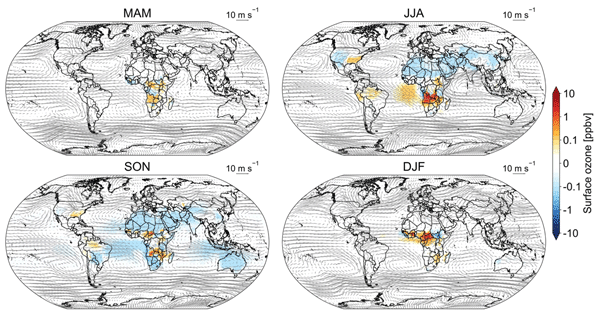
Using geostationary-satellite-derived sub-daily fire radiative power variability versus prescribed diurnal cycles to assess the impact of African fires on tropospheric ozone
Haolin Wang, William Maslanka, Paul I. Palmer, Martin J. Wooster, Haofan Wang, Fei Yao, Liang Feng, Kai Wu, Xiao Lu, and Shaojia Fan
Atmos. Chem. Phys., 25, 17501–17526, https://doi.org/10.5194/acp-25-17501-2025,https://doi.org/10.5194/acp-25-17501-2025, 2025
Short summary

Cited articles

Adams, C., McLinden, C. A., Shephard, M. W., Dickson, N., Dammers, E., Chen, J., Makar, P., Cady-Pereira, K. E., Tam, N., Kharol, S. K., Lamsal, L. N., and Krotkov, N. A.: Satellite-derived emissions of carbon monoxide, ammonia, and nitrogen dioxide from the 2016 Horse River wildfire in the Fort McMurray area, Atmos. Chem. Phys., 19, 2577–2599, https://doi.org/10.5194/acp-19-2577-2019, 2019. 
Akagi, S. K., Yokelson, R. J., Wiedinmyer, C., Alvarado, M. J., Reid, J. S., Karl, T., Crounse, J. D., and Wennberg, P. O.: Emission factors for open and domestic biomass burning for use in atmospheric models, Atmos. Chem. Phys., 11, 4039–4072, https://doi.org/10.5194/acp-11-4039-2011, 2011. 
Andela, N., Kaiser, J. W., van der Werf, G. R., and Wooster, M. J.: New fire diurnal cycle characterizations to improve fire radiative energy assessments made from MODIS observations, Atmos. Chem. Phys., 15, 8831–8846, https://doi.org/10.5194/acp-15-8831-2015, 2015. 
Andreae, M. O.: Emission of trace gases and aerosols from biomass burning – an updated assessment, Atmos. Chem. Phys., 19, 8523–8546, https://doi.org/10.5194/acp-19-8523-2019, 2019. 
Andreae, M. O. and Merlet, P.: Emission of trace gases and aerosols from biomass burning, Global Biogeochem. Cycles, 15, 955–966, https://doi.org/10.1029/2000GB001382, 2001. 
Download
Short summary
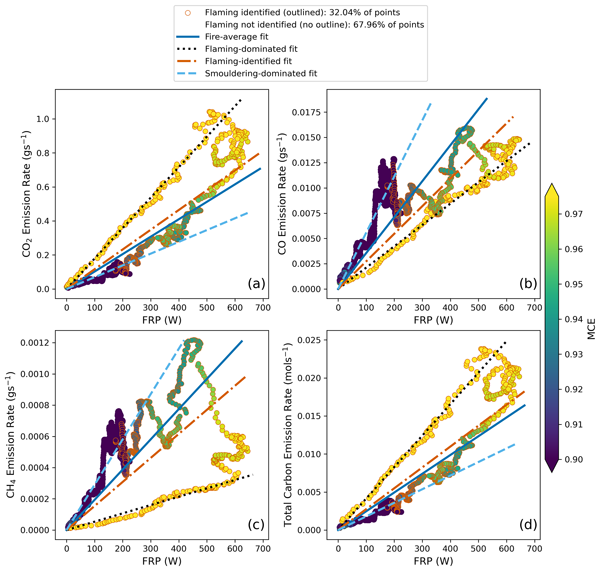
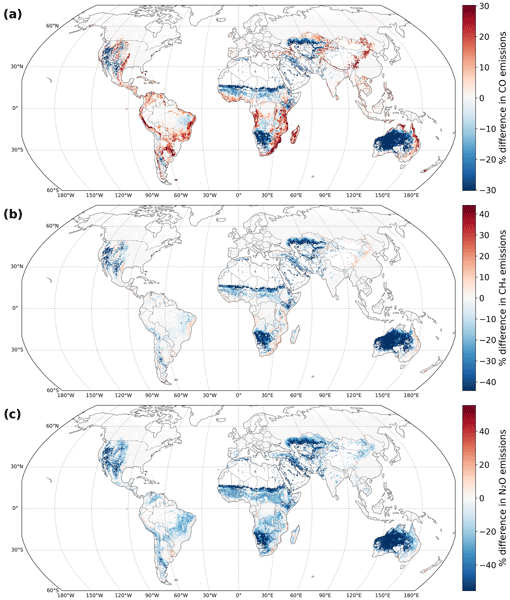
We created a new independent method that uses only near real time satellite data to estimate how much carbon is emitted from landscape fires in the high latitudes. Our estimates are similar, but smaller, than estimates using modelled data, based on laboratory experiments and observations of burned area. This provides the first clear picture of fire emissions across high-latitude regions and will help us better understand the role of wildfires in climate change now and in the future.
Share
Altmetrics
Final-revised paper
Preprint