
Articles | Volume 23, issue 2
https://doi.org/10.5194/bg-23-639-2026
© Author(s) 2026. This work is distributed under
the Creative Commons Attribution 4.0 License.
the Creative Commons Attribution 4.0 License.
https://doi.org/10.5194/bg-23-639-2026
© Author(s) 2026. This work is distributed under
the Creative Commons Attribution 4.0 License.
the Creative Commons Attribution 4.0 License.
Research article
| 
22 Jan 2026
Research article |
| 22 Jan 2026
| 22 Jan 2026
Glaciogenic iron transport pathways to the Kerguelen offshore phytoplankton bloom
Alex Nalivaev
CORRESPONDING AUTHOR

Sorbonne Université, CNRS, IRD, MNHN, Laboratoire d'Océanographie et du Climat: Expérimentations et Approches Numériques (LOCEAN-IPSL), Paris, France
Francesco d'Ovidio
Sorbonne Université, CNRS, IRD, MNHN, Laboratoire d'Océanographie et du Climat: Expérimentations et Approches Numériques (LOCEAN-IPSL), Paris, France
Laurent Bopp
Ecole Normale Supérieure/Université PSL, CNRS, Ecole Polytechnique, Sorbonne Université, Paris, Laboratoire de Météorologie Dynamique (LMD-IPSL) Paris, France
Maristella Berta
Consiglio Nazionale delle Ricerche – Istituto di Scienze Marine (CNR-ISMAR), Lerici (SP), Italy
Louise Rousselet
LEGOS, University of Toulouse, IRD, CNES, CNRS, UPS, Toulouse, France
Clara Azarian
Sorbonne Université, CNRS, IRD, MNHN, Laboratoire d'Océanographie et du Climat: Expérimentations et Approches Numériques (LOCEAN-IPSL), Paris, France
Ecole Nationale des Ponts et Chaussées (ENPC), Champs-sur-Marne, France
Stéphane Blain
Sorbonne Université, CNRS, Laboratoire d'océanographie microbienne (LOMIC), Banyuls sur mer, France
Related authors
No articles found.
Jens Terhaar, Laurent Bopp, Pierre Friedlingstein, Thomas Frölicher, Helene Hollitzer, Tatiana Ilyina, Lester Kwiatkowski, Paul Lerner, Hongmei Li, Anastasia Romanou, Jörg Schwinger, Roland Séférian, and Aaron Wienkers
EGUsphere, https://doi.org/10.5194/egusphere-2026-5757, https://doi.org/10.5194/egusphere-2026-5757, 2026
This preprint is open for discussion and under review for Biogeosciences (BG).
Short summary
Short summary
The ocean absorbs about 30% of CO2 emissions, but how much it will keep absorbing as CO2 levels rise and the climate warms is highly uncertain. Combining climate models with observations, we show models underestimate both the ocean CO2 uptake with increasing atmospheric CO2 and how strongly this uptake weakens with warming, and that the two are linked. Our tighter estimate reduces uncertainty in how much emitted CO2 stays in the atmosphere, and in the warming caused by future emissions.
Xi Ruan, Stéphane Doléac, Laurent Bopp, Julian Mak, Franziska Schwarzkopf, Arne Biastoch, and Marina Lévy
EGUsphere, https://doi.org/10.5194/egusphere-2026-4891, https://doi.org/10.5194/egusphere-2026-4891, 2026
This preprint is open for discussion and under review for Biogeosciences (BG).
Short summary
Short summary
Carbon produced by ocean life traveling from the surface to the deep ocean can help keep our planet cooler. Using simulations, we find that physical ocean processes are an important yet poorly constrained pathway for transport to the deep North Atlantic. Despite regional contrasts in total transport, contributions remain similar. They shape seasonal carbon patterns alongside the dominant pathway. A finer simulation shows stronger transport. These imply the need to better represent ocean physics.
Erica Cioffi, Laurent Bopp, and Lester Kwiatkowski
Biogeosciences, 23, 6073–6093, https://doi.org/10.5194/bg-23-6073-2026, https://doi.org/10.5194/bg-23-6073-2026, 2026
Short summary
Short summary
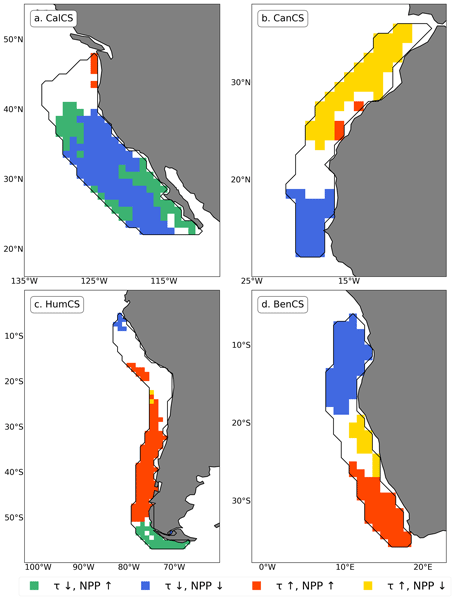
Eastern Boundary Upwelling Systems disproportionately contribute to global productivity and fisheries. Using CMIP6 Earth System Models, we assess response of phytoplankton productivity to climate change in these regions and to what extent it is explained by changes in wind-driven upwelling. While this process drives productivity decline across 25% of upwelling systems area, wind curl, geostrophic transport, stratification and subsurface nutrients changes are needed to explain response elsewhere.
Jeanne Dombret, Hugo Bellenger, Xavier Perrot, Laëtitia Parc, Lester Kwiatkowski, Frédéric Chevallier, Laurent Bopp, Marion Gehlen, Roland Séférian, Sarah Berthet, and James C. Orr
Biogeosciences, 23, 4133–4143, https://doi.org/10.5194/bg-23-4133-2026, https://doi.org/10.5194/bg-23-4133-2026, 2026
Short summary
Short summary
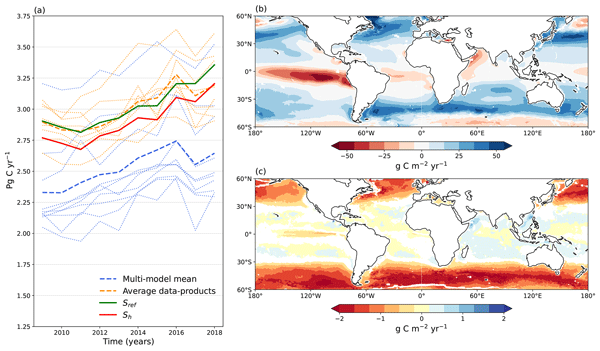
Estimates of ocean CO2 uptake based on atmospheric and oceanic observations typically rely on monthly averages, except for wind speed. Thus they neglect effects of shorter-term events such as storms, which are included in models. Here we account for the effect of this shorter-term variability on ocean carbon uptake and find that it is reduced, mainly because storms lower atmospheric pressure. This refinement closes the gap between data-based and model-based estimates by 25 %.
Pierre Friedlingstein, Michael O'Sullivan, Matthew W. Jones, Robbie M. Andrew, Dorothee C. E. Bakker, Judith Hauck, Peter Landschützer, Corinne Le Quéré, Hongmei Li, Ingrid T. Luijkx, Glen P. Peters, Wouter Peters, Julia Pongratz, Clemens Schwingshackl, Stephen Sitch, Josep G. Canadell, Philippe Ciais, Kjetil Aas, Simone R. Alin, Peter Anthoni, Leticia Barbero, Nicholas R. Bates, Nicolas Bellouin, Alice Benoit-Cattin, Carla F. Berghoff, Raffaele Bernardello, Laurent Bopp, Ida Bagus Mandhara Brasika, Matthew A. Chamberlain, Naveen Chandra, Frédéric Chevallier, Louise P. Chini, Nathan O. Collier, Thomas H. Colligan, Margot Cronin, Laique M. Djeutchouang, Xinyu Dou, Matt P. Enright, Kazutaka Enyo, Michael Erb, Wiley Evans, Richard A. Feely, Liang Feng, Daniel J. Ford, Adrianna Foster, Filippa Fransner, Thomas Gasser, Marion Gehlen, Thanos Gkritzalis, Jefferson Goncalves De Souza, Giacomo Grassi, Luke Gregor, Nicolas Gruber, Bertrand Guenet, Özgür Gürses, Kirsty Harrington, Ian Harris, Jens Heinke, George C. Hurtt, Yosuke Iida, Tatiana Ilyina, Akihiko Ito, Andrew R. Jacobson, Atul K. Jain, Tereza Jarníková, Annika Jersild, Fei Jiang, Steve D. Jones, Etsushi Kato, Ralph F. Keeling, Kees Klein Goldewijk, Jürgen Knauer, Yawen Kong, Jan Ivar Korsbakken, Charles Koven, Taro Kunimitsu, Xin Lan, Junjie Liu, Zhiqiang Liu, Zhu Liu, Claire Lo Monaco, Lei Ma, Gregg Marland, Patrick C. McGuire, Galen A. McKinley, Joe R. Melton, Natalie Monacci, Erwan Monier, Eric J. Morgan, David R. Munro, Jens D. Müller, Shin-Ichiro Nakaoka, Lorna R. Nayagam, Yosuke Niwa, Tobias Nutzel, Are Olsen, Abdirahman M. Omar, Naiqing Pan, Sudhanshu Pandey, Denis Pierrot, Zhangcai Qin, Pierre Regnier, Gregor Rehder, Laure Resplandy, Alizée Roobaert, Thais M. Rosan, Christian Rödenbeck, Jörg Schwinger, Ingunn Skjelvan, T. Luke Smallman, Victoria Spada, Mohanan G. Sreeush, Qing Sun, Adrienne J. Sutton, Colm Sweeney, Didier Swingedouw, Roland Séférian, Shintaro Takao, Hiroaki Tatebe, Hanqin Tian, Xiangjun Tian, Bronte Tilbrook, Hiroyuki Tsujino, Francesco Tubiello, Erik van Ooijen, Guido R. van der Werf, Sebastiaan J. van de Velde, Anthony P. Walker, Rik Wanninkhof, Xiaojuan Yang, Wenping Yuan, Xu Yue, and Jiye Zeng
Earth Syst. Sci. Data, 18, 3211–3288, https://doi.org/10.5194/essd-18-3211-2026, https://doi.org/10.5194/essd-18-3211-2026, 2026
Short summary
Short summary
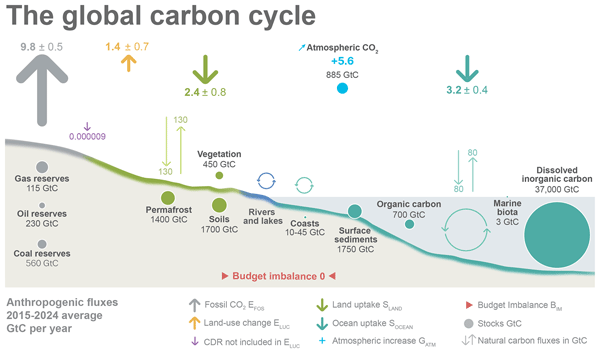
The Global Carbon Budget 2025 describes the methodology, main results, and datasets used to quantify the anthropogenic emissions of carbon dioxide (CO2) and their partitioning among the atmosphere, land ecosystems, and the ocean over the historical period (1750–2025). These living datasets are updated every year to provide the highest transparency and traceability in the reporting of CO2, the key driver of climate change.
Mathieu Delteil, Marina Lévy, and Laurent Bopp
Biogeosciences, 23, 2205–2233, https://doi.org/10.5194/bg-23-2205-2026, https://doi.org/10.5194/bg-23-2205-2026, 2026
Short summary
Short summary
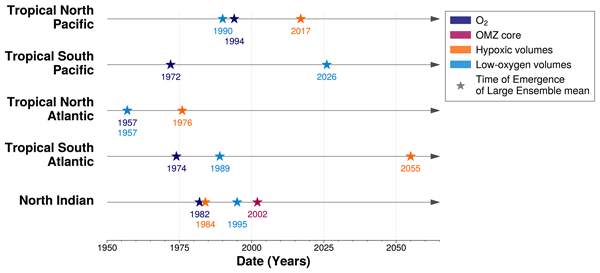
The ocean is losing oxygen due to climate change, threatening ecosystems, especially in naturally low-oxygen areas called Oxygen Minimum Zones (OMZs). Using the IPSL-CM6A-LR Large Ensemble, this study identifies when climate-driven changes in OMZ volumes and regional deoxygenation emerge from natural variability. We highlight hemispheric asymmetries due to ocean ventilation and provide model-based estimates for the timing of detectable OMZ evolution.
Helene A. L. Hollitzer, Laurent Bopp, and Jens Terhaar
EGUsphere, https://doi.org/10.5194/egusphere-2026-683, https://doi.org/10.5194/egusphere-2026-683, 2026
Short summary
Short summary
Due to its vast coastline, the Arctic Ocean receives large amounts of carbon and nutrients from land, yet the impact of these inputs on ocean acidification remains poorly quantified. Using an ocean biogeochemical model, we show that these inputs affect the intensity, vertical structure, and seasonal cycle of acidification. River inputs generally reduce acidification, whereas the coastal erosion intensifies it, emphasizing the value of including these inputs in future Arctic modeling efforts.
Maxime Duranson, Léo Berline, Loïc Guilloux, Alice Della Penna, Mark D. Ohman, Sven Gastauer, Cédric Cotte, Daniela Bănaru, Théo Garcia, Maristella Berta, Andrea Doglioli, Gérald Gregori, Francesco D'Ovidio, and François Carlotti
Biogeosciences, 23, 363–385, https://doi.org/10.5194/bg-23-363-2026, https://doi.org/10.5194/bg-23-363-2026, 2026
Short summary
Short summary
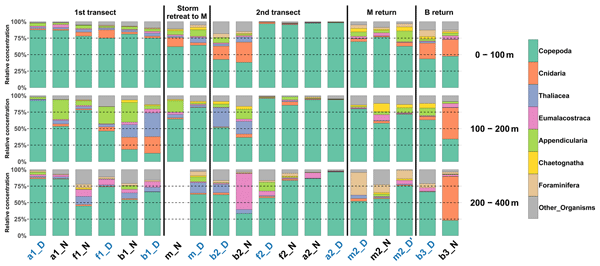
The zooplankton community was investigated using net sampling across the North Balearic Front at fine resolution. The front mostly acts as a zonal boundary between communities with a copepod dominated community to the north and a more diversified community to the south. The front itself exhibited lower zooplankton concentrations. The main community difference occurred in the 0–100 m layer, while deeper layers were more homogeneous.
Sebastien Donnet, Helga S. Huntley, Maristella Berta, Luca Centurioni, Leo Middleton, Tamay Özgökmen, Pierre-Marie Poulain, Alex Kinsella, and Annalisa Griffa
Ocean Sci., 21, 3221–3240, https://doi.org/10.5194/os-21-3221-2025, https://doi.org/10.5194/os-21-3221-2025, 2025
Short summary
Short summary
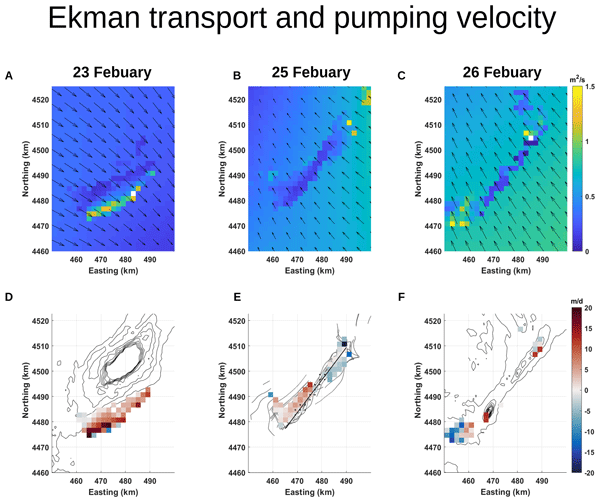
Oceanographic and atmospheric data is used to study the properties and evolution of an eddy in the Balearic Sea. During the period of observation, this eddy elongates and splits. The unusually dense set of observations from satellites, drifters, and ship-mounted instruments provide insight into this splitting process. In particular, the contribution from the wind is assessed. These mechanisms are known to impact the vertical exchanges of oxygen, carbon dioxide, nutrients, and pollutants.
Alban Planchat, Laurent Bopp, and Lester Kwiatkowski
Biogeosciences, 22, 6017–6055, https://doi.org/10.5194/bg-22-6017-2025, https://doi.org/10.5194/bg-22-6017-2025, 2025
Short summary
Short summary
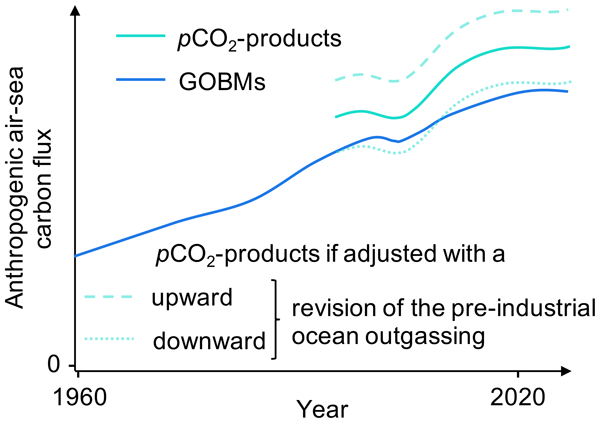
Disparities between observational and model-based estimates of the ocean carbon sink persist, highlighting the need for improved understanding and methodologies to reconcile differences in both magnitude and trends over recent decades. A potential key source of uncertainty lies in the pre-industrial air–sea carbon flux, which is essential for isolating the anthropogenic component from observations. Thus, we take a fresh look at this flux using the alkalinity budget, alongside the carbon budget.
Timothée Bourgeois, Giang T. Tran, Aurich Jeltsch-Thömmes, Jörg Schwinger, Friederike Fröb, Thomas L. Frölicher, Thorsten Blenckner, Olivier Torres, Jean Negrel, David P. Keller, Andreas Oschlies, Laurent Bopp, and Fortunat Joos
Biogeosciences, 22, 5435–5462, https://doi.org/10.5194/bg-22-5435-2025, https://doi.org/10.5194/bg-22-5435-2025, 2025
Short summary
Short summary
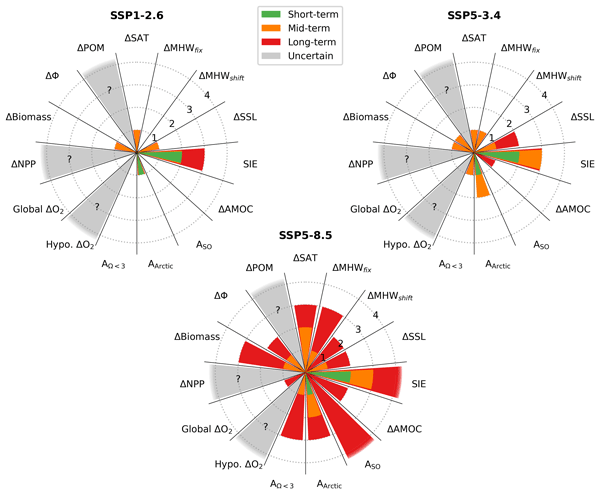
Anthropogenic greenhouse gas emissions significantly impact ocean ecosystems through climate change and acidification, leading to either progressive or abrupt changes. This study maps the crossing of physical and ecological limits for various ocean impact metrics under three emission scenarios. Using Earth system models, we identify when these limits are exceeded, highlighting the urgent need for ambitious climate action to safeguard the world's oceans and ecosystems.
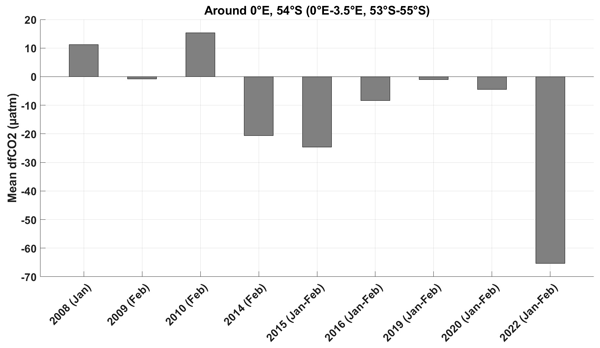
Kirtana Naëck, Jacqueline Boutin, Sebastiaan Swart, Marcel du Plessis, Liliane Merlivat, Laurence Beaumont, Antonio Lourenco, Francesco d'Ovidio, Louise Rousselet, Brian Ward, and Jean-Baptiste Sallée
Biogeosciences, 22, 1947–1968, https://doi.org/10.5194/bg-22-1947-2025, https://doi.org/10.5194/bg-22-1947-2025, 2025
Short summary
Short summary
In summer 2022, a CARbon Interface OCean Atmosphere (CARIOCA) drifting buoy observed an anomalously strong ocean carbon sink in the subpolar Southern Ocean associated with large plumes of chlorophyll a. Lagrangian backward trajectories indicate that these waters originated from the sea ice edge in spring 2021. Our study highlights the northward migration of the CO2 sink associated with early sea ice retreat.
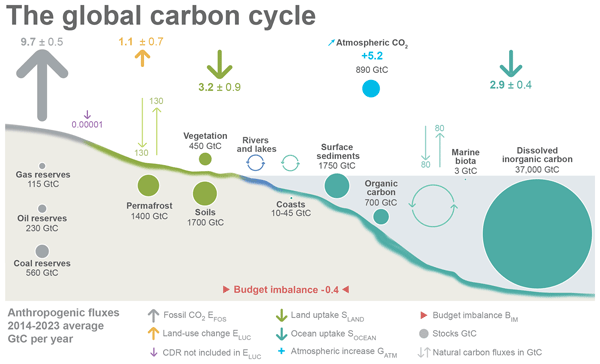
Pierre Friedlingstein, Michael O'Sullivan, Matthew W. Jones, Robbie M. Andrew, Judith Hauck, Peter Landschützer, Corinne Le Quéré, Hongmei Li, Ingrid T. Luijkx, Are Olsen, Glen P. Peters, Wouter Peters, Julia Pongratz, Clemens Schwingshackl, Stephen Sitch, Josep G. Canadell, Philippe Ciais, Robert B. Jackson, Simone R. Alin, Almut Arneth, Vivek Arora, Nicholas R. Bates, Meike Becker, Nicolas Bellouin, Carla F. Berghoff, Henry C. Bittig, Laurent Bopp, Patricia Cadule, Katie Campbell, Matthew A. Chamberlain, Naveen Chandra, Frédéric Chevallier, Louise P. Chini, Thomas Colligan, Jeanne Decayeux, Laique M. Djeutchouang, Xinyu Dou, Carolina Duran Rojas, Kazutaka Enyo, Wiley Evans, Amanda R. Fay, Richard A. Feely, Daniel J. Ford, Adrianna Foster, Thomas Gasser, Marion Gehlen, Thanos Gkritzalis, Giacomo Grassi, Luke Gregor, Nicolas Gruber, Özgür Gürses, Ian Harris, Matthew Hefner, Jens Heinke, George C. Hurtt, Yosuke Iida, Tatiana Ilyina, Andrew R. Jacobson, Atul K. Jain, Tereza Jarníková, Annika Jersild, Fei Jiang, Zhe Jin, Etsushi Kato, Ralph F. Keeling, Kees Klein Goldewijk, Jürgen Knauer, Jan Ivar Korsbakken, Xin Lan, Siv K. Lauvset, Nathalie Lefèvre, Zhu Liu, Junjie Liu, Lei Ma, Shamil Maksyutov, Gregg Marland, Nicolas Mayot, Patrick C. McGuire, Nicolas Metzl, Natalie M. Monacci, Eric J. Morgan, Shin-Ichiro Nakaoka, Craig Neill, Yosuke Niwa, Tobias Nützel, Lea Olivier, Tsuneo Ono, Paul I. Palmer, Denis Pierrot, Zhangcai Qin, Laure Resplandy, Alizée Roobaert, Thais M. Rosan, Christian Rödenbeck, Jörg Schwinger, T. Luke Smallman, Stephen M. Smith, Reinel Sospedra-Alfonso, Tobias Steinhoff, Qing Sun, Adrienne J. Sutton, Roland Séférian, Shintaro Takao, Hiroaki Tatebe, Hanqin Tian, Bronte Tilbrook, Olivier Torres, Etienne Tourigny, Hiroyuki Tsujino, Francesco Tubiello, Guido van der Werf, Rik Wanninkhof, Xuhui Wang, Dongxu Yang, Xiaojuan Yang, Zhen Yu, Wenping Yuan, Xu Yue, Sönke Zaehle, Ning Zeng, and Jiye Zeng
Earth Syst. Sci. Data, 17, 965–1039, https://doi.org/10.5194/essd-17-965-2025, https://doi.org/10.5194/essd-17-965-2025, 2025
Short summary
Short summary
The Global Carbon Budget 2024 describes the methodology, main results, and datasets used to quantify the anthropogenic emissions of carbon dioxide (CO2) and their partitioning among the atmosphere, land ecosystems, and the ocean over the historical period (1750–2024). These living datasets are updated every year to provide the highest transparency and traceability in the reporting of CO2, the key driver of climate change.
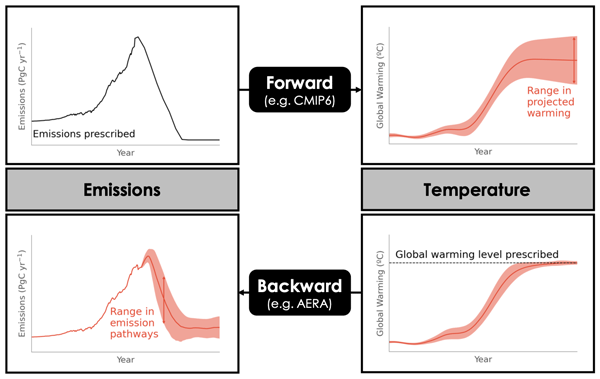
Yona Silvy, Thomas L. Frölicher, Jens Terhaar, Fortunat Joos, Friedrich A. Burger, Fabrice Lacroix, Myles Allen, Raffaele Bernardello, Laurent Bopp, Victor Brovkin, Jonathan R. Buzan, Patricia Cadule, Martin Dix, John Dunne, Pierre Friedlingstein, Goran Georgievski, Tomohiro Hajima, Stuart Jenkins, Michio Kawamiya, Nancy Y. Kiang, Vladimir Lapin, Donghyun Lee, Paul Lerner, Nadine Mengis, Estela A. Monteiro, David Paynter, Glen P. Peters, Anastasia Romanou, Jörg Schwinger, Sarah Sparrow, Eric Stofferahn, Jerry Tjiputra, Etienne Tourigny, and Tilo Ziehn
Earth Syst. Dynam., 15, 1591–1628, https://doi.org/10.5194/esd-15-1591-2024, https://doi.org/10.5194/esd-15-1591-2024, 2024
Short summary
Short summary
The adaptive emission reduction approach is applied with Earth system models to generate temperature stabilization simulations. These simulations provide compatible emission pathways and budgets for a given warming level, uncovering uncertainty ranges previously missing in the Coupled Model Intercomparison Project scenarios. These target-based emission-driven simulations offer a more coherent assessment across models for studying both the carbon cycle and its impacts under climate stabilization.
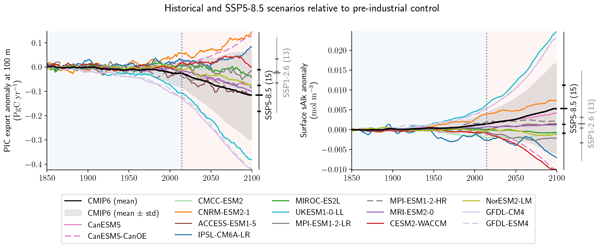
Alban Planchat, Laurent Bopp, Lester Kwiatkowski, and Olivier Torres
Earth Syst. Dynam., 15, 565–588, https://doi.org/10.5194/esd-15-565-2024, https://doi.org/10.5194/esd-15-565-2024, 2024
Short summary
Short summary
Ocean acidification is likely to impact all stages of the ocean carbonate pump. We show divergent responses of CaCO3 export throughout this century in earth system models, with anomalies by 2100 ranging from −74 % to +23 % under a high-emission scenario. While we confirm the limited impact of carbonate pump anomalies on 21st century ocean carbon uptake and acidification, we highlight a potentially abrupt shift in CaCO3 dissolution from deep to subsurface waters beyond 2100.
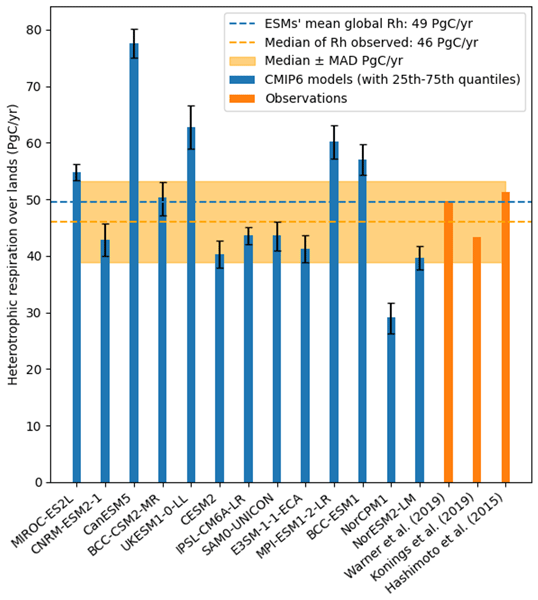
Bertrand Guenet, Jérémie Orliac, Lauric Cécillon, Olivier Torres, Laura Sereni, Philip A. Martin, Pierre Barré, and Laurent Bopp
Biogeosciences, 21, 657–669, https://doi.org/10.5194/bg-21-657-2024, https://doi.org/10.5194/bg-21-657-2024, 2024
Short summary
Short summary
Heterotrophic respiration fluxes are a major flux between surfaces and the atmosphere, but Earth system models do not yet represent them correctly. Here we benchmarked Earth system models against observation-based products, and we identified the important mechanisms that need to be improved in the next-generation Earth system models.
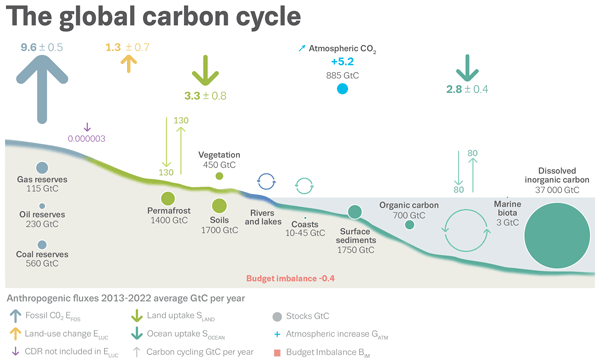
Pierre Friedlingstein, Michael O'Sullivan, Matthew W. Jones, Robbie M. Andrew, Dorothee C. E. Bakker, Judith Hauck, Peter Landschützer, Corinne Le Quéré, Ingrid T. Luijkx, Glen P. Peters, Wouter Peters, Julia Pongratz, Clemens Schwingshackl, Stephen Sitch, Josep G. Canadell, Philippe Ciais, Robert B. Jackson, Simone R. Alin, Peter Anthoni, Leticia Barbero, Nicholas R. Bates, Meike Becker, Nicolas Bellouin, Bertrand Decharme, Laurent Bopp, Ida Bagus Mandhara Brasika, Patricia Cadule, Matthew A. Chamberlain, Naveen Chandra, Thi-Tuyet-Trang Chau, Frédéric Chevallier, Louise P. Chini, Margot Cronin, Xinyu Dou, Kazutaka Enyo, Wiley Evans, Stefanie Falk, Richard A. Feely, Liang Feng, Daniel J. Ford, Thomas Gasser, Josefine Ghattas, Thanos Gkritzalis, Giacomo Grassi, Luke Gregor, Nicolas Gruber, Özgür Gürses, Ian Harris, Matthew Hefner, Jens Heinke, Richard A. Houghton, George C. Hurtt, Yosuke Iida, Tatiana Ilyina, Andrew R. Jacobson, Atul Jain, Tereza Jarníková, Annika Jersild, Fei Jiang, Zhe Jin, Fortunat Joos, Etsushi Kato, Ralph F. Keeling, Daniel Kennedy, Kees Klein Goldewijk, Jürgen Knauer, Jan Ivar Korsbakken, Arne Körtzinger, Xin Lan, Nathalie Lefèvre, Hongmei Li, Junjie Liu, Zhiqiang Liu, Lei Ma, Greg Marland, Nicolas Mayot, Patrick C. McGuire, Galen A. McKinley, Gesa Meyer, Eric J. Morgan, David R. Munro, Shin-Ichiro Nakaoka, Yosuke Niwa, Kevin M. O'Brien, Are Olsen, Abdirahman M. Omar, Tsuneo Ono, Melf Paulsen, Denis Pierrot, Katie Pocock, Benjamin Poulter, Carter M. Powis, Gregor Rehder, Laure Resplandy, Eddy Robertson, Christian Rödenbeck, Thais M. Rosan, Jörg Schwinger, Roland Séférian, T. Luke Smallman, Stephen M. Smith, Reinel Sospedra-Alfonso, Qing Sun, Adrienne J. Sutton, Colm Sweeney, Shintaro Takao, Pieter P. Tans, Hanqin Tian, Bronte Tilbrook, Hiroyuki Tsujino, Francesco Tubiello, Guido R. van der Werf, Erik van Ooijen, Rik Wanninkhof, Michio Watanabe, Cathy Wimart-Rousseau, Dongxu Yang, Xiaojuan Yang, Wenping Yuan, Xu Yue, Sönke Zaehle, Jiye Zeng, and Bo Zheng
Earth Syst. Sci. Data, 15, 5301–5369, https://doi.org/10.5194/essd-15-5301-2023, https://doi.org/10.5194/essd-15-5301-2023, 2023
Short summary
Short summary
The Global Carbon Budget 2023 describes the methodology, main results, and data sets used to quantify the anthropogenic emissions of carbon dioxide (CO2) and their partitioning among the atmosphere, land ecosystems, and the ocean over the historical period (1750–2023). These living datasets are updated every year to provide the highest transparency and traceability in the reporting of CO2, the key driver of climate change.
David T. Ho, Laurent Bopp, Jaime B. Palter, Matthew C. Long, Philip W. Boyd, Griet Neukermans, and Lennart T. Bach
State Planet, 2-oae2023, 12, https://doi.org/10.5194/sp-2-oae2023-12-2023, https://doi.org/10.5194/sp-2-oae2023-12-2023, 2023
Short summary
Short summary
Monitoring, reporting, and verification (MRV) refers to the multistep process to quantify the amount of carbon dioxide removed by a carbon dioxide removal (CDR) activity. Here, we make recommendations for MRV for Ocean Alkalinity Enhancement (OAE) research, arguing that it has an obligation for comprehensiveness, reproducibility, and transparency, as it may become the foundation for assessing large-scale deployment. Both observations and numerical simulations will be needed for MRV.
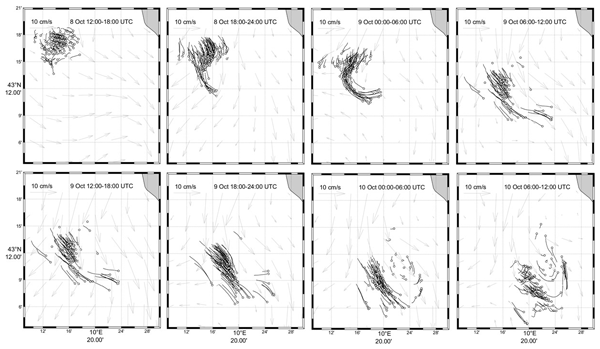
Pierre-Marie Poulain, Luca Centurioni, Carlo Brandini, Stefano Taddei, Maristella Berta, and Milena Menna
Ocean Sci., 19, 1617–1631, https://doi.org/10.5194/os-19-1617-2023, https://doi.org/10.5194/os-19-1617-2023, 2023
Short summary
Short summary
Drifters and a profiling float were deployed in the coastal waters of the southeastern Ligurian Sea to characterize the near-surface circulation at a scale of ~10 km. The drifters were trapped in an offshore-flowing filament and a cyclonic eddy that developed at the southwestern extremity of the filament. Drifter velocities are used to estimate differential kinematic properties and relative dispersion statistics of the surface currents.
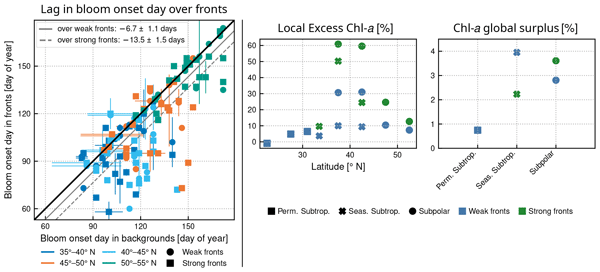
Clément Haëck, Marina Lévy, Inès Mangolte, and Laurent Bopp
Biogeosciences, 20, 1741–1758, https://doi.org/10.5194/bg-20-1741-2023, https://doi.org/10.5194/bg-20-1741-2023, 2023
Short summary
Short summary
Phytoplankton vary in abundance in the ocean over large regions and with the seasons but also because of small-scale heterogeneities in surface temperature, called fronts. Here, using satellite imagery, we found that fronts enhance phytoplankton much more where it is already growing well, but despite large local increases the enhancement for the region is modest (5 %). We also found that blooms start 1 to 2 weeks earlier over fronts. These effects may have implications for ecosystems.
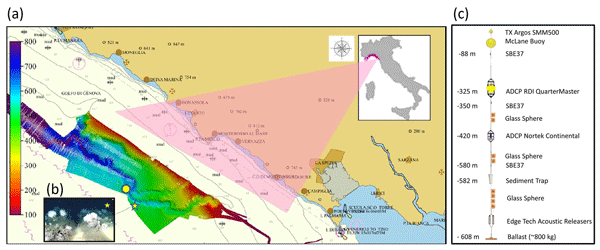
Tiziana Ciuffardi, Zoi Kokkini, Maristella Berta, Marina Locritani, Andrea Bordone, Ivana Delbono, Mireno Borghini, Maurizio Demarte, Roberta Ivaldi, Federica Pannacciulli, Anna Vetrano, Davide Marini, and Giovanni Caprino
Earth Syst. Sci. Data, 15, 1933–1946, https://doi.org/10.5194/essd-15-1933-2023, https://doi.org/10.5194/essd-15-1933-2023, 2023
Short summary
Short summary
This paper presents the results of the first 2 years of the Levante Canyon Mooring, a mooring line placed since 2020 in the eastern Ligurian Sea, to study a canyon area at about 600 m depth characterized by the presence of cold-water living corals. It provides hydrodynamic and thermohaline measurements along the water column, describing a water-mass distribution coherent with previous evidence in the Ligurian Sea. The data also show a Northern Current episodic and local reversal during summer.
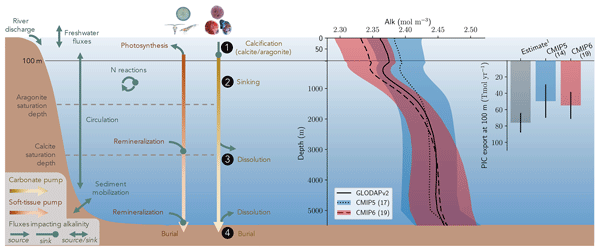
Alban Planchat, Lester Kwiatkowski, Laurent Bopp, Olivier Torres, James R. Christian, Momme Butenschön, Tomas Lovato, Roland Séférian, Matthew A. Chamberlain, Olivier Aumont, Michio Watanabe, Akitomo Yamamoto, Andrew Yool, Tatiana Ilyina, Hiroyuki Tsujino, Kristen M. Krumhardt, Jörg Schwinger, Jerry Tjiputra, John P. Dunne, and Charles Stock
Biogeosciences, 20, 1195–1257, https://doi.org/10.5194/bg-20-1195-2023, https://doi.org/10.5194/bg-20-1195-2023, 2023
Short summary
Short summary
Ocean alkalinity is critical to the uptake of atmospheric carbon and acidification in surface waters. We review the representation of alkalinity and the associated calcium carbonate cycle in Earth system models. While many parameterizations remain present in the latest generation of models, there is a general improvement in the simulated alkalinity distribution. This improvement is related to an increase in the export of biotic calcium carbonate, which closer resembles observations.
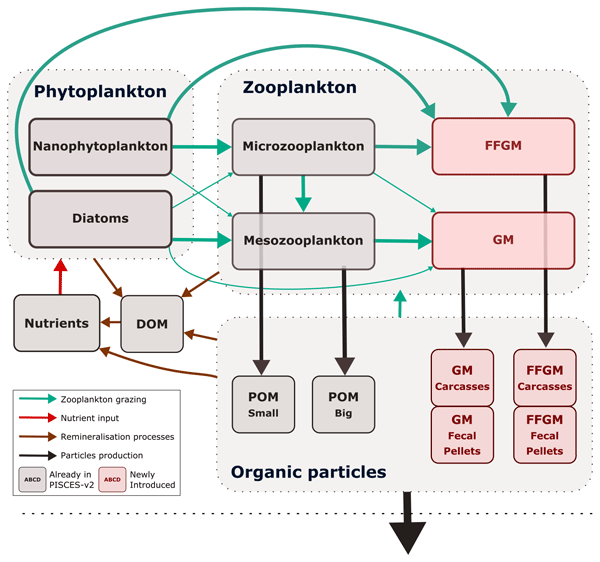
Corentin Clerc, Laurent Bopp, Fabio Benedetti, Meike Vogt, and Olivier Aumont
Biogeosciences, 20, 869–895, https://doi.org/10.5194/bg-20-869-2023, https://doi.org/10.5194/bg-20-869-2023, 2023
Short summary
Short summary
Gelatinous zooplankton play a key role in the ocean carbon cycle. In particular, pelagic tunicates, which feed on a wide size range of prey, produce rapidly sinking detritus. Thus, they efficiently transfer carbon from the surface to the depths. Consequently, we added these organisms to a marine biogeochemical model (PISCES-v2) and evaluated their impact on the global carbon cycle. We found that they contribute significantly to carbon export and that this contribution increases with depth.
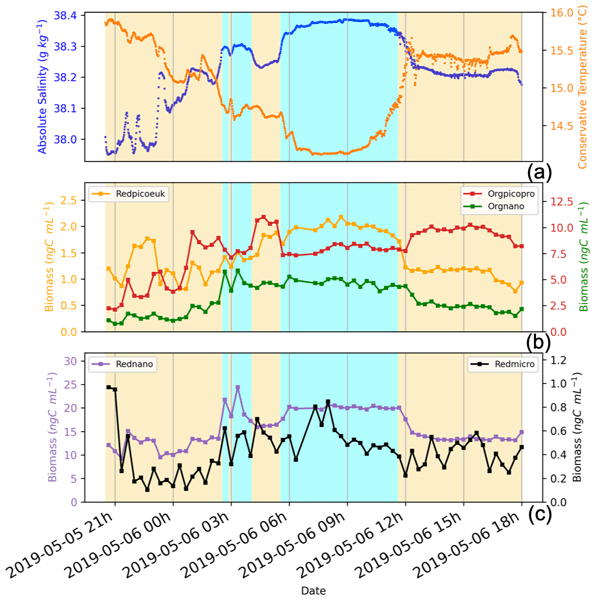
Stéphanie Barrillon, Robin Fuchs, Anne A. Petrenko, Caroline Comby, Anthony Bosse, Christophe Yohia, Jean-Luc Fuda, Nagib Bhairy, Frédéric Cyr, Andrea M. Doglioli, Gérald Grégori, Roxane Tzortzis, Francesco d'Ovidio, and Melilotus Thyssen
Biogeosciences, 20, 141–161, https://doi.org/10.5194/bg-20-141-2023, https://doi.org/10.5194/bg-20-141-2023, 2023
Short summary
Short summary
Extreme weather events can have a major impact on ocean physics and biogeochemistry, but their study is challenging. In May 2019, an intense storm occurred in the north-western Mediterranean Sea, during which in situ multi-platform measurements were performed. The results show a strong impact on the surface phytoplankton, highlighting the need for high-resolution measurements coupling physics and biology during these violent events that may become more common in the context of global change.
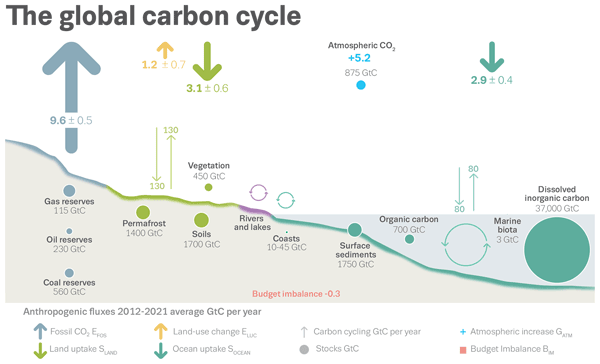
Pierre Friedlingstein, Michael O'Sullivan, Matthew W. Jones, Robbie M. Andrew, Luke Gregor, Judith Hauck, Corinne Le Quéré, Ingrid T. Luijkx, Are Olsen, Glen P. Peters, Wouter Peters, Julia Pongratz, Clemens Schwingshackl, Stephen Sitch, Josep G. Canadell, Philippe Ciais, Robert B. Jackson, Simone R. Alin, Ramdane Alkama, Almut Arneth, Vivek K. Arora, Nicholas R. Bates, Meike Becker, Nicolas Bellouin, Henry C. Bittig, Laurent Bopp, Frédéric Chevallier, Louise P. Chini, Margot Cronin, Wiley Evans, Stefanie Falk, Richard A. Feely, Thomas Gasser, Marion Gehlen, Thanos Gkritzalis, Lucas Gloege, Giacomo Grassi, Nicolas Gruber, Özgür Gürses, Ian Harris, Matthew Hefner, Richard A. Houghton, George C. Hurtt, Yosuke Iida, Tatiana Ilyina, Atul K. Jain, Annika Jersild, Koji Kadono, Etsushi Kato, Daniel Kennedy, Kees Klein Goldewijk, Jürgen Knauer, Jan Ivar Korsbakken, Peter Landschützer, Nathalie Lefèvre, Keith Lindsay, Junjie Liu, Zhu Liu, Gregg Marland, Nicolas Mayot, Matthew J. McGrath, Nicolas Metzl, Natalie M. Monacci, David R. Munro, Shin-Ichiro Nakaoka, Yosuke Niwa, Kevin O'Brien, Tsuneo Ono, Paul I. Palmer, Naiqing Pan, Denis Pierrot, Katie Pocock, Benjamin Poulter, Laure Resplandy, Eddy Robertson, Christian Rödenbeck, Carmen Rodriguez, Thais M. Rosan, Jörg Schwinger, Roland Séférian, Jamie D. Shutler, Ingunn Skjelvan, Tobias Steinhoff, Qing Sun, Adrienne J. Sutton, Colm Sweeney, Shintaro Takao, Toste Tanhua, Pieter P. Tans, Xiangjun Tian, Hanqin Tian, Bronte Tilbrook, Hiroyuki Tsujino, Francesco Tubiello, Guido R. van der Werf, Anthony P. Walker, Rik Wanninkhof, Chris Whitehead, Anna Willstrand Wranne, Rebecca Wright, Wenping Yuan, Chao Yue, Xu Yue, Sönke Zaehle, Jiye Zeng, and Bo Zheng
Earth Syst. Sci. Data, 14, 4811–4900, https://doi.org/10.5194/essd-14-4811-2022, https://doi.org/10.5194/essd-14-4811-2022, 2022
Short summary
Short summary
The Global Carbon Budget 2022 describes the datasets and methodology used to quantify the anthropogenic emissions of carbon dioxide (CO2) and their partitioning among the atmosphere, the land ecosystems, and the ocean. These living datasets are updated every year to provide the highest transparency and traceability in the reporting of CO2, the key driver of climate change.
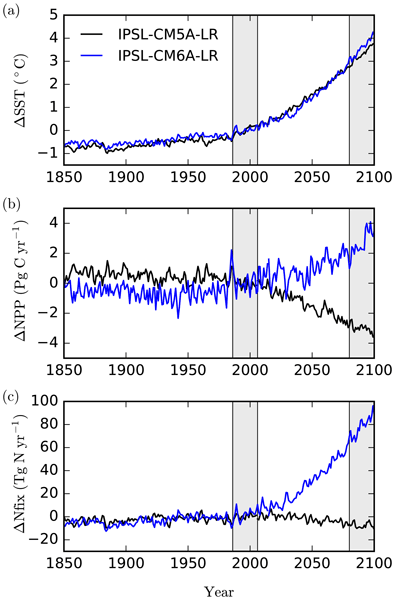
Laurent Bopp, Olivier Aumont, Lester Kwiatkowski, Corentin Clerc, Léonard Dupont, Christian Ethé, Thomas Gorgues, Roland Séférian, and Alessandro Tagliabue
Biogeosciences, 19, 4267–4285, https://doi.org/10.5194/bg-19-4267-2022, https://doi.org/10.5194/bg-19-4267-2022, 2022
Short summary
Short summary
The impact of anthropogenic climate change on the biological production of phytoplankton in the ocean is a cause for concern because its evolution could affect the response of marine ecosystems to climate change. Here, we identify biological N fixation and its response to future climate change as a key process in shaping the future evolution of marine phytoplankton production. Our results show that further study of how this nitrogen fixation responds to environmental change is essential.
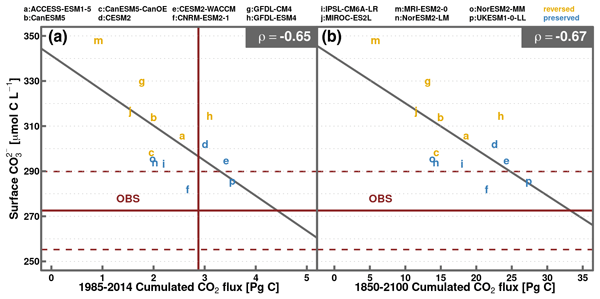
Pradeebane Vaittinada Ayar, Laurent Bopp, Jim R. Christian, Tatiana Ilyina, John P. Krasting, Roland Séférian, Hiroyuki Tsujino, Michio Watanabe, Andrew Yool, and Jerry Tjiputra
Earth Syst. Dynam., 13, 1097–1118, https://doi.org/10.5194/esd-13-1097-2022, https://doi.org/10.5194/esd-13-1097-2022, 2022
Short summary
Short summary
The El Niño–Southern Oscillation is the main driver for the natural variability of global atmospheric CO2. It modulates the CO2 fluxes in the tropical Pacific with anomalous CO2 influx during El Niño and outflux during La Niña. This relationship is projected to reverse by half of Earth system models studied here under the business-as-usual scenario. This study shows models that simulate a positive bias in surface carbonate concentrations simulate a shift in the ENSO–CO2 flux relationship.
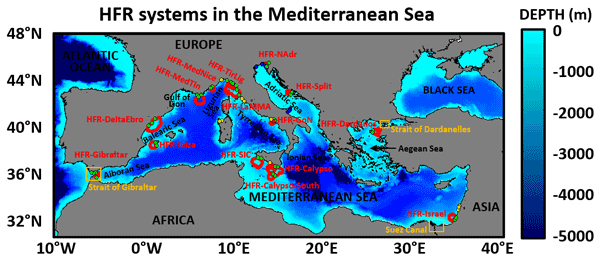
Pablo Lorente, Eva Aguiar, Michele Bendoni, Maristella Berta, Carlo Brandini, Alejandro Cáceres-Euse, Fulvio Capodici, Daniela Cianelli, Giuseppe Ciraolo, Lorenzo Corgnati, Vlado Dadić, Bartolomeo Doronzo, Aldo Drago, Dylan Dumas, Pierpaolo Falco, Maria Fattorini, Adam Gauci, Roberto Gómez, Annalisa Griffa, Charles-Antoine Guérin, Ismael Hernández-Carrasco, Jaime Hernández-Lasheras, Matjaž Ličer, Marcello G. Magaldi, Carlo Mantovani, Hrvoje Mihanović, Anne Molcard, Baptiste Mourre, Alejandro Orfila, Adèle Révelard, Emma Reyes, Jorge Sánchez, Simona Saviano, Roberta Sciascia, Stefano Taddei, Joaquín Tintoré, Yaron Toledo, Laura Ursella, Marco Uttieri, Ivica Vilibić, Enrico Zambianchi, and Vanessa Cardin
Ocean Sci., 18, 761–795, https://doi.org/10.5194/os-18-761-2022, https://doi.org/10.5194/os-18-761-2022, 2022
Short summary
Short summary
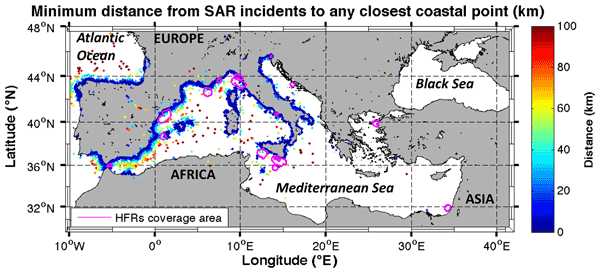
High-frequency radar (HFR) is a land-based remote sensing technology that can provide maps of the surface circulation over broad coastal areas, along with wave and wind information. The main goal of this work is to showcase the current status of the Mediterranean HFR network as well as present and future applications of this sensor for societal benefit such as search and rescue operations, safe vessel navigation, tracking of marine pollutants, and the monitoring of extreme events.
Emma Reyes, Eva Aguiar, Michele Bendoni, Maristella Berta, Carlo Brandini, Alejandro Cáceres-Euse, Fulvio Capodici, Vanessa Cardin, Daniela Cianelli, Giuseppe Ciraolo, Lorenzo Corgnati, Vlado Dadić, Bartolomeo Doronzo, Aldo Drago, Dylan Dumas, Pierpaolo Falco, Maria Fattorini, Maria J. Fernandes, Adam Gauci, Roberto Gómez, Annalisa Griffa, Charles-Antoine Guérin, Ismael Hernández-Carrasco, Jaime Hernández-Lasheras, Matjaž Ličer, Pablo Lorente, Marcello G. Magaldi, Carlo Mantovani, Hrvoje Mihanović, Anne Molcard, Baptiste Mourre, Adèle Révelard, Catalina Reyes-Suárez, Simona Saviano, Roberta Sciascia, Stefano Taddei, Joaquín Tintoré, Yaron Toledo, Marco Uttieri, Ivica Vilibić, Enrico Zambianchi, and Alejandro Orfila
Ocean Sci., 18, 797–837, https://doi.org/10.5194/os-18-797-2022, https://doi.org/10.5194/os-18-797-2022, 2022
Short summary
Short summary
This work reviews the existing advanced and emerging scientific and societal applications using HFR data, developed to address the major challenges identified in Mediterranean coastal waters organized around three main topics: maritime safety, extreme hazards and environmental transport processes. It also includes a discussion and preliminary assessment of the capabilities of existing HFR applications, finally providing a set of recommendations towards setting out future prospects.
Pierre Friedlingstein, Matthew W. Jones, Michael O'Sullivan, Robbie M. Andrew, Dorothee C. E. Bakker, Judith Hauck, Corinne Le Quéré, Glen P. Peters, Wouter Peters, Julia Pongratz, Stephen Sitch, Josep G. Canadell, Philippe Ciais, Rob B. Jackson, Simone R. Alin, Peter Anthoni, Nicholas R. Bates, Meike Becker, Nicolas Bellouin, Laurent Bopp, Thi Tuyet Trang Chau, Frédéric Chevallier, Louise P. Chini, Margot Cronin, Kim I. Currie, Bertrand Decharme, Laique M. Djeutchouang, Xinyu Dou, Wiley Evans, Richard A. Feely, Liang Feng, Thomas Gasser, Dennis Gilfillan, Thanos Gkritzalis, Giacomo Grassi, Luke Gregor, Nicolas Gruber, Özgür Gürses, Ian Harris, Richard A. Houghton, George C. Hurtt, Yosuke Iida, Tatiana Ilyina, Ingrid T. Luijkx, Atul Jain, Steve D. Jones, Etsushi Kato, Daniel Kennedy, Kees Klein Goldewijk, Jürgen Knauer, Jan Ivar Korsbakken, Arne Körtzinger, Peter Landschützer, Siv K. Lauvset, Nathalie Lefèvre, Sebastian Lienert, Junjie Liu, Gregg Marland, Patrick C. McGuire, Joe R. Melton, David R. Munro, Julia E. M. S. Nabel, Shin-Ichiro Nakaoka, Yosuke Niwa, Tsuneo Ono, Denis Pierrot, Benjamin Poulter, Gregor Rehder, Laure Resplandy, Eddy Robertson, Christian Rödenbeck, Thais M. Rosan, Jörg Schwinger, Clemens Schwingshackl, Roland Séférian, Adrienne J. Sutton, Colm Sweeney, Toste Tanhua, Pieter P. Tans, Hanqin Tian, Bronte Tilbrook, Francesco Tubiello, Guido R. van der Werf, Nicolas Vuichard, Chisato Wada, Rik Wanninkhof, Andrew J. Watson, David Willis, Andrew J. Wiltshire, Wenping Yuan, Chao Yue, Xu Yue, Sönke Zaehle, and Jiye Zeng
Earth Syst. Sci. Data, 14, 1917–2005, https://doi.org/10.5194/essd-14-1917-2022, https://doi.org/10.5194/essd-14-1917-2022, 2022
Short summary
Short summary
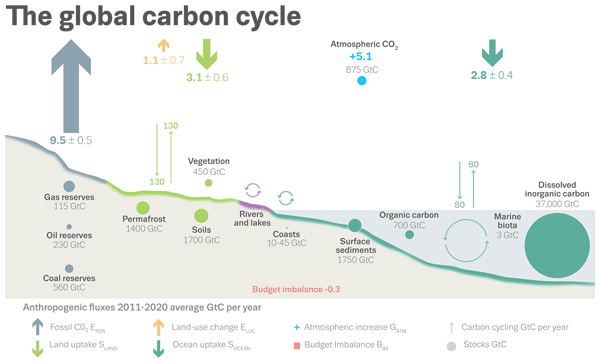
The Global Carbon Budget 2021 describes the data sets and methodology used to quantify the emissions of carbon dioxide and their partitioning among the atmosphere, land, and ocean. These living data are updated every year to provide the highest transparency and traceability in the reporting of CO2, the key driver of climate change.

Roxane Tzortzis, Andrea M. Doglioli, Stéphanie Barrillon, Anne A. Petrenko, Francesco d'Ovidio, Lloyd Izard, Melilotus Thyssen, Ananda Pascual, Bàrbara Barceló-Llull, Frédéric Cyr, Marc Tedetti, Nagib Bhairy, Pierre Garreau, Franck Dumas, and Gérald Gregori
Biogeosciences, 18, 6455–6477, https://doi.org/10.5194/bg-18-6455-2021, https://doi.org/10.5194/bg-18-6455-2021, 2021
Short summary
Short summary
This work analyzes an original high-resolution data set collected in the Mediterranean Sea. The major result is the impact of a fine-scale frontal structure on the distribution of phytoplankton groups, in an area of moderate energy with oligotrophic conditions. Our results provide an in situ confirmation of the findings obtained by previous modeling studies and remote sensing about the structuring effect of the fine-scale ocean dynamics on the structure of the phytoplankton community.
Cited articles
Ardyna, M., Claustre, H., Sallée, J., D'Ovidio, F., Gentili, B., Van Dijken, G., D'Ortenzio, F., and Arrigo, K. R.: Delineating environmental control of phytoplankton biomass and phenology in the Southern Ocean, Geophysical Research Letters, 44, 5016–5024, https://doi.org/10.1002/2016GL072428, 2017. a, b, c, d
Ardyna, M., Lacour, L., Sergi, S., d'Ovidio, F., Sallée, J.-B., Rembauville, M., Blain, S., Tagliabue, A., Schlitzer, R., Jeandel, C., Arrigo, K. R., and Claustre, H.: Hydrothermal vents trigger massive phytoplankton blooms in the Southern Ocean, Nature Communications, 10, 2451, https://doi.org/10.1038/s41467-019-09973-6, 2019. a, b
Arrigo, K. R., Van Dijken, G. L., and Strong, A. L.: Environmental controls of marine productivity hot spots around Antarctica, Journal of Geophysical Research: Oceans, 120, 5545–5565, https://doi.org/10.1002/2015JC010888, 2015. a, b
Arrigo, K. R., Van Dijken, G. L., Castelao, R. M., Luo, H., Rennermalm, A. K., Tedesco, M., Mote, T. L., Oliver, H., and Yager, P. L.: Melting glaciers stimulate large summer phytoplankton blooms in southwest Greenland waters, Geophysical Research Letters, 44, 6278–6285, https://doi.org/10.1002/2017GL073583, 2017. a, b
Azarian, C., Bopp, L., Sallée, J.-B., Swart, S., Guinet, C., and d'Ovidio, F.: Marine heatwaves and global warming impacts on winter waters in the Southern Indian Ocean, Journal of Marine Systems, 243, 103962, https://doi.org/10.1016/j.jmarsys.2023.103962, 2024. a
Ballarotta, M., Ubelmann, C., Veillard, P., Prandi, P., Etienne, H., Mulet, S., Faugère, Y., Dibarboure, G., Morrow, R., and Picot, N.: Improved global sea surface height and current maps from remote sensing and in situ observations, Earth Syst. Sci. Data, 15, 295–315, https://doi.org/10.5194/essd-15-295-2023, 2023. a, b
Beadling, R. L., Russell, J. L., Stouffer, R. J., Mazloff, M., Talley, L. D., Goodman, P. J., Sallée, J. B., Hewitt, H. T., Hyder, P., and Pandde, A.: Representation of Southern Ocean Properties across Coupled Model Intercomparison Project Generations: CMIP3 to CMIP6, Journal of Climate, 33, 6555–6581, https://doi.org/10.1175/JCLI-D-19-0970.1, 2020. a
Berta, M., Griffa, A., Magaldi, M. G., Özgökmen, T. M., Poje, A. C., Haza, A. C., and Olascoaga, M. J.: Improved Surface Velocity and Trajectory Estimates in the Gulf of Mexico from Blended Satellite Altimetry and Drifter Data, Journal of Atmospheric and Oceanic Technology, 32, 1880–1901, https://doi.org/10.1175/JTECH-D-14-00226.1, 2015. a, b
Berta, M., Azarian, C., Nalivaev, A., Blain, S., and D'Ovidio, F.: CARTHE drifters deployment within the MARGOCEAN experiment in the Antarctic Ocean, SEANOE [data set], https://doi.org/10.17882/103561, 2024. a, b
Berthier, E., Le Bris, R., Mabileau, L., Testut, L., and Rémy, F.: Ice wastage on the Kerguelen Islands (49° S, 69° E) between 1963 and 2006, Journal of Geophysical Research: Earth Surface, 114, https://doi.org/10.1029/2008JF001192, 2009. a
Bhatia, M. P., Kujawinski, E. B., Das, S. B., Breier, C. F., Henderson, P. B., and Charette, M. A.: Greenland meltwater as a significant and potentially bioavailable source of iron to the ocean, Nature Geoscience, 6, 274–278, https://doi.org/10.1038/ngeo1746, 2013. a, b
Bindoff, N. L., Cheung, W. W. L., Kairo, J. G., Arístegui, J., Guinder, V. A., Hallberg, R., Hilmi, N., Jiao, N., Karim, M. S., Levin, L., O’Donoghue, S., Purca Cuicapusa, S. R., Rinkevich, B., Suga, T., Tagliabue, A., and Williamson, P.: Changing Ocean, Marine Ecosystems, and Dependent Communities. In: IPCC Special Report on the Ocean and Cryosphere in a Changing Climate, edited by: Pörtner, H.-O., Roberts, D. C., Masson-Delmotte, V., Zhai, P., Tignor, M., Poloczanska, E., Mintenbeck, K., Alegría, A., Nicolai, M., Okem, A., Petzold, J., Rama, B., and Weyer, N. M., Cambridge University Press, Cambridge, UK and New York, NY, USA, 447–587, https://doi.org/10.1017/9781009157964.007, 2019. a
Blain, S. and Obernosterer, I.: MARGOCEAN cruise, RV Marion Dufresne, Flotte oceanographique française, https://doi.org/10.17600/18002958, 2024. a, b
Blain, S., Tréguer, P., Belviso, S., Bucciarelli, E., Denis, M., Desabre, S., Fiala, M., Martin Jézéquel, V., Le Fèvre, J., Mayzaud, P., Marty, J.-C., and Razouls, S.: A biogeochemical study of the island mass e!ect in the context of the iron hypothesis: Kerguelen Islands, Southern Ocean, Deep-Sea Research, 163–187, https://doi.org/10.1016/S0967-0637(00)00047-9, 2000. a
Blain, S., Quéguiner, B., Armand, L., Belviso, S., Bombled, B., Bopp, L., Bowie, A., Brunet, C., Brussaard, C., Carlotti, F., Christaki, U., Corbière, A., Durand, I., Ebersbach, F., Fuda, J.-L., Garcia, N., Gerringa, L., Griffiths, B., Guigue, C., Guillerm, C., Jacquet, S., Jeandel, C., Laan, P., Lefèvre, D., Lo Monaco, C., Malits, A., Mosseri, J., Obernosterer, I., Park, Y.-H., Picheral, M., Pondaven, P., Remenyi, T., Sandroni, V., Sarthou, G., Savoye, N., Scouarnec, L., Souhaut, M., Thuiller, D., Timmermans, K., Trull, T., Uitz, J., Van Beek, P., Veldhuis, M., Vincent, D., Viollier, E., Vong, L., and Wagener, T.: Effect of natural iron fertilization on carbon sequestration in the Southern Ocean, Nature, 446, 1070–1074, https://doi.org/10.1038/nature05700, 2007. a, b, c
Blain, S., Sarthou, G., and Laan, P.: Distribution of dissolved iron during the natural iron-fertilization experiment KEOPS (Kerguelen Plateau, Southern Ocean), Deep Sea Research Part II: Topical Studies in Oceanography, 55, 594–605, https://doi.org/10.1016/j.dsr2.2007.12.028, 2008. a, b
Bowie, A. R., Lannuzel, D., Remenyi, T. A., Wagener, T., Lam, P. J., Boyd, P. W., Guieu, C., Townsend, A. T., and Trull, T. W.: Biogeochemical iron budgets of the Southern Ocean south of Australia: Decoupling of iron and nutrient cycles in the subantarctic zone by the summertime supply, Global Biogeochemical Cycles, 23, https://doi.org/10.1029/2009GB003500, 2009. a
Bowie, A. R., van der Merwe, P., Quéroué, F., Trull, T., Fourquez, M., Planchon, F., Sarthou, G., Chever, F., Townsend, A. T., Obernosterer, I., Sallée, J.-B., and Blain, S.: Iron budgets for three distinct biogeochemical sites around the Kerguelen Archipelago (Southern Ocean) during the natural fertilisation study, KEOPS-2, Biogeosciences, 12, 4421–4445, https://doi.org/10.5194/bg-12-4421-2015, 2015. a, b, c, d
Boyd, P. W. and Ellwood, M. J.: The biogeochemical cycle of iron in the ocean, Nature Geoscience, 3, 675–682, https://doi.org/10.1038/ngeo964, 2010. a, b, c
Boyd, P. W., Watson, A. J., Law, C. S., Abraham, E. R., Trull, T., Murdoch, R., Bakker, D. C. E., Bowie, A. R., Buesseler, K. O., Chang, H., Charette, M., Croot, P., Downing, K., Frew, R., Gall, M., Hadfield, M., Hall, J., Harvey, M., Jameson, G., LaRoche, J., Liddicoat, M., Ling, R., Maldonado, M. T., McKay, R. M., Nodder, S., Pickmere, S., Pridmore, R., Rintoul, S., Safi, K., Sutton, P., Strzepek, R., Tanneberger, K., Turner, S., Waite, A., and Zeldis, J.: A mesoscale phytoplankton bloom in the polar Southern Ocean stimulated by iron fertilization, Nature, 407, 695–702, https://doi.org/10.1038/35037500, 2000. a
Boyd, P. W., Law, C. S., Hutchins, D. A., Abraham, E. R., Croot, P. L., Ellwood, M., Frew, R. D., Hadfield, M., Hall, J., Handy, S., Hare, C., Higgins, J., Hill, P., Hunter, K. A., LeBlanc, K., Maldonado, M. T., McKay, R. M., Mioni, C., Oliver, M., Pickmere, S., Pinkerton, M., Safi, K., Sander, S., Sanudo‐Wilhelmy, S. A., Smith, M., Strzepek, R., Tovar‐Sanchez, A., and Wilhelm, S. W.: FeCycle: Attempting an iron biogeochemical budget from a mesoscale SF6 tracer experiment in unperturbed low iron waters, Global Biogeochemical Cycles, 19, https://doi.org/10.1029/2005GB002494, 2005. a
Boyd, P. W., Jickells, T., Law, C. S., Blain, S., Boyle, E. A., Buesseler, K. O., Coale, K. H., Cullen, J. J., De Baar, H. J. W., Follows, M., Harvey, M., Lancelot, C., Levasseur, M., Owens, N. P. J., Pollard, R., Rivkin, R. B., Sarmiento, J., Schoemann, V., Smetacek, V., Takeda, S., Tsuda, A., Turner, S., and Watson, A. J.: Mesoscale Iron Enrichment Experiments 1993–2005: Synthesis and Future Directions, Science, 315, 612–617, https://doi.org/10.1126/science.1131669, 2007. a
Bucciarelli, E., Blain, S., and Treguer, P.: Iron and manganese in the wake of the Kerguelen Islands Southern Ocean, Marine Chemistry, https://doi.org/10.1016/S0304-4203(00)00070-0, 2001. a
Calil, P. H. R., Doney, S. C., Yumimoto, K., Eguchi, K., and Takemura, T.: Episodic upwelling and dust deposition as bloom triggers in low-nutrient, low-chlorophyll regions, Journal of Geophysical Research, 116, https://doi.org/10.1029/2010JC006704, 2011. a
Chapman, C. C., Lea, M.-A., Meyer, A., Sallée, J.-B., and Hindell, M.: Defining Southern Ocean fronts and their influence on biological and physical processes in a changing climate, Nature Climate Change, 10, 209–219, https://doi.org/10.1038/s41558-020-0705-4, 2020. a
Chassiot, L., Chapron, E., Michel, E., Jomelli, V., Favier, V., Verfaillie, D., Foucher, A., Charton, J., Paterne, M., and Van der Putten, N.: Late Holocene record of subantarctic glacier variability in Table Fjord, Cook Ice Cap, Kerguelen Islands, Quaternary Science Reviews, 344, https://doi.org/10.1016/j.quascirev.2024.108980, 2024. a
Chever, F., Sarthou, G., Bucciarelli, E., Blain, S., and Bowie, A. R.: An iron budget during the natural iron fertilisation experiment KEOPS (Kerguelen Islands, Southern Ocean), Biogeosciences, 7, 455–468, https://doi.org/10.5194/bg-7-455-2010, 2010. a, b
Chinn, T. J.: New Zealand glacier responses to climate change of the past century, New Zealand Journal of Geology and Geophysics, 39, 415–428, https://doi.org/10.1080/00288306.1996.9514723, 1996. a
Crameri, F.: Scientific colour-maps, Zenodo [code], https://doi.org/10.5281/zenodo.1243862, 2018. a
D'Asaro, E. A., Carlson, D. F., Chamecki, M., Harcourt, R. R., Haus, B. K., Fox-Kemper, B., Molemaker, M. J., Poje, A. C., and Yang, D.: Advances in Observing and Understanding Small-Scale Open Ocean Circulation During the Gulf of Mexico Research Initiative Era, Frontiers in Marine Science, 7, 349, https://doi.org/10.3389/fmars.2020.00349, 2020. a
Donohue, K. A., Tracey, K. L., Watts, D. R., Chidichimo, M. P., and Chereskin, T. K.: Mean Antarctic Circumpolar Current transport measured in Drake Passage, Geophysical Research Letters, 43, https://doi.org/10.1002/2016GL070319, 2016. a
d'Ovidio, F., De Monte, S., Alvain, S., Dandonneau, Y., and Lévy, M.: Fluid dynamical niches of phytoplankton types, Proceedings of the National Academy of Sciences, 107, 18366–18370, https://doi.org/10.1073/pnas.1004620107, 2010. a
d'Ovidio, F., Della Penna, A., Trull, T. W., Nencioli, F., Pujol, M.-I., Rio, M.-H., Park, Y.-H., Cotté, C., Zhou, M., and Blain, S.: The biogeochemical structuring role of horizontal stirring: Lagrangian perspectives on iron delivery downstream of the Kerguelen Plateau, Biogeosciences, 12, 5567–5581, https://doi.org/10.5194/bg-12-5567-2015, 2015. a, b, c, d, e, f, g
Ellwood, M. J., Nodder, S. D., King, A. L., Hutchins, D. A., Wilhelm, S. W., and Boyd, P. W.: Pelagic iron cycling during the subtropical spring bloom, east of New Zealand, Marine Chemistry, 160, 18–33, https://doi.org/10.1016/j.marchem.2014.01.004, 2014. a
Elrod, V. A., Berelson, W. M., Coale, K. H., and Johnson, K. S.: The flux of iron from continental shelf sediments: A missing source for global budgets, Geophysical Research Letters, 31, https://doi.org/10.1029/2004GL020216, 2004. a
Escudier, R., Renault, L., Pascual, A., Brasseur, P., Chelton, D., and Beuvier, J.: Eddy properties in the Western Mediterranean Sea from satellite altimetry and a numerical simulation, Journal of Geophysical Research: Oceans, 121, 3990–4006, https://doi.org/10.1002/2015JC011371, 2016. a
Favier, V., Verfaillie, D., Berthier, E., Menegoz, M., Jomelli, V., Kay, J. E., Ducret, L., Malbéteau, Y., Brunstein, D., Gallée, H., Park, Y.-H., and Rinterknecht, V.: Atmospheric drying as the main driver of dramatic glacier wastage in the southern Indian Ocean, Scientific Reports, 6, 32396, https://doi.org/10.1038/srep32396, 2016. a, b
Gerringa, L. J., Alderkamp, A.-C., Laan, P., Thuróczy, C.-E., De Baar, H. J., Mills, M. M., Van Dijken, G. L., Haren, H. V., and Arrigo, K. R.: Iron from melting glaciers fuels the phytoplankton blooms in Amundsen Sea (Southern Ocean): Iron biogeochemistry, Deep Sea Research Part II: Topical Studies in Oceanography, 71–76, 16–31, https://doi.org/10.1016/j.dsr2.2012.03.007, 2012. a, b
Gledhill, M.: The organic complexation of iron in the marine environment: a review, Frontiers in Microbiology, 3, https://doi.org/10.3389/fmicb.2012.00069, 2012. a
Gordon, J. E., Haynes, V. M., and Hubbard, A.: Recent glacier changes and climate trends on South Georgia, Global and Planetary Change, 60, 72–84, https://doi.org/10.1016/j.gloplacha.2006.07.037, 2008. a
Haëck, C., Lévy, M., Mangolte, I., and Bopp, L.: Satellite data reveal earlier and stronger phytoplankton blooms over fronts in the Gulf Stream region, Biogeosciences, 20, 1741–1758, https://doi.org/10.5194/bg-20-1741-2023, 2023. a
Holmes, T. M., Wuttig, K., Chase, Z., Van Der Merwe, P., Townsend, A. T., Schallenberg, C., Tonnard, M., and Bowie, A. R.: Iron availability influences nutrient drawdown in the Heard and McDonald Islands region, Southern Ocean, Marine Chemistry, 211, 1–14, https://doi.org/10.1016/j.marchem.2019.03.002, 2019. a, b
Holmes, T. M., Wuttig, K., Chase, Z., Schallenberg, C., Van Der Merwe, P., Townsend, A. T., and Bowie, A. R.: Glacial and Hydrothermal Sources of Dissolved Iron (II) in Southern Ocean Waters Surrounding Heard and McDonald Islands, Journal of Geophysical Research: Oceans, 125, https://doi.org/10.1029/2020JC016286, 2020. a, b
Hutchins, D. A. and Boyd, P. W.: Marine phytoplankton and the changing ocean iron cycle, Nature Climate Change, 6, 1072–1079, https://doi.org/10.1038/nclimate3147, 2016. a, b, c
Hutchins, D. A. and Tagliabue, A.: Feedbacks between phytoplankton and nutrient cycles in a warming ocean, Nature Geoscience, 17, 495–502, https://doi.org/10.1038/s41561-024-01454-w, 2024. a
Jickells, T. D., An, Z. S., Andersen, K. K., Baker, A. R., Bergametti, G., Brooks, N., Cao, J. J., Boyd, P. W., Duce, R. A., Hunter, K. A., Kawahata, H., Kubilay, N., laRoche, J., Liss, P. S., Mahowald, N., Prospero, J. M., Ridgwell, A. J., Tegen, I., and Torres, R.: Global Iron Connections Between Desert Dust, Ocean Biogeochemistry, and Climate, Science, 308, 67–71, https://doi.org/10.1126/science.1105959, 2005. a
Johnson, K. S., Gordon, R. M., and Coale, K. H.: What controls dissolved iron concentrations in the world ocean?, Marine Chemistry, 57, 137–161, https://doi.org/10.1016/S0304-4203(97)00043-1, 1997. a
Kanna, N., Sugiyama, S., Fukamachi, Y., Nomura, D., and Nishioka, J.: Iron Supply by Subglacial Discharge Into a Fjord Near the Front of a Marine‐Terminating Glacier in Northwestern Greenland, Global Biogeochemical Cycles, 34, https://doi.org/10.1029/2020GB006567, 2020. a, b
Kirkbride, M. P. and Warren, C. R.: Tasman Glacier, New Zealand: 20th-century thinning and predicted calving retreat, Global and Planetary Change, 22, 11–28, https://doi.org/10.1016/S0921-8181(99)00021-1, 1999. a
Korb, R., Whitehouse, M., Atkinson, A., and Thorpe, S.: Magnitude and maintenance of the phytoplankton bloom at South Georgia: a naturally iron-replete environment, Marine Ecology Progress Series, 368, 75–91, https://doi.org/10.3354/meps07525, 2008. a
Krause, J., Carroll, D., Höfer, J., Donaire, J., Achterberg, E. P., Alarcón, E., Liu, T., Meire, L., Zhu, K., and Hopwood, M. J.: The macronutrient and micronutrient (iron and manganese) content of icebergs, The Cryosphere, 18, 5735–5752, https://doi.org/10.5194/tc-18-5735-2024, 2024. a
Lehahn, Y., d'Ovidio, F., Lévy, M., and Heifetz, E.: Stirring of the northeast Atlantic spring bloom: A Lagrangian analysis based on multisatellite data, Journal of Geophysical Research: Oceans, 112, https://doi.org/10.1029/2006JC003927, 2007. a
Lehahn, Y., d'Ovidio, F., and Koren, I.: A Satellite-Based Lagrangian View on Phytoplankton Dynamics, Annual Review of Marine Science, 10, 99–119, https://doi.org/10.1146/annurev-marine-121916-063204, 2018. a
Lévy, M.: The Modulation of Biological Production by Oceanic Mesoscale Turbulence, in: Transport and Mixing in Geophysical Flows, edited by: Weiss, J. B. and Provenzale, A., Springer Berlin Heidelberg, Berlin, Heidelberg, vol. 744, 219–261, ISBN 978-3-540-75214-1, https://doi.org/10.1007/978-3-540-75215-8_9, 2008. a
Lévy, M., Jahn, O., Dutkiewicz, S., Follows, M. J., and d'Ovidio, F.: The dynamical landscape of marine phytoplankton diversity, Journal of The Royal Society Interface, 12, 20150481, https://doi.org/10.1098/rsif.2015.0481, 2015. a
Lévy, M., Franks, P. J. S., and Smith, K. S.: The role of submesoscale currents in structuring marine ecosystems, Nature Communications, 9, 4758, https://doi.org/10.1038/s41467-018-07059-3, 2018. a
Lévy, M., Haëck, C., Mangolte, I., Cassianides, A., and El Hourany, R.: Shift in phytoplankton community composition over fronts, Communications Earth and Environment, 6, https://doi.org/10.1038/s43247-025-02553-1, 2025. a
Lohan, M. C. and Tagliabue, A.: Oceanic Micronutrients: Trace Metals that are Essential for Marine Life, Elements, 14, 385–390, https://doi.org/10.2138/gselements.14.6.385, 2018. a
Mahadevan, A.: The Impact of Submesoscale Physics on Primary Productivity of Plankton, Annual Review of Marine Science, 8, 161–184, https://doi.org/10.1146/annurev-marine-010814-015912, 2016. a
Martin, J. H., Fitzwater, S. E., and Gordon, R. M.: Iron deficiency limits phytoplankton growth in Antarctic waters, Global Biogeochemical Cycles, 4, 5–12, https://doi.org/10.1029/GB004i001p00005, 1990. a
Martin, P., Van Der Loeff, M. R., Cassar, N., Vandromme, P., d'Ovidio, F., Stemmann, L., Rengarajan, R., Soares, M., González, H. E., Ebersbach, F., Lampitt, R. S., Sanders, R., Barnett, B. A., Smetacek, V., and Naqvi, S. W. A.: Iron fertilization enhanced net community production but not downward particle flux during the Southern Ocean iron fertilization experiment LOHAFEX, Global Biogeochemical Cycles, 27, 871–881, https://doi.org/10.1002/gbc.20077, 2013. a
Martínez‐Moreno, J., Hogg, A. M., Kiss, A. E., Constantinou, N. C., and Morrison, A. K.: Kinetic Energy of Eddy‐Like Features From Sea Surface Altimetry, Journal of Advances in Modeling Earth Systems, 11, 3090–3105, https://doi.org/10.1029/2019MS001769, 2019. a
Martínez-Moreno, J., Hogg, A. M., England, M. H., Constantinou, N. C., Kiss, A. E., and Morrison, A. K.: Global changes in oceanic mesoscale currents over the satellite altimetry record, Nature Climate Change, 11, 397–403, https://doi.org/10.1038/s41558-021-01006-9, 2021. a
McGillicuddy, D. J.: Mechanisms of Physical-Biological-Biogeochemical Interaction at the Oceanic Mesoscale, Annual Review of Marine Science, 8, 125–159, https://doi.org/10.1146/annurev-marine-010814-015606, 2016. a
Mongin, M., Molina, E., and Trull, T. W.: Seasonality and scale of the Kerguelen plateau phytoplankton bloom: A remote sensing and modeling analysis of the influence of natural iron fertilization in the Southern Ocean, Deep Sea Research Part II: Topical Studies in Oceanography, 55, 880–892, https://doi.org/10.1016/j.dsr2.2007.12.039, 2008. a
Moore, C. M., Mills, M. M., Arrigo, K. R., Berman-Frank, I., Bopp, L., Boyd, P. W., Galbraith, E. D., Geider, R. J., Guieu, C., Jaccard, S. L., Jickells, T. D., La Roche, J., Lenton, T. M., Mahowald, N. M., Marañón, E., Marinov, I., Moore, J. K., Nakatsuka, T., Oschlies, A., Saito, M. A., Thingstad, T. F., Tsuda, A., and Ulloa, O.: Processes and patterns of oceanic nutrient limitation, Nature Geoscience, 6, 701–710, https://doi.org/10.1038/ngeo1765, 2013. a
Moore, J. K. and Braucher, O.: Sedimentary and mineral dust sources of dissolved iron to the world ocean, Biogeosciences, 5, 631–656, https://doi.org/10.5194/bg-5-631-2008, 2008. a
Morrow, R., Fu, L.-L., Ardhuin, F., Benkiran, M., Chapron, B., Cosme, E., d'Ovidio, F., Farrar, J. T., Gille, S. T., Lapeyre, G., Le Traon, P.-Y., Pascual, A., Ponte, A., Qiu, B., Rascle, N., Ubelmann, C., Wang, J., and Zaron, E. D.: Global Observations of Fine-Scale Ocean Surface Topography With the Surface Water and Ocean Topography (SWOT) Mission, Frontiers in Marine Science, 6, 232, https://doi.org/10.3389/fmars.2019.00232, 2019. a, b
Morrow, R., Fu, L.-L., Rio, M.-H., Ray, R., Prandi, P., Le Traon, P.-Y., and Benveniste, J.: Ocean Circulation from Space, Surveys in Geophysics, 44, 1243–1286, https://doi.org/10.1007/s10712-023-09778-9, 2023. a, b, c
MULTIOBS_GLO_PHY_MYNRT_015_003: E.U. Copernicus Marine Service Information (CMEMS), Marine Data Store (MDS), https://doi.org/10.48670/mds-00327, last access: 24 June 2024. a
NOAA National Centers for Environmental Information: ETOPO 2022 15 Arc-Second Global Relief Model, NOAA National Centers for Environmental Information, https://doi.org/10.25921/fd45-gt74, 2022. a
Novelli, G., Guigand, C. M., Cousin, C., Ryan, E. H., Laxague, N. J. M., Dai, H., Haus, B. K., and Özgökmen, T. M.: A Biodegradable Surface Drifter for Ocean Sampling on a Massive Scale, Journal of Atmospheric and Oceanic Technology, 34, 2509–2532, https://doi.org/10.1175/JTECH-D-17-0055.1, 2017. a, b, c
Novelli, G., Guigand, C. M., and Özgökmen, T. M.: Technological Advances in Drifters for Oil Transport Studies, Marine Technology Society Journal, 52, 53–61, https://doi.org/10.4031/MTSJ.52.6.9, 2018. a, b
OCEANCOLOUR_GLO_BGC_L3_MY_009_103: E.U. Copernicus Marine Service Information (CMEMS), Marine Data Store (MDS), https://doi.org/10.48670/moi-00280, last access: 4 June 2024. a
Park, Y., Durand, I., Kestenare, E., Rougier, G., Zhou, M., d'Ovidio, F., Cotté, C., and Lee, J.: Polar Front around the Kerguelen Islands: An up‐to‐date determination and associated circulation of surface/subsurface waters, Journal of Geophysical Research: Oceans, 119, 6575–6592, https://doi.org/10.1002/2014JC010061, 2014. a
Park, Y., Park, T., Kim, T., Lee, S., Hong, C., Lee, J., Rio, M., Pujol, M., Ballarotta, M., Durand, I., and Provost, C.: Observations of the Antarctic Circumpolar Current over the Udintsev Fracture Zone, the narrowest choke point in the Southern Ocean, Journal of Geophysical Research: Oceans, https://doi.org/10.1029/2019JC015024, 2019. a, b
Park, Y.-H. and Durand, I.: Altimetry-drived Antarctic Circumpolar Current fronts, SEANOE, https://doi.org/10.17882/59800, 2019. a, b
Park, Y.-H., Roquet, F., Durand, I., and Fuda, J.-L.: Large-scale circulation over and around the Northern Kerguelen Plateau, Deep Sea Research Part II: Topical Studies in Oceanography, 55, 566–581, https://doi.org/10.1016/j.dsr2.2007.12.030, 2008. a, b
Pauthenet, E., Roquet, F., Madec, G., Guinet, C., Hindell, M., McMahon, C. R., Harcourt, R., and Nerini, D.: Seasonal Meandering of the Polar Front Upstream of the Kerguelen Plateau, Geophysical Research Letters, 45, 9774–9781, https://doi.org/10.1029/2018GL079614, 2018. a
Pellichero, V., Boutin, J., Claustre, H., Merlivat, L., Sallée, J., and Blain, S.: Relaxation of Wind Stress Drives the Abrupt Onset of Biological Carbon Uptake in the Kerguelen Bloom: A Multisensor Approach, Geophysical Research Letters, 47, https://doi.org/10.1029/2019GL085992, 2020. a
Person, R., Vancoppenolle, M., Aumont, O., and Malsang, M.: Continental and Sea Ice Iron Sources Fertilize the Southern Ocean in Synergy, Geophysical Research Letters, 48, https://doi.org/10.1029/2021GL094761, 2021. a
Planquette, H., Statham, P. J., Fones, G. R., Charette, M. A., Moore, C. M., Salter, I., Nédélec, F. H., Taylor, S. L., French, M., Baker, A., Mahowald, N., and Jickells, T.: Dissolved iron in the vicinity of the Crozet Islands, Southern Ocean, Deep Sea Research Part II: Topical Studies in Oceanography, 54, 1999–2019, https://doi.org/10.1016/j.dsr2.2007.06.019, 2007. a
Planquette, H., Fones, G. R., Statham, P. J., and Morris, P. J.: Origin of iron and aluminium in large particles (> 53 µm) in the Crozet region, Southern Ocean, Marine Chemistry, 115, 31–42, https://doi.org/10.1016/j.marchem.2009.06.002, 2009. a
Planquette, H., Sanders, R. R., Statham, P. J., Morris, P. J., and Fones, G. R.: Fluxes of particulate iron from the upper ocean around the Crozet Islands: A naturally iron-fertilized environment in the Southern Ocean: Fluxes Particulate Iron Crozet, Global Biogeochemical Cycles, 25, https://doi.org/10.1029/2010GB003789, 2011. a
Poje, A. C., Özgökmen, T. M., Lipphardt, B. L., Haus, B. K., Ryan, E. H., Haza, A. C., Jacobs, G. A., Reniers, A. J. H. M., Olascoaga, M. J., Novelli, G., Griffa, A., Beron-Vera, F. J., Chen, S. S., Coelho, E., Hogan, P. J., Kirwan, A. D., Huntley, H. S., and Mariano, A. J.: Submesoscale dispersion in the vicinity of the Deepwater Horizon spill, Proceedings of the National Academy of Sciences, 111, 12693–12698, https://doi.org/10.1073/pnas.1402452111, 2014. a
Quéroué, F., Sarthou, G., Planquette, H. F., Bucciarelli, E., Chever, F., van der Merwe, P., Lannuzel, D., Townsend, A. T., Cheize, M., Blain, S., d'Ovidio, F., and Bowie, A. R.: High variability in dissolved iron concentrations in the vicinity of the Kerguelen Islands (Southern Ocean), Biogeosciences, 12, 3869–3883, https://doi.org/10.5194/bg-12-3869-2015, 2015. a
Raiswell, R., Tranter, M., Benning, L. G., Siegert, M., De'ath, R., Huybrechts, P., and Payne, T.: Contributions from glacially derived sediment to the global iron (oxyhydr)oxide cycle: Implications for iron delivery to the oceans, Geochimica et Cosmochimica Acta, 70, 2765–2780, https://doi.org/10.1016/j.gca.2005.12.027, 2006. a, b
Raiswell, R., Benning, L. G., Tranter, M., and Tulaczyk, S.: Bioavailable iron in the Southern Ocean: the significance of the iceberg conveyor belt, Geochemical Transactions, 9, 7, https://doi.org/10.1186/1467-4866-9-7, 2008. a, b
Raiswell, R., Hawkings, J., Elsenousy, A., Death, R., Tranter, M., and Wadham, J.: Iron in Glacial Systems: Speciation, Reactivity, Freezing Behavior, and Alteration During Transport, Frontiers in Earth Science, 6, 222, https://doi.org/10.3389/feart.2018.00222, 2018. a
Rousselet, L., d'Ovidio, F., Izard, L., Della Penna, A., Petrenko, A., Barrillon, S., Nencioli, F., and Doglioli, A. M.: A Software Package for an Adaptive Satellite-based Sampling for Oceanographic cruises (SPASSOv2.0): tracking fine scale features for physical and biogeochemical studies, Journal of Atmospheric and Oceanic Technology, https://doi.org/10.1175/JTECH-D-24-0071.1, 2025 (code available at: https://github.com/OceanCruises/SPASSO/, last access: 5 December 2023). a, b
Ryan-Keogh, T. J., Thomalla, S. J., Monteiro, P. M. S., and Tagliabue, A.: Multidecadal trend of increasing iron stress in Southern Ocean phytoplankton, Science, 379, 834–840, https://doi.org/10.1126/science.abl5237, 2023. a
Sanial, V., van Beek, P., Lansard, B., Souhaut, M., Kestenare, E., d'Ovidio, F., Zhou, M., and Blain, S.: Use of Ra isotopes to deduce rapid transfer of sediment-derived inputs off Kerguelen, Biogeosciences, 12, 1415–1430, https://doi.org/10.5194/bg-12-1415-2015, 2015. a
Sarmiento, J. L. and Gruber, N.: Ocean biogeochemical dynamics, Princeton university press, Princeton, ISBN 978-0-691-01707-5, 2006. a
Schallenberg, C., Van Der Merwe, P., Chever, F., Cullen, J. T., Lannuzel, D., and Bowie, A. R.: Dissolved iron and iron(II) distributions beneath the pack ice in the East Antarctic (120° E) during the winter/spring transition, Deep Sea Research Part II: Topical Studies in Oceanography, 131, 96–110, https://doi.org/10.1016/j.dsr2.2015.02.019, 2016. a
Schroeder, K., Haza, A., Griffa, A., Özgökmen, T., Poulain, P., Gerin, R., Peggion, G., and Rixen, M.: Relative dispersion in the Liguro-Provençal basin: From sub-mesoscale to mesoscale, Deep Sea Research Part I: Oceanographic Research Papers, 58, 209–228, https://doi.org/10.1016/j.dsr.2010.11.004, 2011. a
SEALEVEL_GLO_PHY_L4_MY_008_047: E.U. Copernicus Marine Service Information (CMEMS), Marine Data Store (MDS), https://doi.org/10.48670/moi-00148, last access: 18 September 2024. a
Sergi, S., Baudena, A., Cotté, C., Ardyna, M., Blain, S., and d'Ovidio, F.: Interaction of the Antarctic Circumpolar Current With Seamounts Fuels Moderate Blooms but Vast Foraging Grounds for Multiple Marine Predators, Frontiers in Marine Science, 7, 416, https://doi.org/10.3389/fmars.2020.00416, 2020. a, b
Strzepek, R. F., Hunter, K. A., Frew, R. D., Harrison, P. J., and Boyd, P. W.: Iron-light interactions differ in Southern Ocean phytoplankton, Limnol. Oceanogr., 55, https://doi.org/10.4319/lo.2012.57.4.1182, 2012. a
Tagliabue, A., Bopp, L., and Aumont, O.: Evaluating the importance of atmospheric and sedimentary iron sources to Southern Ocean biogeochemistry, Geophysical Research Letters, 36, https://doi.org/10.1029/2009GL038914, 2009. a
Tagliabue, A., Bopp, L., Dutay, J.-C., Bowie, A. R., Chever, F., Jean-Baptiste, P., Bucciarelli, E., Lannuzel, D., Remenyi, T., Sarthou, G., Aumont, O., Gehlen, M., and Jeandel, C.: Hydrothermal contribution to the oceanic dissolved iron inventory, Nature Geoscience, 3, 252–256, https://doi.org/10.1038/ngeo818, 2010. a, b
Tagliabue, A., Aumont, O., and Bopp, L.: The impact of different external sources of iron on the global carbon cycle, Geophysical Research Letters, 41, 920–926, https://doi.org/10.1002/2013GL059059, 2014. a
Tagliabue, A., Bowie, A. R., Boyd, P. W., Buck, K. N., Johnson, K. S., and Saito, M. A.: The integral role of iron in ocean biogeochemistry, Nature, 543, 51–59, https://doi.org/10.1038/nature21058, 2017. a
Taylor, J. R. and Ferrari, R.: Ocean fronts trigger high latitude phytoplankton blooms: Blooms at high latitude fronts, Geophysical Research Letters, 38, https://doi.org/10.1029/2011GL049312, 2011. a
Thoppil, R., Blain, S., Zhang, R., Guéneuguès, A., Crispi1, O., Catala, P., Marie, B., and Obernosterer, I.: Response of marine microbes to iron contained in colloids of glacial origin: a Kerguelen Island case study, ISME Communications, 5, https://doi.org/10.1093/ismeco/ycaf093, 2025. a
Thost, D. E. and Truffer, M.: Glacier Recession on Heard Island, Southern Indian Ocean, Arctic, Antarctic, and Alpine Research, 40, 199–214, https://doi.org/10.1657/1523-0430(06-084)[THOST]2.0.CO;2, 2008. a
Twining, B. S. and Baines, S. B.: The Trace Metal Composition of Marine Phytoplankton, Annual Review of Marine Science, 5, 191–215, https://doi.org/10.1146/annurev-marine-121211-172322, 2013. a
Ubelmann, C., Dibarboure, G., Gaultier, L., Ponte, A., Ardhuin, F., Ballarotta, M., and Faugère, Y.: Reconstructing Ocean Surface Current Combining Altimetry and Future Spaceborne Doppler Data, Journal of Geophysical Research: Oceans, 126, https://doi.org/10.1029/2020JC016560, 2021. a, b
Van Beek, P., Bourquin, M., Reyss, J.-L., Souhaut, M., Charette, M., and Jeandel, C.: Radium isotopes to investigate the water mass pathways on the Kerguelen Plateau (Southern Ocean), Deep Sea Research Part II: Topical Studies in Oceanography, 55, 622–637, https://doi.org/10.1016/j.dsr2.2007.12.025, 2008. a, b
van der Merwe, P., Bowie, A. R., Quéroué, F., Armand, L., Blain, S., Chever, F., Davies, D., Dehairs, F., Planchon, F., Sarthou, G., Townsend, A. T., and Trull, T. W.: Sourcing the iron in the naturally fertilised bloom around the Kerguelen Plateau: particulate trace metal dynamics, Biogeosciences, 12, 739–755, https://doi.org/10.5194/bg-12-739-2015, 2015. a, b
Van Der Merwe, P., Wuttig, K., Holmes, T., Trull, T. W., Chase, Z., Townsend, A. T., Goemann, K., and Bowie, A. R.: High Lability Fe Particles Sourced From Glacial Erosion Can Meet Previously Unaccounted Biological Demand: Heard Island, Southern Ocean, Frontiers in Marine Science, 6, 332, https://doi.org/10.3389/fmars.2019.00332, 2019. a, b, c
Venables, H. J. and Meredith, M. P.: Theory and observations of Ekman flux in the chlorophyll distribution downstream of South Georgia, Geophysical Research Letters, 36, https://doi.org/10.1029/2009GL041371, 2009. a, b
Verfaillie, D., Charton, J., Schimmelpfennig, I., Stroebele, Z., Jomelli, V., Bétard, F., Favier, V., Cavero, J., Berthier, E., Goosse, H., Rinterknecht, V., Legentil, C., Charrassin, R., Aumaître, G., Bourlès, D. L., and Keddadouche, K.: Evolution of the Cook Ice Cap (Kerguelen Islands) between the last centuries and 2100 based on cosmogenic dating and glacio-climatic modelling, Antarctic Science, 33, 301–317, https://doi.org/10.1017/S0954102021000080, 2021. a, b, c
Wang, C., Tandeo, P., Mouche, A., Stopa, J. E., Gressani, V., Longepe, N., Vandemark, D., Foster, R. C., and Chapron, B.: Classification of the global Sentinel-1 SAR vignettes for ocean surface process studies, Remote Sensing of Environment, 234, 111457, https://doi.org/10.1016/j.rse.2019.111457, 2019. a, b
Yesson, C., Clark, M. R., Taylor, M. L., and Rogers, A. D.: The global distribution of seamounts based on 30 arc seconds bathymetry data, Deep Sea Research Part I: Oceanographic Research Papers, 58, 442–453, https://doi.org/10.1016/j.dsr.2011.02.004, 2011. a
Short summary
The Kerguelen region hosts a phytoplankton bloom influenced by several iron sources. In particular, glaciers supply iron to the coastal waters. However, the importance of glacial iron for the bloom is not known. Here we calculate iron transport pathways from glaciers to the open ocean using in situ and satellite data, showing that one third of the offshore bloom is reached by glacial iron. These results are important in the context of the melting of the Kerguelen ice cap under climate change.
The Kerguelen region hosts a phytoplankton bloom influenced by several iron sources. In...


Altmetrics
Final-revised paper
Preprint