
Articles | Volume 22, issue 24
https://doi.org/10.5194/bg-22-8005-2025
© Author(s) 2025. This work is distributed under
the Creative Commons Attribution 4.0 License.
the Creative Commons Attribution 4.0 License.
https://doi.org/10.5194/bg-22-8005-2025
© Author(s) 2025. This work is distributed under
the Creative Commons Attribution 4.0 License.
the Creative Commons Attribution 4.0 License.
BG Letters
| Highlight paper
| 
16 Dec 2025
BG Letters | Highlight paper |
| 16 Dec 2025
| 16 Dec 2025
Water vapour dynamics as a key determinant of atmospheric composition and transport mechanisms

Department of Applied Physics, University of Granada, Granada, 18071, Spain
Andalusian Institute for Earth System Research (IISTA), Granada, 18071, Spain
Ivan A. Janssens
Department of Biology, University of Antwerp, Wilrijk, Belgium
Oscar Pérez-Priego
Andalusian Institute for Earth System Research (IISTA), Granada, 18071, Spain
Department of Forest Engineering, University of Córdoba, Córdoba, Spain
Related authors
Andrew S. Kowalski
Weather Clim. Dynam., 7, 1211–1217, https://doi.org/10.5194/wcd-7-1211-2026, https://doi.org/10.5194/wcd-7-1211-2026, 2026
Short summary
Short summary
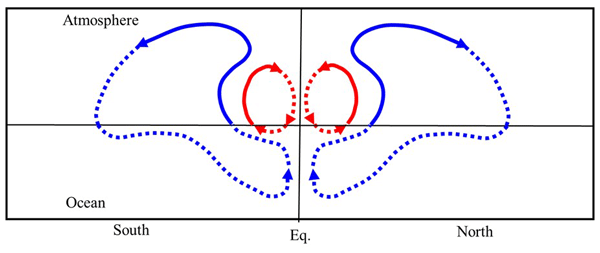
Textbooks describe the atmosphere’s north–south motion as closed circulation cells. This study shows that the water cycle also drives a subtle one-way flow of air, moving it from the humidified subtropics toward regions dried by rain and condensation. This hidden transport helps explain gradients of inert gases and suggests that large-scale atmospheric circulation may be more open than commonly assumed.
Jesús Abril-Gago, Irene Tovar, Enrique Echeverría-Martín, Juana Andújar-Maqueda, Pablo Ortiz-Amezcua, Germán Cabrera-Carrillo, Penélope Serrano-Ortiz, Francisco Domingo, Lucas Alados-Arboledas, Andrew S. Kowalski, Enrique P. Sánchez-Cañete, and Juan Luis Guerrero-Rascado
Biogeosciences, 23, 2569–2581, https://doi.org/10.5194/bg-23-2569-2026, https://doi.org/10.5194/bg-23-2569-2026, 2026
Short summary
Short summary
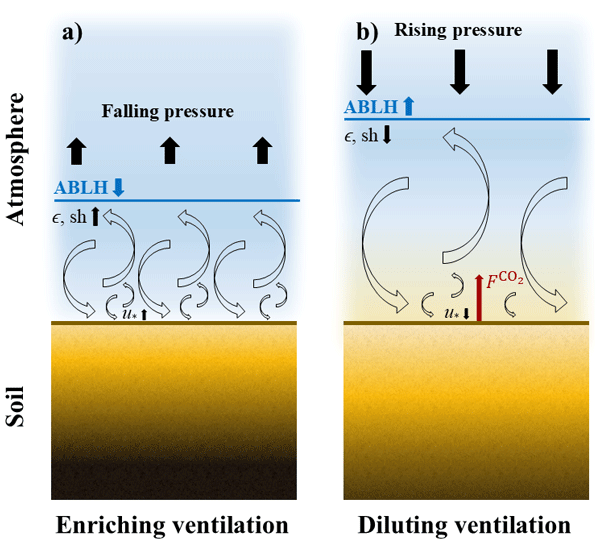
This study investigates non-biological soil CO2 ventilation in a semiarid Mediterranean shrubland and standardizes the criteria for its detection. Ten ventilation events were identified during the SCARCE (Synchronized Characterization of Aerosol, Radon and Carbon dioxide Exchanges in drylands) campaign, with several atmospheric parameters acting as drivers. Surface pressure emerged as the primary driver at the site, while friction velocity and boundary layer turbulence were also found to be relevant, highlighting the value of Doppler lidar for soil–atmosphere exchange studies.
Andrew S. Kowalski
EGUsphere, https://doi.org/10.5194/egusphere-2025-2814, https://doi.org/10.5194/egusphere-2025-2814, 2025
Preprint archived
Short summary
Short summary
This manuscript demonstrates that a mass-based (inertial) framework is essential to the correct definition of diffusive transport, and therefore for defining Ficks first law. It invalidates the molar-based framework used by Roderick and Shakespeare (2025) to identify the contribution of the Soret effect (mass transport due to a temperature gradient) to open-water evaporation.
Andrew S. Kowalski
Biogeosciences, 22, 785–789, https://doi.org/10.5194/bg-22-785-2025, https://doi.org/10.5194/bg-22-785-2025, 2025
Short summary
Short summary
The laws of physics show that leaf oxygen is not photosynthetically enriched but extremely dilute due to the overwhelming effects of humidification. This challenges the prevailing diffusion-only paradigm regarding leaf gas exchanges because non-diffusive transport is required. Such transport also explains why fluxes of carbon dioxide and water vapour become decoupled at very high temperatures, as has been observed but not explained by plant physiologists.
Sergio Aranda-Barranco, Penélope Serrano-Ortiz, Andrew S. Kowalski, and Enrique P. Sánchez-Cañete
SOIL, 11, 213–232, https://doi.org/10.5194/soil-11-213-2025, https://doi.org/10.5194/soil-11-213-2025, 2025
Short summary
Short summary
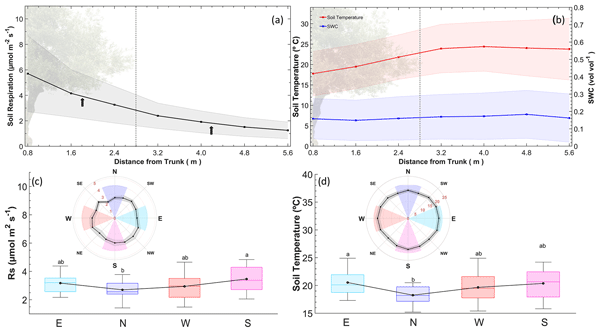
This study investigated soil respiration and the main factors involved in a semi-arid environment (olive grove). For this purpose, 1 year's worth of automatic multi-chamber measurements was used, accompanied by ecosystem respiration data obtained using the eddy covariance technique. The soil respiration annual balance, Q10 parameter, rain pulses, and spatial and temporal variability of soil respiration are presented in this paper.
Ihab Alfadhel, Ignacio Peralta-Maraver, Isabel Reche, Enrique P. Sánchez-Cañete, Sergio Aranda-Barranco, Eva Rodríguez-Velasco, Andrew S. Kowalski, and Penélope Serrano-Ortiz
Biogeosciences, 21, 5117–5129, https://doi.org/10.5194/bg-21-5117-2024, https://doi.org/10.5194/bg-21-5117-2024, 2024
Short summary
Short summary
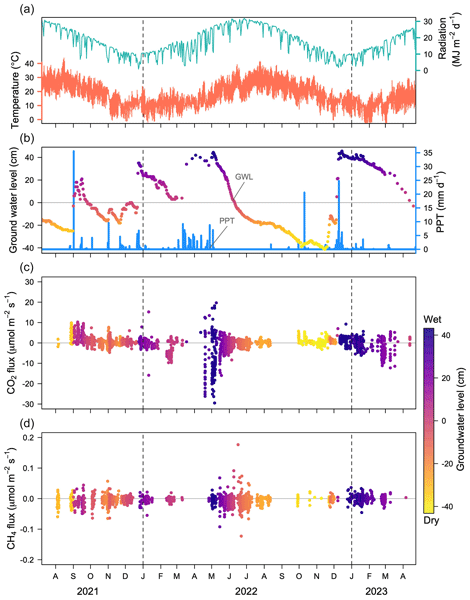
Inland saline lakes are crucial in the global carbon cycle, but increased droughts may alter their carbon exchange capacity. We measured CO2 and CH4 fluxes in a Mediterranean saline lake using the eddy covariance method under dry and wet conditions. We found the lake acts as a carbon sink during wet periods but not during droughts. These results highlight the importance of saline lakes in carbon sequestration and their vulnerability to climate-change-induced droughts.
Andrew S. Kowalski
Weather Clim. Dynam., 7, 1211–1217, https://doi.org/10.5194/wcd-7-1211-2026, https://doi.org/10.5194/wcd-7-1211-2026, 2026
Short summary
Short summary
Textbooks describe the atmosphere’s north–south motion as closed circulation cells. This study shows that the water cycle also drives a subtle one-way flow of air, moving it from the humidified subtropics toward regions dried by rain and condensation. This hidden transport helps explain gradients of inert gases and suggests that large-scale atmospheric circulation may be more open than commonly assumed.
Jesús Abril-Gago, Irene Tovar, Enrique Echeverría-Martín, Juana Andújar-Maqueda, Pablo Ortiz-Amezcua, Germán Cabrera-Carrillo, Penélope Serrano-Ortiz, Francisco Domingo, Lucas Alados-Arboledas, Andrew S. Kowalski, Enrique P. Sánchez-Cañete, and Juan Luis Guerrero-Rascado
Biogeosciences, 23, 2569–2581, https://doi.org/10.5194/bg-23-2569-2026, https://doi.org/10.5194/bg-23-2569-2026, 2026
Short summary
Short summary
This study investigates non-biological soil CO2 ventilation in a semiarid Mediterranean shrubland and standardizes the criteria for its detection. Ten ventilation events were identified during the SCARCE (Synchronized Characterization of Aerosol, Radon and Carbon dioxide Exchanges in drylands) campaign, with several atmospheric parameters acting as drivers. Surface pressure emerged as the primary driver at the site, while friction velocity and boundary layer turbulence were also found to be relevant, highlighting the value of Doppler lidar for soil–atmosphere exchange studies.
Anne L. van Poecke, Laëtitia Bréchet, Clément Stahl, Giacomo Sellan, Lore T. Verryckt, Leandro Van Langenhove, Jordi Sardans, Josep Peñuelas, Andreas Richter, Maarten Op de Beeck, Gabriëlle Hoogsteyns, Benoit Burban, and Ivan A. Janssens
EGUsphere, https://doi.org/10.5194/egusphere-2026-682, https://doi.org/10.5194/egusphere-2026-682, 2026
Preprint archived
Short summary
Short summary
In the Amazon rainforest, long-term fertilisation stimulated the forest canopy to produce more leaves, reducing light availability for young trees. There was no overall increase in volume or improved photosynthesis for young trees. However, increased nutrients combined with lower light availability led to shade adaptations, such as taller stems and thinner leaves. Increases in foliar nutrients varied among species, potentially altering the long-term selection of trees that will grow into adults.
Laëtitia M. Bréchet, Mercedes Ibáñez, Robert B. Jackson, Benoît Burban, Clément Stahl, Damien Bonal, and Ivan A. Janssens
Biogeosciences, 22, 8031–8046, https://doi.org/10.5194/bg-22-8031-2025, https://doi.org/10.5194/bg-22-8031-2025, 2025
Short summary
Short summary
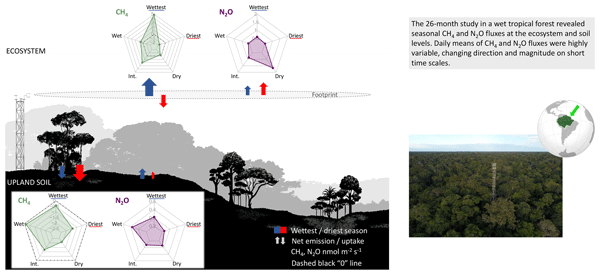
Net ecosystem and soil fluxes of the greenhouse gases methane (CH4) and nitrous oxide (N2O) were measured in a wet tropical forest. The measurements covered a 26-month period including contrasting seasons. The forest absorbed CH4 during the driest season, and emitted it during the wettest season, while consistently emitting N2O. The studied upland soils consistently absorb CH4 but emit N2O. Statistical models identified soil water content as one of the key drivers of these greenhouse gas fluxes.
Andrew S. Kowalski
EGUsphere, https://doi.org/10.5194/egusphere-2025-2814, https://doi.org/10.5194/egusphere-2025-2814, 2025
Preprint archived
Short summary
Short summary
This manuscript demonstrates that a mass-based (inertial) framework is essential to the correct definition of diffusive transport, and therefore for defining Ficks first law. It invalidates the molar-based framework used by Roderick and Shakespeare (2025) to identify the contribution of the Soret effect (mass transport due to a temperature gradient) to open-water evaporation.
Andrew S. Kowalski
Biogeosciences, 22, 785–789, https://doi.org/10.5194/bg-22-785-2025, https://doi.org/10.5194/bg-22-785-2025, 2025
Short summary
Short summary
The laws of physics show that leaf oxygen is not photosynthetically enriched but extremely dilute due to the overwhelming effects of humidification. This challenges the prevailing diffusion-only paradigm regarding leaf gas exchanges because non-diffusive transport is required. Such transport also explains why fluxes of carbon dioxide and water vapour become decoupled at very high temperatures, as has been observed but not explained by plant physiologists.
Sergio Aranda-Barranco, Penélope Serrano-Ortiz, Andrew S. Kowalski, and Enrique P. Sánchez-Cañete
SOIL, 11, 213–232, https://doi.org/10.5194/soil-11-213-2025, https://doi.org/10.5194/soil-11-213-2025, 2025
Short summary
Short summary
This study investigated soil respiration and the main factors involved in a semi-arid environment (olive grove). For this purpose, 1 year's worth of automatic multi-chamber measurements was used, accompanied by ecosystem respiration data obtained using the eddy covariance technique. The soil respiration annual balance, Q10 parameter, rain pulses, and spatial and temporal variability of soil respiration are presented in this paper.
Ihab Alfadhel, Ignacio Peralta-Maraver, Isabel Reche, Enrique P. Sánchez-Cañete, Sergio Aranda-Barranco, Eva Rodríguez-Velasco, Andrew S. Kowalski, and Penélope Serrano-Ortiz
Biogeosciences, 21, 5117–5129, https://doi.org/10.5194/bg-21-5117-2024, https://doi.org/10.5194/bg-21-5117-2024, 2024
Short summary
Short summary
Inland saline lakes are crucial in the global carbon cycle, but increased droughts may alter their carbon exchange capacity. We measured CO2 and CH4 fluxes in a Mediterranean saline lake using the eddy covariance method under dry and wet conditions. We found the lake acts as a carbon sink during wet periods but not during droughts. These results highlight the importance of saline lakes in carbon sequestration and their vulnerability to climate-change-induced droughts.
Jan De Pue, Sebastian Wieneke, Ana Bastos, José Miguel Barrios, Liyang Liu, Philippe Ciais, Alirio Arboleda, Rafiq Hamdi, Maral Maleki, Fabienne Maignan, Françoise Gellens-Meulenberghs, Ivan Janssens, and Manuela Balzarolo
Biogeosciences, 20, 4795–4818, https://doi.org/10.5194/bg-20-4795-2023, https://doi.org/10.5194/bg-20-4795-2023, 2023
Short summary
Short summary
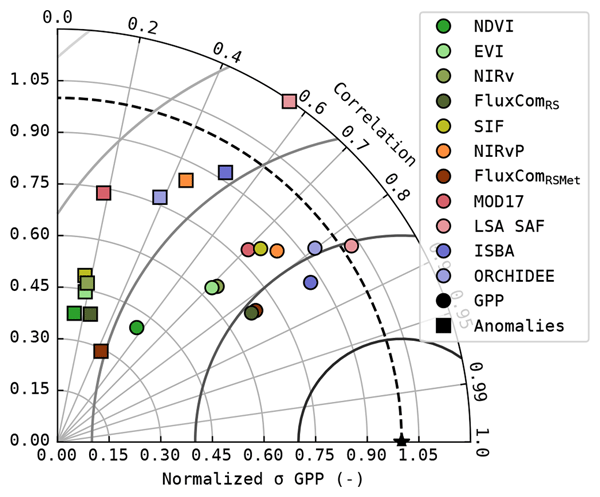
The gross primary production (GPP) of the terrestrial biosphere is a key source of variability in the global carbon cycle. To estimate this flux, models can rely on remote sensing data (RS-driven), meteorological data (meteo-driven) or a combination of both (hybrid). An intercomparison of 11 models demonstrated that RS-driven models lack the sensitivity to short-term anomalies. Conversely, the simulation of soil moisture dynamics and stress response remains a challenge in meteo-driven models.
Sinikka Jasmin Paulus, Tarek Sebastian El-Madany, René Orth, Anke Hildebrandt, Thomas Wutzler, Arnaud Carrara, Gerardo Moreno, Oscar Perez-Priego, Olaf Kolle, Markus Reichstein, and Mirco Migliavacca
Hydrol. Earth Syst. Sci., 26, 6263–6287, https://doi.org/10.5194/hess-26-6263-2022, https://doi.org/10.5194/hess-26-6263-2022, 2022
Short summary
Short summary
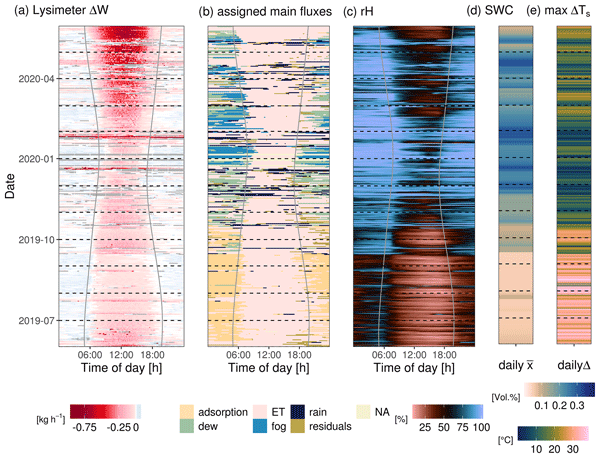
In this study, we analyze small inputs of water to ecosystems such as fog, dew, and adsorption of vapor. To measure them, we use a scaling system and later test our attribution of different water fluxes to weight changes. We found that they occur frequently during 1 year in a dry summer ecosystem. In each season, a different flux seems dominant, but they all mainly occur during the night. Therefore, they could be important for the biosphere because rain is unevenly distributed over the year.
Niel Verbrigghe, Niki I. W. Leblans, Bjarni D. Sigurdsson, Sara Vicca, Chao Fang, Lucia Fuchslueger, Jennifer L. Soong, James T. Weedon, Christopher Poeplau, Cristina Ariza-Carricondo, Michael Bahn, Bertrand Guenet, Per Gundersen, Gunnhildur E. Gunnarsdóttir, Thomas Kätterer, Zhanfeng Liu, Marja Maljanen, Sara Marañón-Jiménez, Kathiravan Meeran, Edda S. Oddsdóttir, Ivika Ostonen, Josep Peñuelas, Andreas Richter, Jordi Sardans, Páll Sigurðsson, Margaret S. Torn, Peter M. Van Bodegom, Erik Verbruggen, Tom W. N. Walker, Håkan Wallander, and Ivan A. Janssens
Biogeosciences, 19, 3381–3393, https://doi.org/10.5194/bg-19-3381-2022, https://doi.org/10.5194/bg-19-3381-2022, 2022
Short summary
Short summary
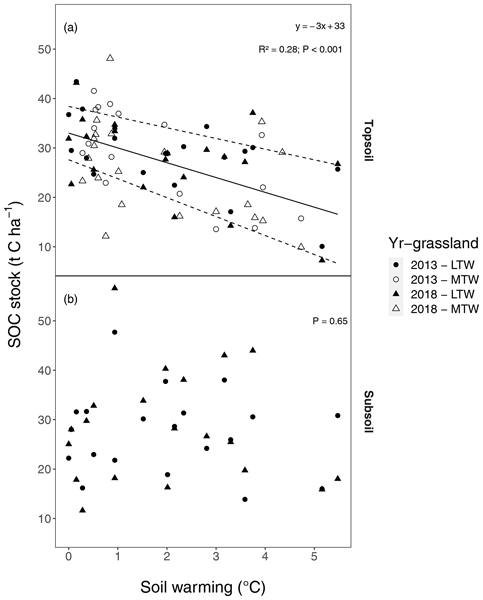
In subarctic grassland on a geothermal warming gradient, we found large reductions in topsoil carbon stocks, with carbon stocks linearly declining with warming intensity. Most importantly, however, we observed that soil carbon stocks stabilised within 5 years of warming and remained unaffected by warming thereafter, even after > 50 years of warming. Moreover, in contrast to the large topsoil carbon losses, subsoil carbon stocks remained unaffected after > 50 years of soil warming.

Melanie S. Verlinden, Hamada AbdElgawad, Arne Ven, Lore T. Verryckt, Sebastian Wieneke, Ivan A. Janssens, and Sara Vicca
Biogeosciences, 19, 2353–2364, https://doi.org/10.5194/bg-19-2353-2022, https://doi.org/10.5194/bg-19-2353-2022, 2022
Short summary
Short summary
Zea mays grows in mesocosms with different soil nutrition levels. At low phosphorus (P) availability, leaf physiological activity initially decreased strongly. P stress decreased over the season. Arbuscular mycorrhizal fungi (AMF) symbiosis increased over the season. AMF symbiosis is most likely responsible for gradual reduction in P stress.
Lore T. Verryckt, Sara Vicca, Leandro Van Langenhove, Clément Stahl, Dolores Asensio, Ifigenia Urbina, Romà Ogaya, Joan Llusià, Oriol Grau, Guille Peguero, Albert Gargallo-Garriga, Elodie A. Courtois, Olga Margalef, Miguel Portillo-Estrada, Philippe Ciais, Michael Obersteiner, Lucia Fuchslueger, Laynara F. Lugli, Pere-Roc Fernandez-Garberí, Helena Vallicrosa, Melanie Verlinden, Christian Ranits, Pieter Vermeir, Sabrina Coste, Erik Verbruggen, Laëtitia Bréchet, Jordi Sardans, Jérôme Chave, Josep Peñuelas, and Ivan A. Janssens
Earth Syst. Sci. Data, 14, 5–18, https://doi.org/10.5194/essd-14-5-2022, https://doi.org/10.5194/essd-14-5-2022, 2022
Short summary
Short summary
We provide a comprehensive dataset of vertical profiles of photosynthesis and important leaf traits, including leaf N and P concentrations, from two 3-year, large-scale nutrient addition experiments conducted in two tropical rainforests in French Guiana. These data present a unique source of information to further improve model representations of the roles of N and P, and other leaf nutrients, in photosynthesis in tropical forests.
Cited articles
Ahrens, C. D.: Essentials of Meteorology, Brooks/Cole, Australia, ISBN 10 0534372007, 2000.
Aparecido, L. M. T., Woo, S., Suazo, C., Hultine, K. R., and Blonder, B.: High water use in desert plants exposed to extreme heat, Ecol. Lett., 23, 1189–1200, https://doi.org/10.1111/ele.13516, 2020.
Aumont, O., Ethé, C., Tagliabue, A., Bopp, L., and Gehlen, M.: PISCES-v2: an ocean biogeochemical model for carbon and ecosystem studies, Geosci. Model Dev., 8, 2465–2513, https://doi.org/10.5194/gmd-8-2465-2015, 2015.
Bolton, D.: The computation of equivalent potential temperature, Monthly Weather Rev., 108, 1046–1053, 1980.
Bousquet, P., Ciais, P., Peylin, M., Ramonet, M., and Monfray, M.: Inverse modelling of annual atmospheric CO2 sources and sinks 1. Method and control inversion, J. Geophys. Res., 104, 26161–26178, 1999.
Buckley, T. N. and Sack, L.: The humidity inside leaves and why you should care: implications of unsaturation of leaf intercellular airspaces, Am. J. Bot., 106, 618–621, https://doi.org/10.1002/ajb2.1282, 2019.
Cowan, I. R. and Farquhar, G. D.: Stomatal function in relation to leaf metabolism and environment, Symp. Soc. Exp. Bio., 31, 471–505, 1977.
De Kauwe, M. G., Medlyn, B. E., Pitman, A. J., Drake, J. E., Ukkola, A., Griebel, A., Pendall, E., Prober, S., and Roderick, M.: Examining the evidence for decoupling between photosynthesis and transpiration during heat extremes, Biogeosciences, 16, 903–916, https://doi.org/10.5194/bg-16-903-2019, 2019.
Diao, H., Cernusak, L. A., Saurer, M., Gessler, A., Siegwolf, R. T. W., and Lehmann, M. M.: Uncoupling of stomatal conductance and photosynthesis at high temperatures: mechanistic insights from online stable isotope techniques, New Phytol., 241, 2366–2378, https://doi.org/10.1111/nph.19558, 2024.
Famiglietti, C. A., Fisher, J. B., Halverson, G., and Borbas, B.: Global validation of MODIS near-surface air and dewpoint temperatures, Geophys. Res. Lett., 45, 7772–7780, https://doi.org/10.1029/2018GL077813, 2018.
Gaastra, P. L.: Photosynthesis of crop plants as influenced by light, carbon dioxide, temperature and stomatal diffusion resistance, edited by: Veenman, H. and Zonen, N. V., doctoral thesis, Wageningen, Netherlands, , 1959.
Gale, J.: Availability of carbon dioxide for photosynthesis at high altitudes: theoretical considerations, Ecol., 149, 78–90, 1972.
Gruber, N., Gloor, M., Fan, S.-M., and Sarmiento, H. L.: Air-sea flux of oxygen estimated from bulk data: Implications For the marine and atmospheric oxygen cycles, Global Biogeochem. Cycles, 15, 783–803, https://doi.org/10.1029/2000GB001302, 2001.
Hersbach, H., Bell, B., Berrisford, P., Hirahara, S., Horányi, A., Muñoz-Sabater, J., Nicolas, J., Peubey, C., Radu, R., Schepers, D., Simmons, A., Soci, C., Abdalla, S., Abellan, X., Balsamo, G., Hechtold, P., Biavati, G., Bidlot, J., Bonavita, M., De Chiara, G., Dahlgren, P., Dee, D., Diamantakis, M., Dragani, R., Flemming, J., Forbes, R., Fuentes, M., Geer, A., Haimberger, L., Healy, S., Hogan, R. J., Hólm, E., Janisková, M., Keeley, S., Laloyaux, P., Lopez, P., Lupu, C., Radnoti, G., de Rosnay, P., Rozum, I., Vamborg, F., Villaume, S., and Thépaut, J.-N.: The ERA5 global reanalysis, Q. J. R. Meteorol. Soc., 146, 1999–2049, https://doi.org/10.1002/qj.3803, 2020.
Jarman, P. D.: The diffusion of carbon dioxide and water vapour through stomata, J. Exp. Bot., 25, 927–936, 1974.
Jones, H. G.: Plants and Microclimate, Cambridge University, Cambridge, UK, ISBN 10 0521279593, https://doi.org/10.1017/CBO9780511845727, 2014.
Keeley, J. E., Osmond, C. B., and Raven, J. A.: Stylites, a vascular land plant without stomata absorbs CO2 via its roots, Nature, 310, 695–695, 1984.
Keeling, R. F. and Shertz, S. R.: Seasonal and interannual variations in atmospheric oxygen and implications for the global carbon cycle, Nature, 358, 723–727, https://doi.org/10.1038/358723a0, 1992.
Keeling, R. F., Stephens, B. B., Najjar, R. G., Doney, S. C., Archer, D., and Heimann, M.: Seasonal variations in the atmospheric
Khalil, M. A. K., Rasmussen, R. A., and Shearer, M. J.: Atmospheric nitrous oxide: patterns of global change during recent decades and centuries, Chemosphere, 47, 807–821, https://doi.org/10.1016/S0045-6535(01)00297-1, 2002.
Knief, C.: Diversity of methane-cycling microorganisms in soils and their relation to oxygen, Curr. Issues Mol. Biol., 33, 23–56, https://doi.org/10.21775/cimb.033.023, 2019.
Kowalski, A. S.: The boundary condition for vertical velocity and its interdependence with surface gas exchange, Atmos. Chem. Phys., 17, 8177–8187, https://doi.org/10.5194/acp-17-8177-2017, 2017.
Kowalski, A. S.: An elucidatory model of oxygen's partial pressure inside substomatal cavities, Biogeosciences, 22, 785–789, https://doi.org/10.5194/bg-22-785-2025, 2025.
Kowalski, A. S. and García-Valdecasas Ojeda, M.: Humidity-determined distributions of surface oxygen, ESS Open Archive [preprint], https://doi.org/10.22541/essoar.174721854.49630082/v1, 2025.
Kowalski, A. S., Serrano-Ortiz, P., Miranda-García, G., and Fratini, G.: Disentangling turbulent gas diffusion from non-diffusive transport in the boundary layer, Bound.-Lay. Meteorol., 179, 347–367, https://doi.org/10.1007/s10546-021-00605-5, 2021.
Krich, C., Mahecha, M. D., Migliavacca, M., De Kauwe, M. G., Griebel, A., Runge, J., and Miralles, D. G.: Decoupling between ecosystem photosynthesis and transpiration: A last resort against overheating, Env. Res. Lett., 17, 044013, https://doi.org/10.1088/1748-9326/ac583e, 2022.
Lu, Y.: Global variations in oceanic evaporation (1958–2005): the role of the changing wind speed, J. Clim., 20, 5376–5390, https://doi.org/10.1175/2007JCLI1714.1, 2007.
Machta, L. and Hughes, E.: Atmospheric oxygen in 1967 to 1970, Science 168, 1582–1584, 1970.
Marchin, R., Medlyn, B. E., Tjoelker, M. G., and Ellsworth, D. S.: Decoupling between stomatal conductance and photosynthesis occurs under extreme heat in broadleaf tree species regardless of water access, Global Change Biol., 29, 6319–6335, https://doi.org/10.1111/gcb.16929, 2023.
Moss, D. N. and Rawlins, S. L.: Concentration of carbon dioxide inside leaves, Nature, 197, 1320–1321, 1963.
Novelli, P. C., Lang, P. M., Masarie, K. A., Hurst, D. F., Myers, R., and Elkins, J. W.: Molecular hydrogen in the troposphere: Global distribution and budget, J. Geophys. Res., 104, 30427–30444, https://doi.org/10.1029/1999JD900788, 1999.
Nuvolari, A.: The making of water vapour power technology: a study of technical change during the British industrial revolution, J. Econ. Hist., 66, 472–476, https://doi.org/10.1017/S0022050706220205, 2006.
Owen, J. M., Pincombe, J. R., and Rogers, R. H.: Source-sink flow inside a rotating cylindrical cavity, J. Fluid Mech., 155, 233–265, 1985.
Pérez-Priego, O., López-Ballesteros, A., Sánchez-Cañete, E.P., Serrano-Ortiz, P., Kutzbach, L., Domingo, F., Eugster, W., and Kowalski, A. S.: Analysing uncertainties in the calculation of fluxes using whole-plant chambers: random and systematic errors, Plant Soil, 393, 229–244, https://doi.org/10.1007/s11104-015-2481-x, 2015.
Petsch, S. T.: The global oxygen cycle, in: Treatise on Geochemistry Volume 8, edited by: Turekian, K. K. and Holland, H. D., Elsevier, Amsterdam, eBook ISBN 9780080548074, 2003.
Petty, G. W.: A first course in atmospheric thermodynamics, Sundog Publishing, Madison, USA, ISBN-10 0-9729033-2-1, 2008.
Portela, E., Kolodziejczyk, N., Gorgues, T., Zika, J., Perruche, C., and Mignot, A.: The ocean's meridional oxygen transport, J. Geophys. Res.-Oceans, 129, e2023JC020259, https://doi.org/10.1029/2023JC020259, 2024.
Prinn, R., Cunnold, D., Rasmussen, R., Simmonds, P., Alyea, F., Crawford, A., Fraser, R., and Rosen, R.: Atmospheric emissions and trends of nitrous oxide deduced from 10 years of ALE-GAGE data, J. Geophys. Res., 95, 18369–18385, 1990.
Raymond, C., Matthews, T., and Horton, R. M.: The emergence of heat and humidity too severe for human tolerance, Sci. Adv., 6, eaaw1838, https://doi.org/10.1126/sciadv.aaw1838, 2020.
Robeson, S. M. and Steyn, D. G.: Evaluation and comparison of statistical forecast models for daily maximum ozone concentrations, Atmos. Env., 24B, 303–312, 1990.
Scafaro, A. P., Posch, B. C., Evans, J. R., Farquhar, G. D., and Atkins, O. K.: Rubisco deactivation and chloroplast electron transport rates co-limit photo-synthesis above optimal leaf temperature in terrestrial plants, Nat. Commun., 14, 2820, https://doi.org/10.1038/s41467-023-38496-4, 2023.
Steele, L. P., Fraser, P. J., Rasmussen, R. A., Khalil, M. A. K., Conway, T. J., Crawford, A. J., Gammon, R. H., Masarie, K. A., and Thoning, K. W.: The global distribution of methane in the troposphere, J. Atmos. Chem., 5, 125–171, https://doi.org/10.1007/978-94-009-3909-7_21, 1987.
Sun, J., Lenschow, D. H., Mahrt, L., and Nappo, C.: The relationships among wind, horizontal pressure gradient, and turbulent momentum transport during CASES-99, J. Atmos. Sci., 70, 3397–3414, https://doi.org/10.1175/JAS-D-12-0233.1, 2013.
Tian, H., Lu, C., Ciaias, P., Michalak, A. M., Canadell, J. G., Saikawa, E., Huntzinger, D. N., Gurney, K. R., Sitch, S., Zhang, B., Yang, J., Bousquet, P., Bruhwiler, L., Chen, G., Dlugokencky, E., Friedlingstein, P., Melillo, J., Pan, S., Poulter, B., Prinn, R., Saunois, M., Schwalm, C. R., and Wofsy, S. C.: The terrestrial biosphere as a net source of greenhouse gases to the atmosphere, Nature, 531, 225–228, https://doi.org/10.1038/nature16946, 2016.
Tohjima, Y., Machida, T., Watai, T., Akama, I., Amari, T., and Moriwaki, Y.: Preparation of gravimetric standards for measurements of atmospheric oxygen and reevaluation of atmospheric oxygen concentration, Journal of Geophysical Research: Atmospheres, 110, D11302, https://doi.org/10.1029/2004JD005595, 2005.
von Caemmerer, S. and Farquhar, G. D.: Some relationships between the biochemistry of photosynthesis and the gas exchange of leaves, Planta, 153, 376–387, 1981.
Wallace, J. M. and Hobbs, P. V.: Atmospheric science: an introductory survey, Elsevier, Amsterdam, the Netherlands, ISBN 10 012732951X, 2006.
Editorial statement
This study presents a novel view on water vapour dynamics and the role it plays for atmospheric composition and transport mechanisms.
This study presents a novel view on water vapour dynamics and the role it plays for atmospheric...
Short summary
Humidification of air reduces the abundances of dry-air gas components such as oxygen, explaining why tropical humidity can be "stifling". This is overlooked due to the common expression of gas concentrations as fractions of dry air. Such neglect of water vapour also masks the key role of its sources and sinks in activating transport mechanisms of other gases. Humidity should be quantified whenever reporting gas concentrations.
Humidification of air reduces the abundances of dry-air gas components such as oxygen,...


Altmetrics
Final-revised paper
Preprint