
Articles | Volume 23, issue 7
https://doi.org/10.5194/bg-23-2277-2026
© Author(s) 2026. This work is distributed under
the Creative Commons Attribution 4.0 License.
the Creative Commons Attribution 4.0 License.
https://doi.org/10.5194/bg-23-2277-2026
© Author(s) 2026. This work is distributed under
the Creative Commons Attribution 4.0 License.
the Creative Commons Attribution 4.0 License.
Research article
| 
08 Apr 2026
Research article |
| 08 Apr 2026
| 08 Apr 2026
Modeling the impact of drainage on peatland CO2 and CH4 fluxes and its underlying drivers

Laboratoire des Sciences du Climat et de l'Environnement, IPSL, CEA-CNRS-UVSQ, Université Paris-Saclay, 91191 Gif sur Yvette, France
Philippe Ciais
Laboratoire des Sciences du Climat et de l'Environnement, IPSL, CEA-CNRS-UVSQ, Université Paris-Saclay, 91191 Gif sur Yvette, France
Thu Hang Nguyen
Laboratoire des Sciences du Climat et de l'Environnement, IPSL, CEA-CNRS-UVSQ, Université Paris-Saclay, 91191 Gif sur Yvette, France
Laboratoire des Sciences du Climat et de l'Environnement, IPSL, CEA-CNRS-UVSQ, Université Paris-Saclay, 91191 Gif sur Yvette, France
Chunjing Qiu
Research Center for Global Change and Ecological Forecasting, School of Ecological and Environmental Sciences, East China Normal University, Shanghai, China
Elodie Salmon
Laboratoire des Sciences du Climat et de l'Environnement, IPSL, CEA-CNRS-UVSQ, Université Paris-Saclay, 91191 Gif sur Yvette, France
Aram Kalhori
GFZ Helmholtz Centre for Geosciences, 14473, Potsdam, Germany
Christophe Guimbaud
Laboratoire de Physique et de Chimie de l'Environnement et de l'Espace, LPC2E, CNRS, OSUC, Univ Orleans, 45071 Orléans, France
Matthias Peichl
Department of Forest Ecology and Management, Swedish University of Agricultural Sciences, 90183 Umeå, Sweden
Joshua L. Ratcliffe
Department of Forest Ecology and Management, Swedish University of Agricultural Sciences, 90183 Umeå, Sweden
Unit for Field-Based Forest Research, Swedish University of Agricultural Sciences, 92291 Vindeln, Sweden
Koffi Dodji Noumonvi
Department of Forest Ecology and Management, Swedish University of Agricultural Sciences, 90183 Umeå, Sweden
Xuefei Li
Institute for Atmospheric and Earth System Research/Physics, Faculty of Science, University of Helsinki, 00014 Helsinki, Finland
Related authors
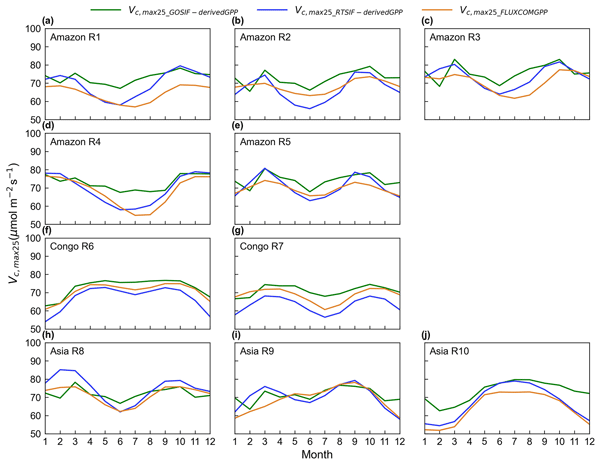
Xueqin Yang, Qingling Sun, Liusheng Han, Jie Tian, Wenping Yuan, Liyang Liu, Wei Zheng, Mei Wang, Yunpeng Wang, and Xiuzhi Chen
Earth Syst. Sci. Data, 17, 3293–3314, https://doi.org/10.5194/essd-17-3293-2025, https://doi.org/10.5194/essd-17-3293-2025, 2025
Short summary
Short summary
Understanding how leaves absorb carbon from the atmosphere is essential for predicting changes in global forests. Young leaves play a key role in this process, but their efficiency has been difficult to measure at large scales. Using satellite data, we developed a new method to track the seasonal patterns of young leaves’ photosynthetic capacity from 2001 to 2018. Our dataset helps scientists better understand forest growth and how ecosystems respond to climate change.
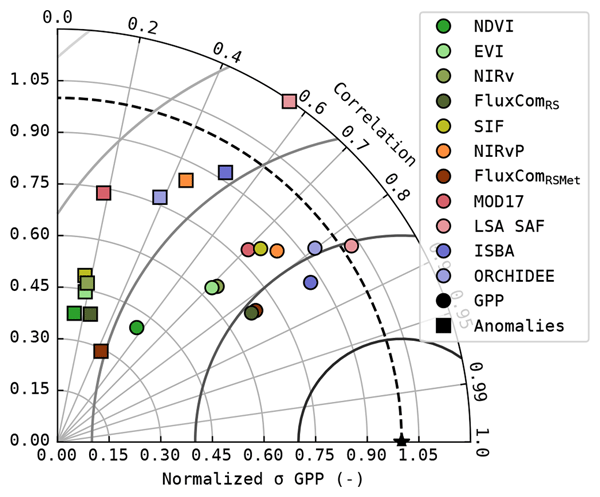
Jan De Pue, Sebastian Wieneke, Ana Bastos, José Miguel Barrios, Liyang Liu, Philippe Ciais, Alirio Arboleda, Rafiq Hamdi, Maral Maleki, Fabienne Maignan, Françoise Gellens-Meulenberghs, Ivan Janssens, and Manuela Balzarolo
Biogeosciences, 20, 4795–4818, https://doi.org/10.5194/bg-20-4795-2023, https://doi.org/10.5194/bg-20-4795-2023, 2023
Short summary
Short summary
The gross primary production (GPP) of the terrestrial biosphere is a key source of variability in the global carbon cycle. To estimate this flux, models can rely on remote sensing data (RS-driven), meteorological data (meteo-driven) or a combination of both (hybrid). An intercomparison of 11 models demonstrated that RS-driven models lack the sensitivity to short-term anomalies. Conversely, the simulation of soil moisture dynamics and stress response remains a challenge in meteo-driven models.
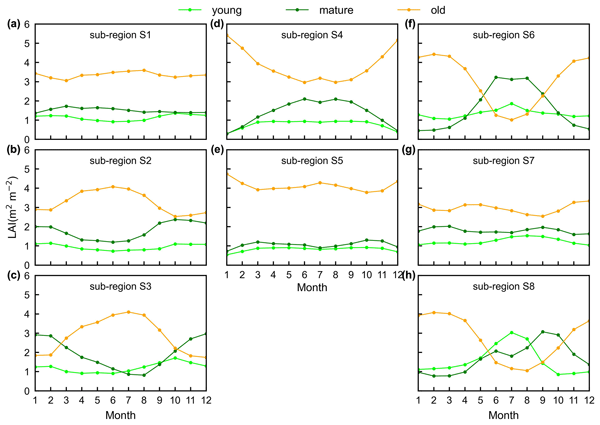
Xueqin Yang, Xiuzhi Chen, Jiashun Ren, Wenping Yuan, Liyang Liu, Juxiu Liu, Dexiang Chen, Yihua Xiao, Qinghai Song, Yanjun Du, Shengbiao Wu, Lei Fan, Xiaoai Dai, Yunpeng Wang, and Yongxian Su
Earth Syst. Sci. Data, 15, 2601–2622, https://doi.org/10.5194/essd-15-2601-2023, https://doi.org/10.5194/essd-15-2601-2023, 2023
Short summary
Short summary
We developed the first time-mapped, continental-scale gridded dataset of monthly leaf area index (LAI) in three leaf age cohorts (i.e., young, mature, and old) from 2001–2018 data (referred to as Lad-LAI). The seasonality of three LAI cohorts from the new Lad-LAI product agrees well at eight sites with very fine-scale collections of monthly LAI. The proposed satellite-based approaches can provide references for mapping finer spatiotemporal-resolution LAI products with different leaf age cohorts.
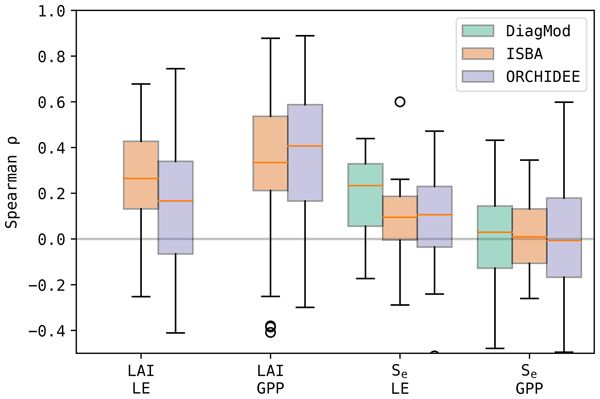
Jan De Pue, José Miguel Barrios, Liyang Liu, Philippe Ciais, Alirio Arboleda, Rafiq Hamdi, Manuela Balzarolo, Fabienne Maignan, and Françoise Gellens-Meulenberghs
Biogeosciences, 19, 4361–4386, https://doi.org/10.5194/bg-19-4361-2022, https://doi.org/10.5194/bg-19-4361-2022, 2022
Short summary
Short summary
The functioning of ecosystems involves numerous biophysical processes which interact with each other. Land surface models (LSMs) are used to describe these processes and form an essential component of climate models. In this paper, we evaluate the performance of three LSMs and their interactions with soil moisture and vegetation. Though we found room for improvement in the simulation of soil moisture and drought stress, the main cause of errors was related to the simulated growth of vegetation.
Chengcheng Huang, Wei He, Brendan Byrne, Ngoc Tu Nguyen, Jingfeng Xiao, Hua Yang, Philippe Ciais, Songhan Wang, Xing Li, Han Ma, Peipei Xu, Mengyao Zhao, Hui Chen, and Weimin Ju
Earth Syst. Sci. Data, 18, 7367–7390, https://doi.org/10.5194/essd-18-7367-2026, https://doi.org/10.5194/essd-18-7367-2026, 2026
Short summary
Short summary
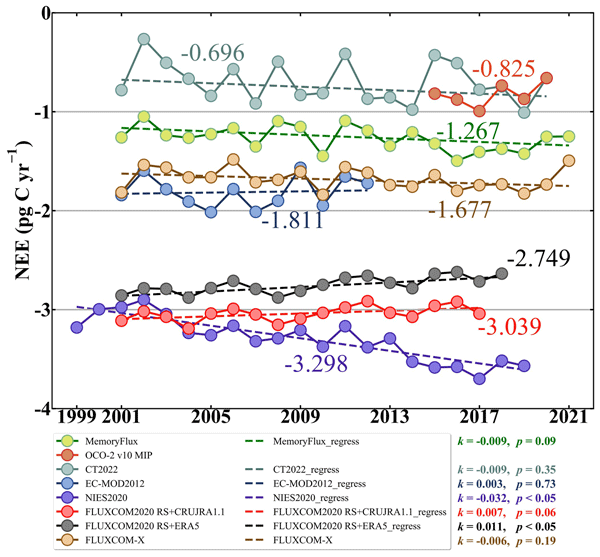
We created MemoryFlux, a new dataset that showed how ecosystems across North America absorbed and released carbon from 2001 to 2021. Using a deep-learning approach trained on historical climate and environmental conditions, we improved estimates of land carbon exchange and captured carbon anomalies associated with major droughts and floods. MemoryFlux provides a more reliable view of carbon cycling and improves our understanding of how ecosystems respond to a changing climate.
Lediane Marcon-Henge, Matthias Peichl, Eric Larmanou, and Alexander Graf
EGUsphere, https://doi.org/10.5194/egusphere-2026-5181, https://doi.org/10.5194/egusphere-2026-5181, 2026
This preprint is open for discussion and under review for Atmospheric Measurement Techniques (AMT).
Short summary
Short summary
Tall towers provide essential measurements of atmospheric carbon dioxide but are scarce. We tested whether a Virtual Tall Tower approach can estimate carbon dioxide at tall-tower heights from concentration and turbulence measurements near the surface. At Svartberget, Sweden, it performed well, although errors increased in early mornings. Good calibration and well-mixed meteorological conditions were essential, suggesting the approach could help expand atmospheric carbon dioxide observations.
Simon Scheiter, Jinfeng Chang, Philippe Ciais, Marie Dury, Louis Francois, Matthew Forrest, Alexandra Henrot, Christopher P. O. Reyer, Sonia Seneviratne, Jörg Steinkamp, Wim Thiery, Wenfang Xu, and Thomas Hickler
Biogeosciences, 23, 6409–6430, https://doi.org/10.5194/bg-23-6409-2026, https://doi.org/10.5194/bg-23-6409-2026, 2026
Short summary
Short summary
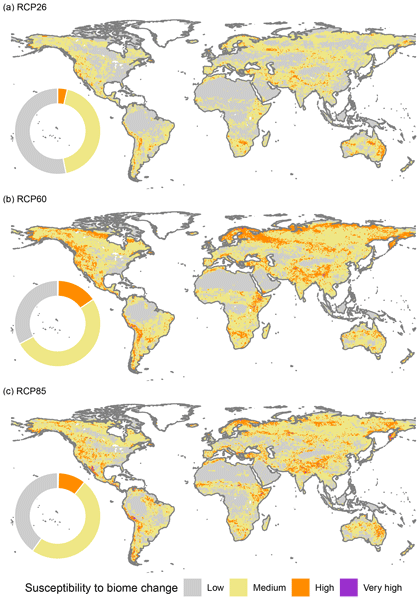
We show how climate change may reshape the world's major biomes, such as forests, grasslands, and tundra. Therefore, we combined dynamic vegetation models, machine learning and observation-based biome maps. We found that many biomes are likely to shift polewards as temperatures rise. Even under low-emission scenarios, large areas could change. These results help identify regions most susceptible to climate change and support global efforts to protect and manage natural ecosystems in the future.

Jiawei Jiang, Zhifeng Yan, Jinshi Jian, Jesper Riis Christiansen, Xinchu Wang, Ren-Min Yang, Zhen Zhang, and Philippe Ciais
Earth Syst. Sci. Data, 18, 6783–6797, https://doi.org/10.5194/essd-18-6783-2026, https://doi.org/10.5194/essd-18-6783-2026, 2026
Short summary
Short summary
Soil methane uptake represents the second-largest sink of atmospheric methane but the field observations have not yet been systematically compiled. Here, we compiled an open global soil methane uptake database from the 1980s, covering most regions in multi-timescale along with the soil moisture and temperature data. The data show strong seasonal changes and different controls across biomes, helping improve climate estimates, models, and satellite evaluations.
Karoliina Särkelä, Timo Vesala, Torben R. Christensen, Juval Cohen, Angelika Kübert, Xuefei Li, Hannu Marttila, Jouni Pulliainen, Eeva-Stiina Tuittila, and Efrén López-Blanco
Biogeosciences, 23, 6037–6052, https://doi.org/10.5194/bg-23-6037-2026, https://doi.org/10.5194/bg-23-6037-2026, 2026
Short summary
Short summary
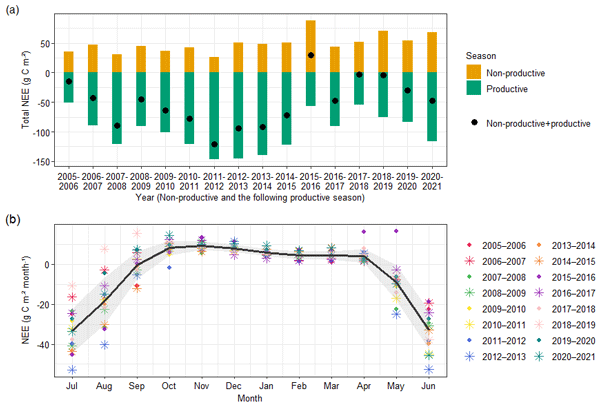
Using a 17-year record of year-round peatland carbon exchange, we found that over half of the carbon sequestrated during summer was released during winter. In one year, CO₂ emissions during snow melt and soil thaw in spring were large enough to shift the peatland from a net carbon sink to a source. These findings demonstrate that winter and early-spring processes have a strong impact over the annual carbon balance of northern peatlands.
Anna-Maria Virkkala, Isabel Wargowsky, Judith Vogt, McKenzie A. Kuhn, Simran Madaan, Tiffany Windholz, Kyle A. Arndt, Gerard Rocher-Ros, Mathias Göckede, David Olefeldt, Edward A. G. Schuur, David Bastviken, Richard O'Keefe, Brendan M. Rogers, Jennifer D. Watts, Kelcy Kent, Kristoffer Aalstad, Kelly Aho, Joonatan Ala-Könni, Haley Alcock, Inge Althuizen, Christopher D. Arp, Jun Asanuma, Mika Aurela, Sivakiruthika Balathandayuthabani, Katrin Attermeyer, Alan Barr, Maialen Barret, Ochirbat Batkhishig, Christina Biasi, Mats P. Björkman, Andrew Black, Elena Blanc-Betes, Pascal Bodmer, Julia Boike, Abdullah Bolek, Frédéric Bouchard, Ingeborg Bussmann, Lea Cabrol, Eleonora Canfora, Sean Carey, Karel Castro-Morales, Namyi Chae, Andreas Christen, Torben R. Christensen, Casper T. Christiansen, Housen Chu, Graham Clark, Francois Clayer, Patrick Crill, Christopher Cunada, Scott J. Davidson, Joshua F. Dean, Sigrid Dengel, Matteo Detto, Catherine Dieleman, Florent Domine, Egor Dyukarev, Colin Edgar, Bo Elberling, Craig A. Emmerton, Eugenie Euskirchen, Grant Falvo, Thomas Friborg, Michelle Garneau, Mariasilvia Giamberini, Mikhail V. Glagolev, Miquel A. Gonzalez-Meler, Gustaf Granath, Jón Guðmundsson, Konsta Happonen, Yoshinobu Harazono, Lorna Harris, Josh Hashemi, Nicholas Hasson, Janna Heerah, Liam Heffernan, Manuel Helbig, Warren Helgason, Michal Heliasz, Greg Henry, Geert Hensgens, Tetsuya Hiyama, Beth Holmes, Macall Hock, David Holl, Jutta Holst, Thomas Holst, Gabriel Hould-Gosselin, Elyn Humphreys, Jacqueline Hung, Jussi Huotari, Hiroki Ikawa, Danil V. Ilyasov, Mamoru Ishikawa, Go Iwahana, Hiroki Iwata, Marcin Antoni Jackowicz-Korczynski, Joachim Jansen, Järvi Järveoja, Vincent E. J. Jassey, Rasmus Jensen, Katharina Jentzsch, Robert G. Jespersen, Carl-Fredrik Johannesson, Cheristy P. Jones, Anders Jonsson, Ji Young Jung, Sari Juutinen, Evan Kane, Jan Karlsson, Sergey Karsanaev, Kuno Kasak, Julia Kelly, Kasha Kempton, Marcus Klaus, George W. Kling, Natascha Kljun, Jacqueline Knutson, Hideki Kobayashi, John Kochendorfer, Kukka-Maaria Kohonen, Pasi Kolari, Mika Korkiakoski, Aino Korrensalo, Pirkko Kortelainen, Egle Koster, Kajar Koster, Ayumi Kotani, Praveena Krishnan, Juliya Kurbatova, Lars Kutzbach, Min Jung Kwon, Ethan D. Kyzivat, Jessica Lagroix, Theodore Langhorst, Elena Lapshina, Tuula Larmola, Klaus S. Larsen, Isabelle Laurion, Justin Ledman, Hanna Lee, A. Joshua Leffler, Lance Lesack, Anders Lindroth, David Lipson, Annalea Lohila, Efrén López-Blanco, Vincent L. St. Louis, Erik Lundin, Miska Luoto, Takashi Machimura, Marta Magnani, Avni Malhotra, Marja Maljanen, Ivan Mammarella, Elisa Männistö, Luca Belelli Marchesini, Phil Marsh, Pertti J. Martikainen, Maija E. Marushchak, Mikhail Mastepanov, Alex Mavrovic, Trofim Maximov, Christina Minions, Daniel F. Nadeau, Marco Montemayor, Tomoaki Morishita, Patrick Murphy, Erin Nicholls, Mats B. Nilsson, Anastasia Niyazova, Jenni Nordén, Koffi Dodji Noumonvi, Hannu Nykänen, Walter Oechel, Anne Ojala, Tomohiro Okadera, Sujan Pal, Alexey V. Panov, Tim Papakyriakou, Dario Papale, Sang-Jong Park, Frans-Jan W. Parmentier, Gilberto Pastorello, Mike Peacock, Matthias Peichl, Roman Petrov, Kyra St. Pierre, Norbert Pirk, Jessica Plein, Vilmantas Preskienis, Anatoly Prokushkin, Jukka Pumpanen, Hilary A. Rains, Niklas Rakos, Aleksi Räsänen, Helena Rautakoski, Riikka Rinnan, Janne Rinne, Adrian Rocha, Nigel Roulet, Alexandre Roy, Anna Rutgersson, Aleksandr F. Sabrekov, Torsten Sachs, Erik Sahlée, Alejandro Salazar, Henrique Oliveira Sawakuchi, Christopher Schulze, Roger Seco, Armando Sepulveda-Jauregui, Svetlana Serikova, Abbey Serrone, Hanna M. Silvennoinen, Sofie Sjogersten, June Skeeter, Jo Snöälv, Sebastian Sobek, Oliver Sonnentag, Emily H. Stanley, Maria Strack, Lena Strom, Patrick Sullivan, Ryan Sullivan, Anna Sytiuk, Torbern Tagesson, Pierre Taillardat, Julie Talbot, Suzanne E. Tank, Mario Tenuta, Irina Terenteva, Frederic Thalasso, Antoine Thiboult, Halldor Thorgeirsson, Fenix Garcia Tigreros, Margaret Torn, Amy Townsend-Small, Claire Treat, Alain Tremblay, Carlo Trotta, Eeva-Stiina Tuittila, Merritt Turetsky, Masahito Ueyama, Muhammad Umair, Aki Vähä, Lona van Delden, Maarten van Hardenbroek, Andrej Varlagin, Ruth K. Varner, Tarmo Virtanen, Elena Veretennikova, Timo Vesala, Carolina Voigt, Jorien E. Vonk, Robert Wagner, Katey Walter Anthony, Qinxue Wang, Masataka Watanabe, Hailey Webb, Jeffrey M. Welker, Andreas Westergaard-Nielsen, Sebastian Westermann, Jeffrey R. White, Christian Wille, Scott N. Williamson, Scott Zolkos, Donatella Zona, and Susan M. Natali
Earth Syst. Sci. Data, 18, 6357–6409, https://doi.org/10.5194/essd-18-6357-2026, https://doi.org/10.5194/essd-18-6357-2026, 2026
Short summary
Short summary
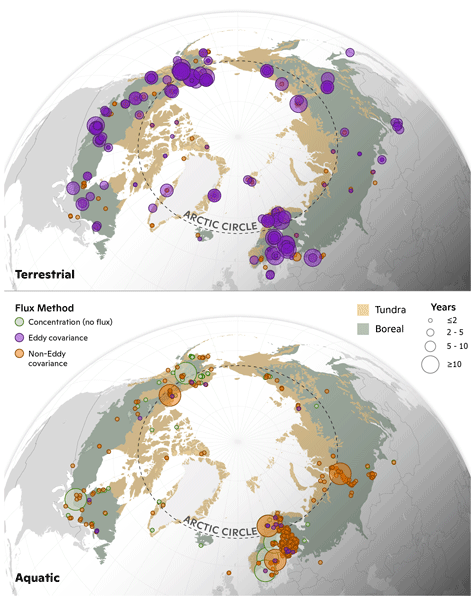
This dataset includes monthly measurements of carbon dioxide and methane exchange between land, water, and the atmosphere from over 1000 sites in Arctic and boreal regions. It combines measurements from a variety of ecosystems, including wetlands, forests, tundra, lakes, and rivers, gathered by over 260 researchers from 1984–2024. This dataset can be used to improve and reduce uncertainty in carbon budgets in order to strengthen our understanding of climate feedbacks in a warming world.
Xiaoying Shi, Daniel M. Ricciuto, Yaoping Wang, Joe R. Melton, Fortunat Joos, Yiqi Luo, Xiaofeng Xu, Dafeng Hui, Qianlai Zhuang, Chunjing Qiu, Hongxing He, Siya Shao, Xingjie Lu, Yongjiu Dai, Akihiko Ito, Qing Sun, Nitin Chaudhary, Ayesha Hussain, Mousong Wu, Jian Zhou, Jingwei Zhang, Ye Yuan, Rachael H. Turton, Eleanor J. Burke, Jiafu Mao, Yuefeng Hao, Natalie A. Griffiths, Verity Salmon, Paul J. Hanson, Melanie A. Mayes, and Peter E. Thornton
EGUsphere, https://doi.org/10.5194/egusphere-2026-5193, https://doi.org/10.5194/egusphere-2026-5193, 2026
This preprint is open for discussion and under review for Biogeosciences (BG).
Short summary
Short summary
Northern peatlands store vast amounts of carbon, but their response to climate change remains uncertain. We compared 15 ecosystem models with observations from a long-term warming and elevated carbon dioxide experiment in Minnesota. Models differed widely in their carbon responses, reflecting differences in ecosystem processes and model parameters. The results identify priorities for improving peatland models and projections of future carbon–climate feedbacks.
Thomas P. Roland, Matthew J. Amesbury, Jessica Royles, Howard Griffiths, Rewi M. Newnham, Andrew B. H. Rees, Joshua L. Ratcliffe, David I. Campbell, Elizabeth D. Keller, W. Troy Baisden, Max Berkelhammer, Marco Aquino-Lopez, and Dan J. Charman
EGUsphere, https://doi.org/10.5194/egusphere-2026-4962, https://doi.org/10.5194/egusphere-2026-4962, 2026
This preprint is open for discussion and under review for Climate of the Past (CP).
Short summary
Short summary
Restiad peatlands in Aotearoa New Zealand preserve geochemical records that may capture past changes in Southern Hemisphere atmospheric circulation. Sampling 13 peatlands, and two monthly across a year, we show that carbon isotopes in wire rush track temperature, while oxygen isotopes reflect the balance of internal root and shoot waters. In two peat cores, twentieth-century trends follow rising carbon dioxide rather than circulation change, indicating that pre-industrial records are needed.
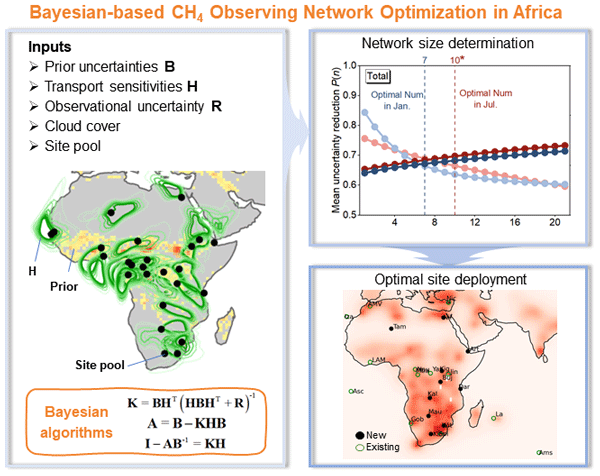
Hui Li, Philippe Ciais, Frédéric Chevallier, Bo Zheng, Paul I. Palmer, Frank Hase, Morgan Lopez, Elsa M. Ordway, Shushi Peng, Danielle Monteverde, Michel Ramonet, Jason M. St. Clair, Le Bienfaiteur Sagang, and Benjamin Poulter
Atmos. Chem. Phys., 26, 11893–11908, https://doi.org/10.5194/acp-26-11893-2026, https://doi.org/10.5194/acp-26-11893-2026, 2026
Short summary
Short summary
We studied how to best place methane monitoring instruments across Africa to better understand where emissions come from. Because observations can overlap in what they detect, adding more sites does not always improve results equally. Using a statistical approach, we identified both the ideal number and locations of sites (ten new sites can reduce emission uncertainty by over 65 % for total African CH4). Our results help guide cost-effective monitoring strategies in regions with limited data.
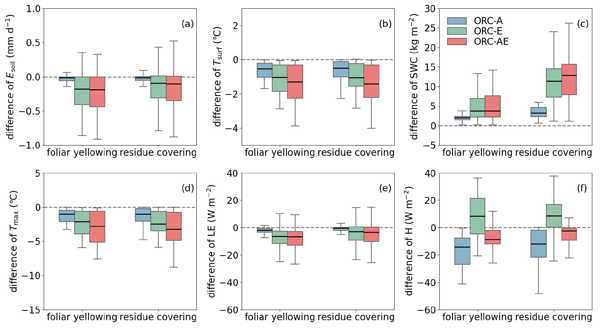
Ke Yu, Yang Su, Ronny Lauerwald, Philippe Ciais, Yi Xi, Haoran Xu, Xianglin Zhang, Nicolas Viovy, Amie Pickering, Marie Collard, and Daniel S. Goll
Geosci. Model Dev., 19, 7217–7237, https://doi.org/10.5194/gmd-19-7217-2026, https://doi.org/10.5194/gmd-19-7217-2026, 2026
Short summary
Short summary
Coupling crop and land surface models helps quantify the climate effects of agriculture, but lacks crop-specific management processes. We enhanced a land surface model with time-varying albedo from foliar yellowing and residue cover, improving the simulation of energy and water fluxes. Results show cooler surfaces and slightly wetter soils during residue cover, highlighting how managements improve climate mitigation and adaptation, advancing the development of climate-smart agriculture.
Sparkle L. Malone, Jaclyn H. Matthes, Cove S. Sturtevant, Angel Chen, Roisin Commane, Kyle B. Delwiche, Ankur R. Desai, Christopher R. Florian, Jonathan D. Gewirtzman, Samuel A. Jurado, David E. Reed, Jinshu Chi, Hiroki Iwata, Erik J. Lundin, Ivan Mammarella, Matthias Peichl, Masahito Ueyama, and Camilo Rey-Sanchez
Earth Syst. Sci. Data Discuss., https://doi.org/10.5194/essd-2026-413, https://doi.org/10.5194/essd-2026-413, 2026
Preprint under review for ESSD
Short summary
Short summary
We created the first continent-wide dataset to test the gradient flux method, which estimates how gases move between ecosystems and the atmosphere. This approach can provide reliable results when sensors are placed under favorable conditions, especially for shorter, less complex vegetation. The dataset will help improve future monitoring and support a better understanding of ecosystem responses to environmental change.
Man Chen, Philippe Ciais, Gustaf Hugelius, and Filipe Aires
Earth Syst. Sci. Data Discuss., https://doi.org/10.5194/essd-2026-254, https://doi.org/10.5194/essd-2026-254, 2026
Preprint under review for ESSD
Short summary
Short summary
Peatlands are vital carbon stores, yet mapping them consistently across borders is challenging due to varying data quality and definitions. We developed PeatCover, a ~90 m resolution map that harmonizes existing inventories with Earth observation and hydro-topographic data through machine learning. PeatCover provides a spatially coherent dataset that resolves fine landscape structures. These improvements enable refined carbon assessments and methane emission models.
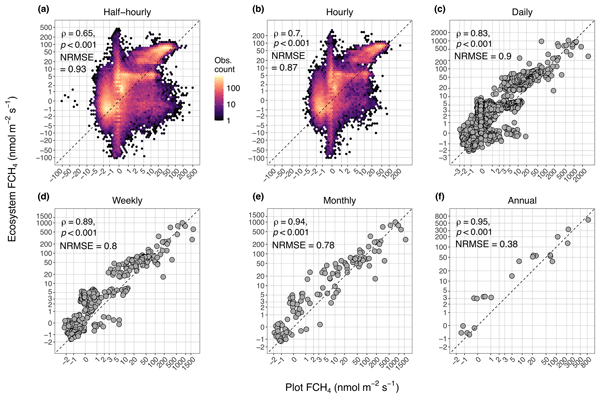
Tiia Määttä, Ankur R. Desai, Masahito Ueyama, Rodrigo Vargas, Eric J. Ward, Zhen Zhang, Gil Bohrer, Kyle Delwiche, Etienne Fluet-Chouinard, Järvi Järveoja, Sara H. Knox, Lulie Melling, Mats B. Nilsson, Matthias Peichl, Angela Che Ing Tang, Eeva-Stiina Tuittila, Jinsong Wang, Sheel Bansal, Sarah Feron, Manuel Helbig, Aino Korrensalo, Ken W. Krauss, Gavin McNicol, Shuli Niu, Zutao Ouyang, Kathleen Savage, Oliver Sonnentag, Robert Jackson, and Avni Malhotra
Biogeosciences, 23, 4379–4445, https://doi.org/10.5194/bg-23-4379-2026, https://doi.org/10.5194/bg-23-4379-2026, 2026
Short summary
Short summary
We compared ecosystem- and plot-scale methane fluxes across wetland and upland sites. Ecosystem-scale fluxes were higher than at plot scale, but differences were small. Vapor pressure deficit, atmospheric pressure, turbulence, and wind direction affected the differences. Both scales could be combined for improved methane flux estimates at coarser temporal scales.
Tim Stripp, Zhixuan Guo, Pierre Friedlingstein, Michael O’Sullivan, Stephen Sitch, Ana Bastos, Philippe Ciais, Jefferson Goncalves de Souza, Akihiko Ito, Wei Li, and Lei Ma
EGUsphere, https://doi.org/10.5194/egusphere-2026-3584, https://doi.org/10.5194/egusphere-2026-3584, 2026
This preprint is open for discussion and under review for Biogeosciences (BG).
Short summary
Short summary
Fire is a key process within the Earth system, yet it is often poorly represented in land carbon cycle models used to estimate how much carbon land ecosystems absorb from the atmosphere. We improved these models by applying long-term burned area data reconstructed from satellite observations. This reduced biases and uncertainty in fire carbon emission estimates and improved estimates of land carbon uptake, implying this method could enhance global and regional carbon budget estimates.
Nikola Besic, Philippe Ciais, Fa Li, Robert Jackson, Kunxiaojia Yuan, Shushi Peng, Benjamin Poulter, Zhen Zhang, and Qing Zhu
EGUsphere, https://doi.org/10.5194/egusphere-2026-2604, https://doi.org/10.5194/egusphere-2026-2604, 2026
This preprint is open for discussion and under review for Geoscientific Model Development (GMD).
Short summary
Short summary
Wetlands are the largest natural source of methane, an important greenhouse gas, but current estimates of their emissions remain highly uncertain because models often disagree. We combined field measurements from wetlands around the world with advanced statistical methods to identify where different models perform best. Our results show that accounting for regional differences in model skill can substantially change local methane estimates and potentially improve future climate assessments.
Rachel Nubwimana, Martin Brandt, Philippe Ciais, Maurice Mugabowindekwe, Sizhuo Li, Andrew Davies, Dimitri Gominski, Rasmus Fensholt, Sassan Saatchi, and Fabian Gieseke
EGUsphere, https://doi.org/10.5194/egusphere-2026-2924, https://doi.org/10.5194/egusphere-2026-2924, 2026
Short summary
Short summary
Trees outside forests; in savannas, farmlands, and drylands are largely invisible in global carbon maps. We developed a model that learns to spot trees in satellite photos and estimate how much carbon they store, trained only on rough existing maps without any manual labeling. Our maps turned out far more accurate than the maps it learned from, showing that smarter analysis of satellite imagery can reveal the hidden carbon stored in the world's overlooked trees.
Eyrún Gyða Gunnlaugsdóttir, Angelika Kübert, Xuefei Li, Timo Vesala, Aino Korrensalo, Elisa Männistö, Eeva-Stiina Tuittila, Pavel Alekseychik, and Ivan Mammarella
EGUsphere, https://doi.org/10.5194/egusphere-2026-3323, https://doi.org/10.5194/egusphere-2026-3323, 2026
Short summary
Short summary
We studied how two nearby peatland types exchange carbon with the atmosphere using long-term field measurements. We found that the fen absorbed more carbon dioxide but also released more methane than the bog, mainly due to differences in vegetation rather than climate. This suggests that plant communities strongly influence how peatlands affect climate and should be considered in future predictions, especially under changing environmental conditions and ecosystem shifts.
Jinan Shi, Jiaxin Li, Lianru Gao, Siyu Liu, Rasmus Fensholt, Philippe Ciais, Xiaojun Li, Qiangqiang Yuan, Jean-Pierre Wigneron, and Lei Fan
Earth Syst. Sci. Data Discuss., https://doi.org/10.5194/essd-2026-193, https://doi.org/10.5194/essd-2026-193, 2026
Revised manuscript under review for ESSD
Short summary
Short summary
Satellite microwaves help monitor global vegetation, but existing data is too coarse.We enhanced it using higher-resolution information from a biomass map. This produced monthly 5-kilometer resolution data of tropical vegetation optical depth from 2015 to 2021. Our results show the enhanced data accurately captures vegetation dynamics and detects forest disturbances like clearing. By providing this finer-scale dataset, our work supports better local monitoring and protection of ecosystems.
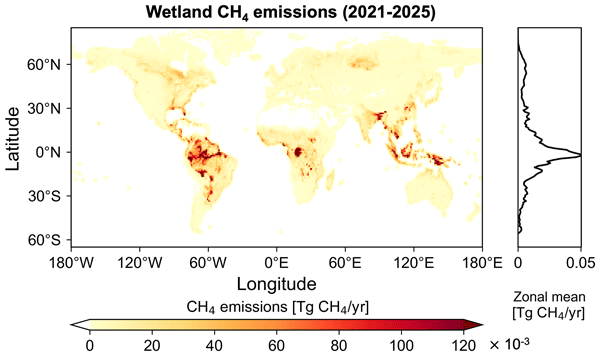
Mengze Li, Robert B. Jackson, Marielle Saunois, Philippe Ciais, Ben Poulter, Josep G. Canadell, Prabir K. Patra, Hanqin Tian, Zhen Zhang, Etienne Fluet-Chouinard, Zutao Ouyang, Ting Zhang, David J. Beerling, Dmitry A. Belikov, Philippe Bousquet, Danilo Custodio, Naveen Chandra, Xinyu Dou, Nicola Gedney, Peter O. Hopcroft, Alison M. Hoyt, Kazuhito Ichii, Akihito Ito, Atul K. Jain, Katherine Jensen, Fortunat Joos, Thomas Kleinen, Masayuki Kondo, Fa Li, Tingting Li, Xiangyu Liu, Shamil Maksyutov, Avni Malhotra, Adrien Martinez, Kyle McDonald, Joe R. Melton, Jurek Müller, Yosuke Niwa, Shufen Pan, Shushi Peng, Changhui Peng, Zhangcai Qin, Peter Raymond, William Riley, Arjo Segers, Rona L. Thompson, Aki Tsuruta, Yi Xi, Kunxiaojia Yuan, Wenxin Zhang, Bo Zheng, Qing Zhu, Qiuan Zhu, and Qianlai Zhuang
Earth Syst. Sci. Data, 18, 3507–3524, https://doi.org/10.5194/essd-18-3507-2026, https://doi.org/10.5194/essd-18-3507-2026, 2026
Short summary
Short summary
We proposed a framework that combines machine-learning and climate data to predict global natural vegetated wetland methane emissions for 2000–2025. We found that although total global emissions remained stable in the post-2020s, Northern Hemisphere emissions surged whilst tropical emissions fell. This approach allows us to rapidly monitor emissions and provides early warnings for climate impacts.
Pierre Friedlingstein, Michael O'Sullivan, Matthew W. Jones, Robbie M. Andrew, Dorothee C. E. Bakker, Judith Hauck, Peter Landschützer, Corinne Le Quéré, Hongmei Li, Ingrid T. Luijkx, Glen P. Peters, Wouter Peters, Julia Pongratz, Clemens Schwingshackl, Stephen Sitch, Josep G. Canadell, Philippe Ciais, Kjetil Aas, Simone R. Alin, Peter Anthoni, Leticia Barbero, Nicholas R. Bates, Nicolas Bellouin, Alice Benoit-Cattin, Carla F. Berghoff, Raffaele Bernardello, Laurent Bopp, Ida Bagus Mandhara Brasika, Matthew A. Chamberlain, Naveen Chandra, Frédéric Chevallier, Louise P. Chini, Nathan O. Collier, Thomas H. Colligan, Margot Cronin, Laique M. Djeutchouang, Xinyu Dou, Matt P. Enright, Kazutaka Enyo, Michael Erb, Wiley Evans, Richard A. Feely, Liang Feng, Daniel J. Ford, Adrianna Foster, Filippa Fransner, Thomas Gasser, Marion Gehlen, Thanos Gkritzalis, Jefferson Goncalves De Souza, Giacomo Grassi, Luke Gregor, Nicolas Gruber, Bertrand Guenet, Özgür Gürses, Kirsty Harrington, Ian Harris, Jens Heinke, George C. Hurtt, Yosuke Iida, Tatiana Ilyina, Akihiko Ito, Andrew R. Jacobson, Atul K. Jain, Tereza Jarníková, Annika Jersild, Fei Jiang, Steve D. Jones, Etsushi Kato, Ralph F. Keeling, Kees Klein Goldewijk, Jürgen Knauer, Yawen Kong, Jan Ivar Korsbakken, Charles Koven, Taro Kunimitsu, Xin Lan, Junjie Liu, Zhiqiang Liu, Zhu Liu, Claire Lo Monaco, Lei Ma, Gregg Marland, Patrick C. McGuire, Galen A. McKinley, Joe R. Melton, Natalie Monacci, Erwan Monier, Eric J. Morgan, David R. Munro, Jens D. Müller, Shin-Ichiro Nakaoka, Lorna R. Nayagam, Yosuke Niwa, Tobias Nutzel, Are Olsen, Abdirahman M. Omar, Naiqing Pan, Sudhanshu Pandey, Denis Pierrot, Zhangcai Qin, Pierre Regnier, Gregor Rehder, Laure Resplandy, Alizée Roobaert, Thais M. Rosan, Christian Rödenbeck, Jörg Schwinger, Ingunn Skjelvan, T. Luke Smallman, Victoria Spada, Mohanan G. Sreeush, Qing Sun, Adrienne J. Sutton, Colm Sweeney, Didier Swingedouw, Roland Séférian, Shintaro Takao, Hiroaki Tatebe, Hanqin Tian, Xiangjun Tian, Bronte Tilbrook, Hiroyuki Tsujino, Francesco Tubiello, Erik van Ooijen, Guido R. van der Werf, Sebastiaan J. van de Velde, Anthony P. Walker, Rik Wanninkhof, Xiaojuan Yang, Wenping Yuan, Xu Yue, and Jiye Zeng
Earth Syst. Sci. Data, 18, 3211–3288, https://doi.org/10.5194/essd-18-3211-2026, https://doi.org/10.5194/essd-18-3211-2026, 2026
Short summary
Short summary
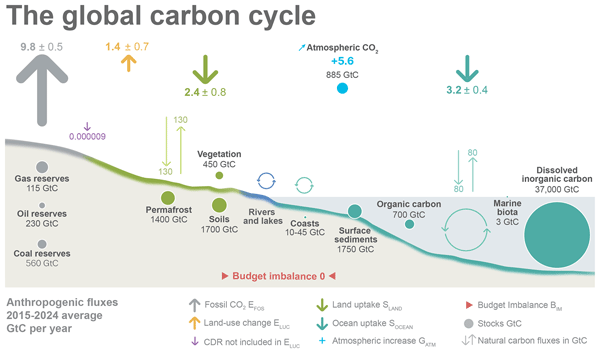
The Global Carbon Budget 2025 describes the methodology, main results, and datasets used to quantify the anthropogenic emissions of carbon dioxide (CO2) and their partitioning among the atmosphere, land ecosystems, and the ocean over the historical period (1750–2025). These living datasets are updated every year to provide the highest transparency and traceability in the reporting of CO2, the key driver of climate change.
Siqing Xu, Yves Balkanski, Philippe Ciais, and Jean Sciare
Atmos. Chem. Phys., 26, 6321–6350, https://doi.org/10.5194/acp-26-6321-2026, https://doi.org/10.5194/acp-26-6321-2026, 2026
Short summary
Short summary
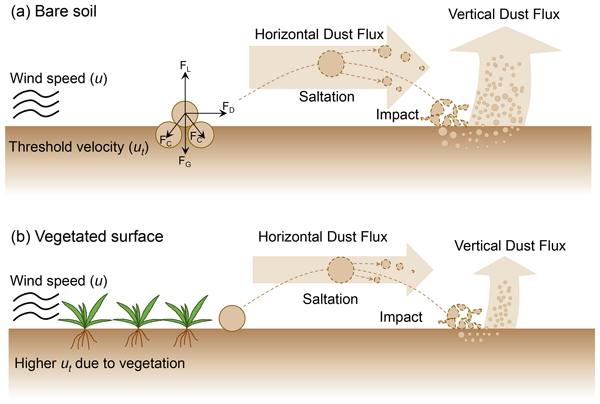
Uncertainty in dust emission estimates stems from simplified surface parameterizations. We incorporate dynamic vegetation cover into the dust emission scheme of an Earth System Model. Including vegetation reduces global dust emissions by 23 % and redistributes regional contributions by suppressing emissions in grass-covered dryland, improving agreement with observations of the global dust cycle. This work establishes a framework for advancing the representation of land–atmosphere feedbacks.
Guohua Liu, Philippe Ciais, Shengli Tao, Hui Yang, Chenwei Xiao, and Ana Bastos
Earth Syst. Sci. Data Discuss., https://doi.org/10.5194/essd-2026-246, https://doi.org/10.5194/essd-2026-246, 2026
Preprint under review for ESSD
Short summary
Short summary
We developed a long-term, moderate-resolution global dataset of forest above ground biomass, from satellite radar data and machine learning. The significance of this dataset lies in its ability to provide a continuous, moderate-resolution view of biomass carbon dynamics, offering a valuable resource for supporting studies of climate change, disturbance, and land use, and will help improve Earth System models and future carbon cycle.
Jincheng Wu, Philippe Ciais, Yuanyuan Huang, Jianing Fang, Pierre Gentine, Yidi Xu, Daniel Goll, Fayong Liu, Xiaomeng Du, Rui Ma, Nan Meng, Mengjie Han, Jinlong Zang, Runda Jiang, and Wei Li
EGUsphere, https://doi.org/10.5194/egusphere-2026-2241, https://doi.org/10.5194/egusphere-2026-2241, 2026
Short summary
Short summary
Predicting land carbon sinks remains a challenge because carbon allocation and turnover are poorly constrained in terrestrial biosphere models. We used a differentiable framework to jointly assimilate daily satellite data and long-term boreal forest growth trajectories. This approach significantly reduced biomass simulation errors. We found that boreal forests sustain biomass through long carbon residence times rather than high allocation rates, making them highly vulnerable to warming.
Liang Chen, Matthias Peichl, Yunpeng Luo, Peng Zhao, Alisa Krasnova, and Frank Berninger
EGUsphere, https://doi.org/10.5194/egusphere-2026-1940, https://doi.org/10.5194/egusphere-2026-1940, 2026
Short summary
Short summary
We conducted a 15-year study of a pine forest to check how nitrogen fertilization affacts forest photosynthsis under dry conditions. We compared two nearby sites by analyzing long-term measurements of carbon exchange. Our results showed that fertilization increased photosynthesis even during summer droughts. However, it also made the forest more sensitive to both dry air and dry soil conditions. Our study suggesuts that the benefits of fertilization may be offset by drought.
Olga Albot, Joshua Ratcliffe, Richard Levy, Sebastian Naeher, Daniel J. King, Catherine Ginnane, Jocelyn Turnbull, Mary Jill Ira Banta, Christopher Wood, Jenny Dahl, Jannine Cooper, and Andy Phillips
Biogeosciences, 23, 2155–2178, https://doi.org/10.5194/bg-23-2155-2026, https://doi.org/10.5194/bg-23-2155-2026, 2026
Short summary
Short summary
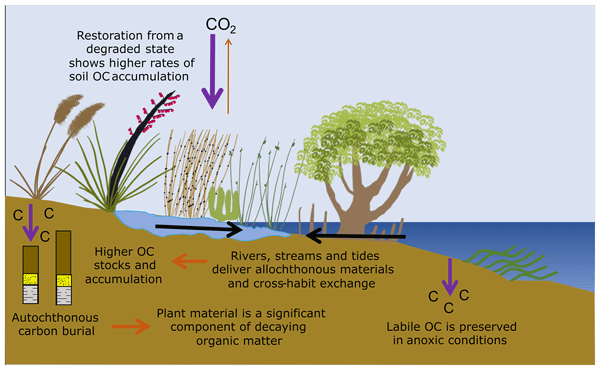
Saltmarshes store carbon in their soils, contributing to climate change mitigation. We analysed five sites across New Zealand and found that carbon storage and accumulation rates vary widely with geomorphic setting, land use history and sediment inputs. Plant material was a major source of carbon in the soil and has been preserved in basal sediments for several centuries. These results improve national blue carbon estimates and highlight the role of saltmarshes as natural climate solutions.
Ke Yu, Yang Su, Philippe Ciais, Ronny Lauerwald, David Makowski, Tianqi Shi, Shengbiao Wu, Petra Sieber, Chuanlong Zhou, and Daniel Goll
EGUsphere, https://doi.org/10.5194/egusphere-2026-219, https://doi.org/10.5194/egusphere-2026-219, 2026
Short summary
Short summary
Bare soil reflectance affects surface energy exchange in agricultural systems, but its field-scale variability is still poorly known. Using satellite observations and machine learning, we examined spatiotemporal variations of bare soil reflectance across European croplands. We show that it varies with soil properties, soil moisture, and observation geometry. These results suggest that dynamic soil reflectance should be taken into account in surface energy balance studies of agroecosystems.
Qinren Shi, Philippe Ciais, Nicolas Megel, Xavier Bonnemaizon, Rohith Teja Mittakola, Richard Engelen, and Chuanlong Zhou
Earth Syst. Sci. Data, 18, 927–944, https://doi.org/10.5194/essd-18-927-2026, https://doi.org/10.5194/essd-18-927-2026, 2026
Short summary
Short summary
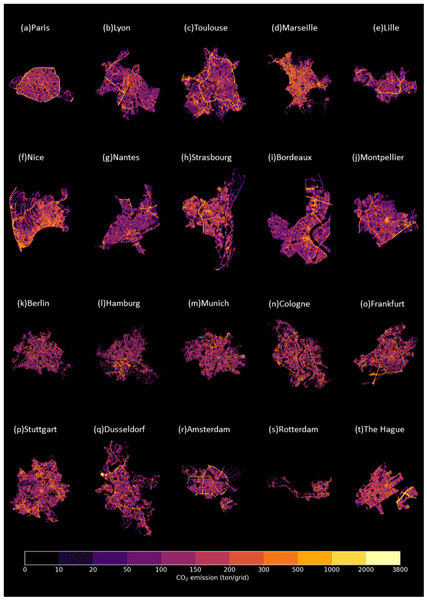
This study developed high-resolution maps (100 m × 100 m) showing how much carbon dioxide is emitted from cars and trucks in 20 European cities every hour. Using anonymous GPS signals from vehicles, we tracked traffic CO2 emission patterns throughout the year 2023. The results show that emissions vary significantly between cities and across different days and seasons. This method could help cities monitor on-road emissions in real time and design better strategies to reduce them.
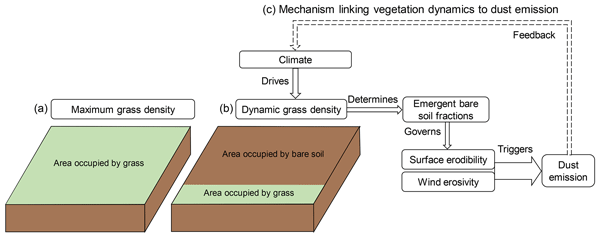
Siqing Xu, Sebastiaan Luyssaert, Yves Balkanski, Philippe Ciais, Nicolas Viovy, Liang Wan, and Jean Sciare
Geosci. Model Dev., 19, 1–25, https://doi.org/10.5194/gmd-19-1-2026, https://doi.org/10.5194/gmd-19-1-2026, 2026
Short summary
Short summary
Prescribing a fixed grassland density in the ORCHIDEE model limits its ability to capture grassland dynamics, leading to unrealistic mortality, especially in semi-arid grasslands. We proposed a dynamic density approach where a positive density-precipitation relationship emerges. This method improves spatial pattern, significantly reduces mortality, sustains productivity, and raises the aridity threshold above which frequent mortality events occur in grasslands.
Jean-Francois Lamarque, Pierre Friedlingstein, Brian Osias, Steve Strongin, Venkatramani Balaji, Kevin W. Bowman, Josep G. Canadell, Philippe Ciais, Heidi Cullen, Kenneth J. Davis, Scott C. Doney, Kevin R. Gurney, Alicia R. Karspeck, Charles D. Koven, Galen McKinley, Glen P. Peters, Julia Pongratz, Britt Stephens, and Colm Sweeney
EGUsphere, https://doi.org/10.5194/egusphere-2025-6457, https://doi.org/10.5194/egusphere-2025-6457, 2026
Short summary
Short summary
This Perspective highlights requirements to scale the carbon credit market and enable the growth in climate solutions funded through such market. The requirements are on the understanding of the value of the proposed carbon credit projects, and on the availability of a verification system. This verification becomes particularly relevant as the carbon credit market scales to significant impacts on CO2 (or other greenhouse gases), such that attribution to collective actions can be identified.
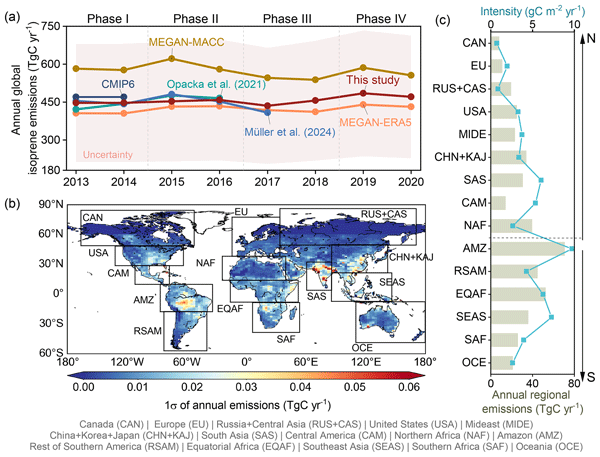
Hui Li, Philippe Ciais, Pramod Kumar, Didier A. Hauglustaine, Frédéric Chevallier, Grégoire Broquet, Dylan B. Millet, Kelley C. Wells, Jinghui Lian, and Bo Zheng
Earth Syst. Sci. Data, 17, 7035–7054, https://doi.org/10.5194/essd-17-7035-2025, https://doi.org/10.5194/essd-17-7035-2025, 2025
Short summary
Short summary
We present the first global, multi-year maps of monthly isoprene emissions (2013–2020) derived from satellite isoprene observations, averaging 456 TgC yr-1. The dataset reveals two emission peaks linked to 2015–2016 El Niño and 2019–2020 extreme heat events, driven mainly by tropical regions such as the Amazon. It highlights the region-specific sensitivity of biogenic isoprene emissions to temperature anomalies, providing new insights into their roles in air quality and climate feedbacks.
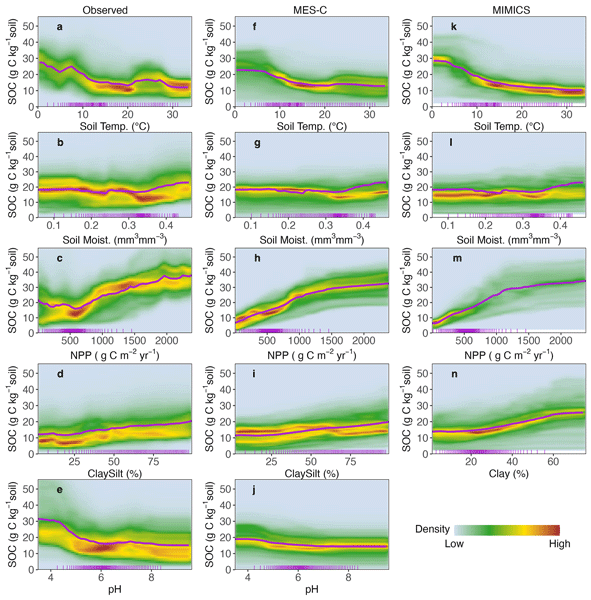
Lingfei Wang, Gab Abramowitz, Ying-Ping Wang, Andy Pitman, Philippe Ciais, and Daniel S. Goll
Biogeosciences, 22, 7845–7863, https://doi.org/10.5194/bg-22-7845-2025, https://doi.org/10.5194/bg-22-7845-2025, 2025
Short summary
Short summary
Accurate estimates of global soil organic carbon (SOC) content and its spatial pattern are critical for future climate change mitigation. However, the most advanced process-based SOC models struggle to do this task. Here we apply multiple explainable machine learning methods to identify missing variables and misrepresented relationships between environmental factors and SOC in these models, offering new insights to guide model development for more reliable SOC predictions.
Laura Bouillon, Valérie Gros, Morgan Lopez, Nicolas Bonnaire, Carole Philippon, Camille Yver Kwok, Leslie David, Olivier Perrussel, Olivier Sanchez, Simone Kotthaus, Jean-Eudes Petit, Philippe Ciais, and Michel Ramonet
Earth Syst. Sci. Data Discuss., https://doi.org/10.5194/essd-2025-602, https://doi.org/10.5194/essd-2025-602, 2025
Revised manuscript accepted for ESSD
Short summary
Short summary
The Saclay observatory, 20 km southwest of Paris, monitored greenhouse and reactive gases, as well as aerosols, over 10 years to assess the impact of urban emissions. By comparing downwind and background conditions, the study revealed significant reductions in pollutants linked to traffic: -35.6 % for CO, -52.3 % for NOₓ, -56.7 % for eBC, and -15 % for CO2. These trends align with emission decrease estimates from AIRPARIF inventories over the same period.
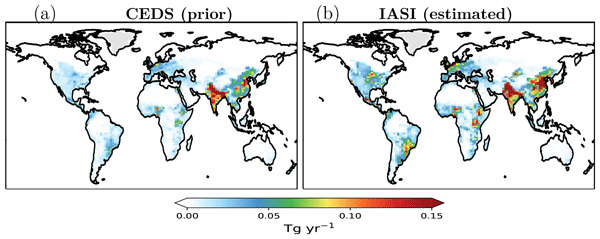
Pramod Kumar, Grégoire Broquet, Didier Hauglustaine, Maureen Beaudor, Lieven Clarisse, Martin Van Damme, Pierre Coheur, Anne Cozic, Bo Zheng, Beatriz Revilla Romero, Antony Delavois, and Philippe Ciais
Atmos. Chem. Phys., 25, 12379–12407, https://doi.org/10.5194/acp-25-12379-2025, https://doi.org/10.5194/acp-25-12379-2025, 2025
Short summary
Short summary
Global maps of the NH3 emissions over 2019–2022 are derived using IASI NH3 spaceborne observations, the LMDZ-INCA chemistry transport model at 1.27°×2.5° resolution, and the mass-balance approach. The average global NH3 emissions over the period are ~97 Tg NH3 yr-1, which is significantly higher than three reference inventories. The analysis provides confidence in the seasonal variability and regional budgets and provides new insights into NH3 emissions at global and regional scales.

Yi Xi, Philippe Ciais, Dan Zhu, Chunjing Qiu, Yuan Zhang, Shushi Peng, Gustaf Hugelius, Simon P. K. Bowring, Daniel S. Goll, and Ying-Ping Wang
Geosci. Model Dev., 18, 6043–6062, https://doi.org/10.5194/gmd-18-6043-2025, https://doi.org/10.5194/gmd-18-6043-2025, 2025
Short summary
Short summary
Including high-latitude deep carbon is critical for projecting future soil carbon emissions, yet it is absent in most land surface models. Here we propose a new carbon accumulation protocol by integrating deep carbon from Yedoma deposits and representing the observed history of peat carbon formation in ORCHIDEE-MICT. Our results show an additional 157 Pg C in present-day Yedoma deposits and a 1–5 m shallower peat depth and 43 % less passive soil carbon in peatlands compared to the conventional protocol.
Yang Su, Nikola Besic, Xianglin Zhang, Yidi Xu, Saverio Francini, Giovanni D'Amico, Gherardo Chirici, Martin Schwartz, Ibrahim Fayad, Sarah Brood, Agnes Pellissier-tanon, Ke Yu, Haotian Chen, Songchao Chen, Alexandre d'Aspremont, and Philippe Ciais
Earth Syst. Sci. Data Discuss., https://doi.org/10.5194/essd-2025-378, https://doi.org/10.5194/essd-2025-378, 2025
Manuscript not accepted for further review
Short summary
Short summary
We created the first long-term map of tree height in Italy, showing yearly changes from 2004 to 2024 at a 30-meter resolution. Using satellite images and laser data from both aircraft and space, we applied deep learning and statistical fusion to produce accurate estimates. This map helps reveal where forests have been disturbed and how they recover over time, offering a valuable tool to support forest protection and climate policy.
Lei Zhu, Philippe Ciais, Yitong Yao, Daniel Goll, Sebastiaan Luyssaert, Isabel Martínez Cano, Arthur Fendrich, Laurent Li, Hui Yang, Sassan Saatchi, Ricardo Dalagnol, and Wei Li
Geosci. Model Dev., 18, 4915–4933, https://doi.org/10.5194/gmd-18-4915-2025, https://doi.org/10.5194/gmd-18-4915-2025, 2025
Short summary
Short summary
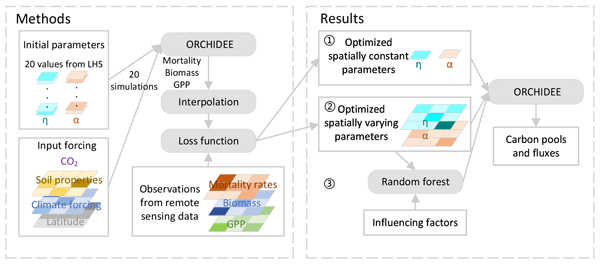
This study enhances the accuracy of modeling the carbon dynamics of the Amazon rainforest by optimizing key model parameters based on satellite data. Using spatially varying parameters for tree mortality and photosynthesis, we improved predictions of biomass, productivity, and tree mortality. Our findings highlight the critical role of wood density and water availability in forest processes, offering insights to use in refining global carbon cycle models.
Zhixuan Guo, Wei Li, Philippe Ciais, Stephen Sitch, Guido R. van der Werf, Simon P. K. Bowring, Ana Bastos, Florent Mouillot, Jiaying He, Minxuan Sun, Lei Zhu, Xiaomeng Du, Nan Wang, and Xiaomeng Huang
Earth Syst. Sci. Data, 17, 3599–3618, https://doi.org/10.5194/essd-17-3599-2025, https://doi.org/10.5194/essd-17-3599-2025, 2025
Short summary
Short summary
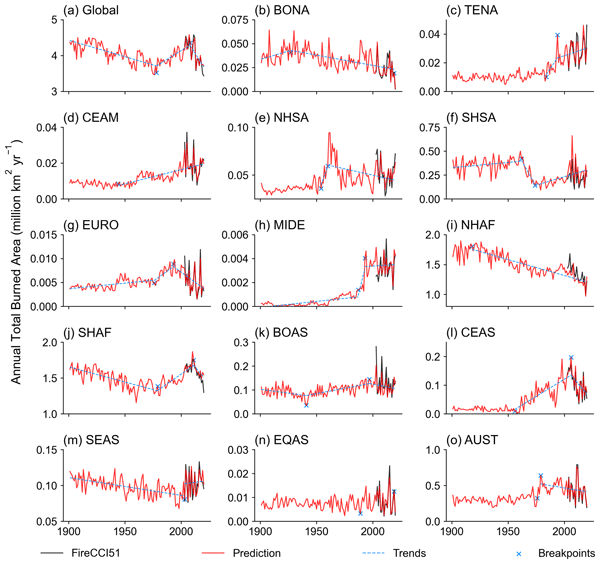
To address the limitations of short time spans in satellite data and spatiotemporal discontinuity in site records, we reconstructed global monthly burned area maps at a 0.5° resolution for 1901–2020 using machine learning models. The global burned area is predicted at 3.46 × 10⁶–4.58 × 10⁶ km² per year, showing a decline from 1901 to 1978, an increase from 1978 to 2008 and a sharper decrease from 2008 to 2020. This dataset provides a benchmark for studies on fire ecology and the carbon cycle.
Elodie Salmon, Bertrand Guenet, and Agnès Ducharne
EGUsphere, https://doi.org/10.5194/egusphere-2025-3511, https://doi.org/10.5194/egusphere-2025-3511, 2025
Short summary
Short summary
Soil organic carbon stockage is a key process to mitigate climate change and is intertwined with soil temperature and moisture and of other secondary soil properties. This study shows the significance of secondary drivers in the relationship between soil moisture and microbial efficiency in soil organic carbon degradation. Using empirical relationships in a global ecosystem model enhanced significantly the heterogeneous spatial pattern of soil organic carbon stock and carbon dioxide fluxes.
Adil Shah, Olivier Laurent, Pramod Kumar, Grégoire Broquet, Loïc Loigerot, Timothé Depelchin, Mathis Lozano, Camille Yver Kwok, Carole Philippon, Clément Romand, Elisa Allegrini, Matthieu Trombetti, and Philippe Ciais
Atmos. Meas. Tech., 18, 3425–3451, https://doi.org/10.5194/amt-18-3425-2025, https://doi.org/10.5194/amt-18-3425-2025, 2025
Short summary
Short summary
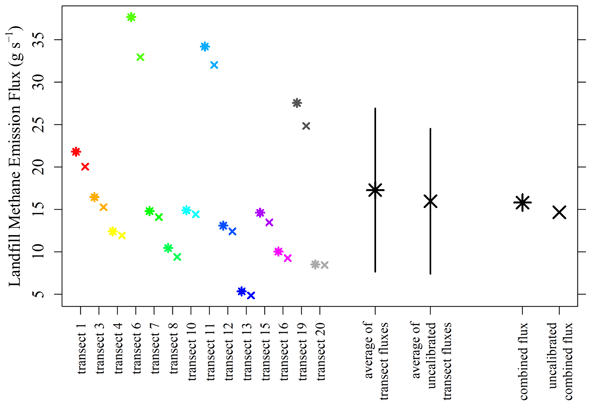
Acetylene mole fraction measurements from the Picarro G2203 were characterised. Abnormal sensor behaviour was observed in wet conditions. A dry linear calibration was derived, although this was invalid below 1.2 ppb due to unstable measurements. The instrument was used to measure acetylene as a methane tracer at a landfill site. Fluxes were derived from 14 downwind transects using both raw and calibrated acetylene mole fraction, with raw measurements resulting in 8 % flux underestimation.
Guohua Liu, Philippe Ciais, Shengli Tao, Hui Yang, and Ana Bastos
Earth Syst. Sci. Data Discuss., https://doi.org/10.5194/essd-2025-330, https://doi.org/10.5194/essd-2025-330, 2025
Manuscript not accepted for further review
Short summary
Short summary
We have developed a long-term and high-resolution global map of above-ground biomass changes from 1993 to 2020 using radar data and machine learning approach. This dataset can help understand the effects of disturbances, land-use changes, and extreme events on global carbon cycle, and enhance the representation of these processes in Earth System Models.
Chuanlong Zhou, Biqing Zhu, Antoine Halff, Steven J. Davis, Zhu Liu, Simon Bowring, Simon Ben Arous, and Philippe Ciais
Earth Syst. Sci. Data, 17, 3431–3446, https://doi.org/10.5194/essd-17-3431-2025, https://doi.org/10.5194/essd-17-3431-2025, 2025
Short summary
Short summary
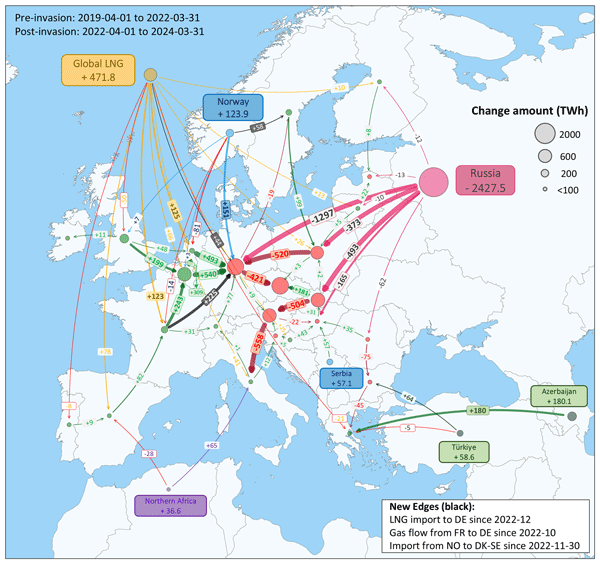
After Russia's 2022 invasion of Ukraine, Europe's energy dynamics shifted significantly. Our study introduces updated datasets tracking changes in natural gas supply, usage, and transmission within the EU27&UK. We discovered that Europe adapted to losing Russian gas by increasing LNG (liquefied natural gas) imports and shifting to renewables. Our insights could shape future energy policies and climate research.
Rimal Abeed, Audrey Fortems-Cheiney, Grégoire Broquet, Robin Plauchu, Isabelle Pison, Antoine Berchet, Elise Potier, Bo Zheng, Gaëlle Dufour, Adriana Coman, Dilek Savas, Guillaume Siour, Henk Eskes, Beatriz Revilla-Romero, Antony Delavois, and Philippe Ciais
EGUsphere, https://doi.org/10.5194/egusphere-2025-3329, https://doi.org/10.5194/egusphere-2025-3329, 2025
Preprint archived
Short summary
Short summary
We investigate changes in air pollution from nitrogen oxides NOx (=NO+NO2) across Eastern China from 2019 to 2021, using a satellite-based modelling approach. Our results show a drop in pollution in 2020 in most provinces, and along the China-Mongolia-Russia Economic Corridor. The analysis also captures emission variations during the Lunar New Year. By estimating emissions at the provincial level, the study provides insights into how major events and policy measures influence local air quality.
Xueqin Yang, Qingling Sun, Liusheng Han, Jie Tian, Wenping Yuan, Liyang Liu, Wei Zheng, Mei Wang, Yunpeng Wang, and Xiuzhi Chen
Earth Syst. Sci. Data, 17, 3293–3314, https://doi.org/10.5194/essd-17-3293-2025, https://doi.org/10.5194/essd-17-3293-2025, 2025
Short summary
Short summary
Understanding how leaves absorb carbon from the atmosphere is essential for predicting changes in global forests. Young leaves play a key role in this process, but their efficiency has been difficult to measure at large scales. Using satellite data, we developed a new method to track the seasonal patterns of young leaves’ photosynthetic capacity from 2001 to 2018. Our dataset helps scientists better understand forest growth and how ecosystems respond to climate change.
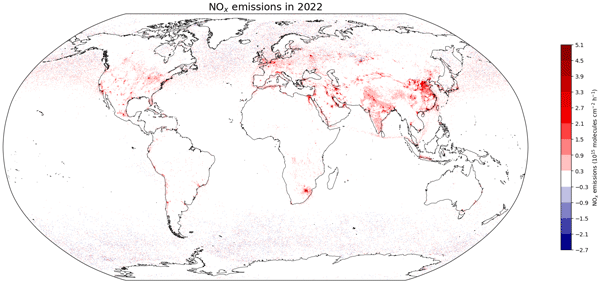
Anthony Rey-Pommier, Alexandre Héraud, Frédéric Chevallier, Philippe Ciais, Theodoros Christoudias, Jonilda Kushta, and Jean Sciare
Earth Syst. Sci. Data, 17, 3329–3351, https://doi.org/10.5194/essd-17-3329-2025, https://doi.org/10.5194/essd-17-3329-2025, 2025
Short summary
Short summary
In this study, we estimate emissions of nitrogen oxides (NOx) in 2022 at high resolution at the global scale, using satellite observations. We provide maps of the emissions and identify several types of sources. Our results are similar to the EDGAR emission inventory. However, differences are found in countries with lower observation densities and lower emissions.
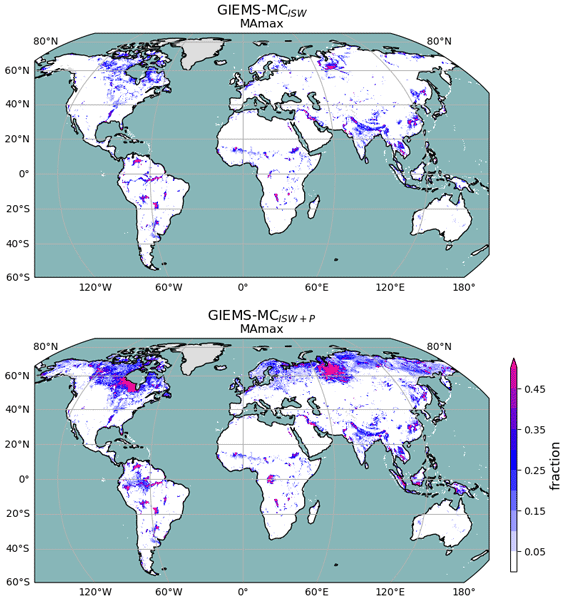
Juliette Bernard, Catherine Prigent, Carlos Jimenez, Etienne Fluet-Chouinard, Bernhard Lehner, Elodie Salmon, Philippe Ciais, Zhen Zhang, Shushi Peng, and Marielle Saunois
Earth Syst. Sci. Data, 17, 2985–3008, https://doi.org/10.5194/essd-17-2985-2025, https://doi.org/10.5194/essd-17-2985-2025, 2025
Short summary
Short summary
Wetlands are responsible for about a third of global emissions of methane, a potent greenhouse gas. We have developed the Global Inundation Extent from Multi-Satellites-MethaneCentric (GIEMS-MC) dataset to represent the dynamics of wetland extent on a global scale (0.25° × 0.25° resolution, monthly time step). This updated resource combines satellite data and existing wetland databases, covering 1992 to 2020. Consistent maps of other methane-emitting surface waters (lakes, rivers, reservoirs, rice paddies) are also provided.
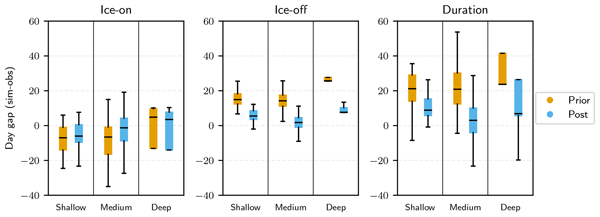
Zacharie Titus, Amélie Cuynet, Elodie Salmon, and Catherine Ottlé
The Cryosphere, 19, 2105–2114, https://doi.org/10.5194/tc-19-2105-2025, https://doi.org/10.5194/tc-19-2105-2025, 2025
Short summary
Short summary
The representation of lake ice dynamics is key to model water–atmosphere energy and mass transfers in cold environments. The use of albedo satellite products to constrain the modeling of ice coverage appears to be very suitable and valuable. In this work, we show how the modeling of lake albedo and ice phenology in the land surface model ORCHIDEE was improved by accounting for fractional ice cover calibrated against lake surface albedo data.
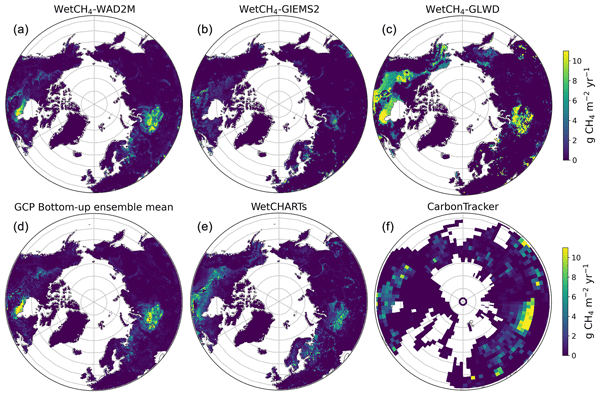
Qing Ying, Benjamin Poulter, Jennifer D. Watts, Kyle A. Arndt, Anna-Maria Virkkala, Lori Bruhwiler, Youmi Oh, Brendan M. Rogers, Susan M. Natali, Hilary Sullivan, Amanda Armstrong, Eric J. Ward, Luke D. Schiferl, Clayton D. Elder, Olli Peltola, Annett Bartsch, Ankur R. Desai, Eugénie Euskirchen, Mathias Göckede, Bernhard Lehner, Mats B. Nilsson, Matthias Peichl, Oliver Sonnentag, Eeva-Stiina Tuittila, Torsten Sachs, Aram Kalhori, Masahito Ueyama, and Zhen Zhang
Earth Syst. Sci. Data, 17, 2507–2534, https://doi.org/10.5194/essd-17-2507-2025, https://doi.org/10.5194/essd-17-2507-2025, 2025
Short summary
Short summary
We present daily methane (CH4) fluxes of northern wetlands at 10 km resolution during 2016–2022 (WetCH4) derived from a novel machine learning framework. We estimated an average annual CH4 emission of 22.8 ± 2.4 Tg CH4 yr−1 (15.7–51.6 Tg CH4 yr−1). Emissions were intensified in 2016, 2020, and 2022, with the largest interannual variation coming from Western Siberia. Continued, all-season tower observations and improved soil moisture products are needed for future improvement of CH4 upscaling.
Minna Ma, Haicheng Zhang, Ronny Lauerwald, Philippe Ciais, and Pierre Regnier
Earth Syst. Dynam., 16, 841–867, https://doi.org/10.5194/esd-16-841-2025, https://doi.org/10.5194/esd-16-841-2025, 2025
Short summary
Short summary
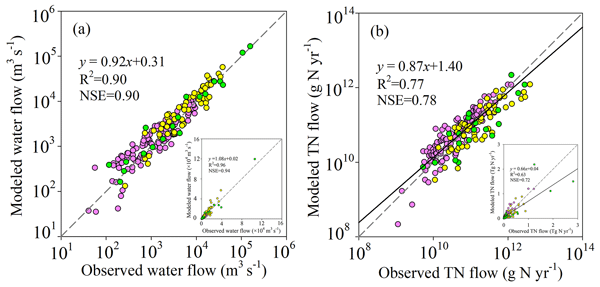
A new offline model (LSM_Nlateral_Off) was developed to simulate the lateral transfer of nitrogen from land to oceans through the river network, incorporating the decomposition of DON (dissolved organic N) and PON (particulate organic N) and denitrification of DIN (dissolved inorganic N) during fluvial transport. Evaluations using observational data indicate that the model reproduces observed rates and seasonal variations in water discharge and N flow well.
Marielle Saunois, Adrien Martinez, Benjamin Poulter, Zhen Zhang, Peter A. Raymond, Pierre Regnier, Josep G. Canadell, Robert B. Jackson, Prabir K. Patra, Philippe Bousquet, Philippe Ciais, Edward J. Dlugokencky, Xin Lan, George H. Allen, David Bastviken, David J. Beerling, Dmitry A. Belikov, Donald R. Blake, Simona Castaldi, Monica Crippa, Bridget R. Deemer, Fraser Dennison, Giuseppe Etiope, Nicola Gedney, Lena Höglund-Isaksson, Meredith A. Holgerson, Peter O. Hopcroft, Gustaf Hugelius, Akihiko Ito, Atul K. Jain, Rajesh Janardanan, Matthew S. Johnson, Thomas Kleinen, Paul B. Krummel, Ronny Lauerwald, Tingting Li, Xiangyu Liu, Kyle C. McDonald, Joe R. Melton, Jens Mühle, Jurek Müller, Fabiola Murguia-Flores, Yosuke Niwa, Sergio Noce, Shufen Pan, Robert J. Parker, Changhui Peng, Michel Ramonet, William J. Riley, Gerard Rocher-Ros, Judith A. Rosentreter, Motoki Sasakawa, Arjo Segers, Steven J. Smith, Emily H. Stanley, Joël Thanwerdas, Hanqin Tian, Aki Tsuruta, Francesco N. Tubiello, Thomas S. Weber, Guido R. van der Werf, Douglas E. J. Worthy, Yi Xi, Yukio Yoshida, Wenxin Zhang, Bo Zheng, Qing Zhu, Qiuan Zhu, and Qianlai Zhuang
Earth Syst. Sci. Data, 17, 1873–1958, https://doi.org/10.5194/essd-17-1873-2025, https://doi.org/10.5194/essd-17-1873-2025, 2025
Short summary
Short summary
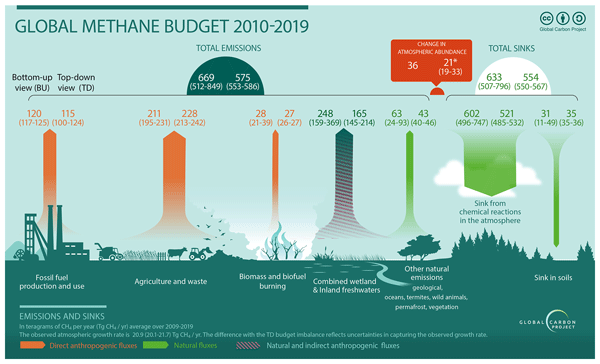
Methane (CH4) is the second most important human-influenced greenhouse gas in terms of climate forcing after carbon dioxide (CO2). A consortium of multi-disciplinary scientists synthesise and update the budget of the sources and sinks of CH4. This edition benefits from important progress in estimating emissions from lakes and ponds, reservoirs, and streams and rivers. For the 2010s decade, global CH4 emissions are estimated at 575 Tg CH4 yr-1, including ~65 % from anthropogenic sources.
Zhu Deng, Philippe Ciais, Liting Hu, Adrien Martinez, Marielle Saunois, Rona L. Thompson, Kushal Tibrewal, Wouter Peters, Brendan Byrne, Giacomo Grassi, Paul I. Palmer, Ingrid T. Luijkx, Zhu Liu, Junjie Liu, Xuekun Fang, Tengjiao Wang, Hanqin Tian, Katsumasa Tanaka, Ana Bastos, Stephen Sitch, Benjamin Poulter, Clément Albergel, Aki Tsuruta, Shamil Maksyutov, Rajesh Janardanan, Yosuke Niwa, Bo Zheng, Joël Thanwerdas, Dmitry Belikov, Arjo Segers, and Frédéric Chevallier
Earth Syst. Sci. Data, 17, 1121–1152, https://doi.org/10.5194/essd-17-1121-2025, https://doi.org/10.5194/essd-17-1121-2025, 2025
Short summary
Short summary
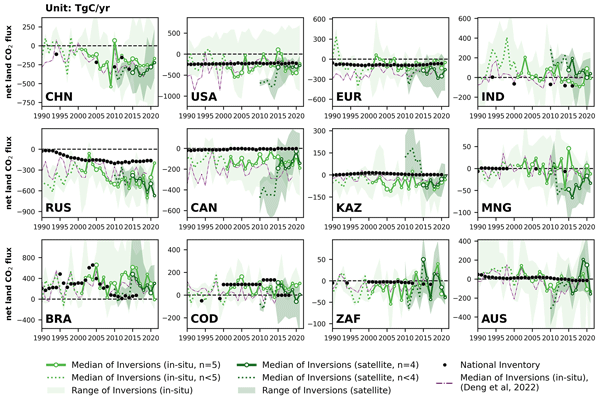
This study reconciles national greenhouse gas (GHG) inventories with updated atmospheric inversion results to evaluate discrepancies for three principal GHG fluxes at the national level. Compared to our previous study, new satellite-based CO2 inversions were included and an updated mask of managed lands was used, improving agreement for Brazil and Canada. The proposed methodology can be regularly applied as a check to assess the gap between top-down inversions and bottom-up inventories.
Pierre Friedlingstein, Michael O'Sullivan, Matthew W. Jones, Robbie M. Andrew, Judith Hauck, Peter Landschützer, Corinne Le Quéré, Hongmei Li, Ingrid T. Luijkx, Are Olsen, Glen P. Peters, Wouter Peters, Julia Pongratz, Clemens Schwingshackl, Stephen Sitch, Josep G. Canadell, Philippe Ciais, Robert B. Jackson, Simone R. Alin, Almut Arneth, Vivek Arora, Nicholas R. Bates, Meike Becker, Nicolas Bellouin, Carla F. Berghoff, Henry C. Bittig, Laurent Bopp, Patricia Cadule, Katie Campbell, Matthew A. Chamberlain, Naveen Chandra, Frédéric Chevallier, Louise P. Chini, Thomas Colligan, Jeanne Decayeux, Laique M. Djeutchouang, Xinyu Dou, Carolina Duran Rojas, Kazutaka Enyo, Wiley Evans, Amanda R. Fay, Richard A. Feely, Daniel J. Ford, Adrianna Foster, Thomas Gasser, Marion Gehlen, Thanos Gkritzalis, Giacomo Grassi, Luke Gregor, Nicolas Gruber, Özgür Gürses, Ian Harris, Matthew Hefner, Jens Heinke, George C. Hurtt, Yosuke Iida, Tatiana Ilyina, Andrew R. Jacobson, Atul K. Jain, Tereza Jarníková, Annika Jersild, Fei Jiang, Zhe Jin, Etsushi Kato, Ralph F. Keeling, Kees Klein Goldewijk, Jürgen Knauer, Jan Ivar Korsbakken, Xin Lan, Siv K. Lauvset, Nathalie Lefèvre, Zhu Liu, Junjie Liu, Lei Ma, Shamil Maksyutov, Gregg Marland, Nicolas Mayot, Patrick C. McGuire, Nicolas Metzl, Natalie M. Monacci, Eric J. Morgan, Shin-Ichiro Nakaoka, Craig Neill, Yosuke Niwa, Tobias Nützel, Lea Olivier, Tsuneo Ono, Paul I. Palmer, Denis Pierrot, Zhangcai Qin, Laure Resplandy, Alizée Roobaert, Thais M. Rosan, Christian Rödenbeck, Jörg Schwinger, T. Luke Smallman, Stephen M. Smith, Reinel Sospedra-Alfonso, Tobias Steinhoff, Qing Sun, Adrienne J. Sutton, Roland Séférian, Shintaro Takao, Hiroaki Tatebe, Hanqin Tian, Bronte Tilbrook, Olivier Torres, Etienne Tourigny, Hiroyuki Tsujino, Francesco Tubiello, Guido van der Werf, Rik Wanninkhof, Xuhui Wang, Dongxu Yang, Xiaojuan Yang, Zhen Yu, Wenping Yuan, Xu Yue, Sönke Zaehle, Ning Zeng, and Jiye Zeng
Earth Syst. Sci. Data, 17, 965–1039, https://doi.org/10.5194/essd-17-965-2025, https://doi.org/10.5194/essd-17-965-2025, 2025
Short summary
Short summary
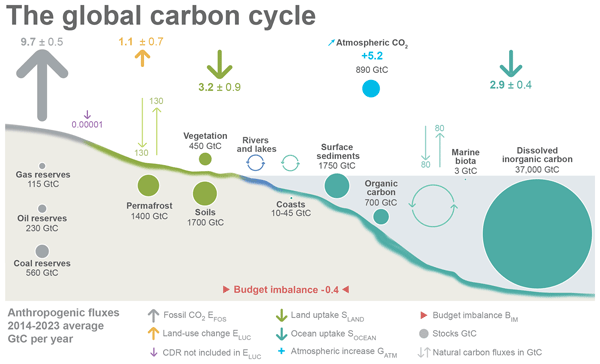
The Global Carbon Budget 2024 describes the methodology, main results, and datasets used to quantify the anthropogenic emissions of carbon dioxide (CO2) and their partitioning among the atmosphere, land ecosystems, and the ocean over the historical period (1750–2024). These living datasets are updated every year to provide the highest transparency and traceability in the reporting of CO2, the key driver of climate change.
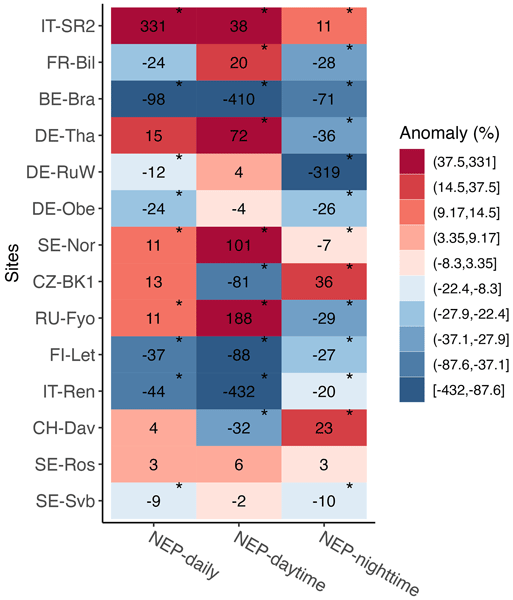
Mana Gharun, Ankit Shekhar, Lukas Hörtnagl, Luana Krebs, Nicola Arriga, Mirco Migliavacca, Marilyn Roland, Bert Gielen, Leonardo Montagnani, Enrico Tomelleri, Ladislav Šigut, Matthias Peichl, Peng Zhao, Marius Schmidt, Thomas Grünwald, Mika Korkiakoski, Annalea Lohila, and Nina Buchmann
Biogeosciences, 22, 1393–1411, https://doi.org/10.5194/bg-22-1393-2025, https://doi.org/10.5194/bg-22-1393-2025, 2025
Short summary
Short summary
The effect of winter warming on forest CO2 fluxes has rarely been investigated. We tested the effect of the warm winter of 2020 on the forest CO2 fluxes across 14 sites in Europe and found that the net ecosystem productivity (NEP) across most sites declined during the warm winter due to increased respiration fluxes.
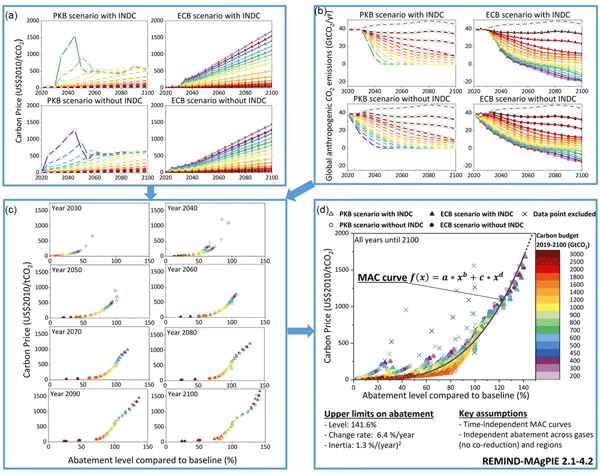
Weiwei Xiong, Katsumasa Tanaka, Philippe Ciais, Daniel J. A. Johansson, and Mariliis Lehtveer
Geosci. Model Dev., 18, 1575–1612, https://doi.org/10.5194/gmd-18-1575-2025, https://doi.org/10.5194/gmd-18-1575-2025, 2025
Short summary
Short summary
emIAM v1.0 is a new emulator for integrated assessment models (IAMs) using global and regional time-independent marginal abatement cost (MAC) curves for multiple greenhouse gases, optionally with time-dependent MAC curves for enhanced accuracy. Combined with climate emulators, emIAM enables development of cost-effective, multi-IAM emission pathways directly linked to temperature targets at low computational cost.
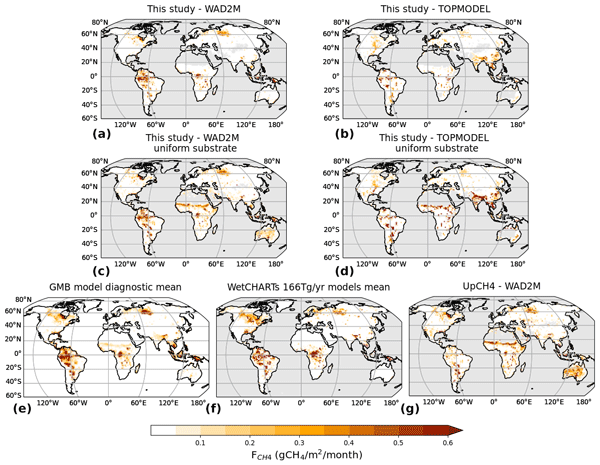
Juliette Bernard, Elodie Salmon, Marielle Saunois, Shushi Peng, Penélope Serrano-Ortiz, Antoine Berchet, Palingamoorthy Gnanamoorthy, Joachim Jansen, and Philippe Ciais
Geosci. Model Dev., 18, 863–883, https://doi.org/10.5194/gmd-18-863-2025, https://doi.org/10.5194/gmd-18-863-2025, 2025
Short summary
Short summary
Despite their importance, uncertainties remain in the evaluation of the drivers of temporal variability of methane emissions from wetlands on a global scale. Here, a simplified global model is developed, taking advantage of advances in remote-sensing data and in situ observations. The model reproduces the large spatial and temporal patterns of emissions, albeit with limitations in the tropics due to data scarcity. This model, while simple, can provide valuable insights into sensitivity analyses.
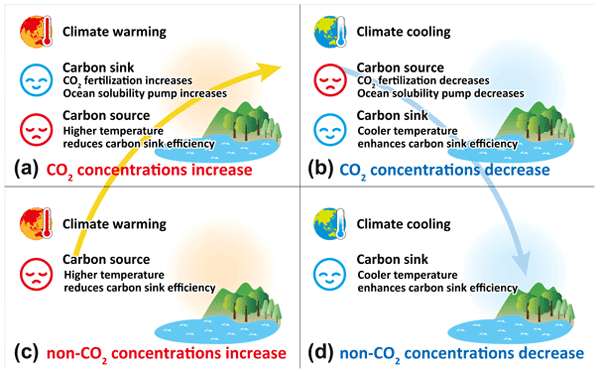
Irina Melnikova, Philippe Ciais, Katsumasa Tanaka, Hideo Shiogama, Kaoru Tachiiri, Tokuta Yokohata, and Olivier Boucher
Earth Syst. Dynam., 16, 257–273, https://doi.org/10.5194/esd-16-257-2025, https://doi.org/10.5194/esd-16-257-2025, 2025
Short summary
Short summary
Reducing non-CO2 greenhouse gases is important alongside CO2 for climate mitigation. Here, we look at how reducing their emissions compares to reducing CO2 using an Earth system model. While both types of gases contribute to warming, their regional climate impacts differ. Besides, the carbon cycle responds differently depending on whether climate change is driven by CO2 or non-CO2 gases. Considering both types of gases is important for carbon cycle analysis and climate mitigation strategies.
Nikola Besic, Nicolas Picard, Cédric Vega, Jean-Daniel Bontemps, Lionel Hertzog, Jean-Pierre Renaud, Fajwel Fogel, Martin Schwartz, Agnès Pellissier-Tanon, Gabriel Destouet, Frédéric Mortier, Milena Planells-Rodriguez, and Philippe Ciais
Geosci. Model Dev., 18, 337–359, https://doi.org/10.5194/gmd-18-337-2025, https://doi.org/10.5194/gmd-18-337-2025, 2025
Short summary
Short summary
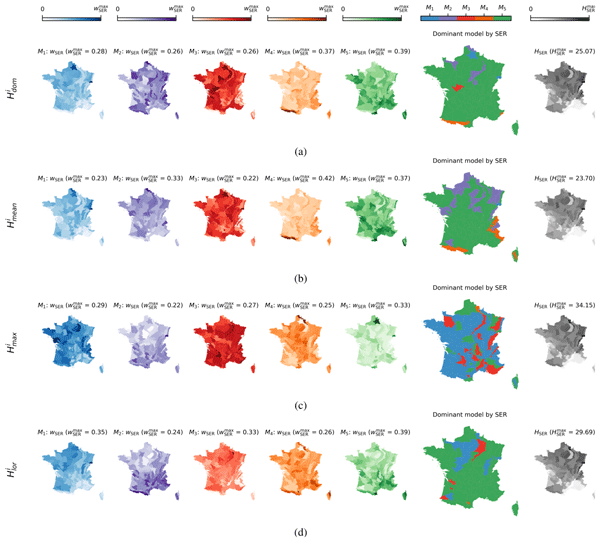
The creation of advanced mapping models for forest attributes, utilizing remote sensing data and incorporating machine or deep learning methods, has become a key area of interest in the domain of forest observation and monitoring. This paper introduces a method where we blend and collectively interpret five models dedicated to estimating forest canopy height. We achieve this through Bayesian model averaging, offering a comprehensive analysis of these remote-sensing-based products.
Zhen Zhang, Benjamin Poulter, Joe R. Melton, William J. Riley, George H. Allen, David J. Beerling, Philippe Bousquet, Josep G. Canadell, Etienne Fluet-Chouinard, Philippe Ciais, Nicola Gedney, Peter O. Hopcroft, Akihiko Ito, Robert B. Jackson, Atul K. Jain, Katherine Jensen, Fortunat Joos, Thomas Kleinen, Sara H. Knox, Tingting Li, Xin Li, Xiangyu Liu, Kyle McDonald, Gavin McNicol, Paul A. Miller, Jurek Müller, Prabir K. Patra, Changhui Peng, Shushi Peng, Zhangcai Qin, Ryan M. Riggs, Marielle Saunois, Qing Sun, Hanqin Tian, Xiaoming Xu, Yuanzhi Yao, Yi Xi, Wenxin Zhang, Qing Zhu, Qiuan Zhu, and Qianlai Zhuang
Biogeosciences, 22, 305–321, https://doi.org/10.5194/bg-22-305-2025, https://doi.org/10.5194/bg-22-305-2025, 2025
Short summary
Short summary
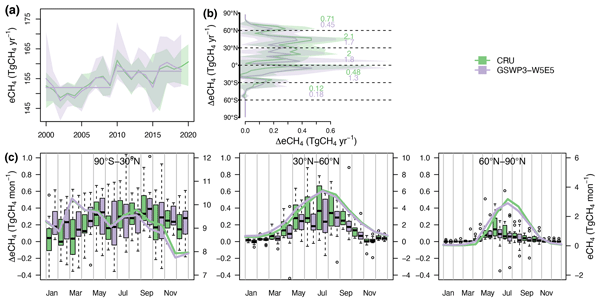
This study assesses global methane emissions from wetlands between 2000 and 2020 using multiple models. We found that wetland emissions increased by 6–7 Tg CH4 yr-1 in the 2010s compared to the 2000s. Rising temperatures primarily drove this increase, while changes in precipitation and CO2 levels also played roles. Our findings highlight the importance of wetlands in the global methane budget and the need for continuous monitoring to understand their impact on climate change.
Lilian Vallet, Charbel Abdallah, Thomas Lauvaux, Lilian Joly, Michel Ramonet, Philippe Ciais, Morgan Lopez, Irène Xueref-Remy, and Florent Mouillot
Biogeosciences, 22, 213–242, https://doi.org/10.5194/bg-22-213-2025, https://doi.org/10.5194/bg-22-213-2025, 2025
Short summary
Short summary
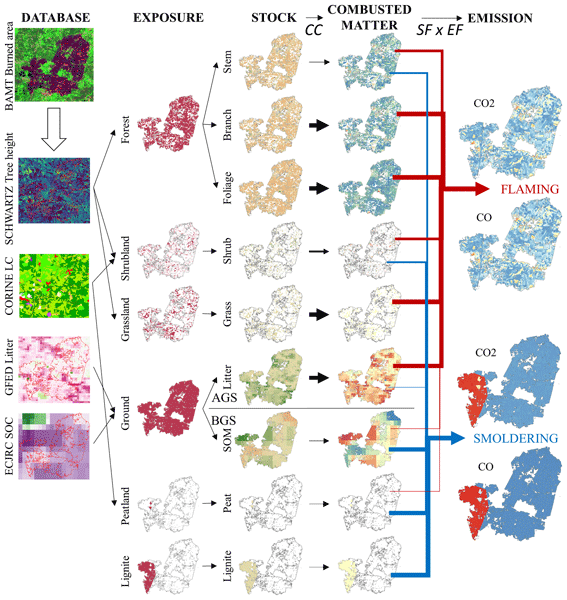
The 2022 fire season had a huge impact on European temperate forest, with several large fires exhibiting prolonged soil combustion reported. We analyzed CO and CO2 concentration recorded at nearby atmospheric towers, revealing intense smoldering combustion. We refined a fire emission model to incorporate this process. We estimated 7.95 Mteq CO2 fire emission, twice the global estimate. Fires contributed to 1.97 % of France's annual carbon footprint, reducing forest carbon sink by 30 % this year.
Vilna Tyystjärvi, Tiina Markkanen, Leif Backman, Maarit Raivonen, Antti Leppänen, Xuefei Li, Paavo Ojanen, Kari Minkkinen, Roosa Hautala, Mikko Peltoniemi, Jani Anttila, Raija Laiho, Annalea Lohila, Raisa Mäkipää, and Tuula Aalto
Biogeosciences, 21, 5745–5771, https://doi.org/10.5194/bg-21-5745-2024, https://doi.org/10.5194/bg-21-5745-2024, 2024
Short summary
Short summary
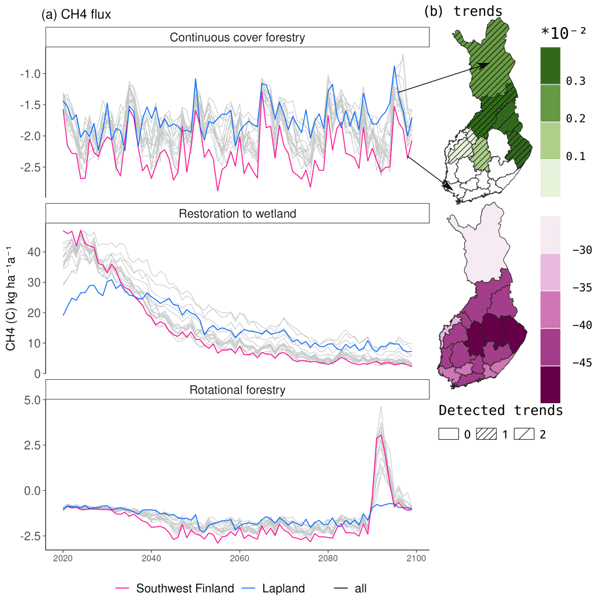
Drainage of boreal peatlands strongly influences soil methane fluxes, with important implications for climatic impacts. Here we simulate methane fluxes in forestry-drained and restored peatlands during the 21st century. We found that restoration turned peatlands into a source of methane, but the magnitude varied regionally. In forests, changes in the water table level influenced methane fluxes, and in general, the sink was weaker under rotational forestry compared to continuous cover forestry.
Jacob A. Nelson, Sophia Walther, Fabian Gans, Basil Kraft, Ulrich Weber, Kimberly Novick, Nina Buchmann, Mirco Migliavacca, Georg Wohlfahrt, Ladislav Šigut, Andreas Ibrom, Dario Papale, Mathias Göckede, Gregory Duveiller, Alexander Knohl, Lukas Hörtnagl, Russell L. Scott, Jiří Dušek, Weijie Zhang, Zayd Mahmoud Hamdi, Markus Reichstein, Sergio Aranda-Barranco, Jonas Ardö, Maarten Op de Beeck, Dave Billesbach, David Bowling, Rosvel Bracho, Christian Brümmer, Gustau Camps-Valls, Shiping Chen, Jamie Rose Cleverly, Ankur Desai, Gang Dong, Tarek S. El-Madany, Eugenie Susanne Euskirchen, Iris Feigenwinter, Marta Galvagno, Giacomo A. Gerosa, Bert Gielen, Ignacio Goded, Sarah Goslee, Christopher Michael Gough, Bernard Heinesch, Kazuhito Ichii, Marcin Antoni Jackowicz-Korczynski, Anne Klosterhalfen, Sara Knox, Hideki Kobayashi, Kukka-Maaria Kohonen, Mika Korkiakoski, Ivan Mammarella, Mana Gharun, Riccardo Marzuoli, Roser Matamala, Stefan Metzger, Leonardo Montagnani, Giacomo Nicolini, Thomas O'Halloran, Jean-Marc Ourcival, Matthias Peichl, Elise Pendall, Borja Ruiz Reverter, Marilyn Roland, Simone Sabbatini, Torsten Sachs, Marius Schmidt, Christopher R. Schwalm, Ankit Shekhar, Richard Silberstein, Maria Lucia Silveira, Donatella Spano, Torbern Tagesson, Gianluca Tramontana, Carlo Trotta, Fabio Turco, Timo Vesala, Caroline Vincke, Domenico Vitale, Enrique R. Vivoni, Yi Wang, William Woodgate, Enrico A. Yepez, Junhui Zhang, Donatella Zona, and Martin Jung
Biogeosciences, 21, 5079–5115, https://doi.org/10.5194/bg-21-5079-2024, https://doi.org/10.5194/bg-21-5079-2024, 2024
Short summary
Short summary
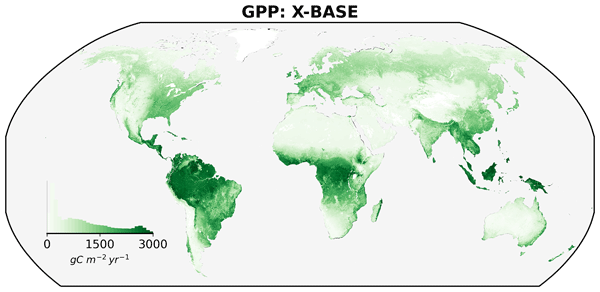
The movement of water, carbon, and energy from the Earth's surface to the atmosphere, or flux, is an important process to understand because it impacts our lives. Here, we outline a method called FLUXCOM-X to estimate global water and CO2 fluxes based on direct measurements from sites around the world. We go on to demonstrate how these new estimates of net CO2 uptake/loss, gross CO2 uptake, total water evaporation, and transpiration from plants compare to previous and independent estimates.
Jinghui Lian, Olivier Laurent, Mali Chariot, Luc Lienhardt, Michel Ramonet, Hervé Utard, Thomas Lauvaux, François-Marie Bréon, Grégoire Broquet, Karina Cucchi, Laurent Millair, and Philippe Ciais
Atmos. Meas. Tech., 17, 5821–5839, https://doi.org/10.5194/amt-17-5821-2024, https://doi.org/10.5194/amt-17-5821-2024, 2024
Short summary
Short summary
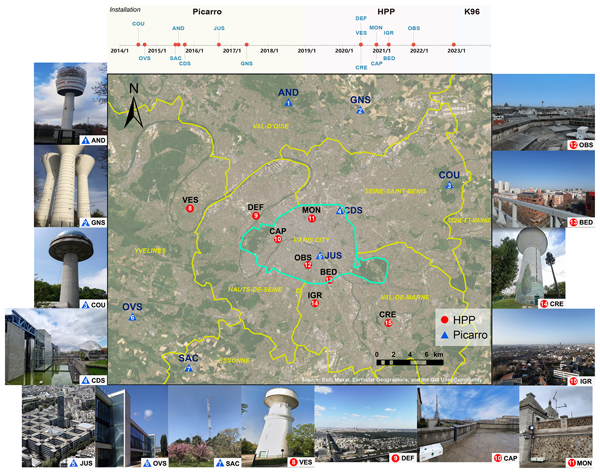
We have designed and deployed a mid-cost medium-precision CO2 sensor monitoring network in Paris since July 2020. The data are automatically calibrated by a newly implemented data processing system. The accuracies of the mid-cost instruments vary from 1.0 to 2.4 ppm for hourly afternoon measurements. Our model–data analyses highlight prospects for integrating mid-cost instrument data with high-precision measurements to improve fine-scale CO2 emission quantification in urban areas.
Josselin Doc, Michel Ramonet, François-Marie Bréon, Delphine Combaz, Mali Chariot, Morgan Lopez, Marc Delmotte, Cristelle Cailteau-Fischbach, Guillaume Nief, Nathanaël Laporte, Thomas Lauvaux, and Philippe Ciais
EGUsphere, https://doi.org/10.5194/egusphere-2024-2826, https://doi.org/10.5194/egusphere-2024-2826, 2024
Short summary
Short summary
Description of the network for measuring greenhouse gas concentrations in the Paris region and analysis of eight years of continuous monitoring.

Thi Lan Anh Dinh, Daniel Goll, Philippe Ciais, and Ronny Lauerwald
Geosci. Model Dev., 17, 6725–6744, https://doi.org/10.5194/gmd-17-6725-2024, https://doi.org/10.5194/gmd-17-6725-2024, 2024
Short summary
Short summary
The study assesses the performance of the dynamic global vegetation model (DGVM) ORCHIDEE in capturing the impact of land-use change on carbon stocks across Europe. Comparisons with observations reveal that the model accurately represents carbon fluxes and stocks. Despite the underestimations in certain land-use conversions, the model describes general trends in soil carbon response to land-use change, aligning with the site observations.
Rodrigo Rivera-Martinez, Pramod Kumar, Olivier Laurent, Gregoire Broquet, Christopher Caldow, Ford Cropley, Diego Santaren, Adil Shah, Cécile Mallet, Michel Ramonet, Leonard Rivier, Catherine Juery, Olivier Duclaux, Caroline Bouchet, Elisa Allegrini, Hervé Utard, and Philippe Ciais
Atmos. Meas. Tech., 17, 4257–4290, https://doi.org/10.5194/amt-17-4257-2024, https://doi.org/10.5194/amt-17-4257-2024, 2024
Short summary
Short summary
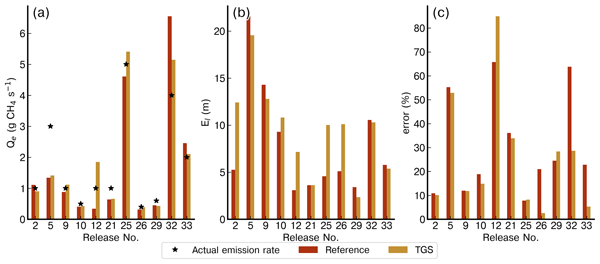
We explore the use of metal oxide semiconductors (MOSs) as a low-cost alternative for detecting and measuring CH4 emissions from industrial facilities. MOSs were exposed to several controlled releases to test their accuracy in detecting and quantifying emissions. Two reconstruction models were compared, and emission estimates were computed using a Gaussian dispersion model. Findings show that MOSs can provide accurate emission estimates with a 25 % emission rate error and a 9.5 m location error.
Mengjie Han, Qing Zhao, Xili Wang, Ying-Ping Wang, Philippe Ciais, Haicheng Zhang, Daniel S. Goll, Lei Zhu, Zhe Zhao, Zhixuan Guo, Chen Wang, Wei Zhuang, Fengchang Wu, and Wei Li
Geosci. Model Dev., 17, 4871–4890, https://doi.org/10.5194/gmd-17-4871-2024, https://doi.org/10.5194/gmd-17-4871-2024, 2024
Short summary
Short summary
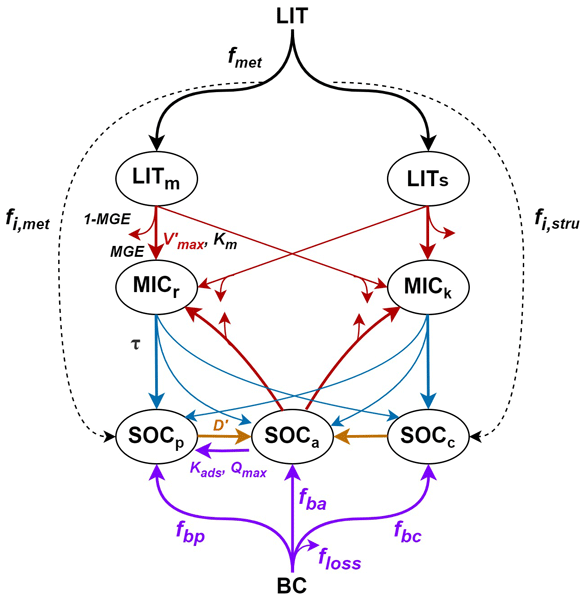
The impact of biochar (BC) on soil organic carbon (SOC) dynamics is not represented in most land carbon models used for assessing land-based climate change mitigation. Our study develops a BC model that incorporates our current understanding of BC effects on SOC based on a soil carbon model (MIMICS). The BC model can reproduce the SOC changes after adding BC, providing a useful tool to couple dynamic land models to evaluate the effectiveness of BC application for CO2 removal from the atmosphere.
Yi Xi, Chunjing Qiu, Yuan Zhang, Dan Zhu, Shushi Peng, Gustaf Hugelius, Jinfeng Chang, Elodie Salmon, and Philippe Ciais
Geosci. Model Dev., 17, 4727–4754, https://doi.org/10.5194/gmd-17-4727-2024, https://doi.org/10.5194/gmd-17-4727-2024, 2024
Short summary
Short summary
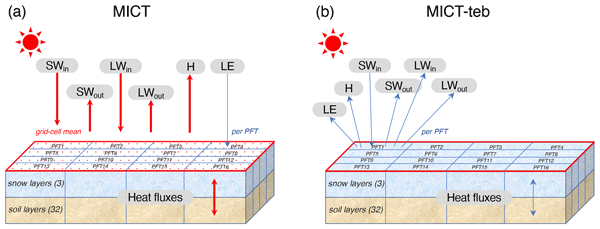
The ORCHIDEE-MICT model can simulate the carbon cycle and hydrology at a sub-grid scale but energy budgets only at a grid scale. This paper assessed the implementation of a multi-tiling energy budget approach in ORCHIDEE-MICT and found warmer surface and soil temperatures, higher soil moisture, and more soil organic carbon across the Northern Hemisphere compared with the original version.
Yitong Yao, Philippe Ciais, Emilie Joetzjer, Wei Li, Lei Zhu, Yujie Wang, Christian Frankenberg, and Nicolas Viovy
Earth Syst. Dynam., 15, 763–778, https://doi.org/10.5194/esd-15-763-2024, https://doi.org/10.5194/esd-15-763-2024, 2024
Short summary
Short summary
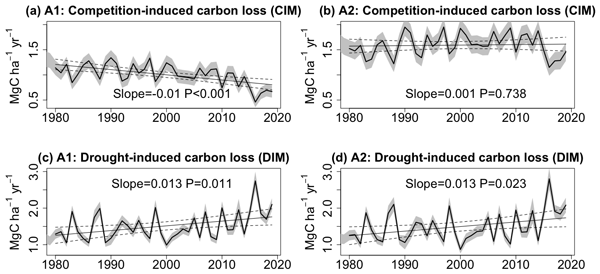
Elevated CO2 concentration (eCO2) is critical for shaping the future path of forest carbon uptake, while uncertainties remain about concurrent carbon loss. Here, we found that eCO2 might amplify competition-induced carbon loss, while the extent of drought-induced carbon loss hinges on the balance between heightened biomass density and water-saving benefits. This is the first time that such carbon loss responses to ongoing climate change have been quantified separately over the Amazon rainforest.

Hanqin Tian, Naiqing Pan, Rona L. Thompson, Josep G. Canadell, Parvadha Suntharalingam, Pierre Regnier, Eric A. Davidson, Michael Prather, Philippe Ciais, Marilena Muntean, Shufen Pan, Wilfried Winiwarter, Sönke Zaehle, Feng Zhou, Robert B. Jackson, Hermann W. Bange, Sarah Berthet, Zihao Bian, Daniele Bianchi, Alexander F. Bouwman, Erik T. Buitenhuis, Geoffrey Dutton, Minpeng Hu, Akihiko Ito, Atul K. Jain, Aurich Jeltsch-Thömmes, Fortunat Joos, Sian Kou-Giesbrecht, Paul B. Krummel, Xin Lan, Angela Landolfi, Ronny Lauerwald, Ya Li, Chaoqun Lu, Taylor Maavara, Manfredi Manizza, Dylan B. Millet, Jens Mühle, Prabir K. Patra, Glen P. Peters, Xiaoyu Qin, Peter Raymond, Laure Resplandy, Judith A. Rosentreter, Hao Shi, Qing Sun, Daniele Tonina, Francesco N. Tubiello, Guido R. van der Werf, Nicolas Vuichard, Junjie Wang, Kelley C. Wells, Luke M. Western, Chris Wilson, Jia Yang, Yuanzhi Yao, Yongfa You, and Qing Zhu
Earth Syst. Sci. Data, 16, 2543–2604, https://doi.org/10.5194/essd-16-2543-2024, https://doi.org/10.5194/essd-16-2543-2024, 2024
Short summary
Short summary
Atmospheric concentrations of nitrous oxide (N2O), a greenhouse gas 273 times more potent than carbon dioxide, have increased by 25 % since the preindustrial period, with the highest observed growth rate in 2020 and 2021. This rapid growth rate has primarily been due to a 40 % increase in anthropogenic emissions since 1980. Observed atmospheric N2O concentrations in recent years have exceeded the worst-case climate scenario, underscoring the importance of reducing anthropogenic N2O emissions.
Léna Gurriaran, Yannig Goude, Katsumasa Tanaka, Biqing Zhu, Zhu Deng, Xuanren Song, and Philippe Ciais
Geosci. Model Dev., 17, 2663–2682, https://doi.org/10.5194/gmd-17-2663-2024, https://doi.org/10.5194/gmd-17-2663-2024, 2024
Short summary
Short summary
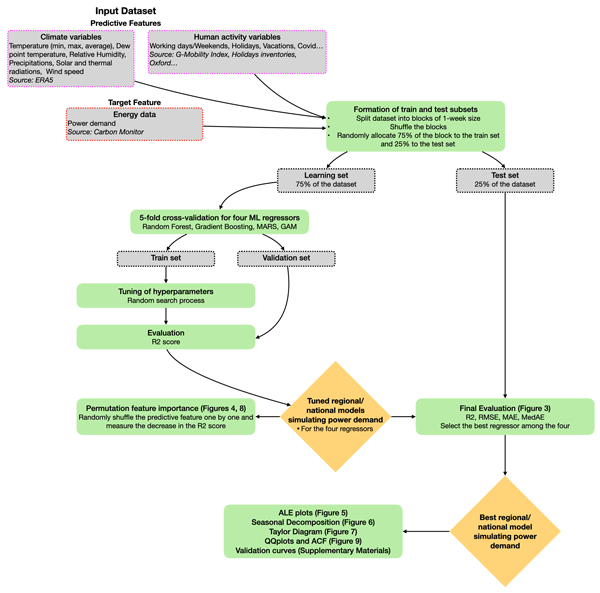
We developed a data-driven model simulating daily regional power demand based on climate and socioeconomic variables. Our model was applied to eight countries or regions (Australia, Brazil, China, EU, India, Russia, South Africa, US), identifying influential factors and their relationship with power demand. Our findings highlight the significance of economic indicators in addition to temperature, showcasing country-specific variations. This research aids energy planning and emission reduction.
Pedro Felipe Arboleda-Obando, Agnès Ducharne, Zun Yin, and Philippe Ciais
Geosci. Model Dev., 17, 2141–2164, https://doi.org/10.5194/gmd-17-2141-2024, https://doi.org/10.5194/gmd-17-2141-2024, 2024
Short summary
Short summary
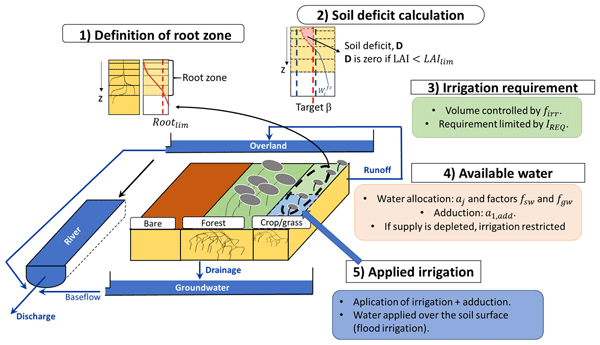
We show a new irrigation scheme included in the ORCHIDEE land surface model. The new irrigation scheme restrains irrigation due to water shortage, includes water adduction, and represents environmental limits and facilities to access water, due to representing infrastructure in a simple way. Our results show that the new irrigation scheme helps simulate acceptable land surface conditions and fluxes in irrigated areas, even if there are difficulties due to shortcomings and limited information.
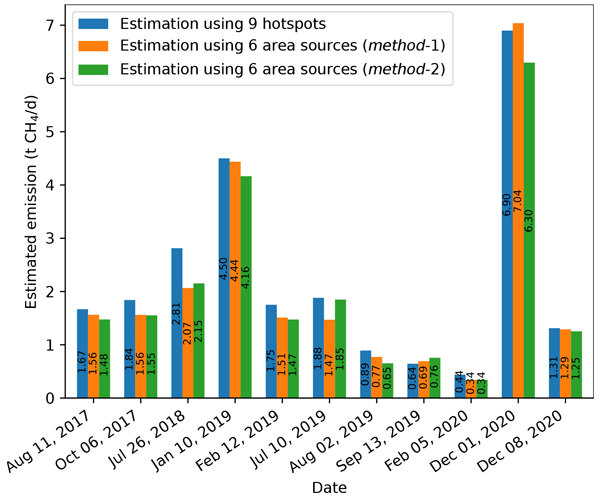
Pramod Kumar, Christopher Caldow, Grégoire Broquet, Adil Shah, Olivier Laurent, Camille Yver-Kwok, Sebastien Ars, Sara Defratyka, Susan Warao Gichuki, Luc Lienhardt, Mathis Lozano, Jean-Daniel Paris, Felix Vogel, Caroline Bouchet, Elisa Allegrini, Robert Kelly, Catherine Juery, and Philippe Ciais
Atmos. Meas. Tech., 17, 1229–1250, https://doi.org/10.5194/amt-17-1229-2024, https://doi.org/10.5194/amt-17-1229-2024, 2024
Short summary
Short summary
This study presents a series of mobile measurement campaigns to monitor the CH4 emissions from an active landfill. These measurements are processed using a Gaussian plume model and atmospheric inversion techniques to quantify the landfill CH4 emissions. The methane emission estimates range between ~0.4 and ~7 t CH4 per day, and their variations are analyzed. The robustness of the estimates is assessed depending on the distance of the measurements from the potential sources in the landfill.
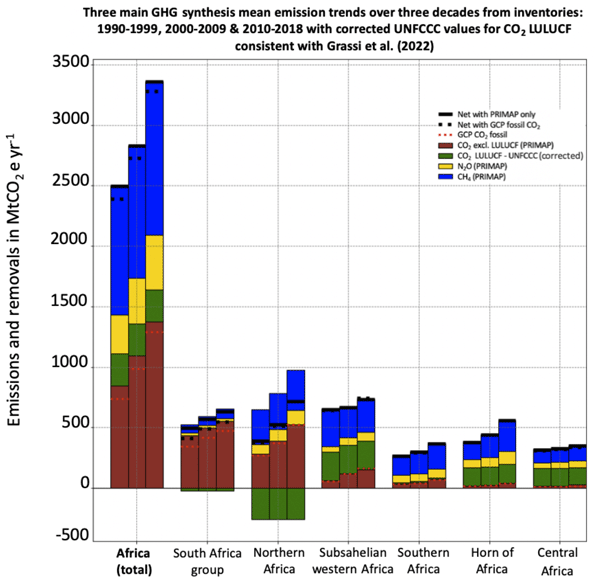
Mounia Mostefaoui, Philippe Ciais, Matthew J. McGrath, Philippe Peylin, Prabir K. Patra, and Yolandi Ernst
Earth Syst. Sci. Data, 16, 245–275, https://doi.org/10.5194/essd-16-245-2024, https://doi.org/10.5194/essd-16-245-2024, 2024
Short summary
Short summary
Our aim is to assess African anthropogenic greenhouse gas emissions and removals by using different data products, including inventories and process-based models, and to compare their relative merits with inversion data coming from satellites. We show a good match among the various estimates in terms of overall trends at a regional level and on a decadal basis, but large differences exist even among similar data types, which is a limit to the possibility of verification of country-reported data.
Jan De Pue, Sebastian Wieneke, Ana Bastos, José Miguel Barrios, Liyang Liu, Philippe Ciais, Alirio Arboleda, Rafiq Hamdi, Maral Maleki, Fabienne Maignan, Françoise Gellens-Meulenberghs, Ivan Janssens, and Manuela Balzarolo
Biogeosciences, 20, 4795–4818, https://doi.org/10.5194/bg-20-4795-2023, https://doi.org/10.5194/bg-20-4795-2023, 2023
Short summary
Short summary
The gross primary production (GPP) of the terrestrial biosphere is a key source of variability in the global carbon cycle. To estimate this flux, models can rely on remote sensing data (RS-driven), meteorological data (meteo-driven) or a combination of both (hybrid). An intercomparison of 11 models demonstrated that RS-driven models lack the sensitivity to short-term anomalies. Conversely, the simulation of soil moisture dynamics and stress response remains a challenge in meteo-driven models.
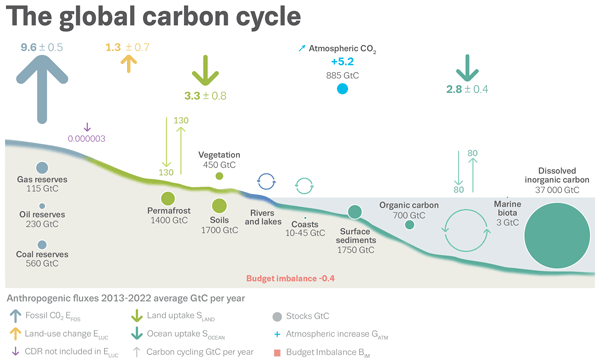
Pierre Friedlingstein, Michael O'Sullivan, Matthew W. Jones, Robbie M. Andrew, Dorothee C. E. Bakker, Judith Hauck, Peter Landschützer, Corinne Le Quéré, Ingrid T. Luijkx, Glen P. Peters, Wouter Peters, Julia Pongratz, Clemens Schwingshackl, Stephen Sitch, Josep G. Canadell, Philippe Ciais, Robert B. Jackson, Simone R. Alin, Peter Anthoni, Leticia Barbero, Nicholas R. Bates, Meike Becker, Nicolas Bellouin, Bertrand Decharme, Laurent Bopp, Ida Bagus Mandhara Brasika, Patricia Cadule, Matthew A. Chamberlain, Naveen Chandra, Thi-Tuyet-Trang Chau, Frédéric Chevallier, Louise P. Chini, Margot Cronin, Xinyu Dou, Kazutaka Enyo, Wiley Evans, Stefanie Falk, Richard A. Feely, Liang Feng, Daniel J. Ford, Thomas Gasser, Josefine Ghattas, Thanos Gkritzalis, Giacomo Grassi, Luke Gregor, Nicolas Gruber, Özgür Gürses, Ian Harris, Matthew Hefner, Jens Heinke, Richard A. Houghton, George C. Hurtt, Yosuke Iida, Tatiana Ilyina, Andrew R. Jacobson, Atul Jain, Tereza Jarníková, Annika Jersild, Fei Jiang, Zhe Jin, Fortunat Joos, Etsushi Kato, Ralph F. Keeling, Daniel Kennedy, Kees Klein Goldewijk, Jürgen Knauer, Jan Ivar Korsbakken, Arne Körtzinger, Xin Lan, Nathalie Lefèvre, Hongmei Li, Junjie Liu, Zhiqiang Liu, Lei Ma, Greg Marland, Nicolas Mayot, Patrick C. McGuire, Galen A. McKinley, Gesa Meyer, Eric J. Morgan, David R. Munro, Shin-Ichiro Nakaoka, Yosuke Niwa, Kevin M. O'Brien, Are Olsen, Abdirahman M. Omar, Tsuneo Ono, Melf Paulsen, Denis Pierrot, Katie Pocock, Benjamin Poulter, Carter M. Powis, Gregor Rehder, Laure Resplandy, Eddy Robertson, Christian Rödenbeck, Thais M. Rosan, Jörg Schwinger, Roland Séférian, T. Luke Smallman, Stephen M. Smith, Reinel Sospedra-Alfonso, Qing Sun, Adrienne J. Sutton, Colm Sweeney, Shintaro Takao, Pieter P. Tans, Hanqin Tian, Bronte Tilbrook, Hiroyuki Tsujino, Francesco Tubiello, Guido R. van der Werf, Erik van Ooijen, Rik Wanninkhof, Michio Watanabe, Cathy Wimart-Rousseau, Dongxu Yang, Xiaojuan Yang, Wenping Yuan, Xu Yue, Sönke Zaehle, Jiye Zeng, and Bo Zheng
Earth Syst. Sci. Data, 15, 5301–5369, https://doi.org/10.5194/essd-15-5301-2023, https://doi.org/10.5194/essd-15-5301-2023, 2023
Short summary
Short summary
The Global Carbon Budget 2023 describes the methodology, main results, and data sets used to quantify the anthropogenic emissions of carbon dioxide (CO2) and their partitioning among the atmosphere, land ecosystems, and the ocean over the historical period (1750–2023). These living datasets are updated every year to provide the highest transparency and traceability in the reporting of CO2, the key driver of climate change.
Ioannis Cheliotis, Thomas Lauvaux, Jinghui Lian, Theodoros Christoudias, George Georgiou, Alba Badia, Frédéric Chevallier, Pramod Kumar, Yathin Kudupaje, Ruixue Lei, and Philippe Ciais
EGUsphere, https://doi.org/10.5194/egusphere-2023-2487, https://doi.org/10.5194/egusphere-2023-2487, 2023
Preprint withdrawn
Short summary
Short summary
A consistent estimation of CO2 emissions is complicated due to the scarcity of CO2 observations. In this study, we showcase the potential to improve the CO2 emissions estimations from the NO2 concentrations based on the NO2-to-CO2 ratio, which should be constant for a source co-emitting NO2 and CO2, by comparing satellite observations with atmospheric chemistry and transport model simulations for NO2 and CO2. Furthermore, we demonstrate the significance of the chemistry in NO2 simulations.
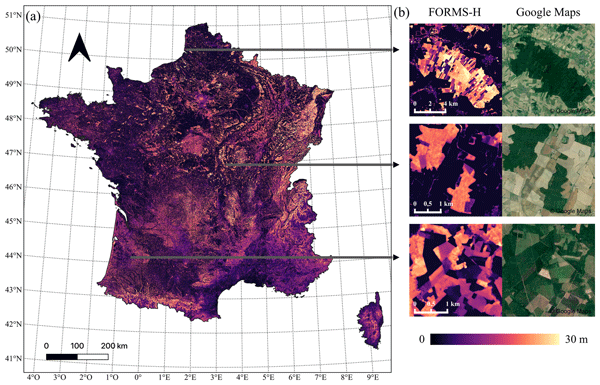
Martin Schwartz, Philippe Ciais, Aurélien De Truchis, Jérôme Chave, Catherine Ottlé, Cedric Vega, Jean-Pierre Wigneron, Manuel Nicolas, Sami Jouaber, Siyu Liu, Martin Brandt, and Ibrahim Fayad
Earth Syst. Sci. Data, 15, 4927–4945, https://doi.org/10.5194/essd-15-4927-2023, https://doi.org/10.5194/essd-15-4927-2023, 2023
Short summary
Short summary
As forests play a key role in climate-related issues, their accurate monitoring is critical to reduce global carbon emissions effectively. Based on open-access remote-sensing sensors, and artificial intelligence methods, we created high-resolution tree height, wood volume, and biomass maps of metropolitan France that outperform previous products. This study, based on freely available data, provides essential information to support climate-efficient forest management policies at a low cost.
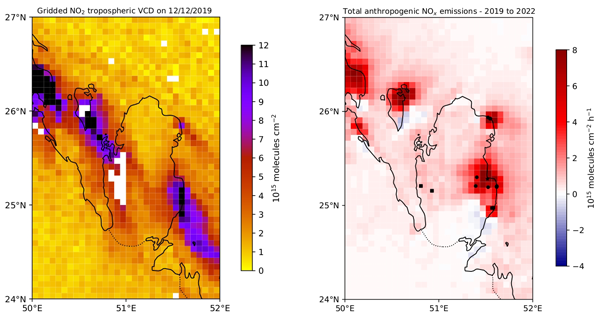
Anthony Rey-Pommier, Frédéric Chevallier, Philippe Ciais, Jonilda Kushta, Theodoros Christoudias, I. Safak Bayram, and Jean Sciare
Atmos. Chem. Phys., 23, 13565–13583, https://doi.org/10.5194/acp-23-13565-2023, https://doi.org/10.5194/acp-23-13565-2023, 2023
Short summary
Short summary
We use four years (2019–2022) of TROPOMI NO2 data to map NOx emissions in Qatar. We estimate average monthly emissions for the country and industrial facilities and derive an emission factor for the power sector. Monthly emissions have a weekly cycle reflecting the social norms in Qatar and an annual cycle consistent with the electricity production by gas-fired power plants. Their mean value is lower than the NOx emissions in global inventories but similar to the emissions reported for 2007.
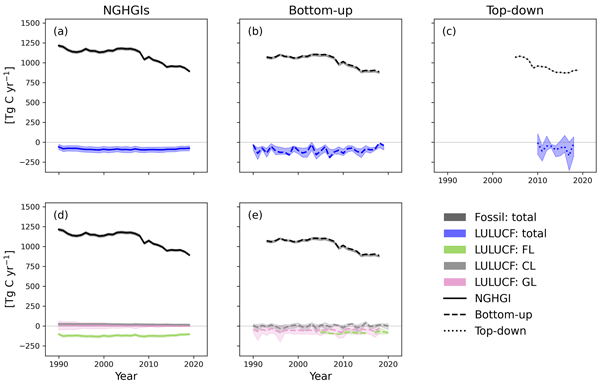
Matthew J. McGrath, Ana Maria Roxana Petrescu, Philippe Peylin, Robbie M. Andrew, Bradley Matthews, Frank Dentener, Juraj Balkovič, Vladislav Bastrikov, Meike Becker, Gregoire Broquet, Philippe Ciais, Audrey Fortems-Cheiney, Raphael Ganzenmüller, Giacomo Grassi, Ian Harris, Matthew Jones, Jürgen Knauer, Matthias Kuhnert, Guillaume Monteil, Saqr Munassar, Paul I. Palmer, Glen P. Peters, Chunjing Qiu, Mart-Jan Schelhaas, Oksana Tarasova, Matteo Vizzarri, Karina Winkler, Gianpaolo Balsamo, Antoine Berchet, Peter Briggs, Patrick Brockmann, Frédéric Chevallier, Giulia Conchedda, Monica Crippa, Stijn N. C. Dellaert, Hugo A. C. Denier van der Gon, Sara Filipek, Pierre Friedlingstein, Richard Fuchs, Michael Gauss, Christoph Gerbig, Diego Guizzardi, Dirk Günther, Richard A. Houghton, Greet Janssens-Maenhout, Ronny Lauerwald, Bas Lerink, Ingrid T. Luijkx, Géraud Moulas, Marilena Muntean, Gert-Jan Nabuurs, Aurélie Paquirissamy, Lucia Perugini, Wouter Peters, Roberto Pilli, Julia Pongratz, Pierre Regnier, Marko Scholze, Yusuf Serengil, Pete Smith, Efisio Solazzo, Rona L. Thompson, Francesco N. Tubiello, Timo Vesala, and Sophia Walther
Earth Syst. Sci. Data, 15, 4295–4370, https://doi.org/10.5194/essd-15-4295-2023, https://doi.org/10.5194/essd-15-4295-2023, 2023
Short summary
Short summary
Accurate estimation of fluxes of carbon dioxide from the land surface is essential for understanding future impacts of greenhouse gas emissions on the climate system. A wide variety of methods currently exist to estimate these sources and sinks. We are continuing work to develop annual comparisons of these diverse methods in order to clarify what they all actually calculate and to resolve apparent disagreement, in addition to highlighting opportunities for increased understanding.
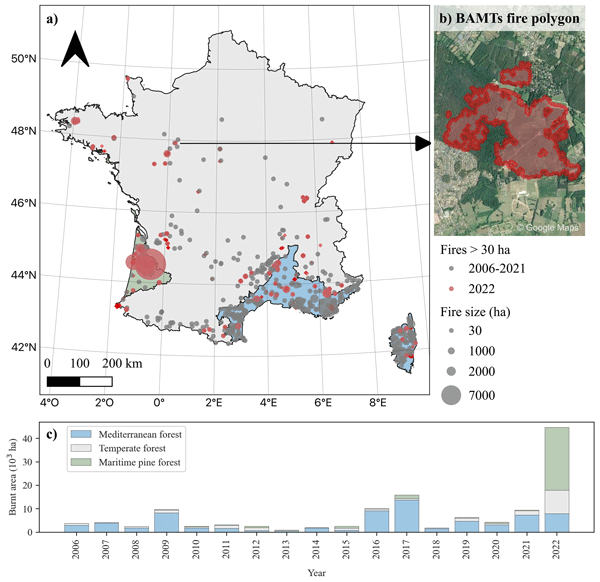
Lilian Vallet, Martin Schwartz, Philippe Ciais, Dave van Wees, Aurelien de Truchis, and Florent Mouillot
Biogeosciences, 20, 3803–3825, https://doi.org/10.5194/bg-20-3803-2023, https://doi.org/10.5194/bg-20-3803-2023, 2023
Short summary
Short summary
This study analyzes the ecological impact of the 2022 summer fire season in France by using high-resolution satellite data. The total biomass loss was 2.553 Mt, equivalent to a 17 % increase of the average natural mortality of all French forests. While Mediterranean forests had a lower biomass loss, there was a drastic increase in burned area and biomass loss over the Atlantic pine forests and temperate forests. This result revisits the distinctiveness of the 2022 fire season.
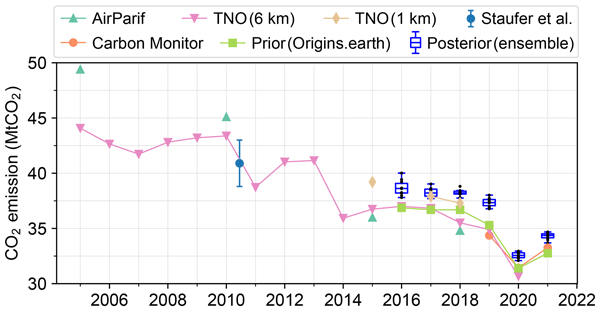
Jinghui Lian, Thomas Lauvaux, Hervé Utard, François-Marie Bréon, Grégoire Broquet, Michel Ramonet, Olivier Laurent, Ivonne Albarus, Mali Chariot, Simone Kotthaus, Martial Haeffelin, Olivier Sanchez, Olivier Perrussel, Hugo Anne Denier van der Gon, Stijn Nicolaas Camiel Dellaert, and Philippe Ciais
Atmos. Chem. Phys., 23, 8823–8835, https://doi.org/10.5194/acp-23-8823-2023, https://doi.org/10.5194/acp-23-8823-2023, 2023
Short summary
Short summary
This study quantifies urban CO2 emissions via an atmospheric inversion for the Paris metropolitan area over a 6-year period from 2016 to 2021. Results show a long-term decreasing trend of about 2 % ± 0.6 % per year in the annual CO2 emissions over Paris. We conclude that our current capacity can deliver near-real-time CO2 emission estimates at the city scale in under a month, and the results agree within 10 % with independent estimates from multiple city-scale inventories.
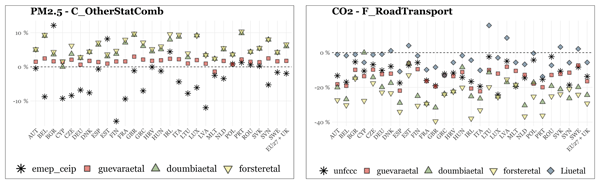
Marc Guevara, Hervé Petetin, Oriol Jorba, Hugo Denier van der Gon, Jeroen Kuenen, Ingrid Super, Claire Granier, Thierno Doumbia, Philippe Ciais, Zhu Liu, Robin D. Lamboll, Sabine Schindlbacher, Bradley Matthews, and Carlos Pérez García-Pando
Atmos. Chem. Phys., 23, 8081–8101, https://doi.org/10.5194/acp-23-8081-2023, https://doi.org/10.5194/acp-23-8081-2023, 2023
Short summary
Short summary
This study provides an intercomparison of European 2020 emission changes derived from official inventories, which are reported by countries under the framework of several international conventions and directives, and non-official near-real-time estimates, the use of which has significantly grown since the COVID-19 outbreak. The results of the work are used to produce recommendations on how best to approach and make use of near-real-time emissions for modelling and monitoring applications.
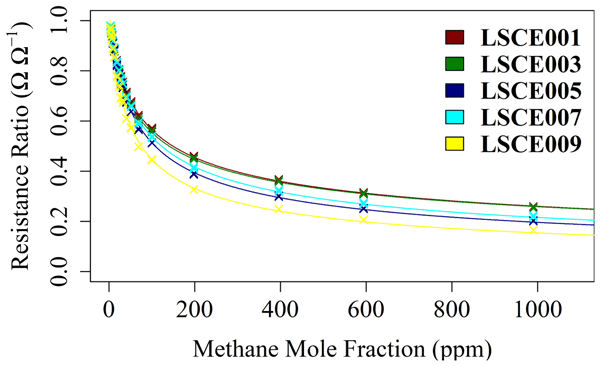
Adil Shah, Olivier Laurent, Luc Lienhardt, Grégoire Broquet, Rodrigo Rivera Martinez, Elisa Allegrini, and Philippe Ciais
Atmos. Meas. Tech., 16, 3391–3419, https://doi.org/10.5194/amt-16-3391-2023, https://doi.org/10.5194/amt-16-3391-2023, 2023
Short summary
Short summary
As methane (CH4) contributes to global warming, more CH4 measurements are required to better characterise source emissions. Hence, we tested a cheap CH4 sensor for 338 d of landfill sampling. We derived an excellent CH4 response model in a stable environment. However, different types of air with the same CH4 level had diverse sensor responses. We characterised temperature and water vapour response but could not replicate field sampling. Thus, other species may cause sensor interactions.
Xueqin Yang, Xiuzhi Chen, Jiashun Ren, Wenping Yuan, Liyang Liu, Juxiu Liu, Dexiang Chen, Yihua Xiao, Qinghai Song, Yanjun Du, Shengbiao Wu, Lei Fan, Xiaoai Dai, Yunpeng Wang, and Yongxian Su
Earth Syst. Sci. Data, 15, 2601–2622, https://doi.org/10.5194/essd-15-2601-2023, https://doi.org/10.5194/essd-15-2601-2023, 2023
Short summary
Short summary
We developed the first time-mapped, continental-scale gridded dataset of monthly leaf area index (LAI) in three leaf age cohorts (i.e., young, mature, and old) from 2001–2018 data (referred to as Lad-LAI). The seasonality of three LAI cohorts from the new Lad-LAI product agrees well at eight sites with very fine-scale collections of monthly LAI. The proposed satellite-based approaches can provide references for mapping finer spatiotemporal-resolution LAI products with different leaf age cohorts.
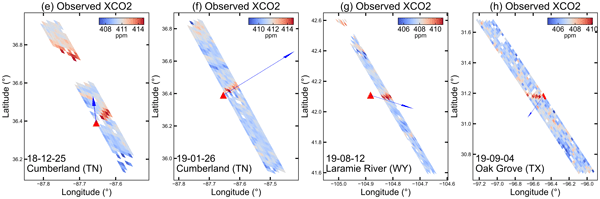
Xiaojuan Lin, Ronald van der A, Jos de Laat, Henk Eskes, Frédéric Chevallier, Philippe Ciais, Zhu Deng, Yuanhao Geng, Xuanren Song, Xiliang Ni, Da Huo, Xinyu Dou, and Zhu Liu
Atmos. Chem. Phys., 23, 6599–6611, https://doi.org/10.5194/acp-23-6599-2023, https://doi.org/10.5194/acp-23-6599-2023, 2023
Short summary
Short summary
Satellite observations provide evidence for CO2 emission signals from isolated power plants. We use these satellite observations to quantify emissions. We found that for power plants with multiple observations, the correlation of estimated and reported emissions is significantly improved compared to a single observation case. This demonstrates that accurate estimation of power plant emissions can be achieved by monitoring from future satellite missions with more frequent observations.
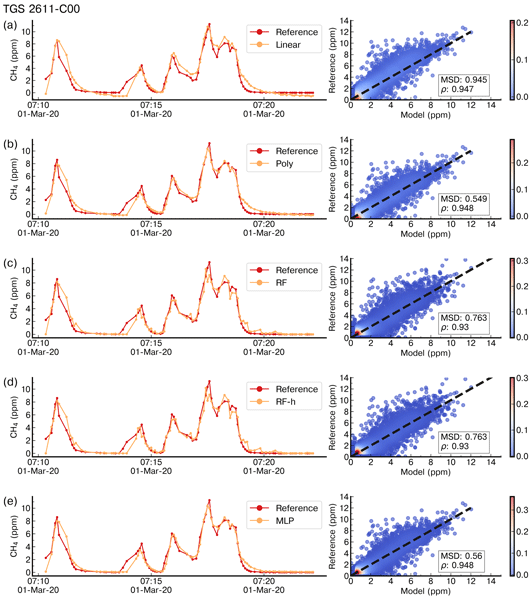
Rodrigo Andres Rivera Martinez, Diego Santaren, Olivier Laurent, Gregoire Broquet, Ford Cropley, Cécile Mallet, Michel Ramonet, Adil Shah, Leonard Rivier, Caroline Bouchet, Catherine Juery, Olivier Duclaux, and Philippe Ciais
Atmos. Meas. Tech., 16, 2209–2235, https://doi.org/10.5194/amt-16-2209-2023, https://doi.org/10.5194/amt-16-2209-2023, 2023
Short summary
Short summary
A network of low-cost sensors is a good alternative to improve the detection of fugitive CH4 emissions. We present the results of four tests conducted with two types of Figaro sensors that were assembled on four chambers in a laboratory experiment: a comparison of five models to reconstruct the CH4 signal, a strategy to reduce the training set size, a detection of age effects in the sensors and a test of the capability to transfer a model between chambers for the same type of sensor.
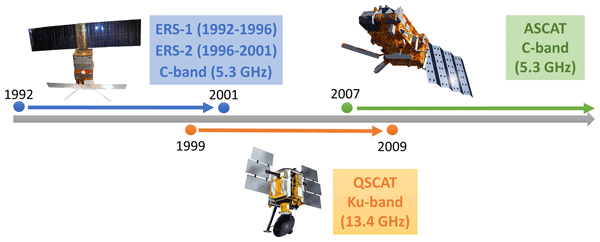
Shengli Tao, Zurui Ao, Jean-Pierre Wigneron, Sassan Saatchi, Philippe Ciais, Jérôme Chave, Thuy Le Toan, Pierre-Louis Frison, Xiaomei Hu, Chi Chen, Lei Fan, Mengjia Wang, Jiangling Zhu, Xia Zhao, Xiaojun Li, Xiangzhuo Liu, Yanjun Su, Tianyu Hu, Qinghua Guo, Zhiheng Wang, Zhiyao Tang, Yi Y. Liu, and Jingyun Fang
Earth Syst. Sci. Data, 15, 1577–1596, https://doi.org/10.5194/essd-15-1577-2023, https://doi.org/10.5194/essd-15-1577-2023, 2023
Short summary
Short summary
We provide the first long-term (since 1992), high-resolution (8.9 km) satellite radar backscatter data set (LHScat) with a C-band (5.3 GHz) signal dynamic for global lands. LHScat was created by fusing signals from ERS (1992–2001; C-band), QSCAT (1999–2009; Ku-band), and ASCAT (since 2007; C-band). LHScat has been validated against independent ERS-2 signals. It could be used in a variety of studies, such as vegetation monitoring and hydrological modelling.
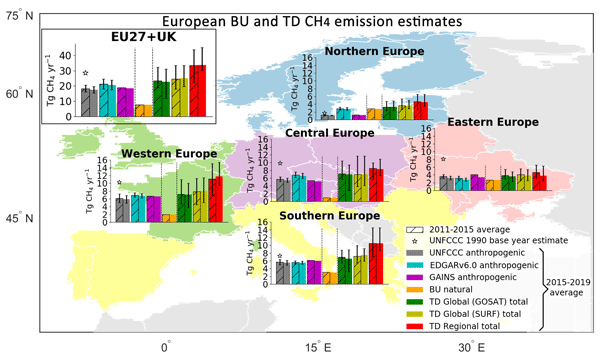
Ana Maria Roxana Petrescu, Chunjing Qiu, Matthew J. McGrath, Philippe Peylin, Glen P. Peters, Philippe Ciais, Rona L. Thompson, Aki Tsuruta, Dominik Brunner, Matthias Kuhnert, Bradley Matthews, Paul I. Palmer, Oksana Tarasova, Pierre Regnier, Ronny Lauerwald, David Bastviken, Lena Höglund-Isaksson, Wilfried Winiwarter, Giuseppe Etiope, Tuula Aalto, Gianpaolo Balsamo, Vladislav Bastrikov, Antoine Berchet, Patrick Brockmann, Giancarlo Ciotoli, Giulia Conchedda, Monica Crippa, Frank Dentener, Christine D. Groot Zwaaftink, Diego Guizzardi, Dirk Günther, Jean-Matthieu Haussaire, Sander Houweling, Greet Janssens-Maenhout, Massaer Kouyate, Adrian Leip, Antti Leppänen, Emanuele Lugato, Manon Maisonnier, Alistair J. Manning, Tiina Markkanen, Joe McNorton, Marilena Muntean, Gabriel D. Oreggioni, Prabir K. Patra, Lucia Perugini, Isabelle Pison, Maarit T. Raivonen, Marielle Saunois, Arjo J. Segers, Pete Smith, Efisio Solazzo, Hanqin Tian, Francesco N. Tubiello, Timo Vesala, Guido R. van der Werf, Chris Wilson, and Sönke Zaehle
Earth Syst. Sci. Data, 15, 1197–1268, https://doi.org/10.5194/essd-15-1197-2023, https://doi.org/10.5194/essd-15-1197-2023, 2023
Short summary
Short summary
This study updates the state-of-the-art scientific overview of CH4 and N2O emissions in the EU27 and UK in Petrescu et al. (2021a). Yearly updates are needed to improve the different respective approaches and to inform on the development of formal verification systems. It integrates the most recent emission inventories, process-based model and regional/global inversions, comparing them with UNFCCC national GHG inventories, in support to policy to facilitate real-time verification procedures.
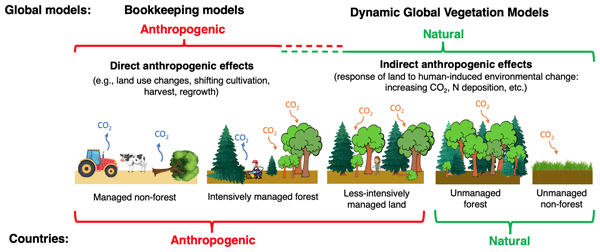
Giacomo Grassi, Clemens Schwingshackl, Thomas Gasser, Richard A. Houghton, Stephen Sitch, Josep G. Canadell, Alessandro Cescatti, Philippe Ciais, Sandro Federici, Pierre Friedlingstein, Werner A. Kurz, Maria J. Sanz Sanchez, Raúl Abad Viñas, Ramdane Alkama, Selma Bultan, Guido Ceccherini, Stefanie Falk, Etsushi Kato, Daniel Kennedy, Jürgen Knauer, Anu Korosuo, Joana Melo, Matthew J. McGrath, Julia E. M. S. Nabel, Benjamin Poulter, Anna A. Romanovskaya, Simone Rossi, Hanqin Tian, Anthony P. Walker, Wenping Yuan, Xu Yue, and Julia Pongratz
Earth Syst. Sci. Data, 15, 1093–1114, https://doi.org/10.5194/essd-15-1093-2023, https://doi.org/10.5194/essd-15-1093-2023, 2023
Short summary
Short summary
Striking differences exist in estimates of land-use CO2 fluxes between the national greenhouse gas inventories and the IPCC assessment reports. These differences hamper an accurate assessment of the collective progress under the Paris Agreement. By implementing an approach that conceptually reconciles land-use CO2 flux from national inventories and the global models used by the IPCC, our study is an important step forward for increasing confidence in land-use CO2 flux estimates.
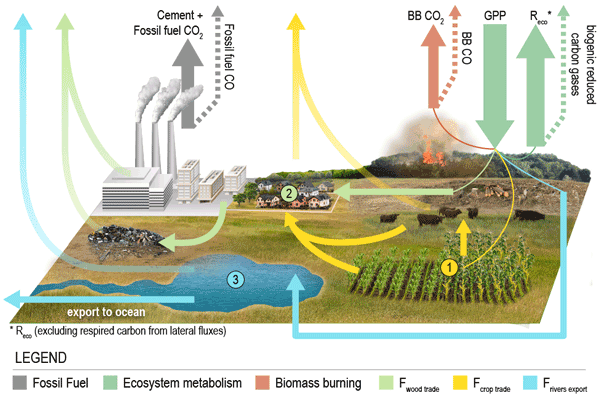
Brendan Byrne, David F. Baker, Sourish Basu, Michael Bertolacci, Kevin W. Bowman, Dustin Carroll, Abhishek Chatterjee, Frédéric Chevallier, Philippe Ciais, Noel Cressie, David Crisp, Sean Crowell, Feng Deng, Zhu Deng, Nicholas M. Deutscher, Manvendra K. Dubey, Sha Feng, Omaira E. García, David W. T. Griffith, Benedikt Herkommer, Lei Hu, Andrew R. Jacobson, Rajesh Janardanan, Sujong Jeong, Matthew S. Johnson, Dylan B. A. Jones, Rigel Kivi, Junjie Liu, Zhiqiang Liu, Shamil Maksyutov, John B. Miller, Scot M. Miller, Isamu Morino, Justus Notholt, Tomohiro Oda, Christopher W. O'Dell, Young-Suk Oh, Hirofumi Ohyama, Prabir K. Patra, Hélène Peiro, Christof Petri, Sajeev Philip, David F. Pollard, Benjamin Poulter, Marine Remaud, Andrew Schuh, Mahesh K. Sha, Kei Shiomi, Kimberly Strong, Colm Sweeney, Yao Té, Hanqin Tian, Voltaire A. Velazco, Mihalis Vrekoussis, Thorsten Warneke, John R. Worden, Debra Wunch, Yuanzhi Yao, Jeongmin Yun, Andrew Zammit-Mangion, and Ning Zeng
Earth Syst. Sci. Data, 15, 963–1004, https://doi.org/10.5194/essd-15-963-2023, https://doi.org/10.5194/essd-15-963-2023, 2023
Short summary
Short summary
Changes in the carbon stocks of terrestrial ecosystems result in emissions and removals of CO2. These can be driven by anthropogenic activities (e.g., deforestation), natural processes (e.g., fires) or in response to rising CO2 (e.g., CO2 fertilization). This paper describes a dataset of CO2 emissions and removals derived from atmospheric CO2 observations. This pilot dataset informs current capabilities and future developments towards top-down monitoring and verification systems.
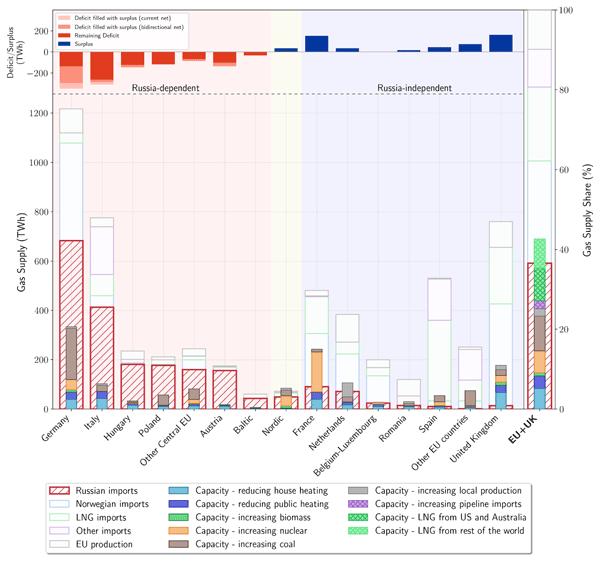
Chuanlong Zhou, Biqing Zhu, Steven J. Davis, Zhu Liu, Antoine Halff, Simon Ben Arous, Hugo de Almeida Rodrigues, and Philippe Ciais
Earth Syst. Sci. Data, 15, 949–961, https://doi.org/10.5194/essd-15-949-2023, https://doi.org/10.5194/essd-15-949-2023, 2023
Short summary
Short summary
Our work aims to analyze sectoral and country-based daily natural gas supply–storage–consumption based on ENTSOG, Eurostat, and multiple datasets in the EU27 and UK. We estimated the magnitude of the Russian gas gap if Russian gas imports were to stop as well as potential short-term solutions to fill this gap. Our datasets could be important in various fields, such as gas/energy consumption and market modeling, carbon emission and climate change research, and policy decision-making.
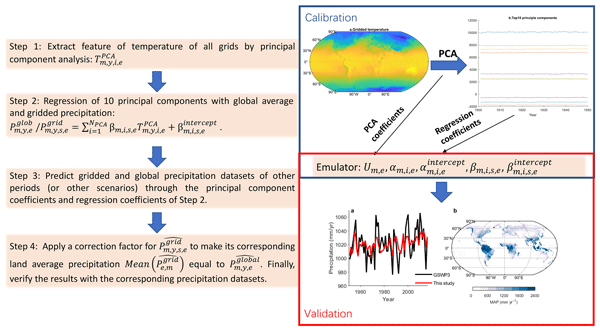
Gang Liu, Shushi Peng, Chris Huntingford, and Yi Xi
Geosci. Model Dev., 16, 1277–1296, https://doi.org/10.5194/gmd-16-1277-2023, https://doi.org/10.5194/gmd-16-1277-2023, 2023
Short summary
Short summary
Due to computational limits, lower-complexity models (LCMs) were developed as a complementary tool for accelerating comprehensive Earth system models (ESMs) but still lack a good precipitation emulator for LCMs. Here, we developed a data-calibrated precipitation emulator (PREMU), a computationally effective way to better estimate historical and simulated precipitation by current ESMs. PREMU has potential applications related to land surface processes and their interactions with climate change.
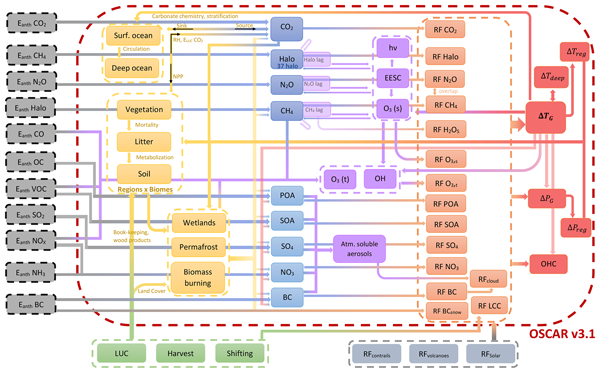
Yann Quilcaille, Thomas Gasser, Philippe Ciais, and Olivier Boucher
Geosci. Model Dev., 16, 1129–1161, https://doi.org/10.5194/gmd-16-1129-2023, https://doi.org/10.5194/gmd-16-1129-2023, 2023
Short summary
Short summary
The model OSCAR is a simple climate model, meaning its representation of the Earth system is simplified but calibrated on models of higher complexity. Here, we diagnose its latest version using a total of 99 experiments in a probabilistic framework and under observational constraints. OSCAR v3.1 shows good agreement with observations, complex Earth system models and emerging properties. Some points for improvements are identified, such as the ocean carbon cycle.
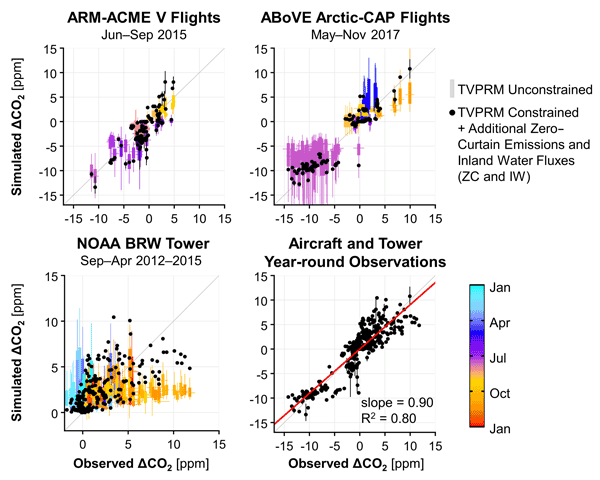
Luke D. Schiferl, Jennifer D. Watts, Erik J. L. Larson, Kyle A. Arndt, Sébastien C. Biraud, Eugénie S. Euskirchen, Jordan P. Goodrich, John M. Henderson, Aram Kalhori, Kathryn McKain, Marikate E. Mountain, J. William Munger, Walter C. Oechel, Colm Sweeney, Yonghong Yi, Donatella Zona, and Róisín Commane
Biogeosciences, 19, 5953–5972, https://doi.org/10.5194/bg-19-5953-2022, https://doi.org/10.5194/bg-19-5953-2022, 2022
Short summary
Short summary
As the Arctic rapidly warms, vast stores of thawing permafrost could release carbon dioxide (CO2) into the atmosphere. We combined observations of atmospheric CO2 concentrations from aircraft and a tower with observed CO2 fluxes from tundra ecosystems and found that the Alaskan North Slope in not a consistent source nor sink of CO2. Our study shows the importance of using both site-level and atmospheric measurements to constrain regional net CO2 fluxes and improve biogenic processes in models.
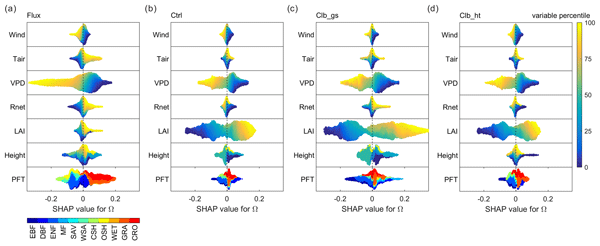
Yuan Zhang, Devaraju Narayanappa, Philippe Ciais, Wei Li, Daniel Goll, Nicolas Vuichard, Martin G. De Kauwe, Laurent Li, and Fabienne Maignan
Geosci. Model Dev., 15, 9111–9125, https://doi.org/10.5194/gmd-15-9111-2022, https://doi.org/10.5194/gmd-15-9111-2022, 2022
Short summary
Short summary
There are a few studies to examine if current models correctly represented the complex processes of transpiration. Here, we use a coefficient Ω, which indicates if transpiration is mainly controlled by vegetation processes or by turbulence, to evaluate the ORCHIDEE model. We found a good performance of ORCHIDEE, but due to compensation of biases in different processes, we also identified how different factors control Ω and where the model is wrong. Our method is generic to evaluate other models.
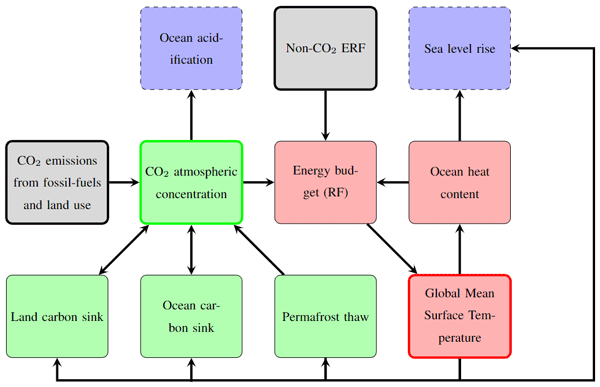
Thomas Bossy, Thomas Gasser, and Philippe Ciais
Geosci. Model Dev., 15, 8831–8868, https://doi.org/10.5194/gmd-15-8831-2022, https://doi.org/10.5194/gmd-15-8831-2022, 2022
Short summary
Short summary
We developed a new simple climate model designed to fill a perceived gap within the existing simple climate models by fulfilling three key requirements: calibration using Bayesian inference, the possibility of coupling with integrated assessment models, and the capacity to explore climate scenarios compatible with limiting climate impacts. Here, we describe the model and its calibration using the latest data from complex CMIP6 models and the IPCC AR6, and we assess its performance.
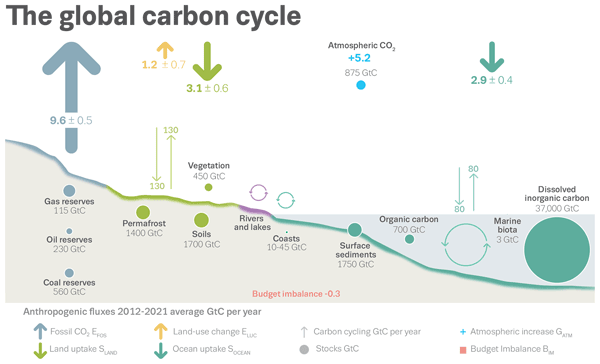
Pierre Friedlingstein, Michael O'Sullivan, Matthew W. Jones, Robbie M. Andrew, Luke Gregor, Judith Hauck, Corinne Le Quéré, Ingrid T. Luijkx, Are Olsen, Glen P. Peters, Wouter Peters, Julia Pongratz, Clemens Schwingshackl, Stephen Sitch, Josep G. Canadell, Philippe Ciais, Robert B. Jackson, Simone R. Alin, Ramdane Alkama, Almut Arneth, Vivek K. Arora, Nicholas R. Bates, Meike Becker, Nicolas Bellouin, Henry C. Bittig, Laurent Bopp, Frédéric Chevallier, Louise P. Chini, Margot Cronin, Wiley Evans, Stefanie Falk, Richard A. Feely, Thomas Gasser, Marion Gehlen, Thanos Gkritzalis, Lucas Gloege, Giacomo Grassi, Nicolas Gruber, Özgür Gürses, Ian Harris, Matthew Hefner, Richard A. Houghton, George C. Hurtt, Yosuke Iida, Tatiana Ilyina, Atul K. Jain, Annika Jersild, Koji Kadono, Etsushi Kato, Daniel Kennedy, Kees Klein Goldewijk, Jürgen Knauer, Jan Ivar Korsbakken, Peter Landschützer, Nathalie Lefèvre, Keith Lindsay, Junjie Liu, Zhu Liu, Gregg Marland, Nicolas Mayot, Matthew J. McGrath, Nicolas Metzl, Natalie M. Monacci, David R. Munro, Shin-Ichiro Nakaoka, Yosuke Niwa, Kevin O'Brien, Tsuneo Ono, Paul I. Palmer, Naiqing Pan, Denis Pierrot, Katie Pocock, Benjamin Poulter, Laure Resplandy, Eddy Robertson, Christian Rödenbeck, Carmen Rodriguez, Thais M. Rosan, Jörg Schwinger, Roland Séférian, Jamie D. Shutler, Ingunn Skjelvan, Tobias Steinhoff, Qing Sun, Adrienne J. Sutton, Colm Sweeney, Shintaro Takao, Toste Tanhua, Pieter P. Tans, Xiangjun Tian, Hanqin Tian, Bronte Tilbrook, Hiroyuki Tsujino, Francesco Tubiello, Guido R. van der Werf, Anthony P. Walker, Rik Wanninkhof, Chris Whitehead, Anna Willstrand Wranne, Rebecca Wright, Wenping Yuan, Chao Yue, Xu Yue, Sönke Zaehle, Jiye Zeng, and Bo Zheng
Earth Syst. Sci. Data, 14, 4811–4900, https://doi.org/10.5194/essd-14-4811-2022, https://doi.org/10.5194/essd-14-4811-2022, 2022
Short summary
Short summary
The Global Carbon Budget 2022 describes the datasets and methodology used to quantify the anthropogenic emissions of carbon dioxide (CO2) and their partitioning among the atmosphere, the land ecosystems, and the ocean. These living datasets are updated every year to provide the highest transparency and traceability in the reporting of CO2, the key driver of climate change.
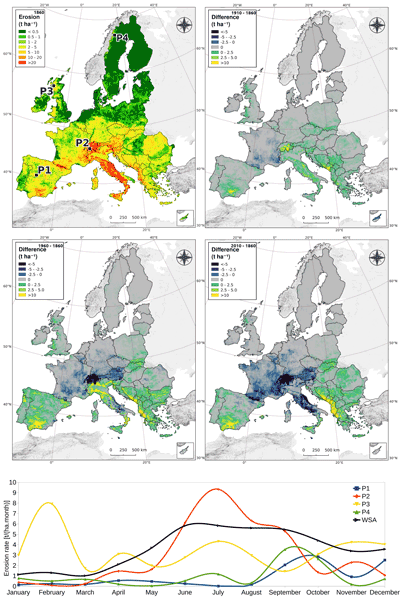
Arthur Nicolaus Fendrich, Philippe Ciais, Emanuele Lugato, Marco Carozzi, Bertrand Guenet, Pasquale Borrelli, Victoria Naipal, Matthew McGrath, Philippe Martin, and Panos Panagos
Geosci. Model Dev., 15, 7835–7857, https://doi.org/10.5194/gmd-15-7835-2022, https://doi.org/10.5194/gmd-15-7835-2022, 2022
Short summary
Short summary
Currently, spatially explicit models for soil carbon stock can simulate the impacts of several changes. However, they do not incorporate the erosion, lateral transport, and deposition (ETD) of soil material. The present work developed ETD formulation, illustrated model calibration and validation for Europe, and presented the results for a depositional site. We expect that our work advances ETD models' description and facilitates their reproduction and incorporation in land surface models.

Yitong Yao, Emilie Joetzjer, Philippe Ciais, Nicolas Viovy, Fabio Cresto Aleina, Jerome Chave, Lawren Sack, Megan Bartlett, Patrick Meir, Rosie Fisher, and Sebastiaan Luyssaert
Geosci. Model Dev., 15, 7809–7833, https://doi.org/10.5194/gmd-15-7809-2022, https://doi.org/10.5194/gmd-15-7809-2022, 2022
Short summary
Short summary
To facilitate more mechanistic modeling of drought effects on forest dynamics, our study implements a hydraulic module to simulate the vertical water flow, change in water storage and percentage loss of stem conductance (PLC). With the relationship between PLC and tree mortality, our model can successfully reproduce the large biomass drop observed under throughfall exclusion. Our hydraulic module provides promising avenues benefiting the prediction for mortality under future drought events.
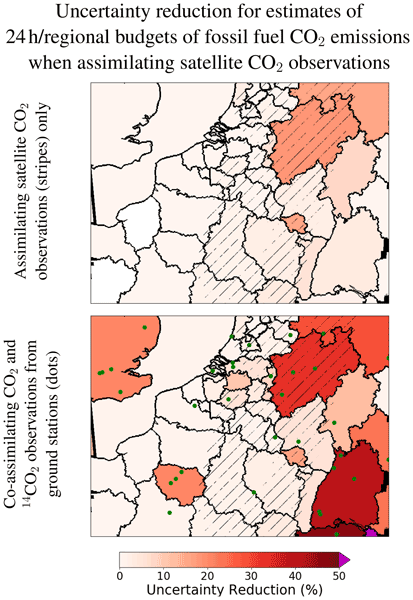
Elise Potier, Grégoire Broquet, Yilong Wang, Diego Santaren, Antoine Berchet, Isabelle Pison, Julia Marshall, Philippe Ciais, François-Marie Bréon, and Frédéric Chevallier
Atmos. Meas. Tech., 15, 5261–5288, https://doi.org/10.5194/amt-15-5261-2022, https://doi.org/10.5194/amt-15-5261-2022, 2022
Short summary
Short summary
Atmospheric inversion at local–regional scales over Europe and pseudo-data assimilation are used to evaluate how CO2 and 14CO2 ground-based measurement networks could complement satellite CO2 imagers to monitor fossil fuel (FF) CO2 emissions. This combination significantly improves precision in the FF emission estimates in areas with a dense network but does not strongly support the separation of the FF from the biogenic signals or the spatio-temporal extrapolation of the satellite information.
Jan De Pue, José Miguel Barrios, Liyang Liu, Philippe Ciais, Alirio Arboleda, Rafiq Hamdi, Manuela Balzarolo, Fabienne Maignan, and Françoise Gellens-Meulenberghs
Biogeosciences, 19, 4361–4386, https://doi.org/10.5194/bg-19-4361-2022, https://doi.org/10.5194/bg-19-4361-2022, 2022
Short summary
Short summary
The functioning of ecosystems involves numerous biophysical processes which interact with each other. Land surface models (LSMs) are used to describe these processes and form an essential component of climate models. In this paper, we evaluate the performance of three LSMs and their interactions with soil moisture and vegetation. Though we found room for improvement in the simulation of soil moisture and drought stress, the main cause of errors was related to the simulated growth of vegetation.
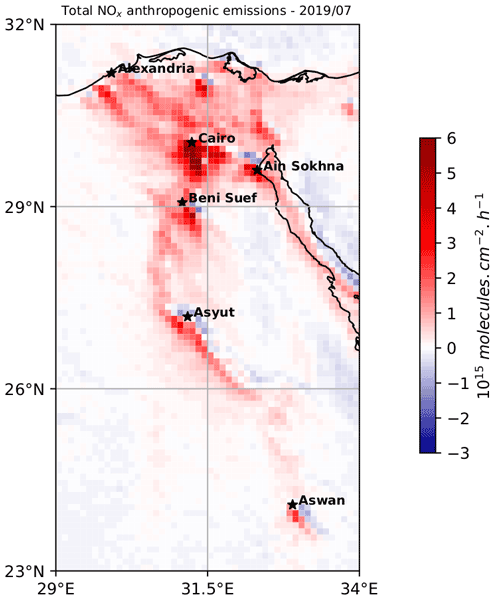
Anthony Rey-Pommier, Frédéric Chevallier, Philippe Ciais, Grégoire Broquet, Theodoros Christoudias, Jonilda Kushta, Didier Hauglustaine, and Jean Sciare
Atmos. Chem. Phys., 22, 11505–11527, https://doi.org/10.5194/acp-22-11505-2022, https://doi.org/10.5194/acp-22-11505-2022, 2022
Short summary
Short summary
Emission inventories for air pollutants can be uncertain in developing countries. In order to overcome these uncertainties, we model nitrogen oxide emissions in Egypt using satellite retrievals. We detect a weekly cycle reflecting Egyptian social norms, an annual cycle consistent with electricity consumption and an activity drop due to the COVID-19 pandemic. However, discrepancies with inventories remain high, illustrating the needs for additional data to improve the potential of our method.
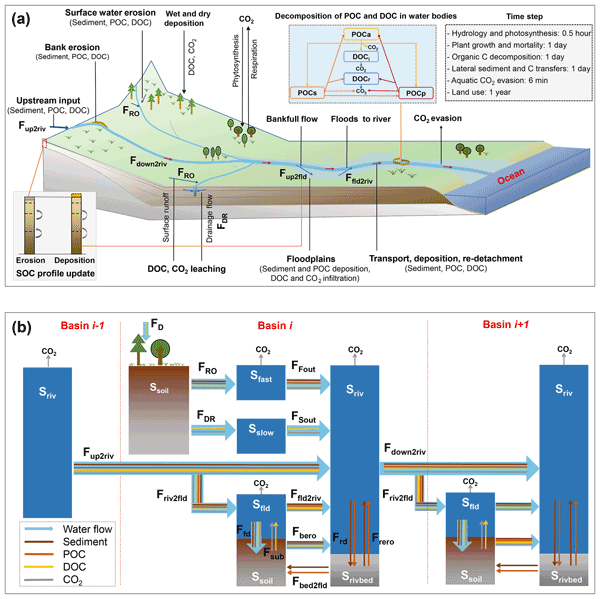
Haicheng Zhang, Ronny Lauerwald, Pierre Regnier, Philippe Ciais, Kristof Van Oost, Victoria Naipal, Bertrand Guenet, and Wenping Yuan
Earth Syst. Dynam., 13, 1119–1144, https://doi.org/10.5194/esd-13-1119-2022, https://doi.org/10.5194/esd-13-1119-2022, 2022
Short summary
Short summary
We present a land surface model which can simulate the complete lateral transfer of sediment and carbon from land to ocean through rivers. Our model captures the water, sediment, and organic carbon discharges in European rivers well. Application of our model in Europe indicates that lateral carbon transfer can strongly change regional land carbon budgets by affecting organic carbon distribution and soil moisture.
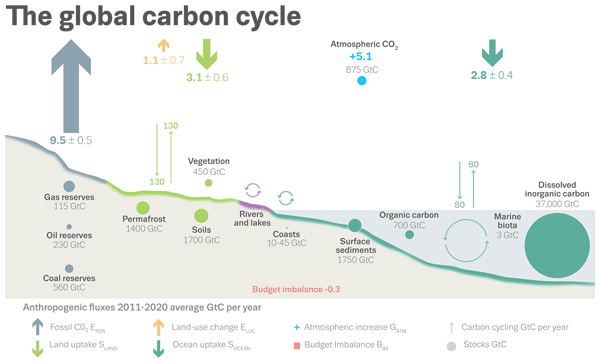
Pierre Friedlingstein, Matthew W. Jones, Michael O'Sullivan, Robbie M. Andrew, Dorothee C. E. Bakker, Judith Hauck, Corinne Le Quéré, Glen P. Peters, Wouter Peters, Julia Pongratz, Stephen Sitch, Josep G. Canadell, Philippe Ciais, Rob B. Jackson, Simone R. Alin, Peter Anthoni, Nicholas R. Bates, Meike Becker, Nicolas Bellouin, Laurent Bopp, Thi Tuyet Trang Chau, Frédéric Chevallier, Louise P. Chini, Margot Cronin, Kim I. Currie, Bertrand Decharme, Laique M. Djeutchouang, Xinyu Dou, Wiley Evans, Richard A. Feely, Liang Feng, Thomas Gasser, Dennis Gilfillan, Thanos Gkritzalis, Giacomo Grassi, Luke Gregor, Nicolas Gruber, Özgür Gürses, Ian Harris, Richard A. Houghton, George C. Hurtt, Yosuke Iida, Tatiana Ilyina, Ingrid T. Luijkx, Atul Jain, Steve D. Jones, Etsushi Kato, Daniel Kennedy, Kees Klein Goldewijk, Jürgen Knauer, Jan Ivar Korsbakken, Arne Körtzinger, Peter Landschützer, Siv K. Lauvset, Nathalie Lefèvre, Sebastian Lienert, Junjie Liu, Gregg Marland, Patrick C. McGuire, Joe R. Melton, David R. Munro, Julia E. M. S. Nabel, Shin-Ichiro Nakaoka, Yosuke Niwa, Tsuneo Ono, Denis Pierrot, Benjamin Poulter, Gregor Rehder, Laure Resplandy, Eddy Robertson, Christian Rödenbeck, Thais M. Rosan, Jörg Schwinger, Clemens Schwingshackl, Roland Séférian, Adrienne J. Sutton, Colm Sweeney, Toste Tanhua, Pieter P. Tans, Hanqin Tian, Bronte Tilbrook, Francesco Tubiello, Guido R. van der Werf, Nicolas Vuichard, Chisato Wada, Rik Wanninkhof, Andrew J. Watson, David Willis, Andrew J. Wiltshire, Wenping Yuan, Chao Yue, Xu Yue, Sönke Zaehle, and Jiye Zeng
Earth Syst. Sci. Data, 14, 1917–2005, https://doi.org/10.5194/essd-14-1917-2022, https://doi.org/10.5194/essd-14-1917-2022, 2022
Short summary
Short summary
The Global Carbon Budget 2021 describes the data sets and methodology used to quantify the emissions of carbon dioxide and their partitioning among the atmosphere, land, and ocean. These living data are updated every year to provide the highest transparency and traceability in the reporting of CO2, the key driver of climate change.
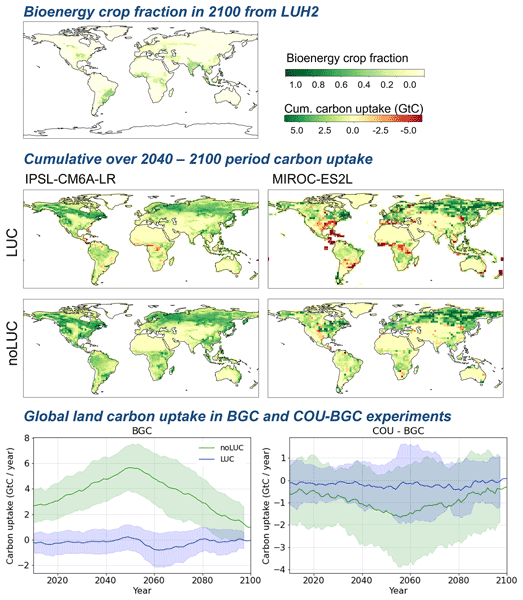
Irina Melnikova, Olivier Boucher, Patricia Cadule, Katsumasa Tanaka, Thomas Gasser, Tomohiro Hajima, Yann Quilcaille, Hideo Shiogama, Roland Séférian, Kaoru Tachiiri, Nicolas Vuichard, Tokuta Yokohata, and Philippe Ciais
Earth Syst. Dynam., 13, 779–794, https://doi.org/10.5194/esd-13-779-2022, https://doi.org/10.5194/esd-13-779-2022, 2022
Short summary
Short summary
The deployment of bioenergy crops for capturing carbon from the atmosphere facilitates global warming mitigation via generating negative CO2 emissions. Here, we explored the consequences of large-scale energy crops deployment on the land carbon cycle. The land-use change for energy crops leads to carbon emissions and loss of future potential increase in carbon uptake by natural ecosystems. This impact should be taken into account by the modeling teams and accounted for in mitigation policies.
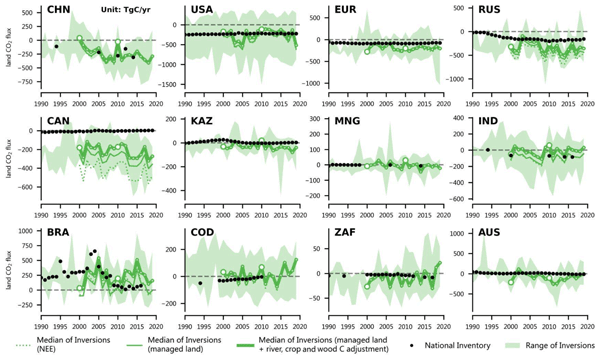
Zhu Deng, Philippe Ciais, Zitely A. Tzompa-Sosa, Marielle Saunois, Chunjing Qiu, Chang Tan, Taochun Sun, Piyu Ke, Yanan Cui, Katsumasa Tanaka, Xin Lin, Rona L. Thompson, Hanqin Tian, Yuanzhi Yao, Yuanyuan Huang, Ronny Lauerwald, Atul K. Jain, Xiaoming Xu, Ana Bastos, Stephen Sitch, Paul I. Palmer, Thomas Lauvaux, Alexandre d'Aspremont, Clément Giron, Antoine Benoit, Benjamin Poulter, Jinfeng Chang, Ana Maria Roxana Petrescu, Steven J. Davis, Zhu Liu, Giacomo Grassi, Clément Albergel, Francesco N. Tubiello, Lucia Perugini, Wouter Peters, and Frédéric Chevallier
Earth Syst. Sci. Data, 14, 1639–1675, https://doi.org/10.5194/essd-14-1639-2022, https://doi.org/10.5194/essd-14-1639-2022, 2022
Short summary
Short summary
In support of the global stocktake of the Paris Agreement on climate change, we proposed a method for reconciling the results of global atmospheric inversions with data from UNFCCC national greenhouse gas inventories (NGHGIs). Here, based on a new global harmonized database that we compiled from the UNFCCC NGHGIs and a comprehensive framework presented in this study to process the results of inversions, we compared their results of carbon dioxide (CO2), methane (CH4), and nitrous oxide (N2O).
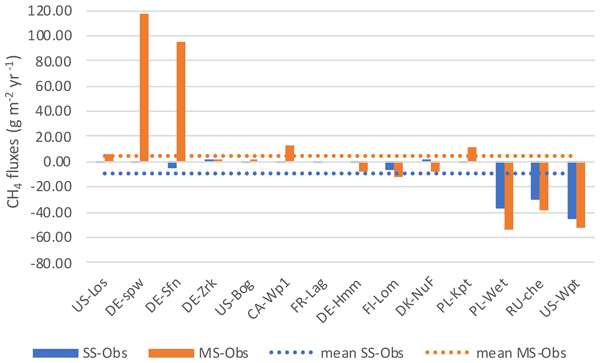
Elodie Salmon, Fabrice Jégou, Bertrand Guenet, Line Jourdain, Chunjing Qiu, Vladislav Bastrikov, Christophe Guimbaud, Dan Zhu, Philippe Ciais, Philippe Peylin, Sébastien Gogo, Fatima Laggoun-Défarge, Mika Aurela, M. Syndonia Bret-Harte, Jiquan Chen, Bogdan H. Chojnicki, Housen Chu, Colin W. Edgar, Eugenie S. Euskirchen, Lawrence B. Flanagan, Krzysztof Fortuniak, David Holl, Janina Klatt, Olaf Kolle, Natalia Kowalska, Lars Kutzbach, Annalea Lohila, Lutz Merbold, Włodzimierz Pawlak, Torsten Sachs, and Klaudia Ziemblińska
Geosci. Model Dev., 15, 2813–2838, https://doi.org/10.5194/gmd-15-2813-2022, https://doi.org/10.5194/gmd-15-2813-2022, 2022
Short summary
Short summary
A methane model that features methane production and transport by plants, the ebullition process and diffusion in soil, oxidation to CO2, and CH4 fluxes to the atmosphere has been embedded in the ORCHIDEE-PEAT land surface model, which includes an explicit representation of northern peatlands. This model, ORCHIDEE-PCH4, was calibrated and evaluated on 14 peatland sites. Results show that the model is sensitive to temperature and substrate availability over the top 75 cm of soil depth.
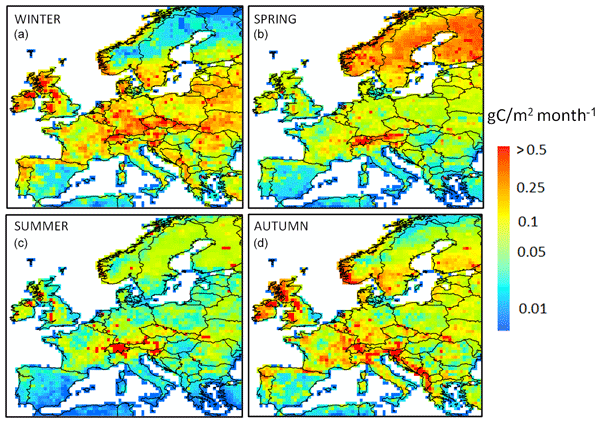
Céline Gommet, Ronny Lauerwald, Philippe Ciais, Bertrand Guenet, Haicheng Zhang, and Pierre Regnier
Earth Syst. Dynam., 13, 393–418, https://doi.org/10.5194/esd-13-393-2022, https://doi.org/10.5194/esd-13-393-2022, 2022
Short summary
Short summary
Dissolved organic carbon (DOC) leaching from soils into river networks is an important component of the land carbon (C) budget, but its spatiotemporal variation is not yet fully constrained. We use a land surface model to simulate the present-day land C budget at the European scale, including leaching of DOC from the soil. We found average leaching of 14.3 Tg C yr−1 (0.6 % of terrestrial net primary production) with seasonal variations. We determine runoff and temperature to be the main drivers.
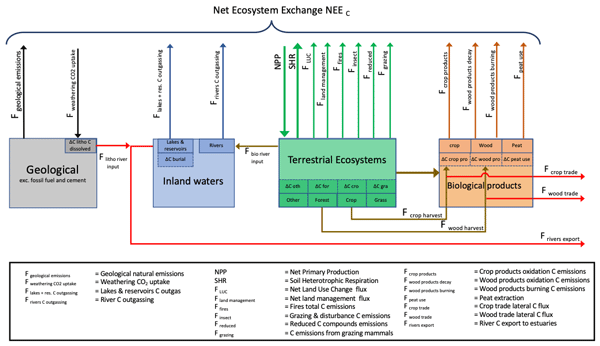
Philippe Ciais, Ana Bastos, Frédéric Chevallier, Ronny Lauerwald, Ben Poulter, Josep G. Canadell, Gustaf Hugelius, Robert B. Jackson, Atul Jain, Matthew Jones, Masayuki Kondo, Ingrid T. Luijkx, Prabir K. Patra, Wouter Peters, Julia Pongratz, Ana Maria Roxana Petrescu, Shilong Piao, Chunjing Qiu, Celso Von Randow, Pierre Regnier, Marielle Saunois, Robert Scholes, Anatoly Shvidenko, Hanqin Tian, Hui Yang, Xuhui Wang, and Bo Zheng
Geosci. Model Dev., 15, 1289–1316, https://doi.org/10.5194/gmd-15-1289-2022, https://doi.org/10.5194/gmd-15-1289-2022, 2022
Short summary
Short summary
The second phase of the Regional Carbon Cycle Assessment and Processes (RECCAP) will provide updated quantification and process understanding of CO2, CH4, and N2O emissions and sinks for ten regions of the globe. In this paper, we give definitions, review different methods, and make recommendations for estimating different components of the total land–atmosphere carbon exchange for each region in a consistent and complete approach.
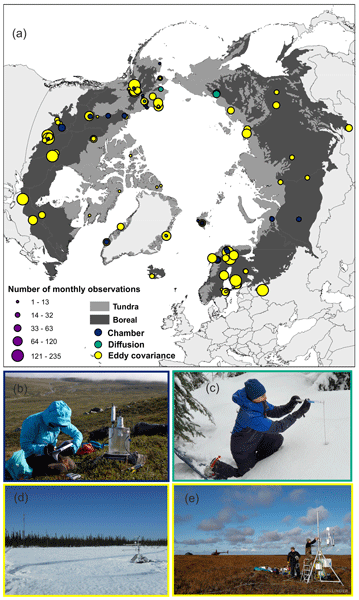
Anna-Maria Virkkala, Susan M. Natali, Brendan M. Rogers, Jennifer D. Watts, Kathleen Savage, Sara June Connon, Marguerite Mauritz, Edward A. G. Schuur, Darcy Peter, Christina Minions, Julia Nojeim, Roisin Commane, Craig A. Emmerton, Mathias Goeckede, Manuel Helbig, David Holl, Hiroki Iwata, Hideki Kobayashi, Pasi Kolari, Efrén López-Blanco, Maija E. Marushchak, Mikhail Mastepanov, Lutz Merbold, Frans-Jan W. Parmentier, Matthias Peichl, Torsten Sachs, Oliver Sonnentag, Masahito Ueyama, Carolina Voigt, Mika Aurela, Julia Boike, Gerardo Celis, Namyi Chae, Torben R. Christensen, M. Syndonia Bret-Harte, Sigrid Dengel, Han Dolman, Colin W. Edgar, Bo Elberling, Eugenie Euskirchen, Achim Grelle, Juha Hatakka, Elyn Humphreys, Järvi Järveoja, Ayumi Kotani, Lars Kutzbach, Tuomas Laurila, Annalea Lohila, Ivan Mammarella, Yojiro Matsuura, Gesa Meyer, Mats B. Nilsson, Steven F. Oberbauer, Sang-Jong Park, Roman Petrov, Anatoly S. Prokushkin, Christopher Schulze, Vincent L. St. Louis, Eeva-Stiina Tuittila, Juha-Pekka Tuovinen, William Quinton, Andrej Varlagin, Donatella Zona, and Viacheslav I. Zyryanov
Earth Syst. Sci. Data, 14, 179–208, https://doi.org/10.5194/essd-14-179-2022, https://doi.org/10.5194/essd-14-179-2022, 2022
Short summary
Short summary
The effects of climate warming on carbon cycling across the Arctic–boreal zone (ABZ) remain poorly understood due to the relatively limited distribution of ABZ flux sites. Fortunately, this flux network is constantly increasing, but new measurements are published in various platforms, making it challenging to understand the ABZ carbon cycle as a whole. Here, we compiled a new database of Arctic–boreal CO2 fluxes to help facilitate large-scale assessments of the ABZ carbon cycle.
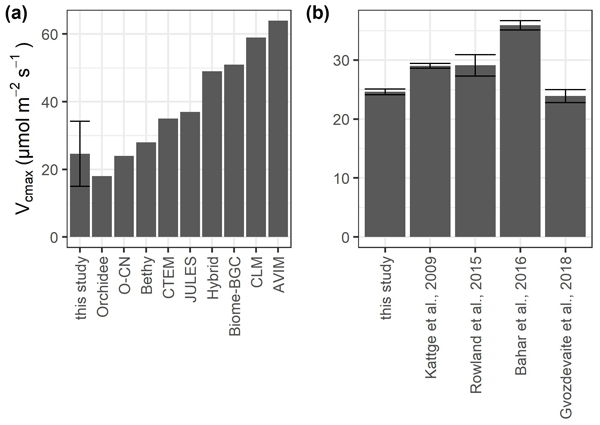
Lore T. Verryckt, Sara Vicca, Leandro Van Langenhove, Clément Stahl, Dolores Asensio, Ifigenia Urbina, Romà Ogaya, Joan Llusià, Oriol Grau, Guille Peguero, Albert Gargallo-Garriga, Elodie A. Courtois, Olga Margalef, Miguel Portillo-Estrada, Philippe Ciais, Michael Obersteiner, Lucia Fuchslueger, Laynara F. Lugli, Pere-Roc Fernandez-Garberí, Helena Vallicrosa, Melanie Verlinden, Christian Ranits, Pieter Vermeir, Sabrina Coste, Erik Verbruggen, Laëtitia Bréchet, Jordi Sardans, Jérôme Chave, Josep Peñuelas, and Ivan A. Janssens
Earth Syst. Sci. Data, 14, 5–18, https://doi.org/10.5194/essd-14-5-2022, https://doi.org/10.5194/essd-14-5-2022, 2022
Short summary
Short summary
We provide a comprehensive dataset of vertical profiles of photosynthesis and important leaf traits, including leaf N and P concentrations, from two 3-year, large-scale nutrient addition experiments conducted in two tropical rainforests in French Guiana. These data present a unique source of information to further improve model representations of the roles of N and P, and other leaf nutrients, in photosynthesis in tropical forests.
Adrian Chappell, Nicholas Webb, Mark Hennen, Charles Zender, Philippe Ciais, Kerstin Schepanski, Brandon Edwards, Nancy Ziegler, Sandra Jones, Yves Balkanski, Daniel Tong, John Leys, Stephan Heidenreich, Robert Hynes, David Fuchs, Zhenzhong Zeng, Marie Ekström, Matthew Baddock, Jeffrey Lee, and Tarek Kandakji
Geosci. Model Dev. Discuss., https://doi.org/10.5194/gmd-2021-337, https://doi.org/10.5194/gmd-2021-337, 2021
Revised manuscript not accepted
Short summary
Short summary
Dust emissions influence global climate while simultaneously reducing the productive potential and resilience of landscapes to climate stressors, together impacting food security and human health. Our results indicate that tuning dust emission models to dust in the atmosphere has hidden dust emission modelling weaknesses and its poor performance. Our new approach will reduce uncertainty and driven by prognostic albedo improve Earth System Models of aerosol effects on future environmental change.
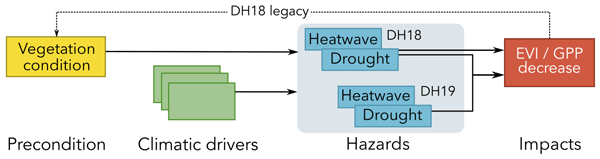
Ana Bastos, René Orth, Markus Reichstein, Philippe Ciais, Nicolas Viovy, Sönke Zaehle, Peter Anthoni, Almut Arneth, Pierre Gentine, Emilie Joetzjer, Sebastian Lienert, Tammas Loughran, Patrick C. McGuire, Sungmin O, Julia Pongratz, and Stephen Sitch
Earth Syst. Dynam., 12, 1015–1035, https://doi.org/10.5194/esd-12-1015-2021, https://doi.org/10.5194/esd-12-1015-2021, 2021
Short summary
Short summary
Temperate biomes in Europe are not prone to recurrent dry and hot conditions in summer. However, these conditions may become more frequent in the coming decades. Because stress conditions can leave legacies for many years, this may result in reduced ecosystem resilience under recurrent stress. We assess vegetation vulnerability to the hot and dry summers in 2018 and 2019 in Europe and find the important role of inter-annual legacy effects from 2018 in modulating the impacts of the 2019 event.
Cited articles
Akaike, H.: A new look at the statistical model identification, IEEE T. Automat. Contr., 19, 716–723, https://doi.org/10.1109/TAC.1974.1100705, 1974.
Antala, M., Juszczak, R., Van Der Tol, C., and Rastogi, A.: Impact of climate change-induced alterations in peatland vegetation phenology and composition on carbon balance, Sci. Total Environ., 827, 154294, https://doi.org/10.1016/j.scitotenv.2022.154294, 2022.
Arnold, K. V., Weslien, P., Nilsson, M., Svensson, B. H., and Klemedtsson, L.: Fluxes of CO2, CH4 and N2O from drained coniferous forests on organic soils, Forest Ecol. Manag., 210, 239–254, https://doi.org/10.1016/j.foreco.2005.02.031, 2005.
Aurela, M., Riutta, T., Laurila, T., Tuovinen, J.-P., Vesala, T., Tuittila, E.-S., Rinne, J., Haapanala, S., and Laine, J.: CO2 exchange of a sedge fen in southern Finland – the impact of a drought period, Tellus B, 59, 826, https://doi.org/10.1111/j.1600-0889.2007.00309.x, 2007.
Bernhofer, C., Grünwald, T., Moderow, U., Hehn, M., Eichelmann, U., Prasse, H., and Postel, U.: FLUXNET2015 DE-Akm Anklam, https://doi.org/10.18140/FLX/1440213, 2009.
Blodau, C.: Carbon cycling in peatlands, A review of processes and controls, Environ. Rev., 10, 111–134, https://doi.org/10.1139/a02-004, 2002.
Boelter, D. H.: Water table drawdown around an open ditch in organic soils, J. Hydrol., 15, 329–340, https://doi.org/10.1016/0022-1694(72)90046-7, 1972.
Conchedda, G. and Tubiello, F. N.: Drainage of organic soils and GHG emissions: validation with country data, Earth Syst. Sci. Data, 12, 3113–3137, https://doi.org/10.5194/essd-12-3113-2020, 2020.
Couwenberg, J., Dommain, R., and Joosten, H.: Greenhouse gas fluxes from tropical peatlands in south-east Asia, Glob. Change Biol., 16, 1715–1732, https://doi.org/10.1111/j.1365-2486.2009.02016.x, 2010.
Desai, A. and Thom, J.: FLUXNET-CH4 US-Los Lost Creek, https://doi.org/10.18140/FLX/1669682, 2020.
Ducharne, A., Ottlé, C., Maignan, F., Vuichard, N., Ghattas, J., Wang, F., Peylin, P., Polcher, J., Guimberteau, M., Maugis, P., Tafasca, S., Tootchi, A., Verhoef, A., and Mizuochi, H.: The hydrol module of ORCHIDEE: scientific documentation, IPSL, https://forge.ipsl.jussieu.fr/orchidee/raw-attachment/wiki/Documentation/eqs_hydrol_25April2018_Ducharne.pdf (last access: 27 March 2026), 2018.
Eggleston, H. S. (Ed.): 2006 IPCC guidelines for national greenhouse gas inventories, IGES, Hayama, Japan, https://www.ipcc-nggip.iges.or.jp/public/2006gl/ (last access: 27 March 2026), 2006.
Evans, C. D., Peacock, M., Baird, A. J., Artz, R. R. E., Burden, A., Callaghan, N., Chapman, P. J., Cooper, H. M., Coyle, M., Craig, E., Cumming, A., Dixon, S., Gauci, V., Grayson, R. P., Helfter, C., Heppell, C. M., Holden, J., Jones, D. L., Kaduk, J., Levy, P., Matthews, R., McNamara, N. P., Misselbrook, T., Oakley, S., Page, S. E., Rayment, M., Ridley, L. M., Stanley, K. M., Williamson, J. L., Worrall, F., and Morrison, R.: Overriding water table control on managed peatland greenhouse gas emissions, Nature, 593, 548–552, https://doi.org/10.1038/s41586-021-03523-1, 2021.
FAO: Peat-GHG tool: A greenhouse gas calculator for peatland management in Indonesia, FAO, Rome, Italy, https://openknowledge.fao.org/handle/20.500.14283/cb4570en (last access: 27 March 2026), 2021.
Fenner, N. and Freeman, C.: Drought-induced carbon loss in peatlands, Nat. Geosci., 4, 895–900, https://doi.org/10.1038/ngeo1323, 2011.
Furukawa, Y., Inubushi, K., Ali, M., Itang, A. M., and Tsuruta, H.: Effect of changing groundwater levels caused by land-use changes on greenhouse gas fluxes from tropical peat lands, Nutr. Cycl. Agroecosys., 71, 81–91, https://doi.org/10.1007/s10705-004-5286-5, 2005.
Gan, D., Zhang, Z., Li, H., Yu, D., Li, Z., Long, R., Niu, S., Zuo, H., Meng, X., Wang, J., and Ma, L.: Ditch emissions partially offset global reductions in methane emissions from peatland drainage, Commun. Earth Environ., 5, 640, https://doi.org/10.1038/s43247-024-01818-5, 2024.
Hilbert, D. W., Roulet, N., and Moore, T.: Modelling and analysis of peatlands as dynamical systems, J. Ecol., 88, 230–242, https://doi.org/10.1046/j.1365-2745.2000.00438.x, 2000.
Holden, J.: Peatland hydrology and carbon release: why small-scale process matters, Philos. T. R. Soc. A, 363, 2891–2913, https://doi.org/10.1098/rsta.2005.1671, 2005.
Huang, X., Silvennoinen, H., Kløve, B., Regina, K., Kandel, T. P., Piayda, A., Karki, S., Lærke, P. E., and Höglind, M.: Modelling CO2 and CH4 emissions from drained peatlands with grass cultivation by the BASGRA-BGC model, Sci. Total Environ., 765, 144385, https://doi.org/10.1016/j.scitotenv.2020.144385, 2021a.
Huang, Y., Ciais, P., Luo, Y., Zhu, D., Wang, Y., Qiu, C., Goll, D. S., Guenet, B., Makowski, D., De Graaf, I., Leifeld, J., Kwon, M. J., Hu, J., and Qu, L.: Tradeoff of CO2 and CH4 emissions from global peatlands under water-table drawdown, Nat. Clim. Change, 11, 618–622, https://doi.org/10.1038/s41558-021-01059-w, 2021b.
Intergovernmental Panel On Climate Change (IPCC): Climate Change 2021 – The Physical Science Basis: Working Group I Contribution to the Sixth Assessment Report of the Intergovernmental Panel on Climate Change, 1st edn., Cambridge University Press, https://doi.org/10.1017/9781009157896, 2023.
Jassey, V. E. J., Reczuga, M. K., Zielińska, M., Słowińska, S., Robroek, B. J. M., Mariotte, P., Seppey, C. V. W., Lara, E., Barabach, J., Słowiński, M., Bragazza, L., Chojnicki, B. H., Lamentowicz, M., Mitchell, E. A. D., and Buttler, A.: Tipping point in plant–fungal interactions under severe drought causes abrupt rise in peatland ecosystem respiration, Glob. Change Biol., 24, 972–986, https://doi.org/10.1111/gcb.13928, 2018.
Joosten, H.: The Global Peatland CO2 Picture: peatland status and drainage related emissions in all countries of the world, Wetlands International, Ede, the Netherlands, https://www.wetlands.org/publications/the-global-peatland-co2-picture/ (last access: 27 March 2026), 2009.
Jung, M., Reichstein, M., Schwalm, C. R., Huntingford, C., Sitch, S., Ahlström, A., Arneth, A., Camps-Valls, G., Ciais, P., Friedlingstein, P., Gans, F., Ichii, K., Jain, A. K., Kato, E., Papale, D., Poulter, B., Raduly, B., Rödenbeck, C., Tramontana, G., Viovy, N., Wang, Y.-P., Weber, U., Zaehle, S., and Zeng, N.: Compensatory water effects link yearly global land CO2 sink changes to temperature, Nature, 541, 516–520, https://doi.org/10.1038/nature20780, 2017.
Kiew, F., Hirata, R., Hirano, T., Xhuan, W. G., Aries, E. B., Kemudang, K., Wenceslaus, J., San, L. K., and Melling, L.: Carbon dioxide balance of an oil palm plantation established on tropical peat, Agr. Forest Meteorol., 295, 108189, https://doi.org/10.1016/j.agrformet.2020.108189, 2020.
Kokkonen, N., Laine, A. M., Laine, J., Vasander, H., Kurki, K., Gong, J., and Tuittila, E.: Responses of peatland vegetation to 15 year water level drawdown as mediated by fertility level, J. Veg. Sci., 30, 1206–1216, https://doi.org/10.1111/jvs.12794, 2019.
Kokkonen, N., Laine, A. M., Männistö, E., Mehtätalo, L., Korrensalo, A., and Tuittila, E.-S.: Two Mechanisms Drive Changes in Boreal Peatland Photosynthesis Following Long-Term Water Level Drawdown: Species Turnover and Altered Photosynthetic Capacity, Ecosystems, 25, 1601–1618, https://doi.org/10.1007/s10021-021-00736-3, 2022.
Kwon, M. J., Ballantyne, A., Ciais, P., Qiu, C., Salmon, E., Raoult, N., Guenet, B., Göckede, M., Euskirchen, E. S., Nykänen, H., Schuur, E. A. G., Turetsky, M. R., Dieleman, C. M., Kane, E. S., and Zona, D.: Lowering water table reduces carbon sink strength and carbon stocks in northern peatlands, Glob. Change Biol., 28, 6752–6770, https://doi.org/10.1111/gcb.16394, 2022.
Laine, A. M., Byrne, K. A., Kiely, G., and Tuittila, E.-S.: The short-term effect of altered water level on carbon dioxide and methane fluxes in a blanket bog, Suo, 60, 65–83, 2009.
Lange, S. and Büchner, M.: ISIMIP3b bias-adjusted atmospheric climate input data (1.1), https://doi.org/10.48364/ISIMIP.842396.1, 2021.
Larmola, T., Tuittila, E.-S., Tiirola, M., Nykänen, H., Martikainen, P. J., Yrjälä, K., Tuomivirta, T., and Fritze, H.: The role of Sphagnum mosses in the methane cycling of a boreal mire, Ecology, 91, 2356–2365, https://doi.org/10.1890/09-1343.1, 2010.
Liu, L.: Data and model code for the paper titled “Modeling the impact of drainage on peatland CO2 and CH4 fluxes and its underlying drivers”, Zenodo [data set, code], https://doi.org/10.5281/zenodo.19328877, 2026.
Liu, L., Qiu, C., Xi, Y., Salmon, E., Kalhori, A., Artz, R. R. E., Guimbaud, C., Peichl, M., Ratcliffe, J. L., Noumonvi, K. D., López, E., Dusek, J., Markkanen, T., Sachs, T., Aurela, M., Nguyen, T.-H., Lohila, A., Mammarella, I., and Ciais, P.: Assessing CO2 Fluxes for European Peatlands in ORCHIDEE-PEAT With Multiple Plant Functional Types, J. Adv. Model. Earth Sy., 17, https://doi.org/10.1029/2025MS004940, 2025.
Lynch, J., Cain, M., Pierrehumbert, R., and Allen, M.: Demonstrating GWP*: a means of reporting warming-equivalent emissions that captures the contrasting impacts of short- and long-lived climate pollutants, Environ. Res. Lett., 15, 044023, https://doi.org/10.1088/1748-9326/ab6d7e, 2020.
Maljanen, M., Sigurdsson, B. D., Guðmundsson, J., Óskarsson, H., Huttunen, J. T., and Martikainen, P. J.: Greenhouse gas balances of managed peatlands in the Nordic countries – present knowledge and gaps, Biogeosciences, 7, 2711–2738, https://doi.org/10.5194/bg-7-2711-2010, 2010.
Martikainen, P. J., Nykänen, H., Alm, J., and Silvola, J.: Change in fluxes of carbon dioxide, methane and nitrous oxide due to forest drainage of mire sites of different trophy, Plant Soil, 168–169, 571–577, https://doi.org/10.1007/BF00029370, 1995.
Mejdová, M., Dušek, J., Foltýnová, L., Macálková, L., and Čížková, H.: Photosynthetic parameters of a sedge-grass marsh as a big-leaf: effect of plant species composition, Sci. Rep.-UK, 11, 3723, https://doi.org/10.1038/s41598-021-82382-2, 2021.
Mohammed Rashid, A., Midi, H., Dhhan, W., and Arasan, J.: Detection of outliers in high-dimensional data using nu-support vector regression, J. Appl. Stat., 49, 2550–2569, https://doi.org/10.1080/02664763.2021.1911965, 2022.
Morel, X., Decharme, B., Delire, C., Krinner, G., Lund, M., Hansen, B. U., and Mastepanov, M.: A new process-based soil methane scheme: evaluation over Arctic field sites with the ISBA land surface model, J. Adv. Model. Earth Sy., 11, 293–326, https://doi.org/10.1029/2018MS001329, 2019.
Mozafari, B., Bruen, M., Donohue, S., Renou-Wilson, F., and O'Loughlin, F.: Peatland dynamics: A review of process-based models and approaches, Sci. Total Environ., 877, 162890, https://doi.org/10.1016/j.scitotenv.2023.162890, 2023.
Munir, T. M., Perkins, M., Kaing, E., and Strack, M.: Carbon dioxide flux and net primary production of a boreal treed bog: Responses to warming and water-table-lowering simulations of climate change, Biogeosciences, 12, 1091–1111, https://doi.org/10.5194/bg-12-1091-2015, 2015.
Neubauer, S. C. and Megonigal, J. P.: Moving Beyond Global Warming Potentials to Quantify the Climatic Role of Ecosystems, Ecosystems, 18, 1000–1013, https://doi.org/10.1007/s10021-015-9879-4, 2015.
Nieveen, J. P., Campbell, D. I., Schipper, L. A., and Blair, I. J.: Carbon exchange of grazed pasture on a drained peat soil, Glob. Change Biol., 11, 607–618, https://doi.org/10.1111/j.1365-2486.2005.00929.x, 2005.
Noumonvi, K. D., Ågren, A. M., Ratcliffe, J. L., Öquist, M. G., Ericson, L., Tong, C. H. M., Järveoja, J., Zhu, W., Osterwalder, S., Peng, H., Erefur, C., Bishop, K., Laudon, H., Nilsson, M. B., and Peichl, M.: The Kulbäcksliden Research Infrastructure: a unique setting for northern peatland studies, Front. Earth Sci., 11, 1194749, https://doi.org/10.3389/feart.2023.1194749, 2023.
Nykänen, H., Alm, J., Silvola, J., Tolonen, K., and Martikainen, P. J.: Methane fluxes on boreal peatlands of different fertility and the effect of long-term experimental lowering of the water table on flux rates, Global Biogeochem. Cy., 12, 53–69, https://doi.org/10.1029/97GB02732, 1998.
Oehri, J., Schaepman-Strub, G., Kim, J.-S., Grysko, R., Kropp, H., Grünberg, I., Zemlianskii, V., Sonnentag, O., Euskirchen, E. S., Reji Chacko, M., Muscari, G., Blanken, P. D., Dean, J. F., di Sarra, A., Harding, R. J., Sobota, I., Kutzbach, L., Plekhanova, E., Riihelä, A., Boike, J., Miller, N. B., Beringer, J., López-Blanco, E., Stoy, P. C., Sullivan, R. C., Kejna, M., Parmentier, F.-J. W., Gamon, J. A., Mastepanov, M., Wille, C., Jackowicz-Korczynski, M., Karger, D. N., Quinton, W. L., Putkonen, J., van As, D., Christensen, T. R., Hakuba, M. Z., Stone, R. S., Metzger, S., Vandecrux, B., Frost, G. V., Wild, M., Hansen, B., Meloni, D., Domine, F., te Beest, M., Sachs, T., Kalhori, A., Rocha, A. V., Williamson, S. N., Morris, S., Atchley, A. L., Essery, R., Runkle, B. R. K., Holl, D., Riihimaki, L. D., Iwata, H., Schuur, E. A. G., Cox, C. J., Grachev, A. A., McFadden, J. P., Fausto, R. S., Göckede, M., Ueyama, M., Pirk, N., de Boer, G., Bret-Harte, M. S., Leppäranta, M., Steffen, K., Friborg, T., Ohmura, A., Edgar, C. W., Olofsson, J., and Chambers, S. D.: Vegetation type is an important predictor of the arctic summer land surface energy budget, Nat. Commun., 13, 6379, https://doi.org/10.1038/s41467-022-34049-3, 2022.
Ofiti, N. O. E., Schmidt, M. W. I., Abiven, S., Hanson, P. J., Iversen, C. M., Wilson, R. M., Kostka, J. E., Wiesenberg, G. L. B., and Malhotra, A.: Climate warming and elevated CO2 alter peatland soil carbon sources and stability, Nat. Commun., 14, 7533, https://doi.org/10.1038/s41467-023-43410-z, 2023.
Page, S. E., Rieley, J. O., and Banks, C. J.: Global and regional importance of the tropical peatland carbon pool, Glob. Change Biol., 17, 798–818, https://doi.org/10.1111/j.1365-2486.2010.02279.x, 2011.
Peacock, M., Audet, J., Bastviken, D., Futter, M. N., Gauci, V., Grinham, A., Harrison, J. A., Kent, M. S., Kosten, S., Lovelock, C. E., Veraart, A. J., and Evans, C. D.: Global importance of methane emissions from drainage ditches and canals, Environ. Res. Lett., 16, 044010, https://doi.org/10.1088/1748-9326/abeb36, 2021.
Peylin, P., Bacour, C., MacBean, N., Leonard, S., Rayner, P., Kuppel, S., Koffi, E., Kane, A., Maignan, F., Chevallier, F., Ciais, P., and Prunet, P.: A new stepwise carbon cycle data assimilation system using multiple data streams to constrain the simulated land surface carbon cycle, Geosci. Model Dev., 9, 3321–3346, https://doi.org/10.5194/gmd-9-3321-2016, 2016.
Prananto, J. A., Minasny, B., Comeau, L., Rudiyanto, R., and Grace, P.: Drainage increases CO2 and N2O emissions from tropical peat soils, Glob. Change Biol., 26, 4583–4600, https://doi.org/10.1111/gcb.15147, 2020.
Qiu, C., Zhu, D., Ciais, P., Guenet, B., Krinner, G., Peng, S., Aurela, M., Bernhofer, C., Brümmer, C., Bret-Harte, S., Chu, H., Chen, J., Desai, A. R., Dušek, J., Euskirchen, E. S., Fortuniak, K., Flanagan, L. B., Friborg, T., Grygoruk, M., Gogo, S., Grünwald, T., Hansen, B. U., Holl, D., Humphreys, E., Hurkuck, M., Kiely, G., Klatt, J., Kutzbach, L., Largeron, C., Laggoun-Défarge, F., Lund, M., Lafleur, P. M., Li, X., Mammarella, I., Merbold, L., Nilsson, M. B., Olejnik, J., Ottosson-Löfvenius, M., Oechel, W., Parmentier, F.-J. W., Peichl, M., Pirk, N., Peltola, O., Pawlak, W., Rasse, D., Rinne, J., Shaver, G., Schmid, H. P., Sottocornola, M., Steinbrecher, R., Sachs, T., Urbaniak, M., Zona, D., and Ziemblinska, K.: ORCHIDEE-PEAT (revision 4596), a model for northern peatland CO2, water, and energy fluxes on daily to annual scales, Geosci. Model Dev., 11, 497–519, https://doi.org/10.5194/gmd-11-497-2018, 2018.
Qiu, C., Zhu, D., Ciais, P., Guenet, B., Peng, S., Krinner, G., Tootchi, A., Ducharne, A., and Hastie, A.: Modelling northern peatland area and carbon dynamics since the Holocene with the ORCHIDEE-PEAT land surface model (SVN r5488), Geosci. Model Dev., 12, 2961–2982, https://doi.org/10.5194/gmd-12-2961-2019, 2019.
Qiu, C., Ciais, P., Zhu, D., Guenet, B., Peng, S., Petrescu, A. M. R., Lauerwald, R., Makowski, D., Gallego-Sala, A. V., Charman, D. J., and Brewer, S. C.: Large historical carbon emissions from cultivated northern peatlands, Sci. Adv., 7, eabf1332, https://doi.org/10.1126/sciadv.abf1332, 2021.
Renou-Wilson, F., Müller, C., Moser, G., and Wilson, D.: To graze or not to graze? Four years greenhouse gas balances and vegetation composition from a drained and a rewetted organic soil under grassland, Agr. Ecosyst. Environ., 222, 156–170, https://doi.org/10.1016/j.agee.2016.02.011, 2016.
Rojstaczer, S. and Deverel, S. J.: Time dependence in atmospheric carbon inputs from drainage of organic soils, Geophys. Res. Lett., 20, 1383–1386, https://doi.org/10.1029/93GL01339, 1993.
Rosset, T., Binet, S., Rigal, F., and Gandois, L.: Peatland Dissolved Organic Carbon Export to Surface Waters: Global Significance and Effects of Anthropogenic Disturbance, Geophys. Res. Lett., 49, e2021GL096616, https://doi.org/10.1029/2021GL096616, 2022.
Roulet, N. T. and Moore, T. R.: The effect of forestry drainage practices on the emission of methane from northern peatlands, Can. J. Forest Res., 25, 491–499, https://doi.org/10.1139/x95-055, 1995.
Rydin, H. and Jeglum, J. K.: The Biology of Peatlands, Oxford University Press, https://doi.org/10.1093/acprof:osobl/9780199602995.001.0001, 2013.
Salmon, E., Jégou, F., Guenet, B., Jourdain, L., Qiu, C., Bastrikov, V., Guimbaud, C., Zhu, D., Ciais, P., Peylin, P., Gogo, S., Laggoun-Défarge, F., Aurela, M., Bret-Harte, M. S., Chen, J., Chojnicki, B. H., Chu, H., Edgar, C. W., Euskirchen, E. S., Flanagan, L. B., Fortuniak, K., Holl, D., Klatt, J., Kolle, O., Kowalska, N., Kutzbach, L., Lohila, A., Merbold, L., Pawlak, W., Sachs, T., and Ziemblińska, K.: Assessing methane emissions for northern peatlands in ORCHIDEE-PEAT revision 7020, Geosci. Model Dev., 15, 2813–2838, https://doi.org/10.5194/gmd-15-2813-2022, 2022.
Säurich, A., Tiemeyer, B., Don, A., Fiedler, S., Bechtold, M., Amelung, W., and Freibauer, A.: Drained organic soils under agriculture – The more degraded the soil the higher the specific basal respiration, Geoderma, 355, 113911, https://doi.org/10.1016/j.geoderma.2019.113911, 2019.
Schilstra, A. J. and Gerding, M. A. W.: Peat Resources, in: Encyclopedia of Energy, Elsevier, 805–810, https://doi.org/10.1016/B0-12-176480-X/00567-2, 2004.
Sirin, A., Chistotin, M., Suvorov, G., Glagolev, M., Kravchenko, I., and Minaeva, T.: Drained peatlands used for extraction and agriculture: Biogeochemical status with special attention to greenhouse gas fluxes and rewetting, Geophys. Res. Abstr., EGU2010-11623, EGU General Assembly 2010, Vienna, Austria, 2010.
Smola, A. J. and Schölkopf, B.: A tutorial on support vector regression, Stat. Comput., 14, 199–222, https://doi.org/10.1023/B:STCO.0000035301.49549.88, 2004.
Strack, M. and Waddington, J. M.: Response of peatland carbon dioxide and methane fluxes to a water table drawdown experiment, Global Biogeochem. Cy., 21, 2006GB002715, https://doi.org/10.1029/2006GB002715, 2007.
Swails, E. E., Ardón, M., Krauss, K. W., Peralta, A. L., Emanuel, R. E., Helton, A. M., Morse, J. L., Gutenberg, L., Cormier, N., Shoch, D., Settlemyer, S., Soderholm, E., Boutin, B. P., Peoples, C., and Ward, S.: Response of soil respiration to changes in soil temperature and water table level in drained and restored peatlands of the southeastern United States, Carbon Balance Manage., 17, 18, https://doi.org/10.1186/s13021-022-00219-5, 2022.
Tarantola, A.: Inverse Problem Theory and Methods for Model Parameter Estimation, SIAM, Philadelphia, USA, 349 pp., 2005.
Tikkasalo, O.-P., Peltola, O., Alekseychik, P., Heikkinen, J., Launiainen, S., Lehtonen, A., Li, Q., Martínez-García, E., Peltoniemi, M., Salovaara, P., Tuominen, V., and Mäkipää, R.: Eddy-covariance fluxes of CO2, CH4 and N2O in a drained peatland forest after clear-cutting, Biogeosciences, 22, 1277–1300, https://doi.org/10.5194/bg-22-1277-2025, 2025.
Tong, C. H. M., Noumonvi, K. D., Ratcliffe, J., Laudon, H., Järveoja, J., Drott, A., Nilsson, M. B., and Peichl, M.: A drained nutrient-poor peatland forest in boreal Sweden constitutes a net carbon sink after integrating terrestrial and aquatic fluxes, Glob. Change Biol., 30, e17246, https://doi.org/10.1111/gcb.17246, 2024.
Truskavetskii, R. S.: Carbon budget of drained peat bogs in Ukrainian Polesie, Eurasian Soil Sci.+, 47, 687–693, https://doi.org/10.1134/S1064229314050238, 2014.
Ueyama, M., Hirano, T., and Kominami, Y.: FLUXNET-CH4 JP-BBY Bibai bog, FLUXNET-CH4 Community Product, https://doi.org/10.18140/FLX/1669646, 2020.
Villa, J. A., Mejía, G. M., Velásquez, D., Botero, A., Acosta, S. A., Marulanda, J. M., Osorno, A. M., and Bohrer, G.: Carbon sequestration and methane emissions along a microtopographic gradient in a tropical Andean peatland, Sci. Total Environ., 654, 651–661, https://doi.org/10.1016/j.scitotenv.2018.11.109, 2019.
Waddington, J. M., Morris, P. J., Kettridge, N., Granath, G., Thompson, D. K., and Moore, P. A.: Hydrological feedbacks in northern peatlands, Ecohydrology, 8, 113–127, https://doi.org/10.1002/eco.1493, 2015.
Xi, Y., Qiu, C., Zhang, Y., Zhu, D., Peng, S., Hugelius, G., Chang, J., Salmon, E., and Ciais, P.: Assessment of a tiling energy budget approach in a land surface model, ORCHIDEE-MICT (r8205), Geosci. Model Dev., 17, 4727–4754, https://doi.org/10.5194/gmd-17-4727-2024, 2024.
Zou, J., Ziegler, A. D., Chen, D., McNicol, G., Ciais, P., Jiang, X., Zheng, C., Wu, J., Wu, J., Lin, Z., He, X., Brown, L. E., Holden, J., Zhang, Z., Ramchunder, S. J., Chen, A., and Zeng, Z.: Rewetting global wetlands effectively reduces major greenhouse gas emissions, Nat. Geosci., 15, 627–632, https://doi.org/10.1038/s41561-022-00989-0, 2022.
Short summary
We simulate virtual idealized drainage at 10 pristine peatland sites. Over time, the emission factors of CO2 flux decrease and the reduction of CH4 emissions is amplified. The sensitivities of flux changes to drainage are primarily controlled by initial CO2 and CH4 fluxes, initial soil carbon content, peat vegetation community, air temperature and initial water table depth. Using GWP100 (100-year Global Warming Potential), our simulation suggested only very small net GHG (greenhouse gas) emission changes when peatland is drained for 50 years.
We simulate virtual idealized drainage at 10 pristine peatland sites. Over time, the emission...


Altmetrics
Final-revised paper
Preprint