
Articles | Volume 23, issue 11
https://doi.org/10.5194/bg-23-3965-2026
© Author(s) 2026. This work is distributed under
the Creative Commons Attribution 4.0 License.
the Creative Commons Attribution 4.0 License.
https://doi.org/10.5194/bg-23-3965-2026
© Author(s) 2026. This work is distributed under
the Creative Commons Attribution 4.0 License.
the Creative Commons Attribution 4.0 License.
Research article
| 
16 Jun 2026
Research article |
| 16 Jun 2026
| 16 Jun 2026
Surface area and Ω-aragonite oversaturation as controls of the runaway precipitation process in ocean alkalinity enhancement
Niels Suitner
CORRESPONDING AUTHOR

Department of Earth System Sciences, University of Hamburg, Bundesstrasse 55, 20146 Hamburg, Germany
Department of Earth System Sciences, University of Hamburg, Bundesstrasse 55, 20146 Hamburg, Germany
Selene Varliero
Department of Chemistry, Materials and Chemical Engineering “Giulio Natta”, Politecnico di Milano, Milan, Italy
Giulia Faucher
GEOMAR Helmholtz Centre for Ocean Research Kiel, Wischhofstrasse 1–3, 24148 Kiel, Germany
Philipp Suessle
GEOMAR Helmholtz Centre for Ocean Research Kiel, Wischhofstrasse 1–3, 24148 Kiel, Germany
Charly A. Moras
Department of Earth System Sciences, University of Hamburg, Bundesstrasse 55, 20146 Hamburg, Germany
Related authors
Allanah Joy Paul, Mathias Haunost, Silvan Urs Goldenberg, Jens Hartmann, Nicolás Sánchez, Julieta Schneider, Niels Suitner, and Ulf Riebesell
Biogeosciences, 22, 2749–2766, https://doi.org/10.5194/bg-22-2749-2025, https://doi.org/10.5194/bg-22-2749-2025, 2025
Short summary
Short summary
Ocean alkalinity enhancement (OAE) is being assessed for its potential to absorb atmospheric CO2 and store it for a long time. OAE still needs comprehensive assessment of its safety and effectiveness. We studied an idealised OAE application in a natural low-nutrient ecosystem over 1 month. Our results showed that biogeochemical functioning remained mostly stable but that the long-term capability for storing carbon may be limited at high alkalinity concentration.
Niels Suitner, Giulia Faucher, Carl Lim, Julieta Schneider, Charly A. Moras, Ulf Riebesell, and Jens Hartmann
Biogeosciences, 21, 4587–4604, https://doi.org/10.5194/bg-21-4587-2024, https://doi.org/10.5194/bg-21-4587-2024, 2024
Short summary
Short summary
Recent studies described the precipitation of carbonates as a result of alkalinity enhancement in seawater, which could adversely affect the carbon sequestration potential of ocean alkalinity enhancement (OAE) approaches. By conducting experiments in natural seawater, this study observed uniform patterns during the triggered runaway carbonate precipitation, which allow the prediction of safe and efficient local application levels of OAE scenarios.
Jens Hartmann, Niels Suitner, Carl Lim, Julieta Schneider, Laura Marín-Samper, Javier Arístegui, Phil Renforth, Jan Taucher, and Ulf Riebesell
Biogeosciences, 20, 781–802, https://doi.org/10.5194/bg-20-781-2023, https://doi.org/10.5194/bg-20-781-2023, 2023
Short summary
Short summary
CO2 can be stored in the ocean via increasing alkalinity of ocean water. Alkalinity can be created via dissolution of alkaline materials, like limestone or soda. Presented research studies boundaries for increasing alkalinity in seawater. The best way to increase alkalinity was found using an equilibrated solution, for example as produced from reactors. Adding particles for dissolution into seawater on the other hand produces the risk of losing alkalinity and degassing of CO2 to the atmosphere.
Abby Lunstrum, David Keller, Jens Hartmann, and Charly Andre Moras
EGUsphere, https://doi.org/10.70212/cdrxiv.2026517.v2, https://doi.org/10.70212/cdrxiv.2026517.v2, 2026
Short summary
Short summary
Ocean alkalinity enhancement (OAE) is a proposed technology to remove CO2 from the atmosphere. The effectiveness of OAE is determined by several physical, biological, and geochemical processes, many of which are poorly constrained and not typically considered in recent assessments. To help align research and improve estimates of OAE efficiency, we provide a framework describing these processes, identify major knowledge gaps, and highlight research priorities.
Philipp Suessle, Kai Georg Schulz, Joana Barcelos e Ramos, Nico Manuel Sievers, Julieta Schneider, Juliane Katharina Tammen, Leila Kittu, Laura Marín-Samper, Maarten Boersma, and Ulf Riebesell
Biogeosciences, 23, 4691–4710, https://doi.org/10.5194/bg-23-4691-2026, https://doi.org/10.5194/bg-23-4691-2026, 2026
Short summary
Short summary
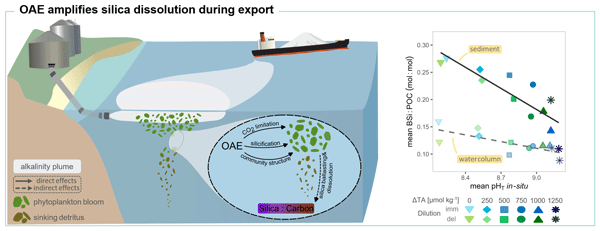
Ocean alkalinity enhancement (OAE) is a negative emission technology that may alter marine diatom communities and particle export. We show that unequilibrated OAE did not change bloom magnitude or particle fluxes, but reduced silica ballasting. The losses intensified during sinking, consistent with pH-enhanced silica dissolution. Our results show that OAE can modify biological-pump efficiency through export-phase alteration of BSi:POC, even when community biomass production remains unchanged.
Matias Saez Moreno, Jens Hartmann, Janine Börker, Peggy Bartsch, and Charly Andre Moras
EGUsphere, https://doi.org/10.5194/egusphere-2026-3277, https://doi.org/10.5194/egusphere-2026-3277, 2026
Short summary
Short summary
We tested three alkaline materials for removing carbon dioxide from seawater under different temperatures and salinities. Sodium bicarbonate worked reliably in all cases. Calcium hydroxide performed best in cold water but lost efficiency in warmer, saltier conditions because of carbonate formation. Magnesium hydroxide dissolved more slowly and was strongly hindered by high salinity. These results show that local ocean conditions strongly affect the performance of ocean alkalinity enhancement.
Arthur Vienne, Patrick Frings, Jet Rijnders, Lucilla Boito, Jens Hartmann, Harun Niron, Reinaldy Poetra, Miguel Portillo Estrada, Tom Reershemius, Laura Steinwidder, Tim Jesper Suhrhoff, and Sara Vicca
SOIL, 12, 421–440, https://doi.org/10.5194/soil-12-421-2026, https://doi.org/10.5194/soil-12-421-2026, 2026
Short summary
Short summary
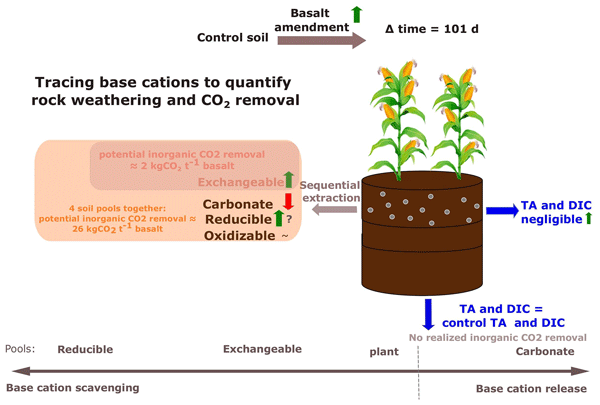
Our study explores Enhanced Weathering (EW) using basalt rock dust to combat climate change. We treated maize-planted mesocosms with varying basalt amounts and monitored them for 101 d. Surprisingly, we found no significant realized inorganic CO2 removal. However, rock weathering was evident through increased exchangeable bases. While inorganic CO2 removal was not realized within this experiment, basalt amendment may enhance soil health and potentially long-term carbon sequestration.
Paul McElhany, Mattias Cape, Giulia Faucher, Christina Frieder, Lenaïg G. Hemery, Debora Iglesias-Rodriguez, Christopher S. Murray, and Wesley Noble
EGUsphere, https://doi.org/10.5194/egusphere-2026-1597, https://doi.org/10.5194/egusphere-2026-1597, 2026
Short summary
Short summary
Marine carbon dioxide removal (mCDR) is an approach to climate change mitigation that can alter ocean carbonate chemistry in ways that affect marine organisms. We reviewed published studies of organisms exposed to mCDR-relevant chemistry conditions (e.g., elevated pH) to identify biological response thresholds, which vary widely by species. This information, compiled in a publicly available database, is useful for considering the risks and benefits of mCDR deployment and for guiding research.
Charly A. Moras, Matias Saez Moreno, Peggy Bartsch, and Jens Hartmann
EGUsphere, https://doi.org/10.5194/egusphere-2025-6144, https://doi.org/10.5194/egusphere-2025-6144, 2026
Short summary
Short summary
Ocean alkalinity enhancement has gained popularity to capture carbon dioxide. Yet, most laboratory experiments were run for short term, with strong mixing and without carbon dioxide exchange. In this research, a new setup tried to reproduce a more natural mixing. Overall, alkalinity remained stable for 6 months, thanks to the carbon dioxide invasion which differs from previous research. Hence, potential pitfalls identified in laboratory studies may not be at play in real world application.
Julieta Schneider, Ulf Riebesell, Charly André Moras, Laura Marín-Samper, Leila Richards Kittu, Joaquín Ortíz-Cortes, and Kai Georg Schulz
Biogeosciences, 23, 137–153, https://doi.org/10.5194/bg-23-137-2026, https://doi.org/10.5194/bg-23-137-2026, 2026
Short summary
Short summary
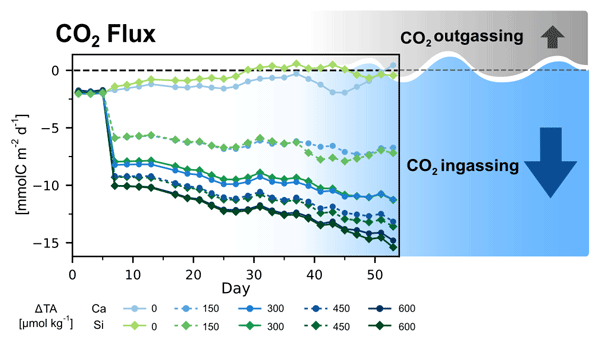
Ocean Alkalinity Enhancement (OAE) is an approach to sequester atmospheric CO2 in the ocean and may alleviate ocean acidification. A large-scale mesocosm experiment in Norway tested calcium- and silicate-based OAE, increasing total alkalinity (TA) by 0–600 µmol kg-1 and measuring CO2 gas exchange. While TA remained stable, we found mineral-type and/or pCO2/pH effects on coccolithophorid calcification, net community production and zooplankton respiration, providing insights for future OAE trials.
Jens S. Hammes, Jens Hartmann, Johannes A. C. Barth, Tobias Linke, Ingrid Smet, Mathilde Hagens, Philip A. E. Pogge von Strandmann, Tom Reershemius, Bruno Casimiro, Arthur Vienne, Anna A. Stoeckel, Ralf Steffens, and Dirk Paessler
EGUsphere, https://doi.org/10.5194/egusphere-2025-5402, https://doi.org/10.5194/egusphere-2025-5402, 2025
Short summary
Short summary
To test enhanced weathering's efficacy, we ran a two-year greenhouse study under warm, wet conditions, comparing several rock additives across farm soils. We tracked alkalinity and cation soil pools. Soil type was decisive: acidic, low-buffer soils exported more additional alkalinity, while alkaline or pH neutral soils retained it in cation pools. The results point to where enhanced weathering can deliver durable carbon removal and underscore the need for long, well-controlled trials.
Allanah Joy Paul, Mathias Haunost, Silvan Urs Goldenberg, Jens Hartmann, Nicolás Sánchez, Julieta Schneider, Niels Suitner, and Ulf Riebesell
Biogeosciences, 22, 2749–2766, https://doi.org/10.5194/bg-22-2749-2025, https://doi.org/10.5194/bg-22-2749-2025, 2025
Short summary
Short summary
Ocean alkalinity enhancement (OAE) is being assessed for its potential to absorb atmospheric CO2 and store it for a long time. OAE still needs comprehensive assessment of its safety and effectiveness. We studied an idealised OAE application in a natural low-nutrient ecosystem over 1 month. Our results showed that biogeochemical functioning remained mostly stable but that the long-term capability for storing carbon may be limited at high alkalinity concentration.
Giulia Faucher, Mathias Haunost, Allanah Joy Paul, Anne Ulrike Christiane Tietz, and Ulf Riebesell
Biogeosciences, 22, 405–415, https://doi.org/10.5194/bg-22-405-2025, https://doi.org/10.5194/bg-22-405-2025, 2025
Short summary
Short summary
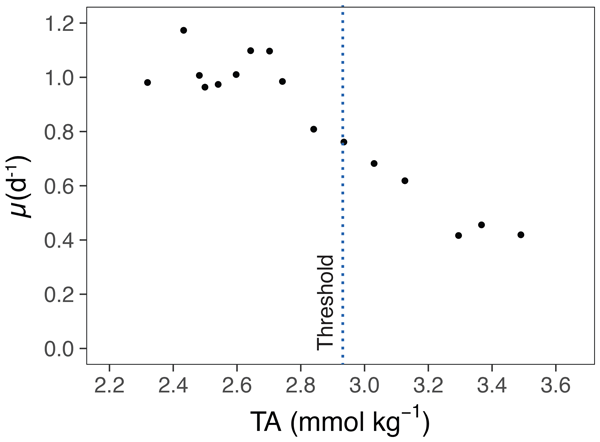
Ocean alkalinity enhancement (OAE) is being evaluated for its capacity to absorb atmospheric CO2 in the ocean and store it long term to mitigate climate change. As researchers plan for field tests to gain insights into OAE, sharing knowledge on its environmental impact on marine ecosystems is urgent. Our study examined NaOH-induced OAE in Emiliania huxleyi, a key coccolithophore species, and found that the added total alkalinity (ΔTA) should stay below 600 µmol kg⁻¹ to avoid negative impacts.
Philipp Suessle, Jan Taucher, Silvan Urs Goldenberg, Moritz Baumann, Kristian Spilling, Andrea Noche-Ferreira, Mari Vanharanta, and Ulf Riebesell
Biogeosciences, 22, 71–86, https://doi.org/10.5194/bg-22-71-2025, https://doi.org/10.5194/bg-22-71-2025, 2025
Short summary
Short summary
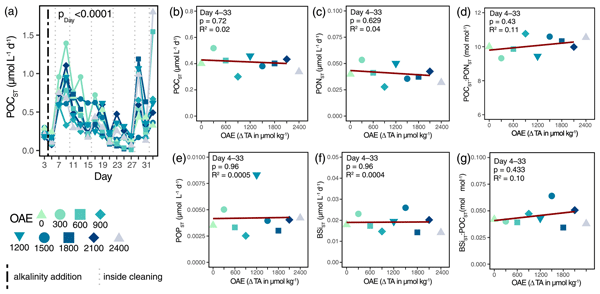
Ocean alkalinity enhancement (OAE) is a negative emission technology which may alter marine communities and the particle export they drive. Here, impacts of carbonate-based OAE on the flux and attenuation of sinking particles in an oligotrophic plankton community are presented. Whilst biological parameters remained unaffected, abiotic carbonate precipitation occurred. Among counteracting OAE’s efficiency, it influenced mineral ballasting and particle sinking velocities, requiring monitoring.
Niels Suitner, Giulia Faucher, Carl Lim, Julieta Schneider, Charly A. Moras, Ulf Riebesell, and Jens Hartmann
Biogeosciences, 21, 4587–4604, https://doi.org/10.5194/bg-21-4587-2024, https://doi.org/10.5194/bg-21-4587-2024, 2024
Short summary
Short summary
Recent studies described the precipitation of carbonates as a result of alkalinity enhancement in seawater, which could adversely affect the carbon sequestration potential of ocean alkalinity enhancement (OAE) approaches. By conducting experiments in natural seawater, this study observed uniform patterns during the triggered runaway carbonate precipitation, which allow the prediction of safe and efficient local application levels of OAE scenarios.
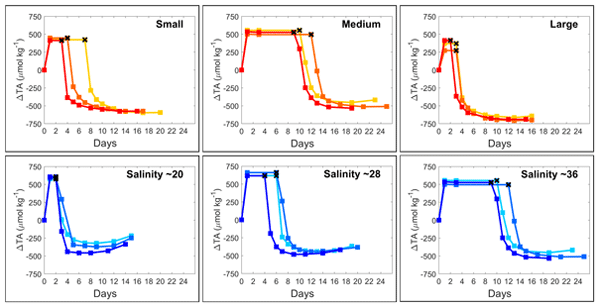
Charly A. Moras, Tyler Cyronak, Lennart T. Bach, Renaud Joannes-Boyau, and Kai G. Schulz
Biogeosciences, 21, 3463–3475, https://doi.org/10.5194/bg-21-3463-2024, https://doi.org/10.5194/bg-21-3463-2024, 2024
Short summary
Short summary
We investigate the effects of mineral grain size and seawater salinity on magnesium hydroxide dissolution and calcium carbonate precipitation kinetics for ocean alkalinity enhancement. Salinity did not affect the dissolution, but calcium carbonate formed earlier at lower salinities due to the lower magnesium and dissolved organic carbon concentrations. Smaller grain sizes dissolved faster but calcium carbonate precipitated earlier, suggesting that medium grain sizes are optimal for kinetics.
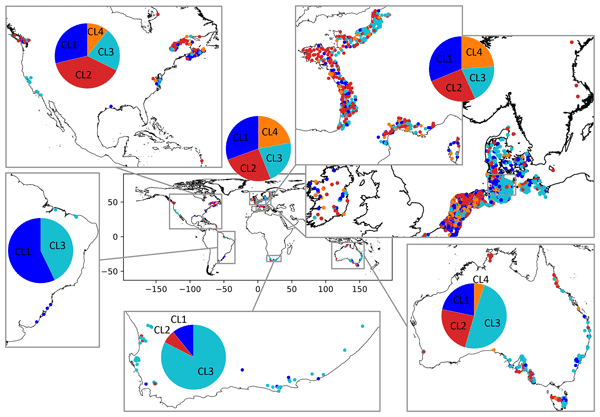
Annika Nolte, Ezra Haaf, Benedikt Heudorfer, Steffen Bender, and Jens Hartmann
Hydrol. Earth Syst. Sci., 28, 1215–1249, https://doi.org/10.5194/hess-28-1215-2024, https://doi.org/10.5194/hess-28-1215-2024, 2024
Short summary
Short summary
This study examines about 8000 groundwater level (GWL) time series from five continents to explore similarities in groundwater systems at different scales. Statistical metrics and machine learning techniques are applied to identify common GWL dynamics patterns and analyze their controlling factors. The study also highlights the potential and limitations of this data-driven approach to improve our understanding of groundwater recharge and discharge processes.
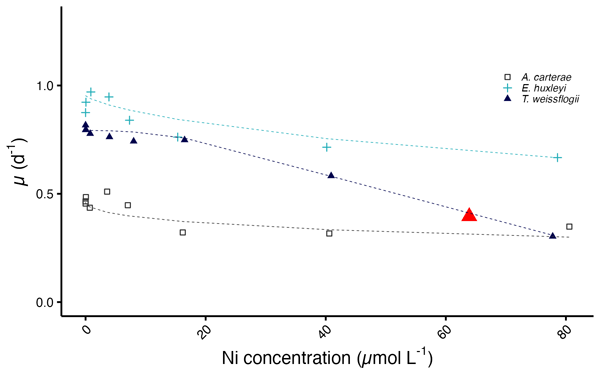
Xiaoke Xin, Giulia Faucher, and Ulf Riebesell
Biogeosciences, 21, 761–772, https://doi.org/10.5194/bg-21-761-2024, https://doi.org/10.5194/bg-21-761-2024, 2024
Short summary
Short summary
Ocean alkalinity enhancement (OAE) is a promising approach to remove CO2 by accelerating natural rock weathering. However, some of the alkaline substances contain trace metals which could be toxic to marine life. By exposing three representative phytoplankton species to Ni released from alkaline materials, we observed varying responses of phytoplankton to nickel concentrations, suggesting caution should be taken and toxic thresholds should be avoided in OAE with Ni-rich materials.
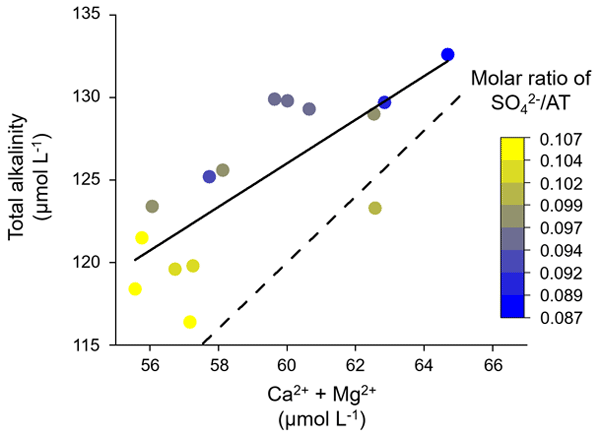
Nele Lehmann, Hugues Lantuit, Michael Ernst Böttcher, Jens Hartmann, Antje Eulenburg, and Helmuth Thomas
Biogeosciences, 20, 3459–3479, https://doi.org/10.5194/bg-20-3459-2023, https://doi.org/10.5194/bg-20-3459-2023, 2023
Short summary
Short summary
Riverine alkalinity in the silicate-dominated headwater catchment at subarctic Iskorasfjellet, northern Norway, was almost entirely derived from weathering of minor carbonate occurrences in the riparian zone. The uphill catchment appeared limited by insufficient contact time of weathering agents and weatherable material. Further, alkalinity increased with decreasing permafrost extent. Thus, with climate change, alkalinity generation is expected to increase in this permafrost-degrading landscape.
Mingyang Tian, Jens Hartmann, Gibran Romero-Mujalli, Thorben Amann, Lishan Ran, and Ji-Hyung Park
Biogeosciences Discuss., https://doi.org/10.5194/bg-2023-131, https://doi.org/10.5194/bg-2023-131, 2023
Manuscript not accepted for further review
Short summary
Short summary
Effective water quality management in the Elbe River from 1984 to 2018 significantly reduced CO2 emissions, particularly after Germany's reunification. Key factors in the reduction include organic carbon removal and nutrient management, with nitrogen control being more critical than phosphorus for the restoration of ecosystem capacity. Unpredictable influxes of organic carbon and the relocation of emissions from wastewater treatment can cause uncertainties for CO2 removals.
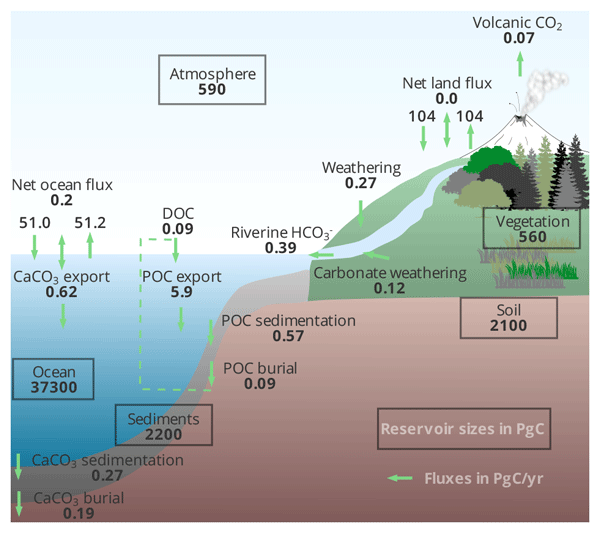
Matteo Willeit, Tatiana Ilyina, Bo Liu, Christoph Heinze, Mahé Perrette, Malte Heinemann, Daniela Dalmonech, Victor Brovkin, Guy Munhoven, Janine Börker, Jens Hartmann, Gibran Romero-Mujalli, and Andrey Ganopolski
Geosci. Model Dev., 16, 3501–3534, https://doi.org/10.5194/gmd-16-3501-2023, https://doi.org/10.5194/gmd-16-3501-2023, 2023
Short summary
Short summary
In this paper we present the carbon cycle component of the newly developed fast Earth system model CLIMBER-X. The model can be run with interactive atmospheric CO2 to investigate the feedbacks between climate and the carbon cycle on temporal scales ranging from decades to > 100 000 years. CLIMBER-X is expected to be a useful tool for studying past climate–carbon cycle changes and for the investigation of the long-term future evolution of the Earth system.
Jens Hartmann, Niels Suitner, Carl Lim, Julieta Schneider, Laura Marín-Samper, Javier Arístegui, Phil Renforth, Jan Taucher, and Ulf Riebesell
Biogeosciences, 20, 781–802, https://doi.org/10.5194/bg-20-781-2023, https://doi.org/10.5194/bg-20-781-2023, 2023
Short summary
Short summary
CO2 can be stored in the ocean via increasing alkalinity of ocean water. Alkalinity can be created via dissolution of alkaline materials, like limestone or soda. Presented research studies boundaries for increasing alkalinity in seawater. The best way to increase alkalinity was found using an equilibrated solution, for example as produced from reactors. Adding particles for dissolution into seawater on the other hand produces the risk of losing alkalinity and degassing of CO2 to the atmosphere.

Shuang Gao, Jörg Schwinger, Jerry Tjiputra, Ingo Bethke, Jens Hartmann, Emilio Mayorga, and Christoph Heinze
Biogeosciences, 20, 93–119, https://doi.org/10.5194/bg-20-93-2023, https://doi.org/10.5194/bg-20-93-2023, 2023
Short summary
Short summary
We assess the impact of riverine nutrients and carbon (C) on projected marine primary production (PP) and C uptake using a fully coupled Earth system model. Riverine inputs alleviate nutrient limitation and thus lessen the projected PP decline by up to 0.7 Pg C yr−1 globally. The effect of increased riverine C may be larger than the effect of nutrient inputs in the future on the projected ocean C uptake, while in the historical period increased nutrient inputs are considered the largest driver.

Charly A. Moras, Lennart T. Bach, Tyler Cyronak, Renaud Joannes-Boyau, and Kai G. Schulz
Biogeosciences, 19, 3537–3557, https://doi.org/10.5194/bg-19-3537-2022, https://doi.org/10.5194/bg-19-3537-2022, 2022
Short summary
Short summary
This research presents the first laboratory results of quick and hydrated lime dissolution in natural seawater. These two minerals are of great interest for ocean alkalinity enhancement, a strategy aiming to decrease atmospheric CO2 concentrations. Following the dissolution of these minerals, we identified several hurdles and presented ways to avoid them or completely negate them. Finally, we proceeded to various simulations in today’s oceans to implement the strategy at its highest potential.
Cited articles
Bach, L. T., Riebesell, U., Sett, S., Febiri, S., Rzepka, P., and Schulz, K. G.: An approach for particle sinking velocity measurements in the 3–400 µm size range and considerations on the effect of temperature on sinking rates, Mar. Biol., 159, 1853–1864, https://doi.org/10.1007/s00227-012-1945-2, 2012.
Badjatya, P., Akca, A. H., Fraga Alvarez, D. V., Chang, B., Ma, S., Pang, X., Wang, E., van Hinsberg, Q., Esposito, D. V., and Kawashima, S.: Carbon-negative cement manufacturing from seawater-derived magnesium feedstocks, P. Natl. Acad. Sci. USA, 119, e2114680119, https://doi.org/10.1073/pnas.2114680119, 2022.
Berner, R. A.: The role of magnesium in the crystal growth of calcite and aragonite from sea water, Geochim. Cosmochim. Ac., 39, 489–504, https://doi.org/10.1016/0016-7037(75)90102-7, 1975.
Bialik, O. M., Sisma-Ventura, G., Vogt-Vincent, N., Silverman, J., and Katz, T.: Role of oceanic abiotic carbonate precipitation in future atmospheric CO(2) regulation, Sci. Rep.-UK, 12, 15970, https://doi.org/10.1038/s41598-022-20446-7, 2022.
Broecker, W. S. and Takahashi, T.: Calcium carbonate precipitation on the Bahama Banks, J. Geophys. Res., 71, 1575–1602, https://doi.org/10.1029/JZ071i006p01575, 1966.
Brunauer, S., Emmett, P. H., and Teller, E.: Adsorption of gases in multimolecular layers, J. Am. Chem. Soc., 60, 309–319, 1938.
Burton, E. A. and Walter, L. M.: The role of pH in phosphate inhibition of calcite and aragonite precipitation rates in seawater, Geochim. Cosmochim. Ac., 54, 797–808, https://doi.org/10.1016/0016-7037(90)90374-T, 1990.
Bustos-Serrano, H., Morse, J. W., and Millero, F. J.: The formation of whitings on the Little Bahama Bank, Mar. Chem., 113, 1–8, https://doi.org/10.1016/j.marchem.2008.10.006, 2009.
Caserini, S., Pagano, D., Campo, F., Abbà, A., De Marco, S., Righi, D., Renforth, P., and Grosso, M.: Potential of Maritime Transport for Ocean Liming and Atmospheric CO2 Removal, Frontiers in Climate, 3, https://doi.org/10.3389/fclim.2021.575900, 2021.
Chave, K. E. and Suess, E.: Calcium Carbonate Saturation in Seawater: Effects of Dissolved Organic Matter, Limnol. Oceanogr., 15, 633–637, https://doi.org/10.4319/lo.1970.15.4.0633, 1970.
Eisaman, M. D., Geilert, S., Renforth, P., Bastianini, L., Campbell, J., Dale, A. W., Foteinis, S., Grasse, P., Hawrot, O., Löscher, C. R., Rau, G. H., and Rønning, J.: Assessing the technical aspects of ocean-alkalinity-enhancement approaches, in: Guide to Best Practices in Ocean Alkalinity Enhancement Research, edited by: Oschlies, A., Stevenson, A., Bach, L. T., Fennel, K., Rickaby, R. E. M., Satterfield, T., Webb, R., and Gattuso, J.-P., Copernicus Publications, State Planet, 2-oae2023, 3, https://doi.org/10.5194/sp-2-oae2023-3-2023, 2023.
Faucher, G., Haunost, M., Paul, A. J., Tietz, A. U. C., and Riebesell, U.: Growth response of Emiliania huxleyi to ocean alkalinity enhancement, Biogeosciences, 22, 405–415, https://doi.org/10.5194/bg-22-405-2025, 2025.
Ferderer, A., Chase, Z., Kennedy, F., Schulz, K. G., and Bach, L. T.: Assessing the influence of ocean alkalinity enhancement on a coastal phytoplankton community, Biogeosciences, 19, 5375–5399, https://doi.org/10.5194/bg-19-5375-2022, 2022.
Fuhr, M., Geilert, S., Schmidt, M., Liebetrau, V., Vogt, C., Ledwig, B., and Wallmann, K.: Kinetics of Olivine Weathering in Seawater: An Experimental Study, Frontiers in Climate, 4, https://doi.org/10.3389/fclim.2022.831587, 2022.
Fuss, S., Lamb, W. F., Callaghan, M. W., Hilaire, J., Creutzig, F., Amann, T., Beringer, T., de Oliveira Garcia, W., Hartmann, J., Khanna, T., Luderer, G., Nemet, G. F., Rogelj, J., Smith, P., Vicente, J. L. V., Wilcox, J., del Mar Zamora Dominguez, M., and Minx, J. C.: Negative emissions – Part 2: Costs, potentials and side effects, Environ. Res. Lett., 13, https://doi.org/10.1088/1748-9326/aabf9f, 2018.
Gately, J. A., Kim, S. M., Jin, B., Brzezinski, M. A., and Iglesias-Rodriguez, M. D.: Coccolithophores and diatoms resilient to ocean alkalinity enhancement: A glimpse of hope?, Science Advances, 9, eadg6066, https://doi.org/10.1126/sciadv.adg6066, 2023.
Goldenberg, S. U., Riebesell, U., Brüggemann, D., Börner, G., Sswat, M., Folkvord, A., Couret, M., Spjelkavik, S., Sánchez, N., Jaspers, C., and Moyano, M.: Early life stages of fish under ocean alkalinity enhancement in coastal plankton communities, Biogeosciences, 21, 4521–4532, https://doi.org/10.5194/bg-21-4521-2024, 2024.
Haas, A. R.: The Effect of the Addition of Alkali to Sea Water Upon the Hydrogen Ion Concentration, J. Biol. Chem., 26, 515–517, https://doi.org/10.1016/s0021-9258(18)87433-6, 1916.
Hartmann, J., West, A. J., Renforth, P., Köhler, P., De La Rocha, C. L., Wolf-Gladrow, D. A., Dürr, H. H., and Scheffran, J.: Enhanced chemical weathering as a geoengineering strategy to reduce atmospheric carbon dioxide, supply nutrients, and mitigate ocean acidification, Rev. Geophys., 51, 113–149, https://doi.org/10.1002/rog.20004, 2013.
Hartmann, J., Suitner, N., Lim, C., Schneider, J., Marín-Samper, L., Arístegui, J., Renforth, P., Taucher, J., and Riebesell, U.: Stability of alkalinity in ocean alkalinity enhancement (OAE) approaches – consequences for durability of CO2 storage, Biogeosciences, 20, 781–802, https://doi.org/10.5194/bg-20-781-2023, 2023.
Harvey, L. D. D.: Mitigating the atmospheric CO2 increase and ocean acidification by adding limestone powder to upwelling regions, J. Geophys. Res.-Oceans, 113, https://doi.org/10.1029/2007jc004373, 2008.
He, J. and Tyka, M. D.: Limits and CO2 equilibration of near-coast alkalinity enhancement, Biogeosciences, 20, 27–43, https://doi.org/10.5194/bg-20-27-2023, 2023.
Ilyina, T., Six, K. D., Segschneider, J., Maier-Reimer, E., Li, H., and Núñez-Riboni, I.: Global ocean biogeochemistry model HAMOCC: Model architecture and performance as component of the MPI-Earth system model in different CMIP5 experimental realizations, J. Adv. Model. Earth Sy., 5, 287–315, https://doi.org/10.1029/2012ms000178, 2013.
Inskeep, W. P. and Bloom, P. R.: An evaluation of rate equations for calcite precipitation kinetics at pCO2 less than 0.01 atm and pH greater than 8, Geochim. Cosmochim. Ac., 49, 2165–2180, https://doi.org/10.1016/0016-7037(85)90074-2, 1985.
IPCC: Technical Summary, in: Climate Change 2021 – The Physical Science Basis, 35–144, https://doi.org/10.1017/9781009157896.002, 2023.
Iyer, G., Hultman, N., Eom, J., McJeon, H., Patel, P., and Clarke, L.: Diffusion of low-carbon technologies and the feasibility of long-term climate targets, Technol. Forecast. Soc., 90, 103–118, https://doi.org/10.1016/j.techfore.2013.08.025, 2015.
Kapp, E. M.: The precipitation of calcium and magnesium from sea water by sodium hydroxide, Biol. Bull., 55, 453–458, 1928.
Kellock, C., Castillo Alvarez, M. C., Finch, A., Penkman, K., Kroger, R., Clog, M., and Allison, N.: Optimising a method for aragonite precipitation in simulated biogenic calcification media, PLoS One, 17, e0278627, https://doi.org/10.1371/journal.pone.0278627, 2022.
Kheshgi, H. S.: Sequestering atmospheric carbon dioxide by increasing ocean alkalinity, Energy, 20, 915–922., https://doi.org/10.1016/0360-5442(95)00035-F 1995.
Marín-Samper, L., Arístegui, J., Hernández-Hernández, N., Ortiz, J., Archer, S. D., Ludwig, A., and Riebesell, U.: Assessing the impact of CO2-equilibrated ocean alkalinity enhancement on microbial metabolic rates in an oligotrophic system, Biogeosciences, 21, 2859–2876, https://doi.org/10.5194/bg-21-2859-2024, 2024.
Marion, G. M., Millero, F. J., and Feistel, R.: Precipitation of solid phase calcium carbonates and their effect on application of seawater SA–T–P models, Ocean Sci., 5, 285–291, https://doi.org/10.5194/os-5-285-2009, 2009.
Minx, J. C., Lamb, W. F., Callaghan, M. W., Fuss, S., Hilaire, J., Creutzig, F., Amann, T., Beringer, T., de Oliveira Garcia, W., Hartmann, J., Khanna, T., Lenzi, D., Luderer, G., Nemet, G. F., Rogelj, J., Smith, P., Vicente Vicente, J. L., Wilcox, J., and del Mar Zamora Dominguez, M.: Negative emissions – Part 1: Research landscape and synthesis, Environ. Res. Lett., 13, https://doi.org/10.1088/1748-9326/aabf9b, 2018.
Moras, C. A., Bach, L. T., Cyronak, T., Joannes-Boyau, R., and Schulz, K. G.: Ocean alkalinity enhancement – avoiding runaway CaCO3 precipitation during quick and hydrated lime dissolution, Biogeosciences, 19, 3537–3557, https://doi.org/10.5194/bg-19-3537-2022, 2022.
Moras, C. A., Cyronak, T., Bach, L. T., Joannes-Boyau, R., and Schulz, K. G.: Effects of grain size and seawater salinity on magnesium hydroxide dissolution and secondary calcium carbonate precipitation kinetics: implications for ocean alkalinity enhancement, Biogeosciences, 21, 3463–3475, https://doi.org/10.5194/bg-21-3463-2024, 2024.
Morse, J. W. and He, S.: Influences of T, S and PCO2 on the pseudo-homogeneous precipitation of CaCO3 from seawater: implications for whiting formation, Mar. Chem., 41, 291–297., https://doi.org/10.1016/0304-4203(93)90261-L, 1993.
Morse, J. W., Gledhill, D. K., and Millero, F. J.: Caco3 precipitation kinetics in waters from the great Bahama bank, Geochim. Cosmochim. Ac., 67, 2819–2826, https://doi.org/10.1016/s0016-7037(03)00103-0, 2003.
Morse, J. W., Arvidson, R. S., and Lüttge, A.: Calcium carbonate formation and dissolution, Chem. Rev., 107, 342–381, https://doi.org/10.1021/cr050358j, 2007.
Mucci, A. and Morse, J. W.: The incorporation of
Oschlies, A., Bach, L. T., Rickaby, R. E. M., Satterfield, T., Webb, R., and Gattuso, J.-P.: Climate targets, carbon dioxide removal, and the potential role of ocean alkalinity enhancement, in: Guide to Best Practices in Ocean Alkalinity Enhancement Research, edited by: Oschlies, A., Stevenson, A., Bach, L. T., Fennel, K., Rickaby, R. E. M., Satterfield, T., Webb, R., and Gattuso, J.-P., Copernicus Publications, State Planet, 2-oae2023, 1, https://doi.org/10.5194/sp-2-oae2023-1-2023, 2023.
Ou, Y., Xue, Z. G., and Hu, X.: A numerical assessment of ocean alkalinity enhancement efficiency on a river-dominated continental shelf – a case study in the northern Gulf of Mexico, Environ. Res. Lett., https://doi.org/10.1088/1748-9326/adaa8b, 2025.
Pan, Y., Li, Y., Ma, Q., He, H., Wang, S., Sun, Z., Cai, W.-J., Dong, B., Di, Y., Fu, W., and Chen, C.-T. A.: The role of
Paul, A. J., Haunost, M., Goldenberg, S. U., Hartmann, J., Sánchez, N., Schneider, J., Suitner, N., and Riebesell, U.: Ocean alkalinity enhancement in an open-ocean ecosystem: biogeochemical responses and carbon storage durability, Biogeosciences, 22, 2749–2766, https://doi.org/10.5194/bg-22-2749-2025, 2025.
Pokrovsky, O. S.: Precipitation of calcium and magnesium carbonates from homogeneous supersaturated solutions, J. Cryst. Growth, 186, 233–239, https://doi.org/10.1016/S0022-0248(97)00462-4, 1998.
Pytkowicz, R.: Calcium carbonate retention in supersaturated seawater, Am. J. Sci., 273, 515–522, https://doi.org/10.2475/ajs.273.6.515 1973.
Pytkowicz, R. M.: Rates of Inorganic Calcium Carbonate Nucleation, J. Geol., 73, 196–199, https://doi.org/10.1086/627056, 1965.
Rau, G. H. and Caldeira, K.: Enhanced carbonate dissolution as a means of sequestering carbon dioxide in the ocean, Energ. Convers. Manage., 40, 1803–1813, https://doi.org/10.1016/S0196-8904(99)00071-0, 1999.
Renforth, P. and Henderson, G.: Assessing ocean alkalinity for carbon sequestration, Rev. Geophys., 55, 636–674, https://doi.org/10.1002/2016rg000533, 2017.
Ringham, M. C., Hirtle, N., Shaw, C., Lu, X., Herndon, J., Carter, B. R., and Eisaman, M. D.: An assessment of ocean alkalinity enhancement using aqueous hydroxides: kinetics, efficiency, and precipitation thresholds, Biogeosciences, 21, 3551–3570, https://doi.org/10.5194/bg-21-3551-2024, 2024.
Rogelj, J., Popp, A., Calvin, K. V., Luderer, G., Emmerling, J., Gernaat, D., Fujimori, S., Strefler, J., Hasegawa, T., Marangoni, G., Krey, V., Kriegler, E., Riahi, K., van Vuuren, D. P., Doelman, J., Drouet, L., Edmonds, J., Fricko, O., Harmsen, M., Havlík, P., Humpenöder, F., Stehfest, E., and Tavoni, M.: Scenarios towards limiting global mean temperature increase below 1.5 °C, Nat. Clim. Change, 8, 325–332, https://doi.org/10.1038/s41558-018-0091-3, 2018.
Sánchez, N., Goldenberg, S. U., Brüggemann, D., Jaspers, C., Taucher, J., and Riebesell, U.: Plankton food web structure and productivity under ocean alkalinity enhancement, Sci. Adv., 10, eado0264, https://doi.org/10.1126/sciadv.ado0264, 2024.
Schulz, K. G., Bach, L. T., and Dickson, A. G.: Seawater carbonate chemistry considerations for ocean alkalinity enhancement research: theory, measurements, and calculations, in: Guide to Best Practices in Ocean Alkalinity Enhancement Research, edited by: Oschlies, A., Stevenson, A., Bach, L. T., Fennel, K., Rickaby, R. E. M., Satterfield, T., Webb, R., and Gattuso, J.-P., Copernicus Publications, State Planet, 2-oae2023, 2, https://doi.org/10.5194/sp-2-oae2023-2-2023, 2023.
Schwinger, J., Bourgeois, T., and Rickels, W.: On the emission-path dependency of the efficiency of ocean alkalinity enhancement, Environ. Res. Lett., 19, https://doi.org/10.1088/1748-9326/ad5a27, 2024.
Sers, M. R. and Victor, P. A.: The Energy-emissions Trap, Ecol. Econ., 151, 10–21, https://doi.org/10.1016/j.ecolecon.2018.04.004, 2018.
Sjöberg, E.: A fundamental equation for calcite dissolution kinetics, Geochim. Cosmochim. Ac., 40, 441–447, https://doi.org/10.1016/0016-7037(76)90009-0, 1976.
Söhnel, O. and Mullin, J. W.: Interpretation of crystallization induction periods, J. Colloid Interf. Sci., 123, 43–50, https://doi.org/10.1016/0021-9797(88)90219-6, 1988.
Suessle, P., Taucher, J., Goldenberg, S. U., Baumann, M., Spilling, K., Noche-Ferreira, A., Vanharanta, M., and Riebesell, U.: Particle fluxes by subtropical pelagic communities under ocean alkalinity enhancement, Biogeosciences, 22, 71–86, https://doi.org/10.5194/bg-22-71-2025, 2025.
Suitner, N.: Datasets for: Surface area and Ω-aragonite oversaturation as controls of the runaway precipitation process in ocean alkalinity enhancement, Zenodo [data set], https://doi.org/10.5281/zenodo.20324920, 2026.
Suitner, N., Faucher, G., Lim, C., Schneider, J., Moras, C. A., Riebesell, U., and Hartmann, J.: Ocean alkalinity enhancement approaches and the predictability of runaway precipitation processes: results of an experimental study to determine critical alkalinity ranges for safe and sustainable application scenarios, Biogeosciences, 21, 4587–4604, https://doi.org/10.5194/bg-21-4587-2024, 2024.
Tjørve, K. M. and Tjørve, E.: The use of Gompertz models in growth analyses, and new Gompertz-model approach: An addition to the Unified-Richards family, PLoS One, 12, e0178691, https://doi.org/10.1371/journal.pone.0178691, 2017.
UNFCCC: Report of the Conference of the Parties to the United Nations Framework Convention on Climate Change (21st Session, 2015: Paris), Retrived December, vol. 4, GE.16-01192(E), 2015.
Varliero, S., Buono, A., Caserini, S., Raos, G., and Macchi, P.: Chemical Aspect of Ocean Liming for CO2 Removal: Dissolution Kinetics of Calcium Hydroxide in Seawater, ACS Engineering Au, https://doi.org/10.1021/acsengineeringau.4c00008, 2024.
Wang, H., Pilcher, D. J., Kearney, K. A., Cross, J. N., Shugart, O. M., Eisaman, M. D., and Carter, B. R.: Simulated impact of ocean alkalinity enhancement on atmospheric CO2 removal in the Bering Sea, Earths Future, 11, https://doi.org/10.1029/2022EF002816, 2023.
Wells, M. L. and Goldberg, E. D.: Marine submicron particles, Mar. Chem., 40, 5–18, https://doi.org/10.1016/0304-4203(92)90045-C, 1992.
Wurgaft, E., Steiner, Z., Luz, B., and Lazar, B.: Evidence for inorganic precipitation of CaCO3 on suspended solids in the open water of the Red Sea, Mar. Chem., 186, 145–155, https://doi.org/10.1016/j.marchem.2016.09.006, 2016.
Wurgaft, E., Wang, Z. A., Churchill, J. H., Dellapenna, T., Song, S., Du, J., Ringham, M. C., Rivlin, T., and Lazar, B.: Particle Triggered Reactions as an Important Mechanism of Alkalinity and Inorganic Carbon Removal in River Plumes, Geophys. Res. Lett., 48, 277, https://doi.org/10.1029/2021gl093178, 2021.
Xin, X., Goldenberg, S. U., Taucher, J., Stuhr, A., Aristegui, J., and Riebesell, U.: Resilience of Phytoplankton and Microzooplankton Communities under Ocean Alkalinity Enhancement in the Oligotrophic Ocean, Environ. Sci. Technol., https://doi.org/10.1021/acs.est.4c09838, 2024.
Zeebe, R. and Wolf-Gladrow, D.: CO2 in Seawater: Equilibrium, Kinetics, Isotopes, Elsevier Oceanography Book Series, 65, Amsterdam, 361 pp., ISBN 0-444-50946-1, 2001.
Zhong, S. and Mucci, A.: Calcite and aragonite precipitation from seawater solutions of various salinities: Precipitation rates and overgrowth compositions, Chem. Geol., 78, 283–299, https://doi.org/10.1016/0009-2541(89)90064-8, 1989.
Zhou, M., Tyka, M. D., Ho, D. T., Yankovsky, E., Bachman, S., Nicholas, T., Karspeck, A. R., and Long, M. C.: Mapping the global variation in the efficiency of ocean alkalinity enhancement for carbon dioxide removal, Nat. Clim. Change, 1–7, https://doi.org/10.1038/s41558-024-02179-9, 2024.
Short summary
Alkalinity leakage limits the efficiency of ocean alkalinity enhancement. Drivers of this process remain unquantified, restricting accurate assessments. The induced runaway process can be modeled using surface area and aragonite oversaturation as key factors. This study proposes a framework for improving predictability of alkalinity loss due to runaway precipitation, emphasizing the need for field experiments to validate theoretical models concerning dilution and particle sinking processes.
Alkalinity leakage limits the efficiency of ocean alkalinity enhancement. Drivers of this...


Altmetrics
Final-revised paper
Preprint