
Articles | Volume 23, issue 14
https://doi.org/10.5194/bg-23-4927-2026
© Author(s) 2026. This work is distributed under
the Creative Commons Attribution 4.0 License.
the Creative Commons Attribution 4.0 License.
https://doi.org/10.5194/bg-23-4927-2026
© Author(s) 2026. This work is distributed under
the Creative Commons Attribution 4.0 License.
the Creative Commons Attribution 4.0 License.
Research article
| 
20 Jul 2026
Research article |
| 20 Jul 2026
| 20 Jul 2026
Assessing forest biomass and productivity with data-driven vegetation indices: insights from 900 000 simulated forest stands

Helmholtz Centre for Environmental Research – UFZ, Dept. of Ecological Modelling, Permoserstr. 15, 04318 Leipzig, Germany
Rico Fischer
Julius Kühn-Institute (JKI) – Federal Research Centre for Cultivated Plants, Institute for Forest Protection, Erwin-Baur-Str. 27, 06484 Quedlinburg, Germany
Andreas Huth
Helmholtz Centre for Environmental Research – UFZ, Dept. of Ecological Modelling, Permoserstr. 15, 04318 Leipzig, Germany
Osnabrück University, Institute of Environmental Systems Research, Barbarastr. 12, 49076 Osnabrück, Germany
German Centre for Integrative Biodiversity Research (iDiv) Halle-Jena-Leipzig, Puschstr. 4, 04103 Leipzig, Germany
Related authors
Niklas Bruns, Andreas Huth, Stephan Thober, and Samuel M. Fischer
EGUsphere, https://doi.org/10.5194/egusphere-2026-4918, https://doi.org/10.5194/egusphere-2026-4918, 2026
This preprint is open for discussion and under review for Geoscientific Model Development (GMD).
Short summary
Short summary
Forests and water are tightly linked: trees shape how water moves through landscapes, while water availability controls forest growth. Models of forests and hydrology are typically developed separately. We coupled an individual-based forest model with a distributed hydrological model for a German catchment. Dynamic vegetation substantially altered water partitioning, shifting evapotranspiration towards transpiration, and river discharge was found to carry information about forest productivity.
Samuel M. Fischer, Xugao Wang, and Andreas Huth
Biogeosciences, 21, 3305–3319, https://doi.org/10.5194/bg-21-3305-2024, https://doi.org/10.5194/bg-21-3305-2024, 2024
Short summary
Short summary
Understanding the drivers of forest productivity is key for accurately assessing forests’ role in the global carbon cycle. Yet, despite significant research effort, it is not fully understood how the productivity of a forest can be deduced from its stand structure. We suggest tackling this problem by identifying the share and structure of immature trees within forests and show that this approach could significantly improve estimates of forests’ net productivity and carbon uptake.
Niklas Bruns, Andreas Huth, Stephan Thober, and Samuel M. Fischer
EGUsphere, https://doi.org/10.5194/egusphere-2026-4918, https://doi.org/10.5194/egusphere-2026-4918, 2026
This preprint is open for discussion and under review for Geoscientific Model Development (GMD).
Short summary
Short summary
Forests and water are tightly linked: trees shape how water moves through landscapes, while water availability controls forest growth. Models of forests and hydrology are typically developed separately. We coupled an individual-based forest model with a distributed hydrological model for a German catchment. Dynamic vegetation substantially altered water partitioning, shifting evapotranspiration towards transpiration, and river discharge was found to carry information about forest productivity.
Leonard Grohmann, Lea Albrecht, Kostas Papathanassiou, and Andreas Huth
EGUsphere, https://doi.org/10.5194/egusphere-2026-613, https://doi.org/10.5194/egusphere-2026-613, 2026
Short summary
Short summary
We developed a new way to better understand forest structure and biomass by linking a detailed forest growth model with a satellite-based radar simulation. By combining ecological processes with radar observations, we show how forest height and biomass can be estimated more reliably across different forest stages. This approach improves the interpretation of satellite data and supports more accurate large-scale forest monitoring and carbon assessment.
Kevin Wolf, Evelyn Jäkel, André Ehrlich, Michael Schäfer, Hannes Feilhauer, Andreas Huth, and Manfred Wendisch
Biogeosciences, 22, 7797–7817, https://doi.org/10.5194/bg-22-7797-2025, https://doi.org/10.5194/bg-22-7797-2025, 2025
Short summary
Short summary
This paper presents combined atmosphere-vegetation radiative transfer simulations to systematically investigate cloud-induced biases in remotely sensed vegetation indices (VIs) derived from below-cloud measurements. The biases in VIs have been investigated for the general case of two-band VIs, and for the special cases of the normalized difference vegetation index (NDVI), the normalized difference water index (NDWI), and the enhanced vegetation index (EVI).
Kevin Wolf, Evelyn Jäkel, André Ehrlich, Michael Schäfer, Hannes Feilhauer, Andreas Huth, Alexandra Weigelt, and Manfred Wendisch
Biogeosciences, 22, 2909–2933, https://doi.org/10.5194/bg-22-2909-2025, https://doi.org/10.5194/bg-22-2909-2025, 2025
Short summary
Short summary
This paper reports an investigation of the influence of clouds on vegetation albedo using a coupled atmosphere–vegetation radiative transfer model. Both models are iteratively linked to simulate cloud–vegetation–radiation interactions over canopies more realistically. Solar, spectral, and broadband irradiances have been simulated under varying cloud conditions. The simulated irradiances were used to investigate the spectral and broadband effect of clouds on vegetation albedo.
Samuel M. Fischer, Xugao Wang, and Andreas Huth
Biogeosciences, 21, 3305–3319, https://doi.org/10.5194/bg-21-3305-2024, https://doi.org/10.5194/bg-21-3305-2024, 2024
Short summary
Short summary
Understanding the drivers of forest productivity is key for accurately assessing forests’ role in the global carbon cycle. Yet, despite significant research effort, it is not fully understood how the productivity of a forest can be deduced from its stand structure. We suggest tackling this problem by identifying the share and structure of immature trees within forests and show that this approach could significantly improve estimates of forests’ net productivity and carbon uptake.
Nikolai Knapp, Sabine Attinger, and Andreas Huth
Biogeosciences, 19, 4929–4944, https://doi.org/10.5194/bg-19-4929-2022, https://doi.org/10.5194/bg-19-4929-2022, 2022
Short summary
Short summary
The biomass of forests is determined by forest growth and mortality. These quantities can be estimated with different methods such as inventories, remote sensing and modeling. These methods are usually being applied at different spatial scales. The scales influence the obtained frequency distributions of biomass, growth and mortality. This study suggests how to transfer between scales, when using forest models of different complexity for a tropical forest.
Ulrike Hiltner, Andreas Huth, and Rico Fischer
Biogeosciences, 19, 1891–1911, https://doi.org/10.5194/bg-19-1891-2022, https://doi.org/10.5194/bg-19-1891-2022, 2022
Short summary
Short summary
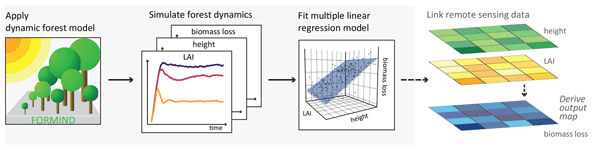
Quantifying biomass loss rates due to stem mortality is important for estimating the role of tropical forests in the global carbon cycle. We analyse the consequences of long-term elevated stem mortality for tropical forest dynamics and biomass loss. Based on simulations, we developed a statistical model to estimate biomass loss rates of forests in different successional states from forest attributes. Assuming a doubling of tree mortality, biomass loss increased from 3.2 % yr-1 to 4.5 % yr-1.
J. Pacheco-Labrador, U. Weber, X. Ma, M. D. Mahecha, N. Carvalhais, C. Wirth, A. Huth, F. J. Bohn, G. Kraemer, U. Heiden, FunDivEUROPE members, and M. Migliavacca
Int. Arch. Photogramm. Remote Sens. Spatial Inf. Sci., XLVI-1-W1-2021, 49–55, https://doi.org/10.5194/isprs-archives-XLVI-1-W1-2021-49-2022, https://doi.org/10.5194/isprs-archives-XLVI-1-W1-2021-49-2022, 2022
Cited articles
Almeida, C. T. D., Galvão, L. S., Aragão, L. E. D. O. C. E., Ometto, J. P. H. B., Jacon, A. D., Pereira, F. R. D. S., Sato, L. Y., Lopes, A. P., Graça, P. M. L. D. A., Silva, C. V. D. J., Ferreira-Ferreira, J., and Longo, M.: Combining LiDAR and Hyperspectral Data for Aboveground Biomass Modeling in the Brazilian Amazon Using Different Regression Algorithms, Remote Sens. Environ., 232, 111323, https://doi.org/10.1016/j.rse.2019.111323, 2019. a
Badgley, G., Anderegg, L. D. L., Berry, J. A., and Field, C. B.: Terrestrial Gross Primary Production: Using NIRV to Scale from Site to Globe, Glob. Change Biol., 25, 3731–3740, https://doi.org/10.1111/gcb.14729, 2019. a, b
Bohn, F. J. and Huth, A.: The Importance of Forest Structure to Biodiversity–Productivity Relationships, Royal Soc. Open Sci., 4, 160521, https://doi.org/10.1098/rsos.160521, 2017. a, b, c, d
Bohn, F. J., Frank, K., and Huth, A.: Of Climate and Its Resulting Tree Growth: Simulating the Productivity of Temperate Forests, Ecol. Model., 278, 9–17, https://doi.org/10.1016/j.ecolmodel.2014.01.021, 2014. a
Brown, L.: A Shortwave Infrared Modification to the Simple Ratio for LAI Retrieval in Boreal Forests An Image and Model Analysis, Remote Sens. Environ., 71, 16–25, https://doi.org/10.1016/S0034-4257(99)00035-8, 2000. a
Bugmann, H. and Seidl, R.: The Evolution, Complexity and Diversity of Models of Long-term Forest Dynamics, J. Ecol., 110, 2288–2307, https://doi.org/10.1111/1365-2745.13989, 2022. a
Camps-Valls, G., Campos-Taberner, M., Moreno-Martínez, Á., Walther, S., Duveiller, G., Cescatti, A., Mahecha, M. D., Muñoz-Marí, J., García-Haro, F. J., Guanter, L., Jung, M., Gamon, J. A., Reichstein, M., and Running, S. W.: A Unified Vegetation Index for Quantifying the Terrestrial Biosphere, Science Advances, 7, eabc7447, https://doi.org/10.1126/sciadv.abc7447, 2021. a
Coops, N. C.: Characterizing Forest Growth and Productivity Using Remotely Sensed Data, Current Forestry Reports, 1, 195–205, https://doi.org/10.1007/s40725-015-0020-x, 2015. a
Curran, P. J.: Remote Sensing of Foliar Chemistry, Remote Sens. Environ., 30, 271–278, https://doi.org/10.1016/0034-4257(89)90069-2, 1989. a
Dong, M., Liu, S., Jiang, R., Qi, J., De Solan, B., Comar, A., Li, L., Li, W., Ding, Y., and Baret, F.: Comparing and Combining Data-Driven and Model-Driven Approaches to Monitor Wheat Green Area Index with High Spatio-Temporal Resolution Satellites, Remote Sens. Environ., 305, 114118, https://doi.org/10.1016/j.rse.2024.114118, 2024. a, b, c
Dubayah, R., Armston, J., Healey, S. P., Bruening, J. M., Patterson, P. L., Kellner, J. R., Duncanson, L., Saarela, S., Ståhl, G., Yang, Z., Tang, H., Blair, J. B., Fatoyinbo, L., Goetz, S., Hancock, S., Hansen, M., Hofton, M., Hurtt, G., and Luthcke, S.: GEDI Launches a New Era of Biomass Inference from Space, Environ. Res. Lett., 17, 095001, https://doi.org/10.1088/1748-9326/ac8694, 2022. a
Fang, H.: Retrieving Leaf Area Index Using a Genetic Algorithm with a Canopy Radiative Transfer Model, Remote Sens. Environ., 85, 257–270, https://doi.org/10.1016/S0034-4257(03)00005-1, 2003. a, b
Ferretti, M., Fischer, C., Gessler, A., Graham, C., Meusburger, K., Abegg, M., Bebi, P., Bergamini, A., Brockerhoff, E. G., Brunner, I., Bühler, C., Conedera, M., Cothereau, P., D'Odorico, P., Düggelin, C., Ginzler, C., Grendelmeier, A., Haeni, M., Hagedorn, F., Hägeli, M., Hegetschweiler, K. T., Holderegger, R., Krumm, F., Gugerli, F., Queloz, V., Rigling, A., Risch, A. C., Rohner, B., Rosset, C., Scherrer, D., Schulz, T., Thürig, E., Traub, B., Von Arx, G., Waldner, P., Wohlgemuth, T., Zimmermann, N. E., and Shackleton, R. T.: Advancing Forest Inventorying and Monitoring, Ann. For. Sci., 81, 6, https://doi.org/10.1186/s13595-023-01220-9, 2024. a
Fischer, R., Bohn, F., Dantas de Paula, M., Dislich, C., Groeneveld, J., Gutiérrez, A. G., Kazmierczak, M., Knapp, N., Lehmann, S., Paulick, S., Pütz, S., Rödig, E., Taubert, F., Köhler, P., and Huth, A.: Lessons Learned from Applying a Forest Gap Model to Understand Ecosystem and Carbon Dynamics of Complex Tropical Forests, Ecol. Model., 326, 124–133, https://doi.org/10.1016/j.ecolmodel.2015.11.018, 2016. a
Fischer, S. M., Fischer, R., and Huth, A.: Forest Characteristics and Reflectance Spectra of Simulated Temperate Forests under Different Uncertainty Regimes, Zenodo [data set], https://doi.org/10.5281/zenodo.16748241, 2025. a
Fu, Y., Yang, G., Pu, R., Li, Z., Li, H., Xu, X., Song, X., Yang, X., and Zhao, C.: An Overview of Crop Nitrogen Status Assessment Using Hyperspectral Remote Sensing: Current Status and Perspectives, Eur. J. Agron., 124, 126241, https://doi.org/10.1016/j.eja.2021.126241, 2021. a
Gao, B.-c.: NDWI – A Normalized Difference Water Index for Remote Sensing of Vegetation Liquid Water from Space, Remote Sens. Environ., 58, 257–266, https://doi.org/10.1016/S0034-4257(96)00067-3, 1996. a
Gitelson, A. A., Peng, Y., Arkebauer, T. J., and Schepers, J.: Relationships between Gross Primary Production, Green LAI, and Canopy Chlorophyll Content in Maize: Implications for Remote Sensing of Primary Production, Remote Sens. Environ., 144, 65–72, https://doi.org/10.1016/j.rse.2014.01.004, 2014. a
Gong, P., Pu, R., Biging, G., and Larrieu, M.: Estimation of Forest Leaf Area Index Using Vegetation Indices Derived from Hyperion Hyperspectral Data, IEEE T. Geosci. Remote, 41, 1355–1362, https://doi.org/10.1109/TGRS.2003.812910, 2003. a, b, c
Guanter, L., Kaufmann, H., Segl, K., Foerster, S., Rogass, C., Chabrillat, S., Kuester, T., Hollstein, A., Rossner, G., Chlebek, C., Straif, C., Fischer, S., Schrader, S., Storch, T., Heiden, U., Mueller, A., Bachmann, M., Mühle, H., Müller, R., Habermeyer, M., Ohndorf, A., Hill, J., Buddenbaum, H., Hostert, P., Van Der Linden, S., Leitão, P., Rabe, A., Doerffer, R., Krasemann, H., Xi, H., Mauser, W., Hank, T., Locherer, M., Rast, M., Staenz, K., and Sang, B.: The EnMAP Spaceborne Imaging Spectroscopy Mission for Earth Observation, Remote Sensing, 7, 8830–8857, https://doi.org/10.3390/rs70708830, 2015. a
Henniger, H., Bohn, F. J., Schmidt, K., and Huth, A.: A New Approach Combining a Multilayer Radiative Transfer Model with an Individual-Based Forest Model: Application to Boreal Forests in Finland, Remote Sensing, 15, 3078, https://doi.org/10.3390/rs15123078, 2023a. a, b, c, d
Henniger, H., Huth, A., Frank, K., and Bohn, F. J.: Creating Virtual Forests around the Globe and Analysing Their State Space, Ecol. Model., 483, 110404, https://doi.org/10.1016/j.ecolmodel.2023.110404, 2023b. a, b, c, d
Hilker, T., Hall, F. G., Coops, N. C., Lyapustin, A., Wang, Y., Nesic, Z., Grant, N., Black, T. A., Wulder, M. A., and Kljun, N.: Remote Sensing of Photosynthetic Light-Use Efficiency across Two Forested Biomes: Spatial Scaling, Remote Sens. Environ., 114, 2863–2874, https://doi.org/10.1016/j.rse.2010.07.004, 2010. a
Holtmann, A., Huth, A., Pohl, F., Rebmann, C., and Fischer, R.: Carbon Sequestration in Mixed Deciduous Forests: The Influence of Tree Size and Species Composition Derived from Model Experiments, Forests, 12, 726, https://doi.org/10.3390/f12060726, 2021. a, b
Houborg, R. and McCabe, M. F.: A Hybrid Training Approach for Leaf Area Index Estimation via Cubist and Random Forests Machine-Learning, ISPRS J. Photogramm., 135, 173–188, https://doi.org/10.1016/j.isprsjprs.2017.10.004, 2018. a
Hovi, A. and Rautiainen, M.: Spectral Composition of Shortwave Radiation Transmitted by Forest Canopies, Trees, 34, 1499–1506, https://doi.org/10.1007/s00468-020-02005-7, 2020. a
Jin, H. and Eklundh, L.: A Physically Based Vegetation Index for Improved Monitoring of Plant Phenology, Remote Sens. Environ., 152, 512–525, https://doi.org/10.1016/j.rse.2014.07.010, 2014. a
Joiner, J., Yoshida, Y., Zhang, Y., Duveiller, G., Jung, M., Lyapustin, A., Wang, Y., and Tucker, C. J.: Estimation of Terrestrial Global Gross Primary Production (GPP) with Satellite Data-Driven Models and Eddy Covariance Flux Data, Remote Sensing, 10, 1346, https://doi.org/10.3390/rs10091346, 2018. a
Jucker, T., Fischer, F. J., Chave, J., Coomes, D. A., Caspersen, J., Ali, A., Loubota Panzou, G. J., Feldpausch, T. R., Falster, D., Usoltsev, V. A., Adu-Bredu, S., Alves, L. F., Aminpour, M., Angoboy, I. B., Anten, N. P. R., Antin, C., Askari, Y., Muñoz, R., Ayyappan, N., Balvanera, P., Banin, L., Barbier, N., Battles, J. J., Beeckman, H., Bocko, Y. E., Bond-Lamberty, B., Bongers, F., Bowers, S., Brade, T., van Breugel, M., Chantrain, A., Chaudhary, R., Dai, J., Dalponte, M., Dimobe, K., Domec, J.-C., Doucet, J.-L., Duursma, R. A., Enríquez, M., van Ewijk, K. Y., Farfán-Rios, W., Fayolle, A., Forni, E., Forrester, D. I., Gilani, H., Godlee, J. L., Gourlet-Fleury, S., Haeni, M., Hall, J. S., He, J.-K., Hemp, A., Hernández-Stefanoni, J. L., Higgins, S. I., Holdaway, R. J., Hussain, K., Hutley, L. B., Ichie, T., Iida, Y., Jiang, H.-s., Joshi, P. R., Kaboli, H., Larsary, M. K., Kenzo, T., Kloeppel, B. D., Kohyama, T., Kunwar, S., Kuyah, S., Kvasnica, J., Lin, S., Lines, E. R., Liu, H., Lorimer, C., Loumeto, J.-J., Malhi, Y., Marshall, P. L., Mattsson, E., Matula, R., Meave, J. A., Mensah, S., Mi, X., Momo, S., Moncrieff, G. R., Mora, F., Nissanka, S. P., O'Hara, K. L., Pearce, S., Pelissier, R., Peri, P. L., Ploton, P., Poorter, L., Pour, M. J., Pourbabaei, H., Dupuy-Rada, J. M., Ribeiro, S. C., Ryan, C., Sanaei, A., Sanger, J., Schlund, M., Sellan, G., Shenkin, A., Sonké, B., Sterck, F. J., Svátek, M., Takagi, K., Trugman, A. T., Ullah, F., Vadeboncoeur, M. A., Valipour, A., Vanderwel, M. C., Vovides, A. G., Wang, W., Wang, L.-Q., Wirth, C., Woods, M., Xiang, W., Ximenes, F. d. A., Xu, Y., Yamada, T., and Zavala, M. A.: Tallo: A Global Tree Allometry and Crown Architecture Database, Glob. Change Biol., 28, 5254–5268, https://doi.org/10.1111/gcb.16302, 2022. a
Kattge, J., Díaz, S., Lavorel, S., Prentice, I. C., Leadley, P., Bönisch, G., Garnier, E., Westoby, M., Reich, P. B., Wright, I. J., Cornelissen, J. H. C., Violle, C., Harrison, S. P., Van Bodegom, P. M., Reichstein, M., Enquist, B. J., Soudzilovskaia, N. A., Ackerly, D. D., Anand, M., Atkin, O., Bahn, M., Baker, T. R., Baldocchi, D., Bekker, R., Blanco, C. C., Blonder, B., Bond, W. J., Bradstock, R., Bunker, D. E., Casanoves, F., Cavender-Bares, J., Chambers, J. Q., Chapin Iii, F. S., Chave, J., Coomes, D., Cornwell, W. K., Craine, J. M., Dobrin, B. H., Duarte, L., Durka, W., Elser, J., Esser, G., Estiarte, M., Fagan, W. F., Fang, J., Fernández-Méndez, F., Fidelis, A., Finegan, B., Flores, O., Ford, H., Frank, D., Freschet, G. T., Fyllas, N. M., Gallagher, R. V., Green, W. A., Gutierrez, A. G., Hickler, T., Higgins, S. I., Hodgson, J. G., Jalili, A., Jansen, S., Joly, C. A., Kerkhoff, A. J., Kirkup, D., Kitajima, K., Kleyer, M., Klotz, S., Knops, J. M. H., Kramer, K., Kühn, I., Kurokawa, H., Laughlin, D., Lee, T. D., Leishman, M., Lens, F., Lenz, T., Lewis, S. L., Lloyd, J., Llusià, J., Louault, F., Ma, S., Mahecha, M. D., Manning, P., Massad, T., Medlyn, B. E., Messier, J., Moles, A. T., Müller, S. C., Nadrowski, K., Naeem, S., Niinemets, Ü., Nöllert, S., Nüske, A., Ogaya, R., Oleksyn, J., Onipchenko, V. G., Onoda, Y., Ordoñez, J., Overbeck, G., Ozinga, W. A., Patiño, S., Paula, S., Pausas, J. G., Peñuelas, J., Phillips, O. L., Pillar, V., Poorter, H., Poorter, L., Poschlod, P., Prinzing, A., Proulx, R., Rammig, A., Reinsch, S., Reu, B., Sack, L., Salgado-Negret, B., Sardans, J., Shiodera, S., Shipley, B., Siefert, A., Sosinski, E., Soussana, J.-F., Swaine, E., Swenson, N., Thompson, K., Thornton, P., Waldram, M., Weiher, E., White, M., White, S., Wright, S. J., Yguel, B., Zaehle, S., Zanne, A. E., and Wirth, C.: TRY – a Global Database of Plant Traits, Glob. Change Biol., 17, 2905–2935, https://doi.org/10.1111/j.1365-2486.2011.02451.x, 2011. a
Lang, N., Jetz, W., Schindler, K., and Wegner, J. D.: A High-Resolution Canopy Height Model of the Earth, Nat. Ecol. Evol., 7, 1778–1789, https://doi.org/10.1038/s41559-023-02206-6, 2023. a
Lemaire, G., Francois, C., Soudani, K., Berveiller, D., Pontailler, J., Breda, N., Genet, H., Davi, H., and Dufrene, E.: Calibration and Validation of Hyperspectral Indices for the Estimation of Broadleaved Forest Leaf Chlorophyll Content, Leaf Mass per Area, Leaf Area Index and Leaf Canopy Biomass, Remote Sens. Environ., 112, 3846–3864, https://doi.org/10.1016/j.rse.2008.06.005, 2008. a, b, c
Maidment, D. R. (Ed.): Handbook of Hydrology, McGraw-Hill, New York, ISBN 978-0-07-039732-3, 1993. a
Maréchaux, I., Langerwisch, F., Huth, A., Bugmann, H., Morin, X., Reyer, C. P., Seidl, R., Collalti, A., Dantas de Paula, M., Fischer, R., Gutsch, M., Lexer, M. J., Lischke, H., Rammig, A., Rödig, E., Sakschewski, B., Taubert, F., Thonicke, K., Vacchiano, G., and Bohn, F. J.: Tackling Unresolved Questions in Forest Ecology: The Past and Future Role of Simulation Models, Ecol. Evol., 11, 3746–3770, https://doi.org/10.1002/ece3.7391, 2021. a
McFeeters, S. K.: The Use of the Normalized Difference Water Index (NDWI) in the Delineation of Open Water Features, Int. J. Remote Sens., 17, 1425–1432, https://doi.org/10.1080/01431169608948714, 1996. a
Mousivand, A., Menenti, M., Gorte, B., and Verhoef, W.: Global Sensitivity Analysis of the Spectral Radiance of a Soil–Vegetation System, Remote Sens. Environ., 145, 131–144, https://doi.org/10.1016/j.rse.2014.01.023, 2014. a
Mugabowindekwe, M., Brandt, M., Chave, J., Reiner, F., Skole, D. L., Kariryaa, A., Igel, C., Hiernaux, P., Ciais, P., Mertz, O., Tong, X., Li, S., Rwanyiziri, G., Dushimiyimana, T., Ndoli, A., Uwizeyimana, V., Lillesø, J.-P. B., Gieseke, F., Tucker, C. J., Saatchi, S., and Fensholt, R.: Nation-Wide Mapping of Tree-Level Aboveground Carbon Stocks in Rwanda, Nat. Clim. Change, 13, 91–97, https://doi.org/10.1038/s41558-022-01544-w, 2023. a
Muñoz Sabater, J.: ERA5-Land Hourly Data from 1950 to Present, Copernicus Climate Change Service (C3S) Climate Data Store (CDS) [data set], https://doi.org/10.24381/CDS.E2161BAC, 2019. a
Mutanga, O., Masenyama, A., and Sibanda, M.: Spectral Saturation in the Remote Sensing of High-Density Vegetation Traits: A Systematic Review of Progress, Challenges, and Prospects, ISPRS J. Photogramm., 198, 297–309, https://doi.org/10.1016/j.isprsjprs.2023.03.010, 2023. a
Park, J. H., Gan, J., and Park, C.: Discrepancies between Global Forest Net Primary Productivity Estimates Derived from MODIS and Forest Inventory Data and Underlying Factors, Remote Sensing, 13, 1441, https://doi.org/10.3390/rs13081441, 2021. a
Patacca, M., Lindner, M., Lucas-Borja, M. E., Cordonnier, T., Fidej, G., Gardiner, B., Hauf, Y., Jasinevičius, G., Labonne, S., Linkevičius, E., Mahnken, M., Milanovic, S., Nabuurs, G.-J., Nagel, T. A., Nikinmaa, L., Panyatov, M., Bercak, R., Seidl, R., Ostrogović Sever, M. Z., Socha, J., Thom, D., Vuletic, D., Zudin, S., and Schelhaas, M.-J.: Significant Increase in Natural Disturbance Impacts on European Forests since 1950, Glob. Change Biol., 29, 1359–1376, https://doi.org/10.1111/gcb.16531, 2023. a
Pohl, F., Werban, U., Kumar, R., Hildebrandt, A., and Rebmann, C.: Observational Evidence of Legacy Effects of the 2018 Drought on a Mixed Deciduous Forest in Germany, Sci. Rep., 13, 10863, https://doi.org/10.1038/s41598-023-38087-9, 2023. a
Prikaziuk, E. and van der Tol, C.: Global Sensitivity Analysis of the SCOPE Model in Sentinel-3 Bands: Thermal Domain Focus, Remote Sensing, 11, 2424, https://doi.org/10.3390/rs11202424, 2019. a
Psomas, A., Kneubühler, M., Huber, S., Itten, K., and Zimmermann, N. E.: Hyperspectral Remote Sensing for Estimating Aboveground Biomass and for Exploring Species Richness Patterns of Grassland Habitats, Int. J. Remote Sens., 32, 9007–9031, https://doi.org/10.1080/01431161.2010.532172, 2011. a
Qian, S.-E.: Hyperspectral Satellites, Evolution, and Development History, IEEE J. Sel. Top. Appl., 14, 7032–7056, https://doi.org/10.1109/JSTARS.2021.3090256, 2021. a
Reich, P. B.: Key Canopy Traits Drive Forest Productivity, P. Roy. Soc. B-Biol. Sci., 279, 2128–2134, https://doi.org/10.1098/rspb.2011.2270, 2012. a
Rödig, E., Huth, A., Bohn, F., Rebmann, C., and Cuntz, M.: Estimating the Carbon Fluxes of Forests with an Individual-Based Forest Model, Forest Ecosystems, 4, 4, https://doi.org/10.1186/s40663-017-0091-1, 2017. a, b
Rödig, E., Cuntz, M., Rammig, A., Fischer, R., Taubert, F., and Huth, A.: The Importance of Forest Structure for Carbon Fluxes of the Amazon Rainforest, Environ. Res. Lett., 13, 054013, https://doi.org/10.1088/1748-9326/aabc61, 2018. a
Running, S. W., Nemani, R. R., Heinsch, F. A., Zhao, M., Reeves, M., and Hashimoto, H.: A Continuous Satellite-Derived Measure of Global Terrestrial Primary Production, BioScience, 54, 547, https://doi.org/10.1641/0006-3568(2004)054[0547:ACSMOG]2.0.CO;2, 2004. a
Santoro, M., Cartus, O., Carvalhais, N., Rozendaal, D. M. A., Avitabile, V., Araza, A., de Bruin, S., Herold, M., Quegan, S., Rodríguez-Veiga, P., Balzter, H., Carreiras, J., Schepaschenko, D., Korets, M., Shimada, M., Itoh, T., Moreno Martínez, Á., Cavlovic, J., Cazzolla Gatti, R., da Conceição Bispo, P., Dewnath, N., Labrière, N., Liang, J., Lindsell, J., Mitchard, E. T. A., Morel, A., Pacheco Pascagaza, A. M., Ryan, C. M., Slik, F., Vaglio Laurin, G., Verbeeck, H., Wijaya, A., and Willcock, S.: The global forest above-ground biomass pool for 2010 estimated from high-resolution satellite observations, Earth Syst. Sci. Data, 13, 3927–3950, https://doi.org/10.5194/essd-13-3927-2021, 2021. a
Shugart, H. H., Wang, B., Fischer, R., Ma, J., Fang, J., Yan, X., Huth, A., and Armstrong, A. H.: Gap Models and Their Individual-Based Relatives in the Assessment of the Consequences of Global Change, Environ. Res. Lett., 13, 033001, https://doi.org/10.1088/1748-9326/aaaacc, 2018. a
Storch, T., Honold, H.-P., Chabrillat, S., Habermeyer, M., Tucker, P., Brell, M., Ohndorf, A., Wirth, K., Betz, M., Kuchler, M., Mühle, H., Carmona, E., Baur, S., Mücke, M., Löw, S., Schulze, D., Zimmermann, S., Lenzen, C., Wiesner, S., Aida, S., Kahle, R., Willburger, P., Hartung, S., Dietrich, D., Plesia, N., Tegler, M., Schork, K., Alonso, K., Marshall, D., Gerasch, B., Schwind, P., Pato, M., Schneider, M., De Los Reyes, R., Langheinrich, M., Wenzel, J., Bachmann, M., Holzwarth, S., Pinnel, N., Guanter, L., Segl, K., Scheffler, D., Foerster, S., Bohn, N., Bracher, A., Soppa, M. A., Gascon, F., Green, R., Kokaly, R., Moreno, J., Ong, C., Sornig, M., Wernitz, R., Bagschik, K., Reintsema, D., La Porta, L., Schickling, A., and Fischer, S.: The EnMAP Imaging Spectroscopy Mission towards Operations, Remote Sens. Environ., 294, 113632, https://doi.org/10.1016/j.rse.2023.113632, 2023. a
Turner, D. P., Ritts, W. D., Cohen, W. B., Gower, S. T., Running, S. W., Zhao, M., Costa, M. H., Kirschbaum, A. A., Ham, J. M., Saleska, S. R., and Ahl, D. E.: Evaluation of MODIS NPP and GPP Products across Multiple Biomes, Remote Sens. Environ., 102, 282–292, https://doi.org/10.1016/j.rse.2006.02.017, 2006. a
Verrelst, J., Rivera, J. P., van der Tol, C., Magnani, F., Mohammed, G., and Moreno, J.: Global Sensitivity Analysis of the SCOPE Model: What Drives Simulated Canopy-Leaving Sun-Induced Fluorescence?, Remote Sens. Environ., 166, 8–21, https://doi.org/10.1016/j.rse.2015.06.002, 2015. a, b
Wang, J., Lopez-Lozano, R., Weiss, M., Buis, S., Li, W., Liu, S., Baret, F., and Zhang, J.: Crop Specific Inversion of PROSAIL to Retrieve Green Area Index (GAI) from Several Decametric Satellites Using a Bayesian Framework, Remote Sens. Environ., 278, 113085, https://doi.org/10.1016/j.rse.2022.113085, 2022. a, b
Watt, M. S., Leonardo, E. M. C., Estarija, H. J. C., Massam, P., De Silva, D., O'Neill, R., Lane, D., McDougal, R., Buddenbaum, H., and Zarco-Tejada, P. J.: Long-Term Effects of Water Stress on Hyperspectral Remote Sensing Indicators in Young Radiata Pine, Forest Ecol. Manag., 502, 119707, https://doi.org/10.1016/j.foreco.2021.119707, 2021. a
Xiao, J., Chevallier, F., Gomez, C., Guanter, L., Hicke, J. A., Huete, A. R., Ichii, K., Ni, W., Pang, Y., Rahman, A. F., Sun, G., Yuan, W., Zhang, L., and Zhang, X.: Remote Sensing of the Terrestrial Carbon Cycle: A Review of Advances over 50 Years, Remote Sens. Environ., 233, 111383, https://doi.org/10.1016/j.rse.2019.111383, 2019. a, b
Yang, P., Verhoef, W., and van der Tol, C.: The mSCOPE Model: A Simple Adaptation to the SCOPE Model to Describe Reflectance, Fluorescence and Photosynthesis of Vertically Heterogeneous Canopies, Remote Sens. Environ., 201, 1–11, https://doi.org/10.1016/j.rse.2017.08.029, 2017. a, b
Zeng, Y., Hao, D., Huete, A., Dechant, B., Berry, J., Chen, J. M., Joiner, J., Frankenberg, C., Bond-Lamberty, B., Ryu, Y., Xiao, J., Asrar, G. R., and Chen, M.: Optical Vegetation Indices for Monitoring Terrestrial Ecosystems Globally, Nat. Rev. Earth Environ., 3, 477–493, https://doi.org/10.1038/s43017-022-00298-5, 2022. a, b, c, d, e, f, g, h
Zhang, H., Bai, J., Sun, R., Wang, Y., Pan, Y., McGuire, P. C., and Xiao, Z.: Improved Global Gross Primary Productivity Estimation by Considering Canopy Nitrogen Concentrations and Multiple Environmental Factors, Remote Sensing, 15, 698, https://doi.org/10.3390/rs15030698, 2023. a
Zhou, J.-J., Zhang, Y.-H., Han, Z.-M., Liu, X.-Y., Jian, Y.-F., Hu, C.-G., and Dian, Y.-Y.: Evaluating the Performance of Hyperspectral Leaf Reflectance to Detect Water Stress and Estimation of Photosynthetic Capacities, Remote Sens., 13, 2160, https://doi.org/10.3390/rs13112160, 2021. a
Short summary
We explored how satellite light measurements can reveal forest health and growth more accurately. Using computer models of many forest types, we discovered new ways to combine light wavelengths that strongly relate to forest size and productivity. Our results show that with the right wavelength choices, satellite data could give precise insights into forests, supporting better monitoring and management of these vital ecosystems worldwide.
We explored how satellite light measurements can reveal forest health and growth more...


Altmetrics
Final-revised paper
Preprint