Articles | Volume 19, issue 5
https://doi.org/10.5194/bg-19-1491-2022
© Author(s) 2022. This work is distributed under
the Creative Commons Attribution 4.0 License.
https://doi.org/10.5194/bg-19-1491-2022
© Author(s) 2022. This work is distributed under
the Creative Commons Attribution 4.0 License.
Microbial labilization and diversification of pyrogenic dissolved organic matter
Aleksandar I. Goranov
Department of Chemistry and Biochemistry, Old Dominion University,
Norfolk, VA, USA
Andrew S. Wozniak
School of Marine Science and Policy, College of Earth, Ocean, and
Environment, University of Delaware, Lewes, DE, USA
Kyle W. Bostick
Department of Geological Sciences, University of Florida, Gainesville,
FL, USA
current address: Fugro Marine USA, Inc., 6100 Hillcroft Avenue, Houston, TX, USA
Andrew R. Zimmerman
Department of Geological Sciences, University of Florida, Gainesville,
FL, USA
Siddhartha Mitra
Department of Geological Sciences, East Carolina University,
Greenville, NC, USA
Patrick G. Hatcher
CORRESPONDING AUTHOR
Department of Chemistry and Biochemistry, Old Dominion University,
Norfolk, VA, USA
Related authors
No articles found.
Felix E. Agblemanyo, Daniel Ammer, Amber E. Birt, Malique R. Bowen, Jennifer F. Biddle, Amanda A. Frossard, and Andrew S. Wozniak
EGUsphere, https://doi.org/10.5194/egusphere-2026-3084, https://doi.org/10.5194/egusphere-2026-3084, 2026
This preprint is open for discussion and under review for Biogeosciences (BG).
Short summary
Short summary
By combining surfactant and fluorescent dissolved organic matter measurements with microbial community profiling at stations within the northwestern Atlantic Ocean, this study identifies tryptophan-like fluorescence as a strong predictor of surfactant concentrations. It also reveals that diverse microbial taxa, including picoeukaryotic phytoplankton, heterotrophic bacteria, phagotrophs, and parasitic dinoflagellates, may contribute to surfactant production.
Sean Fettrow, Andrew Wozniak, Holly A. Michael, and Angelia L. Seyfferth
Biogeosciences, 21, 2367–2384, https://doi.org/10.5194/bg-21-2367-2024, https://doi.org/10.5194/bg-21-2367-2024, 2024
Short summary
Short summary
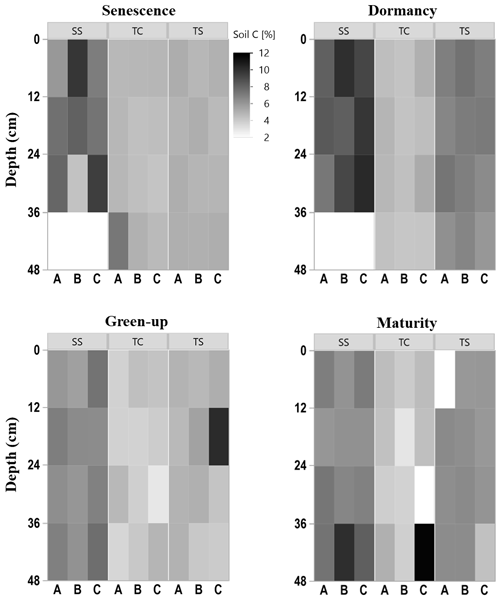
Salt marshes play a big role in global carbon (C) storage, and C stock estimates are used to predict future changes. However, spatial and temporal gradients in C burial rates over the landscape exist due to variations in water inundation, dominant plant species and stage of growth, and tidal action. We quantified soil C concentrations in soil cores across time and space beside several porewater biogeochemical variables and discussed the controls on variability in soil C in salt marsh ecosystems.
Short summary
Wildfire-derived molecules are ubiquitous in the aquatic environment, but their biological fate remains understudied. We have evaluated the compositional changes that occur to wildfire-derived molecules after incubation with soil microbes. We observe a significant degradation but also a production of numerous new labile molecules. Our results indicate that wildfire-derived molecules can be broken down and the carbon and nitrogen therein can be incorporated into microbial food webs.
Wildfire-derived molecules are ubiquitous in the aquatic environment, but their biological fate...
Altmetrics
Final-revised paper
Preprint