
Articles | Volume 22, issue 23
https://doi.org/10.5194/bg-22-7519-2025
© Author(s) 2025. This work is distributed under
the Creative Commons Attribution 4.0 License.
the Creative Commons Attribution 4.0 License.
https://doi.org/10.5194/bg-22-7519-2025
© Author(s) 2025. This work is distributed under
the Creative Commons Attribution 4.0 License.
the Creative Commons Attribution 4.0 License.
Research article
| 
02 Dec 2025
Research article |
| 02 Dec 2025
| 02 Dec 2025
Mesoscale eddies heterogeneously modulate CO2 fluxes in eddy-rich regions of the Southern Ocean
Mariana Salinas-Matus
CORRESPONDING AUTHOR

Ocean Biogeochemistry, Climate Variability Department, Max Planck Institute for Meteorology, Hamburg, Germany
International Max Planck Research School on Earth System Modelling, Hamburg, Germany
Modeling the carbon cycle in the Earth system, Department of Earth System Sciences, Universität Hamburg, Hamburg, Germany
Nuno Serra
Modeling the carbon cycle in the Earth system, Department of Earth System Sciences, Universität Hamburg, Hamburg, Germany
Fatemeh Chegini
Modeling the carbon cycle in the Earth system, Department of Earth System Sciences, Universität Hamburg, Hamburg, Germany
Tatiana Ilyina
Modeling the carbon cycle in the Earth system, Department of Earth System Sciences, Universität Hamburg, Hamburg, Germany
Earth system modeling, Helmholtz-Zentrum Hereon, Geesthacht, Germany
Ocean Biogeochemistry, Climate Variability Department, Max Planck Institute for Meteorology, Hamburg, Germany
Related authors
No articles found.
Vivek K. Arora, Chris D. Jones, Pierre Friedlingstein, Tatiana Ilyina, Guilherme L. Torres Mendonça, Benjamin Sanderson, Charles Koven, Heather Graven, Michio Kawamiya, Victor Brovkin, John Dunne, Forrest M. Hoffman, Julia Pongratz, James T. Randerson, Anastasia Romanou, Sönke Zaehle, and Kirsten Zickfeld
EGUsphere, https://doi.org/10.5194/egusphere-2026-5533, https://doi.org/10.5194/egusphere-2026-5533, 2026
This preprint is open for discussion and under review for Geoscientific Model Development (GMD).
Short summary
Short summary
Earth system models (ESM) are important tools for understanding how the Earth’s climate and carbon cycle interact, and how Earth system responds to anthropogenic CO2 emissions. The Coupled Climate-Carbon Cycle Model Intercomparison Project (C4MIP) compares Earth system models from around the world in context of climate and carbon cycle interactions. This manuscript describes the new set of experiments for C4MIP for the seventh phase of the coupled modelling intercomparison project (CMIP7).
Jens Terhaar, Laurent Bopp, Pierre Friedlingstein, Thomas Frölicher, Helene Hollitzer, Tatiana Ilyina, Lester Kwiatkowski, Paul Lerner, Hongmei Li, Anastasia Romanou, Jörg Schwinger, Roland Séférian, and Aaron Wienkers
EGUsphere, https://doi.org/10.5194/egusphere-2026-5757, https://doi.org/10.5194/egusphere-2026-5757, 2026
This preprint is open for discussion and under review for Biogeosciences (BG).
Short summary
Short summary
The ocean absorbs about 30% of CO2 emissions, but how much it will keep absorbing as CO2 levels rise and the climate warms is highly uncertain. Combining climate models with observations, we show models underestimate both the ocean CO2 uptake with increasing atmospheric CO2 and how strongly this uptake weakens with warming, and that the two are linked. Our tighter estimate reduces uncertainty in how much emitted CO2 stays in the atmosphere, and in the warming caused by future emissions.
Chris Smith, Lennart Ramme, Christopher D. Wells, Ada Gjermundsen, Hongmei Li, Tatiana Ilyina, Adakudlu Muralidhar, Timothée Bourgeois, Jörg Schwinger, Alejandro Romero-Prieto, Chao Li, and Cecilie Mauritzen
Earth Syst. Dynam., 17, 893–911, https://doi.org/10.5194/esd-17-893-2026, https://doi.org/10.5194/esd-17-893-2026, 2026
Short summary
Short summary
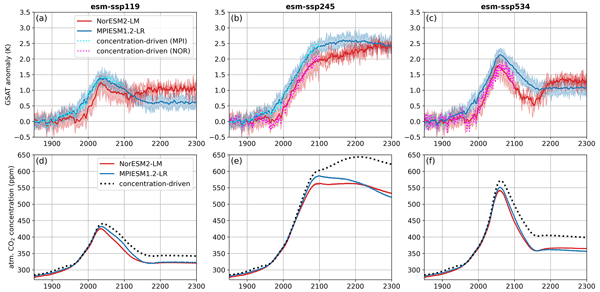
We run two Earth System Models models in CO2 emissions-driven mode to 2300 for three climate scenarios. For climate overshoot scenarios, there is a large residual warming in the 22nd century in one model, despite negative CO2 emissions, related to Southern Ocean heat release. In both models, while global mean surface temperature is largely reversible, other global and regional climate models exhibit hysteresis and irreversibility.
Benjamin M. Sanderson, Marit Sandstad, Alejandro Romero-Prieto, Stuart Jenkins, Charles Koven, Glen Peters, Roland Séfèrian, Andrew H. MacDougall, Ashwin Seshadri, Victor Brovkin, John Dunne, Abigail L. S. Swann, Torben Koenigk, Rosie A. Fisher, David Hohn, Tatiana Ilyina, Chris D. Jones, Hongmei Li, Peter Lawrence, Spencer Liddicoat, Nadine Mengis, Anastasia Romanou, Lori T. Sentman, Chris Smith, Norman J. Steinert, Jerry Tjiputra, and Tilo Ziehn
EGUsphere, https://doi.org/10.5194/egusphere-2026-1875, https://doi.org/10.5194/egusphere-2026-1875, 2026
Short summary
Short summary
When humanity stops emitting carbon dioxide, will temperatures keep rising, stabilize, or fall? Our study reveals in most models, temperatures remain nearly stable, but this hides a balance between the warming in response to radiation imbalance, and the cooling due to uptake of carbon in the land and ocean. Understanding this balance helps refine how much more CO2 we can safely emit.
Pierre Friedlingstein, Michael O'Sullivan, Matthew W. Jones, Robbie M. Andrew, Dorothee C. E. Bakker, Judith Hauck, Peter Landschützer, Corinne Le Quéré, Hongmei Li, Ingrid T. Luijkx, Glen P. Peters, Wouter Peters, Julia Pongratz, Clemens Schwingshackl, Stephen Sitch, Josep G. Canadell, Philippe Ciais, Kjetil Aas, Simone R. Alin, Peter Anthoni, Leticia Barbero, Nicholas R. Bates, Nicolas Bellouin, Alice Benoit-Cattin, Carla F. Berghoff, Raffaele Bernardello, Laurent Bopp, Ida Bagus Mandhara Brasika, Matthew A. Chamberlain, Naveen Chandra, Frédéric Chevallier, Louise P. Chini, Nathan O. Collier, Thomas H. Colligan, Margot Cronin, Laique M. Djeutchouang, Xinyu Dou, Matt P. Enright, Kazutaka Enyo, Michael Erb, Wiley Evans, Richard A. Feely, Liang Feng, Daniel J. Ford, Adrianna Foster, Filippa Fransner, Thomas Gasser, Marion Gehlen, Thanos Gkritzalis, Jefferson Goncalves De Souza, Giacomo Grassi, Luke Gregor, Nicolas Gruber, Bertrand Guenet, Özgür Gürses, Kirsty Harrington, Ian Harris, Jens Heinke, George C. Hurtt, Yosuke Iida, Tatiana Ilyina, Akihiko Ito, Andrew R. Jacobson, Atul K. Jain, Tereza Jarníková, Annika Jersild, Fei Jiang, Steve D. Jones, Etsushi Kato, Ralph F. Keeling, Kees Klein Goldewijk, Jürgen Knauer, Yawen Kong, Jan Ivar Korsbakken, Charles Koven, Taro Kunimitsu, Xin Lan, Junjie Liu, Zhiqiang Liu, Zhu Liu, Claire Lo Monaco, Lei Ma, Gregg Marland, Patrick C. McGuire, Galen A. McKinley, Joe R. Melton, Natalie Monacci, Erwan Monier, Eric J. Morgan, David R. Munro, Jens D. Müller, Shin-Ichiro Nakaoka, Lorna R. Nayagam, Yosuke Niwa, Tobias Nutzel, Are Olsen, Abdirahman M. Omar, Naiqing Pan, Sudhanshu Pandey, Denis Pierrot, Zhangcai Qin, Pierre Regnier, Gregor Rehder, Laure Resplandy, Alizée Roobaert, Thais M. Rosan, Christian Rödenbeck, Jörg Schwinger, Ingunn Skjelvan, T. Luke Smallman, Victoria Spada, Mohanan G. Sreeush, Qing Sun, Adrienne J. Sutton, Colm Sweeney, Didier Swingedouw, Roland Séférian, Shintaro Takao, Hiroaki Tatebe, Hanqin Tian, Xiangjun Tian, Bronte Tilbrook, Hiroyuki Tsujino, Francesco Tubiello, Erik van Ooijen, Guido R. van der Werf, Sebastiaan J. van de Velde, Anthony P. Walker, Rik Wanninkhof, Xiaojuan Yang, Wenping Yuan, Xu Yue, and Jiye Zeng
Earth Syst. Sci. Data, 18, 3211–3288, https://doi.org/10.5194/essd-18-3211-2026, https://doi.org/10.5194/essd-18-3211-2026, 2026
Short summary
Short summary
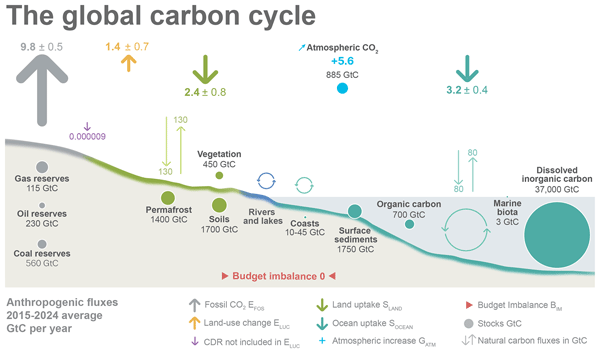
The Global Carbon Budget 2025 describes the methodology, main results, and datasets used to quantify the anthropogenic emissions of carbon dioxide (CO2) and their partitioning among the atmosphere, land ecosystems, and the ocean over the historical period (1750–2025). These living datasets are updated every year to provide the highest transparency and traceability in the reporting of CO2, the key driver of climate change.

Joeran Maerz, Katharina D. Six, Soeren Ahmerkamp, and Tatiana Ilyina
Biogeosciences, 23, 1897–1929, https://doi.org/10.5194/bg-23-1897-2026, https://doi.org/10.5194/bg-23-1897-2026, 2026
Short summary
Short summary
CO2 taken up by marine algae can escape ocean surface waters through subsequent particle formation and sinking. Representing this biological carbon pump (BCP) in Earth system models remains challenging and poses uncertainties for future projections. We show that an advanced BCP representation regionally buffers ocean biogeochemistry compared to a classical approach while both respond globally similar to climate warming. Particle microstructure turns out as a key uncertainty for sinking fluxes.
Lucas Carnier Casaroli, Nuno Serra, Fatemeh Chegini, and Tatiana Ilyina
EGUsphere, https://doi.org/10.5194/egusphere-2026-504, https://doi.org/10.5194/egusphere-2026-504, 2026
Short summary
Short summary
This study shows that vortices in the equatorial Pacific strongly influence how the ocean absorbs and releases carbon dioxide. Using a 30-year high-resolution ocean biogeochemical model, we found that these vortices reshape carbon transport and primary production differently during El Niño and La Niña. The vortices can even reverse the role of the ocean from releasing to absorbing carbon, showing that motions hundreds of kilometers wide can shape basin-scale carbon patterns.
Wolfgang A. Müller, Stephan Lorenz, Trang V. Pham, Andrea Schneidereit, Renate Brokopf, Victor Brovkin, Nils Brüggemann, Fatemeh Chegini, Dietmar Dommenget, Kristina Fröhlich, Barbara Früh, Veronika Gayler, Helmuth Haak, Stefan Hagemann, Moritz Hanke, Tatiana Ilyina, Johann Jungclaus, Martin Köhler, Peter Korn, Luis Kornblueh, Clarissa A. Kroll, Julian Krüger, Karel Castro-Morales, Ulrike Niemeier, Holger Pohlmann, Iuliia Polkova, Roland Potthast, Thomas Riddick, Manuel Schlund, Tobias Stacke, Roland Wirth, Dakuan Yu, and Jochem Marotzke
Geosci. Model Dev., 18, 9385–9415, https://doi.org/10.5194/gmd-18-9385-2025, https://doi.org/10.5194/gmd-18-9385-2025, 2025
Short summary
Short summary
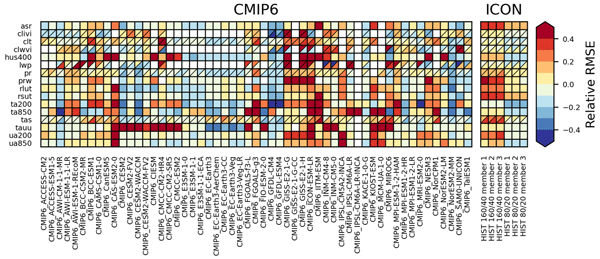
We provide a new Earth System model configuration framed into the ICON architecture, which provides the baseline for the next generation of climate predictions and projections (hereafter ICON XPP). Two resolutions of ICON XPP are presented that show high runtime performances making it suitable to run long integrations and large-ensemble experiments. ICON XPP similarly perform to CMIP6-class of climate models making it a good basis for climate forecasts and projections, and climate research.
Victor Brovkin, Benjamin M. Sanderson, Noel G. Brizuela, Tomohiro Hajima, Tatiana Ilyina, Chris D. Jones, Charles Koven, David Lawrence, Peter Lawrence, Hongmei Li, Spencer Liddcoat, Anastasia Romanou, Roland Séférian, Lori T. Sentman, Abigail L. S. Swann, Jerry Tjiputra, Tilo Ziehn, and Alexander J. Winkler
Earth Syst. Dynam., 16, 2021–2034, https://doi.org/10.5194/esd-16-2021-2025, https://doi.org/10.5194/esd-16-2021-2025, 2025
Short summary
Short summary
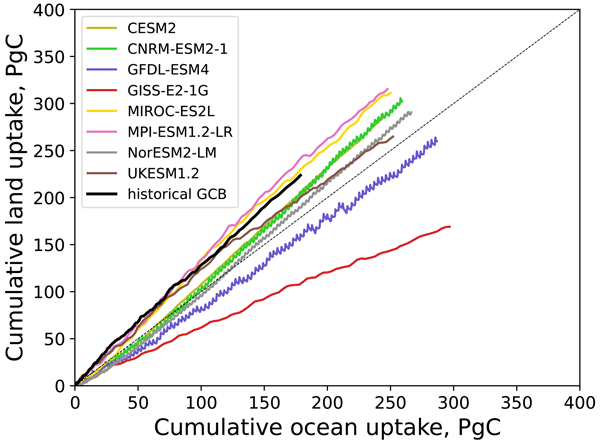
Idealized experiments with Earth system models provide a basis for understanding the response of the carbon cycle to emissions. We show that most models exhibit a quasi-linear relationship between cumulative carbon uptake on land and in the ocean and hypothesize that this relationship does not depend on emission pathways. We reduce the coupled system to only one differential equation, which represents a powerful simplification of the Earth system dynamics as a function of fossil fuel emissions.
Yohei Takano and Tatiana Ilyina
EGUsphere, https://doi.org/10.5194/egusphere-2025-3757, https://doi.org/10.5194/egusphere-2025-3757, 2025
Short summary
Short summary
Ocean oxygen levels are changing, but we have limited observations to track these changes over time. Natural fluctuations in climate systems, called internal climate variability, make it challenging to detect long-term changes. This study uses model simulations and new observational data to understand how these factors affect our view of past and future oxygen loss. The findings highlight the need to maintain global ocean monitoring to track oxygen loss and evaluate future changes.
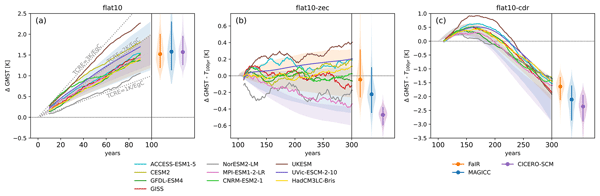
Benjamin M. Sanderson, Victor Brovkin, Rosie A. Fisher, David Hohn, Tatiana Ilyina, Chris D. Jones, Torben Koenigk, Charles Koven, Hongmei Li, David M. Lawrence, Peter Lawrence, Spencer Liddicoat, Andrew H. MacDougall, Nadine Mengis, Zebedee Nicholls, Eleanor O'Rourke, Anastasia Romanou, Marit Sandstad, Jörg Schwinger, Roland Séférian, Lori T. Sentman, Isla R. Simpson, Chris Smith, Norman J. Steinert, Abigail L. S. Swann, Jerry Tjiputra, and Tilo Ziehn
Geosci. Model Dev., 18, 5699–5724, https://doi.org/10.5194/gmd-18-5699-2025, https://doi.org/10.5194/gmd-18-5699-2025, 2025
Short summary
Short summary
This study investigates how climate models warm in response to simplified carbon emissions trajectories, refining the understanding of climate reversibility and commitment. Metrics are defined for warming response to cumulative emissions and for the cessation of emissions or ramp-down to net-zero and net-negative levels. Results indicate that previous concentration-driven experiments may have overstated the Zero Emissions Commitment due to emissions rates exceeding historical levels.
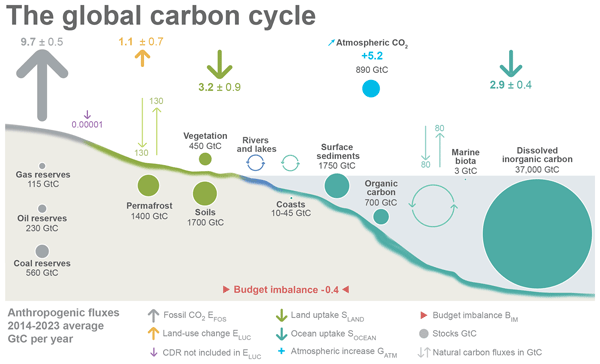
Pierre Friedlingstein, Michael O'Sullivan, Matthew W. Jones, Robbie M. Andrew, Judith Hauck, Peter Landschützer, Corinne Le Quéré, Hongmei Li, Ingrid T. Luijkx, Are Olsen, Glen P. Peters, Wouter Peters, Julia Pongratz, Clemens Schwingshackl, Stephen Sitch, Josep G. Canadell, Philippe Ciais, Robert B. Jackson, Simone R. Alin, Almut Arneth, Vivek Arora, Nicholas R. Bates, Meike Becker, Nicolas Bellouin, Carla F. Berghoff, Henry C. Bittig, Laurent Bopp, Patricia Cadule, Katie Campbell, Matthew A. Chamberlain, Naveen Chandra, Frédéric Chevallier, Louise P. Chini, Thomas Colligan, Jeanne Decayeux, Laique M. Djeutchouang, Xinyu Dou, Carolina Duran Rojas, Kazutaka Enyo, Wiley Evans, Amanda R. Fay, Richard A. Feely, Daniel J. Ford, Adrianna Foster, Thomas Gasser, Marion Gehlen, Thanos Gkritzalis, Giacomo Grassi, Luke Gregor, Nicolas Gruber, Özgür Gürses, Ian Harris, Matthew Hefner, Jens Heinke, George C. Hurtt, Yosuke Iida, Tatiana Ilyina, Andrew R. Jacobson, Atul K. Jain, Tereza Jarníková, Annika Jersild, Fei Jiang, Zhe Jin, Etsushi Kato, Ralph F. Keeling, Kees Klein Goldewijk, Jürgen Knauer, Jan Ivar Korsbakken, Xin Lan, Siv K. Lauvset, Nathalie Lefèvre, Zhu Liu, Junjie Liu, Lei Ma, Shamil Maksyutov, Gregg Marland, Nicolas Mayot, Patrick C. McGuire, Nicolas Metzl, Natalie M. Monacci, Eric J. Morgan, Shin-Ichiro Nakaoka, Craig Neill, Yosuke Niwa, Tobias Nützel, Lea Olivier, Tsuneo Ono, Paul I. Palmer, Denis Pierrot, Zhangcai Qin, Laure Resplandy, Alizée Roobaert, Thais M. Rosan, Christian Rödenbeck, Jörg Schwinger, T. Luke Smallman, Stephen M. Smith, Reinel Sospedra-Alfonso, Tobias Steinhoff, Qing Sun, Adrienne J. Sutton, Roland Séférian, Shintaro Takao, Hiroaki Tatebe, Hanqin Tian, Bronte Tilbrook, Olivier Torres, Etienne Tourigny, Hiroyuki Tsujino, Francesco Tubiello, Guido van der Werf, Rik Wanninkhof, Xuhui Wang, Dongxu Yang, Xiaojuan Yang, Zhen Yu, Wenping Yuan, Xu Yue, Sönke Zaehle, Ning Zeng, and Jiye Zeng
Earth Syst. Sci. Data, 17, 965–1039, https://doi.org/10.5194/essd-17-965-2025, https://doi.org/10.5194/essd-17-965-2025, 2025
Short summary
Short summary
The Global Carbon Budget 2024 describes the methodology, main results, and datasets used to quantify the anthropogenic emissions of carbon dioxide (CO2) and their partitioning among the atmosphere, land ecosystems, and the ocean over the historical period (1750–2024). These living datasets are updated every year to provide the highest transparency and traceability in the reporting of CO2, the key driver of climate change.
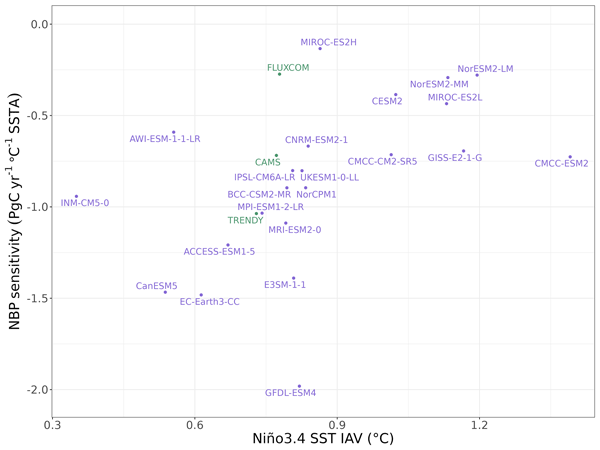
István Dunkl, Ana Bastos, and Tatiana Ilyina
Earth Syst. Dynam., 16, 151–167, https://doi.org/10.5194/esd-16-151-2025, https://doi.org/10.5194/esd-16-151-2025, 2025
Short summary
Short summary
While the El Niño–Southern Oscillation, a climate mode, has a similar impact on CO2 growth rates across Earth system models, there is significant uncertainty in the processes behind this relationship. We found a compensatory effect that masks differences in the sensitivity of carbon fluxes to climate anomalies and observed that the carbon fluxes contributing to global CO2 anomalies originate from different regions and are caused by different drivers.
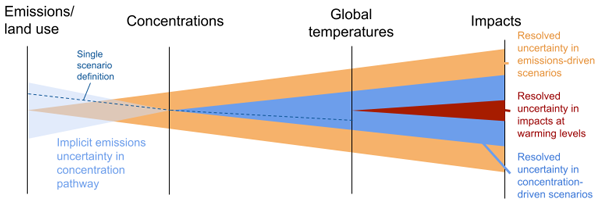
Benjamin M. Sanderson, Ben B. B. Booth, John Dunne, Veronika Eyring, Rosie A. Fisher, Pierre Friedlingstein, Matthew J. Gidden, Tomohiro Hajima, Chris D. Jones, Colin G. Jones, Andrew King, Charles D. Koven, David M. Lawrence, Jason Lowe, Nadine Mengis, Glen P. Peters, Joeri Rogelj, Chris Smith, Abigail C. Snyder, Isla R. Simpson, Abigail L. S. Swann, Claudia Tebaldi, Tatiana Ilyina, Carl-Friedrich Schleussner, Roland Séférian, Bjørn H. Samset, Detlef van Vuuren, and Sönke Zaehle
Geosci. Model Dev., 17, 8141–8172, https://doi.org/10.5194/gmd-17-8141-2024, https://doi.org/10.5194/gmd-17-8141-2024, 2024
Short summary
Short summary
We discuss how, in order to provide more relevant guidance for climate policy, coordinated climate experiments should adopt a greater focus on simulations where Earth system models are provided with carbon emissions from fossil fuels together with land use change instructions, rather than past approaches that have largely focused on experiments with prescribed atmospheric carbon dioxide concentrations. We discuss how these goals might be achieved in coordinated climate modeling experiments.

Colin G. Jones, Fanny Adloff, Ben B. B. Booth, Peter M. Cox, Veronika Eyring, Pierre Friedlingstein, Katja Frieler, Helene T. Hewitt, Hazel A. Jeffery, Sylvie Joussaume, Torben Koenigk, Bryan N. Lawrence, Eleanor O'Rourke, Malcolm J. Roberts, Benjamin M. Sanderson, Roland Séférian, Samuel Somot, Pier Luigi Vidale, Detlef van Vuuren, Mario Acosta, Mats Bentsen, Raffaele Bernardello, Richard Betts, Ed Blockley, Julien Boé, Tom Bracegirdle, Pascale Braconnot, Victor Brovkin, Carlo Buontempo, Francisco Doblas-Reyes, Markus Donat, Italo Epicoco, Pete Falloon, Sandro Fiore, Thomas Frölicher, Neven S. Fučkar, Matthew J. Gidden, Helge F. Goessling, Rune Grand Graversen, Silvio Gualdi, José M. Gutiérrez, Tatiana Ilyina, Daniela Jacob, Chris D. Jones, Martin Juckes, Elizabeth Kendon, Erik Kjellström, Reto Knutti, Jason Lowe, Matthew Mizielinski, Paola Nassisi, Michael Obersteiner, Pierre Regnier, Romain Roehrig, David Salas y Mélia, Carl-Friedrich Schleussner, Michael Schulz, Enrico Scoccimarro, Laurent Terray, Hannes Thiemann, Richard A. Wood, Shuting Yang, and Sönke Zaehle
Earth Syst. Dynam., 15, 1319–1351, https://doi.org/10.5194/esd-15-1319-2024, https://doi.org/10.5194/esd-15-1319-2024, 2024
Short summary
Short summary
We propose a number of priority areas for the international climate research community to address over the coming decade. Advances in these areas will both increase our understanding of past and future Earth system change, including the societal and environmental impacts of this change, and deliver significantly improved scientific support to international climate policy, such as future IPCC assessments and the UNFCCC Global Stocktake.
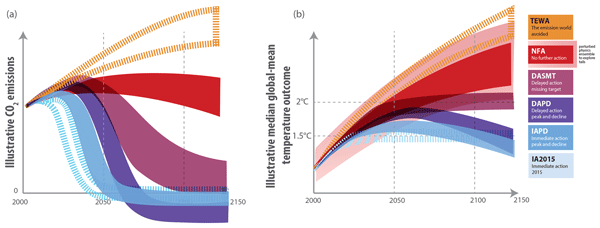
Malte Meinshausen, Carl-Friedrich Schleussner, Kathleen Beyer, Greg Bodeker, Olivier Boucher, Josep G. Canadell, John S. Daniel, Aïda Diongue-Niang, Fatima Driouech, Erich Fischer, Piers Forster, Michael Grose, Gerrit Hansen, Zeke Hausfather, Tatiana Ilyina, Jarmo S. Kikstra, Joyce Kimutai, Andrew D. King, June-Yi Lee, Chris Lennard, Tabea Lissner, Alexander Nauels, Glen P. Peters, Anna Pirani, Gian-Kasper Plattner, Hans Pörtner, Joeri Rogelj, Maisa Rojas, Joyashree Roy, Bjørn H. Samset, Benjamin M. Sanderson, Roland Séférian, Sonia Seneviratne, Christopher J. Smith, Sophie Szopa, Adelle Thomas, Diana Urge-Vorsatz, Guus J. M. Velders, Tokuta Yokohata, Tilo Ziehn, and Zebedee Nicholls
Geosci. Model Dev., 17, 4533–4559, https://doi.org/10.5194/gmd-17-4533-2024, https://doi.org/10.5194/gmd-17-4533-2024, 2024
Short summary
Short summary
The scientific community is considering new scenarios to succeed RCPs and SSPs for the next generation of Earth system model runs to project future climate change. To contribute to that effort, we reflect on relevant policy and scientific research questions and suggest categories for representative emission pathways. These categories are tailored to the Paris Agreement long-term temperature goal, high-risk outcomes in the absence of further climate policy and worlds “that could have been”.
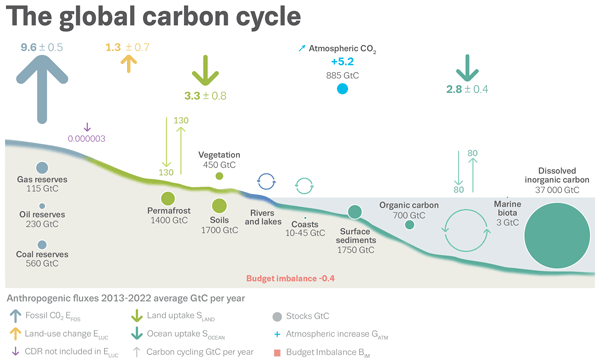
Pierre Friedlingstein, Michael O'Sullivan, Matthew W. Jones, Robbie M. Andrew, Dorothee C. E. Bakker, Judith Hauck, Peter Landschützer, Corinne Le Quéré, Ingrid T. Luijkx, Glen P. Peters, Wouter Peters, Julia Pongratz, Clemens Schwingshackl, Stephen Sitch, Josep G. Canadell, Philippe Ciais, Robert B. Jackson, Simone R. Alin, Peter Anthoni, Leticia Barbero, Nicholas R. Bates, Meike Becker, Nicolas Bellouin, Bertrand Decharme, Laurent Bopp, Ida Bagus Mandhara Brasika, Patricia Cadule, Matthew A. Chamberlain, Naveen Chandra, Thi-Tuyet-Trang Chau, Frédéric Chevallier, Louise P. Chini, Margot Cronin, Xinyu Dou, Kazutaka Enyo, Wiley Evans, Stefanie Falk, Richard A. Feely, Liang Feng, Daniel J. Ford, Thomas Gasser, Josefine Ghattas, Thanos Gkritzalis, Giacomo Grassi, Luke Gregor, Nicolas Gruber, Özgür Gürses, Ian Harris, Matthew Hefner, Jens Heinke, Richard A. Houghton, George C. Hurtt, Yosuke Iida, Tatiana Ilyina, Andrew R. Jacobson, Atul Jain, Tereza Jarníková, Annika Jersild, Fei Jiang, Zhe Jin, Fortunat Joos, Etsushi Kato, Ralph F. Keeling, Daniel Kennedy, Kees Klein Goldewijk, Jürgen Knauer, Jan Ivar Korsbakken, Arne Körtzinger, Xin Lan, Nathalie Lefèvre, Hongmei Li, Junjie Liu, Zhiqiang Liu, Lei Ma, Greg Marland, Nicolas Mayot, Patrick C. McGuire, Galen A. McKinley, Gesa Meyer, Eric J. Morgan, David R. Munro, Shin-Ichiro Nakaoka, Yosuke Niwa, Kevin M. O'Brien, Are Olsen, Abdirahman M. Omar, Tsuneo Ono, Melf Paulsen, Denis Pierrot, Katie Pocock, Benjamin Poulter, Carter M. Powis, Gregor Rehder, Laure Resplandy, Eddy Robertson, Christian Rödenbeck, Thais M. Rosan, Jörg Schwinger, Roland Séférian, T. Luke Smallman, Stephen M. Smith, Reinel Sospedra-Alfonso, Qing Sun, Adrienne J. Sutton, Colm Sweeney, Shintaro Takao, Pieter P. Tans, Hanqin Tian, Bronte Tilbrook, Hiroyuki Tsujino, Francesco Tubiello, Guido R. van der Werf, Erik van Ooijen, Rik Wanninkhof, Michio Watanabe, Cathy Wimart-Rousseau, Dongxu Yang, Xiaojuan Yang, Wenping Yuan, Xu Yue, Sönke Zaehle, Jiye Zeng, and Bo Zheng
Earth Syst. Sci. Data, 15, 5301–5369, https://doi.org/10.5194/essd-15-5301-2023, https://doi.org/10.5194/essd-15-5301-2023, 2023
Short summary
Short summary
The Global Carbon Budget 2023 describes the methodology, main results, and data sets used to quantify the anthropogenic emissions of carbon dioxide (CO2) and their partitioning among the atmosphere, land ecosystems, and the ocean over the historical period (1750–2023). These living datasets are updated every year to provide the highest transparency and traceability in the reporting of CO2, the key driver of climate change.
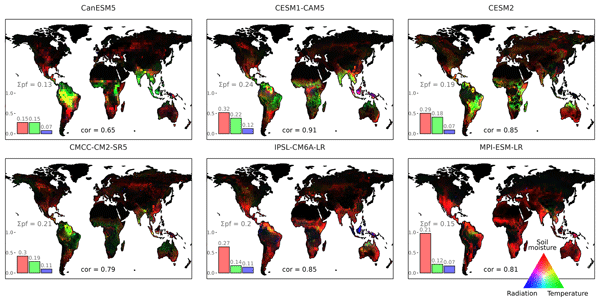
István Dunkl, Nicole Lovenduski, Alessio Collalti, Vivek K. Arora, Tatiana Ilyina, and Victor Brovkin
Biogeosciences, 20, 3523–3538, https://doi.org/10.5194/bg-20-3523-2023, https://doi.org/10.5194/bg-20-3523-2023, 2023
Short summary
Short summary
Despite differences in the reproduction of gross primary productivity (GPP) by Earth system models (ESMs), ESMs have similar predictability of the global carbon cycle. We found that, although GPP variability originates from different regions and is driven by different climatic variables across the ESMs, the ESMs rely on the same mechanisms to predict their own GPP. This shows that the predictability of the carbon cycle is limited by our understanding of variability rather than predictability.
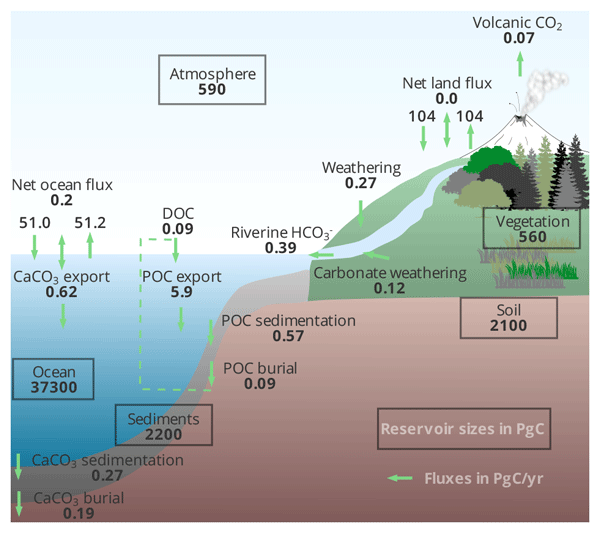
Matteo Willeit, Tatiana Ilyina, Bo Liu, Christoph Heinze, Mahé Perrette, Malte Heinemann, Daniela Dalmonech, Victor Brovkin, Guy Munhoven, Janine Börker, Jens Hartmann, Gibran Romero-Mujalli, and Andrey Ganopolski
Geosci. Model Dev., 16, 3501–3534, https://doi.org/10.5194/gmd-16-3501-2023, https://doi.org/10.5194/gmd-16-3501-2023, 2023
Short summary
Short summary
In this paper we present the carbon cycle component of the newly developed fast Earth system model CLIMBER-X. The model can be run with interactive atmospheric CO2 to investigate the feedbacks between climate and the carbon cycle on temporal scales ranging from decades to > 100 000 years. CLIMBER-X is expected to be a useful tool for studying past climate–carbon cycle changes and for the investigation of the long-term future evolution of the Earth system.
Alban Planchat, Lester Kwiatkowski, Laurent Bopp, Olivier Torres, James R. Christian, Momme Butenschön, Tomas Lovato, Roland Séférian, Matthew A. Chamberlain, Olivier Aumont, Michio Watanabe, Akitomo Yamamoto, Andrew Yool, Tatiana Ilyina, Hiroyuki Tsujino, Kristen M. Krumhardt, Jörg Schwinger, Jerry Tjiputra, John P. Dunne, and Charles Stock
Biogeosciences, 20, 1195–1257, https://doi.org/10.5194/bg-20-1195-2023, https://doi.org/10.5194/bg-20-1195-2023, 2023
Short summary
Short summary
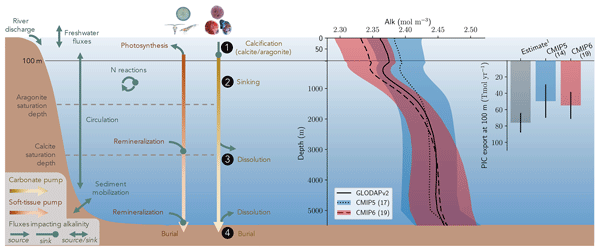
Ocean alkalinity is critical to the uptake of atmospheric carbon and acidification in surface waters. We review the representation of alkalinity and the associated calcium carbonate cycle in Earth system models. While many parameterizations remain present in the latest generation of models, there is a general improvement in the simulated alkalinity distribution. This improvement is related to an increase in the export of biotic calcium carbonate, which closer resembles observations.
Hongmei Li, Tatiana Ilyina, Tammas Loughran, Aaron Spring, and Julia Pongratz
Earth Syst. Dynam., 14, 101–119, https://doi.org/10.5194/esd-14-101-2023, https://doi.org/10.5194/esd-14-101-2023, 2023
Short summary
Short summary
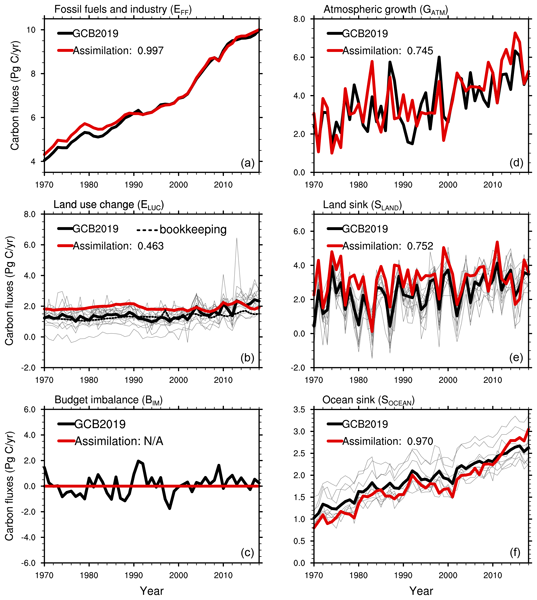
For the first time, our decadal prediction system based on Max Planck Institute Earth System Model enables prognostic atmospheric CO2 with an interactive carbon cycle. The evolution of CO2 fluxes and atmospheric CO2 growth is reconstructed well by assimilating data products; retrospective predictions show high confidence in predicting changes in the next year. The Earth system predictions provide valuable inputs for understanding the global carbon cycle and informing climate-relevant policy.
Cathy Hohenegger, Peter Korn, Leonidas Linardakis, René Redler, Reiner Schnur, Panagiotis Adamidis, Jiawei Bao, Swantje Bastin, Milad Behravesh, Martin Bergemann, Joachim Biercamp, Hendryk Bockelmann, Renate Brokopf, Nils Brüggemann, Lucas Casaroli, Fatemeh Chegini, George Datseris, Monika Esch, Geet George, Marco Giorgetta, Oliver Gutjahr, Helmuth Haak, Moritz Hanke, Tatiana Ilyina, Thomas Jahns, Johann Jungclaus, Marcel Kern, Daniel Klocke, Lukas Kluft, Tobias Kölling, Luis Kornblueh, Sergey Kosukhin, Clarissa Kroll, Junhong Lee, Thorsten Mauritsen, Carolin Mehlmann, Theresa Mieslinger, Ann Kristin Naumann, Laura Paccini, Angel Peinado, Divya Sri Praturi, Dian Putrasahan, Sebastian Rast, Thomas Riddick, Niklas Roeber, Hauke Schmidt, Uwe Schulzweida, Florian Schütte, Hans Segura, Radomyra Shevchenko, Vikram Singh, Mia Specht, Claudia Christine Stephan, Jin-Song von Storch, Raphaela Vogel, Christian Wengel, Marius Winkler, Florian Ziemen, Jochem Marotzke, and Bjorn Stevens
Geosci. Model Dev., 16, 779–811, https://doi.org/10.5194/gmd-16-779-2023, https://doi.org/10.5194/gmd-16-779-2023, 2023
Short summary
Short summary
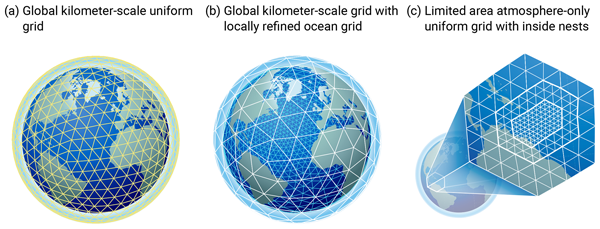
Models of the Earth system used to understand climate and predict its change typically employ a grid spacing of about 100 km. Yet, many atmospheric and oceanic processes occur on much smaller scales. In this study, we present a new model configuration designed for the simulation of the components of the Earth system and their interactions at kilometer and smaller scales, allowing an explicit representation of the main drivers of the flow of energy and matter by solving the underlying equations.
Leonidas Linardakis, Irene Stemmler, Moritz Hanke, Lennart Ramme, Fatemeh Chegini, Tatiana Ilyina, and Peter Korn
Geosci. Model Dev., 15, 9157–9176, https://doi.org/10.5194/gmd-15-9157-2022, https://doi.org/10.5194/gmd-15-9157-2022, 2022
Short summary
Short summary
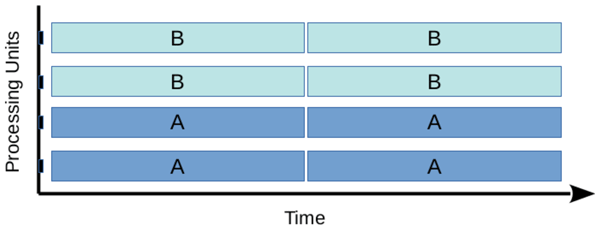
In Earth system modelling, we are facing the challenge of making efficient use of very large machines, with millions of cores. To meet this challenge we will need to employ multi-level and multi-dimensional parallelism. Component concurrency, being a function parallel technique, offers an additional dimension to the traditional data-parallel approaches. In this paper we examine the behaviour of component concurrency and identify the conditions for its optimal application.
Pierre Friedlingstein, Michael O'Sullivan, Matthew W. Jones, Robbie M. Andrew, Luke Gregor, Judith Hauck, Corinne Le Quéré, Ingrid T. Luijkx, Are Olsen, Glen P. Peters, Wouter Peters, Julia Pongratz, Clemens Schwingshackl, Stephen Sitch, Josep G. Canadell, Philippe Ciais, Robert B. Jackson, Simone R. Alin, Ramdane Alkama, Almut Arneth, Vivek K. Arora, Nicholas R. Bates, Meike Becker, Nicolas Bellouin, Henry C. Bittig, Laurent Bopp, Frédéric Chevallier, Louise P. Chini, Margot Cronin, Wiley Evans, Stefanie Falk, Richard A. Feely, Thomas Gasser, Marion Gehlen, Thanos Gkritzalis, Lucas Gloege, Giacomo Grassi, Nicolas Gruber, Özgür Gürses, Ian Harris, Matthew Hefner, Richard A. Houghton, George C. Hurtt, Yosuke Iida, Tatiana Ilyina, Atul K. Jain, Annika Jersild, Koji Kadono, Etsushi Kato, Daniel Kennedy, Kees Klein Goldewijk, Jürgen Knauer, Jan Ivar Korsbakken, Peter Landschützer, Nathalie Lefèvre, Keith Lindsay, Junjie Liu, Zhu Liu, Gregg Marland, Nicolas Mayot, Matthew J. McGrath, Nicolas Metzl, Natalie M. Monacci, David R. Munro, Shin-Ichiro Nakaoka, Yosuke Niwa, Kevin O'Brien, Tsuneo Ono, Paul I. Palmer, Naiqing Pan, Denis Pierrot, Katie Pocock, Benjamin Poulter, Laure Resplandy, Eddy Robertson, Christian Rödenbeck, Carmen Rodriguez, Thais M. Rosan, Jörg Schwinger, Roland Séférian, Jamie D. Shutler, Ingunn Skjelvan, Tobias Steinhoff, Qing Sun, Adrienne J. Sutton, Colm Sweeney, Shintaro Takao, Toste Tanhua, Pieter P. Tans, Xiangjun Tian, Hanqin Tian, Bronte Tilbrook, Hiroyuki Tsujino, Francesco Tubiello, Guido R. van der Werf, Anthony P. Walker, Rik Wanninkhof, Chris Whitehead, Anna Willstrand Wranne, Rebecca Wright, Wenping Yuan, Chao Yue, Xu Yue, Sönke Zaehle, Jiye Zeng, and Bo Zheng
Earth Syst. Sci. Data, 14, 4811–4900, https://doi.org/10.5194/essd-14-4811-2022, https://doi.org/10.5194/essd-14-4811-2022, 2022
Short summary
Short summary
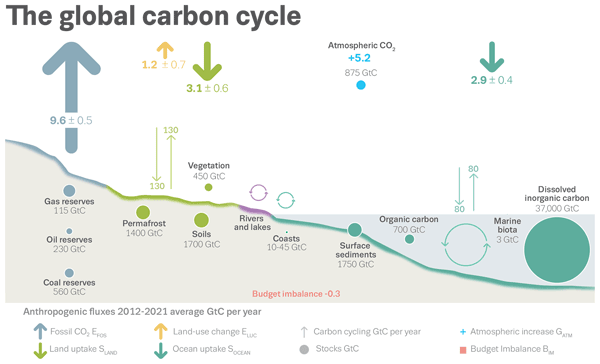
The Global Carbon Budget 2022 describes the datasets and methodology used to quantify the anthropogenic emissions of carbon dioxide (CO2) and their partitioning among the atmosphere, the land ecosystems, and the ocean. These living datasets are updated every year to provide the highest transparency and traceability in the reporting of CO2, the key driver of climate change.
Pradeebane Vaittinada Ayar, Laurent Bopp, Jim R. Christian, Tatiana Ilyina, John P. Krasting, Roland Séférian, Hiroyuki Tsujino, Michio Watanabe, Andrew Yool, and Jerry Tjiputra
Earth Syst. Dynam., 13, 1097–1118, https://doi.org/10.5194/esd-13-1097-2022, https://doi.org/10.5194/esd-13-1097-2022, 2022
Short summary
Short summary
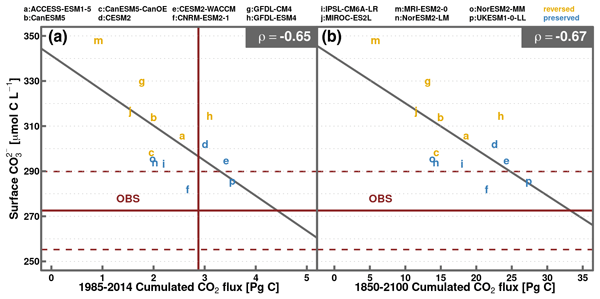
The El Niño–Southern Oscillation is the main driver for the natural variability of global atmospheric CO2. It modulates the CO2 fluxes in the tropical Pacific with anomalous CO2 influx during El Niño and outflux during La Niña. This relationship is projected to reverse by half of Earth system models studied here under the business-as-usual scenario. This study shows models that simulate a positive bias in surface carbonate concentrations simulate a shift in the ENSO–CO2 flux relationship.
Pierre Friedlingstein, Matthew W. Jones, Michael O'Sullivan, Robbie M. Andrew, Dorothee C. E. Bakker, Judith Hauck, Corinne Le Quéré, Glen P. Peters, Wouter Peters, Julia Pongratz, Stephen Sitch, Josep G. Canadell, Philippe Ciais, Rob B. Jackson, Simone R. Alin, Peter Anthoni, Nicholas R. Bates, Meike Becker, Nicolas Bellouin, Laurent Bopp, Thi Tuyet Trang Chau, Frédéric Chevallier, Louise P. Chini, Margot Cronin, Kim I. Currie, Bertrand Decharme, Laique M. Djeutchouang, Xinyu Dou, Wiley Evans, Richard A. Feely, Liang Feng, Thomas Gasser, Dennis Gilfillan, Thanos Gkritzalis, Giacomo Grassi, Luke Gregor, Nicolas Gruber, Özgür Gürses, Ian Harris, Richard A. Houghton, George C. Hurtt, Yosuke Iida, Tatiana Ilyina, Ingrid T. Luijkx, Atul Jain, Steve D. Jones, Etsushi Kato, Daniel Kennedy, Kees Klein Goldewijk, Jürgen Knauer, Jan Ivar Korsbakken, Arne Körtzinger, Peter Landschützer, Siv K. Lauvset, Nathalie Lefèvre, Sebastian Lienert, Junjie Liu, Gregg Marland, Patrick C. McGuire, Joe R. Melton, David R. Munro, Julia E. M. S. Nabel, Shin-Ichiro Nakaoka, Yosuke Niwa, Tsuneo Ono, Denis Pierrot, Benjamin Poulter, Gregor Rehder, Laure Resplandy, Eddy Robertson, Christian Rödenbeck, Thais M. Rosan, Jörg Schwinger, Clemens Schwingshackl, Roland Séférian, Adrienne J. Sutton, Colm Sweeney, Toste Tanhua, Pieter P. Tans, Hanqin Tian, Bronte Tilbrook, Francesco Tubiello, Guido R. van der Werf, Nicolas Vuichard, Chisato Wada, Rik Wanninkhof, Andrew J. Watson, David Willis, Andrew J. Wiltshire, Wenping Yuan, Chao Yue, Xu Yue, Sönke Zaehle, and Jiye Zeng
Earth Syst. Sci. Data, 14, 1917–2005, https://doi.org/10.5194/essd-14-1917-2022, https://doi.org/10.5194/essd-14-1917-2022, 2022
Short summary
Short summary
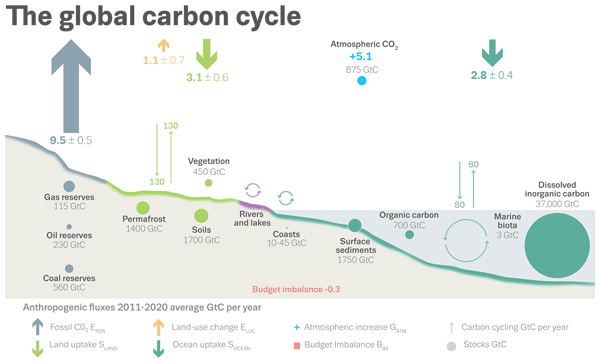
The Global Carbon Budget 2021 describes the data sets and methodology used to quantify the emissions of carbon dioxide and their partitioning among the atmosphere, land, and ocean. These living data are updated every year to provide the highest transparency and traceability in the reporting of CO2, the key driver of climate change.
Thomas Extier, Katharina D. Six, Bo Liu, Hanna Paulsen, and Tatiana Ilyina
Clim. Past, 18, 273–292, https://doi.org/10.5194/cp-18-273-2022, https://doi.org/10.5194/cp-18-273-2022, 2022
Short summary
Short summary
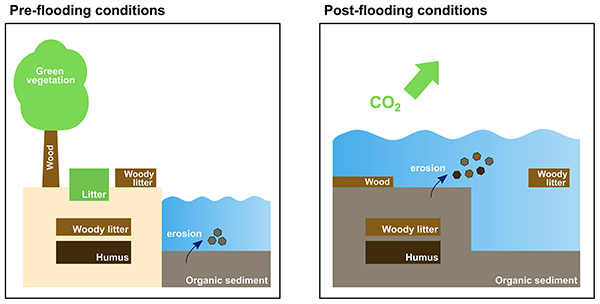
The role of land–sea fluxes during deglacial flooding in ocean biogeochemistry and CO2 exchange remains poorly constrained due to the lack of climate models that consider such fluxes. We implement the terrestrial organic matter fluxes into the ocean at a transiently changing land–sea interface in MPI-ESM and investigate their effect during the last deglaciation. Most of the terrestrial carbon goes to the ocean during flooding events of Meltwater Pulse 1a, which leads to regional CO2 outgassing.
Guokun Lyu, Nuno Serra, Meng Zhou, and Detlef Stammer
Ocean Sci., 18, 51–66, https://doi.org/10.5194/os-18-51-2022, https://doi.org/10.5194/os-18-51-2022, 2022
Short summary
Short summary
This study explores the Arctic sea level variability depending on different timescales and the relation to temperature, salinity and mass changes, identifying key parameters and regions that need to be observed coordinately. The decadal sea level variability reflects salinity changes. But it can only reflect salinity change at periods of greater than 1 year, highlighting the requirement for enhancing in situ hydrographic observations and complicated interpolation methods.
Aaron Spring, István Dunkl, Hongmei Li, Victor Brovkin, and Tatiana Ilyina
Earth Syst. Dynam., 12, 1139–1167, https://doi.org/10.5194/esd-12-1139-2021, https://doi.org/10.5194/esd-12-1139-2021, 2021
Short summary
Short summary
Numerical carbon cycle prediction models usually do not start from observed carbon states due to sparse observations. Instead, only physical climate is reconstructed, assuming that the carbon cycle follows indirectly. Here, we test in an idealized framework how well this indirect and direct reconstruction with perfect observations works. We find that indirect reconstruction works quite well and that improvements from the direct method are limited, strengthening the current indirect use.
Cited articles
Barré, N., Provost, C., and Saraceno, M.: Spatial and temporal scales of the Brazil-Malvinas Current confluence documented by simultaneous MODIS Aqua 1.1-km resolution SST and color images, Advances in Space Research, 37, 770–786, https://doi.org/10.1016/j.asr.2005.09.026, 2006. a
Beal, L. M., Ruijter, W. P. D., Biastoch, A., Zahn, R., Cronin, M., Hermes, J., Lutjeharms, J., Quartly, G., Tozuka, T., Baker-Yeboah, S., Bornman, T., Cipollini, P., Dijkstra, H., Hall, I., Park, W., Peeters, F., Penven, P., Ridderinkhof, H., and Zinke, J.: On the role of the Agulhas system in ocean circulation and climate, Nature, 472, 429–436, https://doi.org/10.1038/nature09983, 2011. a
Beech, N., Rackow, T., Semmler, T., and Jung, T.: High-latitude Southern Ocean eddy activity projected to evolve with anthropogenic climate change, Communications Earth and Environment, 6, https://doi.org/10.1038/s43247-025-02221-4, 2025. a
Biastoch, A., Böning, C. W., Schwarzkopf, F. U., and Lutjeharms, J. R.: Increase in Agulhas leakage due to poleward shift of Southern Hemisphere westerlies, Nature, 462, 495–498, https://doi.org/10.1038/nature08519, 2009. a
Bilgen, S. I. and Kirtman, B. P.: Impact of ocean model resolution on understanding the delayed warming of the Southern Ocean, Environmental Research Letters, 15, https://doi.org/10.1088/1748-9326/abbc3e, 2020. a
Chaigneau, A., Eldin, G., and Dewitte, B.: Eddy activity in the four major upwelling systems from satellite altimetry (1992-2007), Progress in Oceanography, 83, 117–123, https://doi.org/10.1016/j.pocean.2009.07.012, 2009. a
Chelton, D. B., Gaube, P., Schlax, M. G., Early, J. J., and Samelson, R. M.: The Influence of Nonlinear Mesoscale Eddies on Near-Surface Oceanic Chlorophyll, Science, 334, 328–332, https://doi.org/10.1126/science.1208897, 2011a. a
Chelton, D. B., Schlax, M. G., and Samelson, R. M.: Global observations of nonlinear mesoscale eddies, Progress in Oceanography, 91, 167–216, https://doi.org/10.1016/j.pocean.2011.01.002, 2011b. a, b
Chikamoto, M. O. and DiNezio, P.: Multi-Century Changes in the Ocean Carbon Cycle Controlled by the Tropical Oceans and the Southern Ocean, Global Biogeochemical Cycles, 35, https://doi.org/10.1029/2021GB007090, 2021. a
Dawson, H. R., Strutton, P. G., and Gaube, P.: The Unusual Surface Chlorophyll Signatures of Southern Ocean Eddies, Journal of Geophysical Research: Oceans, 123, 6053–6069, https://doi.org/10.1029/2017JC013628, 2018. a
Dong, Y., Bakker, D. C. E., Bell, T. G., Yang, M., Landschützer, P., Hauck, J., Rödenbeck, C., Kitidis, V., Bushinsky, S. M., and Liss, P. S.: Direct observational evidence of strong CO2 uptake in the Southern Ocean, Science Advances, 10, eadn5781, https://doi.org/10.1126/sciadv.adn5781, 2024. a
Dufour, C. O., Griffies, S. M., de Souza, G. F., Frenger, I., Morrison, A. K., Palter, J. B., Sarmiento, J. L., Galbraith, E. D., Dunne, J. P., Anderson, W. G., and Slater, R. D.: Role of mesoscale eddies in cross-frontal transport of heat and biogeochemical tracers in the Southern Ocean, Journal of Physical Oceanography, 45, 3057–3081, https://doi.org/10.1175/JPO-D-14-0240.1, 2015. a, b
Farneti, R., Delworth, T. L., Rosati, A. J., Griffies, S. M., and Zeng, F.: The role of mesoscale eddies in the rectification of the Southern ocean response to climate change, Journal of Physical Oceanography, 40, 1539–1557, https://doi.org/10.1175/2010JPO4353.1, 2010. a
Ford, D. J., Tilstone, G. H., Shutler, J. D., Kitidis, V., Sheen, K. L., Dall’Olmo, G., and Orselli, I. B.: Mesoscale Eddies Enhance the Air-Sea CO2 Sink in the South Atlantic Ocean, Geophysical Research Letters, 50, https://doi.org/10.1029/2022GL102137, 2023. a, b
Frenger, I., Münnich, M., Gruber, N., and Knutti, R.: Southern Ocean eddy phenomenology, Journal of Geophysical Research: Oceans, 120, 7413–7449, https://doi.org/10.1002/2015JC011047, 2015. a, b
Friedlingstein, P., O'Sullivan, M., Jones, M. W., Andrew, R. M., Gregor, L., Hauck, J., Le Quéré, C., Luijkx, I. T., Olsen, A., Peters, G. P., Peters, W., Pongratz, J., Schwingshackl, C., Sitch, S., Canadell, J. G., Ciais, P., Jackson, R. B., Alin, S. R., Alkama, R., Arneth, A., Arora, V. K., Bates, N. R., Becker, M., Bellouin, N., Bittig, H. C., Bopp, L., Chevallier, F., Chini, L. P., Cronin, M., Evans, W., Falk, S., Feely, R. A., Gasser, T., Gehlen, M., Gkritzalis, T., Gloege, L., Grassi, G., Gruber, N., Gürses, Ö., Harris, I., Hefner, M., Houghton, R. A., Hurtt, G. C., Iida, Y., Ilyina, T., Jain, A. K., Jersild, A., Kadono, K., Kato, E., Kennedy, D., Klein Goldewijk, K., Knauer, J., Korsbakken, J. I., Landschützer, P., Lefèvre, N., Lindsay, K., Liu, J., Liu, Z., Marland, G., Mayot, N., McGrath, M. J., Metzl, N., Monacci, N. M., Munro, D. R., Nakaoka, S.-I., Niwa, Y., O'Brien, K., Ono, T., Palmer, P. I., Pan, N., Pierrot, D., Pocock, K., Poulter, B., Resplandy, L., Robertson, E., Rödenbeck, C., Rodriguez, C., Rosan, T. M., Schwinger, J., Séférian, R., Shutler, J. D., Skjelvan, I., Steinhoff, T., Sun, Q., Sutton, A. J., Sweeney, C., Takao, S., Tanhua, T., Tans, P. P., Tian, X., Tian, H., Tilbrook, B., Tsujino, H., Tubiello, F., van der Werf, G. R., Walker, A. P., Wanninkhof, R., Whitehead, C., Willstrand Wranne, A., Wright, R., Yuan, W., Yue, C., Yue, X., Zaehle, S., Zeng, J., and Zheng, B.: Global Carbon Budget 2022, Earth Syst. Sci. Data, 14, 4811–4900, https://doi.org/10.5194/essd-14-4811-2022, 2022. a
Gray, A. R.: The Four-Dimensional Carbon Cycle of the Southern Ocean, Annual Review of Marine Science, 41, 53, https://doi.org/10.1146/annurev-marine-041923-104057, 2023. a
Griffies, S. M., Winton, M., Anderson, W. G., Benson, R., Delworth, T. L., Dufour, C. O., Dunne, J. P., Goddard, P., Morrison, A. K., Rosati, A., Wittenberg, A. T., Yin, J., and Zhang, R.: Impacts on ocean heat from transient mesoscale eddies in a hierarchy of climate models, Journal of Climate, 28, 952–977, https://doi.org/10.1175/JCLI-D-14-00353.1, 2015. a
Gu, Y., Katul, G. G., and Cassar, N.: Multiscale Temporal Variability of the Global Air-Sea CO2 Flux Anomaly, Journal of Geophysical Research: Biogeosciences, 128, https://doi.org/10.1029/2022JG006934, 2023. a, b
Guo, Y. and Timmermans, M. L.: The Role of Ocean Mesoscale Variability in Air-Sea CO2 Exchange: A Global Perspective, Geophysical Research Letters, 51, https://doi.org/10.1029/2024GL108373, 2024. a, b, c
Haarsma, R. J., Campos, E. J., Drijfhout, S., Hazeleger, W., and Severijns, C.: Impacts of interruption of the Agulhas leakage on the tropical Atlantic in coupled ocean-atmosphere simulations, Climate Dynamics, 36, 989–1003, https://doi.org/10.1007/s00382-009-0692-7, 2011. a
He, Q., Zhan, W., Cai, S., Du, Y., Chen, Z., Tang, S., and Zhan, H.: Enhancing impacts of mesoscale eddies on Southern Ocean temperature variability and extremes, Proceedings of the National Academy of Sciences of the United States of America, 120, https://doi.org/10.1073/pnas.2302292120, 2023. a
Hersbach, H., Bell, B., Berrisford, P., Hirahara, S., Horányi, A., Muñoz-Sabater, J., Nicolas, J., Peubey, C., Radu, R., Schepers, D., Simmons, A., Soci, C., Abdalla, S., Abellan, X., Balsamo, G., Bechtold, P., Biavati, G., Bidlot, J., Bonavita, M., Chiara, G. D., Dahlgren, P., Dee, D., Diamantakis, M., Dragani, R., Flemming, J., Forbes, R., Fuentes, M., Geer, A., Haimberger, L., Healy, S., Hogan, R. J., Hólm, E., Janisková, M., Keeley, S., Laloyaux, P., Lopez, P., Lupu, C., Radnoti, G., de Rosnay, P., Rozum, I., Vamborg, F., Villaume, S., and Thépaut, J. N.: The ERA5 global reanalysis, Quarterly Journal of the Royal Meteorological Society, 146, 1999–2049, https://doi.org/10.1002/qj.3803, 2020. a
Hewitt, H., Fox-Kemper, B., Pearson, B., Roberts, M., and Klocke, D.: The small scales of the ocean may hold the key to surprises, Nature Climate Change, 12, 494–496, https://doi.org/10.1038/s41558-022-01383-9, 2022. a
Hogg, A. M. C., Meredith, M. P., Chambers, D. P., Abrahamsen, E. P., Hughes, C. W., and Morrison, A. K.: Recent trends in the Southern Ocean eddy field, Journal of Geophysical Research: Oceans, 120, 257–267, https://doi.org/10.1002/2014JC010470, 2015. a, b, c
Ilyina, T., Six, K. D., Segschneider, J., Maier-Reimer, E., Li, H., and Núñez-Riboni, I.: Global ocean biogeochemistry model HAMOCC: Model architecture and performance as component of the MPI-Earth system model in different CMIP5 experimental realizations, Journal of Advances in Modeling Earth Systems, 5, 287–315, https://doi.org/10.1029/2012MS000178, 2013. a, b
Jones, C. D., Arora, V., Friedlingstein, P., Bopp, L., Brovkin, V., Dunne, J., Graven, H., Hoffman, F., Ilyina, T., John, J. G., Jung, M., Kawamiya, M., Koven, C., Pongratz, J., Raddatz, T., Randerson, J. T., and Zaehle, S.: C4MIP – The Coupled Climate–Carbon Cycle Model Intercomparison Project: experimental protocol for CMIP6, Geosci. Model Dev., 9, 2853–2880, https://doi.org/10.5194/gmd-9-2853-2016, 2016. a
Jones, E. M., Hoppema, M., Strass, V., Hauck, J., Salt, L., Ossebaar, S., Klaas, C., van Heuven, S. M., Wolf-Gladrow, D., Stöven, T., and de Baar, H. J.: Mesoscale features create hotspots of carbon uptake in the Antarctic Circumpolar Current, Deep-Sea Research Part II, 138, 39–51, https://doi.org/10.1016/j.dsr2.2015.10.006, 2017. a, b, c, d
Kim, D., Lee, S. E., Cho, S., Kang, D. J., Park, G. H., and Kang, S. K.: Mesoscale eddy effects on sea-air CO2 fluxes in the northern Philippine Sea, Frontiers in Marine Science, 9, https://doi.org/10.3389/fmars.2022.970678, 2022. a
Korn, P.: Formulation of an unstructured grid model for global ocean dynamics, Journal of Computational Physics, 339, 525–552, https://doi.org/10.1016/j.jcp.2017.03.009, 2017. a, b
Korn, P., Brüggemann, N., Jungclaus, J. H., Lorenz, S. J., Gutjahr, O., Haak, H., Linardakis, L., Mehlmann, C., Mikolajewicz, U., Notz, D., Putrasahan, D. A., Singh, V., von Storch, J. S., Zhu, X., and Marotzke, J.: ICON-O: The Ocean Component of the ICON Earth System Model – Global Simulation Characteristics and Local Telescoping Capability, Journal of Advances in Modeling Earth Systems, 14, https://doi.org/10.1029/2021MS002952, 2022. a, b
Landschützer, P., Gruber, N., and Bakker, D. C.: Decadal variations and trends of the global ocean carbon sink, Global Biogeochemical Cycles, 30, 1396–1417, https://doi.org/10.1002/2015GB005359, 2016. a
Lerner, P., Romanou, A., Kelley, M., Romanski, J., Ruedy, R., and Russell, G.: Drivers of Air-Sea CO2 Flux Seasonality and its Long-Term Changes in the NASA-GISS Model CMIP6 Submission, Journal of Advances in Modeling Earth Systems, 13, https://doi.org/10.1029/2019MS002028, 2021. a
Li, X., Gan, B., Zhang, Z., Cao, Z., Qiu, B., Chen, Z., and Wu, L.: Oceanic uptake of CO2 enhanced by mesoscale eddies, Science Advances, 11, eadt4195, https://doi.org/10.1126/sciadv.adt4195, 2025. a, b, c
Lévy, M., Couespel, D., Haëck, C., Keerthi, M., Mangolte, I., and Prend, C. J.: The Impact of Fine-Scale Currents on Biogeochemical Cycles in a Changing Ocean, Annual Review of Marine Science, 16, 191–215, https://doi.org/10.1146/annurev-marine-020723-020531, 2023. a
Martínez-Moreno, J., Hogg, A. M. C., England, M. H., Constantinou, N. C., Kiss, A. E., and Morrison, A. K.: Global changes in oceanic mesoscale currents over the satellite altimetry record, Nature Climate Change, 11, 397–403, https://doi.org/10.1038/s41558-021-01006-9, 2021. a
Mason, E., Pascual, A., Gaube, P., Ruiz, S., Pelegrí, J. L., and Delepoulle, A.: Subregional characterization of mesoscale eddies across the Brazil-Malvinas Confluence, Journal of Geophysical Research: Oceans, 122, 3329–3357, https://doi.org/10.1002/2016JC012611, 2017. a
McGillicuddy, D. J.: Mechanisms of Physical-Biological-Biogeochemical Interaction at the Oceanic Mesoscale, Annual Review of Marine Science, 8, 125–159, https://doi.org/10.1146/annurev-marine-010814-015606, 2016. a, b
Moreau, S., Penna, A. D., Llort, J., Patel, R., Langlais, C., Boyd, P. W., Matear, R. J., Phillips, H. E., Trull, T. W., Tilbrook, B., Lenton, A., and Strutton, P. G.: Eddy-induced carbon transport across the Antarctic Circumpolar Current, Global Biogeochemical Cycles, 31, 1368–1386, https://doi.org/10.1002/2017GB005669, 2017. a
Morrison, A. K., Saenko, O. A., Hogg, A. M. C., and Spence, P.: The role of vertical eddy flux in Southern Ocean heat uptake, Geophysical Research Letters, 40, 5445–5450, https://doi.org/10.1002/2013GL057706, 2013. a
Morrison, A. K., Griffies, S. M., Winton, M., Anderson, W. G., and Sarmiento, J. L.: Mechanisms of Southern Ocean heat uptake and transport in a global eddying climate model, Journal of Climate, 29, 2059–2075, https://doi.org/10.1175/JCLI-D-15-0579.1, 2016. a
Okubo, A.: Horizontal dispersion of floatable particles in the vicinity of velocity singularities such as convergences, Deep-Sea Research, 17, 445–454, https://doi.org/10.1016/0011-7471(70)90059-8, 1970. a
Orselli, I. B., Goyet, C., Kerr, R., de Azevedo, J. L., Araujo, M., Galdino, F., Touratier, F., and Garcia, C. A.: The effect of Agulhas eddies on absorption and transport of anthropogenic carbon in the South Atlantic Ocean, Climate, 7, https://doi.org/10.3390/CLI7060084, 2019a. a, b
Orselli, I. B., Kerr, R., Azevedo, J. L., Galdino, F., Araujo, M., and Garcia, C. A.: The sea-air CO2 net fluxes in the South Atlantic Ocean and the role played by Agulhas eddies, Progress in Oceanography, 170, 40–52, https://doi.org/10.1016/j.pocean.2018.10.006, 2019b. a
Pardo, P. C., Tilbrook, B., Langlais, C., Trull, T. W., and Rintoul, S. R.: Carbon uptake and biogeochemical change in the Southern Ocean, south of Tasmania, Biogeosciences, 14, 5217–5237, https://doi.org/10.5194/bg-14-5217-2017, 2017. a
Patel, R. S., Llort, J., Strutton, P. G., Phillips, H. E., Moreau, S., Pardo, P. C., and Lenton, A.: The Biogeochemical Structure of Southern Ocean Mesoscale Eddies, Journal of Geophysical Research: Oceans, 125, https://doi.org/10.1029/2020JC016115, 2020. a
Petersen, M. R., Williams, S. J., Maltrud, M. E., Hecht, M. W., and Hamann, B.: A three-dimensional eddy census of a high-resolution global ocean simulation, Journal of Geophysical Research: Oceans, 118, 1759–1774, https://doi.org/10.1002/jgrc.20155, 2013. a
Pezzi, L. P., de Souza, R. B., Santini, M. F., Miller, A. J., Carvalho, J. T., Parise, C. K., Quadro, M. F., Rosa, E. B., Justino, F., Sutil, U. A., Cabrera, M. J., Babanin, A. V., Voermans, J., Nascimento, E. L., Alves, R. C., Munchow, G. B., and Rubert, J.: Oceanic eddy-induced modifications to air–sea heat and CO2 fluxes in the Brazil-Malvinas Confluence, Scientific Reports, 11, https://doi.org/10.1038/s41598-021-89985-9, 2021. a, b
Putrasahan, D. A., Gutjahr, O., Haak, H., Jungclaus, J. H., Lohmann, K., Roberts, M. J., and von Storch, J. S.: Effect of Resolving Ocean Eddies on the Transient Response of Global Mean Surface Temperature to Abrupt 4xCO2 Forcing, Geophysical Research Letters, 48, https://doi.org/10.1029/2020GL092049, 2021. a
Richardson, P. L.: Agulhas leakage into the Atlantic estimated with subsurface floats and surface drifters, Deep-Sea Research Part I, 54, 1361–1389, https://doi.org/10.1016/j.dsr.2007.04.010, 2007. a
Rintoul, S. R. and Sokolov, S.: Baroclinic transport variability of the Antarctic Circumpolar Current south of Australia (WOCE repeat section SR3), Journal of Geophysical Research: Oceans, 106, 2815–2832, https://doi.org/10.1029/2000jc900107, 2001. a
Salinas, M.: Code for “Mesoscale eddies heterogeneously modulate CO2 fluxes in eddy-rich regions of the Southern Ocean”, Edmond, V3 [code], https://doi.org/10.17617/3.LQT15X, 2025. a
Salinas Matus, M., Serra, N., Chegini, F., and Ilyina, T.: Data used in “Mesoscale eddies heterogeneously modulate CO2 fluxes in eddy-rich regions of the Southern Ocean”, DOKU at DKRZ [data set], https://www.wdc-climate.de/ui/entry?acronym=DKRZ_LTA_727_ds00002 (last access: 5 November 2025), 2025. a
Sarmiento, J. L. and Gruber, N.: Ocean biogeochemical dynamics, in: Ocean biogeochemical dynamics, Princeton University Press, Princeton, NJ, 528 pp., ISBN 978-0-691-01707-5, 2006. a
Schütte, F., Brandt, P., and Karstensen, J.: Occurrence and characteristics of mesoscale eddies in the tropical northeastern Atlantic Ocean, Ocean Sci., 12, 663–685, https://doi.org/10.5194/os-12-663-2016, 2016a. a
Schütte, F., Karstensen, J., Krahmann, G., Hauss, H., Fiedler, B., Brandt, P., Visbeck, M., and Körtzinger, A.: Characterization of “dead-zone” eddies in the eastern tropical North Atlantic, Biogeosciences, 13, 5865–5881, https://doi.org/10.5194/bg-13-5865-2016, 2016b. a
Six, K. D. and Maier-Reimer, E.: Effects of plankton dynamics on seasonal carbon fluxes in an ocean general circulation model, Global Biogeochemical Cycles, 10, 559–583, https://doi.org/10.1029/96GB02561, 1996. a, b
Smith, T. G., Nicholson, S. A., Engelbrecht, F. A., Chang, N., Mongwe, N. P., and Monteiro, P. M.: The Heat and Carbon Characteristics of Modeled Mesoscale Eddies in the South-East Atlantic Ocean, Journal of Geophysical Research: Oceans, 128, https://doi.org/10.1029/2023JC020337, 2023. a, b
Smith, T. G., Nicholson, S.-A., Chang, N., and Monteiro, P. M. S.: Evolution of Air-Sea Fluxes in Modeled Long-Lived Mesoscale Eddies in the South Atlantic Ocean, ESS Open Archive [preprint], https://doi.org/10.22541/essoar.175611383.38862200/v1, 2025. a
Song, H., Marshall, J., Munro, D. R., Dutkiewicz, S., Sweeney, C., McGillicuddy, D. J., and Hausmann, U.: Mesoscale modulation of air-sea CO2 flux in Drake Passage, Journal of Geophysical Research: Oceans, 121, 6635–6649, https://doi.org/10.1002/2016JC011714, 2016. a
Souza, R., Pezzi, L., Swart, S., Oliveira, F., and Santini, M.: Air-sea interactions over eddies in the Brazil-malvinas confluence, Remote Sensing, 13, https://doi.org/10.3390/rs13071335, 2021. a
Su, J., Strutton, P. G., and Schallenberg, C.: The subsurface biological structure of Southern Ocean eddies revealed by BGC-Argo floats, Journal of Marine Systems, 220, https://doi.org/10.1016/j.jmarsys.2021.103569, 2021. a
Takahashi, T., Olafsson, J., Goddard, J. G., Chipman, D. W., and Sutherland, S. C.: Seasonal variation of CO2 and nutrients in the high‐latitude surface oceans: A comparative study, Global Biogeochemical Cycles, 7, 843–878, https://doi.org/10.1029/93GB02263, 1993. a, b
Talley, L. D., Pickard, G. L., Emery, W. J., and Swift, J. H.: Chapter 4 – Typical Distributions of Water Characteristics, in: Descriptive Physical Oceanography (Sixth Edition), edited by: Talley, L. D., Pickard, G. L., Emery, W. J., and Swift, J. H., 67–110, Academic Press, Boston, 6th edn., ISBN 978-0-7506-4552-2, https://doi.org/10.1016/B978-0-7506-4552-2.10004-6, 2011. a
van Westen, R. M. and Dijkstra, H. A.: Ocean eddies strongly affect global mean sea-level projections, Science Advances, 7, eabf1674, https://doi.org/10.1126/sciadv.abf1674, 2021. a
von Storch, J. S., Haak, H., Hertwig, E., and Fast, I.: Vertical heat and salt fluxes due to resolved and parameterized meso-scale Eddies, Ocean Modelling, 108, 1–19, https://doi.org/10.1016/j.ocemod.2016.10.001, 2016. a
Vu, B. L., Stegner, A., and Arsouze, T.: Angular momentum eddy detection and tracking algorithm (AMEDA) and its application to coastal eddy formation, Journal of Atmospheric and Oceanic Technology, 35, 739–762, https://doi.org/10.1175/JTECH-D-17-0010.1, 2018. a
Wanninkhof, R.: Relationship between wind speed and gas exchange over the ocean, Journal of Geophysical Research, 97, 7373–7382, https://doi.org/10.1029/92JC00188, 1992. a
Wanninkhof, R.: Relationship between wind speed and gas exchange over the ocean revisited, Limnology and Oceanography: Methods, 12, 351–362, https://doi.org/10.4319/lom.2014.12.351, 2014. a, b, c
Weiss, J.: The dynamics of enstrophy transfer in two-dimensional hydrodynamics, Physica D, 48, 273–294, https://doi.org/10.1016/0167-2789(91)90088-Q, 1991. a
Zhang, Z., Wang, W., and Qiu, B.: Oceanic mass transport by mesoscale eddies, Science, 345, 322–324, https://doi.org/10.1126/science.1252418, 2014. a
Short summary
We use a 27-year eddy-resolving ocean-biogeochemical simulation to assess how mesoscale eddies modulate air–sea CO2 fluxes in the Southern Ocean. Eddies act as persistent carbon sinks, with anticyclones showing enhanced carbon uptake efficiency. Mesoscale features account for ~10 % of the total carbon uptake in the Southern Ocean and about 1 % of the anomalous carbon uptake.
We use a 27-year eddy-resolving ocean-biogeochemical simulation to assess how mesoscale eddies...


Altmetrics
Final-revised paper
Preprint