
Articles | Volume 23, issue 17
https://doi.org/10.5194/bg-23-6037-2026
© Author(s) 2026. This work is distributed under
the Creative Commons Attribution 4.0 License.
the Creative Commons Attribution 4.0 License.
https://doi.org/10.5194/bg-23-6037-2026
© Author(s) 2026. This work is distributed under
the Creative Commons Attribution 4.0 License.
the Creative Commons Attribution 4.0 License.
Research article
| 
03 Sep 2026
Research article |
| 03 Sep 2026
| 03 Sep 2026
Ecosystem respiration during snowmelt and soil thaw leads to a rare annual CO2 net loss in a boreal fen
Karoliina Särkelä
CORRESPONDING AUTHOR

Water, Energy and Environmental Engineering Research Unit, University of Oulu, Oulu, Finland
Timo Vesala
Institute for Atmospheric and Earth System Research, University of Helsinki, Helsinki, Finland
Torben R. Christensen
Water, Energy and Environmental Engineering Research Unit, University of Oulu, Oulu, Finland
Department of Ecoscience and Arctic Research Centre, Aarhus University, Roskilde, Denmark
Juval Cohen
Finnish Meteorological Institute, Helsinki, Finland
Angelika Kübert
Institute for Atmospheric and Earth System Research, University of Helsinki, Helsinki, Finland
Xuefei Li
Institute for Atmospheric and Earth System Research, University of Helsinki, Helsinki, Finland
Hannu Marttila
Water, Energy and Environmental Engineering Research Unit, University of Oulu, Oulu, Finland
Jouni Pulliainen
Finnish Meteorological Institute, Helsinki, Finland
Eeva-Stiina Tuittila
School of Forest Sciences, University of Eastern Finland, Joensuu, Finland
Efrén López-Blanco
Department of Ecoscience and Arctic Research Centre, Aarhus University, Roskilde, Denmark
Department of Environment and Minerals, Greenland Institute of Natural Resources, Nuuk, Greenland
Related authors
Karoliina Särkelä, Janne J. Salovaara, Veli-Matti Vesterinen, Joula Siponen, Katariina Salmela-Aro, Laura Riuttanen, and Katja Anniina Lauri
Geosci. Commun., 9, 7–19, https://doi.org/10.5194/gc-9-7-2026, https://doi.org/10.5194/gc-9-7-2026, 2026
Short summary
Short summary
We examine students’ perceived sense of belonging, its conditions, and its impact on learning in a climate change context in the ‘Environmental Changes at Higher Latitudes’ master’s programme. With high degree of mobility and little physical co-presence, the programme lacks traditional belonging factors. Interviews reveal three key constructs: familiarity, recognition, and relevance, crucial for climate and geoscience education.
Pavel Konstantinovich Alekseychik, Mikko Peltoniemi, Raisa Mäkipää, Ville Tuominen, Tuomas Laurila, Hamlyn Jones, Mitro Müller, Evgeny Lopatin, Helena Rautakoski, Timo Vesala, and Samuli Launiainen
Biogeosciences, 23, 7091–7127, https://doi.org/10.5194/bg-23-7091-2026, https://doi.org/10.5194/bg-23-7091-2026, 2026
Short summary
Short summary
As the Boreal climate shifts towards warmer temperatures and more unpredictable precipitation patterns, forest management needs to become more efficient and climate-friendly. We monitored a managed Finnish spruce forest on peat soil for two summer seasons characterized with severe drought episodes. A wide range of data was used, including carbon dioxide exchange, evapotranspiration, tree growth, meteorology and maps of tree health obtained by drone imaging. Clear, but complex forest responses to drought were revealed.
Miika Läpikivi, Maarit Liimatainen, Milla Niiranen, Valtteri Hyöky, Hermanni Aaltonen, Bjørn Kløve, and Hannu Marttila
EGUsphere, https://doi.org/10.5194/egusphere-2026-5602, https://doi.org/10.5194/egusphere-2026-5602, 2026
This preprint is open for discussion and under review for Hydrology and Earth System Sciences (HESS).
Short summary
Short summary
This paper utilized field-scale measurements of greenhouse gases and nutrients in drainage water. Nitrogen losses through the drainage were highly seasonal, are affected by the drainage management and the peat depth within the field. Increased greenhouse gas concentrations were observed with increased concentration in drainage water was observed only during the grassland renewal. The results show that management actions can have meaningful impact to mitigate impacts of managed peatlands.
Üllar Rannik, Ivan Mammarella, Timo Vesala, Pirkko Väkimies, Hilkka Heiskari-Tuohiniemi, and Mika Korkiakoski
Atmos. Meas. Tech., 19, 6159–6169, https://doi.org/10.5194/amt-19-6159-2026, https://doi.org/10.5194/amt-19-6159-2026, 2026
Short summary
Short summary
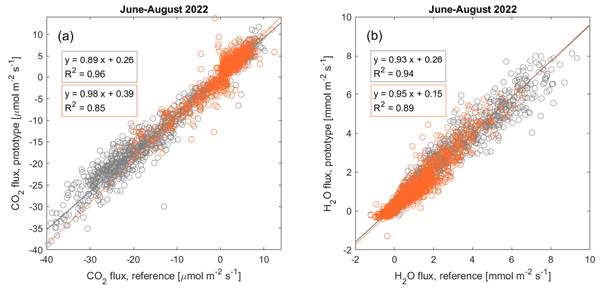
We present a case study that aimed to develop an inexpensive yet precise fast-response carbon dioxide and water vapour sensor. A working prototype was developed and field-tested against a scientific eddy covariance setup. Attention was paid to internal auto-calibration procedure such that signal drifting was avoided and the instrument was capable of measuring fluxes with high correlation relative to the reference setup.
Ekaterina Ezhova, Üllar Rannik, Santeri Tuovinen, Olga Garmash, Otso Peräkylä, Piaopiao Ke, Topi Laanti, Janne Lampilahti, Markus Lampimäki, Anna Lintunen, Veli-Matti Kerminen, Janne Rinne, Timo Vesala, and Markku Kulmala
Atmos. Chem. Phys., 26, 13463–13483, https://doi.org/10.5194/acp-26-13463-2026, https://doi.org/10.5194/acp-26-13463-2026, 2026
Short summary
Short summary
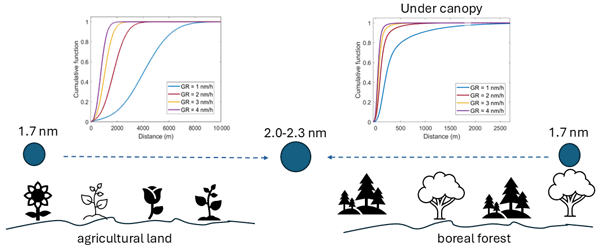
In boreal region, emissions from plants contribute to formation and growth of aerosol particles. Measurements suggest that concentration of small ions, which could be produced locally, differ in forests and agricultural fields. As a step to interpretation, we explain the concept of local aerosol production and estimate a spatial scale of an ecosystem needed to produce small ions. This scale is about few km in open areas such as agricultural fields and 500 m in the pine forest with closed canopy.
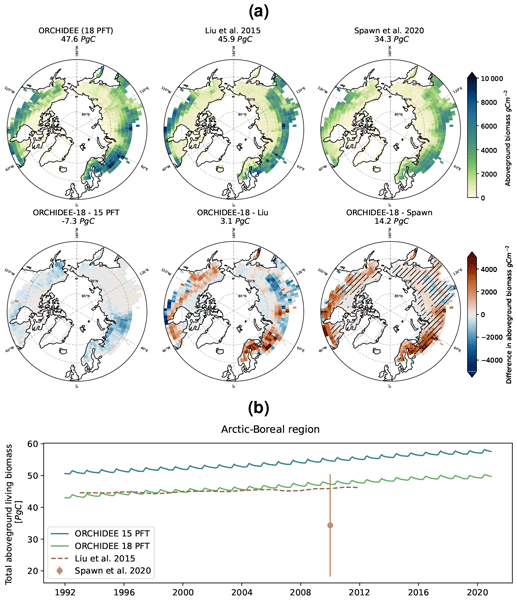
Anna Kirchner, Efrén López-Blanco, Vladislav Bastrikov, Sebastiaan Luyssaert, Philippe Peylin, and Anne Sofie Lansø
Biogeosciences, 23, 6521–6555, https://doi.org/10.5194/bg-23-6521-2026, https://doi.org/10.5194/bg-23-6521-2026, 2026
Short summary
Short summary
Shrubs need to be represented in climate models, because they shape the response of high-latitude regions to climate change. We added three shrub types to the ORCHIDEE (Organising Carbon and Hydrology In Dynamic Ecosystems) land surface model using Arctic observations. Including shrubs reduces simulated biomass and carbon uptake, improving model agreement with measurements. This is a simple, observation-based approach and an important step towards better representations of shrubs and their climate change response in models.
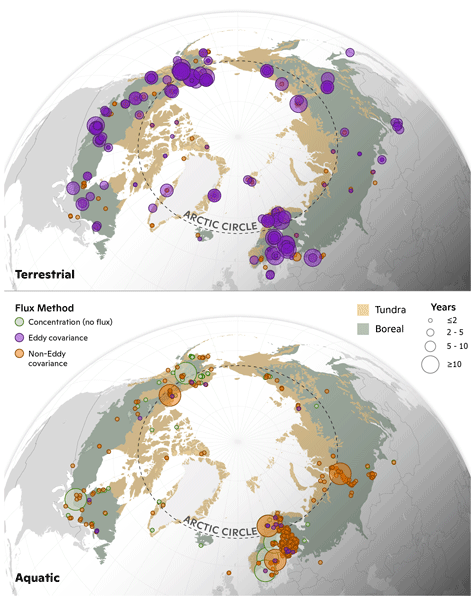
Anna-Maria Virkkala, Isabel Wargowsky, Judith Vogt, McKenzie A. Kuhn, Simran Madaan, Tiffany Windholz, Kyle A. Arndt, Gerard Rocher-Ros, Mathias Göckede, David Olefeldt, Edward A. G. Schuur, David Bastviken, Richard O'Keefe, Brendan M. Rogers, Jennifer D. Watts, Kelcy Kent, Kristoffer Aalstad, Kelly Aho, Joonatan Ala-Könni, Haley Alcock, Inge Althuizen, Christopher D. Arp, Jun Asanuma, Mika Aurela, Sivakiruthika Balathandayuthabani, Katrin Attermeyer, Alan Barr, Maialen Barret, Ochirbat Batkhishig, Christina Biasi, Mats P. Björkman, Andrew Black, Elena Blanc-Betes, Pascal Bodmer, Julia Boike, Abdullah Bolek, Frédéric Bouchard, Ingeborg Bussmann, Lea Cabrol, Eleonora Canfora, Sean Carey, Karel Castro-Morales, Namyi Chae, Andreas Christen, Torben R. Christensen, Casper T. Christiansen, Housen Chu, Graham Clark, Francois Clayer, Patrick Crill, Christopher Cunada, Scott J. Davidson, Joshua F. Dean, Sigrid Dengel, Matteo Detto, Catherine Dieleman, Florent Domine, Egor Dyukarev, Colin Edgar, Bo Elberling, Craig A. Emmerton, Eugenie Euskirchen, Grant Falvo, Thomas Friborg, Michelle Garneau, Mariasilvia Giamberini, Mikhail V. Glagolev, Miquel A. Gonzalez-Meler, Gustaf Granath, Jón Guðmundsson, Konsta Happonen, Yoshinobu Harazono, Lorna Harris, Josh Hashemi, Nicholas Hasson, Janna Heerah, Liam Heffernan, Manuel Helbig, Warren Helgason, Michal Heliasz, Greg Henry, Geert Hensgens, Tetsuya Hiyama, Beth Holmes, Macall Hock, David Holl, Jutta Holst, Thomas Holst, Gabriel Hould-Gosselin, Elyn Humphreys, Jacqueline Hung, Jussi Huotari, Hiroki Ikawa, Danil V. Ilyasov, Mamoru Ishikawa, Go Iwahana, Hiroki Iwata, Marcin Antoni Jackowicz-Korczynski, Joachim Jansen, Järvi Järveoja, Vincent E. J. Jassey, Rasmus Jensen, Katharina Jentzsch, Robert G. Jespersen, Carl-Fredrik Johannesson, Cheristy P. Jones, Anders Jonsson, Ji Young Jung, Sari Juutinen, Evan Kane, Jan Karlsson, Sergey Karsanaev, Kuno Kasak, Julia Kelly, Kasha Kempton, Marcus Klaus, George W. Kling, Natascha Kljun, Jacqueline Knutson, Hideki Kobayashi, John Kochendorfer, Kukka-Maaria Kohonen, Pasi Kolari, Mika Korkiakoski, Aino Korrensalo, Pirkko Kortelainen, Egle Koster, Kajar Koster, Ayumi Kotani, Praveena Krishnan, Juliya Kurbatova, Lars Kutzbach, Min Jung Kwon, Ethan D. Kyzivat, Jessica Lagroix, Theodore Langhorst, Elena Lapshina, Tuula Larmola, Klaus S. Larsen, Isabelle Laurion, Justin Ledman, Hanna Lee, A. Joshua Leffler, Lance Lesack, Anders Lindroth, David Lipson, Annalea Lohila, Efrén López-Blanco, Vincent L. St. Louis, Erik Lundin, Miska Luoto, Takashi Machimura, Marta Magnani, Avni Malhotra, Marja Maljanen, Ivan Mammarella, Elisa Männistö, Luca Belelli Marchesini, Phil Marsh, Pertti J. Martikainen, Maija E. Marushchak, Mikhail Mastepanov, Alex Mavrovic, Trofim Maximov, Christina Minions, Daniel F. Nadeau, Marco Montemayor, Tomoaki Morishita, Patrick Murphy, Erin Nicholls, Mats B. Nilsson, Anastasia Niyazova, Jenni Nordén, Koffi Dodji Noumonvi, Hannu Nykänen, Walter Oechel, Anne Ojala, Tomohiro Okadera, Sujan Pal, Alexey V. Panov, Tim Papakyriakou, Dario Papale, Sang-Jong Park, Frans-Jan W. Parmentier, Gilberto Pastorello, Mike Peacock, Matthias Peichl, Roman Petrov, Kyra St. Pierre, Norbert Pirk, Jessica Plein, Vilmantas Preskienis, Anatoly Prokushkin, Jukka Pumpanen, Hilary A. Rains, Niklas Rakos, Aleksi Räsänen, Helena Rautakoski, Riikka Rinnan, Janne Rinne, Adrian Rocha, Nigel Roulet, Alexandre Roy, Anna Rutgersson, Aleksandr F. Sabrekov, Torsten Sachs, Erik Sahlée, Alejandro Salazar, Henrique Oliveira Sawakuchi, Christopher Schulze, Roger Seco, Armando Sepulveda-Jauregui, Svetlana Serikova, Abbey Serrone, Hanna M. Silvennoinen, Sofie Sjogersten, June Skeeter, Jo Snöälv, Sebastian Sobek, Oliver Sonnentag, Emily H. Stanley, Maria Strack, Lena Strom, Patrick Sullivan, Ryan Sullivan, Anna Sytiuk, Torbern Tagesson, Pierre Taillardat, Julie Talbot, Suzanne E. Tank, Mario Tenuta, Irina Terenteva, Frederic Thalasso, Antoine Thiboult, Halldor Thorgeirsson, Fenix Garcia Tigreros, Margaret Torn, Amy Townsend-Small, Claire Treat, Alain Tremblay, Carlo Trotta, Eeva-Stiina Tuittila, Merritt Turetsky, Masahito Ueyama, Muhammad Umair, Aki Vähä, Lona van Delden, Maarten van Hardenbroek, Andrej Varlagin, Ruth K. Varner, Tarmo Virtanen, Elena Veretennikova, Timo Vesala, Carolina Voigt, Jorien E. Vonk, Robert Wagner, Katey Walter Anthony, Qinxue Wang, Masataka Watanabe, Hailey Webb, Jeffrey M. Welker, Andreas Westergaard-Nielsen, Sebastian Westermann, Jeffrey R. White, Christian Wille, Scott N. Williamson, Scott Zolkos, Donatella Zona, and Susan M. Natali
Earth Syst. Sci. Data, 18, 6357–6409, https://doi.org/10.5194/essd-18-6357-2026, https://doi.org/10.5194/essd-18-6357-2026, 2026
Short summary
Short summary
This dataset includes monthly measurements of carbon dioxide and methane exchange between land, water, and the atmosphere from over 1000 sites in Arctic and boreal regions. It combines measurements from a variety of ecosystems, including wetlands, forests, tundra, lakes, and rivers, gathered by over 260 researchers from 1984–2024. This dataset can be used to improve and reduce uncertainty in carbon budgets in order to strengthen our understanding of climate feedbacks in a warming world.
Signe Hillerup Larsen, Kirsty Langley, Daniel A. Rudd, Mikhail Mastepanov, Niels Martin Schmidt, Arno C. Hammann, Andreas Westergaard-Nielsen, Efrén Lopéz-Blanco, and Torben R. Christensen
EGUsphere, https://doi.org/10.5194/egusphere-2026-3962, https://doi.org/10.5194/egusphere-2026-3962, 2026
This preprint is open for discussion and under review for The Cryosphere (TC).
Short summary
Short summary
Snow cover shapes Arctic ecosystems by controlling for example when plants flower and glaciers melt. Using 26 years of daily satellite images over Greenland, we found high year-to-year variability and no systematic change in the length of the snow-free season at three long-term ecosystem monitoring sites. Thus, detecting the effects of climate change on snow cover and the ecosystems depending on it requires longer monitoring records, underscoring the value of continued long-term observation.
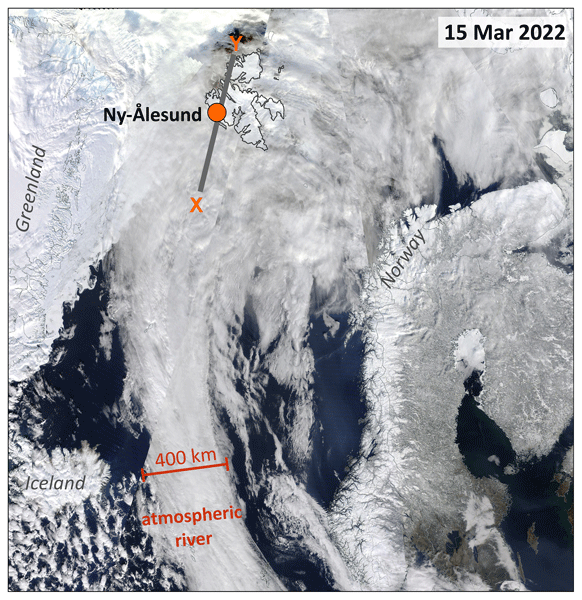
Hannah Bailey, Jason E. Box, Ben G. Kopec, Valtteri Hyöky, Hannu Marttila, Jeffrey M. Welker, Jack Kohler, Dmitry V. Divine, and Alun Hubbard
The Cryosphere, 20, 4421–4436, https://doi.org/10.5194/tc-20-4421-2026, https://doi.org/10.5194/tc-20-4421-2026, 2026
Short summary
Short summary
Atmospheric rivers (ARs) are narrow corridors of intense heat and moisture that can deliver extreme weather to the Arctic. We investigate a record March 2022 event in Svalbard using measurements of air and precipitation to track its origin and evolution. While the AR brought unusual winter rain and snow melt, it also delivered substantial snowfall that partially offset glacier mass loss. These findings show that the impacts of ARs on Arctic glaciers are more complex than typically reported.
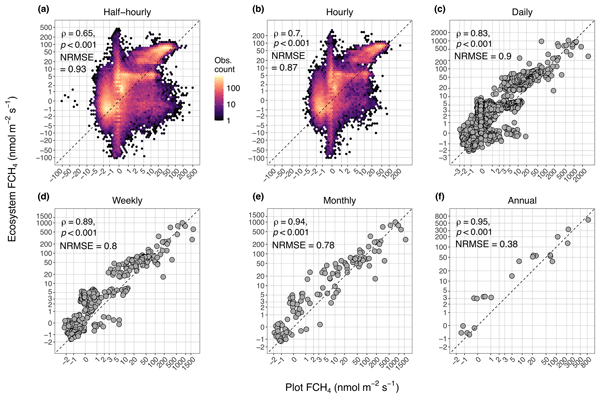
Tiia Määttä, Ankur R. Desai, Masahito Ueyama, Rodrigo Vargas, Eric J. Ward, Zhen Zhang, Gil Bohrer, Kyle Delwiche, Etienne Fluet-Chouinard, Järvi Järveoja, Sara H. Knox, Lulie Melling, Mats B. Nilsson, Matthias Peichl, Angela Che Ing Tang, Eeva-Stiina Tuittila, Jinsong Wang, Sheel Bansal, Sarah Feron, Manuel Helbig, Aino Korrensalo, Ken W. Krauss, Gavin McNicol, Shuli Niu, Zutao Ouyang, Kathleen Savage, Oliver Sonnentag, Robert Jackson, and Avni Malhotra
Biogeosciences, 23, 4379–4445, https://doi.org/10.5194/bg-23-4379-2026, https://doi.org/10.5194/bg-23-4379-2026, 2026
Short summary
Short summary
We compared ecosystem- and plot-scale methane fluxes across wetland and upland sites. Ecosystem-scale fluxes were higher than at plot scale, but differences were small. Vapor pressure deficit, atmospheric pressure, turbulence, and wind direction affected the differences. Both scales could be combined for improved methane flux estimates at coarser temporal scales.
Eyrún Gyða Gunnlaugsdóttir, Angelika Kübert, Xuefei Li, Timo Vesala, Aino Korrensalo, Elisa Männistö, Eeva-Stiina Tuittila, Pavel Alekseychik, and Ivan Mammarella
EGUsphere, https://doi.org/10.5194/egusphere-2026-3323, https://doi.org/10.5194/egusphere-2026-3323, 2026
Short summary
Short summary
We studied how two nearby peatland types exchange carbon with the atmosphere using long-term field measurements. We found that the fen absorbed more carbon dioxide but also released more methane than the bog, mainly due to differences in vegetation rather than climate. This suggests that plant communities strongly influence how peatlands affect climate and should be considered in future predictions, especially under changing environmental conditions and ecosystem shifts.
Shaakir Dar, Olga Silantyeva, Pertti Ala-aho, Benjamin Walter, John Hult, Valtteri Hyöky, Jeffrey Welker, and Hannu Marttila
EGUsphere, https://doi.org/10.5194/egusphere-2026-2589, https://doi.org/10.5194/egusphere-2026-2589, 2026
Short summary
Short summary
Snow can lose water directly to the air, but this process also changes the natural chemical fingerprints stored in snow. We used controlled wind-tunnel experiments with different snow types and airflow conditions to test why these changes vary. We found that wind controls how much snow is lost, but snow structure controls how strongly its fingerprints change. This means climate, water, and ice-record studies may misread snow signals if they ignore snow structure.
Petra Korhonen, Pertti Ala-Aho, Bjørn Kløve, and Hannu Marttila
Hydrol. Earth Syst. Sci., 30, 3019–3040, https://doi.org/10.5194/hess-30-3019-2026, https://doi.org/10.5194/hess-30-3019-2026, 2026
Short summary
Short summary
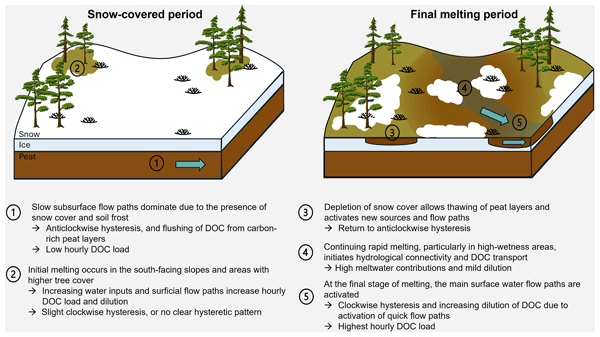
We studied how the melting of snow affects the release of dissolved organic carbon (DOC) in a northern peatland. Using detailed aerial surveys of snow cover, landscape moisture, and continuous water quality measurements revealed that DOC is released as snow cover melts, especially in wetter areas. Our results show how the snowmelt patterns control DOC transport, highlighting the sensitivity of northern peatland ecosystems to climate-driven changes in snow cover.
Liyang Liu, Philippe Ciais, Thu Hang Nguyen, Yi Xi, Chunjing Qiu, Elodie Salmon, Aram Kalhori, Christophe Guimbaud, Matthias Peichl, Joshua L. Ratcliffe, Koffi Dodji Noumonvi, and Xuefei Li
Biogeosciences, 23, 2277–2308, https://doi.org/10.5194/bg-23-2277-2026, https://doi.org/10.5194/bg-23-2277-2026, 2026
Short summary
Short summary
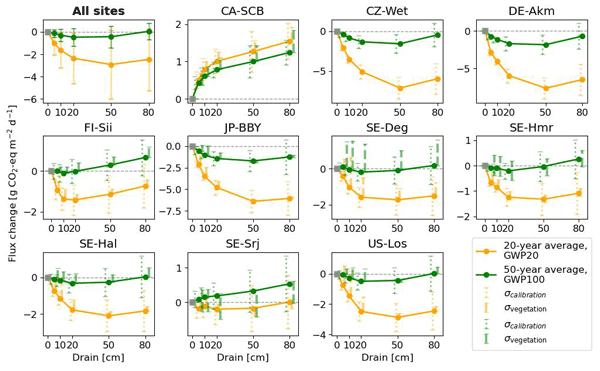
We simulate virtual idealized drainage at 10 pristine peatland sites. Over time, the emission factors of CO2 flux decrease and the reduction of CH4 emissions is amplified. The sensitivities of flux changes to drainage are primarily controlled by initial CO2 and CH4 fluxes, initial soil carbon content, peat vegetation community, air temperature and initial water table depth. Using GWP100 (100-year Global Warming Potential), our simulation suggested only very small net GHG (greenhouse gas) emission changes when peatland is drained for 50 years.
Tamara Emmerichs, Fabrice Lacroix, Victor Brovkin, Sönke Zaehle, Cheng Gong, Yu Zhu, Sofie Sjogersten, Carolina Voigt, Klaus Steenberg Larsen, and Eeva-Stiina Tuitila
EGUsphere, https://doi.org/10.5194/egusphere-2026-1514, https://doi.org/10.5194/egusphere-2026-1514, 2026
Short summary
Short summary
Shrubs use water and carbon differently and are expanding in warming tundra and grasslands, yet global models lack accuracy. We added two shrub types to a vegetation model including soil nutrients and carbon exchange. Half of the modeled shrubs showed good performance whereas their growth is 40 % higher as at grasses. Deciduous shrubs reduce nitrogen more than evergreens. Including shrubs improves Arctic carbon cycle predictions, revealing nitrogen limits cause underestimation in global models.
Karoliina Särkelä, Janne J. Salovaara, Veli-Matti Vesterinen, Joula Siponen, Katariina Salmela-Aro, Laura Riuttanen, and Katja Anniina Lauri
Geosci. Commun., 9, 7–19, https://doi.org/10.5194/gc-9-7-2026, https://doi.org/10.5194/gc-9-7-2026, 2026
Short summary
Short summary
We examine students’ perceived sense of belonging, its conditions, and its impact on learning in a climate change context in the ‘Environmental Changes at Higher Latitudes’ master’s programme. With high degree of mobility and little physical co-presence, the programme lacks traditional belonging factors. Interviews reveal three key constructs: familiarity, recognition, and relevance, crucial for climate and geoscience education.
Pinja Venäläinen, Colleen Mortimer, Kari Luojus, Lawrence Mudryk, Matias Takala, and Jouni Pulliainen
The Cryosphere, 19, 6301–6318, https://doi.org/10.5194/tc-19-6301-2025, https://doi.org/10.5194/tc-19-6301-2025, 2025
Short summary
Short summary
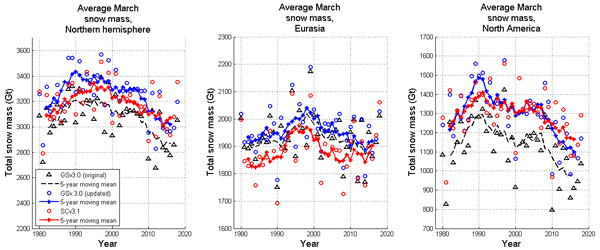
Satellite data-based estimation of large snow water equivalent (SWE) values can be improved with bias correction. This study updates the bias correction method by using updated snow course data, extending correction to two new months. Additionally, bias correction is expanded from a monthly to a daily time scale. The daily bias correction offers more accurate hemispheric snow mass estimation, aligning well with reanalysis data.
Marco M. Lehmann, Josie Geris, Ilja van Meerveld, Daniele Penna, Youri Rothfuss, Matteo Verdone, Pertti Ala-Aho, Matyas Arvai, Alise Babre, Philippe Balandier, Fabian Bernhard, Lukrecija Butorac, Simon D. Carrière, Natalie C. Ceperley, Zuosinan Chen, Alicia Correa, Haoyu Diao, David Dubbert, Maren Dubbert, Fabio Ercoli, Marius G. Floriancic, Alligin Ghazoul, Teresa E. Gimeno, Damien Gounelle, Frank Hagedorn, Christophe Hissler, Frédéric Huneau, Alberto Iraheta, Tamara Jakovljević, Nerantzis Kazakis, Zoltan Kern, Laura Kinzinger, Karl Knaebel, Johannes Kobler, Jiri Kocum, Charlotte Koeber, Gerbrand Koren, Angelika Kübert, Dawid Kupka, Samuel Le Gall, Aleksi Lehtonen, Thomas Leydier, Philippe Malagoli, Francesca Sofia Manca di Villahermosa, Chiara Marchina, Núria Martínez-Carreras, Nicolas Martin-StPaul, Hannu Marttila, Aline Meyer Oliveira, Gael Monvoisin, Natalie Orlowski, Kadi Palmik-Das, Aurel Persoiu, Andrei Popa, Egor Prikaziuk, Cécile Quantin, Katja T. Rinne-Garmston, Clara Rohde, Martin Sanda, Matthias Saurer, Daniel Schulz, Michael P. Stockinger, Christine Stumpp, Jean-Stéphane Vénisse, Lukas Vlcek, Stylianos Voudouris, Björn Weeser, Mark E. Wilkinson, Giulia Zuecco, and Katrin Meusburger
Earth Syst. Sci. Data, 17, 6129–6147, https://doi.org/10.5194/essd-17-6129-2025, https://doi.org/10.5194/essd-17-6129-2025, 2025
Short summary
Short summary
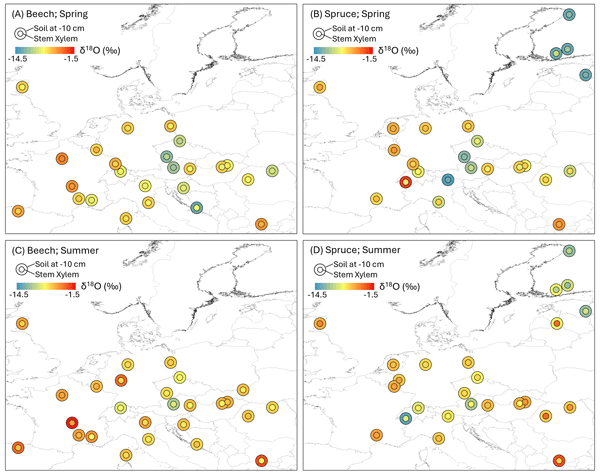
This study describes a unique large-scale isotope dataset to study water dynamics in European forests. Researchers collected data from 40 beech and spruce forest sites in spring and summer 2023, using a standardized method to ensure consistency. The results show that water sources for trees change between seasons and vary by tree species. This large dataset offers valuable information for understanding plant water use, improving ecohydrological models, and mapping water cycles across Europe.
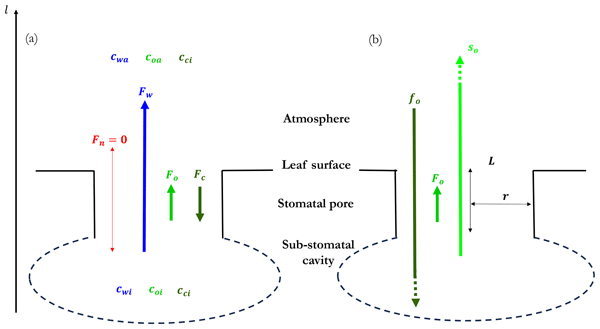
Jordi Vilà-Guerau de Arellano, Roderick Dewar, Kim A. P. Faassen, Teemu Hölttä, Remco de Kok, Ingrid T. Luijkx, and Timo Vesala
Biogeosciences, 22, 6327–6341, https://doi.org/10.5194/bg-22-6327-2025, https://doi.org/10.5194/bg-22-6327-2025, 2025
Short summary
Short summary
This study explores how oxygen moves through tiny pores in leaves, especially when water vapor is also flowing out. We show that under common conditions, oxygen can move from the leaf to the air even when its concentration is higher outside – a surprising effect. Our findings help explain oxygen exchange in still air and support better models of plant–atmosphere interactions.
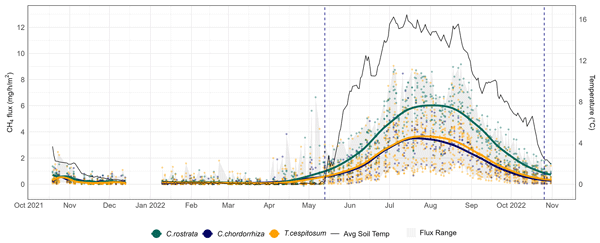
Eeva Järvi-Laturi, Teemu Tahvanainen, Eero Koskinen, Efrén López-Blanco, Juho Lämsä, Hannu Marttila, Mikhail Mastepanov, Riku Paavola, Maria Väisänen, and Torben R. Christensen
Biogeosciences, 22, 6343–6367, https://doi.org/10.5194/bg-22-6343-2025, https://doi.org/10.5194/bg-22-6343-2025, 2025
Short summary
Short summary
Our research investigates how plant community composition influences methane emissions in a northern boreal rich fen. We measured methane fluxes year-round using manual chambers across 36 plots. Our findings suggest that sedges, particularly Carex rostrata, significantly impact the fluxes throughout the year. This study enhances our understanding of vegetation-driven methane emissions, providing valuable insights for predicting future changes in peatland methane emissions.
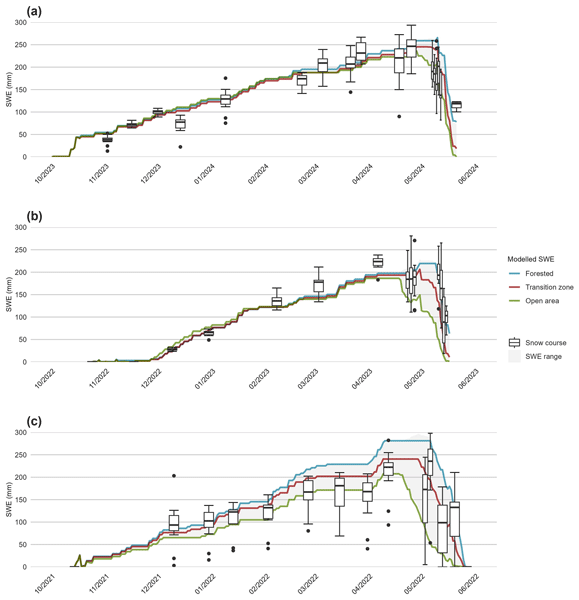
Maiju Ylönen, Hannu Marttila, Joschka Geissler, Anton Kuzmin, Pasi Korpelainen, Timo Kumpula, and Pertti Ala-Aho
The Cryosphere, 19, 4585–4610, https://doi.org/10.5194/tc-19-4585-2025, https://doi.org/10.5194/tc-19-4585-2025, 2025
Short summary
Short summary
We collected snow depth maps four times during the winter from two different sites and used them as input for a model to predict daily snow depth and snow water equivalent (SWE). Our results show similar snow depth patterns at different sites, with snow depths being the highest in forests and forest gaps and the lowest in open areas. The results can extend operational snow course measurements and their temporal and spatial coverage, helping hydrological forecasting and water resource management.
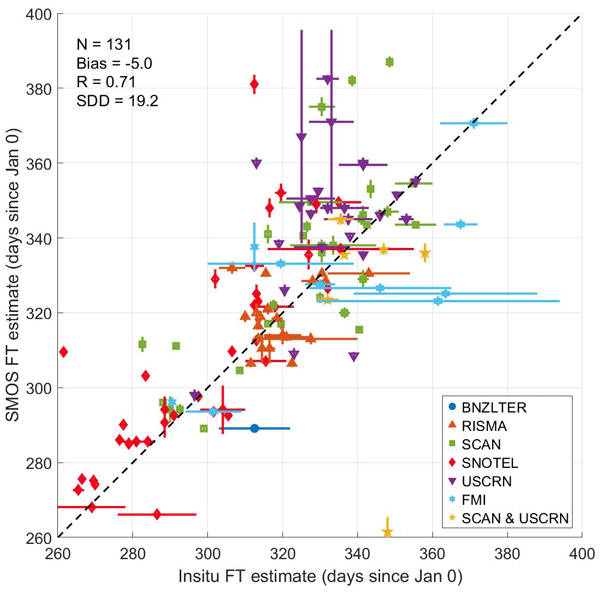
Kimmo Rautiainen, Manu Holmberg, Juval Cohen, Arnaud Mialon, Mike Schwank, Juha Lemmetyinen, Antonio de la Fuente, and Yann Kerr
Earth Syst. Sci. Data, 17, 5337–5353, https://doi.org/10.5194/essd-17-5337-2025, https://doi.org/10.5194/essd-17-5337-2025, 2025
Short summary
Short summary
The SMOS (Soil Moisture and Ocean Salinity) Soil Freeze–Thaw State product uses satellite data to monitor seasonal soil freezing and thawing globally, with a focus on high-latitude regions. This is important for understanding greenhouse gas emissions, as frozen soil is associated with methane release. The product provides accurate data on key events such as the first day of soil freezing in autumn, helping scientists to study climate change, ecosystem dynamics, and its impact on our planet.
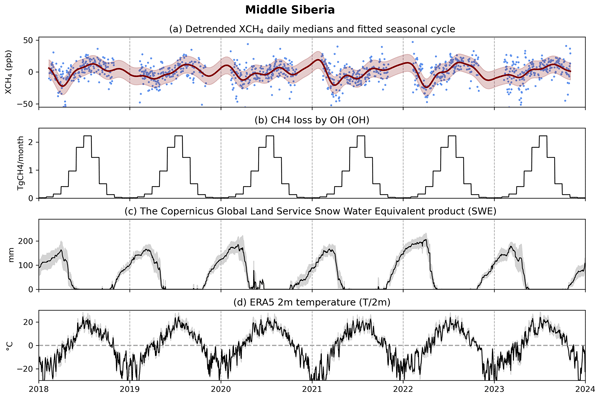
Ella Kivimäki, Maria Tenkanen, Tuula Aalto, Michael Buchwitz, Kari Luojus, Jouni Pulliainen, Kimmo Rautiainen, Oliver Schneising, Anu-Maija Sundström, Johanna Tamminen, Aki Tsuruta, and Hannakaisa Lindqvist
Biogeosciences, 22, 5193–5230, https://doi.org/10.5194/bg-22-5193-2025, https://doi.org/10.5194/bg-22-5193-2025, 2025
Short summary
Short summary
We study how environmental variables influencing natural methane fluxes explain the seasonal variability in satellite-observed methane in Northern Hemisphere high-latitude wetland areas. Using two atmospheric model set-ups, we assess consistency with satellite data. Methane loss through reaction with hydroxyl radicals and links with snow cover, temperature, and snowmelt had the strongest influence. Our study highlights the value of satellite observations for understanding large-scale wetland emissions.
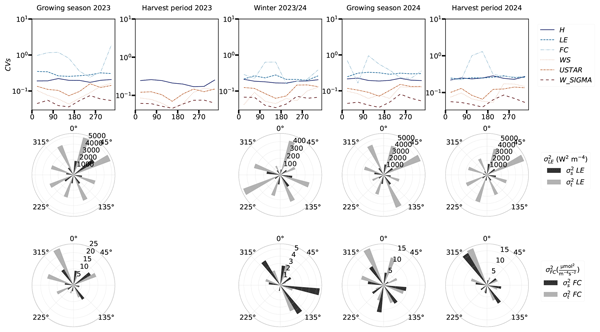
José Ángel Callejas-Rodelas, Alexander Knohl, Ivan Mammarella, Timo Vesala, Olli Peltola, and Christian Markwitz
Biogeosciences, 22, 4507–4529, https://doi.org/10.5194/bg-22-4507-2025, https://doi.org/10.5194/bg-22-4507-2025, 2025
Short summary
Short summary
The spatial variability of CO2 and water vapour exchanges with the atmosphere was quantified above an agroforestry system and further compared to a monocropping system using a total of four eddy covariance stations. The variability of fluxes within the agroforestry site was found to be as large as the variability between agroforestry and monocropping site, induced by the heterogeneity of the site, which highlights the need for replicated measurements above such ecosystems.
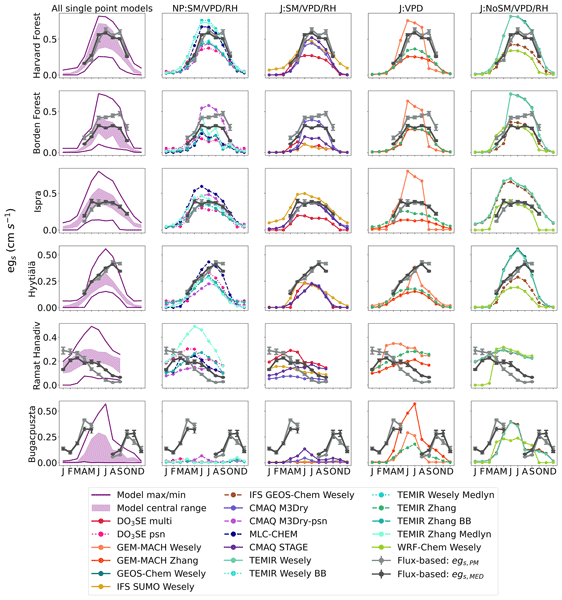
Anam M. Khan, Olivia E. Clifton, Jesse O. Bash, Sam Bland, Nathan Booth, Philip Cheung, Lisa Emberson, Johannes Flemming, Erick Fredj, Stefano Galmarini, Laurens Ganzeveld, Orestis Gazetas, Ignacio Goded, Christian Hogrefe, Christopher D. Holmes, László Horváth, Vincent Huijnen, Qian Li, Paul A. Makar, Ivan Mammarella, Giovanni Manca, J. William Munger, Juan L. Pérez-Camanyo, Jonathan Pleim, Limei Ran, Roberto San Jose, Donna Schwede, Sam J. Silva, Ralf Staebler, Shihan Sun, Amos P. K. Tai, Eran Tas, Timo Vesala, Tamás Weidinger, Zhiyong Wu, Leiming Zhang, and Paul C. Stoy
Atmos. Chem. Phys., 25, 8613–8635, https://doi.org/10.5194/acp-25-8613-2025, https://doi.org/10.5194/acp-25-8613-2025, 2025
Short summary
Short summary
Vegetation removes tropospheric ozone through stomatal uptake, and accurately modeling the stomatal uptake of ozone is important for modeling dry deposition and air quality. We evaluated the stomatal component of ozone dry deposition modeled by atmospheric chemistry models at six sites. We find that models and observation-based estimates agree at times during the growing season at all sites, but some models overestimated the stomatal component during the dry summers at a seasonally dry site.

Anke Fluhrer, Martin J. Baur, María Piles, Bagher Bayat, Mehdi Rahmati, David Chaparro, Clémence Dubois, Florian M. Hellwig, Carsten Montzka, Angelika Kübert, Marlin M. Mueller, Isabel Augscheller, Francois Jonard, Konstantin Schellenberg, and Thomas Jagdhuber
Biogeosciences, 22, 3721–3746, https://doi.org/10.5194/bg-22-3721-2025, https://doi.org/10.5194/bg-22-3721-2025, 2025
Short summary
Short summary
This study compares established evapotranspiration products in central Europe and evaluates their multi-seasonal performance during wet and drought phases in 2017–2020 together with important soil–plant–atmosphere drivers. Results show that SEVIRI, ERA5-land, and GLEAM perform best compared to ICOS (Integrated Carbon Observation System) measurements. During moisture-limited drought years, ET (evapotranspiration) decreases due to decreasing soil moisture and increasing vapor pressure deficit, while in other years ET is mainly controlled by VPD (vapor pressure deficit).
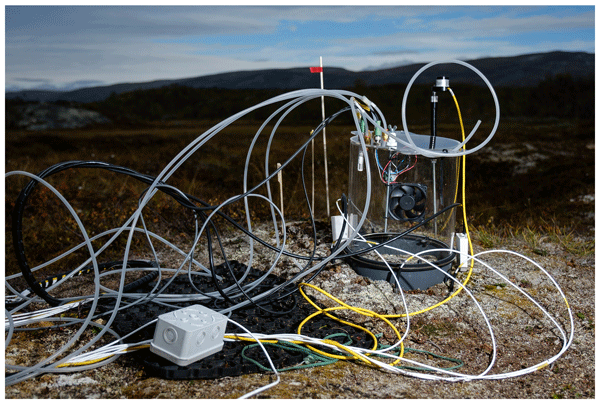
Nathalie Ylenia Triches, Jan Engel, Abdullah Bolek, Timo Vesala, Maija E. Marushchak, Anna-Maria Virkkala, Martin Heimann, and Mathias Göckede
Atmos. Meas. Tech., 18, 3407–3424, https://doi.org/10.5194/amt-18-3407-2025, https://doi.org/10.5194/amt-18-3407-2025, 2025
Short summary
Short summary
This study explores nitrous oxide (N2O) fluxes from a nutrient-poor sub-Arctic peatland. N2O is a potent greenhouse gas; understanding its fluxes is essential for addressing global warming. Using a new instrument and flux chambers, we introduce a system to reliably detect low N2O fluxes and provide recommendations on chamber closure times and flux calculation methods to better quantify N2O fluxes. We encourage researchers to further investigate N2O fluxes in low-nutrient environments.
Shaakir Shabir Dar, Eric Klein, Pertti Ala-aho, Hannu Marttila, Sonja Wahl, and Jeffrey Welker
EGUsphere, https://doi.org/10.5194/egusphere-2025-2724, https://doi.org/10.5194/egusphere-2025-2724, 2025
Preprint archived
Short summary
Short summary
Using laser based instruments, we observed snow turning directly to vapor inside the pack and at its surface. In cold, calm weather vapor moves slowly upward; on warmer, windy days air pushes vapor deeper into the snow. These dynamics control snow loss and must be included in hydrological and climate models.
Teemu Juselius-Rajamäki, Sanna Piilo, Susanna Salminen-Paatero, Emilia Tuomaala, Tarmo Virtanen, Atte Korhola, Anna Autio, Hannu Marttila, Pertti Ala-Aho, Annalea Lohila, and Minna Väliranta
Biogeosciences, 22, 3047–3071, https://doi.org/10.5194/bg-22-3047-2025, https://doi.org/10.5194/bg-22-3047-2025, 2025
Short summary
Short summary
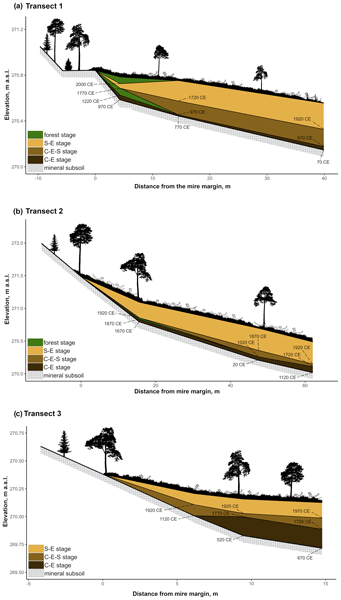
Vegetation can be used to infer the potential climate feedback of peatlands. New studies have shown the recent expansion of peatlands, but their plant community succession has not been studied. Although generally described as dry bog-type vegetation, our results show that peatland margins in a subarctic fen began as wet fen with high methane emissions and shifted to bog-type peatland area only after the Little Ice Age. Thus, they have acted as a carbon source for most of their history.
Qing Ying, Benjamin Poulter, Jennifer D. Watts, Kyle A. Arndt, Anna-Maria Virkkala, Lori Bruhwiler, Youmi Oh, Brendan M. Rogers, Susan M. Natali, Hilary Sullivan, Amanda Armstrong, Eric J. Ward, Luke D. Schiferl, Clayton D. Elder, Olli Peltola, Annett Bartsch, Ankur R. Desai, Eugénie Euskirchen, Mathias Göckede, Bernhard Lehner, Mats B. Nilsson, Matthias Peichl, Oliver Sonnentag, Eeva-Stiina Tuittila, Torsten Sachs, Aram Kalhori, Masahito Ueyama, and Zhen Zhang
Earth Syst. Sci. Data, 17, 2507–2534, https://doi.org/10.5194/essd-17-2507-2025, https://doi.org/10.5194/essd-17-2507-2025, 2025
Short summary
Short summary
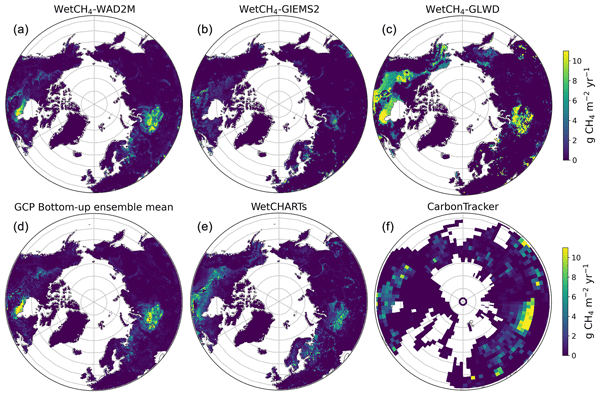
We present daily methane (CH4) fluxes of northern wetlands at 10 km resolution during 2016–2022 (WetCH4) derived from a novel machine learning framework. We estimated an average annual CH4 emission of 22.8 ± 2.4 Tg CH4 yr−1 (15.7–51.6 Tg CH4 yr−1). Emissions were intensified in 2016, 2020, and 2022, with the largest interannual variation coming from Western Siberia. Continued, all-season tower observations and improved soil moisture products are needed for future improvement of CH4 upscaling.
Aki Vähä, Timo Vesala, Sofya Guseva, Anders Lindroth, Andreas Lorke, Sally MacIntyre, and Ivan Mammarella
Biogeosciences, 22, 1651–1671, https://doi.org/10.5194/bg-22-1651-2025, https://doi.org/10.5194/bg-22-1651-2025, 2025
Short summary
Short summary
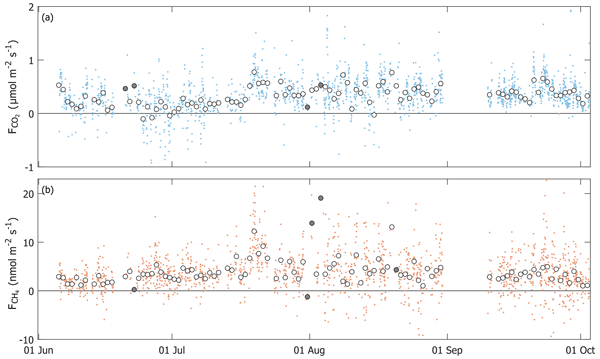
Boreal rivers are significant sources of carbon dioxide (CO2) and methane (CH4) for the atmosphere, but the controls of these emissions are uncertain. We measured 4 months of CO2 and CH4 exchanges between a regulated boreal river and the atmosphere with eddy covariance. We found statistical relationships between the gas exchange and several environmental variables, the most important of which were dissolved CO2 partial pressure in water, wind speed and water temperature.
Vilna Tyystjärvi, Tiina Markkanen, Leif Backman, Maarit Raivonen, Antti Leppänen, Xuefei Li, Paavo Ojanen, Kari Minkkinen, Roosa Hautala, Mikko Peltoniemi, Jani Anttila, Raija Laiho, Annalea Lohila, Raisa Mäkipää, and Tuula Aalto
Biogeosciences, 21, 5745–5771, https://doi.org/10.5194/bg-21-5745-2024, https://doi.org/10.5194/bg-21-5745-2024, 2024
Short summary
Short summary
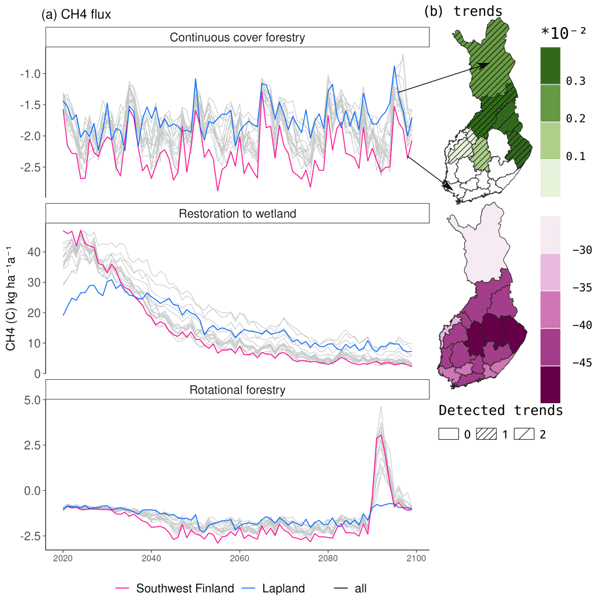
Drainage of boreal peatlands strongly influences soil methane fluxes, with important implications for climatic impacts. Here we simulate methane fluxes in forestry-drained and restored peatlands during the 21st century. We found that restoration turned peatlands into a source of methane, but the magnitude varied regionally. In forests, changes in the water table level influenced methane fluxes, and in general, the sink was weaker under rotational forestry compared to continuous cover forestry.
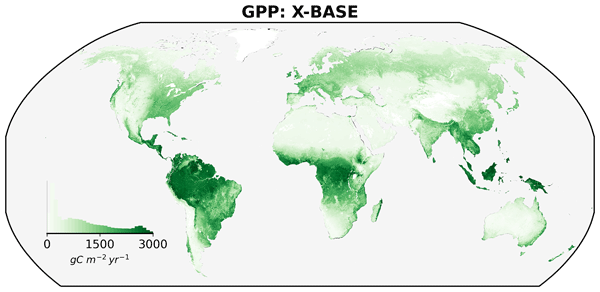
Jacob A. Nelson, Sophia Walther, Fabian Gans, Basil Kraft, Ulrich Weber, Kimberly Novick, Nina Buchmann, Mirco Migliavacca, Georg Wohlfahrt, Ladislav Šigut, Andreas Ibrom, Dario Papale, Mathias Göckede, Gregory Duveiller, Alexander Knohl, Lukas Hörtnagl, Russell L. Scott, Jiří Dušek, Weijie Zhang, Zayd Mahmoud Hamdi, Markus Reichstein, Sergio Aranda-Barranco, Jonas Ardö, Maarten Op de Beeck, Dave Billesbach, David Bowling, Rosvel Bracho, Christian Brümmer, Gustau Camps-Valls, Shiping Chen, Jamie Rose Cleverly, Ankur Desai, Gang Dong, Tarek S. El-Madany, Eugenie Susanne Euskirchen, Iris Feigenwinter, Marta Galvagno, Giacomo A. Gerosa, Bert Gielen, Ignacio Goded, Sarah Goslee, Christopher Michael Gough, Bernard Heinesch, Kazuhito Ichii, Marcin Antoni Jackowicz-Korczynski, Anne Klosterhalfen, Sara Knox, Hideki Kobayashi, Kukka-Maaria Kohonen, Mika Korkiakoski, Ivan Mammarella, Mana Gharun, Riccardo Marzuoli, Roser Matamala, Stefan Metzger, Leonardo Montagnani, Giacomo Nicolini, Thomas O'Halloran, Jean-Marc Ourcival, Matthias Peichl, Elise Pendall, Borja Ruiz Reverter, Marilyn Roland, Simone Sabbatini, Torsten Sachs, Marius Schmidt, Christopher R. Schwalm, Ankit Shekhar, Richard Silberstein, Maria Lucia Silveira, Donatella Spano, Torbern Tagesson, Gianluca Tramontana, Carlo Trotta, Fabio Turco, Timo Vesala, Caroline Vincke, Domenico Vitale, Enrique R. Vivoni, Yi Wang, William Woodgate, Enrico A. Yepez, Junhui Zhang, Donatella Zona, and Martin Jung
Biogeosciences, 21, 5079–5115, https://doi.org/10.5194/bg-21-5079-2024, https://doi.org/10.5194/bg-21-5079-2024, 2024
Short summary
Short summary
The movement of water, carbon, and energy from the Earth's surface to the atmosphere, or flux, is an important process to understand because it impacts our lives. Here, we outline a method called FLUXCOM-X to estimate global water and CO2 fluxes based on direct measurements from sites around the world. We go on to demonstrate how these new estimates of net CO2 uptake/loss, gross CO2 uptake, total water evaporation, and transpiration from plants compare to previous and independent estimates.
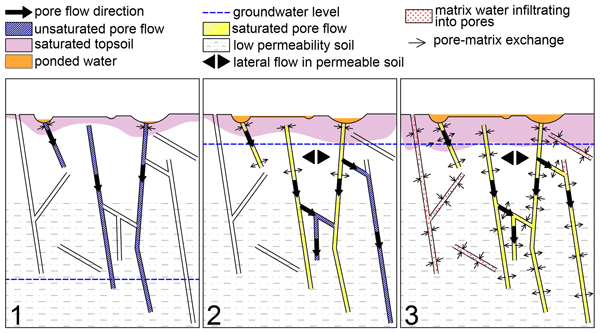
Filip Muhic, Pertti Ala-Aho, Matthias Sprenger, Björn Klöve, and Hannu Marttila
Hydrol. Earth Syst. Sci., 28, 4861–4881, https://doi.org/10.5194/hess-28-4861-2024, https://doi.org/10.5194/hess-28-4861-2024, 2024
Short summary
Short summary
The snowmelt event governs the hydrological cycle of sub-arctic areas. In this study, we conducted a tracer experiment on a forested hilltop in Lapland to identify how high-volume infiltration events modify the soil water storage. We found that a strong tracer signal remained in deeper soil layers after the experiment and over the winter, but it got fully displaced during the snowmelt. We propose a conceptual infiltration model that explains how the snowmelt homogenizes the soil water storage.

Jari-Pekka Nousu, Kersti Leppä, Hannu Marttila, Pertti Ala-aho, Giulia Mazzotti, Terhikki Manninen, Mika Korkiakoski, Mika Aurela, Annalea Lohila, and Samuli Launiainen
Hydrol. Earth Syst. Sci., 28, 4643–4666, https://doi.org/10.5194/hess-28-4643-2024, https://doi.org/10.5194/hess-28-4643-2024, 2024
Short summary
Short summary
We used hydrological models, field measurements, and satellite-based data to study the soil moisture dynamics in a subarctic catchment. The role of groundwater was studied with different ways to model the groundwater dynamics and via comparisons to the observational data. The choice of groundwater model was shown to have a strong impact, and representation of lateral flow was important to capture wet soil conditions. Our results provide insights for ecohydrological studies in boreal regions.
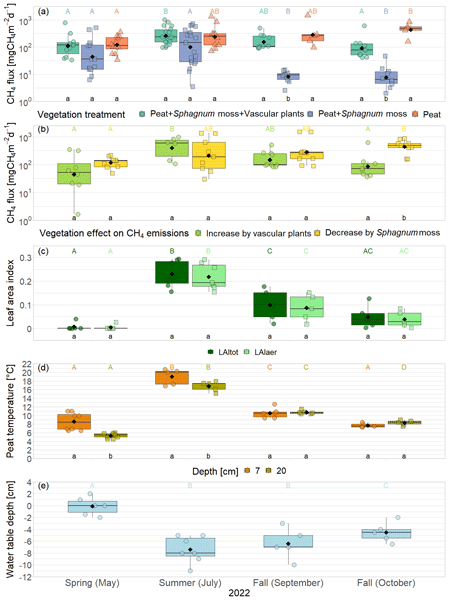
Katharina Jentzsch, Elisa Männistö, Maija E. Marushchak, Aino Korrensalo, Lona van Delden, Eeva-Stiina Tuittila, Christian Knoblauch, and Claire C. Treat
Biogeosciences, 21, 3761–3788, https://doi.org/10.5194/bg-21-3761-2024, https://doi.org/10.5194/bg-21-3761-2024, 2024
Short summary
Short summary
During cold seasons, methane release from northern wetlands is important but often underestimated. We studied a boreal bog to understand methane emissions in spring and fall. At cold temperatures, methane release decreases due to lower production rates, but efficient methane transport through plant structures, decaying plants, and the release of methane stored in the pore water keep emissions ongoing. Understanding these seasonal processes can improve models for methane release in cold climates.
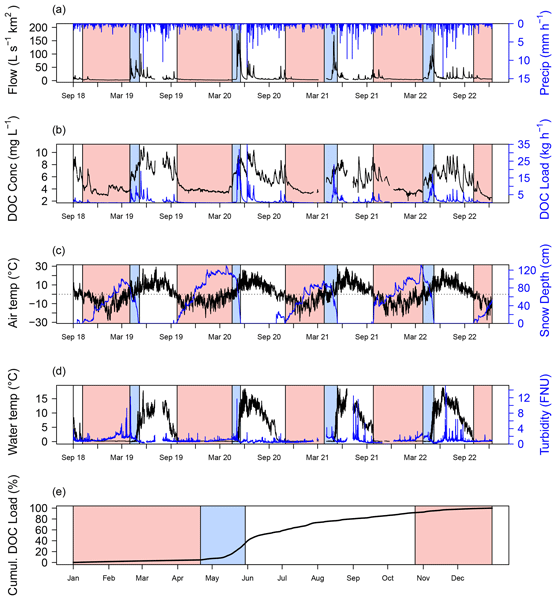
Danny Croghan, Pertti Ala-Aho, Jeffrey Welker, Kaisa-Riikka Mustonen, Kieran Khamis, David M. Hannah, Jussi Vuorenmaa, Bjørn Kløve, and Hannu Marttila
Hydrol. Earth Syst. Sci., 28, 1055–1070, https://doi.org/10.5194/hess-28-1055-2024, https://doi.org/10.5194/hess-28-1055-2024, 2024
Short summary
Short summary
The transport of dissolved organic carbon (DOC) from land into streams is changing due to climate change. We used a multi-year dataset of DOC and predictors of DOC in a subarctic stream to find out how transport of DOC varied between seasons and between years. We found that the way DOC is transported varied strongly seasonally, but year-to-year differences were less apparent. We conclude that the mechanisms of transport show a higher degree of interannual consistency than previously thought.
Jari-Pekka Nousu, Matthieu Lafaysse, Giulia Mazzotti, Pertti Ala-aho, Hannu Marttila, Bertrand Cluzet, Mika Aurela, Annalea Lohila, Pasi Kolari, Aaron Boone, Mathieu Fructus, and Samuli Launiainen
The Cryosphere, 18, 231–263, https://doi.org/10.5194/tc-18-231-2024, https://doi.org/10.5194/tc-18-231-2024, 2024
Short summary
Short summary
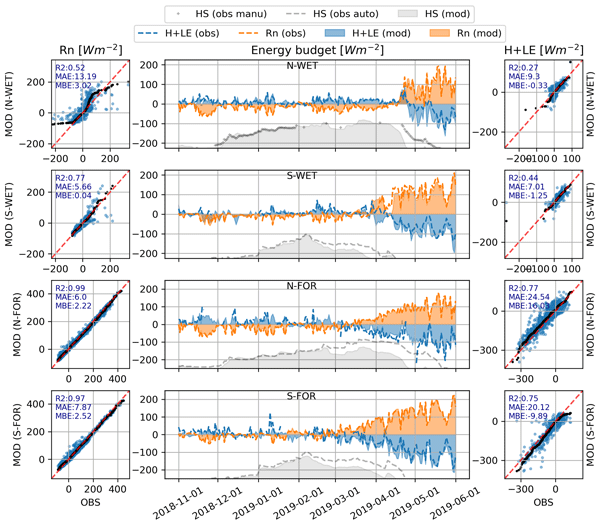
The snowpack has a major impact on the land surface energy budget. Accurate simulation of the snowpack energy budget is difficult, and studies that evaluate models against energy budget observations are rare. We compared predictions from well-known models with observations of energy budgets, snow depths and soil temperatures in Finland. Our study identified contrasting strengths and limitations for the models. These results can be used for choosing the right models depending on the use cases.
Markku Kulmala, Anna Lintunen, Hanna Lappalainen, Annele Virtanen, Chao Yan, Ekaterina Ezhova, Tuomo Nieminen, Ilona Riipinen, Risto Makkonen, Johanna Tamminen, Anu-Maija Sundström, Antti Arola, Armin Hansel, Kari Lehtinen, Timo Vesala, Tuukka Petäjä, Jaana Bäck, Tom Kokkonen, and Veli-Matti Kerminen
Atmos. Chem. Phys., 23, 14949–14971, https://doi.org/10.5194/acp-23-14949-2023, https://doi.org/10.5194/acp-23-14949-2023, 2023
Short summary
Short summary
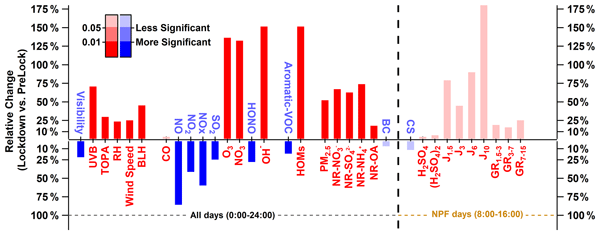
To be able to meet global grand challenges, we need comprehensive open data with proper metadata. In this opinion paper, we describe the SMEAR (Station for Measuring Earth surface – Atmosphere Relations) concept and include several examples (cases), such as new particle formation and growth, feedback loops and the effect of COVID-19, and what has been learned from these investigations. The future needs and the potential of comprehensive observations of the environment are summarized.
Leo-Juhani Meriö, Anssi Rauhala, Pertti Ala-aho, Anton Kuzmin, Pasi Korpelainen, Timo Kumpula, Bjørn Kløve, and Hannu Marttila
The Cryosphere, 17, 4363–4380, https://doi.org/10.5194/tc-17-4363-2023, https://doi.org/10.5194/tc-17-4363-2023, 2023
Short summary
Short summary
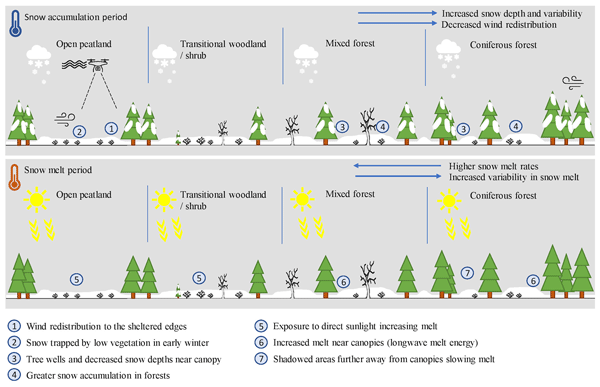
Information on seasonal snow cover is essential in understanding snow processes and operational forecasting. We study the spatiotemporal variability in snow depth and snow processes in a subarctic, boreal landscape using drones. We identified multiple theoretically known snow processes and interactions between snow and vegetation. The results highlight the applicability of the drones to be used for a detailed study of snow depth in multiple land cover types and snow–vegetation interactions.
Anssi Rauhala, Leo-Juhani Meriö, Anton Kuzmin, Pasi Korpelainen, Pertti Ala-aho, Timo Kumpula, Bjørn Kløve, and Hannu Marttila
The Cryosphere, 17, 4343–4362, https://doi.org/10.5194/tc-17-4343-2023, https://doi.org/10.5194/tc-17-4343-2023, 2023
Short summary
Short summary
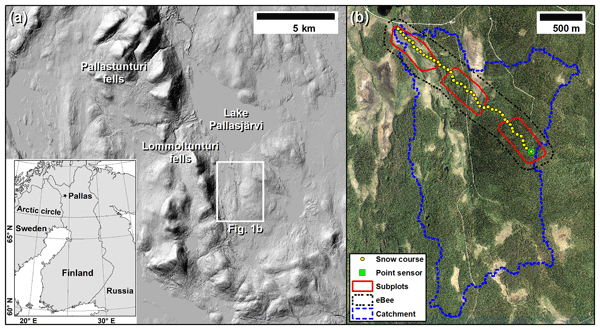
Snow conditions in the Northern Hemisphere are rapidly changing, and information on snow depth is important for decision-making. We present snow depth measurements using different drones throughout the winter at a subarctic site. Generally, all drones produced good estimates of snow depth in open areas. However, differences were observed in the accuracies produced by the different drones, and a reduction in accuracy was observed when moving from an open mire area to forest-covered areas.
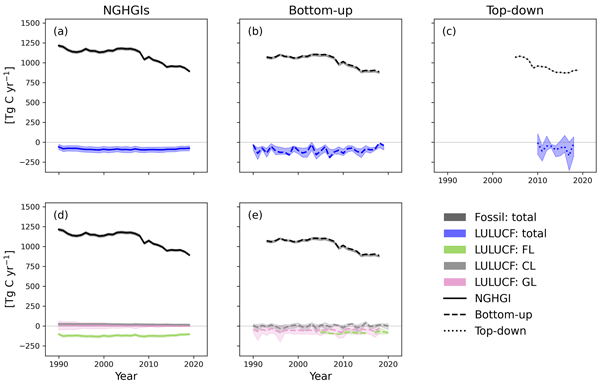
Matthew J. McGrath, Ana Maria Roxana Petrescu, Philippe Peylin, Robbie M. Andrew, Bradley Matthews, Frank Dentener, Juraj Balkovič, Vladislav Bastrikov, Meike Becker, Gregoire Broquet, Philippe Ciais, Audrey Fortems-Cheiney, Raphael Ganzenmüller, Giacomo Grassi, Ian Harris, Matthew Jones, Jürgen Knauer, Matthias Kuhnert, Guillaume Monteil, Saqr Munassar, Paul I. Palmer, Glen P. Peters, Chunjing Qiu, Mart-Jan Schelhaas, Oksana Tarasova, Matteo Vizzarri, Karina Winkler, Gianpaolo Balsamo, Antoine Berchet, Peter Briggs, Patrick Brockmann, Frédéric Chevallier, Giulia Conchedda, Monica Crippa, Stijn N. C. Dellaert, Hugo A. C. Denier van der Gon, Sara Filipek, Pierre Friedlingstein, Richard Fuchs, Michael Gauss, Christoph Gerbig, Diego Guizzardi, Dirk Günther, Richard A. Houghton, Greet Janssens-Maenhout, Ronny Lauerwald, Bas Lerink, Ingrid T. Luijkx, Géraud Moulas, Marilena Muntean, Gert-Jan Nabuurs, Aurélie Paquirissamy, Lucia Perugini, Wouter Peters, Roberto Pilli, Julia Pongratz, Pierre Regnier, Marko Scholze, Yusuf Serengil, Pete Smith, Efisio Solazzo, Rona L. Thompson, Francesco N. Tubiello, Timo Vesala, and Sophia Walther
Earth Syst. Sci. Data, 15, 4295–4370, https://doi.org/10.5194/essd-15-4295-2023, https://doi.org/10.5194/essd-15-4295-2023, 2023
Short summary
Short summary
Accurate estimation of fluxes of carbon dioxide from the land surface is essential for understanding future impacts of greenhouse gas emissions on the climate system. A wide variety of methods currently exist to estimate these sources and sinks. We are continuing work to develop annual comparisons of these diverse methods in order to clarify what they all actually calculate and to resolve apparent disagreement, in addition to highlighting opportunities for increased understanding.
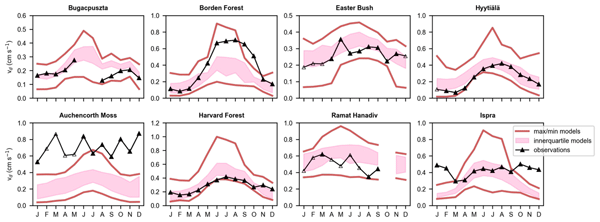
Olivia E. Clifton, Donna Schwede, Christian Hogrefe, Jesse O. Bash, Sam Bland, Philip Cheung, Mhairi Coyle, Lisa Emberson, Johannes Flemming, Erick Fredj, Stefano Galmarini, Laurens Ganzeveld, Orestis Gazetas, Ignacio Goded, Christopher D. Holmes, László Horváth, Vincent Huijnen, Qian Li, Paul A. Makar, Ivan Mammarella, Giovanni Manca, J. William Munger, Juan L. Pérez-Camanyo, Jonathan Pleim, Limei Ran, Roberto San Jose, Sam J. Silva, Ralf Staebler, Shihan Sun, Amos P. K. Tai, Eran Tas, Timo Vesala, Tamás Weidinger, Zhiyong Wu, and Leiming Zhang
Atmos. Chem. Phys., 23, 9911–9961, https://doi.org/10.5194/acp-23-9911-2023, https://doi.org/10.5194/acp-23-9911-2023, 2023
Short summary
Short summary
A primary sink of air pollutants is dry deposition. Dry deposition estimates differ across the models used to simulate atmospheric chemistry. Here, we introduce an effort to examine dry deposition schemes from atmospheric chemistry models. We provide our approach’s rationale, document the schemes, and describe datasets used to drive and evaluate the schemes. We also launch the analysis of results by evaluating against observations and identifying the processes leading to model–model differences.
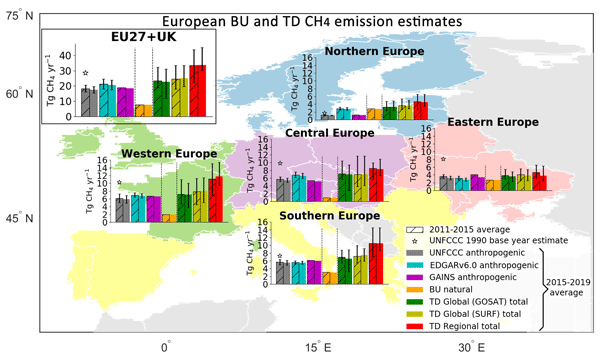
Ana Maria Roxana Petrescu, Chunjing Qiu, Matthew J. McGrath, Philippe Peylin, Glen P. Peters, Philippe Ciais, Rona L. Thompson, Aki Tsuruta, Dominik Brunner, Matthias Kuhnert, Bradley Matthews, Paul I. Palmer, Oksana Tarasova, Pierre Regnier, Ronny Lauerwald, David Bastviken, Lena Höglund-Isaksson, Wilfried Winiwarter, Giuseppe Etiope, Tuula Aalto, Gianpaolo Balsamo, Vladislav Bastrikov, Antoine Berchet, Patrick Brockmann, Giancarlo Ciotoli, Giulia Conchedda, Monica Crippa, Frank Dentener, Christine D. Groot Zwaaftink, Diego Guizzardi, Dirk Günther, Jean-Matthieu Haussaire, Sander Houweling, Greet Janssens-Maenhout, Massaer Kouyate, Adrian Leip, Antti Leppänen, Emanuele Lugato, Manon Maisonnier, Alistair J. Manning, Tiina Markkanen, Joe McNorton, Marilena Muntean, Gabriel D. Oreggioni, Prabir K. Patra, Lucia Perugini, Isabelle Pison, Maarit T. Raivonen, Marielle Saunois, Arjo J. Segers, Pete Smith, Efisio Solazzo, Hanqin Tian, Francesco N. Tubiello, Timo Vesala, Guido R. van der Werf, Chris Wilson, and Sönke Zaehle
Earth Syst. Sci. Data, 15, 1197–1268, https://doi.org/10.5194/essd-15-1197-2023, https://doi.org/10.5194/essd-15-1197-2023, 2023
Short summary
Short summary
This study updates the state-of-the-art scientific overview of CH4 and N2O emissions in the EU27 and UK in Petrescu et al. (2021a). Yearly updates are needed to improve the different respective approaches and to inform on the development of formal verification systems. It integrates the most recent emission inventories, process-based model and regional/global inversions, comparing them with UNFCCC national GHG inventories, in support to policy to facilitate real-time verification procedures.
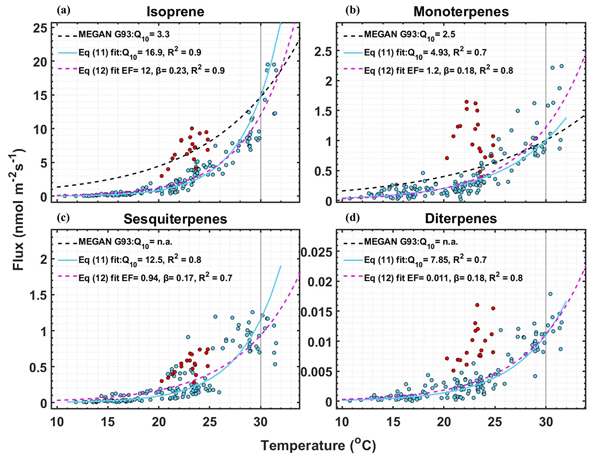
Lejish Vettikkat, Pasi Miettinen, Angela Buchholz, Pekka Rantala, Hao Yu, Simon Schallhart, Tuukka Petäjä, Roger Seco, Elisa Männistö, Markku Kulmala, Eeva-Stiina Tuittila, Alex B. Guenther, and Siegfried Schobesberger
Atmos. Chem. Phys., 23, 2683–2698, https://doi.org/10.5194/acp-23-2683-2023, https://doi.org/10.5194/acp-23-2683-2023, 2023
Short summary
Short summary
Wetlands cover a substantial fraction of the land mass in the northern latitudes, from northern Europe to Siberia and Canada. Yet, their isoprene and terpene emissions remain understudied. Here, we used a state-of-the-art measurement technique to quantify ecosystem-scale emissions from a boreal wetland during an unusually warm spring/summer. We found that the emissions from this wetland were (a) higher and (b) even more strongly dependent on temperature than commonly thought.
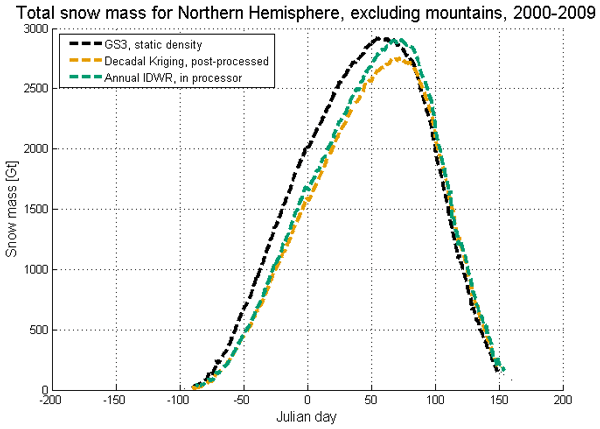
Pinja Venäläinen, Kari Luojus, Colleen Mortimer, Juha Lemmetyinen, Jouni Pulliainen, Matias Takala, Mikko Moisander, and Lina Zschenderlein
The Cryosphere, 17, 719–736, https://doi.org/10.5194/tc-17-719-2023, https://doi.org/10.5194/tc-17-719-2023, 2023
Short summary
Short summary
Snow water equivalent (SWE) is a valuable characteristic of snow cover. In this research, we improve the radiometer-based GlobSnow SWE retrieval methodology by implementing spatially and temporally varying snow densities into the retrieval procedure. In addition to improving the accuracy of SWE retrieval, varying snow densities were found to improve the magnitude and seasonal evolution of the Northern Hemisphere snow mass estimate compared to the baseline product.
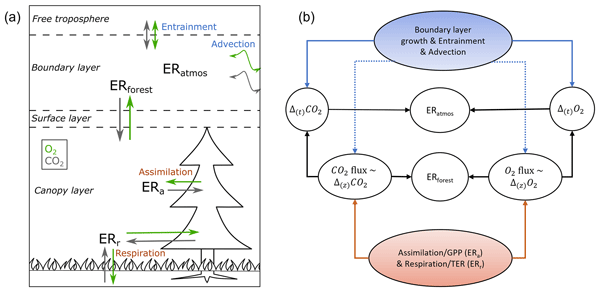
Kim A. P. Faassen, Linh N. T. Nguyen, Eadin R. Broekema, Bert A. M. Kers, Ivan Mammarella, Timo Vesala, Penelope A. Pickers, Andrew C. Manning, Jordi Vilà-Guerau de Arellano, Harro A. J. Meijer, Wouter Peters, and Ingrid T. Luijkx
Atmos. Chem. Phys., 23, 851–876, https://doi.org/10.5194/acp-23-851-2023, https://doi.org/10.5194/acp-23-851-2023, 2023
Short summary
Short summary
The exchange ratio (ER) between atmospheric O2 and CO2 provides a useful tracer for separately estimating photosynthesis and respiration processes in the forest carbon balance. This is highly relevant to better understand the expected biosphere sink, which determines future atmospheric CO2 levels. We therefore measured O2, CO2, and their ER above a boreal forest in Finland and investigated their diurnal behaviour for a representative day, and we show the most suitable way to determine the ER.
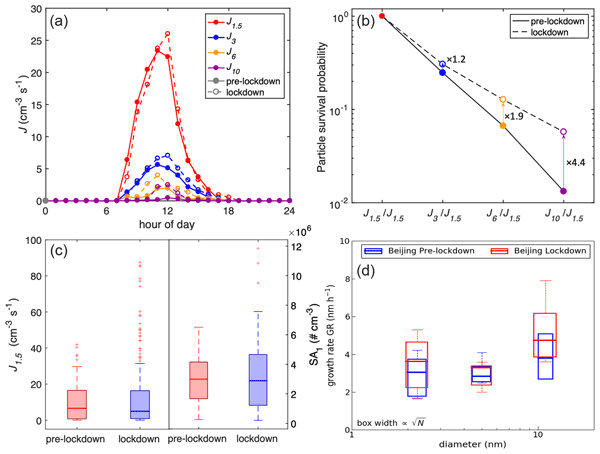
Chao Yan, Yicheng Shen, Dominik Stolzenburg, Lubna Dada, Ximeng Qi, Simo Hakala, Anu-Maija Sundström, Yishuo Guo, Antti Lipponen, Tom V. Kokkonen, Jenni Kontkanen, Runlong Cai, Jing Cai, Tommy Chan, Liangduo Chen, Biwu Chu, Chenjuan Deng, Wei Du, Xiaolong Fan, Xu-Cheng He, Juha Kangasluoma, Joni Kujansuu, Mona Kurppa, Chang Li, Yiran Li, Zhuohui Lin, Yiliang Liu, Yuliang Liu, Yiqun Lu, Wei Nie, Jouni Pulliainen, Xiaohui Qiao, Yonghong Wang, Yifan Wen, Ye Wu, Gan Yang, Lei Yao, Rujing Yin, Gen Zhang, Shaojun Zhang, Feixue Zheng, Ying Zhou, Antti Arola, Johanna Tamminen, Pauli Paasonen, Yele Sun, Lin Wang, Neil M. Donahue, Yongchun Liu, Federico Bianchi, Kaspar R. Daellenbach, Douglas R. Worsnop, Veli-Matti Kerminen, Tuukka Petäjä, Aijun Ding, Jingkun Jiang, and Markku Kulmala
Atmos. Chem. Phys., 22, 12207–12220, https://doi.org/10.5194/acp-22-12207-2022, https://doi.org/10.5194/acp-22-12207-2022, 2022
Short summary
Short summary
Atmospheric new particle formation (NPF) is a dominant source of atmospheric ultrafine particles. In urban environments, traffic emissions are a major source of primary pollutants, but their contribution to NPF remains under debate. During the COVID-19 lockdown, traffic emissions were significantly reduced, providing a unique chance to examine their relevance to NPF. Based on our comprehensive measurements, we demonstrate that traffic emissions alone are not able to explain the NPF in Beijing.

Kukka-Maaria Kohonen, Roderick Dewar, Gianluca Tramontana, Aleksanteri Mauranen, Pasi Kolari, Linda M. J. Kooijmans, Dario Papale, Timo Vesala, and Ivan Mammarella
Biogeosciences, 19, 4067–4088, https://doi.org/10.5194/bg-19-4067-2022, https://doi.org/10.5194/bg-19-4067-2022, 2022
Short summary
Short summary
Four different methods for quantifying photosynthesis (GPP) at ecosystem scale were tested, of which two are based on carbon dioxide (CO2) and two on carbonyl sulfide (COS) flux measurements. CO2-based methods are traditional partitioning, and a new method uses machine learning. We introduce a novel method for calculating GPP from COS fluxes, with potentially better applicability than the former methods. Both COS-based methods gave on average higher GPP estimates than the CO2-based estimates.
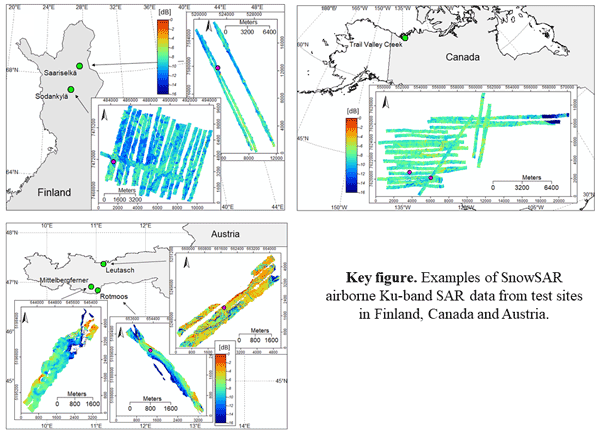
Juha Lemmetyinen, Juval Cohen, Anna Kontu, Juho Vehviläinen, Henna-Reetta Hannula, Ioanna Merkouriadi, Stefan Scheiblauer, Helmut Rott, Thomas Nagler, Elisabeth Ripper, Kelly Elder, Hans-Peter Marshall, Reinhard Fromm, Marc Adams, Chris Derksen, Joshua King, Adriano Meta, Alex Coccia, Nick Rutter, Melody Sandells, Giovanni Macelloni, Emanuele Santi, Marion Leduc-Leballeur, Richard Essery, Cecile Menard, and Michael Kern
Earth Syst. Sci. Data, 14, 3915–3945, https://doi.org/10.5194/essd-14-3915-2022, https://doi.org/10.5194/essd-14-3915-2022, 2022
Short summary
Short summary
The manuscript describes airborne, dual-polarised X and Ku band synthetic aperture radar (SAR) data collected over several campaigns over snow-covered terrain in Finland, Austria and Canada. Colocated snow and meteorological observations are also presented. The data are meant for science users interested in investigating X/Ku band radar signatures from natural environments in winter conditions.
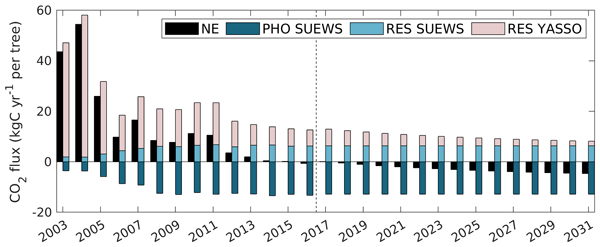
Minttu Havu, Liisa Kulmala, Pasi Kolari, Timo Vesala, Anu Riikonen, and Leena Järvi
Biogeosciences, 19, 2121–2143, https://doi.org/10.5194/bg-19-2121-2022, https://doi.org/10.5194/bg-19-2121-2022, 2022
Short summary
Short summary
The carbon sequestration potential of two street tree species and the soil beneath them was quantified with the urban land surface model SUEWS and the soil carbon model Yasso. The street tree plantings turned into a modest sink of carbon from the atmosphere after 14 years. Overall, the results indicate the importance of soil in urban carbon sequestration estimations, as soil respiration exceeded the carbon uptake in the early phase, due to the high initial carbon loss from the soil.
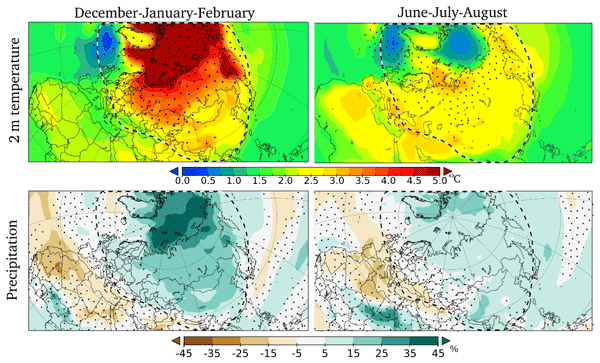
Hanna K. Lappalainen, Tuukka Petäjä, Timo Vihma, Jouni Räisänen, Alexander Baklanov, Sergey Chalov, Igor Esau, Ekaterina Ezhova, Matti Leppäranta, Dmitry Pozdnyakov, Jukka Pumpanen, Meinrat O. Andreae, Mikhail Arshinov, Eija Asmi, Jianhui Bai, Igor Bashmachnikov, Boris Belan, Federico Bianchi, Boris Biskaborn, Michael Boy, Jaana Bäck, Bin Cheng, Natalia Chubarova, Jonathan Duplissy, Egor Dyukarev, Konstantinos Eleftheriadis, Martin Forsius, Martin Heimann, Sirkku Juhola, Vladimir Konovalov, Igor Konovalov, Pavel Konstantinov, Kajar Köster, Elena Lapshina, Anna Lintunen, Alexander Mahura, Risto Makkonen, Svetlana Malkhazova, Ivan Mammarella, Stefano Mammola, Stephany Buenrostro Mazon, Outi Meinander, Eugene Mikhailov, Victoria Miles, Stanislav Myslenkov, Dmitry Orlov, Jean-Daniel Paris, Roberta Pirazzini, Olga Popovicheva, Jouni Pulliainen, Kimmo Rautiainen, Torsten Sachs, Vladimir Shevchenko, Andrey Skorokhod, Andreas Stohl, Elli Suhonen, Erik S. Thomson, Marina Tsidilina, Veli-Pekka Tynkkynen, Petteri Uotila, Aki Virkkula, Nadezhda Voropay, Tobias Wolf, Sayaka Yasunaka, Jiahua Zhang, Yubao Qiu, Aijun Ding, Huadong Guo, Valery Bondur, Nikolay Kasimov, Sergej Zilitinkevich, Veli-Matti Kerminen, and Markku Kulmala
Atmos. Chem. Phys., 22, 4413–4469, https://doi.org/10.5194/acp-22-4413-2022, https://doi.org/10.5194/acp-22-4413-2022, 2022
Short summary
Short summary
We summarize results during the last 5 years in the northern Eurasian region, especially from Russia, and introduce recent observations of the air quality in the urban environments in China. Although the scientific knowledge in these regions has increased, there are still gaps in our understanding of large-scale climate–Earth surface interactions and feedbacks. This arises from limitations in research infrastructures and integrative data analyses, hindering a comprehensive system analysis.
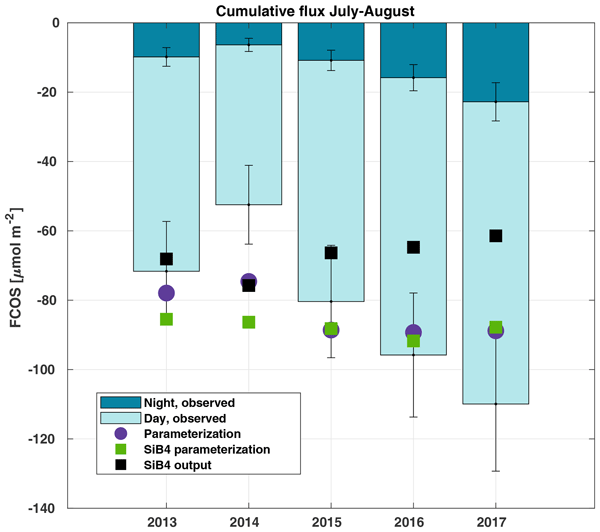
Timo Vesala, Kukka-Maaria Kohonen, Linda M. J. Kooijmans, Arnaud P. Praplan, Lenka Foltýnová, Pasi Kolari, Markku Kulmala, Jaana Bäck, David Nelson, Dan Yakir, Mark Zahniser, and Ivan Mammarella
Atmos. Chem. Phys., 22, 2569–2584, https://doi.org/10.5194/acp-22-2569-2022, https://doi.org/10.5194/acp-22-2569-2022, 2022
Short summary
Short summary
Carbonyl sulfide (COS) provides new insights into carbon cycle research. We present an easy-to-use flux parameterization and the longest existing time series of forest–atmosphere COS exchange measurements, which allow us to study both seasonal and interannual variability. We observed only uptake of COS by the forest on an annual basis, with 37 % variability between years. Upscaling the boreal COS uptake using a biosphere model indicates a significant missing COS sink at high latitudes.
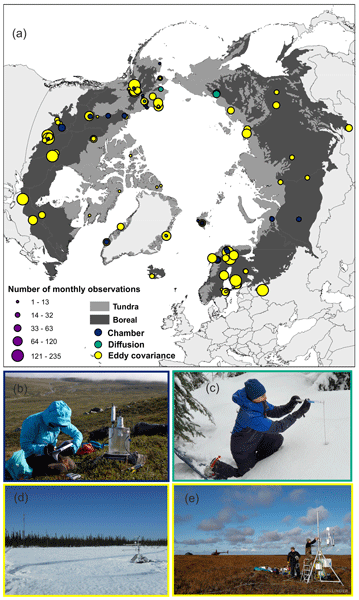
Anna-Maria Virkkala, Susan M. Natali, Brendan M. Rogers, Jennifer D. Watts, Kathleen Savage, Sara June Connon, Marguerite Mauritz, Edward A. G. Schuur, Darcy Peter, Christina Minions, Julia Nojeim, Roisin Commane, Craig A. Emmerton, Mathias Goeckede, Manuel Helbig, David Holl, Hiroki Iwata, Hideki Kobayashi, Pasi Kolari, Efrén López-Blanco, Maija E. Marushchak, Mikhail Mastepanov, Lutz Merbold, Frans-Jan W. Parmentier, Matthias Peichl, Torsten Sachs, Oliver Sonnentag, Masahito Ueyama, Carolina Voigt, Mika Aurela, Julia Boike, Gerardo Celis, Namyi Chae, Torben R. Christensen, M. Syndonia Bret-Harte, Sigrid Dengel, Han Dolman, Colin W. Edgar, Bo Elberling, Eugenie Euskirchen, Achim Grelle, Juha Hatakka, Elyn Humphreys, Järvi Järveoja, Ayumi Kotani, Lars Kutzbach, Tuomas Laurila, Annalea Lohila, Ivan Mammarella, Yojiro Matsuura, Gesa Meyer, Mats B. Nilsson, Steven F. Oberbauer, Sang-Jong Park, Roman Petrov, Anatoly S. Prokushkin, Christopher Schulze, Vincent L. St. Louis, Eeva-Stiina Tuittila, Juha-Pekka Tuovinen, William Quinton, Andrej Varlagin, Donatella Zona, and Viacheslav I. Zyryanov
Earth Syst. Sci. Data, 14, 179–208, https://doi.org/10.5194/essd-14-179-2022, https://doi.org/10.5194/essd-14-179-2022, 2022
Short summary
Short summary
The effects of climate warming on carbon cycling across the Arctic–boreal zone (ABZ) remain poorly understood due to the relatively limited distribution of ABZ flux sites. Fortunately, this flux network is constantly increasing, but new measurements are published in various platforms, making it challenging to understand the ABZ carbon cycle as a whole. Here, we compiled a new database of Arctic–boreal CO2 fluxes to help facilitate large-scale assessments of the ABZ carbon cycle.
Linda M. J. Kooijmans, Ara Cho, Jin Ma, Aleya Kaushik, Katherine D. Haynes, Ian Baker, Ingrid T. Luijkx, Mathijs Groenink, Wouter Peters, John B. Miller, Joseph A. Berry, Jerome Ogée, Laura K. Meredith, Wu Sun, Kukka-Maaria Kohonen, Timo Vesala, Ivan Mammarella, Huilin Chen, Felix M. Spielmann, Georg Wohlfahrt, Max Berkelhammer, Mary E. Whelan, Kadmiel Maseyk, Ulli Seibt, Roisin Commane, Richard Wehr, and Maarten Krol
Biogeosciences, 18, 6547–6565, https://doi.org/10.5194/bg-18-6547-2021, https://doi.org/10.5194/bg-18-6547-2021, 2021
Short summary
Short summary
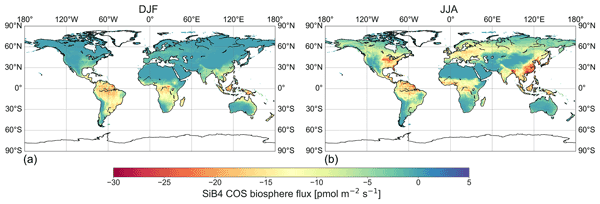
The gas carbonyl sulfide (COS) can be used to estimate photosynthesis. To adopt this approach on regional and global scales, we need biosphere models that can simulate COS exchange. So far, such models have not been evaluated against observations. We evaluate the COS biosphere exchange of the SiB4 model against COS flux observations. We find that the model is capable of simulating key processes in COS biosphere exchange. Still, we give recommendations for further improvement of the model.
Cited articles
Alekseychik, P., Peltola, O., Li, X., Aurela, M., Hatakka, J., Pihlatie, M., Rinne, J., Haapanala, S., Laakso, H., Taipale, R., Matilainen, T., Salminen, T., Levula, J., Ke, P., and Kolari, P.: SMEAR II Siikaneva 1 wetland eddy covariance (Version 3), University of Helsinki, Institute for Atmospheric and Earth System Research [data set], https://doi.org/10.23729/a3c8d0fe-2a69-4aa9-acbd-5da569fd264e, 2024a.
Alekseychik, P., Kolari, P., Rinne, J., Haapanala, S., Laakso, H., Taipale, R., Matilainen, T., Salminen, T., Levula, J., and Tuittila, E.: SMEAR II Siikaneva 1 wetland meteorology and soil (Version 4), University of Helsinki, Institute for Atmospheric and Earth System Research [data set], https://doi.org/10.23729/0766621e-99bf-42f2-ad55-889cdb08b66a, 2024b.
AMAP: Arctic Climate Change Update 2021: Key Trends and Impacts, Arctic Monitoring and Assessment Programme (AMAP), Tromsø, Norway, viii, 148 pp., ISBN 978-82-7971-201-5, 2021.
Arndt, K. A., Lipson, D. A., Hashemi, J., Oechel, W. C., and Zona, D.: Snow melt stimulates ecosystem respiration in Arctic ecosystems, Glob. Change Biol., 26, 5042–5051, https://doi.org/10.1111/gcb.15193, 2020.
Arndt, K. A., Hashemi, J., Natali, S. M., Schiferl, L. D., and Virkkala, A.-M.: Recent Advances and Challenges in Monitoring and Modeling Non-Growing Season Carbon Dioxide Fluxes from the Arctic Boreal Zone, Curr. Clim. Change Rep., 9, 27–40, https://doi.org/10.1007/s40641-023-00190-4, 2023.
Aurela, M., Laurila, T., and Tuovinen, J.-P.: Annual CO2 balance of a subarctic fen in northern Europe: Importance of the wintertime efflux, J. Geophys. Res.-Atmos., 107, ACH 17-1–ACH 17-12, https://doi.org/10.1029/2002JD002055, 2002.
Aurela, M., Laurila, T., and Tuovinen, J.-P.: The timing of snow melt controls the annual CO2 balance in a subarctic fen, Geophys. Res. Lett., 31, https://doi.org/10.1029/2004GL020315, 2004.
Baldocchi, D. D.: Assessing the eddy covariance technique for evaluating carbon dioxide exchange rates of ecosystems: past, present and future, Glob. Change Biol., 9, 479–492, https://doi.org/10.1046/j.1365-2486.2003.00629.x, 2003.
Böttcher, K., Aurela, M., Kervinen, M., Markkanen, T., Mattila, O.-P., Kolari, P., Metsämäki, S., Aalto, T., Arslan, A. N., and Pulliainen, J.: MODIS time-series-derived indicators for the beginning of the growing season in boreal coniferous forest – A comparison with CO2 flux measurements and phenological observations in Finland, Remote Sens. Environ., 140, 625–638, https://doi.org/10.1016/j.rse.2013.09.022, 2014.
Breiman, L.: Random forests, Mach. Learn., 45, 5–32, https://doi.org/10.1023/a:1010933404324, 2001.
Brooks, P. D., McKnight, D., and Elder, K.: Carbon limitation of soil respiration under winter snowpacks: Potential feedbacks between growing season and winter carbon fluxes, Glob. Change Biol., 11, 231–238, https://doi.org/10.1111/j.1365-2486.2004.00877.x, 2005.
Byrne, B., Liu, J., Yi, Y., Chatterjee, A., Basu, S., Cheng, R., Doughty, R., Chevallier, F., Bowman, K. W., Parazoo, N. C., Crisp, D., Li, X., Xiao, J., Sitch, S., Guenet, B., Deng, F., Johnson, M. S., Philip, S., McGuire, P. C., and Miller, C. E.: Multi-year observations reveal a larger than expected autumn respiration signal across northeast Eurasia, Biogeosciences, 19, 4779–4799, https://doi.org/10.5194/bg-19-4779-2022, 2022.
Byun, E., Rezanezhad, F., Fairbairn, L., Slowinski, S., Basiliko, N., Price, J. S., Quinton, W. L., Roy-Léveillée, P., Webster, K., Van and Cappellen, P.: Temperature, moisture and freeze–thaw controls on CO2 production in soil incubations from northern peatlands, Sci. Rep., 11, 23219, https://doi.org/10.1038/s41598-021-02606-3, 2021.
Campeau, A., Vachon, D., Bishop, K., Nilsson, M. B., and Wallin, M. B.: Autumn destabilization of deep porewater CO2 store in a northern peatland driven by turbulent diffusion, Nat. Commun., 12, 6857, https://doi.org/10.1038/s41467-021-27059-0, 2021.
Cohen, J., Rautiainen, K., Lemmetyinen, J., Smolander, T., Vehviläinen, J., and Pulliainen, J.: Sentinel-1 based soil freeze/thaw estimation in boreal forest environments, Remote Sens. Environ., 254, 112267, https://doi.org/10.1016/j.rse.2020.112267, 2021.
Commane, R., Lindaas, J., Benmergui, J., Luus, K. A., Chang, R. Y.-W., Daube, B. C., Euskirchen, E. S., Henderson, J. M., Karion, A., Miller, J. B., Miller, S. M., Parazoo, N. C., Randerson, J. T., Sweeney, C., Tans, P., Thoning, K., Veraverbeke, S., Miller, C. E., and Wofsy, S. C.: Carbon dioxide sources from Alaska driven by increasing early winter respiration from Arctic tundra, P. Natl. Acad. Sci. USA, 114, 5361–5366, https://doi.org/10.1073/pnas.1618567114, 2017.
Drebs, A., Nordlund, A., Karlsson, P., Helminen, J., and Rissanen, P.: Climatological statistics of Finland 1971–2000, Finnish Meteorological Institute, Helsinki, 99 pp., ISBN 951-697-568-2, 2002.
Gorham, E.: Northern Peatlands: Role in the Carbon Cycle and Probable Responses to Climatic Warming, Ecol. Appl., 1, 182–195, https://doi.org/10.2307/1941811, 1991.
Hallikainen, M. T., Ulaby, F. T., Dobson, M. C., El-Rayes, M. A., and Wu, L.-K.: Microwave dielectric behavior of wet soil – Part 1: Empirical models and experimental observations, IEEE T. Geosci. Remote, GE-23, 25–34, https://doi.org/10.1109/TGRS.1985.289497, 1985.
Hugelius, G., Loisel, J., Chadburn, S., Jackson, R. B., Jones, M., MacDonald, G., Marushchak, M., Olefeldt, D., Packalen, M., Siewert, M. B., Treat, C., Turetsky, M., Voigt, C., and Yu, Z.: Large stocks of peatland carbon and nitrogen are vulnerable to permafrost thaw, P. Natl. Acad. Sci. USA, 117, 20438–20446, https://doi.org/10.1073/pnas.1916387117, 2020.
Hugelius, G., Ramage, J., Burke, E., Chatterjee, A., Smallman, T. L., Aalto, T., Bastos, A., Biasi, C., Canadell, J. G., Chevallier, F., Ciais, P., Chang, J., Feng, L., Jones, M. W., Kleinen, T., Kuhn, M., Liu, J., and Zheng, B.: Permafrost Region Greenhouse Gas Budgets Suggest a Weak CO2 Sink and CH4 and N2O Sources, Global Biogeochem. Cy., 38, e2023GB007969, https://doi.org/10.1029/2023GB007969, 2024.
Kollo, J., Metslaid, S., Padari, A., Hordo, M., Kangur, A., and Noe, S. M.: Trends in thermal growing season length from years 1955–2020 – A case study in hemiboreal forest in Estonia, Boreal Environ. Res., 28, 169–180, 2023.
Korrensalo, A., Mammarella, I., Alekseychik, P., Vesala, T., and Tuittila, E.-S.: Plant mediated methane efflux from a boreal peatland complex, Plant Soil, 471, 375–392, https://doi.org/10.1007/s11104-021-05180-9, 2022.
Kübert, A., Lohila, A., Vekuri, H., Hatakka, J., Laurila, T., Mäkelä, T., Rainne, J., Suopajärvi, S., Tuovinen, J.-P., and Aurela, M.: Summer temperatures largely control annual methane budgets of a northern peatland, Agr. Forest Meteorol., 381, 111101, https://doi.org/10.1016/j.agrformet.2026.111101, 2026.
Körner, C., Möhl, P., and Hiltbrunner, E.: Four ways to define the growing season, Ecol. Lett., 26, 1277–1292, https://doi.org/10.1111/ele.14260, 2023.
Kulmala, L., Pumpanen, J., Kolari, P., Dengel, S., Berninger, F., Köster, K., Matkala, L., Vanhatalo, A., Vesala, T., and Bäck, J.: Inter- and intra-annual dynamics of photosynthesis differ between forest floor vegetation and tree canopy in a subarctic Scots pine stand, Agr. Forest Meteorol., 271, 1–11, https://doi.org/10.1016/j.agrformet.2019.02.029, 2019.
López-Blanco, E., Lund, M., Williams, M., Tamstorf, M. P., Westergaard-Nielsen, A., Exbrayat, J.-F., Hansen, B. U., and Christensen, T. R.: Exchange of CO2 in Arctic tundra: impacts of meteorological variations and biological disturbance, Biogeosciences, 14, 4467–4483, https://doi.org/10.5194/bg-14-4467-2017, 2017.
López-Blanco, E., Lund, M., Christensen, T. R., Tamstorf, M. P., Smallman, T. L., Slevin, D., Westergaard-Nielsen, A., Hansen, B. U., Abermann, J., and Williams, M.: Plant Traits are Key Determinants in Buffering the Meteorological Sensitivity of Net Carbon Exchanges of Arctic Tundra, J. Geophys. Res.-Biogeo., 123, 2675–2694, https://doi.org/10.1029/2018JG004386, 2018.
López-Blanco, E., Väisänen, M., Salmon, E., Jones, C. P., Schmidt, N. M., Marttila, H., Lohila, A., Juutinen, S., Scheller, J., and Christensen, T. R.: The net ecosystem carbon balance (NECB) at catchment scales in the Arctic, Front. Environ. Sci., 13, 1544586, https://doi.org/10.3389/fenvs.2025.1544586, 2025.
Luojus, K. P., Pulliainen, J. T., Metsamäki, S. J., and Hallikainen, M. T.: Snow-Covered Area Estimation Using Satellite Radar Wide-Swath Images, IEEE T. Geosci. Remote, 45, 978–989, https://doi.org/10.1109/TGRS.2006.888864, 2007.
Mammarella, I., Peltola, O., Nordbo, A., Järvi, L., and Rannik, Ü.: Quantifying the uncertainty of eddy covariance fluxes due to the use of different software packages and combinations of processing steps in two contrasting ecosystems, Atmos. Meas. Tech., 9, 4915–4933, https://doi.org/10.5194/amt-9-4915-2016, 2016.
Martz, F., Vuosku, J., Ovaskainen, A., Stark, S., and Rautio, P.: The Snow Must Go On: Ground Ice Encasement, Snow Compaction and Absence of Snow Differently Cause Soil Hypoxia, CO2 Accumulation and Tree Seedling Damage in Boreal Forest, PLoS One, 11, e0156620, https://doi.org/10.1371/journal.pone.0156620, 2016.
Mastepanov, M., Sigsgaard, C., Tagesson, T., Ström, L., Tamstorf, M. P., Lund, M., and Christensen, T. R.: Revisiting factors controlling methane emissions from high-Arctic tundra, Biogeosciences, 10, 5139–5158, https://doi.org/10.5194/bg-10-5139-2013, 2013.
Morgner, E., Elberling, B., Strebel, D., and Cooper, E. J.: Importance of winter in annual ecosystem respiration in the High Arctic, Polar Res., 29, 58–74, https://doi.org/10.1111/j.1751-8369.2010.00151.x, 2010.
Nagler, T. and Rott, H.: Retrieval of wet snow by means of multitemporal SAR data, IEEE T. Geosci. Remote, 38, 754–765, https://doi.org/10.1109/36.842004, 2000.
Natali, S. M., Watts, J. D., Rogers, B. M., Potter, S., Ludwig, S. M., Selbmann, A.-K., Sullivan, P. F., Abbott, B. W., Arndt, K. A., Birch, L., Björkman, M. P., Bloom, A. A., Celis, G., Christensen, T. R., Christiansen, C. T., Commane, R., Cooper, E. J., Crill, P., Czimczik, C., Davydov, S., Du, J., Egan, J. E., Elberling, B., Euskirchen, E. S., Friborg, T., Genet, H., Göckede, M., Goodrich, J. P., Grogan, P., Helbig, M., Jafarov, E. E., Jastrow, J. D., Kalhori, A. A. M., Kim, Y., Kimball, J. S., Kutzbach, L., Lara, M. J., Larsen, K. S., Lee, B.-Y., Liu, Z., Loranty, M. M., Lund, M., Lupascu, M., Madani, N., Malhotra, A., Matamala, R., McFarland, J., McGuire, A. D., Michelsen, A., Minions, C., Oechel, W. C., Olefeldt, D., Parmentier, F.-J. W., Pirk, N., Poulter, B., Quinton, W., Rezanezhad, F., Risk, D., Sachs, T., Schaefer, K., Schmidt, N. M., Schuur, E. A. G., Semenchuk, P. R., Shaver, G., Sonnentag, O., Starr, G., Treat, C. C., Waldrop, M. P., Wang, Y., Welker, J., Wille, C., Xu, X., Zhang, Z., Zhuang, Q., and Zona, D.: Large loss of CO2 in winter observed across the northern permafrost region, Nat. Clim. Chang., 9, 852–857, https://doi.org/10.1038/s41558-019-0592-8, 2019.
Nichols, J. E. and Peteet, D. M.: Rapid expansion of northern peatlands and doubled estimate of carbon storage, Nat. Geosci., 12, 917–921, https://doi.org/10.1038/s41561-019-0454-z, 2019.
Pallandt, M. M. T. A., Kumar, J., Mauritz, M., Schuur, E. A. G., Virkkala, A.-M., Celis, G., Hoffman, F. M., and Göckede, M.: Representativeness assessment of the pan-Arctic eddy covariance site network and optimized future enhancements, Biogeosciences, 19, 559–583, https://doi.org/10.5194/bg-19-559-2022, 2022.
Pedregosa, F., Varoquaux, G., Gramfort, A., Michel, V., Thirion, B., Grisel, O., Blondel, M., Prettenhofer, P., Weiss, R., Dubourg, V., Vanderplas, J., Passos, A., Cournapeau, D., Brucher, M., Perrot, M., and Duchesnay, É.: Scikit-learn: machine learning in python, J. Mach. Learn. Res., 12, 2825–2830, 2011.
Pongracz, A., Wårlind, D., Miller, P. A., Gustafson, A., Rabin, S. S., and Parmentier, F.-J. W.: Warming-induced contrasts in snow depth drive the future trajectory of soil carbon loss across the Arctic-Boreal region, Commun. Earth Environ., 5, 684, https://doi.org/10.1038/s43247-024-01838-1, 2024.
Rafat, A., Byun, E., Rezanezhad, F., Quinton, W. L., Humphreys, E. R., Webster, K., and Van Cappellen, P.: The definition of the non-growing season matters: a case study of net ecosystem carbon exchange from a Canadian peatland, Environ. Res. Commun., 4, 021003, https://doi.org/10.1088/2515-7620/ac53c2, 2022.
Rantanen, M., Karpechko, A. Y., Lipponen, A., Nordling, K., Hyvärinen, O., Ruosteenoja, K., Vihma, T., and Laaksonen, A.: Arctic warming amplification, Commun. Earth Environ., 3, 1–10, https://doi.org/10.1038/s43247-022-00498-3, 2022.
Rantanen, M., Lee, S. H., and Aalto, J.: Asymmetric warming rates between warm and cold weather regimes in Europe, Atmos. Sci. Lett., 24, e1178, https://doi.org/10.1002/asl.1178, 2023.
Raz-Yaseef, N., Torn, M. S., Wu, Y., Billesbach, D. P., Liljedahl, A. K., Kneafsey, T. J., Romanovsky, V. E., Cook, D. R., and Wullschleger, S. D.: Large CO2 and CH4 emissions from polygonal tundra during spring thaw in northern Alaska, Geophys. Res. Lett., 44, 504–513, https://doi.org/10.1002/2016GL071220, 2017.
Rinne, J., Tuovinen, J.-P., Klemedtsson, L., Aurela, M., Holst, J., Lohila, A., Weslien, P., Vestin, P., Łakomiec, P., Peichl, M., Tuittila, E.-S., Heiskanen, L., Laurila, T., Li, X., Alekseychik, P., Mammarella, I., Ström, L., Crill, P., and Nilsson, M. B.: Effect of the 2018 European drought on methane and carbon dioxide exchange of northern mire ecosystems, Philos. T. R. Soc. B, 375, 20190517, https://doi.org/10.1098/rstb.2019.0517, 2020.
Riutta, T., Laine, J., and Tuittila, E.-S.: Sensitivity of CO2 Exchange of Fen Ecosystem Components to Water Level Variation, Ecosystems, 10, 718–733, https://doi.org/10.1007/s10021-007-9046-7, 2007.
Ruosteenoja, K., Jylhä, K., and Kämäräinen, M.: Climate Projections for Finland Under the RCP Forcing Scenarios, Geophysica, 51, 17–50, 2016
See, C. R., Virkkala, A.-M., Natali, S. M., Rogers, B. M., Mauritz, M., Biasi, C., Bokhorst, S., Boike, J., Bret-Harte, M. S., Celis, G., Chae, N., Christensen, T. R., Murner (Connon), S. J., Dengel, S., Dolman, H., Edgar, C. W., Elberling, B., Emmerton, C. A., Euskirchen, E. S., Göckede, M., Grelle, A., Heffernan, L., Helbig, M., Holl, D., Humphreys, E., Iwata, H., Järveoja, J., Kobayashi, H., Kochendorfer, J., Kolari, P., Kotani, A., Kutzbach, L., Kwon, M. J., Lathrop, E. R., López-Blanco, E., Mammarella, I., Marushchak, M. E., Mastepanov, M., Matsuura, Y., Merbold, L., Meyer, G., Minions, C., Nilsson, M. B., Nojeim, J., Oberbauer, S. F., Olefeldt, D., Park, S.-J., Parmentier, F.-J. W., Peichl, M., Peter, D., Petrov, R., Poyatos, R., Prokushkin, A. S., Quinton, W., Rodenhizer, H., Sachs, T., Savage, K., Schulze, C., Sjögersten, S., Sonnentag, O., St. Louis, V. L., Torn, M. S., Tuittila, E.-S., Ueyama, M., Varlagin, A., Voigt, C., Watts, J. D., Zona, D., Zyryanov, V. I., and Schuur, E. A. G.: Decadal increases in carbon uptake offset by respiratory losses across northern permafrost ecosystems, Nat. Clim. Chang., 14, 853–862, https://doi.org/10.1038/s41558-024-02057-4, 2024.
Sullivan, B. W., Dore, S., Montes-Helu, M. C., Kolb, T. E., and Hart, S. C.: Pulse Emissions of Carbon Dioxide during Snowmelt at a High-Elevation Site in Northern Arizona, U.S.A, Arct. Antarct. Alp. Res., 44, 247–254, https://doi.org/10.1657/1938-4246-44.2.247, 2012.
Ulaby, F. T., Moore, R. K., and Fung, A. K.: Microwave Remote Sensing, Active and Passive: Volume II, Radar Remote Sensing and Surface Scattering and Emission Theory, Longman Higher Education, 634 pp., ISBN 978-0890061916, 1982.
Virkkala, A.-M., Aalto, J., Rogers, B. M., Tagesson, T., Treat, C. C., Natali, S. M., Watts, J. D., Potter, S., Lehtonen, A., Mauritz, M., Schuur, E. A. G., Kochendorfer, J., Zona, D., Oechel, W., Kobayashi, H., Humphreys, E., Goeckede, M., Iwata, H., Lafleur, P. M., Euskirchen, E. S., Bokhorst, S., Marushchak, M., Martikainen, P. J., Elberling, B., Voigt, C., Biasi, C., Sonnentag, O., Parmentier, F.-J. W., Ueyama, M., Celis, G., St.Louis, V. L., Emmerton, C. A., Peichl, M., Chi, J., Järveoja, J., Nilsson, M. B., Oberbauer, S. F., Torn, M. S., Park, S.-J., Dolman, H., Mammarella, I., Chae, N., Poyatos, R., López-Blanco, E., Christensen, T. R., Kwon, M. J., Sachs, T., Holl, D., and Luoto, M.: Statistical upscaling of ecosystem CO2 fluxes across the terrestrial tundra and boreal domain: Regional patterns and uncertainties, Glob. Change Biol., 27, 4040–4059, 2021.
Virkkala, A.-M., Natali, S. M., Rogers, B. M., Watts, J. D., Savage, K., Connon, S. J., Mauritz, M., Schuur, E. A. G., Peter, D., Minions, C., Nojeim, J., Commane, R., Emmerton, C. A., Goeckede, M., Helbig, M., Holl, D., Iwata, H., Kobayashi, H., Kolari, P., López-Blanco, E., Marushchak, M. E., Mastepanov, M., Merbold, L., Parmentier, F.-J. W., Peichl, M., Sachs, T., Sonnentag, O., Ueyama, M., Voigt, C., Aurela, M., Boike, J., Celis, G., Chae, N., Christensen, T. R., Bret-Harte, M. S., Dengel, S., Dolman, H., Edgar, C. W., Elberling, B., Euskirchen, E., Grelle, A., Hatakka, J., Humphreys, E., Järveoja, J., Kotani, A., Kutzbach, L., Laurila, T., Lohila, A., Mammarella, I., Matsuura, Y., Meyer, G., Nilsson, M. B., Oberbauer, S. F., Park, S.-J., Petrov, R., Prokushkin, A. S., Schulze, C., St. Louis, V. L., Tuittila, E.-S., Tuovinen, J.-P., Quinton, W., Varlagin, A., Zona, D., and Zyryanov, V. I.: The ABCflux database: Arctic–boreal CO2 flux observations and ancillary information aggregated to monthly time steps across terrestrial ecosystems, Earth Syst. Sci. Data, 14, 179–208, https://doi.org/10.5194/essd-14-179-2022, 2022.
Wang, H., Yu, L., Chen, L., Zhang, Z., Li, X., Liang, N., Peng, C., and He, J.-S.: Carbon fluxes and soil carbon dynamics along a gradient of biogeomorphic succession in alpine wetlands of Tibetan Plateau, Fundam. Res., 3, 151–159, https://doi.org/10.1016/j.fmre.2022.09.024, 2023.
Watts, J. D., Farina, M., Kimball, J. S., Schiferl, L. D., Liu, Z., Arndt, K. A., Zona, D., Ballantyne, A., Euskirchen, E. S., Parmentier, F.-J. W., Helbig, M., Sonnentag, O., Tagesson, T., Rinne, J., Ikawa, H., Ueyama, M., Kobayashi, H., Sachs, T., Nadeau, D. F., Kochendorfer, J., Jackowicz-Korczynski, M., Virkkala, A., Aurela, M., Commane, R., Byrne, B., Birch, L., Johnson, M. S., Madani, N., Rogers, B., Du, J., Endsley, A., Savage, K., Poulter, B., Zhang, Z., Bruhwiler, L. M., Miller, C. E., Goetz, S., and Oechel, W. C.: Carbon uptake in Eurasian boreal forests dominates the high-latitude net ecosystem carbon budget, Glob. Change Biol., 29, 1870–1889, https://doi.org/10.1111/gcb.16553, 2023.
Wei, J., Li, X., Liu, L., Christensen, T. R., Jiang, Z., Ma, Y., Wu, X., Yao, H., and López-Blanco, E.: Radiation, soil water content, and temperature effects on carbon cycling in an alpine swamp meadow of the northeastern Qinghai–Tibetan Plateau, Biogeosciences, 19, 861–875, https://doi.org/10.5194/bg-19-861-2022, 2022.
Wutzler, T., Lucas-Moffat, A., Migliavacca, M., Knauer, J., Sickel, K., Šigut, L., Menzer, O., and Reichstein, M.: Basic and extensible post-processing of eddy covariance flux data with REddyProc, Biogeosciences, 15, 5015–5030, https://doi.org/10.5194/bg-15-5015-2018, 2018.
Yao, H., Peng, H., Hong, B., Guo, Q., Ding, H., Hong, Y., Zhu, Y., Cai, C., and Chi, J.: Environmental Controls on Multi-Scale Dynamics of Net Carbon Dioxide Exchange From an Alpine Peatland on the Eastern Qinghai-Tibet Plateau, Front. Plant Sci., 12, https://doi.org/10.3389/fpls.2021.791343, 2022.
Yu, Z., Beilman, D. W., Frolking, S., MacDonald, G. M., Roulet, N. T., Camill, P., and Charman, D. J.: Peatlands and Their Role in the Global Carbon Cycle, Eos T. AGU, 92, 97–98, https://doi.org/10.1029/2011EO120001, 2011.
Short summary
Using a 17-year record of year-round peatland carbon exchange, we found that over half of the carbon sequestrated during summer was released during winter. In one year, CO₂ emissions during snow melt and soil thaw in spring were large enough to shift the peatland from a net carbon sink to a source. These findings demonstrate that winter and early-spring processes have a strong impact over the annual carbon balance of northern peatlands.
Using a 17-year record of year-round peatland carbon exchange, we found that over half of the...


Altmetrics
Final-revised paper
Preprint