
Articles | Volume 23, issue 19
https://doi.org/10.5194/bg-23-7091-2026
© Author(s) 2026. This work is distributed under
the Creative Commons Attribution 4.0 License.
the Creative Commons Attribution 4.0 License.
https://doi.org/10.5194/bg-23-7091-2026
© Author(s) 2026. This work is distributed under
the Creative Commons Attribution 4.0 License.
the Creative Commons Attribution 4.0 License.
Research article
| 
09 Oct 2026
Research article |
| 09 Oct 2026
| 09 Oct 2026
Drought responses of a Norway spruce forest on drained peat soil: combining sap-flow sensors, eddy-covariance, meteorological, soil and UAV data
Pavel Konstantinovich Alekseychik
CORRESPONDING AUTHOR

Bioeconomy and Environment, Natural Resources Institute Finland, 00710 Helsinki, Finland
Institute for Atmospheric and Earth System Research/Physics, Faculty of Science, University of Helsinki, P.O. Box 68, 00014 Helsinki, Finland
Mikko Peltoniemi
Bioeconomy and Environment, Natural Resources Institute Finland, 00710 Helsinki, Finland
Raisa Mäkipää
Bioeconomy and Environment, Natural Resources Institute Finland, 00710 Helsinki, Finland
Ville Tuominen
Finnish Meteorological Institute (FMI), Climate System Research, 00560 Helsinki, Finland
Tuomas Laurila
Finnish Meteorological Institute (FMI), Climate System Research, 00560 Helsinki, Finland
Hamlyn Jones
School of Life Sciences, University of Dundee, DD1 5EH Dundee, UK
School of Agriculture and Environment, University of Western Australia, WA 6009 Perth, Australia
Mitro Müller
Natural resources, Natural Resources Institute Finland, 00710 Helsinki, Finland
Evegeny Lopatin
Bioeconomy and Environment, Natural Resources Institute Finland, 00710 Helsinki, Finland
Helena Rautakoski
Finnish Meteorological Institute (FMI), Climate System Research, 00560 Helsinki, Finland
Timo Vesala
Institute for Atmospheric and Earth System Research/Physics, Faculty of Science, University of Helsinki, P.O. Box 68, 00014 Helsinki, Finland
Institute for Atmospheric and Earth System Research/Forest Sciences, Faculty of Agriculture and Forestry, University of Helsinki, P.O. Box 27, 00014 Helsinki, Finland
Samuli Launiainen
Bioeconomy and Environment, Natural Resources Institute Finland, 00710 Helsinki, Finland
Related authors
Eyrún Gyða Gunnlaugsdóttir, Angelika Kübert, Xuefei Li, Timo Vesala, Aino Korrensalo, Elisa Männistö, Eeva-Stiina Tuittila, Pavel Alekseychik, and Ivan Mammarella
EGUsphere, https://doi.org/10.5194/egusphere-2026-3323, https://doi.org/10.5194/egusphere-2026-3323, 2026
Short summary
Short summary
We studied how two nearby peatland types exchange carbon with the atmosphere using long-term field measurements. We found that the fen absorbed more carbon dioxide but also released more methane than the bog, mainly due to differences in vegetation rather than climate. This suggests that plant communities strongly influence how peatlands affect climate and should be considered in future predictions, especially under changing environmental conditions and ecosystem shifts.
Olli-Pekka Tikkasalo, Olli Peltola, Pavel Alekseychik, Juha Heikkinen, Samuli Launiainen, Aleksi Lehtonen, Qian Li, Eduardo Martínez-García, Mikko Peltoniemi, Petri Salovaara, Ville Tuominen, and Raisa Mäkipää
Biogeosciences, 22, 1277–1300, https://doi.org/10.5194/bg-22-1277-2025, https://doi.org/10.5194/bg-22-1277-2025, 2025
Short summary
Short summary
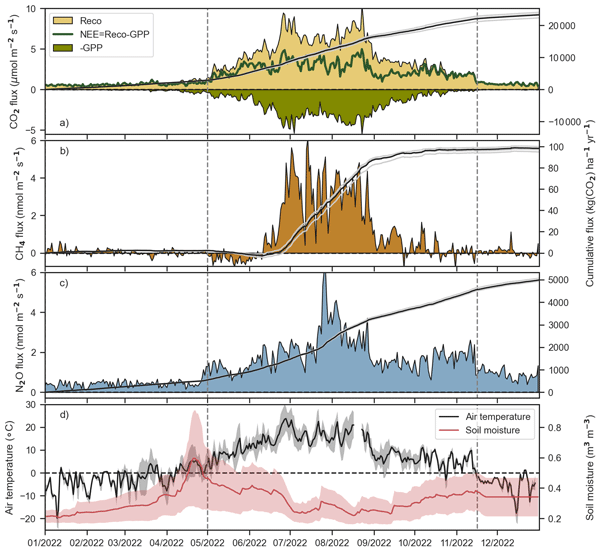
The emissions of greenhouse gases (GHGs) carbon dioxide (CO2), methane (CH4) and nitrous oxide (N2O) were measured from a clear-cut peatland forest site. The measurements covered the whole year of 2022, which was the second growing season after the clear-cut. The site was a strong GHG source, and the highest emissions came from CO2, followed by N2O and CH4. A statistical model that included information on different surfaces at the site was developed to unravel surface-type-specific GHG fluxes.
Üllar Rannik, Ivan Mammarella, Timo Vesala, Pirkko Väkimies, Hilkka Heiskari-Tuohiniemi, and Mika Korkiakoski
Atmos. Meas. Tech., 19, 6159–6169, https://doi.org/10.5194/amt-19-6159-2026, https://doi.org/10.5194/amt-19-6159-2026, 2026
Short summary
Short summary
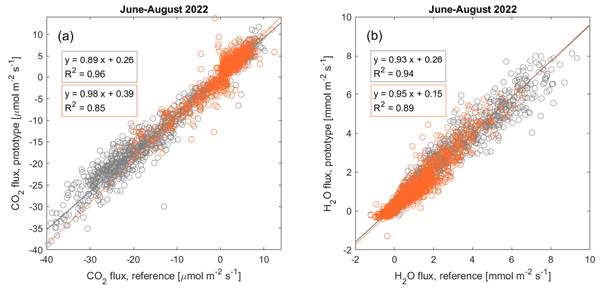
We present a case study that aimed to develop an inexpensive yet precise fast-response carbon dioxide and water vapour sensor. A working prototype was developed and field-tested against a scientific eddy covariance setup. Attention was paid to internal auto-calibration procedure such that signal drifting was avoided and the instrument was capable of measuring fluxes with high correlation relative to the reference setup.
Ekaterina Ezhova, Üllar Rannik, Santeri Tuovinen, Olga Garmash, Otso Peräkylä, Piaopiao Ke, Topi Laanti, Janne Lampilahti, Markus Lampimäki, Anna Lintunen, Veli-Matti Kerminen, Janne Rinne, Timo Vesala, and Markku Kulmala
Atmos. Chem. Phys., 26, 13463–13483, https://doi.org/10.5194/acp-26-13463-2026, https://doi.org/10.5194/acp-26-13463-2026, 2026
Short summary
Short summary
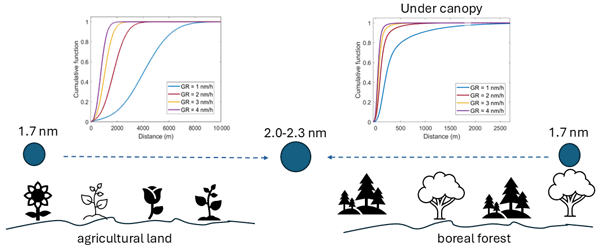
In boreal region, emissions from plants contribute to formation and growth of aerosol particles. Measurements suggest that concentration of small ions, which could be produced locally, differ in forests and agricultural fields. As a step to interpretation, we explain the concept of local aerosol production and estimate a spatial scale of an ecosystem needed to produce small ions. This scale is about few km in open areas such as agricultural fields and 500 m in the pine forest with closed canopy.
Ahmed Hasan Shahriyer, David Kraus, Tiina Markkanen, Mika Korkiakoski, Helena Rautakoski, Suvi Orttenvuori, Yao Gao, Henri Kajasilta, Rüdiger Grote, Annalea Lohila, and Tuula Aalto
Geosci. Model Dev., 19, 8815–8838, https://doi.org/10.5194/gmd-19-8815-2026, https://doi.org/10.5194/gmd-19-8815-2026, 2026
Short summary
Short summary
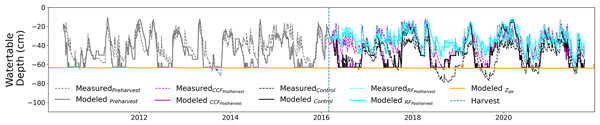
Using the process-based model LandscapeDNDC, we successfully simulated the hydrological and carbon-cycle responses of a drained peatland ecosystem under control, rotational forestry and continuous cover forestry management. The developed framework provides a valuable tool for evaluating future management scenarios and supporting the development of forest management strategies aimed at achieving climate neutrality in peatland ecosystems.
Anna-Maria Virkkala, Isabel Wargowsky, Judith Vogt, McKenzie A. Kuhn, Simran Madaan, Tiffany Windholz, Kyle A. Arndt, Gerard Rocher-Ros, Mathias Göckede, David Olefeldt, Edward A. G. Schuur, David Bastviken, Richard O'Keefe, Brendan M. Rogers, Jennifer D. Watts, Kelcy Kent, Kristoffer Aalstad, Kelly Aho, Joonatan Ala-Könni, Haley Alcock, Inge Althuizen, Christopher D. Arp, Jun Asanuma, Mika Aurela, Sivakiruthika Balathandayuthabani, Katrin Attermeyer, Alan Barr, Maialen Barret, Ochirbat Batkhishig, Christina Biasi, Mats P. Björkman, Andrew Black, Elena Blanc-Betes, Pascal Bodmer, Julia Boike, Abdullah Bolek, Frédéric Bouchard, Ingeborg Bussmann, Lea Cabrol, Eleonora Canfora, Sean Carey, Karel Castro-Morales, Namyi Chae, Andreas Christen, Torben R. Christensen, Casper T. Christiansen, Housen Chu, Graham Clark, Francois Clayer, Patrick Crill, Christopher Cunada, Scott J. Davidson, Joshua F. Dean, Sigrid Dengel, Matteo Detto, Catherine Dieleman, Florent Domine, Egor Dyukarev, Colin Edgar, Bo Elberling, Craig A. Emmerton, Eugenie Euskirchen, Grant Falvo, Thomas Friborg, Michelle Garneau, Mariasilvia Giamberini, Mikhail V. Glagolev, Miquel A. Gonzalez-Meler, Gustaf Granath, Jón Guðmundsson, Konsta Happonen, Yoshinobu Harazono, Lorna Harris, Josh Hashemi, Nicholas Hasson, Janna Heerah, Liam Heffernan, Manuel Helbig, Warren Helgason, Michal Heliasz, Greg Henry, Geert Hensgens, Tetsuya Hiyama, Beth Holmes, Macall Hock, David Holl, Jutta Holst, Thomas Holst, Gabriel Hould-Gosselin, Elyn Humphreys, Jacqueline Hung, Jussi Huotari, Hiroki Ikawa, Danil V. Ilyasov, Mamoru Ishikawa, Go Iwahana, Hiroki Iwata, Marcin Antoni Jackowicz-Korczynski, Joachim Jansen, Järvi Järveoja, Vincent E. J. Jassey, Rasmus Jensen, Katharina Jentzsch, Robert G. Jespersen, Carl-Fredrik Johannesson, Cheristy P. Jones, Anders Jonsson, Ji Young Jung, Sari Juutinen, Evan Kane, Jan Karlsson, Sergey Karsanaev, Kuno Kasak, Julia Kelly, Kasha Kempton, Marcus Klaus, George W. Kling, Natascha Kljun, Jacqueline Knutson, Hideki Kobayashi, John Kochendorfer, Kukka-Maaria Kohonen, Pasi Kolari, Mika Korkiakoski, Aino Korrensalo, Pirkko Kortelainen, Egle Koster, Kajar Koster, Ayumi Kotani, Praveena Krishnan, Juliya Kurbatova, Lars Kutzbach, Min Jung Kwon, Ethan D. Kyzivat, Jessica Lagroix, Theodore Langhorst, Elena Lapshina, Tuula Larmola, Klaus S. Larsen, Isabelle Laurion, Justin Ledman, Hanna Lee, A. Joshua Leffler, Lance Lesack, Anders Lindroth, David Lipson, Annalea Lohila, Efrén López-Blanco, Vincent L. St. Louis, Erik Lundin, Miska Luoto, Takashi Machimura, Marta Magnani, Avni Malhotra, Marja Maljanen, Ivan Mammarella, Elisa Männistö, Luca Belelli Marchesini, Phil Marsh, Pertti J. Martikainen, Maija E. Marushchak, Mikhail Mastepanov, Alex Mavrovic, Trofim Maximov, Christina Minions, Daniel F. Nadeau, Marco Montemayor, Tomoaki Morishita, Patrick Murphy, Erin Nicholls, Mats B. Nilsson, Anastasia Niyazova, Jenni Nordén, Koffi Dodji Noumonvi, Hannu Nykänen, Walter Oechel, Anne Ojala, Tomohiro Okadera, Sujan Pal, Alexey V. Panov, Tim Papakyriakou, Dario Papale, Sang-Jong Park, Frans-Jan W. Parmentier, Gilberto Pastorello, Mike Peacock, Matthias Peichl, Roman Petrov, Kyra St. Pierre, Norbert Pirk, Jessica Plein, Vilmantas Preskienis, Anatoly Prokushkin, Jukka Pumpanen, Hilary A. Rains, Niklas Rakos, Aleksi Räsänen, Helena Rautakoski, Riikka Rinnan, Janne Rinne, Adrian Rocha, Nigel Roulet, Alexandre Roy, Anna Rutgersson, Aleksandr F. Sabrekov, Torsten Sachs, Erik Sahlée, Alejandro Salazar, Henrique Oliveira Sawakuchi, Christopher Schulze, Roger Seco, Armando Sepulveda-Jauregui, Svetlana Serikova, Abbey Serrone, Hanna M. Silvennoinen, Sofie Sjogersten, June Skeeter, Jo Snöälv, Sebastian Sobek, Oliver Sonnentag, Emily H. Stanley, Maria Strack, Lena Strom, Patrick Sullivan, Ryan Sullivan, Anna Sytiuk, Torbern Tagesson, Pierre Taillardat, Julie Talbot, Suzanne E. Tank, Mario Tenuta, Irina Terenteva, Frederic Thalasso, Antoine Thiboult, Halldor Thorgeirsson, Fenix Garcia Tigreros, Margaret Torn, Amy Townsend-Small, Claire Treat, Alain Tremblay, Carlo Trotta, Eeva-Stiina Tuittila, Merritt Turetsky, Masahito Ueyama, Muhammad Umair, Aki Vähä, Lona van Delden, Maarten van Hardenbroek, Andrej Varlagin, Ruth K. Varner, Tarmo Virtanen, Elena Veretennikova, Timo Vesala, Carolina Voigt, Jorien E. Vonk, Robert Wagner, Katey Walter Anthony, Qinxue Wang, Masataka Watanabe, Hailey Webb, Jeffrey M. Welker, Andreas Westergaard-Nielsen, Sebastian Westermann, Jeffrey R. White, Christian Wille, Scott N. Williamson, Scott Zolkos, Donatella Zona, and Susan M. Natali
Earth Syst. Sci. Data, 18, 6357–6409, https://doi.org/10.5194/essd-18-6357-2026, https://doi.org/10.5194/essd-18-6357-2026, 2026
Short summary
Short summary
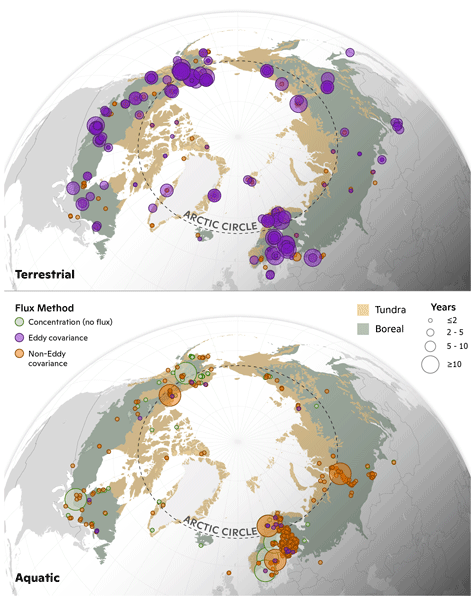
This dataset includes monthly measurements of carbon dioxide and methane exchange between land, water, and the atmosphere from over 1000 sites in Arctic and boreal regions. It combines measurements from a variety of ecosystems, including wetlands, forests, tundra, lakes, and rivers, gathered by over 260 researchers from 1984–2024. This dataset can be used to improve and reduce uncertainty in carbon budgets in order to strengthen our understanding of climate feedbacks in a warming world.
Karoliina Särkelä, Timo Vesala, Torben R. Christensen, Juval Cohen, Angelika Kübert, Xuefei Li, Hannu Marttila, Jouni Pulliainen, Eeva-Stiina Tuittila, and Efrén López-Blanco
Biogeosciences, 23, 6037–6052, https://doi.org/10.5194/bg-23-6037-2026, https://doi.org/10.5194/bg-23-6037-2026, 2026
Short summary
Short summary
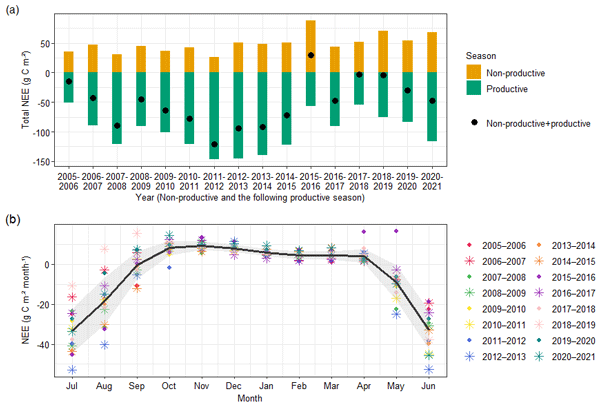
Using a 17-year record of year-round peatland carbon exchange, we found that over half of the carbon sequestrated during summer was released during winter. In one year, CO₂ emissions during snow melt and soil thaw in spring were large enough to shift the peatland from a net carbon sink to a source. These findings demonstrate that winter and early-spring processes have a strong impact over the annual carbon balance of northern peatlands.
Eyrún Gyða Gunnlaugsdóttir, Angelika Kübert, Xuefei Li, Timo Vesala, Aino Korrensalo, Elisa Männistö, Eeva-Stiina Tuittila, Pavel Alekseychik, and Ivan Mammarella
EGUsphere, https://doi.org/10.5194/egusphere-2026-3323, https://doi.org/10.5194/egusphere-2026-3323, 2026
Short summary
Short summary
We studied how two nearby peatland types exchange carbon with the atmosphere using long-term field measurements. We found that the fen absorbed more carbon dioxide but also released more methane than the bog, mainly due to differences in vegetation rather than climate. This suggests that plant communities strongly influence how peatlands affect climate and should be considered in future predictions, especially under changing environmental conditions and ecosystem shifts.
Jette Elena Stoebke, David Wårlind, Stefan Olin, Annemarie Eckes-Shephard, Bogdan Brzeziecki, Mikko Peltoniemi, and Thomas A. M. Pugh
Geosci. Model Dev., 19, 3595–3615, https://doi.org/10.5194/gmd-19-3595-2026, https://doi.org/10.5194/gmd-19-3595-2026, 2026
Short summary
Short summary
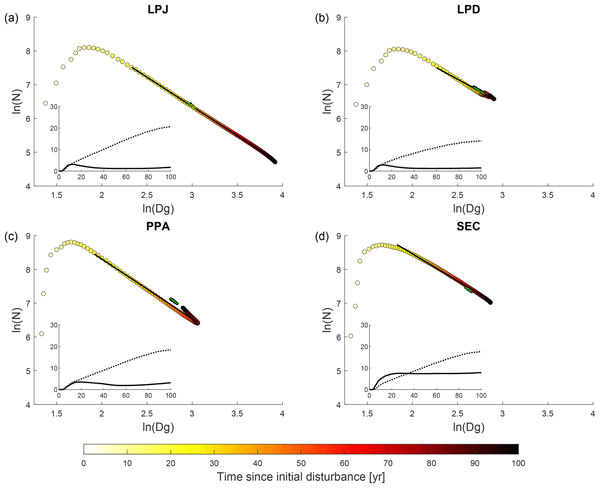
Forests are shaped by how trees compete for light. We improved a widely used vegetation model by introducing spatially explicit canopies, allowing light distribution to vary realistically, especially after disturbances like tree death or harvest. This enhances the simulation of forest structure, tree coexistence, and regeneration, providing a better model for predicting forest dynamics and responses to management and environmental change.
Hui Tang, Samuli Launianen, Julius Vira, Liisa Kulmala, Taru Palosuo, Hermanni Aaltonen, Olli Nevalainen, Istem Fer, Henriikka Vekuri, Jari-Pekka Nousu, Mika Korkiakoski, and Jari Liski
EGUsphere, https://doi.org/10.5194/egusphere-2025-5972, https://doi.org/10.5194/egusphere-2025-5972, 2025
Short summary
Short summary
We present a modelling approach to study how crops in northern climates deal with water stress. By combining several years of field measurements with the modelling approach, we show that both oat and forage grasses use water cautiously, helping them preserve enough soil water to stay productive during dry periods. Our results highlight the need to better understand how northern crops use water for improving their food production in the future, when more frequent and severe drought will occur.
Tuuli Miinalainen, Amanda Ojasalo, Holly Croft, Mika Aurela, Mikko Peltoniemi, Silvia Caldararu, Sönke Zaehle, and Tea Thum
Biogeosciences, 22, 6937–6962, https://doi.org/10.5194/bg-22-6937-2025, https://doi.org/10.5194/bg-22-6937-2025, 2025
Short summary
Short summary
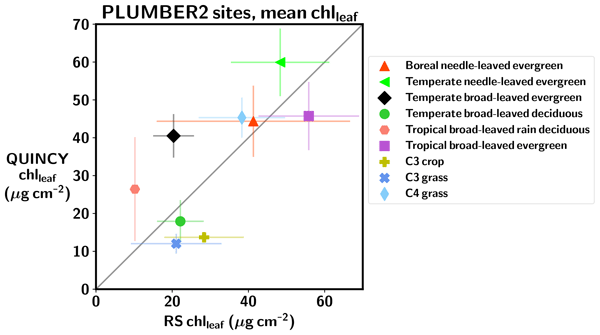
Estimating the future carbon budget requires an accurate understanding of the interlinkages between the land carbon and nitrogen cycles. We use a remote sensing leaf chlorophyll product to evaluate a terrestrial biosphere model, QUINCY (QUantifying Interactions between terrestrial Nutrient CYcles and the climate system). Our study showcases how the latest advancements in remote sensing-based vegetation monitoring can be harnessed for improving and evaluating process-based vegetation models.
Jordi Vilà-Guerau de Arellano, Roderick Dewar, Kim A. P. Faassen, Teemu Hölttä, Remco de Kok, Ingrid T. Luijkx, and Timo Vesala
Biogeosciences, 22, 6327–6341, https://doi.org/10.5194/bg-22-6327-2025, https://doi.org/10.5194/bg-22-6327-2025, 2025
Short summary
Short summary
This study explores how oxygen moves through tiny pores in leaves, especially when water vapor is also flowing out. We show that under common conditions, oxygen can move from the leaf to the air even when its concentration is higher outside – a surprising effect. Our findings help explain oxygen exchange in still air and support better models of plant–atmosphere interactions.
Borja García-Pascual, Carlos Martín-Cortés, Xin Zhou, Evgeny Lopatin, Mauricio Acuna, and Kalle Kärhä
ISPRS Ann. Photogramm. Remote Sens. Spatial Inf. Sci., X-2-W2-2025, 49–56, https://doi.org/10.5194/isprs-annals-X-2-W2-2025-49-2025, https://doi.org/10.5194/isprs-annals-X-2-W2-2025-49-2025, 2025
Evgeny Lopatin, Kari Väätäinen, Harri Kaartinen, Heikki Hyyti, Lauri Sikanen, Yrjö Nuutinen, and Mauricio Acuna
ISPRS Ann. Photogramm. Remote Sens. Spatial Inf. Sci., X-2-W2-2025, 117–123, https://doi.org/10.5194/isprs-annals-X-2-W2-2025-117-2025, https://doi.org/10.5194/isprs-annals-X-2-W2-2025-117-2025, 2025
Jere Kaivosoja, Samuli Launiainen, and Heli Peltola
ISPRS Ann. Photogramm. Remote Sens. Spatial Inf. Sci., X-2-W2-2025, 89–94, https://doi.org/10.5194/isprs-annals-X-2-W2-2025-89-2025, https://doi.org/10.5194/isprs-annals-X-2-W2-2025-89-2025, 2025
Paul Szejner, Eduardo Martínez-García, Helena Haakana, Juha Heikkinen, Katja T. Rinne-Garmston, Petri Kilpeläinen, Giles Young, Elina Sahlstedt, Raisa Mäkipää, and Aleksi Lehtonen
EGUsphere, https://doi.org/10.5194/egusphere-2025-4994, https://doi.org/10.5194/egusphere-2025-4994, 2025
Short summary
Short summary
This study examines tree growth of Norway spruce (Picea abies) and Scots Pine (Pinus sylvestris) in southern Finland (1990–2022) using tree-ring stable carbon isotopes to track intrinsic water-use efficiency (iWUE) and climate responses. Growth declined with rising atmospheric dryness. Norway spruce showed weaker iWUE adjustment and greater growth sensitivity than Scots pine, indicating higher vulnerability to water limitation.
Boris Ťupek, Aleksi Lehtonen, Stefano Manzoni, Elisa Bruni, Petr Baldrian, Etienne Richy, Bartosz Adamczyk, Bertrand Guenet, and Raisa Mäkipää
Biogeosciences, 22, 5497–5510, https://doi.org/10.5194/bg-22-5497-2025, https://doi.org/10.5194/bg-22-5497-2025, 2025
Short summary
Short summary
We explored soil microbial respiration (Rh) kinetics of low-dose and long-term N fertilization in N-limited boreal forest in connection with CH4 and N2O fluxes and soil and tree C sinks. The insights show that N fertilization affects C retention in boreal forest soils by modifying Rh sensitivities to soil temperature and moisture. The key findings reveal that N-enriched soils exhibited reduced sensitivity of Rh to moisture, which contributed to enhanced soil C sequestration on an annual level.
José Ángel Callejas-Rodelas, Alexander Knohl, Ivan Mammarella, Timo Vesala, Olli Peltola, and Christian Markwitz
Biogeosciences, 22, 4507–4529, https://doi.org/10.5194/bg-22-4507-2025, https://doi.org/10.5194/bg-22-4507-2025, 2025
Short summary
Short summary
The spatial variability of CO2 and water vapour exchanges with the atmosphere was quantified above an agroforestry system and further compared to a monocropping system using a total of four eddy covariance stations. The variability of fluxes within the agroforestry site was found to be as large as the variability between agroforestry and monocropping site, induced by the heterogeneity of the site, which highlights the need for replicated measurements above such ecosystems.
Anam M. Khan, Olivia E. Clifton, Jesse O. Bash, Sam Bland, Nathan Booth, Philip Cheung, Lisa Emberson, Johannes Flemming, Erick Fredj, Stefano Galmarini, Laurens Ganzeveld, Orestis Gazetas, Ignacio Goded, Christian Hogrefe, Christopher D. Holmes, László Horváth, Vincent Huijnen, Qian Li, Paul A. Makar, Ivan Mammarella, Giovanni Manca, J. William Munger, Juan L. Pérez-Camanyo, Jonathan Pleim, Limei Ran, Roberto San Jose, Donna Schwede, Sam J. Silva, Ralf Staebler, Shihan Sun, Amos P. K. Tai, Eran Tas, Timo Vesala, Tamás Weidinger, Zhiyong Wu, Leiming Zhang, and Paul C. Stoy
Atmos. Chem. Phys., 25, 8613–8635, https://doi.org/10.5194/acp-25-8613-2025, https://doi.org/10.5194/acp-25-8613-2025, 2025
Short summary
Short summary
Vegetation removes tropospheric ozone through stomatal uptake, and accurately modeling the stomatal uptake of ozone is important for modeling dry deposition and air quality. We evaluated the stomatal component of ozone dry deposition modeled by atmospheric chemistry models at six sites. We find that models and observation-based estimates agree at times during the growing season at all sites, but some models overestimated the stomatal component during the dry summers at a seasonally dry site.
Nathalie Ylenia Triches, Jan Engel, Abdullah Bolek, Timo Vesala, Maija E. Marushchak, Anna-Maria Virkkala, Martin Heimann, and Mathias Göckede
Atmos. Meas. Tech., 18, 3407–3424, https://doi.org/10.5194/amt-18-3407-2025, https://doi.org/10.5194/amt-18-3407-2025, 2025
Short summary
Short summary
This study explores nitrous oxide (N2O) fluxes from a nutrient-poor sub-Arctic peatland. N2O is a potent greenhouse gas; understanding its fluxes is essential for addressing global warming. Using a new instrument and flux chambers, we introduce a system to reliably detect low N2O fluxes and provide recommendations on chamber closure times and flux calculation methods to better quantify N2O fluxes. We encourage researchers to further investigate N2O fluxes in low-nutrient environments.
Piaopiao Ke, Anna Lintunen, Pasi Kolari, Annalea Lohila, Santeri Tuovinen, Janne Lampilahti, Roseline Thakur, Maija Peltola, Otso Peräkylä, Tuomo Nieminen, Ekaterina Ezhova, Mari Pihlatie, Asta Laasonen, Markku Koskinen, Helena Rautakoski, Laura Heimsch, Tom Kokkonen, Aki Vähä, Ivan Mammarella, Steffen Noe, Jaana Bäck, Veli-Matti Kerminen, and Markku Kulmala
Biogeosciences, 22, 3235–3251, https://doi.org/10.5194/bg-22-3235-2025, https://doi.org/10.5194/bg-22-3235-2025, 2025
Short summary
Short summary
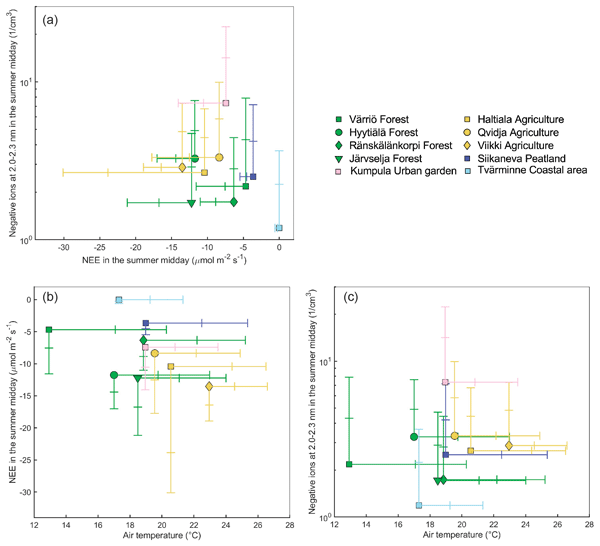
Our research explores diverse ecosystems’ roles in climate cooling via the concept of CarbonSink+ potential. We measured CO2 uptake and local aerosol production in forests, farms, peatlands, urban gardens, and coastal areas across Finland and Estonia. The long-term data reveal that, while forests are vital with regard to CarbonSink+ potential, farms and urban gardens also play significant roles. These insights can help optimize management policy of natural resources to mitigate global warming.
Aki Vähä, Timo Vesala, Sofya Guseva, Anders Lindroth, Andreas Lorke, Sally MacIntyre, and Ivan Mammarella
Biogeosciences, 22, 1651–1671, https://doi.org/10.5194/bg-22-1651-2025, https://doi.org/10.5194/bg-22-1651-2025, 2025
Short summary
Short summary
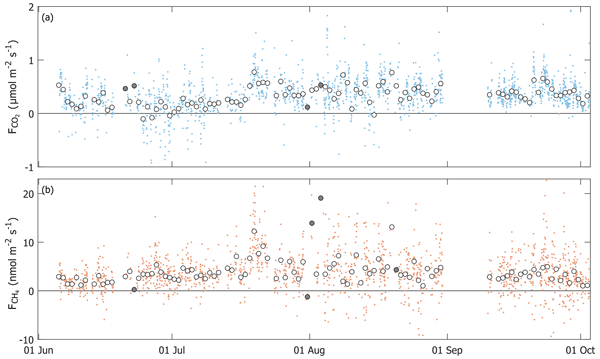
Boreal rivers are significant sources of carbon dioxide (CO2) and methane (CH4) for the atmosphere, but the controls of these emissions are uncertain. We measured 4 months of CO2 and CH4 exchanges between a regulated boreal river and the atmosphere with eddy covariance. We found statistical relationships between the gas exchange and several environmental variables, the most important of which were dissolved CO2 partial pressure in water, wind speed and water temperature.
Olli-Pekka Tikkasalo, Olli Peltola, Pavel Alekseychik, Juha Heikkinen, Samuli Launiainen, Aleksi Lehtonen, Qian Li, Eduardo Martínez-García, Mikko Peltoniemi, Petri Salovaara, Ville Tuominen, and Raisa Mäkipää
Biogeosciences, 22, 1277–1300, https://doi.org/10.5194/bg-22-1277-2025, https://doi.org/10.5194/bg-22-1277-2025, 2025
Short summary
Short summary
The emissions of greenhouse gases (GHGs) carbon dioxide (CO2), methane (CH4) and nitrous oxide (N2O) were measured from a clear-cut peatland forest site. The measurements covered the whole year of 2022, which was the second growing season after the clear-cut. The site was a strong GHG source, and the highest emissions came from CO2, followed by N2O and CH4. A statistical model that included information on different surfaces at the site was developed to unravel surface-type-specific GHG fluxes.
Vilna Tyystjärvi, Tiina Markkanen, Leif Backman, Maarit Raivonen, Antti Leppänen, Xuefei Li, Paavo Ojanen, Kari Minkkinen, Roosa Hautala, Mikko Peltoniemi, Jani Anttila, Raija Laiho, Annalea Lohila, Raisa Mäkipää, and Tuula Aalto
Biogeosciences, 21, 5745–5771, https://doi.org/10.5194/bg-21-5745-2024, https://doi.org/10.5194/bg-21-5745-2024, 2024
Short summary
Short summary
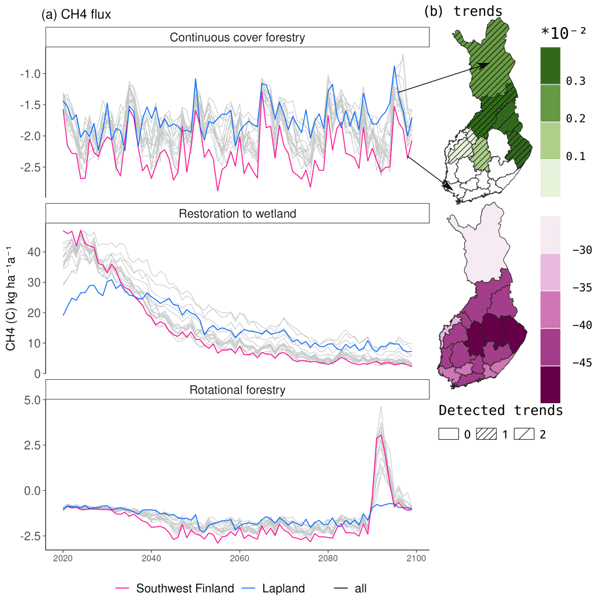
Drainage of boreal peatlands strongly influences soil methane fluxes, with important implications for climatic impacts. Here we simulate methane fluxes in forestry-drained and restored peatlands during the 21st century. We found that restoration turned peatlands into a source of methane, but the magnitude varied regionally. In forests, changes in the water table level influenced methane fluxes, and in general, the sink was weaker under rotational forestry compared to continuous cover forestry.
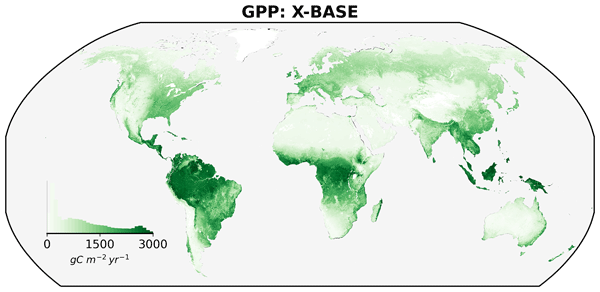
Jacob A. Nelson, Sophia Walther, Fabian Gans, Basil Kraft, Ulrich Weber, Kimberly Novick, Nina Buchmann, Mirco Migliavacca, Georg Wohlfahrt, Ladislav Šigut, Andreas Ibrom, Dario Papale, Mathias Göckede, Gregory Duveiller, Alexander Knohl, Lukas Hörtnagl, Russell L. Scott, Jiří Dušek, Weijie Zhang, Zayd Mahmoud Hamdi, Markus Reichstein, Sergio Aranda-Barranco, Jonas Ardö, Maarten Op de Beeck, Dave Billesbach, David Bowling, Rosvel Bracho, Christian Brümmer, Gustau Camps-Valls, Shiping Chen, Jamie Rose Cleverly, Ankur Desai, Gang Dong, Tarek S. El-Madany, Eugenie Susanne Euskirchen, Iris Feigenwinter, Marta Galvagno, Giacomo A. Gerosa, Bert Gielen, Ignacio Goded, Sarah Goslee, Christopher Michael Gough, Bernard Heinesch, Kazuhito Ichii, Marcin Antoni Jackowicz-Korczynski, Anne Klosterhalfen, Sara Knox, Hideki Kobayashi, Kukka-Maaria Kohonen, Mika Korkiakoski, Ivan Mammarella, Mana Gharun, Riccardo Marzuoli, Roser Matamala, Stefan Metzger, Leonardo Montagnani, Giacomo Nicolini, Thomas O'Halloran, Jean-Marc Ourcival, Matthias Peichl, Elise Pendall, Borja Ruiz Reverter, Marilyn Roland, Simone Sabbatini, Torsten Sachs, Marius Schmidt, Christopher R. Schwalm, Ankit Shekhar, Richard Silberstein, Maria Lucia Silveira, Donatella Spano, Torbern Tagesson, Gianluca Tramontana, Carlo Trotta, Fabio Turco, Timo Vesala, Caroline Vincke, Domenico Vitale, Enrique R. Vivoni, Yi Wang, William Woodgate, Enrico A. Yepez, Junhui Zhang, Donatella Zona, and Martin Jung
Biogeosciences, 21, 5079–5115, https://doi.org/10.5194/bg-21-5079-2024, https://doi.org/10.5194/bg-21-5079-2024, 2024
Short summary
Short summary
The movement of water, carbon, and energy from the Earth's surface to the atmosphere, or flux, is an important process to understand because it impacts our lives. Here, we outline a method called FLUXCOM-X to estimate global water and CO2 fluxes based on direct measurements from sites around the world. We go on to demonstrate how these new estimates of net CO2 uptake/loss, gross CO2 uptake, total water evaporation, and transpiration from plants compare to previous and independent estimates.

Jari-Pekka Nousu, Kersti Leppä, Hannu Marttila, Pertti Ala-aho, Giulia Mazzotti, Terhikki Manninen, Mika Korkiakoski, Mika Aurela, Annalea Lohila, and Samuli Launiainen
Hydrol. Earth Syst. Sci., 28, 4643–4666, https://doi.org/10.5194/hess-28-4643-2024, https://doi.org/10.5194/hess-28-4643-2024, 2024
Short summary
Short summary
We used hydrological models, field measurements, and satellite-based data to study the soil moisture dynamics in a subarctic catchment. The role of groundwater was studied with different ways to model the groundwater dynamics and via comparisons to the observational data. The choice of groundwater model was shown to have a strong impact, and representation of lateral flow was important to capture wet soil conditions. Our results provide insights for ecohydrological studies in boreal regions.
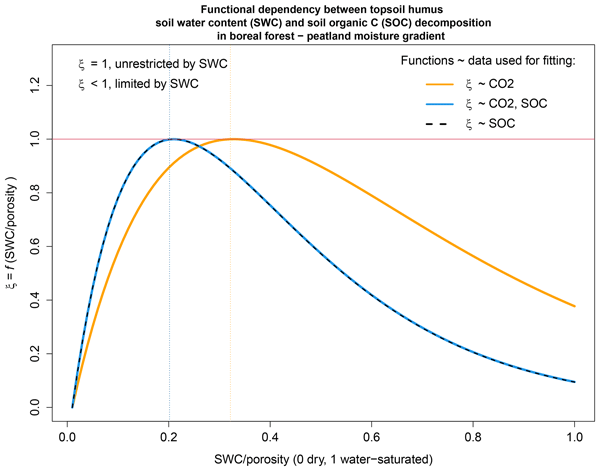
Boris Ťupek, Aleksi Lehtonen, Alla Yurova, Rose Abramoff, Bertrand Guenet, Elisa Bruni, Samuli Launiainen, Mikko Peltoniemi, Shoji Hashimoto, Xianglin Tian, Juha Heikkinen, Kari Minkkinen, and Raisa Mäkipää
Geosci. Model Dev., 17, 5349–5367, https://doi.org/10.5194/gmd-17-5349-2024, https://doi.org/10.5194/gmd-17-5349-2024, 2024
Short summary
Short summary
Updating the Yasso07 soil C model's dependency on decomposition with a hump-shaped Ricker moisture function improved modelled soil organic C (SOC) stocks in a catena of mineral and organic soils in boreal forest. The Ricker function, set to peak at a rate of 1 and calibrated against SOC and CO2 data using a Bayesian approach, showed a maximum in well-drained soils. Using SOC and CO2 data together with the moisture only from the topsoil humus was crucial for accurate model estimates.
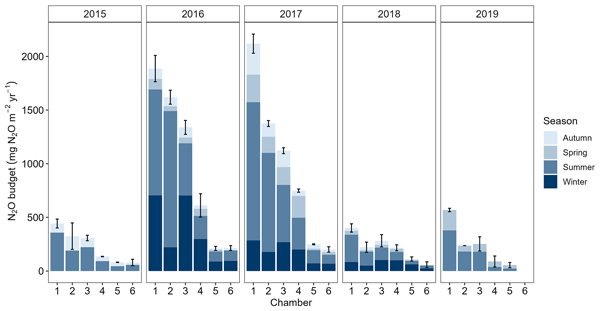
Helena Rautakoski, Mika Korkiakoski, Jarmo Mäkelä, Markku Koskinen, Kari Minkkinen, Mika Aurela, Paavo Ojanen, and Annalea Lohila
Biogeosciences, 21, 1867–1886, https://doi.org/10.5194/bg-21-1867-2024, https://doi.org/10.5194/bg-21-1867-2024, 2024
Short summary
Short summary
Current and future nitrous oxide (N2O) emissions are difficult to estimate due to their high variability in space and time. Several years of N2O fluxes from drained boreal peatland forest indicate high importance of summer precipitation, winter temperature, and snow conditions in controlling annual N2O emissions. The results indicate increasing year-to-year variation in N2O emissions in changing climate with more extreme seasonal weather conditions.
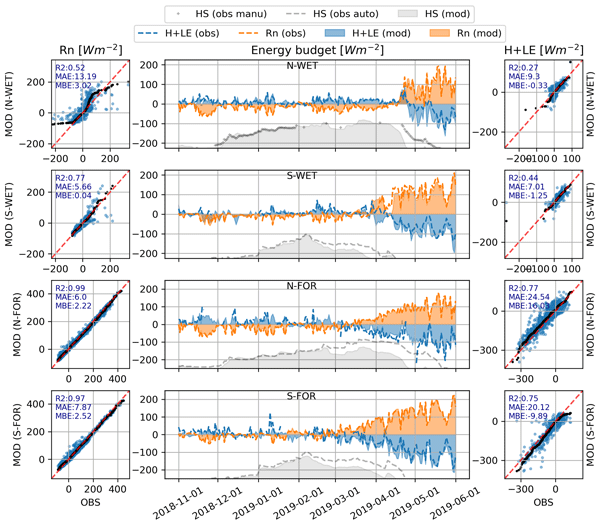
Jari-Pekka Nousu, Matthieu Lafaysse, Giulia Mazzotti, Pertti Ala-aho, Hannu Marttila, Bertrand Cluzet, Mika Aurela, Annalea Lohila, Pasi Kolari, Aaron Boone, Mathieu Fructus, and Samuli Launiainen
The Cryosphere, 18, 231–263, https://doi.org/10.5194/tc-18-231-2024, https://doi.org/10.5194/tc-18-231-2024, 2024
Short summary
Short summary
The snowpack has a major impact on the land surface energy budget. Accurate simulation of the snowpack energy budget is difficult, and studies that evaluate models against energy budget observations are rare. We compared predictions from well-known models with observations of energy budgets, snow depths and soil temperatures in Finland. Our study identified contrasting strengths and limitations for the models. These results can be used for choosing the right models depending on the use cases.
Paolo Cristofanelli, Cosimo Fratticioli, Lynn Hazan, Mali Chariot, Cedric Couret, Orestis Gazetas, Dagmar Kubistin, Antti Laitinen, Ari Leskinen, Tuomas Laurila, Matthias Lindauer, Giovanni Manca, Michel Ramonet, Pamela Trisolino, and Martin Steinbacher
Atmos. Meas. Tech., 16, 5977–5994, https://doi.org/10.5194/amt-16-5977-2023, https://doi.org/10.5194/amt-16-5977-2023, 2023
Short summary
Short summary
We investigated the application of two automatic methods for detecting spikes due to local emissions in greenhouse gas (GHG) observations at a subset of sites from the ICOS Atmosphere network. We analysed the sensitivity to the spike frequency of using different methods and settings. We documented the impact of the de-spiking on different temporal aggregations (i.e. hourly, monthly and seasonal averages) of CO2, CH4 and CO 1 min time series.
Markku Kulmala, Anna Lintunen, Hanna Lappalainen, Annele Virtanen, Chao Yan, Ekaterina Ezhova, Tuomo Nieminen, Ilona Riipinen, Risto Makkonen, Johanna Tamminen, Anu-Maija Sundström, Antti Arola, Armin Hansel, Kari Lehtinen, Timo Vesala, Tuukka Petäjä, Jaana Bäck, Tom Kokkonen, and Veli-Matti Kerminen
Atmos. Chem. Phys., 23, 14949–14971, https://doi.org/10.5194/acp-23-14949-2023, https://doi.org/10.5194/acp-23-14949-2023, 2023
Short summary
Short summary
To be able to meet global grand challenges, we need comprehensive open data with proper metadata. In this opinion paper, we describe the SMEAR (Station for Measuring Earth surface – Atmosphere Relations) concept and include several examples (cases), such as new particle formation and growth, feedback loops and the effect of COVID-19, and what has been learned from these investigations. The future needs and the potential of comprehensive observations of the environment are summarized.
Matthew J. McGrath, Ana Maria Roxana Petrescu, Philippe Peylin, Robbie M. Andrew, Bradley Matthews, Frank Dentener, Juraj Balkovič, Vladislav Bastrikov, Meike Becker, Gregoire Broquet, Philippe Ciais, Audrey Fortems-Cheiney, Raphael Ganzenmüller, Giacomo Grassi, Ian Harris, Matthew Jones, Jürgen Knauer, Matthias Kuhnert, Guillaume Monteil, Saqr Munassar, Paul I. Palmer, Glen P. Peters, Chunjing Qiu, Mart-Jan Schelhaas, Oksana Tarasova, Matteo Vizzarri, Karina Winkler, Gianpaolo Balsamo, Antoine Berchet, Peter Briggs, Patrick Brockmann, Frédéric Chevallier, Giulia Conchedda, Monica Crippa, Stijn N. C. Dellaert, Hugo A. C. Denier van der Gon, Sara Filipek, Pierre Friedlingstein, Richard Fuchs, Michael Gauss, Christoph Gerbig, Diego Guizzardi, Dirk Günther, Richard A. Houghton, Greet Janssens-Maenhout, Ronny Lauerwald, Bas Lerink, Ingrid T. Luijkx, Géraud Moulas, Marilena Muntean, Gert-Jan Nabuurs, Aurélie Paquirissamy, Lucia Perugini, Wouter Peters, Roberto Pilli, Julia Pongratz, Pierre Regnier, Marko Scholze, Yusuf Serengil, Pete Smith, Efisio Solazzo, Rona L. Thompson, Francesco N. Tubiello, Timo Vesala, and Sophia Walther
Earth Syst. Sci. Data, 15, 4295–4370, https://doi.org/10.5194/essd-15-4295-2023, https://doi.org/10.5194/essd-15-4295-2023, 2023
Short summary
Short summary
Accurate estimation of fluxes of carbon dioxide from the land surface is essential for understanding future impacts of greenhouse gas emissions on the climate system. A wide variety of methods currently exist to estimate these sources and sinks. We are continuing work to develop annual comparisons of these diverse methods in order to clarify what they all actually calculate and to resolve apparent disagreement, in addition to highlighting opportunities for increased understanding.
Olivia E. Clifton, Donna Schwede, Christian Hogrefe, Jesse O. Bash, Sam Bland, Philip Cheung, Mhairi Coyle, Lisa Emberson, Johannes Flemming, Erick Fredj, Stefano Galmarini, Laurens Ganzeveld, Orestis Gazetas, Ignacio Goded, Christopher D. Holmes, László Horváth, Vincent Huijnen, Qian Li, Paul A. Makar, Ivan Mammarella, Giovanni Manca, J. William Munger, Juan L. Pérez-Camanyo, Jonathan Pleim, Limei Ran, Roberto San Jose, Sam J. Silva, Ralf Staebler, Shihan Sun, Amos P. K. Tai, Eran Tas, Timo Vesala, Tamás Weidinger, Zhiyong Wu, and Leiming Zhang
Atmos. Chem. Phys., 23, 9911–9961, https://doi.org/10.5194/acp-23-9911-2023, https://doi.org/10.5194/acp-23-9911-2023, 2023
Short summary
Short summary
A primary sink of air pollutants is dry deposition. Dry deposition estimates differ across the models used to simulate atmospheric chemistry. Here, we introduce an effort to examine dry deposition schemes from atmospheric chemistry models. We provide our approach’s rationale, document the schemes, and describe datasets used to drive and evaluate the schemes. We also launch the analysis of results by evaluating against observations and identifying the processes leading to model–model differences.
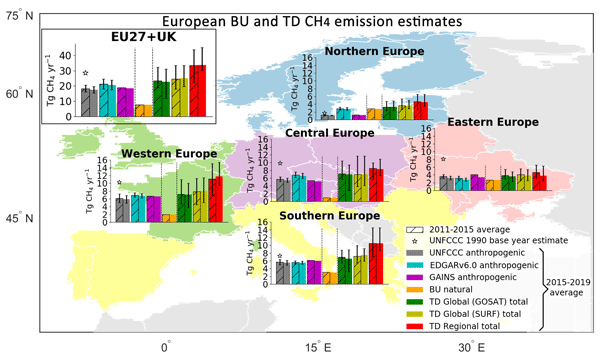
Ana Maria Roxana Petrescu, Chunjing Qiu, Matthew J. McGrath, Philippe Peylin, Glen P. Peters, Philippe Ciais, Rona L. Thompson, Aki Tsuruta, Dominik Brunner, Matthias Kuhnert, Bradley Matthews, Paul I. Palmer, Oksana Tarasova, Pierre Regnier, Ronny Lauerwald, David Bastviken, Lena Höglund-Isaksson, Wilfried Winiwarter, Giuseppe Etiope, Tuula Aalto, Gianpaolo Balsamo, Vladislav Bastrikov, Antoine Berchet, Patrick Brockmann, Giancarlo Ciotoli, Giulia Conchedda, Monica Crippa, Frank Dentener, Christine D. Groot Zwaaftink, Diego Guizzardi, Dirk Günther, Jean-Matthieu Haussaire, Sander Houweling, Greet Janssens-Maenhout, Massaer Kouyate, Adrian Leip, Antti Leppänen, Emanuele Lugato, Manon Maisonnier, Alistair J. Manning, Tiina Markkanen, Joe McNorton, Marilena Muntean, Gabriel D. Oreggioni, Prabir K. Patra, Lucia Perugini, Isabelle Pison, Maarit T. Raivonen, Marielle Saunois, Arjo J. Segers, Pete Smith, Efisio Solazzo, Hanqin Tian, Francesco N. Tubiello, Timo Vesala, Guido R. van der Werf, Chris Wilson, and Sönke Zaehle
Earth Syst. Sci. Data, 15, 1197–1268, https://doi.org/10.5194/essd-15-1197-2023, https://doi.org/10.5194/essd-15-1197-2023, 2023
Short summary
Short summary
This study updates the state-of-the-art scientific overview of CH4 and N2O emissions in the EU27 and UK in Petrescu et al. (2021a). Yearly updates are needed to improve the different respective approaches and to inform on the development of formal verification systems. It integrates the most recent emission inventories, process-based model and regional/global inversions, comparing them with UNFCCC national GHG inventories, in support to policy to facilitate real-time verification procedures.
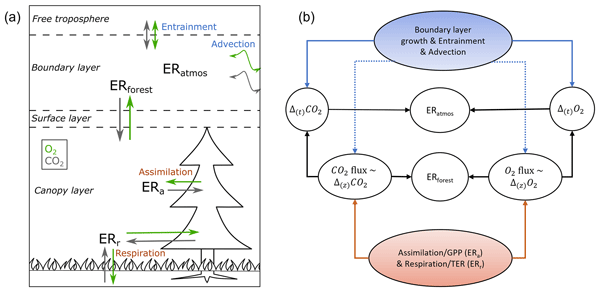
Kim A. P. Faassen, Linh N. T. Nguyen, Eadin R. Broekema, Bert A. M. Kers, Ivan Mammarella, Timo Vesala, Penelope A. Pickers, Andrew C. Manning, Jordi Vilà-Guerau de Arellano, Harro A. J. Meijer, Wouter Peters, and Ingrid T. Luijkx
Atmos. Chem. Phys., 23, 851–876, https://doi.org/10.5194/acp-23-851-2023, https://doi.org/10.5194/acp-23-851-2023, 2023
Short summary
Short summary
The exchange ratio (ER) between atmospheric O2 and CO2 provides a useful tracer for separately estimating photosynthesis and respiration processes in the forest carbon balance. This is highly relevant to better understand the expected biosphere sink, which determines future atmospheric CO2 levels. We therefore measured O2, CO2, and their ER above a boreal forest in Finland and investigated their diurnal behaviour for a representative day, and we show the most suitable way to determine the ER.
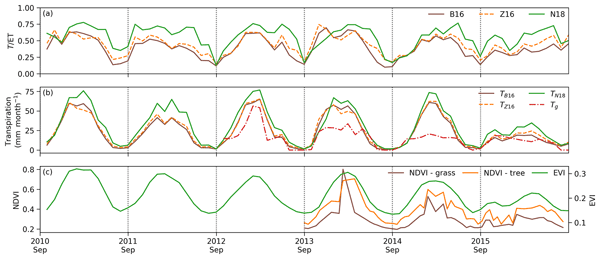
Matti Räsänen, Mika Aurela, Ville Vakkari, Johan P. Beukes, Juha-Pekka Tuovinen, Pieter G. Van Zyl, Miroslav Josipovic, Stefan J. Siebert, Tuomas Laurila, Markku Kulmala, Lauri Laakso, Janne Rinne, Ram Oren, and Gabriel Katul
Hydrol. Earth Syst. Sci., 26, 5773–5791, https://doi.org/10.5194/hess-26-5773-2022, https://doi.org/10.5194/hess-26-5773-2022, 2022
Short summary
Short summary
The productivity of semiarid grazed grasslands is linked to the variation in rainfall and transpiration. By combining carbon dioxide and water flux measurements, we show that the annual transpiration is nearly constant during wet years while grasses react quickly to dry spells and drought, which reduce transpiration. The planning of annual grazing strategies could consider the early-season rainfall frequency that was linked to the portion of annual transpiration.
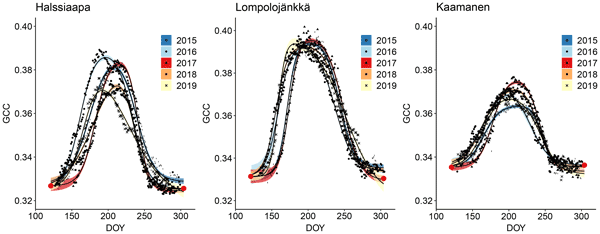
Maiju Linkosalmi, Juha-Pekka Tuovinen, Olli Nevalainen, Mikko Peltoniemi, Cemal M. Taniş, Ali N. Arslan, Juuso Rainne, Annalea Lohila, Tuomas Laurila, and Mika Aurela
Biogeosciences, 19, 4747–4765, https://doi.org/10.5194/bg-19-4747-2022, https://doi.org/10.5194/bg-19-4747-2022, 2022
Short summary
Short summary
Vegetation greenness was monitored with digital cameras in three northern peatlands during five growing seasons. The greenness index derived from the images was highest at the most nutrient-rich site. Greenness indicated the main phases of phenology and correlated with CO2 uptake, though this was mainly related to the common seasonal cycle. The cameras and Sentinel-2 satellite showed consistent results, but more frequent satellite data are needed for reliable detection of phenological phases.

Kukka-Maaria Kohonen, Roderick Dewar, Gianluca Tramontana, Aleksanteri Mauranen, Pasi Kolari, Linda M. J. Kooijmans, Dario Papale, Timo Vesala, and Ivan Mammarella
Biogeosciences, 19, 4067–4088, https://doi.org/10.5194/bg-19-4067-2022, https://doi.org/10.5194/bg-19-4067-2022, 2022
Short summary
Short summary
Four different methods for quantifying photosynthesis (GPP) at ecosystem scale were tested, of which two are based on carbon dioxide (CO2) and two on carbonyl sulfide (COS) flux measurements. CO2-based methods are traditional partitioning, and a new method uses machine learning. We introduce a novel method for calculating GPP from COS fluxes, with potentially better applicability than the former methods. Both COS-based methods gave on average higher GPP estimates than the CO2-based estimates.

Sari Juutinen, Mika Aurela, Juha-Pekka Tuovinen, Viktor Ivakhov, Maiju Linkosalmi, Aleksi Räsänen, Tarmo Virtanen, Juha Mikola, Johanna Nyman, Emmi Vähä, Marina Loskutova, Alexander Makshtas, and Tuomas Laurila
Biogeosciences, 19, 3151–3167, https://doi.org/10.5194/bg-19-3151-2022, https://doi.org/10.5194/bg-19-3151-2022, 2022
Short summary
Short summary
We measured CO2 and CH4 fluxes in heterogenous Arctic tundra in eastern Siberia. We found that tundra wetlands with sedge and grass vegetation contributed disproportionately to the landscape's ecosystem CO2 uptake and CH4 emissions to the atmosphere. Moreover, we observed high CH4 consumption in dry tundra, particularly in barren areas, offsetting part of the CH4 emissions from the wetlands.
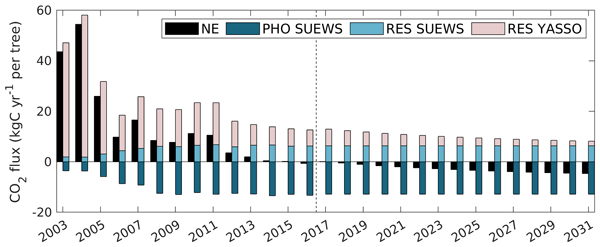
Minttu Havu, Liisa Kulmala, Pasi Kolari, Timo Vesala, Anu Riikonen, and Leena Järvi
Biogeosciences, 19, 2121–2143, https://doi.org/10.5194/bg-19-2121-2022, https://doi.org/10.5194/bg-19-2121-2022, 2022
Short summary
Short summary
The carbon sequestration potential of two street tree species and the soil beneath them was quantified with the urban land surface model SUEWS and the soil carbon model Yasso. The street tree plantings turned into a modest sink of carbon from the atmosphere after 14 years. Overall, the results indicate the importance of soil in urban carbon sequestration estimations, as soil respiration exceeded the carbon uptake in the early phase, due to the high initial carbon loss from the soil.
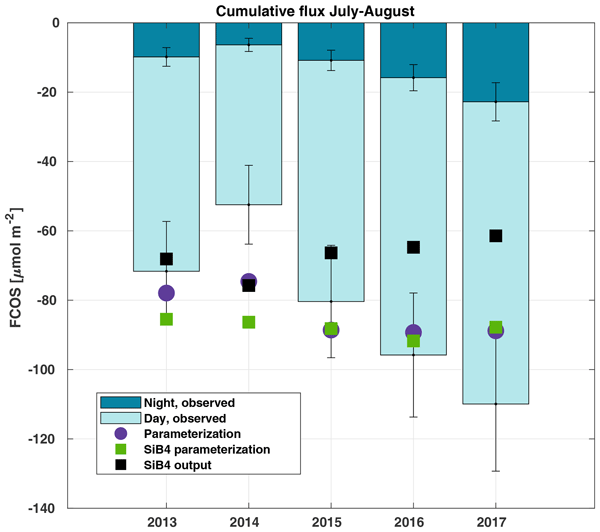
Timo Vesala, Kukka-Maaria Kohonen, Linda M. J. Kooijmans, Arnaud P. Praplan, Lenka Foltýnová, Pasi Kolari, Markku Kulmala, Jaana Bäck, David Nelson, Dan Yakir, Mark Zahniser, and Ivan Mammarella
Atmos. Chem. Phys., 22, 2569–2584, https://doi.org/10.5194/acp-22-2569-2022, https://doi.org/10.5194/acp-22-2569-2022, 2022
Short summary
Short summary
Carbonyl sulfide (COS) provides new insights into carbon cycle research. We present an easy-to-use flux parameterization and the longest existing time series of forest–atmosphere COS exchange measurements, which allow us to study both seasonal and interannual variability. We observed only uptake of COS by the forest on an annual basis, with 37 % variability between years. Upscaling the boreal COS uptake using a biosphere model indicates a significant missing COS sink at high latitudes.
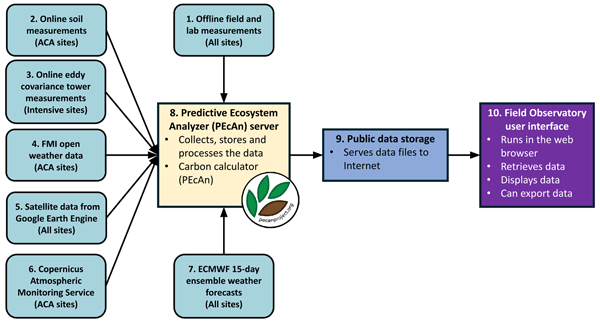
Olli Nevalainen, Olli Niemitalo, Istem Fer, Antti Juntunen, Tuomas Mattila, Olli Koskela, Joni Kukkamäki, Layla Höckerstedt, Laura Mäkelä, Pieta Jarva, Laura Heimsch, Henriikka Vekuri, Liisa Kulmala, Åsa Stam, Otto Kuusela, Stephanie Gerin, Toni Viskari, Julius Vira, Jari Hyväluoma, Juha-Pekka Tuovinen, Annalea Lohila, Tuomas Laurila, Jussi Heinonsalo, Tuula Aalto, Iivari Kunttu, and Jari Liski
Geosci. Instrum. Method. Data Syst., 11, 93–109, https://doi.org/10.5194/gi-11-93-2022, https://doi.org/10.5194/gi-11-93-2022, 2022
Short summary
Short summary
Better monitoring of soil carbon sequestration is needed to understand the best carbon farming practices in different soils and climate conditions. We, the Field Observatory Network (FiON), have therefore established a methodology for monitoring and forecasting agricultural carbon sequestration by combining offline and near-real-time field measurements, weather data, satellite imagery, and modeling. To disseminate our work, we built a website called the Field Observatory (fieldobservatory.org).
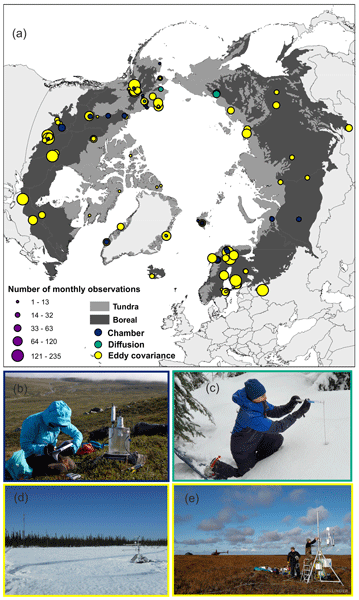
Anna-Maria Virkkala, Susan M. Natali, Brendan M. Rogers, Jennifer D. Watts, Kathleen Savage, Sara June Connon, Marguerite Mauritz, Edward A. G. Schuur, Darcy Peter, Christina Minions, Julia Nojeim, Roisin Commane, Craig A. Emmerton, Mathias Goeckede, Manuel Helbig, David Holl, Hiroki Iwata, Hideki Kobayashi, Pasi Kolari, Efrén López-Blanco, Maija E. Marushchak, Mikhail Mastepanov, Lutz Merbold, Frans-Jan W. Parmentier, Matthias Peichl, Torsten Sachs, Oliver Sonnentag, Masahito Ueyama, Carolina Voigt, Mika Aurela, Julia Boike, Gerardo Celis, Namyi Chae, Torben R. Christensen, M. Syndonia Bret-Harte, Sigrid Dengel, Han Dolman, Colin W. Edgar, Bo Elberling, Eugenie Euskirchen, Achim Grelle, Juha Hatakka, Elyn Humphreys, Järvi Järveoja, Ayumi Kotani, Lars Kutzbach, Tuomas Laurila, Annalea Lohila, Ivan Mammarella, Yojiro Matsuura, Gesa Meyer, Mats B. Nilsson, Steven F. Oberbauer, Sang-Jong Park, Roman Petrov, Anatoly S. Prokushkin, Christopher Schulze, Vincent L. St. Louis, Eeva-Stiina Tuittila, Juha-Pekka Tuovinen, William Quinton, Andrej Varlagin, Donatella Zona, and Viacheslav I. Zyryanov
Earth Syst. Sci. Data, 14, 179–208, https://doi.org/10.5194/essd-14-179-2022, https://doi.org/10.5194/essd-14-179-2022, 2022
Short summary
Short summary
The effects of climate warming on carbon cycling across the Arctic–boreal zone (ABZ) remain poorly understood due to the relatively limited distribution of ABZ flux sites. Fortunately, this flux network is constantly increasing, but new measurements are published in various platforms, making it challenging to understand the ABZ carbon cycle as a whole. Here, we compiled a new database of Arctic–boreal CO2 fluxes to help facilitate large-scale assessments of the ABZ carbon cycle.
Linda M. J. Kooijmans, Ara Cho, Jin Ma, Aleya Kaushik, Katherine D. Haynes, Ian Baker, Ingrid T. Luijkx, Mathijs Groenink, Wouter Peters, John B. Miller, Joseph A. Berry, Jerome Ogée, Laura K. Meredith, Wu Sun, Kukka-Maaria Kohonen, Timo Vesala, Ivan Mammarella, Huilin Chen, Felix M. Spielmann, Georg Wohlfahrt, Max Berkelhammer, Mary E. Whelan, Kadmiel Maseyk, Ulli Seibt, Roisin Commane, Richard Wehr, and Maarten Krol
Biogeosciences, 18, 6547–6565, https://doi.org/10.5194/bg-18-6547-2021, https://doi.org/10.5194/bg-18-6547-2021, 2021
Short summary
Short summary
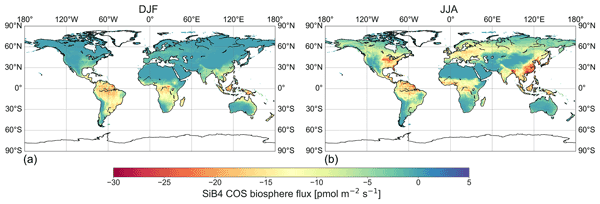
The gas carbonyl sulfide (COS) can be used to estimate photosynthesis. To adopt this approach on regional and global scales, we need biosphere models that can simulate COS exchange. So far, such models have not been evaluated against observations. We evaluate the COS biosphere exchange of the SiB4 model against COS flux observations. We find that the model is capable of simulating key processes in COS biosphere exchange. Still, we give recommendations for further improvement of the model.

Jari Walden, Liisa Pirjola, Tuomas Laurila, Juha Hatakka, Heidi Pettersson, Tuomas Walden, Jukka-Pekka Jalkanen, Harri Nordlund, Toivo Truuts, Miika Meretoja, and Kimmo K. Kahma
Atmos. Chem. Phys., 21, 18175–18194, https://doi.org/10.5194/acp-21-18175-2021, https://doi.org/10.5194/acp-21-18175-2021, 2021
Short summary
Short summary
Ship emissions play an important role in the deposition of gaseous compounds and nanoparticles (Ntot), affecting climate, human health (especially in coastal areas), and eutrophication. Micrometeorological methods showed that ship emissions were mainly responsible for the deposition of Ntot, whereas they only accounted for a minor proportion of CO2 deposition. An uncertainty analysis applied to the fluxes and fuel sulfur content results demonstrated the reliability of the results.
Cited articles
Adams, J.: climate_indices, an open-source Python library providing reference implementations of commonly used climate indices, https://github.com/monocongo/climate_indices (last access: 24 August 2026), 2017.
Aldea, J., Bianchi, S., Nilsson, U., Hynynen, J., Lee, D., Holmström, E., and Huuskonen, S.: Evaluation of growth models for mixed forests used in Swedish and Finnish decision support systems, For. Ecol. Manag., 529, 120721, https://doi.org/10.1016/j.foreco.2022.120721, 2023.
Alderfasi, A. A. and Nielsen, D. C.: Use of crop water stress index for monitoring water status and scheduling irrigation in wheat, Agric. Water Manag., 47, 69–75, 2001.
Alekseychik, P., Korrensalo, A., Mammarella, I., Launiainen, S., Tuittila, E.-S., Korpela, I., and Vesala, T.: Carbon balance of a Finnish bog: temporal variability and limiting factors based on 6 years of eddy-covariance data, Biogeosciences, 18, 4681–4704, https://doi.org/10.5194/bg-18-4681-2021, 2021.
Arend, M., Link, R. M., Patthey, R., Hoch, G., Schuldt, B., and Kahmen, A.: Rapid hydraulic collapse as cause of drought-induced mortality in conifers, Proc. Natl. Acad. Sci. USA, 118, e2025251118, https://doi.org/10.1073/pnas.2025251118, 2021.
Aslan, T., Launiainen, S., Kolari, P., Peltola, O., Aalto, J., Bäck, J., Vesala, T., and Mammarella, I.: Thinning turned boreal forest to a temporary carbon source – short-term effects of partial harvest on carbon dioxide and water vapor fluxes, Agric. For. Meteorol., 353, 110061, https://doi.org/10.1016/j.agrformet.2024.110061, 2024.
Aubinet, M., Vesala, T., and Papale, D. (Eds): Eddy covariance: a practical guide to measurement and data analysis, Springer, https://doi.org/10.1007/978-94-007-2351-1, 2012.
Balting, D. F., AghaKouchak, A., Lohmann, G., and Ionita, M.: Northern Hemisphere drought risk in a warming climate, npj Clim. Atmos. Sci., 4, 61, https://doi.org/10.1038/s41612-021-00218-2, 2021.
Barbedo, J. G. A.: A review on the use of unmanned aerial vehicles and imaging sensors for monitoring and assessing plant stresses, Drones, 3, 40, https://doi.org/10.3390/drones3020040, 2019.
Beniston, M. and Stephenson, D. B.: Extreme climatic events and their evolution under changing climatic conditions, Global Planet. Change, 44, 1–9, https://doi.org/10.1016/j.gloplacha.2004.06.001, 2004.
Bennett, A. C., Penman, T. D., Arndt, S. K., Roxburgh, S. H., and Bennett, L. T.: Climate more important than soils for predicting forest biomass at the continental scale, Ecography, 43, 1692–1705, 2020.
Berni, J. A. J., Zarco-Tejada, P. J., Suárez, L., González-Dugo, V., and Fereres, E.: Remote sensing of vegetation from UAV platforms using lightweight multispectral and thermal imaging sensors, Int. Arch. Photogramm. Remote Sens. Spatial Inf. Sci., 38, 6 pp., 2009.
Bouriaud, O. and Popa, I.: Comparative dendroclimatic study of Scots pine, Norway spruce, and silver fir in the Vrancea Range, Eastern Carpathian Mountains, Trees, 23, 95–106, 2009.
Bréda, N., Huc, R., Granier, A., and Dreyer, E.: Temperate forest trees and stands under severe drought: a review of ecophysiological responses, adaptation processes and long-term consequences, Ann. For. Sci., 63, 625–644, 2006.
Brunner, A., Valkonen, S., Goude, M., Hanssen, K. H., and Erefur, C.: Chapter 2: Definitions and terminology: What is continuous cover forestry in Fennoscandia?, in: Continuous Cover Forestry in Boreal Nordic Countries, edited by: Rautio, P., Routa, J., Huuskonen, S., Holmström, E., Cedergren, J., and Kuehne, C., Springer, Cham, 11–43, https://doi.org/10.1007/978-3-031-70484-0_2, 2024.
Čermák, J., Kučera, J., and Nadezhdina, N.: Sap flow measurements with some thermodynamic methods, flow integration within trees and scaling up from sample trees to entire forest stands, Trees, 18, 529–546, 2004.
Čermák, J., Kučera, J., Bauerle, W. L., Phillips, N., and Hinckley, T. M.: Tree water storage and its diurnal dynamics related to sap flow and changes in stem volume in old-growth Douglas-fir trees, Tree Physiol., 27, 181–198, https://doi.org/10.1093/treephys/27.2.181, 2007.
Čermák, P., Kolář, T., Žid, T., Trnka, M., and Rybníček, M.: Norway spruce responses to drought forcing in areas affected by forest decline, For. Syst., 28, e016, https://doi.org/10.5424/fs/2019283-14868, 2019.
Clausnitzer, F., Köstner, B., Schwärzel, K., and Bernhofer, C.: Relationships between canopy transpiration, atmospheric conditions and soil water availability – Analyses of long-term sap-flow measurements in an old Norway spruce forest at the Ore Mountains/Germany, Agric. For. Meteorol., 151, 1023–1034, 2011.
Danneyrolles, V., Boucher, Y., Fournier, R., and Valeria, O.: Positive effects of projected climate change on post-disturbance forest regrowth rates in northeastern North American boreal forests, Environ. Res. Lett., 18, 024041, https://doi.org/10.1088/1748-9326/acb72a, 2023.
Del Río, M., Pretzsch, H., Ruíz-Peinado, R., Ampoorter, E., Annighöfer, P., Barbeito, I., Bielak, K., Brazaitis, G., Coll, L., Drössler, L., and Fabrika, M.: Species interactions increase the temporal stability of community productivity in Pinus sylvestris–Fagus sylvatica mixtures across Europe, J. Ecol., 105, 1032–1043, 2017.
Ditmarová, Ľ., Kurjak, D., Palmroth, S., Kmeť, J., and Střelcová, K.: Physiological responses of Norway spruce (Picea abies) seedlings to drought stress, Tree Physiol., 30, 205–213, 2010.
D'Orangeville, L., Maxwell, J., Kneeshaw, D., Pederson, N., Duchesne, L., Logan, T., Houle, D., Arseneault, D., Beier, C. M., Bishop, D. A., Druckenbrod, D., Fraver, S., Girard, F., Halman, J., Hansen, C., Hart, J. L., Hartmann, H., Kaye, M., Leblanc, D., Manzoni, S., Ouimet, R., Rayback, S., Rollinson, C. R., and Phillips, R. P.: Drought timing and local climate determine the sensitivity of eastern temperate forests to drought, Glob. Change Biol., 24, 2339–2351, https://doi.org/10.1111/gcb.14096, 2018.
Dreyer, I., Antunes, S., Hoshi, T., Müller-Röber, B., Palme, K., Pongs, O., Reintanz, B., and Hedrich, R.: Plant K+ channel alpha-subunits assemble indiscriminately, Biophys. J., 72, 2143–2150, 1997.
Ecke, S., Dempewolf, J., Frey, J., Schwaller, A., Endres, E., Klemmt, H. J., Tiede, D., and Seifert, T.: UAV-based forest health monitoring: A systematic review, Remote Sens., 14, 3205, https://doi.org/10.3390/rs14133205, 2022.
Elkin, C., Giuggiola, A., Rigling, A., and Bugmann, H.: Short- and long-term efficacy of forest thinning to mitigate drought impacts in mountain forests in the European Alps, Ecol. Appl., 25, 1083–1098, 2015.
Erdem, Y., Arin, L., Erdem, T., Polat, S., Deveci, M., Okursoy, H., and Gültaş, H. T.: Crop water stress index for assessing irrigation scheduling of drip irrigated broccoli (Brassica oleracea L. var. italica), Agric. Water Manag., 98, 148–156, 2010.
Escós, J., Alados, C. L., Pugnaire, F. I., Puigdefábregas, J., and Emlen, J.: Stress resistance strategy in an arid land shrub: interactions between developmental instability and fractal dimension, J. Arid Environ., 45, 325–336, 2000.
Felsche, E., Böhnisch, A., Poschlod, B., and Ludwig, R.: European hot and dry summers are projected to become more frequent and expand northwards, Commun. Earth Environ., 5, 410, https://doi.org/10.1038/s43247-024-01575-5, 2024.
Friedrichs, D. A., Trouet, V., Büntgen, U., Frank, D. C., Esper, J., Neuwirth, B., and Löffler, J.: Species-specific climate sensitivity of tree growth in Central-West Germany, Trees, 23, 729–739, 2009.
Galiano, L., Timofeeva, G., Saurer, M., Siegwolf, R., Martínez-Vilalta, J., Hommel, R., and Gessler, A.: The fate of recently fixed carbon after drought release: towards unravelling C storage regulation in Tilia platyphyllos and Pinus sylvestris, Plant Cell Environ., 40, 1711–1724, 2017.
Gartner, K., Nadezhdina, N., Englisch, M., Čermak, J., and Leitgeb, E.: Sap flow of birch and Norway spruce during the European heat and drought in summer 2003, For. Ecol. Manag., 258, 590–599, 2009.
Gebhardt, T., Häberle, K.-H., Matyssek, R., Schulz, C., and Ammer, C.: The more, the better? Water relations of Norway spruce stands after progressive thinning, Agric. For. Meteorol., 197, 235–243, 2014.
Gessler, A., Bottero, A., Marshall, J., and Arend, M.: The way back: recovery of trees from drought and its implication for acclimation, New Phytol., 228, 1704–1709,https://doi.org/10.1111/nph.16703, 2020.
Giuggiola, A., Bugmann, H., Zingg, A., Dobbertin, M., and Rigling, A.: Reduction of stand density increases drought resistance in xeric Scots pine forests, For. Ecol. Manag., 310, 827–835, 2013.
Gómez-Candón, D., Virlet, N., Labbé, S., Jolivot, A., and Regnard, J.-L.: Field phenotyping of water stress at tree scale by UAV-sensed imagery: new insights for thermal acquisition and calibration, Precis. Agric., 17, 786–800, 2016.
Gonzalez-Dugo, V., Zarco-Tejada, P., Berni, J. A., Suarez, L., Goldhamer, D., and Fereres, E.: Almond tree canopy temperature reveals intra-crown variability that is water stress-dependent, Agric. For. Meteorol., 154, 156–165, 2012.
Granier, A., Reichstein, M., Bréda, N., Janssens, I. A., Falge, E., Ciais, P., Grünwald, T., Aubinet, M., Berbigier, P., Bernhofer, C., and Buchmann, N.: Evidence for soil water control on carbon and water dynamics in European forests during the extremely dry year: 2003, Agr. Forest Meteorol., 143, 123–145, https://doi.org/10.1016/j.agrformet.2006.12.004, 2007.
Guilioni, L., Jones, H. G., Leinonen, I., and Lhomme, J.-P.: On the relationships between stomatal resistance and leaf temperatures in thermography, Agric. For. Meteorol., 148, 1908–1912, 2008.
Hammond, W.M., Williams, A. P., Abatzoglou, J. T., Adams, H. D., Klein, T., López, R., Sáenz-Romero, C., Hartmann, H., Breshears, D. D., and Allen, C. D.: Global field observations of tree die-off reveal hotter-drought fingerprint for Earth's forests, Nat. Commun., 13, 1761, https://doi.org/10.1038/s41467-022-29289-2, 2022.
Härkönen, S., Lehtonen, A., Manninen, T., Tuominen, S., and Peltoniemi, M.: Estimating forest leaf area index using satellite images: comparison of k-NN based Landsat-NFI LAI with MODIS-RSR based LAI product for Finland, Boreal Environ. Res., 20, 181–195, 2015.
Hartmann, H., Ziegler, W., Kolle, O., and Trumbore, S.: Thirst beats hunger – declining hydration during drought prevents carbon starvation in Norway spruce saplings, New Phytol., 200, 340–349, 2013.
Högberg, P., Ceder, L.A., Astrup, R., Binkley, D., Dalsgaard, L., Egnell, G., Filipchuk, A., Genet, H., Ilintsev, A., Kurz, W.A., Laganière, J., Lemprière, T., Lundblad, M., Lundmark, T., Mäkipää, R., Malysheva, N., Mohr, C.W., Nordin, A., Petersson, H., Repo, A., Schepaschenko, D., Shvidenko, A., Soegaard, G., and Kraxner, F.: Sustainable boreal forest management challenges and opportunities for climate change mitigation, Report 2021/11, https://pure.iiasa.ac.at/17778 (last access: 14 September 2026), 2021.
Hyyppä, E., Yu, X., Kaartinen, H., Hakala, T., Kukko, A., Vastaranta, M., and Hyyppä, J.: Comparison of backpack, handheld, under-canopy UAV, and above-canopy UAV laser scanning for field reference data collection in boreal forests, Remote Sens., 12, 3327, https://doi.org/10.3390/rs12203327, 2020.
Jackson, R. D., Idso, S. B., Reginato, R. J., and Pinter Jr., P. J.: Canopy temperature as a crop water stress indicator, Water Resour. Res., 17, 1133–1138, 1981.
Jactel, H., Petit, J., Desprez-Loustau, M.-L., Delzon, S., Piou, D., Battisti, A., and Koricheva, J.: Drought effects on damage by forest insects and pathogens: a meta-analysis, Glob. Change Biol., 18, 267–276, 2011.
Jia, X., Zha, T. S., Gong, J. N., Wu, B., Zhang, Y. Q., Qin, S. G., Chen, G. P., Feng, W., Kellomäki, S., and Peltola, H.: Energy partitioning over a semi-arid shrubland in northern China, Hydrol. Process., 30, 972–985, 2016.
Jones, H. G.: Plants and Microclimate, 2nd edn., Cambridge University Press, Cambridge, ISBN: 978-0-521-42524-7, 1992.
Jönsson, A. M., Eklundh, L., Hellström, M., Bärring, L., and Jönsson, P.: Annual changes in MODIS vegetation indices of Swedish coniferous forests in relation to snow dynamics and tree phenology, Remote Sens. Environ., 114, 2719–2730, 2010.
Junttila, S., Vastaranta, M., Hämäläinen, J., Latva-Käyrä, P., Holopainen, M., Hernández Clemente, R., Hyyppä, H., and Navarro-Cerrillo, R. M.: Effect of forest structure and health on the relative surface temperature captured by airborne thermal imagery – case study in Norway spruce-dominated stands in southern Finland, Scand. J. For. Res., 32, 154–165, 2017.
Kansanen, K., Packalen, P., Lähivaara, T., Seppänen, A., Vauhkonen, J., Maltamo, M., and Mehtätalo, L.: Refining and evaluating a Horvitz–Thompson-like stand density estimator in individual tree detection based on airborne laser scanning, Can. J. For. Res., 52, 527–538, 2022.
Karkauskaite, P., Tagesson, T., and Fensholt, R.: Evaluation of the plant phenology index (PPI), NDVI and EVI for start-of-season trend analysis of the Northern Hemisphere boreal zone, Remote Sens., 9, 485, 2017.
Kimmins, J. P.: Forest Ecology, Macmillan Publishing Company, New York, ISBN 10 0023640502, 1987.
Kljun, N., Calanca, P., Rotach, M. W., and Schmid, H. P.: A simple two-dimensional parameterisation for Flux Footprint Prediction (FFP), Geosci. Model Dev., 8, 3695–3713, https://doi.org/10.5194/gmd-8-3695-2015, 2015.
Kohler, M., Sohn, J., Nägele, G., and Bauhus, J.: Can drought tolerance of Norway spruce (Picea abies (L.) Karst.) be increased through thinning?, Eur. J. For. Res., 129, 1109–1118, 2010.
Kolb, T. E., Fettig, C. J., Ayres, M. P., Bentz, B. J., Hicke, J. A., Mathiasen, R., Stewart, J. E., and Weed, A. S.: Observed and anticipated impacts of drought on forest insects and diseases in the United States, For. Ecol. Manag., 380, 321–334, 2016.
Köstner, B. M. M., Schulze, E. D., Kelliher, F. M., Hollinger, D. Y., Byers, J. N., Hunt, J. E., McSeveny, T. M., Meserth, R., and Weir, P.L.: Transpiration and canopy conductance in a pristine broad-leaved forest of Nothofagus: an analysis of xylem sap flow and eddy correlation measurements, Oecologia, 91, 350–359. 1992.
Kopačková-Strnadová, V., Koucká, L., Jelének, J., Lhotáková, Z., and Oulehle, F.: Canopy top, height and photosynthetic pigment estimation using parrot sequoia multispectral imagery and the unmanned aerial vehicle (UAV), Remote Sens., 13, 705, https://doi.org/10.3390/rs13040705, 2021.
Kowalska, N., Šigut, L., Stojanović, M., Fischer, M., Kyselova, I., and Pavelka, M.: Analysis of floodplain forest sensitivity to drought, Philos. Trans. R. Soc. B, 375, 20190518, https://doi.org/10.1098/rstb.2019.0518, 2020.
Krasnova, A., Krasnov, D., Cordey, H. P. E., and Noe, S. M.: Eddy-covariance carbon fluxes of a heterogeneous forest: one tower – two heights, EGUsphere [preprint], https://doi.org/10.5194/egusphere-2022-384, 2022.
Krause, S. and Sanders, T.G.M. Mapping tree water deficit with UAV thermal imaging and meteorological data. Remote Sens Earth Syst Sci 6(3-4):275-296, https://doi.org/10.1007/s41976-023-00094-9, 2023.
Kuželka, K., Slavík, M., and Surový, P.: Very high density point clouds from UAV laser scanning for automatic tree stem detection and direct diameter measurement, Remote Sens., 12, 1236, https://doi.org/10.3390/rs12081236, 2020.
Lasslop, G., Reichstein, M., Papale, D., Richardson, A. D., Arneth, A., Barr, A., Stoy, P., and Wohlfahrt, G.: Separation of net ecosystem exchange into assimilation and respiration using a light response curve approach: critical issues and global evaluation, Glob. Change Biol., 16, 187–208, 2010.
Launiainen, S.: Seasonal and inter-annual variability of energy exchange above a boreal Scots pine forest, Biogeosciences, 7, 3921–3940, https://doi.org/10.5194/bg-7-3921-2010, 2010.
Launiainen, S., Guan, M., Salmivaara, A., and Kieloaho, A.-J.: Modeling boreal forest evapotranspiration and water balance at stand and catchment scales: a spatial approach, Hydrol. Earth Syst. Sci., 23, 3457–3480, https://doi.org/10.5194/hess-23-3457-2019, 2019.
Launiainen, S., Katul, G. G., Leppä, K., Kolari, P., Aslan, T., Grönholm, T., Korhonen, L., Mammarella, I., and Vesala, T.: Does growing atmospheric CO2 explain increasing carbon sink in a boreal coniferous forest?, Glob. Change Biol., 28, 2910–2929, 2022.
Laurent, M., Antoine, N., and Joël, G.: Effects of different thinning intensities on drought response in Norway spruce (Picea abies (L.) Karst.), For. Ecol. Manag., 183, 47–60, 2003.
Laurila, T., Aurela, M., Hatakka, J., Hotanen, J.-P., Jauhiainen, J., Korkiakoski, M., Korpela, L., Koskinen, M., Laiho, R., Lehtonen, A., Leppä, K., Linkosalmi, M., Lohila, A., Minkkinen, K., Mäkelä, T., Mäkiranta, P., Nieminen, M., Ojanen, P., Peltoniemi, M., Penttilä, T., Rainne, J., Rautakoski, H., Saarinen, M., Salovaara, P., Sarkkola, S., and Mäkipää, R.: Set-up and instrumentation of the greenhouse gas measurements on experimental sites of continuous cover forestry, Natural Resources and Bioeconomy Studies, 26/2021, Natural Resources Institute Finland, Helsinki, 51 pp., ISBN: 978-952-380-191-2, 2021.
Lehtonen, A., Eyvindson, K., Härkönen, K., Leppä, K., Salmivaara, A., Peltoniemi, M., Salminen, O., Sarkkola, S., Launiainen, S., Ojanen, P., Räty, M., and Mäkipää, R.: Potential of continuous cover forestry on drained peatlands to increase the carbon sink in Finland, Sci. Rep., 13, 15510, https://doi.org/10.1038/s41598-023-42315-7, 2023.
Leinonen, I., Grant, O. M., Tagliavia, C. P. P., Chaves, M. M., and Jones, H. G.: Estimating stomatal conductance with thermal imagery, Plant Cell Environ., 29, 1508–1518, 2006.
Leppä, K., Korkiakoski, M., Nieminen, M., Laiho, R., Hotanen, J.-P., Kieloaho, A. J., Korpela, L., Laurila, T., Lohila, A., Minkkinen, K., and Mäkipää, R.: Vegetation controls of water and energy balance of a drained peatland forest: responses to alternative harvesting practices, Agric. For. Meteorol., 295, 108198, https://doi.org/10.1016/j.agrformet.2020.108198, 2020.
Lévesque, M., Rigling, A., Bugmann, H., Weber, P., and Brang, P.: Growth response of five co-occurring conifers to drought across a wide climatic gradient in Central Europe, Agric. For. Meteorol., 197, 1–12, 2014.
Lindroth, A., Holst, J., Linderson, M. L., Aurela, M., Biermann, T., Heliasz, M., Chi, J., Ibrom, A., Kolari, P., Klemedtsson, L., and Krasnova, A.: Effects of drought and meteorological forcing on carbon and water fluxes in Nordic forests during the dry summer of 2018, Philos. Trans. R. Soc. B, 375, 20190516, https://doi.org/10.1098/rstb.2019.0516, 2020.
Liu, C., Peltoniemi, M., Alekseychik, P., Mäkelä, A., and Hölttä, T.: A coupled model of hydraulic ecophysiology and cambial growth – accounting for biophysical limitations and phenology improves stem diameter prediction at high temporal resolution, Plant Cell Environ., 48, 1344–1365, 2025.
Ludovisi, R., Tauro, F., Salvati, R., Khoury, S., Mugnozza Scarascia, G., and Harfouche, A.: UAV-based thermal imaging for high-throughput field phenotyping of black poplar response to drought, Front. Plant Sci., 8, 1681, https://doi.org/10.3389/fpls.2017.01681, 2017.
Maes, W. H., Huete, A. R., Avino, M., Boer, M. M., Dehaan, R., Pendall, E., Griebel, A., and Steppe, K.: Can UAV-based infrared thermography be used to study plant-parasite interactions between mistletoe and eucalypt trees?, Remote Sens., 10, 2062, https://doi.org/10.3390/rs10122062, 2018.
Mamkin, V., Varlagin, A., Yaseneva, I., and Kurbatova, J.: Response of spruce forest ecosystem CO2 fluxes to inter-annual climate anomalies in the Southern Taiga, Forests, 13, 1019, https://doi.org/10.3390/f13071019, 2022.
Manase, A., Manyevere, A., Abd Elbasit, M. A., and Mashamaite, C.: The use of UAV-based systems in monitoring forest health: potentials and challenges, Sci. Afr., 28, e02724, https://doi.org/10.1016/j.sciaf.2025.e02724, 2025.
Manrique-Alba, À., Beguería, S., Molina, A. J., González-Sanchis, M., Tomàs-Burguera, M., Del Campo, A. D., Colangelo, M., and Camarero, J. J.: Long-term thinning effects on tree growth, drought response and water use efficiency at two Aleppo pine plantations in Spain, Sci. Total Environ., 728, 138536, 2020.
Martín-Benito, D., Del Río, M., Heinrich, I., Helle, G., and Cañellas, I.: Response of climate-growth relationships and water use efficiency to thinning in a Pinus nigra afforestation, For. Ecol. Manag., 259, 967–975, 2010.
Martínez-García, E., Nilsson, M. B., Laudon, H., Lundmark, T., Fransson, J. E., Wallerman, J., and Peichl, M.: Drought response of the boreal forest carbon sink is driven by understorey–tree composition, Nat. Geosci., 17, 197–204, 2024.
Martínez-García, E., Rautakoski, H., Rissanen, A. J., Adamczyk, B., Anttila, J., Lehtonen, A., Li, Q., Lohila, A., Peltoniemi, M., Sarkkola, S., and Ťupek, B.: Short-term effects of harvesting alternatives on soil nitrous oxide fluxes in a boreal drained peatland forest, Geoderma, 465, 117648, https://doi.org/10.1016/j.geoderma.2025.117648, 2026.
Matkala, L., Kulmala, L., Kolari, P., Aurela, M., and Bäck, J.: Resilience of subarctic Scots pine and Norway spruce forests to extreme weather events, Agric. For. Meteorol., 296, 108239, 2021.
McGloin, R., Šigut, L., Fischer, M., Foltýnová, L., Chawla, S., Trnka, M., Pavelka, M., and Marek, M. V.: Available energy partitioning during drought at two Norway spruce forests and a European beech forest in Central Europe, J. Geophys. Res.-Atmos., 124, 3726–3742, 2019.
McKee, T. B., Doesken, N. J., and Kleist, J.: The relationship of drought frequency and duration to time scales, in: Proceedings of the 8th Conference on Applied Climatology, 17, 179–183, 1993.
Menberu, M. W., Marttila, H., Ronkanen, A.-K., Haghighi, A. T., and Kløve, B.: Hydraulic and physical properties of managed and intact peatlands: application of the van Genuchten–Mualem models to peat soils, Water Resour. Res., 57, e2020WR028624, https://doi.org/10.1029/2020WR028624, 2021.
Mirabel, A., Girardin, M. P., Metsaranta, J., Way, D., and Reich, P. B.: Increasing atmospheric dryness reduces boreal forest tree growth, Nat. Commun., 14, 6901, https://doi.org/10.1038/s41467-023-42466-1, 2023.
Misson, L., Nicault, A., and Guiot, J.: Effects of different thinning intensities on drought response in Norway spruce (Picea abies (L.) Karst.), For. Ecol. Manag., 183, 47–60, 2003.
Monteith, J.: Evaporation and environment, Symp. Soc. Exp. Biol., 19, 205–234, PMID: 5321565, 1965.
Oogathoo, S., Houle, D., Duchesne, L., and Kneeshaw, D.: Vapour pressure deficit and solar radiation are the major drivers of transpiration of balsam fir and black spruce tree species in humid boreal regions, even during a short-term drought, Agric. For. Meteorol., 291, 108063, https://doi.org/10.1016/j.agrformet.2020.108063, 2020.
Oren, R. J. S. S., Sperry, J. S., Katul, G. G., Pataki, D. E., Ewers, B. E., Phillips, N., and Schäfer, K. V. R.: Survey and synthesis of intra‐and interspecific variation in stomatal sensitivity to vapour pressure deficit, Planet Cell Environ., 22, 1515–1526, 1999.
Ovenden, T. S., Perks, M. P., Clarke, T. K., Mencuccini, M., and Jump, A. S.: Life after recovery: increased resolution of forest resilience assessment sheds new light on post-drought compensatory growth and recovery dynamics, J. Ecol., 109, 3157–3170, 2021.
Owen, P. R. and Thomson, W. R.: Heat transfer across rough surfaces, J. Fluid Mech., 15, 321–334, 1963.
Paulo, A. A., Rosa, R. D., and Pereira, L. S.: Climate trends and behaviour of drought indices based on precipitation and evapotranspiration in Portugal, Nat. Hazards Earth Syst. Sci., 12, 1481–1491, 2012.
Peltoniemi, M.: Dendrometer and sapflow measurements of Norway spruce trees in a peatland harvesting experiment in Ränskälänkorpi, Zenodo [data set], https://doi.org/10.5281/zenodo.10043607, 2023.
Peltoniemi, M.: Temperature invariant tree dendrometer frame – construction and installation, Zenodo [data set], https://doi.org/10.5281/zenodo.18019069, 2025.
Popescu, S. C. and Wynne, R. H.: Seeing the trees in the forest, Photogramm. Eng. Remote Sens., 70, 589–604, 2004.
Pretzsch, H.: Stand density and growth of Norway spruce (Picea abies (L.) Karst.) and European beech (Fagus sylvatica L.): evidence from long-term experimental plots, Eur. J. For. Res., 124, 193–205, 2005.
Pretzsch, H., Schütze, G., and Biber, P.: Drought can favour the growth of small in relation to tall trees in mature stands of Norway spruce and European beech, For. Ecosyst., 5, 1–19, 2018.
Rebmann, C., Aubinet, M., Schmid, H., Arriga, N., Aurela, M., Burba, G., Clement, R., De Ligne, A., Fratini, G., Gielen, B., and Grace, J.: ICOS eddy covariance flux-station site setup: a review, Int. Agrophys., 32, 471–494, 2018.
Ruosteenoja, K. and Jylhä, K.: Projected climate change in Finland during the 21st century calculated from CMIP6 model simulations, Geophysica, 56, 39–69, 2021.
Saarinen, N., Vastaranta, M., Näsi, R., Rosnell, T., Hakala, T., Honkavaara, E., Wulder, M. A., Luoma, V., Tommaselli, A. M., Imai, N. N., and Ribeiro, E. A.: Assessing biodiversity in boreal forests with UAV-based photogrammetric point clouds and hyperspectral imaging, Remote Sens., 10, 338, 2018.
Salminen, H. and Jalkanen, R.: Modelling the effect of temperature on height increment of Scots pine at high latitudes, Silva Fennica, 39, 497–508, https://doi.org/10.14214/sf.362, 2005.
Scherrer, D., Bader, M. K. F., and Körner, C.: Drought-sensitivity ranking of deciduous tree species based on thermal imaging of forest canopies, Agric. For. Meteorol., 151, 1632–1640, 2011.
Schmied, G., Hilmers, T., Mellert, K. H., Uhl, E., Buness, V., Ambs, D., Steckel, M., Biber, P., Šeho, M., Hoffmann, Y. D., and Pretzsch, H.: Nutrient regime modulates drought response patterns of three temperate tree species, Sci. Total Environ., 868, 161601, https://doi.org/10.1016/j.scitotenv.2023.161601, 2023.
Schmied, G., Hilmers, T., Uhl, E., and Pretzsch, H.: The past matters: previous management strategies modulate current growth and drought responses of Norway spruce (Picea abies H. Karst.), Forests, 13, 243, https://doi.org/10.3390/f13020243, 2022.
Schönbeck, L. C., Schuler, P., Lehmann, M. M., Mas, E., Mekarni, L., Pivovaroff, A. L., Turberg, P., and Grossiord, C.: Increasing temperature and vapour pressure deficit lead to hydraulic damages in the absence of soil drought, Plant Cell Environ., 45, 3275–3289, 2022.
Seidel, H., Schunk, C., Matiu, M., and Menzel, A.: Diverging drought resistance of scots pine provenances revealed by infrared thermography, Frontiers in plant science, 7, 1247, https://doi.org/10.3389/fpls.2016.01247, 2016.
Silva, C. A., Hudak, A. T., Vierling, L. A., Loudermilk, E. L., O'Brien, J. J., Hiers, J. K., Jack, S. B., Gonzalez-Benecke, C., Lee, H., Falkowski, M. J., and Khosravipour, A.: Imputation of individual longleaf pine (Pinus palustris Mill.) tree attributes from field and LiDAR data, Can. J. Remote Sens., 42, 554–573, 2016.
Smigaj, M., Gaulton, R., Suarez, J. C., and Barr, S. L.: Canopy temperature from an Unmanned Aerial Vehicle as an indicator of tree stress associated with red band needle blight severity, Forest Ecol. Manag., 433, 699–708, https://doi.org/10.1016/j.foreco.2018.11.032, 2019.
Smigaj, M., Agarwal, A., Bartholomeus, H., Decuyper, M., Elsherif, A., de Jonge, A., and Kooistra, L.: Thermal infrared remote sensing of stress responses in forest environments: a review of developments, challenges, and opportunities, Curr. For. Rep., 10, 56–76, 2024.
Sohn, J. A., Saha, S., and Bauhus, J.: Potential of forest thinning to mitigate drought stress: a meta-analysis, For. Ecol. Manag., 380, 261–273, 2016.
Sohn, J. A., Gebhardt, T., Ammer, C., Bauhus, J., Häberle, K.-H., Matyssek, R., and Grams, T. E. E.: Mitigation of drought by thinning: short-term and long-term effects on growth and physiological performance of Norway spruce (Picea abies), For. Ecol. Manag., 308, 188–197, 2013.
Střelcová, K., Kurjak, D., Leštianska, A., Kovalčíková, D., Ditmarová, Ľ., Škvarenina, J., and Ahmed, Y. A. R.:. Differences in transpiration of Norway spruce drought stressed trees and trees well supplied with water, Biologia, 68, 1118–1122, 2013.
Subke, J. A. and Tenhunen, J. D.: Direct measurements of CO2 flux below a spruce forest canopy, Agric. For. Meteorol., 126, 157–168, 2004.
Tardieu, F. and Simonneau, T.: Variability among species of stomatal control under fluctuating soil water status and evaporative demand: modelling isohydric and anisohydric behaviours, J. Exp. Bot., 49, 419–432, 1998.
Thom, A. S., Stewart, J. B., Oliver, H. R., and Gash, J. H. C.: Comparison of aerodynamic and energy budget estimates of fluxes over a pine forest, Q. J. R. Meteorol. Soc., 101, 93–105, 1975.
Tmušić, G., Manfreda, S., Aasen, H., James, M. R., Gonçalves, G., Ben-Dor, E., Brook, A., Polinova, M., Arranz, J. J., Mészáros, J., and Zhuang, R.: Current practices in UAS-based environmental monitoring, Remote Sens., 12, 1001, https://doi.org/10.3390/rs12061001, 2020.
Tupek, B., Mäkipää, R., Heikkinen, J., Peltoniemi, M., Ukonmaanaho, L., Hokkanen, T., Nöjd, P., Nevalainen, S., Lindgren, M., and Lehtonen, A.: Foliar turnover rates in Finland – comparing estimates from needle-cohort and litterfall-biomass methods, https://doi.org/10.60910/avn0-9u03, 2015.
Venäläinen, A., Lehtonen, I., Laapas, M., Ruosteenoja, K., Tikkanen, O. P., Viiri, H., Ikonen, V. P., and Peltola, H.: Climate change induces multiple risks to boreal forests and forestry in Finland: a literature review, Glob. Change Biol., 26, 4178–4196, 2020.
Verma, S. B.: Aerodynamic resistances to transfers of heat, mass and momentum, Papers in Natural Resources, 1211, https://digitalcommons.unl.edu/natrespapers/1211/ (last access: 14 September 2026), 1989.
Vicca, S., Balzarolo, M., Filella, I., Granier, A., Herbst, M., Knohl, A., Longdoz, B., Mund, M., Nagy, Z., Pintér, K., and Rambal, S.: Remotely-sensed detection of effects of extreme droughts on gross primary production, Sci. Rep., 6, 28269, https://doi.org/10.1038/srep28269, 2016.
Vicente-Serrano, S. M., Beguería, S., and López-Moreno, J. I.: A multiscalar drought index sensitive to global warming: the standardized precipitation evapotranspiration index, J. Clim., 23, 1696–1718, 2010.
Vitali, V., Büntgen, U., and Bauhus, J.: Silver fir and Douglas fir are more tolerant to extreme droughts than Norway spruce in south-western Germany, Glob. Change Biol., 23, 5108–5119, 2017.
Wallin, G., Linder, S., Lindroth, A., Räntfors, M., Flemberg, S., and Grelle, A.: Carbon dioxide exchange in Norway spruce at the shoot, tree and ecosystem scale, Tree Physiol., 21, 969–976, 2001.
Wang, J., Taylor, A. R., and D'Orangeville, L.: Warming-induced tree growth may help offset increasing disturbance across the Canadian boreal forest, Proc. Natl. Acad. Sci. USA, 120, e2212780120, https://doi.org/10.1073/pnas.221278012, 2023.
Waring, R. H. and Franklin, J. F.: Evergreen coniferous forests of the Pacific Northwest: massive long-lived conifers dominating these forests are adapted to a winter-wet, summer-dry environment, Science, 204, 1380–1386, 1979.
Zang, C., Pretzsch, H., and Rothe, A.: Size-dependent responses to summer drought in Scots pine, Norway spruce and common oak, Trees, 26, 557–569, 2012.
Zang, C. S., Buras, A., Esquivel-Muelbert, A., Jump, A. S., Rigling, A., and Rammig, A.: Standardized drought indices in ecological research: why one size does not fit all, Glob. Change Biol., 26, 322–324, 2020.
Zavadilová, I., Szatniewska, J., Stojanović, M., Fleischer, P., Vágner, L., Pavelka, M., and Petrík, P.: The effect of thinning intensity on sap flow and growth of Norway spruce, J. For. Sci., 69, 205–216, 2023.
Zhang, Z., Zhao, P., Zhao, X., Zhou, J., Zhao, P., Zeng, X., Hu, Y., and Ouyang, L.:. The tree height‐related spatial variances of tree sap flux density and its scale‐up to stand transpiration in a subtropical evergreen broadleaf forest, Ecohydrology, 11, e1979, https://doi.org/10.1002/eco.1979, 2018.
Zhao, J., Lange, H., and Meissner, H.: Estimating carbon sink strength of Norway spruce forests using machine learning, Forests, 13, 1721, https://doi.org/10.3390/f13101721, 2022.
Zhong, Z., He, B., Wang, Y. P., Chen, H. W., Chen, D., Fu, Y. H., Chen, Y., Guo, L., Deng, Y., Huang, L., and Yuan, W.: Disentangling the effects of vapor pressure deficit on northern terrestrial vegetation productivity, Sci. Adv., 9, eadf3166, https://doi.org/10.1126/sciadv.adf3166, 2023.
Zlobin, I. E., Kartashov, A. V., Pashkovskiy, P. P., Ivanov, Y. V., Kreslavski, V. D., and Kuznetsov, V. V.: Comparative photosynthetic responses of Norway spruce and Scots pine seedlings to prolonged water deficiency, J. Photochem. Photobiol. B, 201, 111659, https://doi.org/10.1016/j.jphotobiol.2019.111659, 2019.
Zweifel, R., Item, H., and Häsler, R.: Link between diurnal stem radius changes and tree water relations, Tree Physiol., 21, 869–876, 2001.
Zweifel, R., Zimmermann, L., and Newbery, D. M.: Modeling tree water deficit from microclimate: an approach to quantifying drought stress, Tree Physiol., 25, 147–156, 2005.
Short summary
As the Boreal climate shifts towards warmer temperatures and more unpredictable precipitation patterns, forest management needs to become more efficient and climate-friendly. We monitored a managed Finnish spruce forest on peat soil for two summer seasons characterized with severe drought episodes. A wide range of data was used, including carbon dioxide exchange, evapotranspiration, tree growth, meteorology and maps of tree health obtained by drone imaging. Clear, but complex forest responses to drought were revealed.
As the Boreal climate shifts towards warmer temperatures and more unpredictable precipitation...


Altmetrics
Final-revised paper
Preprint