
Articles | Volume 23, issue 3
https://doi.org/10.5194/bg-23-1103-2026
© Author(s) 2026. This work is distributed under
the Creative Commons Attribution 4.0 License.
the Creative Commons Attribution 4.0 License.
https://doi.org/10.5194/bg-23-1103-2026
© Author(s) 2026. This work is distributed under
the Creative Commons Attribution 4.0 License.
the Creative Commons Attribution 4.0 License.
Research article
| 
06 Feb 2026
Research article |
| 06 Feb 2026
| 06 Feb 2026
Reconstructing changes in nitrogen input to the Danube-influenced Black Sea Shelf during the Holocene
Andreas Neumann
CORRESPONDING AUTHOR

Institute of Carbon Cycles, Helmholtz-Zentrum Hereon, Geesthacht, Germany
Justus E. E. van Beusekom
Institute of Carbon Cycles, Helmholtz-Zentrum Hereon, Geesthacht, Germany
Alexander Bratek
Institute of Carbon Cycles, Helmholtz-Zentrum Hereon, Geesthacht, Germany
Center for Earth System Research and Sustainability, Institute of Geology, Universität Hamburg, Hamburg, Germany
Jana Friedrich
Institute of Carbon Cycles, Helmholtz-Zentrum Hereon, Geesthacht, Germany
Department of Nuclear Sciences and Applications, IAEA Marine Environment Laboratories, International Atomic Energy Agency, 98000 Monaco, Principality of Monaco
Jürgen Möbius
Center for Earth System Research and Sustainability, Institute of Geology, Universität Hamburg, Hamburg, Germany
Tina Sanders
Institute of Carbon Cycles, Helmholtz-Zentrum Hereon, Geesthacht, Germany
Hendrik Wolschke
Institute of Coastal Environmental Chemistry, Helmholtz-Zentrum Hereon, Geesthacht, Germany
Kirstin Dähnke
Institute of Carbon Cycles, Helmholtz-Zentrum Hereon, Geesthacht, Germany
Related authors
Morgan Reed Raven, Nitai Amiel, Dror L. Angel, James P. Barry, Thomas M. Blattmann, Laura Boicenco, Antoine Crémière, Natalya Evans, Nora Gallarotti, Sebastian Haas, Jan-Hendrik Hehemann, Peter Krost, Pranay Lal, David Lordkipanidze, Tiia Luostarinen, Aaron M. Martinez, Allison J. Matzelle, Selma Menabit, Mihaela Muresan, Andreas Neumann, Jean-Daniel Paris, Christopher R. Pearce, Nick Reynard, Daniel L. Sanchez, Florence Schubotz, Violeta Slabakova, Adrian Stanica, Elena Stoica, Andrew K. Sweetman, Tina Treude, Yoana G. Voynova, and Nikolaos D. Zarokanellos
Biogeosciences, 23, 3755–3776, https://doi.org/10.5194/bg-23-3755-2026, https://doi.org/10.5194/bg-23-3755-2026, 2026
Short summary
Short summary
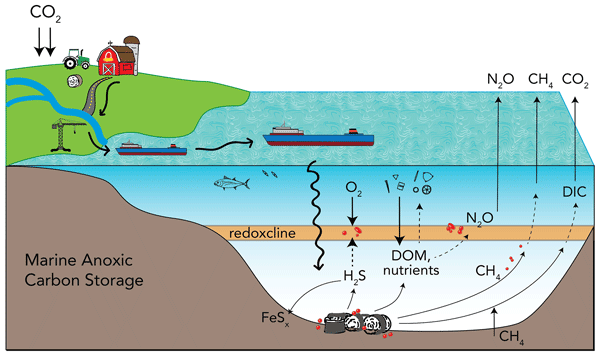
In addition to reducing emissions, vast quantities of CO2 will need to be removed from the atmosphere to meet climate goals. One strategy known as Marine Anoxic Carbon Storage (MACS) would bury plant carbon for thousands of years in parts in the ocean that lack oxygen, where carbon preservation can be highly efficient. We evaluate the environmental and other impacts of hypothetical large-scale MACS deployment from an interdisciplinary, international perspective and present a research roadmap.
Mona Norbisrath, Andreas Neumann, Kirstin Dähnke, Tina Sanders, Andreas Schöl, Justus E. E. van Beusekom, and Helmuth Thomas
Biogeosciences, 20, 4307–4321, https://doi.org/10.5194/bg-20-4307-2023, https://doi.org/10.5194/bg-20-4307-2023, 2023
Short summary
Short summary
Total alkalinity (TA) is the oceanic capacity to store CO2. Estuaries can be a TA source. Anaerobic metabolic pathways like denitrification (reduction of NO3− to N2) generate TA and are a major nitrogen (N) sink. Another important N sink is anammox that transforms NH4+ with NO2− into N2 without TA generation. By combining TA and N2 production, we identified a TA source, denitrification, occurring in the water column and suggest anammox as the dominant N2 producer in the bottom layer of the Ems.
Bryce Van Dam, Nele Lehmann, Mary A. Zeller, Andreas Neumann, Daniel Pröfrock, Marko Lipka, Helmuth Thomas, and Michael Ernst Böttcher
Biogeosciences, 19, 3775–3789, https://doi.org/10.5194/bg-19-3775-2022, https://doi.org/10.5194/bg-19-3775-2022, 2022
Short summary
Short summary
We quantified sediment–water exchange at shallow sites in the North and Baltic seas. We found that porewater irrigation rates in the former were approximately twice as high as previously estimated, likely driven by relatively high bioirrigative activity. In contrast, we found small net fluxes of alkalinity, ranging from −35 µmol m−2 h−1 (uptake) to 53 µmol m−2 h−1 (release). We attribute this to low net denitrification, carbonate mineral (re-)precipitation, and sulfide (re-)oxidation.
Adam Francis, Robyn E. Tuerena, Raja S. Ganeshram, Markus Ankele, Alex R. Baker, Kirstin Dähnke, Sarah E. Reynolds, Ulrike Baranowski, and Claire Mahaffey
EGUsphere, https://doi.org/10.5194/egusphere-2026-4372, https://doi.org/10.5194/egusphere-2026-4372, 2026
This preprint is open for discussion and under review for Biogeosciences (BG).
Short summary
Short summary
The Mediterranean Sea has very low nutrient levels yet shows an unusual nutrient balance. We measured nitrogen and phosphorus forms in water collected across the sea to help explain this. Atmospheric sources, from human nitrogen pollution and desert dust, shape the Mediterranean nutrient distribution. Inputs can be direct or can stimulate microorganisms to take up nitrogen from the atmosphere. These inputs sink with dense water and affect nutrient supply and productivity across the wider ocean.
Morgan Reed Raven, Nitai Amiel, Dror L. Angel, James P. Barry, Thomas M. Blattmann, Laura Boicenco, Antoine Crémière, Natalya Evans, Nora Gallarotti, Sebastian Haas, Jan-Hendrik Hehemann, Peter Krost, Pranay Lal, David Lordkipanidze, Tiia Luostarinen, Aaron M. Martinez, Allison J. Matzelle, Selma Menabit, Mihaela Muresan, Andreas Neumann, Jean-Daniel Paris, Christopher R. Pearce, Nick Reynard, Daniel L. Sanchez, Florence Schubotz, Violeta Slabakova, Adrian Stanica, Elena Stoica, Andrew K. Sweetman, Tina Treude, Yoana G. Voynova, and Nikolaos D. Zarokanellos
Biogeosciences, 23, 3755–3776, https://doi.org/10.5194/bg-23-3755-2026, https://doi.org/10.5194/bg-23-3755-2026, 2026
Short summary
Short summary
In addition to reducing emissions, vast quantities of CO2 will need to be removed from the atmosphere to meet climate goals. One strategy known as Marine Anoxic Carbon Storage (MACS) would bury plant carbon for thousands of years in parts in the ocean that lack oxygen, where carbon preservation can be highly efficient. We evaluate the environmental and other impacts of hypothetical large-scale MACS deployment from an interdisciplinary, international perspective and present a research roadmap.
Gaziza Konyssova, Vera Sidorenko, Alexey Androsov, Sabine Horn, Sara Rubinetti, Ivan Kuznetsov, Karen Helen Wiltshire, and Justus van Beusekom
Biogeosciences, 22, 7745–7767, https://doi.org/10.5194/bg-22-7745-2025, https://doi.org/10.5194/bg-22-7745-2025, 2025
Short summary
Short summary
Combining long-term measurements, ocean modelling, and machine learning, we investigated the processes controlling suspended particulate matter concentrations in a Wadden Sea basin. Winter concentrations are shaped mainly by wind and tides, while biological activity exerts stronger influence in spring and summer. The study also reveals different short-term dynamics at shallow and deep sites, improving interpretation of long-term coastal observations.
Gesa Schulz, Kirstin Dähnke, Tina Sanders, Jan Penopp, Hermann W. Bange, Rena Czeschel, and Birgit Gaye
Biogeosciences, 22, 5943–5959, https://doi.org/10.5194/bg-22-5943-2025, https://doi.org/10.5194/bg-22-5943-2025, 2025
Short summary
Short summary
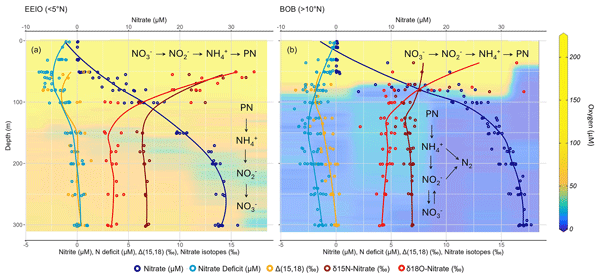
Oxygen-minimum zones (OMZs) are low-oxygen ocean areas that deplete nitrogen, a key marine nutrient. Understanding nitrogen cycling in OMZs is crucial for the global nitrogen cycle. This study examined nitrogen cycling in the OMZ of the Bay of Bengal and the East Equatorial Indian Ocean, revealing limited mixing between both regions. Surface phytoplankton consumes nitrate, while deeper nitrification recycles nitrogen. In the BoB’s OMZ (100–300 m), nitrogen loss likely occurs via anammox.
Bennet Juhls, Anne Morgenstern, Jens Hölemann, Antje Eulenburg, Birgit Heim, Frederieke Miesner, Hendrik Grotheer, Gesine Mollenhauer, Hanno Meyer, Ephraim Erkens, Felica Yara Gehde, Sofia Antonova, Sergey Chalov, Maria Tereshina, Oxana Erina, Evgeniya Fingert, Ekaterina Abramova, Tina Sanders, Liudmila Lebedeva, Nikolai Torgovkin, Georgii Maksimov, Vasily Povazhnyi, Rafael Gonçalves-Araujo, Urban Wünsch, Antonina Chetverova, Sophie Opfergelt, and Pier Paul Overduin
Earth Syst. Sci. Data, 17, 1–28, https://doi.org/10.5194/essd-17-1-2025, https://doi.org/10.5194/essd-17-1-2025, 2025
Short summary
Short summary
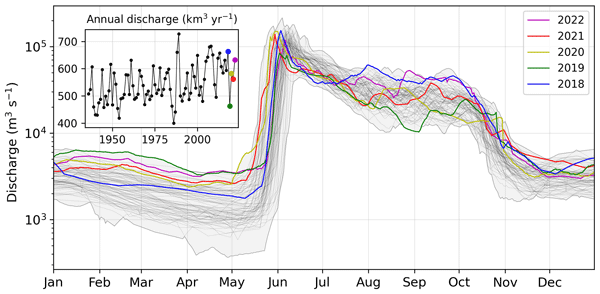
The Siberian Arctic is warming fast: permafrost is thawing, river chemistry is changing, and coastal ecosystems are affected. We aimed to understand changes in the Lena River, a major Arctic river flowing to the Arctic Ocean, by collecting 4.5 years of detailed water data, including temperature and carbon and nutrient contents. This dataset records current conditions and helps us to detect future changes. Explore it at https://doi.org/10.1594/PANGAEA.913197 and https://lena-monitoring.awi.de/.
Mona Norbisrath, Justus E. E. van Beusekom, and Helmuth Thomas
Ocean Sci., 20, 1423–1440, https://doi.org/10.5194/os-20-1423-2024, https://doi.org/10.5194/os-20-1423-2024, 2024
Short summary
Short summary
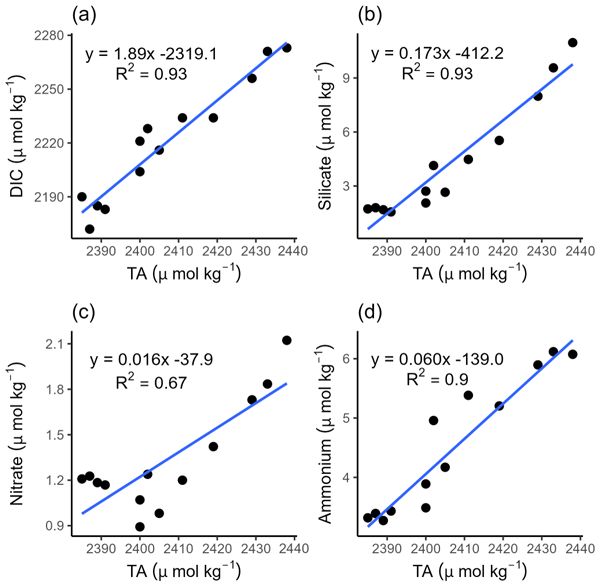
We present an observational study investigating total alkalinity (TA) in the Dutch Wadden Sea. Discrete water samples were used to identify the TA spatial distribution patterns and locate and shed light on TA sources. By observing a tidal cycle, the sediments and pore water exchange were identified as local TA sources. We assumed metabolically driven CaCO3 dissolution as the TA source in the upper, oxic sediments and anaerobic metabolic processes as TA sources in the deeper, anoxic ones.
Louise C. V. Rewrie, Burkard Baschek, Justus E. E. van Beusekom, Arne Körtzinger, Gregor Ollesch, and Yoana G. Voynova
Biogeosciences, 20, 4931–4947, https://doi.org/10.5194/bg-20-4931-2023, https://doi.org/10.5194/bg-20-4931-2023, 2023
Short summary
Short summary
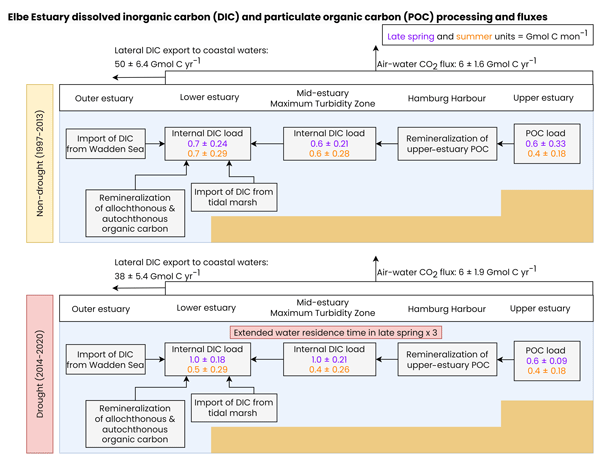
After heavy pollution in the 1980s, a long-term inorganic carbon increase in the Elbe Estuary (1997–2020) was fueled by phytoplankton and organic carbon production in the upper estuary, associated with improved water quality. A recent drought (2014–2020) modulated the trend, extending the water residence time and the dry summer season into May. The drought enhanced production of inorganic carbon in the estuary but significantly decreased the annual inorganic carbon export to coastal waters.
Mona Norbisrath, Andreas Neumann, Kirstin Dähnke, Tina Sanders, Andreas Schöl, Justus E. E. van Beusekom, and Helmuth Thomas
Biogeosciences, 20, 4307–4321, https://doi.org/10.5194/bg-20-4307-2023, https://doi.org/10.5194/bg-20-4307-2023, 2023
Short summary
Short summary
Total alkalinity (TA) is the oceanic capacity to store CO2. Estuaries can be a TA source. Anaerobic metabolic pathways like denitrification (reduction of NO3− to N2) generate TA and are a major nitrogen (N) sink. Another important N sink is anammox that transforms NH4+ with NO2− into N2 without TA generation. By combining TA and N2 production, we identified a TA source, denitrification, occurring in the water column and suggest anammox as the dominant N2 producer in the bottom layer of the Ems.
Gesa Schulz, Tina Sanders, Yoana G. Voynova, Hermann W. Bange, and Kirstin Dähnke
Biogeosciences, 20, 3229–3247, https://doi.org/10.5194/bg-20-3229-2023, https://doi.org/10.5194/bg-20-3229-2023, 2023
Short summary
Short summary
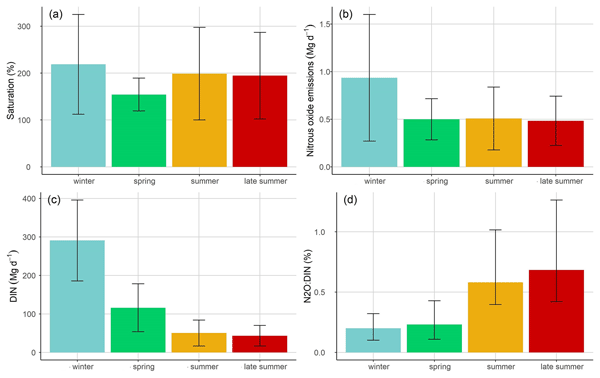
Nitrous oxide (N2O) is an important greenhouse gas. However, N2O emissions from estuaries underlie significant uncertainties due to limited data availability and high spatiotemporal variability. We found the Elbe Estuary (Germany) to be a year-round source of N2O, with the highest emissions in winter along with high nitrogen loads. However, in spring and summer, N2O emissions did not decrease alongside lower nitrogen loads because organic matter fueled in situ N2O production along the estuary.
Olga Ogneva, Gesine Mollenhauer, Bennet Juhls, Tina Sanders, Juri Palmtag, Matthias Fuchs, Hendrik Grotheer, Paul J. Mann, and Jens Strauss
Biogeosciences, 20, 1423–1441, https://doi.org/10.5194/bg-20-1423-2023, https://doi.org/10.5194/bg-20-1423-2023, 2023
Short summary
Short summary
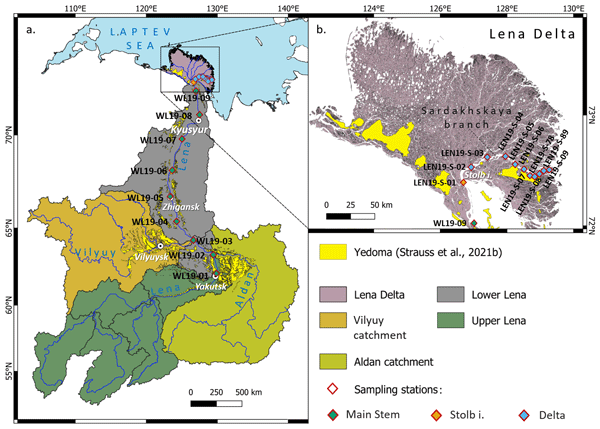
Arctic warming accelerates permafrost thaw and release of terrestrial organic matter (OM) via rivers to the Arctic Ocean. We compared particulate organic carbon (POC), total suspended matter, and C isotopes (δ13C and Δ14C of POC) in the Lena delta and Lena River along a ~1600 km transect. We show that the Lena delta, as an interface between the Lena River and the Arctic Ocean, plays a crucial role in determining the qualitative and quantitative composition of OM discharged into the Arctic Ocean.
Johannes J. Rick, Mirco Scharfe, Tatyana Romanova, Justus E. E. van Beusekom, Ragnhild Asmus, Harald Asmus, Finn Mielck, Anja Kamp, Rainer Sieger, and Karen H. Wiltshire
Earth Syst. Sci. Data, 15, 1037–1057, https://doi.org/10.5194/essd-15-1037-2023, https://doi.org/10.5194/essd-15-1037-2023, 2023
Short summary
Short summary
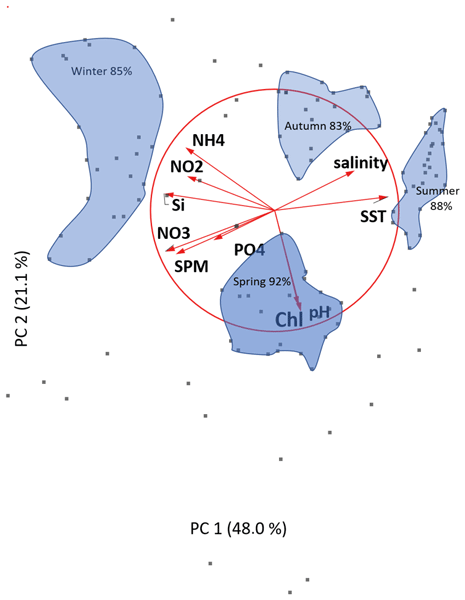
The Sylt Roads (Wadden Sea) time series is illustrated. Since 1984, the water temperature has risen by 1.1 °C, while pH and salinity decreased by 0.2 and 0.3 units. Nutrients (P, N) displayed a period of high eutrophication until 1998 and have decreased since 1999, while Si showed a parallel increase. Chlorophyll did not mirror these changes, probably due to a switch in nutrient limitation. Until 1998, algae were primarily limited by Si, and since 1999, P limitation has become more important.
Kirstin Dähnke, Tina Sanders, Yoana Voynova, and Scott D. Wankel
Biogeosciences, 19, 5879–5891, https://doi.org/10.5194/bg-19-5879-2022, https://doi.org/10.5194/bg-19-5879-2022, 2022
Short summary
Short summary
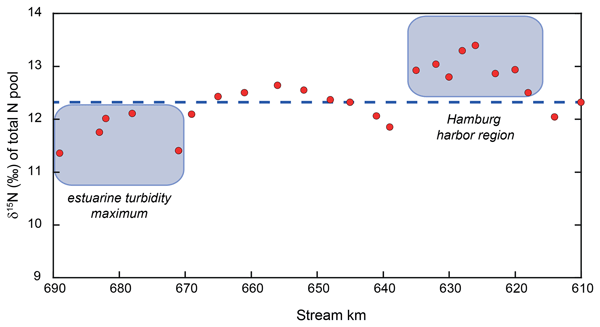
Nitrogen is an important macronutrient that fuels algal production in rivers and coastal regions. We investigated the production and removal of nitrogen-bearing compounds in the freshwater section of the tidal Elbe Estuary and found that particles in the water column are key for the production and removal of water column nitrate. Using a stable isotope approach, we pinpointed regions where additional removal of nitrate or input from sediments plays an important role in estuarine biogeochemistry.

Mona Norbisrath, Johannes Pätsch, Kirstin Dähnke, Tina Sanders, Gesa Schulz, Justus E. E. van Beusekom, and Helmuth Thomas
Biogeosciences, 19, 5151–5165, https://doi.org/10.5194/bg-19-5151-2022, https://doi.org/10.5194/bg-19-5151-2022, 2022
Short summary
Short summary
Total alkalinity (TA) regulates the oceanic storage capacity of atmospheric CO2. TA is also metabolically generated in estuaries and influences coastal carbon storage through its inflows. We used water samples and identified the Hamburg port area as the one with highest TA generation. Of the overall riverine TA load, 14 % is generated within the estuary. Using a biogeochemical model, we estimated potential effects on the coastal carbon storage under possible anthropogenic and climate changes.
Bryce Van Dam, Nele Lehmann, Mary A. Zeller, Andreas Neumann, Daniel Pröfrock, Marko Lipka, Helmuth Thomas, and Michael Ernst Böttcher
Biogeosciences, 19, 3775–3789, https://doi.org/10.5194/bg-19-3775-2022, https://doi.org/10.5194/bg-19-3775-2022, 2022
Short summary
Short summary
We quantified sediment–water exchange at shallow sites in the North and Baltic seas. We found that porewater irrigation rates in the former were approximately twice as high as previously estimated, likely driven by relatively high bioirrigative activity. In contrast, we found small net fluxes of alkalinity, ranging from −35 µmol m−2 h−1 (uptake) to 53 µmol m−2 h−1 (release). We attribute this to low net denitrification, carbonate mineral (re-)precipitation, and sulfide (re-)oxidation.
Matthias Fuchs, Juri Palmtag, Bennet Juhls, Pier Paul Overduin, Guido Grosse, Ahmed Abdelwahab, Michael Bedington, Tina Sanders, Olga Ogneva, Irina V. Fedorova, Nikita S. Zimov, Paul J. Mann, and Jens Strauss
Earth Syst. Sci. Data, 14, 2279–2301, https://doi.org/10.5194/essd-14-2279-2022, https://doi.org/10.5194/essd-14-2279-2022, 2022
Short summary
Short summary
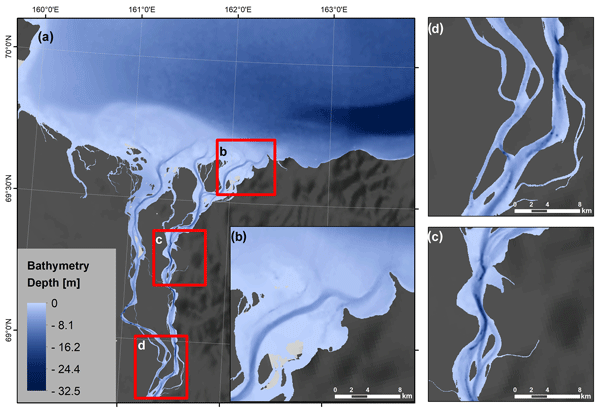
We created digital, high-resolution bathymetry data sets for the Lena Delta and Kolyma Gulf regions in northeastern Siberia. Based on nautical charts, we digitized depth points and isobath lines, which serve as an input for a 50 m bathymetry model. The benefit of this data set is the accurate mapping of near-shore areas as well as the offshore continuation of the main deep river channels. This will improve the estimation of river outflow and the nutrient flux output into the coastal zone.
Shichao Tian, Birgit Gaye, Jianhui Tang, Yongming Luo, Wenguo Li, Niko Lahajnar, Kirstin Dähnke, Tina Sanders, Tianqi Xiong, Weidong Zhai, and Kay-Christian Emeis
Biogeosciences, 19, 2397–2415, https://doi.org/10.5194/bg-19-2397-2022, https://doi.org/10.5194/bg-19-2397-2022, 2022
Short summary
Short summary
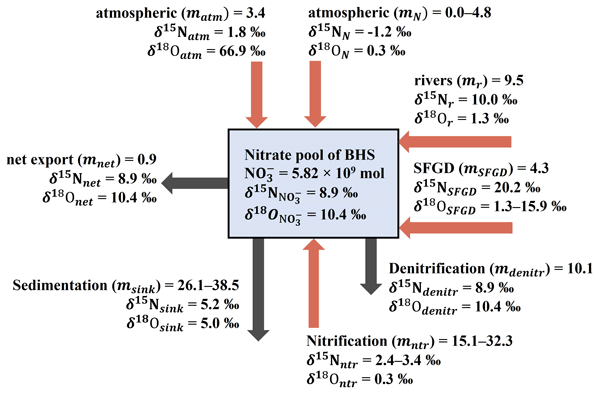
We constrain the nitrogen budget and in particular the internal sources and sinks of nitrate in the Bohai Sea by using a mass-based and dual stable isotope approach based on δ15N and δ18O of nitrate. Based on available mass fluxes and isotope data an updated nitrogen budget is proposed. Compared to previous estimates, it is more complete and includes the impact of the interior cycle (nitrification) on the nitrate pool. The main external nitrogen sources are rivers contributing 19.2 %–25.6 %.

Charlotte Haugk, Loeka L. Jongejans, Kai Mangelsdorf, Matthias Fuchs, Olga Ogneva, Juri Palmtag, Gesine Mollenhauer, Paul J. Mann, P. Paul Overduin, Guido Grosse, Tina Sanders, Robyn E. Tuerena, Lutz Schirrmeister, Sebastian Wetterich, Alexander Kizyakov, Cornelia Karger, and Jens Strauss
Biogeosciences, 19, 2079–2094, https://doi.org/10.5194/bg-19-2079-2022, https://doi.org/10.5194/bg-19-2079-2022, 2022
Short summary
Short summary
Buried animal and plant remains (carbon) from the last ice age were freeze-locked in permafrost. At an extremely fast eroding permafrost cliff in the Lena Delta (Siberia), we found this formerly frozen carbon well preserved. Our results show that ongoing degradation releases substantial amounts of this carbon, making it available for future carbon emissions. This mobilisation at the studied cliff and also similarly eroding sites bear the potential to affect rivers and oceans negatively.
Gesa Schulz, Tina Sanders, Justus E. E. van Beusekom, Yoana G. Voynova, Andreas Schöl, and Kirstin Dähnke
Biogeosciences, 19, 2007–2024, https://doi.org/10.5194/bg-19-2007-2022, https://doi.org/10.5194/bg-19-2007-2022, 2022
Short summary
Short summary
Estuaries can significantly alter nutrient loads before reaching coastal waters. Our study of the heavily managed Ems estuary (Northern Germany) reveals three zones of nitrogen turnover along the estuary with water-column denitrification in the most upstream hyper-turbid part, nitrate production in the middle reaches and mixing/nitrate uptake in the North Sea. Suspended particulate matter was the overarching control on nitrogen cycling in the hyper-turbid estuary.
Cited articles
Anderson, C. and Cabana, G.: Does delta15N in river food webs reflect the intensity and origin of N loads from the watershed?, Sci. Total Environ., 367, 968–978, https://doi.org/10.1016/j.scitotenv.2006.01.029, 2006.
Appleby, P. G. and Oldfield, F.: The Calculation of Lead-210 Dates Assuming a Constant Rate of Supply of Unsupported 210Pb to the Sediment, Catena, 5, 1–8, https://doi.org/10.1016/S0341-8162(78)80002-2, 1978.
Bratek, A., Emeis, K.-C., Sanders, T., Wankel, S. D., Struck, U., Möbius, J., and Dähnke, K.: Nitrate sources and the effect of land cover on the isotopic composition of nitrate in the catchment of the Rhône River, Isotopes in Environmental and Health Studies, 56, 14–35, https://doi.org/10.1080/10256016.2020.1723580, 2020.
Bunzel, D., Milker, Y., Müller-Navarra, K., Arz, H. W., Friedrich, J., Lahajnar, N., and Schmiedl, G.: Integrated stratigraphy of foreland salt-marsh sediments of the south-eastern North Sea region, Newsletters Stratigr., 53, 415–442, https://doi.org/10.1127/nos/2020/0540, 2020.
Constantinescu, A. M., Tyler, A. N., Stanica, A., Spyrakos, E., Hunter, P. D., Catianis, I., and Panin, N.: A century of human interventions on sediment flux variations in the Danube-Black Sea transition zone, Front. Mar. Sci., 10, 1068065, https://doi.org/10.3389/fmars.2023.1068065, 2023.
Coolen, M. J. L.: 7000 Years of Emiliania huxleyi Viruses in the Black Sea, Science, 333, 451–452, https://doi.org/10.1126/science.1200072, 2011.
Cutmore, A., Bale, N., Hennekam, R., Yang, B., Rush, D., Reichart, G.-J., Hopmans, E. C., and Schouten, S.: Impact of deoxygenation and hydrological changes on the Black Sea nitrogen cycle during the Last Deglaciation and Holocene, Clim. Past, 21, 957–971, https://doi.org/10.5194/cp-21-957-2025, 2025.
Dähnke, K., Serna, A., Blanz, T., and Emeis, K.-C.: Sub-recent nitrogen-isotope trends in sediments from Skagerrak (North Sea) and Kattegat: Changes in N-budgets and N-sources?, Marine Geology, 253, 92–98, https://doi.org/10.1016/j.margeo.2008.04.017, 2008.
European Commission: Directive 2000/60/EC of the European Parliament and of the Council of 23 October 2000 establishing a framework for community action in the field of water policy, Off. J. Eur. Communities, https://eur-lex.europa.eu/eli/dir/2000/60/oj/eng (last access: 22 January 2026), 2000.
Fuchsman, C. A., Murray, J. W., and Konovalov, S. K.: Concentration and natural stable isotope profiles of nitrogen species in the Black Sea, Marine Chemistry, 111, 90–105, https://doi.org/10.1016/j.marchem.2008.04.009, 2008.
Fuchsman, C. A., Paul, B., Staley, J. T., Yakushev, E. V., and Murray, J. W.: Detection of transient denitrification during a high organic matter event in the Black Sea, Global Biogeochemical Cycles, 33, 143–162, https://doi.org/10.1029/2018GB006032, 2019.
Fulton, J. M., Arthur, M. A., and Freeman, K. H.: Black Sea nitrogen cycling and the preservation of phytoplankton δ15N signals during the Holocene, Global Biogeochem. Cycles, 26, GB2030, https://doi.org/10.1029/2011GB004196, 2012.
Giosan, L., Coolen, M., Kaplan, J., Constantinescu, S., Filip, F., Filipova-Marinova, M., Kettner, A. J., and Thom, N.: Early Anthropogenic Transformation of the Danube-Black Sea System, Sci. Rep., 2, 582, https://doi.org/10.1038/srep00582, 2012.
Hay, B. J., Arthur, M. A., Dean, W. E., Neff, E. D., and Honjo, S.: Sediment deposition in the Late Holocene abyssal Black Sea with climatic and chronological implications, Deep Sea Research Part A. Oceanographic Research Papers, 38, S1211–S1235, https://doi.org/10.1016/S0198-0149(10)80031-7, 1991.
Heaton, T. J., Köhler, P., Butzin, M., Bard, E., Reimer, R. W., Austin, W. E. N., Bronk Ramsey, C., Hughen, K. A., Kromer, B., Reimer, P. J., Adkins, J., Burke, A., Cook, M. S., Olsen, J., and Skinner, L. C.: Marine20-the marine radiocarbon age calibration curve (0–55,000 cal BP), Radiocarbon, 62, https://doi.org/10.1017/RDC.2020.68, 2020.
Johannsen, A., Dähnke, K., and Emeis, K.-C.: Isotopic composition of nitrate in five German rivers discharging into the North Sea, Organic Geochemistry, 39, 1689, https://doi.org/10.1016/j.orggeochem.2008.03.004, 2008.
Kaplan, J. O., Krumhardt, K. M., and Zimmermann, N.: The prehistoric and preindustrial deforestation of Europe, Quaternary Science Reviews, 28, 3016–3034, https://doi.org/10.1016/j.quascirev.2009.09.028, 2009.
Kendall, C., Elliott, E. M., and Wankel, S. D.: Tracing anthropogenic inputs of nitrogen to ecosystems, in: Stable isotopes in ecology and environmental science, 375–449, Wiley-Blackwell Publishing Ltd, https://doi.org/10.1002/9780470691854.ch12, 2007.
Kok, M. D., Schouten, S., and Sinninghe Damsté, J. S.: Formation of insoluble, nonhydrolyzable, sulfur-rich macromolecules via incorporation of inorganic sulfur species into algal carbohydrates, Geochim. Cosmochim. Acta, 64, 2689–2699, 2000.
Kovacs, A. and Zavadsky, I.: Success and sustainability of nutrient pollution reduction in the Danube River Basin: recovery and future protection of the Black Sea Northwest shelf, Water International, 46, 176–194, https://doi.org/10.1080/02508060.2021.1891703, 2021.
Kuypers, M., Sliekers, A., Lavik, G., Schmid, M., Jørgensen, B. B., Kuenen, J. G., Sinninghe Damsté, J. S., Strous M., and Jetten, M. S. M.: Anaerobic ammonium oxidation by anammox bacteria in the Black Sea, Nature, 422, 608–611, https://doi.org/10.1038/nature01472, 2003.
Lessard, E., Merico, A., and Tyrrell, T.: Nitrate: Phosphate Ratios and Emiliania huxleyi Blooms, Limnology and Oceanography, 50, 1020–1024, https://doi.org/10.4319/lo.2005.50.3.1020, 2005.
Mann, M. E., Zhang, Z., Rutherford, S., Bradley, R. S., Hughes, M. K., Shindell, D., Ammann, C., Faluvegi, G., and Ni, F.: Global Signatures and Dynamical Origins of the Little Ice Age and Medieval Climate Anomaly, Science, 326, 1256–1260, https://doi.org/10.1126/science.1177303, 2009.
Maselli, V. and Trincardi, F.: Man made deltas, Scientific Reports, 3, 1926, https://doi.org/10.1038/srep01926, 2013.
McKinney, C. R., McCrea, J. M., Epstein, S., Allen, H. A., and Urey, H. C.: Improvements in mass spectrometers for the measurement of small differences in isotope abundance ratios, Rev. Sci. Instrum., 21, 724–730, 1950.
Minagawa, M. and Wada, E.: Nitrogen Isotope Ratios of Red Tide Organisms in the East-China-Sea – a Characterization of Biological Nitrogen-Fixation, Mar. Chem., 19, 245–259, https://doi.org/10.1016/0304-4203(86)90026-5, 1986.
Möbius, J.: Isotope fractionation during nitrogen remineralization (ammonification): Implications for nitrogen isotope biogeochemistry, Geochimica et Cosmochimica Acta, 422–432, https://doi.org/10.1016/j.gca.2012.11.048, 2013.
Möbius, J. and Dähnke, K.: Nitrate drawdown and its unexpected isotope effect in the Danube estuarine transition zone, Limnology and Oceanography, 60, 1008–1019, https://doi.org/10.1002/lno.10068, 2015.
Möbius, J., Lahajnar, N., and Emeis, K.-C.: Diagenetic control of nitrogen isotope ratios in Holocene sapropels and recent sediments from the Eastern Mediterranean Sea, Biogeosciences, 7, 3901–3914, https://doi.org/10.5194/bg-7-3901-2010, 2010.
Oguz, T., Tuğrul, S., Kideys, A., Ediger, V., and Kubilay, N.: Physical and biogeochemical characteristics of the Black Sea, The Sea, 14, 1331–1369, 2005.
Oguz, T., Dippner, J. W., and Kaymaz, Z.: Climatic regulation of the Black Sea hydro-meteorological and ecological properties at interannual-to-decadal time scales, Journal of Marine Systems, 60, 235–254, https://doi.org/10.1016/j.jmarsys.2005.11.011, 2006.
Panin, N., Duţu, L. T., and Duţu, F.: The Danube Delta, Méditerranée, 126, 37–54, https://doi.org/10.4000/mediterranee.8186, 2016.
Raven, M. R., Fike, D. A., Gomes, M. L., Webb, S. M., Bradley, A. S., and McClelland, H.-L. O.: Organic carbon burial during OAE2 driven by changes in the locus of organic matter sulfurization, Nat. Commun., 9, 3409, https://doi.org/10.1038/s41467-018-05943-6, 2018.
Reimer, P. J. and Reimer, R. W.: A marine reservoir correction database and on-line interface, Radiocarbon, 43, 461–463, 2001.
Ross, D. A., Degens, E. T., and Macilvaine, J.: Black Sea: Recent Sedimentary History, Science, 170, 163–165, https://doi.org/10.1126/science.170.3954.163, 1970.
Serna, A., Pätsch, J., Dähnke, K., Wiesner, M. G., Hass, H. C., Zeiler, M., Hebbeln, D., and Emeis, K.-C.: History of anthropogenic nitrogen input to the German Bight/SE North Sea as reflected by nitrogen isotopes in surface sediments, sediment cores and hindcast models, Continental Shelf Research, 30, 1626–1638, https://doi.org/10.1016/j.csr.2010.06.010, 2010.
Wang, J. L., Baskaran, M., Cukrov, N., and Du, J.: Geochemical mobility of 137Cs in marine environments based on laboratory and field studies, Chemical Geology, 614, 121179, https://doi.org/10.1016/j.chemgeo.2022.121179, 2022.
Zhang, X., Sigman, D. M., Morel, F. M. M., and Kraepiel, A. M. L.: Nitrogen isotope fractionation by alternative nitrogenases and past ocean anoxia, Proceedings of the National Academy of Sciences, 111, 4782–4787, https://doi.org/10.1073/pnas.1402976111, 2014.
Short summary
The North-Western shelf of the Black Sea is substantially influenced by the discharge of nutrients from River Danube. We have sampled the sediment there and measured particulate carbon and nitrogen to reconstruct the variability of nitrogen sources to the NW shelf. Our results demonstrate that the balance of riverine nitrogen input and marine nitrogen fixation is sensitive to climate changes. Nitrogen from human activities is detectable in NW shelf sediment since the 12th century.
The North-Western shelf of the Black Sea is substantially influenced by the discharge of...


Altmetrics
Final-revised paper
Preprint