Articles | Volume 23, issue 10
https://doi.org/10.5194/bg-23-3299-2026
Research article
 | 
18 May 2026
Research article |  | 18 May 2026

The efficiency and ocean acidification mitigation potential of ocean alkalinity enhancement on multi-centennial timescales

Hendrik Grosselindemann, Friedrich A. Burger, and Thomas L. Frölicher

Related authors

Subsurface dissolution reduces the efficiency of mineral-based open-ocean alkalinity enhancement
Friedrich A. Burger, Urs Hofmann Elizondo, Hendrik Grosselindemann, and Thomas L. Frölicher
Biogeosciences, 23, 3279–3298, https://doi.org/10.5194/bg-23-3279-2026,https://doi.org/10.5194/bg-23-3279-2026, 2026
Short summary
Long-term variability and trends in the Agulhas Leakage and its impacts on the global overturning
Hendrik Großelindemann, Frederic S. Castruccio, Gokhan Danabasoglu, and Arne Biastoch
Ocean Sci., 21, 93–112, https://doi.org/10.5194/os-21-93-2025,https://doi.org/10.5194/os-21-93-2025, 2025
Short summary

Cited articles

Acksen, S., Koeve, W., Pahlow, M., Somes, C. J., and Oschlies, A.: Influence of Deep-Sea Carbonate Sediments on the Durability of Carbon Storage from Ocean Alkalinity Enhancement, ESS Open Archive, 2026, https://doi.org/10.22541/essoar.15001952/v1, 2026. a
Albright, R., Caldeira, L., Hosfelt, J., Kwiatkowski, L., Maclaren, J. K., Mason, B. M., Nebuchina, Y., Ninokawa, A., Pongratz, J., Ricke, K. L., Rivlin, T., Schneider, K., Sesboüé, M., Shamberger, K., Silverman, J., Wolfe, K., Zhu, K., and Caldeira, K.: Reversal of ocean acidification enhances net coral reef calcification, Nature, 531, 362–365, https://doi.org/10.1038/nature17155, 2016. a, b
Anderson, J. L., Balaji, V., Broccoli, A.. J., Cooke, W.. F., Delworth, T. L., Dixon, K. W., Donner, L. J., Dunne, K. A., Freidenreich, S. M., Garner, S. T., Gudgel, R. G., Gordon, C. T., Held, I. M., Hemler, R. S., Horowitz, L. W., Klein, S. A., Knutson, T. R., Kushner, P. J., Langenhost, A. R., Lau, N.-C., Liang, Z., Malyshev, S. L., Milly, P. C. D., Nath, M. J., Ploshay, J. J., Ramaswamy, V., Schwarzkopf, M. D., Shevliakova, E., Sirutis, J. J., Soden, B. J., Stern, W. F., Thompson, L. A., Wilson, R. J., Wittenberg, A. T., and Wyman, B. L.: The New GFDL Global Atmosphere and Land Model AM2–LM2: Evaluation with Prescribed SST Simulations, J. Climate, 17, 4641–4673, https://doi.org/10.1175/JCLI-3223.1, 2004. a
Bach, L. T., Gill, S. J., Rickaby, R. E. M., Gore, S., and Renforth, P.: CO2 Removal With Enhanced Weathering and Ocean Alkalinity Enhancement: Potential Risks and Co-benefits for Marine Pelagic Ecosystems, Frontiers in Climate, 1, 7, https://doi.org/10.3389/fclim.2019.00007, 2019. a
Bednaršek, N., van de Mortel, H., Pelletier, G., García-Reyes, M., Feely, R. A., and Dickson, A. G.: Assessment framework to predict sensitivity of marine calcifiers to ocean alkalinity enhancement – identification of biological thresholds and importance of precautionary principle, Biogeosciences, 22, 473–498, https://doi.org/10.5194/bg-22-473-2025, 2025. a, b, c, d
Download
Short summary
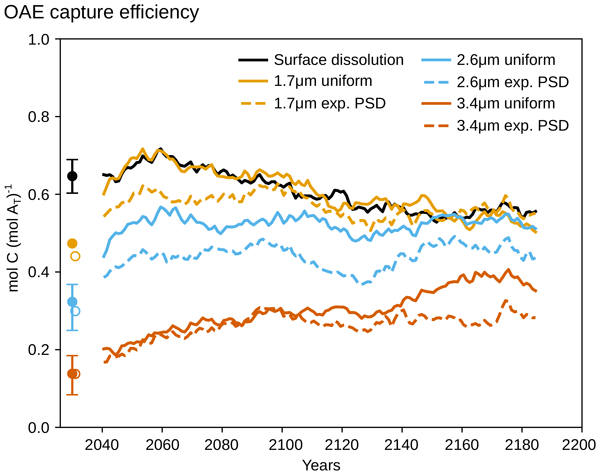
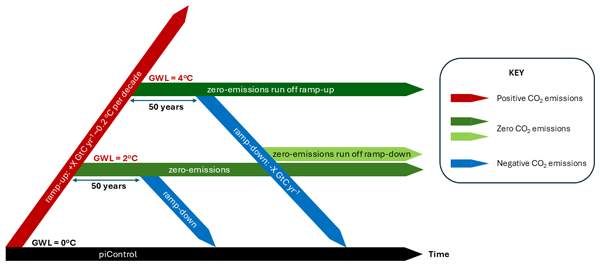
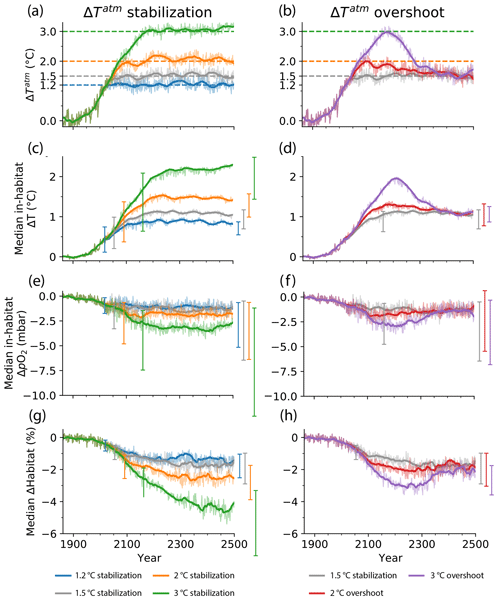
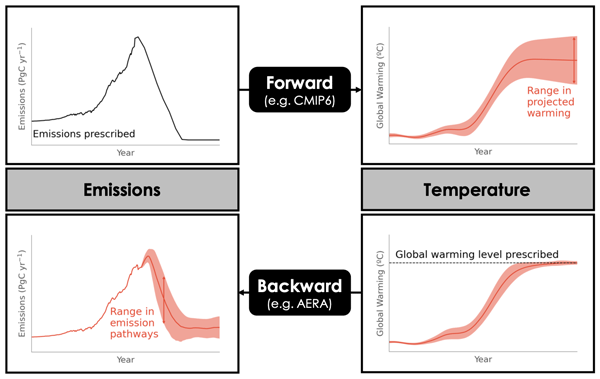
We assess the long-term carbon cycle, climate and ocean acidification response of ocean alkalinity enhancement (OAE) using an emission-driven Earth system model across warming stabilization scenarios. OAE lowers atmospheric CO2 and produces a scenario-independent linear cooling. Gross carbon capture efficiency remains high, while net efficiencies decline over time due to carbon-cycle feedbacks. Ocean acidification mitigation by OAE is dominated by CO2 drawdown on long timescales.
Share
Altmetrics
Final-revised paper
Preprint