
Articles | Volume 23, issue 14
https://doi.org/10.5194/bg-23-4967-2026
© Author(s) 2026. This work is distributed under
the Creative Commons Attribution 4.0 License.
the Creative Commons Attribution 4.0 License.
https://doi.org/10.5194/bg-23-4967-2026
© Author(s) 2026. This work is distributed under
the Creative Commons Attribution 4.0 License.
the Creative Commons Attribution 4.0 License.
Research article
| 
21 Jul 2026
Research article |
| 21 Jul 2026
| 21 Jul 2026
High-dimensional parameter optimization of a biogeochemical model: a multi-variable BGC-Argo data assimilation approach
Quentin Hyvernat
CORRESPONDING AUTHOR

Mercator Ocean International, 31400 Toulouse, France
Laboratoire d'Océanographie de Villefranche, CNRS, Sorbonne Université, 06230 Villefranche-sur-Mer, France
Alexandre Mignot
Mercator Ocean International, 31400 Toulouse, France
Elodie Gutknecht
Mercator Ocean International, 31400 Toulouse, France
Giovanni Ruggiero
Mercator Ocean International, 31400 Toulouse, France
Coralie Perruche
Mercator Ocean International, 31400 Toulouse, France
Guillaume Samson
Mercator Ocean International, 31400 Toulouse, France
Raphaëlle Sauzède
Institut de la Mer de Villefranche, CNRS, Sorbonne Université, 06230 Villefranche-sur-Mer, France
Olivier Aumont
Sorbonne Université (CNRS/IRD/MNHN), LOCEAN-IPSL, 75005 Paris, France
Hervé Claustre
Laboratoire d'Océanographie de Villefranche, CNRS, Sorbonne Université, 06230 Villefranche-sur-Mer, France
Fabrizio D'Ortenzio
Laboratoire d'Océanographie de Villefranche, CNRS, Sorbonne Université, 06230 Villefranche-sur-Mer, France
Related authors
No articles found.
Wilhem Riom, Nicolas Mayot, Alexandre Mignot, Vincent Taillandier, and Fabrizio D'Ortenzio
State Planet, 7-osr10, 4, https://doi.org/10.5194/sp-7-osr10-4-2026, https://doi.org/10.5194/sp-7-osr10-4-2026, 2026
Short summary
Short summary
Over the ocean, phytoplankton (the microscopic algae at the basis of the marine foodweb) present characteristic cyclical patterns modulated by the passage of seasons. Climate change is modifying the marine environment and these seasonal cycles. This study presents a method that identifies the geographical displacement of these cycles applied over the last 30 years of satellite observations. It suggests that cycles normally typical of low latitude regions are extending towards high latitudes.
Alexandre Mignot, Nina Bednaršek, Sarah Albernhe, Stefano Ciavatta, Patrick Lehodey, and Jules Lehodey
State Planet Discuss., https://doi.org/10.5194/sp-2026-21, https://doi.org/10.5194/sp-2026-21, 2026
Preprint under review for SP
Short summary
Short summary
Tiny sea snails called pteropods build delicate shells that dissolve as the ocean absorbs carbon dioxide, while warming shrinks the areas where they can live. Using satellite-based ocean data from 1995 to 2025, we built two indicators that track, worldwide, how much shell damage occurs and how much suitable habitat remains. Over three decades, shell damage rose and suitable habitat shrank, confirming that both acidification and warming are reshaping where these animals can survive.
Jules Victor Lehodey, Alexandre Mignot, Alexandre Ganachaud, Sarah Albernhe, and Simon Nicol
Geosci. Model Dev., 19, 8349–8366, https://doi.org/10.5194/gmd-19-8349-2026, https://doi.org/10.5194/gmd-19-8349-2026, 2026
Short summary
Short summary
Marine zooplankton transfer energy from microscopic algae to fish and larger predators. Understanding their distribution helps predict how oceans respond to climate change. We developed SeapoPym, a freely available model that simulates zooplankton using ocean temperature and plant productivity. This tool lets scientists test biological hypotheses and estimate parameters from observations.
Salem Ibrahim Salem, Andre Valente, Shubha Sathyendranath, Andrei Chuprin, Théo Renard, Jaime Pitarch, Ruth Airs, Moreno Ana, Maria-Manuel Angelico, David Antoine, Robert Arnone, Florinda Artuso, Paulo O. Oliveira, William Balch, Kathryn Barker, Ray Barlow, Simon Bélanger, Marco Bellacicco, Jean-François Berthon, Şükrü Beşiktepe, Francesco Bignami, Yngve Borsheim, Astrid Bracher, Federica Braga, Vittorio Brando, Robert J. W. Brewin, Vanda Brotas, Elisabetta Canuti, Francisco P. Chavez, Andrés Cianca, Hervé Claustre, Lesley Clementson, Simone Colella, Raul Costa, Cristina Nunes, Richard Crout, Emmanuel Devred, Annalisa Di Cicco, Federico Falcini, Ivan Farace, Afonso Ferreira, Scott Freeman, Robert Frouin, Carlos García-Soto, Isabella Giardina, Stuart W. Gibb, Arthur Gleason, Ralf Goericke, Richard Gould, Michael Grant, Nathalie Guillocheau, Hiroto Higa, Stanford B. Hooker, Chuamin Hu, Joji Ishizaka, Thomas Jackson, Mati Kahru, Milton Kampel, Bokyung Kim, Holger Klein, Piotr Kowalczuk, Susanne Kratzer, Raphael Kudela, Antonia Lai, Rosario Lavezza, Jesus Ledesma, Huiwon Lee, Steven Lohrenz, Hubert Loisel, Vivian Lutz, Antonio Mannino, Francesca Margiotta, Victor Martinez-Vicente, Salvatore Marullo, Luca Massi, Patricia Matrai, Atsushi Matsuoka, David McKee, Chiara Melillo, Carlos B. Mendes, Brian G. Mitchell, Tiffany Moisan, Enrique Montes, Frank Muller-Karger, Aimee Neeley, Michael Novak, Leonie O'Dowd, Michael Ondrusek, Emanuele Organelli, Heeyoon Park, Trevor Platt, Francesca Polonelli, Alex Poulton, Mariella Ragni, Michel Repecaud, Maurizio Ribera d’Alcalà, Tamara Rodriguez-Ramos, Rüdiger Röttgers, Manuel Ruiz-Villarreal, Michela Sammartino, Rosalia Santoleri, Gian Marco Scarpa, Thomas Schroeder, Valeria Segura, Timothy Smyth, Denise Smythe-Wright, Heidi M. Sosik, Joanna Stoń-Egiert, Malcolm Taberner, Jing Tan, Rob Thomas, Crystal Thomas, Gavin Tilstone, Andreia Tracana, Michael Twardowski, Vincenzo Vellucci, Gianluca Volpe, Kenneth Voss, Jeremy Werdell, Marcel Wernand, Bozena Wojtasiewicz, Simon Wright, Sunmi Yang, Giuseppe Zibordi, Maria Laura Zoffoli, and Steve Groom
Earth Syst. Sci. Data Discuss., https://doi.org/10.5194/essd-2026-539, https://doi.org/10.5194/essd-2026-539, 2026
Preprint under review for ESSD
Short summary
Short summary
This paper presents the fourth version of the ESA Ocean Colour Climate Change Initiative global in situ bio-optical database. The updated compilation combines observations from many international data sources collected between 1996 and 2025 and includes major expansions in coverage and variables. The dataset provides a consistent reference for validating satellite ocean-colour products and supports algorithm development and long-term climate studies.
Elodie Gutknecht, Bruno Levier, Romain Escudier, Guillaume Reffray, Sylvain Cailleau, Stefano Ciavatta, Muriel Lux, Michelle Devlin, Lisette Enserink, Naomi Greenwood, and Hjalte Parner
State Planet Discuss., https://doi.org/10.5194/sp-2026-8, https://doi.org/10.5194/sp-2026-8, 2026
Preprint under review for SP
Short summary
Short summary
Declining oxygen levels near the seafloor can harm marine ecosystems. We investigated oxygen conditions across the North-East Atlantic shelf seas using ocean modelling. We found that low oxygen affects around one quarter of the shelf, with some areas experiencing severe oxygen loss, and that oxygen levels have decreased in recent decades beyond currently recognized vulnerable zones. These results highlight the need for continued monitoring and improved protection of marine environments.
Flavien Petit, Julia Uitz, Louison Dufour, Collin Roesler, Frédéric Partensky, Laurence Garczarek, Priscillia Gourvil, Céline Dimier, Melek Golbol, Vincenzo Vellucci, David Antoine, Christophe Penkerc'h, Vincent Taillandier, and Hervé Claustre
Biogeosciences, 23, 4561–4582, https://doi.org/10.5194/bg-23-4561-2026, https://doi.org/10.5194/bg-23-4561-2026, 2026
Short summary
Short summary
We studied whether ocean sensors can detect changes in microscopic algae communities that influence marine ecosystems and carbon uptake. We combined laboratory experiments and ocean observations to test sensors that measure how algae emit light at different colors when illuminated. We found that combining these light measurements with other optical signals improves the identification of broad community types. This approach could help future ocean floats better track ecosystem change globally.
Jozef Skákala, Shubha Sathyendranath, Yuri Artioli, Deep S. Banerjee, Heather Bouman, Robert J. W. Brewin, Momme Butenschön, Stefano Ciavatta, Stephanie Dutkiewicz, Yanna Fidai, David Ford, Grinson George, Karen Guihou, Bror Jönsson, Marija Bačeković Koloper, Žarko Kovač, Lekshmi Krishnakumary, Gemma Kulk, Charlotte Laufkötter, Gennadi Lessin, Jann Paul Mattern, Angélique Melet, Alexandre Mignot, David Moffat, Fanny Monteiro, Mayra Rodriguez Bennadji, Cécile S. Rousseaux, Ranjini Swaminathan, Osvaldo Ulloa, and Jerry Tjiputra
Ocean Sci., 22, 1457–1481, https://doi.org/10.5194/os-22-1457-2026, https://doi.org/10.5194/os-22-1457-2026, 2026
Short summary
Short summary
Marine primary production (PP) is a key component of the Earth's climate system, but its current estimates and future projections are highly uncertain. We review the PP uncertainties and discuss their sources both across the ecosystem and satellite models. We propose to reduce the PP uncertainties by better addressing the PP model structures and parametrizations. We also argue that for many models it is desirable to consider spatial and temporal variability in the model parameter values.
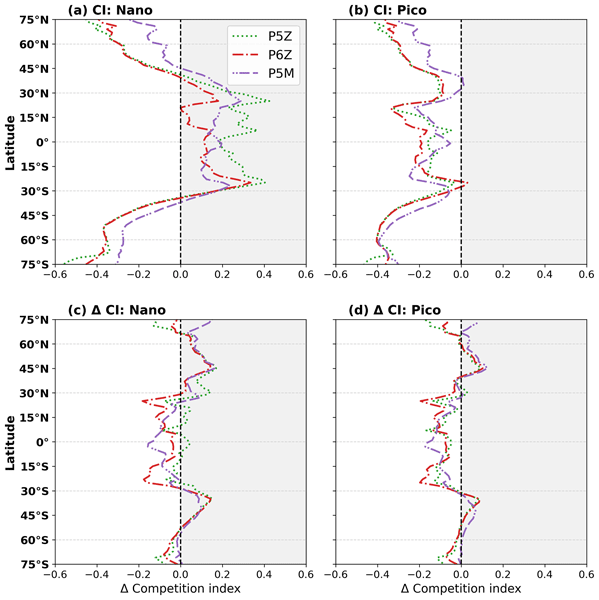
Jonathan Rogerson, Alessandro Tagliabue, Agathe Nguyen, Marcello Vichi, Lewis Wrightson, Prima Anugerahanti, Olivier Aumont, and Marion Gehlen
Biogeosciences, 23, 3179–3194, https://doi.org/10.5194/bg-23-3179-2026, https://doi.org/10.5194/bg-23-3179-2026, 2026
Short summary
Short summary
We use five different versions of a biogeochemical model to show that how phytoplankton growth processes are represented strongly shapes projections of future ocean productivity and carbon export. Added model complexity does not have a uniform global effect as some new processes mainly influence specific ocean regions, while others, such as an additional small phytoplankton type, lead to large intramodel differences in future trends and latitudinal patterns of productivity and carbon export.
Marilaure Grégoire, Gianpiero Cossarini, Corinne Derval, Elodie Gutknecht, Susan Kay, Julien Lamouroux, Helen Morrison, Coralie Perruche, Annette Samuelsen, Lena Spruch, Anna Teruzzi, Luc Vandenbulcke, Karina Von Schuckmann, and Tsuyoshi Wakamatsu
EGUsphere, https://doi.org/10.5194/egusphere-2026-813, https://doi.org/10.5194/egusphere-2026-813, 2026
Short summary
Short summary
We review the advancements in our capabilities to predict the green ocean in the frame of the European Copernicus Marine Service since its start in 2015 and for the five European seas, the Arctic and Global oceans. The evolutions of the prediction systems, delivered products and computing resources requirements are reviewed. Recommendations for future developments are proposed based on a SWOT analysis of current CMEMS green ocean prediction systems and products.
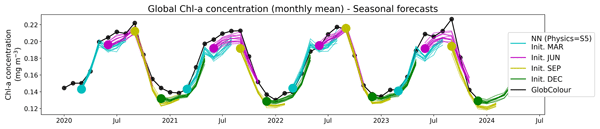
Gabriela Martinez Balbontin, Julien Jouanno, Rachid Benshila, Julien Lamouroux, Coralie Perruche, and Stefano Ciavatta
Biogeosciences, 23, 2601–2620, https://doi.org/10.5194/bg-23-2601-2026, https://doi.org/10.5194/bg-23-2601-2026, 2026
Short summary
Short summary
This study uses machine learning to predict global sea surface chlorophyll a, which is important for monitoring marine ecosystems and the carbon cycle. Using forecasts of sea surface temperature, salinity, height, and mixed layer depth, we generate global predictions up to six months ahead in just minutes. Our approach matches state-of-the-art numerical methods while being faster and more resource-efficient.
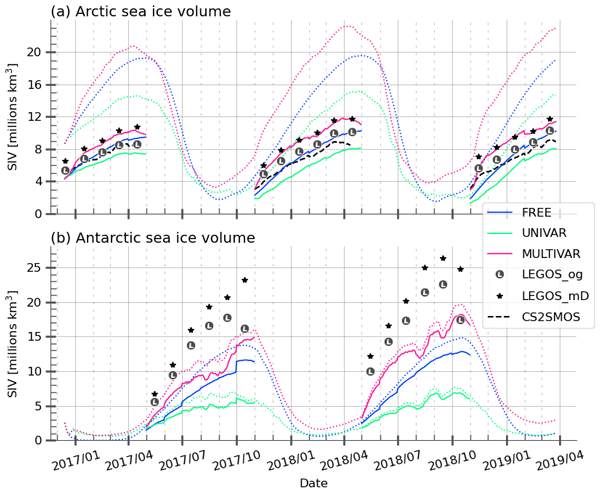
Aliette Chenal, Gilles Garric, Charles-Emmanuel Testut, Mathieu Hamon, Giovanni Ruggiero, Florent Garnier, and Pierre-Yves Le Traon
The Cryosphere, 20, 369–395, https://doi.org/10.5194/tc-20-369-2026, https://doi.org/10.5194/tc-20-369-2026, 2026
Short summary
Short summary
This study proposes to improve the representation of ice and snow volumes in the Arctic and Antarctic based on a novel multivariate assimilation method using freeboard radar and snow depth satellite data. The approach leads to an improved sea ice and snow volume representation, even during summer when satellite data is limited. The performance of the assimilated system is better in the Arctic than in Antarctica, where ocean/ice interactions play a key role.
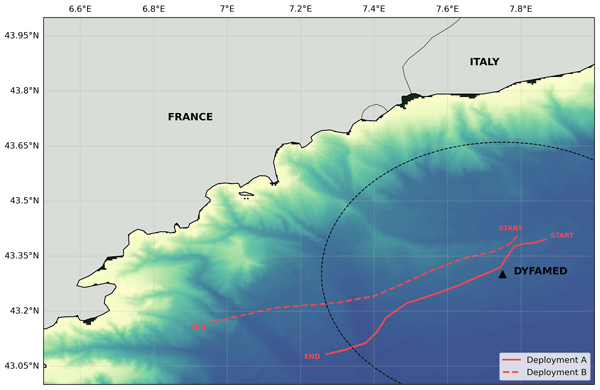
Louise Delaigue, Pierre Cauchy, Dorian Cazau, Julien Bonnel, Sara Pensieri, Roberto Bozzano, Anatole Gros-Martial, Christophe Schaeffer, Arnaud David, Paco Stil, Antoine Poteau, Catherine Schmechtig, Edouard Leymarie, and Hervé Claustre
Ocean Sci., 22, 101–117, https://doi.org/10.5194/os-22-101-2026, https://doi.org/10.5194/os-22-101-2026, 2026
Short summary
Short summary
We tested a new way to measure ocean winds using sound recorded deep underwater by an autonomous float. By listening to how wind and waves create noise at the surface, we showed that these floats can track changes in wind speed with good accuracy. This approach can extend wind monitoring to remote seas where satellites and buoys struggle, helping us better understand how the ocean and atmosphere exchange heat, gases, and energy.
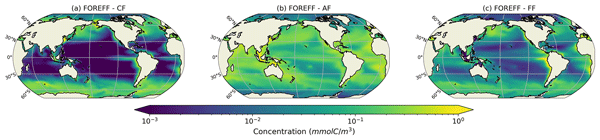
Lisa Di Matteo, Fabio Benedetti, Sakina-Dorothée Ayata, and Olivier Aumont
Biogeosciences, 22, 7233–7268, https://doi.org/10.5194/bg-22-7233-2025, https://doi.org/10.5194/bg-22-7233-2025, 2025
Short summary
Short summary
Mesozooplankton gather small current-drifting animals. They are very diverse and play key roles in the functioning of marine ecosystem and carbon cycle, especially through the production of rapidly sinking particles. Usually represented as one compartment, here we add three feeding strategies in an ocean biogeochemical model and investigate their impact on carbon cycle at global scale. We find distinct distributions between mesozooplankton types and diverse contributions to carbon export.
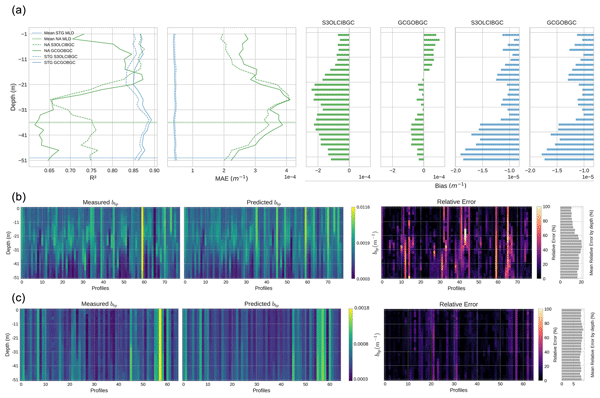
Jorge García-Jiménez, Ana B. Ruescas, Julia Amorós-López, and Raphaëlle Sauzède
Ocean Sci., 21, 1677–1694, https://doi.org/10.5194/os-21-1677-2025, https://doi.org/10.5194/os-21-1677-2025, 2025
Short summary
Short summary
Estimation of particulate organic carbon (POC) relies on proxies like the particulate backscattering coefficient (bbp) derived from BioGeoChemical-Argo (BGC-Argo) floats and satellite data. BGC-Argo floats provide global insights into vertical bio-optical dynamics. This study integrates Sentinel-3 OLCI (Ocean and Land Colour Instrument) data and machine learning approaches to improve bbp estimates in the top 250 m of the water column. The results differ based on the dynamics of the study areas.
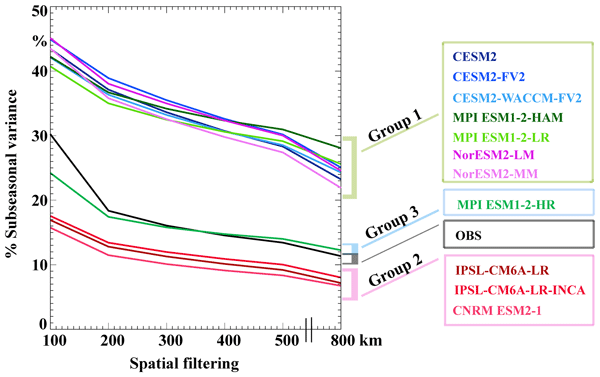
Madhavan Girijakumari Keerthi, Olivier Aumont, Lester Kwiatkowski, and Marina Levy
Biogeosciences, 22, 2163–2180, https://doi.org/10.5194/bg-22-2163-2025, https://doi.org/10.5194/bg-22-2163-2025, 2025
Short summary
Short summary
We assessed how well climate models replicate sub-seasonal changes in ocean chlorophyll observed by satellites. Models struggle to capture these variations accurately. Some overestimate fluctuations and their impact on annual chlorophyll variability, while others underestimate them. The underestimation is likely due to limited model resolution, while the overestimation may come from internal model oscillations.
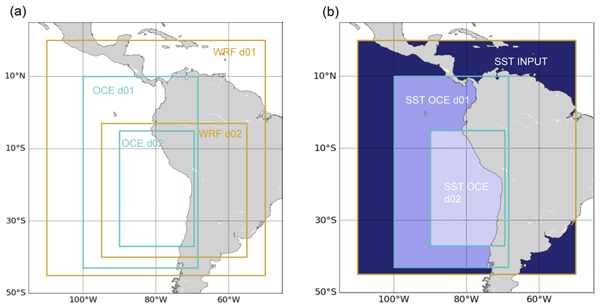
Sébastien Masson, Swen Jullien, Eric Maisonnave, David Gill, Guillaume Samson, Mathieu Le Corre, and Lionel Renault
Geosci. Model Dev., 18, 1241–1263, https://doi.org/10.5194/gmd-18-1241-2025, https://doi.org/10.5194/gmd-18-1241-2025, 2025
Short summary
Short summary
This article details a new feature we implemented in the popular regional atmospheric model WRF. This feature allows for data exchange between WRF and any other model (e.g. an ocean model) using the coupling library Ocean–Atmosphere–Sea–Ice–Soil Model Coupling Toolkit (OASIS3-MCT). This coupling interface is designed to be non-intrusive, flexible and modular. It also offers the possibility of taking into account the nested zooms used in WRF or in the models with which it is coupled.
Eva Álvarez, Gianpiero Cossarini, Anna Teruzzi, Jorn Bruggeman, Karsten Bolding, Stefano Ciavatta, Vincenzo Vellucci, Fabrizio D'Ortenzio, David Antoine, and Paolo Lazzari
Biogeosciences, 20, 4591–4624, https://doi.org/10.5194/bg-20-4591-2023, https://doi.org/10.5194/bg-20-4591-2023, 2023
Short summary
Short summary
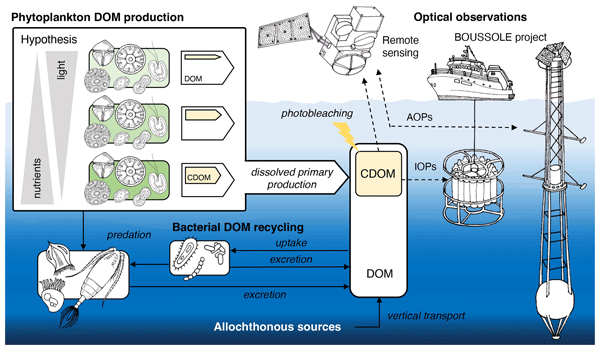
Chromophoric dissolved organic matter (CDOM) interacts with the ambient light and gives the waters of the Mediterranean Sea their colour. We propose a novel parameterization of the CDOM cycle, whose parameter values have been optimized by using the data of the monitoring site BOUSSOLE. Nutrient and light limitations for locally produced CDOM caused aCDOM(λ) to covary with chlorophyll, while the above-average CDOM concentrations observed at this site were maintained by allochthonous sources.
Joelle Habib, Caroline Ulses, Claude Estournel, Milad Fakhri, Patrick Marsaleix, Mireille Pujo-Pay, Marine Fourrier, Laurent Coppola, Alexandre Mignot, Laurent Mortier, and Pascal Conan
Biogeosciences, 20, 3203–3228, https://doi.org/10.5194/bg-20-3203-2023, https://doi.org/10.5194/bg-20-3203-2023, 2023
Short summary
Short summary
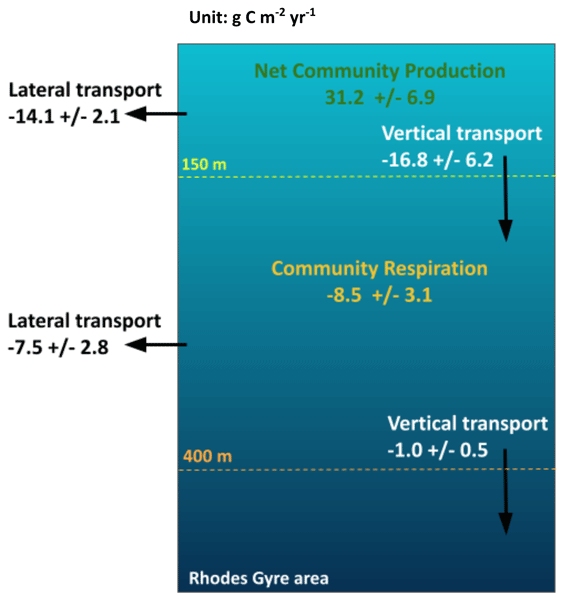
The Rhodes Gyre, eastern Mediterranean Sea, is the main Levantine Intermediate Water formation site. In this study, we use a 3D physical–biogeochemical model to investigate the seasonal and interannual variability of organic carbon dynamics in the gyre. Our results show its autotrophic nature and its high interannual variability, with enhanced primary production, downward exports, and onward exports to the surrounding regions during years marked by intense heat losses and deep mixed layers.
Alexandre Mignot, Hervé Claustre, Gianpiero Cossarini, Fabrizio D'Ortenzio, Elodie Gutknecht, Julien Lamouroux, Paolo Lazzari, Coralie Perruche, Stefano Salon, Raphaëlle Sauzède, Vincent Taillandier, and Anna Teruzzi
Biogeosciences, 20, 1405–1422, https://doi.org/10.5194/bg-20-1405-2023, https://doi.org/10.5194/bg-20-1405-2023, 2023
Short summary
Short summary
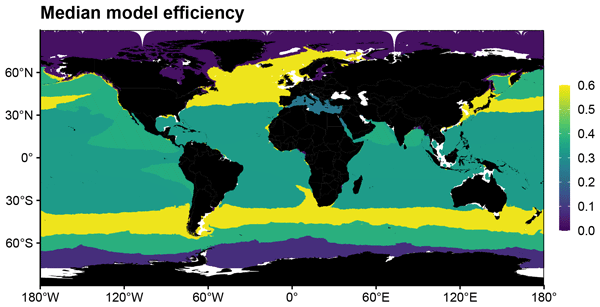
Numerical models of ocean biogeochemistry are becoming a major tool to detect and predict the impact of climate change on marine resources and monitor ocean health. Here, we demonstrate the use of the global array of BGC-Argo floats for the assessment of biogeochemical models. We first detail the handling of the BGC-Argo data set for model assessment purposes. We then present 23 assessment metrics to quantify the consistency of BGC model simulations with respect to BGC-Argo data.
Alban Planchat, Lester Kwiatkowski, Laurent Bopp, Olivier Torres, James R. Christian, Momme Butenschön, Tomas Lovato, Roland Séférian, Matthew A. Chamberlain, Olivier Aumont, Michio Watanabe, Akitomo Yamamoto, Andrew Yool, Tatiana Ilyina, Hiroyuki Tsujino, Kristen M. Krumhardt, Jörg Schwinger, Jerry Tjiputra, John P. Dunne, and Charles Stock
Biogeosciences, 20, 1195–1257, https://doi.org/10.5194/bg-20-1195-2023, https://doi.org/10.5194/bg-20-1195-2023, 2023
Short summary
Short summary
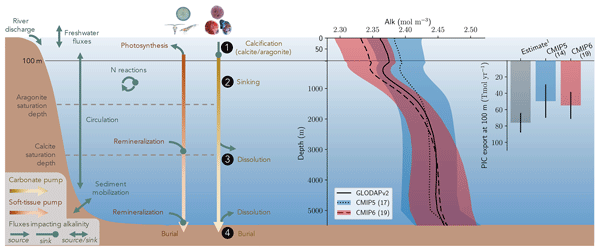
Ocean alkalinity is critical to the uptake of atmospheric carbon and acidification in surface waters. We review the representation of alkalinity and the associated calcium carbonate cycle in Earth system models. While many parameterizations remain present in the latest generation of models, there is a general improvement in the simulated alkalinity distribution. This improvement is related to an increase in the export of biotic calcium carbonate, which closer resembles observations.
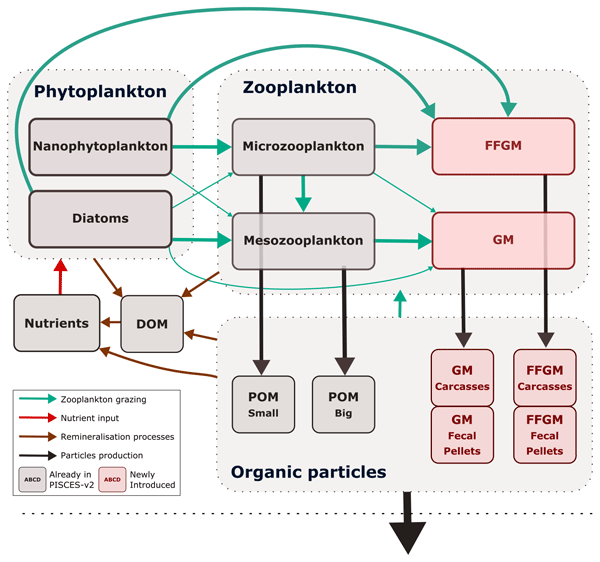
Corentin Clerc, Laurent Bopp, Fabio Benedetti, Meike Vogt, and Olivier Aumont
Biogeosciences, 20, 869–895, https://doi.org/10.5194/bg-20-869-2023, https://doi.org/10.5194/bg-20-869-2023, 2023
Short summary
Short summary
Gelatinous zooplankton play a key role in the ocean carbon cycle. In particular, pelagic tunicates, which feed on a wide size range of prey, produce rapidly sinking detritus. Thus, they efficiently transfer carbon from the surface to the depths. Consequently, we added these organisms to a marine biogeochemical model (PISCES-v2) and evaluated their impact on the global carbon cycle. We found that they contribute significantly to carbon export and that this contribution increases with depth.
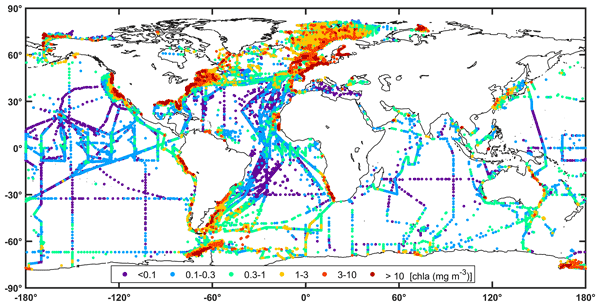
André Valente, Shubha Sathyendranath, Vanda Brotas, Steve Groom, Michael Grant, Thomas Jackson, Andrei Chuprin, Malcolm Taberner, Ruth Airs, David Antoine, Robert Arnone, William M. Balch, Kathryn Barker, Ray Barlow, Simon Bélanger, Jean-François Berthon, Şükrü Beşiktepe, Yngve Borsheim, Astrid Bracher, Vittorio Brando, Robert J. W. Brewin, Elisabetta Canuti, Francisco P. Chavez, Andrés Cianca, Hervé Claustre, Lesley Clementson, Richard Crout, Afonso Ferreira, Scott Freeman, Robert Frouin, Carlos García-Soto, Stuart W. Gibb, Ralf Goericke, Richard Gould, Nathalie Guillocheau, Stanford B. Hooker, Chuamin Hu, Mati Kahru, Milton Kampel, Holger Klein, Susanne Kratzer, Raphael Kudela, Jesus Ledesma, Steven Lohrenz, Hubert Loisel, Antonio Mannino, Victor Martinez-Vicente, Patricia Matrai, David McKee, Brian G. Mitchell, Tiffany Moisan, Enrique Montes, Frank Muller-Karger, Aimee Neeley, Michael Novak, Leonie O'Dowd, Michael Ondrusek, Trevor Platt, Alex J. Poulton, Michel Repecaud, Rüdiger Röttgers, Thomas Schroeder, Timothy Smyth, Denise Smythe-Wright, Heidi M. Sosik, Crystal Thomas, Rob Thomas, Gavin Tilstone, Andreia Tracana, Michael Twardowski, Vincenzo Vellucci, Kenneth Voss, Jeremy Werdell, Marcel Wernand, Bozena Wojtasiewicz, Simon Wright, and Giuseppe Zibordi
Earth Syst. Sci. Data, 14, 5737–5770, https://doi.org/10.5194/essd-14-5737-2022, https://doi.org/10.5194/essd-14-5737-2022, 2022
Short summary
Short summary
A compiled set of in situ data is vital to evaluate the quality of ocean-colour satellite data records. Here we describe the global compilation of bio-optical in situ data (spanning from 1997 to 2021) used for the validation of the ocean-colour products from the ESA Ocean Colour Climate Change Initiative (OC-CCI). The compilation merges and harmonizes several in situ data sources into a simple format that could be used directly for the evaluation of satellite-derived ocean-colour data.
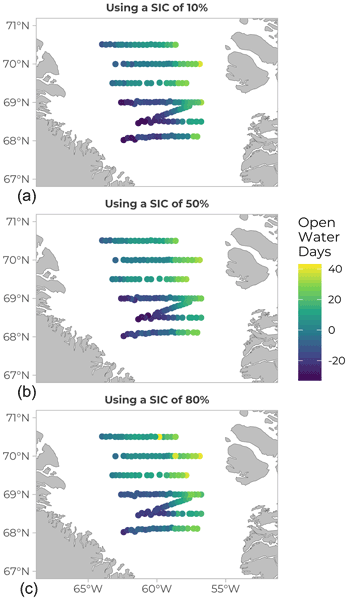
Flavienne Bruyant, Rémi Amiraux, Marie-Pier Amyot, Philippe Archambault, Lise Artigue, Lucas Barbedo de Freitas, Guislain Bécu, Simon Bélanger, Pascaline Bourgain, Annick Bricaud, Etienne Brouard, Camille Brunet, Tonya Burgers, Danielle Caleb, Katrine Chalut, Hervé Claustre, Véronique Cornet-Barthaux, Pierre Coupel, Marine Cusa, Fanny Cusset, Laeticia Dadaglio, Marty Davelaar, Gabrièle Deslongchamps, Céline Dimier, Julie Dinasquet, Dany Dumont, Brent Else, Igor Eulaers, Joannie Ferland, Gabrielle Filteau, Marie-Hélène Forget, Jérome Fort, Louis Fortier, Martí Galí, Morgane Gallinari, Svend-Erik Garbus, Nicole Garcia, Catherine Gérikas Ribeiro, Colline Gombault, Priscilla Gourvil, Clémence Goyens, Cindy Grant, Pierre-Luc Grondin, Pascal Guillot, Sandrine Hillion, Rachel Hussherr, Fabien Joux, Hannah Joy-Warren, Gabriel Joyal, David Kieber, Augustin Lafond, José Lagunas, Patrick Lajeunesse, Catherine Lalande, Jade Larivière, Florence Le Gall, Karine Leblanc, Mathieu Leblanc, Justine Legras, Keith Lévesque, Kate-M. Lewis, Edouard Leymarie, Aude Leynaert, Thomas Linkowski, Martine Lizotte, Adriana Lopes dos Santos, Claudie Marec, Dominique Marie, Guillaume Massé, Philippe Massicotte, Atsushi Matsuoka, Lisa A. Miller, Sharif Mirshak, Nathalie Morata, Brivaela Moriceau, Philippe-Israël Morin, Simon Morisset, Anders Mosbech, Alfonso Mucci, Gabrielle Nadaï, Christian Nozais, Ingrid Obernosterer, Thimoté Paire, Christos Panagiotopoulos, Marie Parenteau, Noémie Pelletier, Marc Picheral, Bernard Quéguiner, Patrick Raimbault, Joséphine Ras, Eric Rehm, Llúcia Ribot Lacosta, Jean-François Rontani, Blanche Saint-Béat, Julie Sansoulet, Noé Sardet, Catherine Schmechtig, Antoine Sciandra, Richard Sempéré, Caroline Sévigny, Jordan Toullec, Margot Tragin, Jean-Éric Tremblay, Annie-Pier Trottier, Daniel Vaulot, Anda Vladoiu, Lei Xue, Gustavo Yunda-Guarin, and Marcel Babin
Earth Syst. Sci. Data, 14, 4607–4642, https://doi.org/10.5194/essd-14-4607-2022, https://doi.org/10.5194/essd-14-4607-2022, 2022
Short summary
Short summary
This paper presents a dataset acquired during a research cruise held in Baffin Bay in 2016. We observed that the disappearance of sea ice in the Arctic Ocean increases both the length and spatial extent of the phytoplankton growth season. In the future, this will impact the food webs on which the local populations depend for their food supply and fisheries. This dataset will provide insight into quantifying these impacts and help the decision-making process for policymakers.
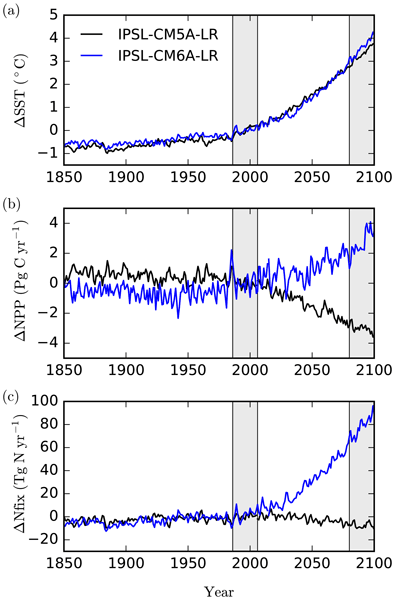
Laurent Bopp, Olivier Aumont, Lester Kwiatkowski, Corentin Clerc, Léonard Dupont, Christian Ethé, Thomas Gorgues, Roland Séférian, and Alessandro Tagliabue
Biogeosciences, 19, 4267–4285, https://doi.org/10.5194/bg-19-4267-2022, https://doi.org/10.5194/bg-19-4267-2022, 2022
Short summary
Short summary
The impact of anthropogenic climate change on the biological production of phytoplankton in the ocean is a cause for concern because its evolution could affect the response of marine ecosystems to climate change. Here, we identify biological N fixation and its response to future climate change as a key process in shaping the future evolution of marine phytoplankton production. Our results show that further study of how this nitrogen fixation responds to environmental change is essential.
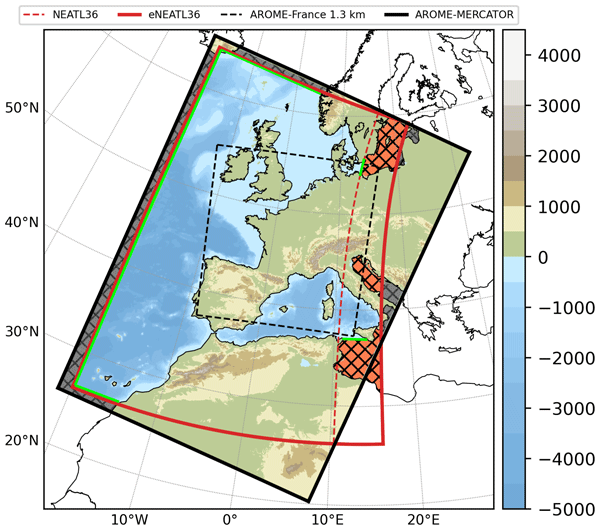
Joris Pianezze, Jonathan Beuvier, Cindy Lebeaupin Brossier, Guillaume Samson, Ghislain Faure, and Gilles Garric
Nat. Hazards Earth Syst. Sci., 22, 1301–1324, https://doi.org/10.5194/nhess-22-1301-2022, https://doi.org/10.5194/nhess-22-1301-2022, 2022
Short summary
Short summary
Most numerical weather and oceanic prediction systems do not consider ocean–atmosphere feedback during forecast, and this can lead to significant forecast errors, notably in cases of severe situations. A new high-resolution coupled ocean–atmosphere system is presented in this paper. This forecast-oriented system, based on current regional operational systems and evaluated using satellite and in situ observations, shows that the coupling improves both atmospheric and oceanic forecasts.
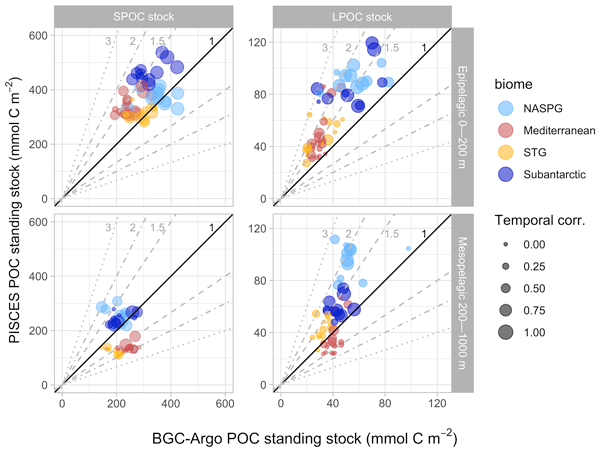
Martí Galí, Marcus Falls, Hervé Claustre, Olivier Aumont, and Raffaele Bernardello
Biogeosciences, 19, 1245–1275, https://doi.org/10.5194/bg-19-1245-2022, https://doi.org/10.5194/bg-19-1245-2022, 2022
Short summary
Short summary
Part of the organic matter produced by plankton in the upper ocean is exported to the deep ocean. This process, known as the biological carbon pump, is key for the regulation of atmospheric carbon dioxide and global climate. However, the dynamics of organic particles below the upper ocean layer are not well understood. Here we compared the measurements acquired by autonomous robots in the top 1000 m of the ocean to a numerical model, which can help improve future climate projections.
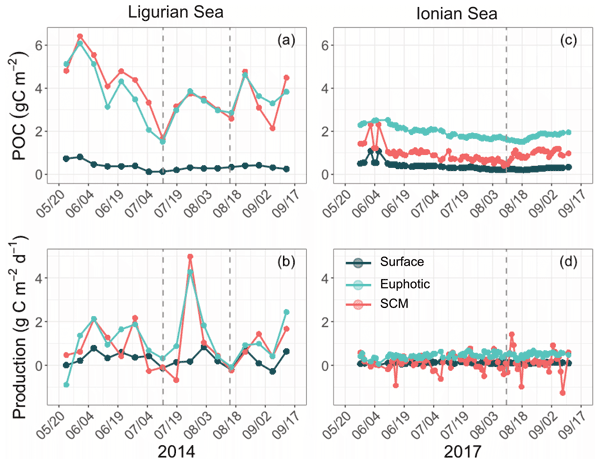
Marie Barbieux, Julia Uitz, Alexandre Mignot, Collin Roesler, Hervé Claustre, Bernard Gentili, Vincent Taillandier, Fabrizio D'Ortenzio, Hubert Loisel, Antoine Poteau, Edouard Leymarie, Christophe Penkerc'h, Catherine Schmechtig, and Annick Bricaud
Biogeosciences, 19, 1165–1194, https://doi.org/10.5194/bg-19-1165-2022, https://doi.org/10.5194/bg-19-1165-2022, 2022
Short summary
Short summary
This study assesses marine biological production in two Mediterranean systems representative of vast desert-like (oligotrophic) areas encountered in the global ocean. We use a novel approach based on non-intrusive high-frequency in situ measurements by two profiling robots, the BioGeoChemical-Argo (BGC-Argo) floats. Our results indicate substantial yet variable production rates and contribution to the whole water column of the subsurface layer, typically considered steady and non-productive.
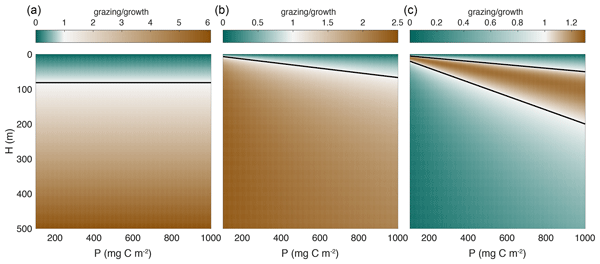
Mara Freilich, Alexandre Mignot, Glenn Flierl, and Raffaele Ferrari
Biogeosciences, 18, 5595–5607, https://doi.org/10.5194/bg-18-5595-2021, https://doi.org/10.5194/bg-18-5595-2021, 2021
Short summary
Short summary
Observations reveal that in some regions phytoplankton biomass increases during the wintertime when growth conditions are sub-optimal, which has been attributed to a release from grazing during mixed layer deepening. Measurements of grazer populations to support this theory are lacking. We demonstrate that a release from grazing when the winter mixed layer is deepening holds only for certain grazing models, extending the use of phytoplankton observations to make inferences about grazer dynamics.
Cited articles
Aumont, O., Ethé, C., Tagliabue, A., Bopp, L., and Gehlen, M.: PISCES-v2: an ocean biogeochemical model for carbon and ecosystem studies, Geosci. Model Dev., 8, 2465–2513, https://doi.org/10.5194/gmd-8-2465-2015, 2015.
Bendtsen, J., Vives, C. R., and Richardson, K.: Primary production in the North Atlantic estimated from in situ water column data observed by Argo floats and remote sensing, Front. Mar. Sci., 10, https://doi.org/10.3389/fmars.2023.1062413, 2023.
Bittig, H. C., Steinhoff, T., Claustre, H., Fiedler, B., Williams, N. L., Sauzède, R., Körtzinger, A., and Gattuso, J.-P.: An Alternative to Static Climatologies: Robust Estimation of Open Ocean CO2 Variables and Nutrient Concentrations From T, S, and O2 Data Using Bayesian Neural Networks, Front. Mar. Sci., 5, https://doi.org/10.3389/fmars.2018.00328, 2018.
Bock, N., Cornec, M., Claustre, H., and Duhamel, S.: Biogeographical Classification of the Global Ocean From BGC-Argo Floats, Global Biogeochem. Cy., 36, e2021GB007233, https://doi.org/10.1029/2021GB007233, 2022.
Breitburg, D., Levin, L. A., Oschlies, A., Grégoire, M., Chavez, F. P., Conley, D. J., Garçon, V., Gilbert, D., Gutiérrez, D., Isensee, K., Jacinto, G. S., Limburg, K. E., Montes, I., Naqvi, S. W. A., Pitcher, G. C., Rabalais, N. N., Roman, M. R., Rose, K. A., Seibel, B. A., Telszewski, M., Yasuhara, M., and Zhang, J.: Declining oxygen in the global ocean and coastal waters, Science, 359, https://doi.org/10.1126/science.aam7240, 2018.
Brodeau, L., Barnier, B., Treguier, A.-M., Penduff, T., and Gulev, S.: An ERA40-based atmospheric forcing for global ocean circulation models, Ocean Model., 31, 88–104, https://doi.org/10.1016/j.ocemod.2009.10.005, 2010.
Campolongo, F., Saltelli, A., and Tarantola, S.: Sensitivity Anaysis as an Ingredient of Modeling, Stat. Sci., 15, 377–395, https://doi.org/10.1214/ss/1009213004, 2000.
Cermeño, P., Dutkiewicz, S., Harris, R. P., Follows, M., Schofield, O., and Falkowski, P. G.: The role of nutricline depth in regulating the ocean carbon cycle, P. Natl. Acad. Sci. USA, 105, 20344–20349, https://doi.org/10.1073/pnas.0811302106, 2008.
Chu, P. C., Ivanov, L. M., and Margolina, T. M.: On non-linear sensitivity of marine biological models to parameter variations, Ecol. Model., 206, 369–382, 2007.
Claustre, H., Johnson, K. S., and Takeshita, Y.: Observing the Global Ocean with Biogeochemical-Argo, Ann. Rev. Mar. Sci., 12, 23–48, https://doi.org/10.1146/annurev-marine-010419-010956, 2020.
Cornec, M., Claustre, H., Mignot, A., Guidi, L., Lacour, L., Poteau, A., D'Ortenzio, F., Gentili, B., and Schmechtig, C.: Deep Chlorophyll Maxima in the Global Ocean: Occurrences, Drivers and Characteristics, Global Biogeochem. Cy., 35, e2020GB006759, https://doi.org/10.1029/2020GB006759, 2021.
Denman, K. L.: Modelling planktonic ecosystems: parameterizing complexity, Prog. Oceanogr., 57, 429–452, https://doi.org/10.1016/S0079-6611(03)00109-5, 2003.
de Boyer Montégut, C., Madec, G., Fischer, A. S., Lazar, A., and Iudicone, D.: Mixed layer depth over the global ocean: An examination of profile data and a profile-based climatology, J. Geophys. Res.-Ocean., 109, https://doi.org/10.1029/2004JC002378, 2004.
DeVries, T., Liang, J.-H., and Deutsch, C.: A mechanistic particle flux model applied to the oceanic phosphorus cycle, Biogeosciences, 11, 5381–5398, https://doi.org/10.5194/bg-11-5381-2014, 2014.
Doléac, S., Lévy, M., El Hourany, R., and Bopp, L.: Toward more robust net primary production projections in the North Atlantic Ocean, Biogeosciences, 22, 841–862, https://doi.org/10.5194/bg-22-841-2025, 2025.
Doney, S. C., Fabry, V. J., Feely, R. A., and Kleypas, J. A.: Ocean Acidification: The Other CO2 Problem, Ann. Rev. Mar. Sci., 1, 169–192, https://doi.org/10.1146/annurev.marine.010908.163834, 2009.
Dowd, M., Jones, E., and Parslow, J.: A statistical overview and perspectives on data assimilation for marine biogeochemical models, Environmetrics, 25, 203–213, https://doi.org/10.1002/env.2264, 2014.
Dulvy, N. K., Pacoureau, N., Rigby, C. L., Pollom, R. A., Jabado, R. W., Ebert, D. A., Finucci, B., Pollock, C. M., Cheok, J., Derrick, D. H., Herman, K. B., Sherman, C. S., VanderWright, W. J., Lawson, J. M., Walls, R. H. L., Carlson, J. K., Charvet, P., Bineesh, K. K., Fernando, D., Ralph, G. M., Matsushiba, J. H., Hilton-Taylor, C., Fordham, S. V., and Simpfendorfer, C. A.: Overfishing drives over one-third of all sharks and rays toward a global extinction crisis, Curr. Biol., 31, 4773-4787, https://doi.org/10.1016/j.cub.2021.08.062, 2021.
Elvira, V. and Martino, L.: Advances in Importance Sampling, in: Wiley StatsRef: Statistics Reference Online, John Wiley & Sons, Ltd., 1–14, https://doi.org/10.1002/9781118445112.stat08284, 2021.
E.U. Copernicus Marine Service Information (CMEMS): Global Ocean Biogeochemistry Analysis and Forecast, Marine Data Store (MDS) [data set], https://doi.org/10.48670/moi-00170, 2021a.
E.U. Copernicus Marine Service Information (CMEMS): Nutrient and carbon profiles vertical distribution, Marine Data Store (MDS) [data set], https://doi.org/10.48670/moi-00015, 2021b.
E.U. Copernicus Marine Service Information (CMEMS): Global Ocean 3D Chlorophyll-a concentration, Particulate Backscattering coefficient, Particulate Organic Carbon, Downwelling Photosynthetic Available Radiation and downwelling irradiance at three different wavelengths (ED380, ED412 and ED490), Marine Data Store (MDS) [data set], https://doi.org/10.48670/moi-00046, 2021c.
E.U. Copernicus Marine Service Information (CMEMS): Global Ocean Colour (Copernicus-GlobColour), Bio-Geo-Chemical, L4 (monthly and interpolated) from Satellite Observations (1997–ongoing), Marine Data Store (MDS) [data set], https://doi.org/10.48670/moi-00281, 2022.
Fennel, K., Losch, M., Schröter, J., and Wenzel, M.: Testing a marine ecosystem model: sensitivity analysis and parameter optimization, J. Mar. Syst., 28, 45–63, https://doi.org/10.1016/S0924-7963(00)00083-X, 2001.
Fennel, K., Gehlen, M., Brasseur, P., Brown, C. W., Ciavatta, S., Cossarini, G., Crise, A., Edwards, C. A., Ford, D., Friedrichs, M. A. M., Gregoire, M., Jones, E., Kim, H.-C., Lamouroux, J., Murtugudde, R., Perruche, C., and the GODAE OceanView Marine Ecosystem Analysis and Prediction Task Team: Advancing Marine Biogeochemical and Ecosystem Reanalyses and Forecasts as Tools for Monitoring and Managing Ecosystem Health, Front. Mar. Sci., 6, 89, https://doi.org/10.3389/fmars.2019.00089, 2019.
Fennel, K., Mattern, J. P., Doney, S. C., Bopp, L., Moore, A. M., Wang, B., and Yu, L.: Ocean biogeochemical modelling, Nat. Rev. Methods Primers, 2, 76, https://doi.org/10.1038/s43586-022-00154-2, 2022.
Friedrichs, M. A. M., Dusenberry, J. A., Anderson, L. A., Armstrong, R. A., Chai, F., Christian, J. R., Doney, S. C., Dunne, J., Fujii, M., Hood, R., McGillicuddy Jr., D. J., Moore, J. K., Schartau, M., Spitz, Y. H., and Wiggert, J. D.: Assessment of skill and portability in regional marine biogeochemical models: Role of multiple planktonic groups, J. Geophys. Res.-Ocean., 112, https://doi.org/10.1029/2006JC003852, 2007.
Galí, M., Falls, M., Claustre, H., Aumont, O., and Bernardello, R.: Bridging the gaps between particulate backscattering measurements and modeled particulate organic carbon in the ocean, Biogeosciences, 19, 1245–1275, https://doi.org/10.5194/bg-19-1245-2022, 2022.
Germineaud, C., Brankart, J.-M., and Brasseur, P.: An Ensemble-Based Probabilistic Score Approach to Compare Observation Scenarios: An Application to Biogeochemical-Argo Deployments, 36, 2307–2326, https://doi.org/10.1175/JTECH-D-19-0002.1, 2019.
Gutknecht, E., Reffray, G., Mignot, A., Dabrowski, T., and Sotillo, M. G.: Modelling the marine ecosystem of Iberia–Biscay–Ireland (IBI) European waters for CMEMS operational applications, Ocean Sci., 15, 1489–1516, https://doi.org/10.5194/os-15-1489-2019, 2019.
Henson, S. A., Laufkötter, C., Leung, S., Giering, S. L. C., Palevsky, H. I., and Cavan, E. L.: Uncertain response of ocean biological carbon export in a changing world, Nat. Geosci., 15, 248–254, https://doi.org/10.1038/s41561-022-00927-0, 2022.
Hermans, J., Delaunoy, A., Rozet, F., Wehenkel, A., Begy, V., and Louppe, G.: A Trust Crisis In Simulation-Based Inference? Beware, Your Posterior Approximations Can Be Unfaithful, arXiv [preprint], https://doi.org/10.48550/arXiv.2110.06581, 2022.
Hersbach, H., Bell, B., Berrisford, P., Hirahara, S., Horányi, A., Muñoz-Sabater, J., Nicolas, J., Peubey, C., Radu, R., Schepers, D., Simmons, A., Soci, C., Abdalla, S., Abellan, X., Balsamo, G., Bechtold, P., Biavati, G., Bidlot, J., Bonavita, M., De Chiara, G., Dahlgren, P., Dee, D., Diamantakis, M., Dragani, R., Flemming, J., Forbes, R., Fuentes, M., Geer, A., Haimberger, L., Healy, S., Hogan, R. J., Hólm, E., Janisková, M., Keeley, S., Laloyaux, P., Lopez, P., Lupu, C., Radnoti, G., de Rosnay, P., Rozum, I., Vamborg, F., Villaume, S., and Thépaut, J.-N.: The ERA5 global reanalysis, Q. J. Roy. Meteorol. Soc., 146, 1999–2049, https://doi.org/10.1002/qj.3803, 2020.
Hieronymus, J., Hieronymus, M., Gröger, M., Schwinger, J., Bernadello, R., Tourigny, E., Sicardi, V., Ruvalcaba Baroni, I., and Wyser, K.: Net primary production annual maxima in the North Atlantic projected to shift in the 21st century, Biogeosciences, 21, 2189–2206, https://doi.org/10.5194/bg-21-2189-2024, 2024.
Hoegh-Guldberg, O., Poloczanska, E. S., Skirving, W., and Dove, S.: Coral Reef Ecosystems under Climate Change and Ocean Acidification, Front. Mar. Sci., 4, https://doi.org/10.3389/fmars.2017.00158, 2017.
Homma, T. and Saltelli, A.: Importance measures in global sensitivity analysis of nonlinear models, Reliab. Eng. Syst. Safety, 52, 1–17, https://doi.org/10.1016/0951-8320(96)00002-6, 1996.
Hoshiba, Y., Hirata, T., Shigemitsu, M., Nakano, H., Hashioka, T., Masuda, Y., and Yamanaka, Y.: Biological data assimilation for parameter estimation of a phytoplankton functional type model for the western North Pacific, Ocean Sci., 14, 371–386, https://doi.org/10.5194/os-14-371-2018, 2018.
Huntley, M. E.: Temperature-Dependent Production of Marine Copepods: A Global Synthesis, Am. Nat., 140, 201–242, https://doi.org/10.1086/285410, 1992.
Hurtt, G. C. and Armstrong, R. A.: A pelagic ecosystem model calibrated with BATS data, Deep-Sea Res. Pt. II, 43, 653–683, https://doi.org/10.1016/0967-0645(96)00007-0, 1996.
Issan, O., Riley, P., Camporeale, E., and Kramer, B.: Bayesian Inference and Global Sensitivity Analysis for Ambient Solar Wind Prediction, Space Weather, 21, e2023SW003555, https://doi.org/10.1029/2023SW003555, 2023.
Iwanaga, T., Usher, W., and Herman, J.: Toward SALib 2.0: Advancing the accessibility and interpretability of global sensitivity analyses, Socio-Environ. Syst. Model., 4, 18155–18155, https://doi.org/10.18174/sesmo.18155, 2022.
Johnson, K. S., Plant, J. N., Coletti, L. J., Jannasch, H. W., Sakamoto, C. M., Riser, S. C., Swift, D. D., Williams, N. L., Boss, E., Haëntjens, N., Talley, L. D., and Sarmiento, J. L.: Biogeochemical sensor performance in the SOCCOM profiling float array, J. Geophys. Res.-Ocean., 122, 6416–6436, https://doi.org/10.1002/2017JC012838, 2017.
Johnson, K. S., Plant, J. N., Maurer, T. L., Takeshita, Y., Maurer, T. L., and Takeshita, Y.: Processing BGC-Argo pH data at the DAC level, Ifremer, https://doi.org/10.13155/57195, 2025.
Keeling, R. E., Körtzinger, A., and Gruber, N.: Ocean deoxygenation in a warming world, Ann. Rev. Mar. Sci., 2, 199–229, https://doi.org/10.1146/annurev.marine.010908.163855, 2010.
Lacroix, G. and Grégoire, M.: Revisited ecosystem model (MODECOGeL) of the Ligurian Sea: seasonal and interannual variability due to atmospheric forcing, J. Mar. Syst., 37, 229–258, https://doi.org/10.1016/S0924-7963(02)00190-2, 2002.
Limburg, K. E., Breitburg, D., Swaney, D. P., and Jacinto, G.: Ocean Deoxygenation: A Primer, One Earth, 2, 24–29, https://doi.org/10.1016/j.oneear.2020.01.001, 2020.
Liu, T., Qiu, Y., Lin, X., Ni, X., Wang, L., Li, H., and Jing, C.: Dissolved Oxygen Recovery in the Oxygen Minimum Zone of the Arabian Sea in Recent Decade as Observed by BGC-Argo Floats, Geophys. Res. Lett., 51, e2024GL108841, https://doi.org/10.1029/2024GL108841, 2024.
Löptien, U. and Dietze, H.: Reciprocal bias compensation and ensuing uncertainties in model-based climate projections: pelagic biogeochemistry versus ocean mixing, Biogeosciences, 16, 1865–1881, https://doi.org/10.5194/bg-16-1865-2019, 2019.
Löptien, U., Dietze, H., Preuss, R., and Toussaint, U. V.: Mapping manifestations of parametric uncertainty in projected pelagic oxygen concentrations back to contemporary local model fidelity, Sci. Rep., 11, 20949, https://doi.org/10.1038/s41598-021-00334-2, 2021.
Lucazeau, F.: Analysis and Mapping of an Updated Terrestrial Heat Flow Data Set, Geochem. Geophy. Geosy., 20, 4001–4024, https://doi.org/10.1029/2019GC008389, 2019.
MacLeod, M., Arp, H. P. H., Tekman, M. B., and Jahnke, A.: The global threat from plastic pollution, Science, 373, 61–65, https://doi.org/10.1126/science.abg5433, 2021.
Madec, G., Bourdallé-Badie, R., Chanut, J., Clementi, E., Coward, A., Ethé, C., Iovino, D., Lea, D., Lévy, C., Lovato, T., Martin, N., Masson, S., Mocavero, S., Rousset, C., Storkey, D., Müeller, S., Nurser, G., Bell, M., Samson, G., Mathiot, P., Mele, F., and Moulin, A.: NEMO ocean engine, Zenodo [code], https://doi.org/10.5281/zenodo.6334656, 2022.
Madec, G., Bell, M., Blaker, A., Bricaud, C., Bruciaferri, D., Castrillo, M., Calvert, D., Chanut, J., Clementi, E., Coward, A., Epicoco, I., Éthé, C., Ganderton, J., Harle, J., Hutchinson, K., Iovino, D., Lea, D., Lovato, T., Martin, M., Martin, N., Mele, F., Martins, D., Masson, S., Mathiot, P., Mele, F., Mocavero, S., Müller, S., Nurser, A. J. G., Paronuzzi, S., Peltier, M., Person, R., Rousset, C., Rynders, S., Samson, G., Téchené, S., Vancoppenolle, M., and Wilson, C.: NEMO Ocean Engine Reference Manual, Zenodo, https://doi.org/10.5281/zenodo.8167700, 2023.
Mamnun, N.: Uncertainties in ocean biogeochemical simulations: Application of ensemble data assimilation to a one-dimensional model, Front. Mar. Sci., 9, https://doi.org/10.3389/fmars.2022.984236, 2022.
Mamnun, N., Völker, C., Vrekoussis, M., and Nerger, L.: Uncertainties in ocean biogeochemical simulations: Application of ensemble data assimilation to a one-dimensional model, Front. Mar. Sci., 9, https://doi.org/10.3389/fmars.2022.984236, 2022.
Martino, L., Elvira, V., and Louzada, F.: Effective sample size for importance sampling based on discrepancy measures, Signal Process., 131, 386–401, https://doi.org/10.1016/j.sigpro.2016.08.025, 2017.
Matear, R.: Parameter optimization and analysis of ecosystem models using simulated annealing: A case study at Station P, J. Mar. Res., 53, 571–607, https://doi.org/10.1357/0022240953213098, 1995.
Mattern, J. P., Dowd, M., and Fennel, K.: Particle filter-based data assimilation for a three-dimensional biological ocean model and satellite observations, J. Geophys. Res.-Ocean., 118, 2746–2760, https://doi.org/10.1002/jgrc.20213, 2013.
Mayot, N., Buitenhuis, E. T., Wright, R. M., Hauck, J., Bakker, D. C. E., and Le Quéré, C.: Constraining the trend in the ocean CO2 sink during 2000–2022, Nat. Commun., 15, 8429, https://doi.org/10.1038/s41467-024-52641-7, 2024.
Mignot, A., Claustre, H., Uitz, J., Poteau, A., D'Ortenzio, F., and Xing, X.: Understanding the seasonal dynamics of phytoplankton biomass and the deep chlorophyll maximum in oligotrophic environments: A Bio-Argo float investigation, Global Biogeochem. Cy., 28, 856–876, https://doi.org/10.1002/2013GB004781, 2014.
Mignot, A., Ferrari, R., and Claustre, H.: Floats with bio-optical sensors reveal what processes trigger the North Atlantic bloom, Nat. Commun., 9, 190, https://doi.org/10.1038/s41467-017-02143-6, 2018.
Mignot, A., D'Ortenzio, F., Taillandier, V., Cossarini, G., and Salon, S.: Quantifying Observational Errors in Biogeochemical-Argo Oxygen, Nitrate, and Chlorophyll a Concentrations, Geophys. Res. Lett., 46, 4330–4337, https://doi.org/10.1029/2018GL080541, 2019.
Mignot, A., Claustre, H., Cossarini, G., D'Ortenzio, F., Gutknecht, E., Lamouroux, J., Lazzari, P., Perruche, C., Salon, S., Sauzède, R., Taillandier, V., and Teruzzi, A.: Using machine learning and Biogeochemical-Argo (BGC-Argo) floats to assess biogeochemical models and optimize observing system design, Biogeosciences, 20, 1405–1422, https://doi.org/10.5194/bg-20-1405-2023, 2023.
Minamide, M. and Zhang, F.: Adaptive Observation Error Inflation for Assimilating All-Sky Satellite Radiance, Mon. Weather Rev., 145, 1063–1081, https://doi.org/10.1175/MWR-D-16-0257.1, 2017.
Morel, A., Huot, Y., Gentili, B., Werdell, P. J., Hooker, S. B., and Franz, B. A.: Examining the consistency of products derived from various ocean color sensors in open ocean (Case 1) waters in the perspective of a multi-sensor approach, Remote Sens. Environ., 111, 69–88, https://doi.org/10.1016/j.rse.2007.03.012, 2007.
Ohishi, S., Miyoshi, T., and Kachi, M.: An ensemble Kalman filter-based ocean data assimilation system improved by adaptive observation error inflation (AOEI), Geosci. Model Dev., 15, 9057–9073, https://doi.org/10.5194/gmd-15-9057-2022, 2022.
Olsen, A., Key, R. M., van Heuven, S., Lauvset, S. K., Velo, A., Lin, X., Schirnick, C., Kozyr, A., Tanhua, T., Hoppema, M., Jutterström, S., Steinfeldt, R., Jeansson, E., Ishii, M., Pérez, F. F., and Suzuki, T.: The Global Ocean Data Analysis Project version 2 (GLODAPv2) – an internally consistent data product for the world ocean, Earth Syst. Sci. Data, 8, 297–323, https://doi.org/10.5194/essd-8-297-2016, 2016.
Orr, J. C.: Anthropogenic ocean acidification over the twenty-first century and its impact on calcifying organisms, Nature, 437, 681–686, https://doi.org/10.1038/nature04095, 2005.
Orr, J. C., Fabry, V. J., Aumont, O., Bopp, L., Doney, S. C., Feely, R. A., Gnanadesikan, A., Gruber, N., Ishida, A., Joos, F., Key, R. M., Lindsay, K., Maier-Reimer, E., Matear, R., Monfray, P., Mouchet, A., Najjar, R. G., Plattner, G.-K., Rodgers, K. B., Sabine, C. L., Sarmiento, J. L., Schlitzer, R., Slater, R. D., Totterdell, I. J., Weirig, M.-F., Yamanaka, Y., and Yool, A.: Anthropogenic ocean acidification over the twenty-first century and its impact on calcifying organisms, Nature, 437, 681–686, https://doi.org/10.1038/nature04095, 2005.
Owen, A. and Zhou, Y.: Safe and Effective Importance Sampling, J. Am. Stat. Assoc., 95, 135–143, https://doi.org/10.2307/2669533, 2000.
Pasquier, B., Holzer, M., Chamberlain, M. A., Matear, R. J., Bindoff, N. L., and Primeau, F. W.: Optimal parameters for the ocean's nutrient, carbon, and oxygen cycles compensate for circulation biases but replumb the biological pump, Biogeosciences, 20, 2985–3009, https://doi.org/10.5194/bg-20-2985-2023, 2023.
Pauly, D., Christensen, V., Guénette, S., Pitcher, T. J., Sumaila, U. R., Walters, C. J., Watson, R., and Zeller, D.: Towards sustainability in world fisheries, Nature, 418, 689–695, https://doi.org/10.1038/nature01017, 2002.
Pedregosa, F., Varoquaux, G., Gramfort, A., Michel, V., Thirion, B., Grisel, O., Blondel, M., Prettenhofer, P., Weiss, R., Dubourg, V., Vanderplas, J., Passos, A., Cournapeau, D., Brucher, M., Perrot, M., and Duchesnay, É.: Scikit-learn: Machine Learning in Python, J. Mach. Learn. Res., 12, 2825–2830, 2011.
Picheral, M., Catalano, C., Brousseau, D., Claustre, H., Coppola, L., Leymarie, E., Coindat, J., Dias, F., Fevre, S., Guidi, L., Irisson, J. O., Legendre, L., Lombard, F., Mortier, L., Penkerch, C., Rogge, A., Schmechtig, C., Thibault, S., Tixier, T., Waite, A., and Stemmann, L.: The Underwater Vision Profiler 6: an imaging sensor of particle size spectra and plankton, for autonomous and cabled platforms, Limnol. Oceanogr. Method., 20, 115–129, https://doi.org/10.1002/lom3.10475, 2022.
Povl, A., Fumihiko, A., Turki, A., et al.: Argo float data and metadata from Global Data Assembly Centre (Argo GDAC), SEANOE [data set], https://doi.org/10.17882/42182, 2026.
Prieur, C., Viry, L., Blayo, E., and Brankart, J.-M.: A global sensitivity analysis approach for marine biogeochemical modeling, Ocean Model., 139, 101402, https://doi.org/10.1016/j.ocemod.2019.101402, 2019.
Raices Cruz, I., Lindström, J., Troffaes, M. C. M., and Sahlin, U.: Iterative importance sampling with Markov chain Monte Carlo sampling in robust Bayesian analysis, Comput. Stat. Data Anal., 176, 107558, https://doi.org/10.1016/j.csda.2022.107558, 2022.
Reffray, G., Bourdalle-Badie, R., and Calone, C.: Modelling turbulent vertical mixing sensitivity using a 1D version of NEMO, Geosci. Model Dev., 8, 69–86, https://doi.org/10.5194/gmd-8-69-2015, 2015.
Renardy, M., Joslyn, L. R., Millar, J. A., and Kirschner, D. E.: To Sobol or not to Sobol? The effects of sampling schemes in systems biology applications, Math. Biosci., 337, 108593, https://doi.org/10.1016/j.mbs.2021.108593, 2021.
Ristic, B., Arulampalam, S., and Gordon, N.: Beyond the Kalman Filter: Particle Filters for Tracking Applications, Artech House, 299 pp., ISBN 9781580536318, 2004.
Rodgers, K. B., Schwinger, J., Fassbender, A. J., Landschützer, P., Yamaguchi, R., Frenzel, H., Stein, K., Müller, J. D., Goris, N., Sharma, S., Bushinsky, S., Chau, T.-T.-T., Gehlen, M., Gallego, M. A., Gloege, L., Gregor, L., Gruber, N., Hauck, J., Iida, Y., Ishii, M., Keppler, L., Kim, J.-E., Schlunegger, S., Tjiputra, J., Toyama, K., Vaittinada Ayar, P., and Velo, A.: Seasonal Variability of the Surface Ocean Carbon Cycle: A Synthesis, Global Biogeochem. Cy., 37, e2023GB007798, https://doi.org/10.1029/2023GB007798, 2023.
Rohr, T., Richardson, A. J., Lenton, A., Chamberlain, M. A., and Shadwick, E. H.: Zooplankton grazing is the largest source of uncertainty for marine carbon cycling in CMIP6 models, Commun. Earth Environ., 4, 1–22, https://doi.org/10.1038/s43247-023-00871-w, 2023.
Sauerland, V., Kriest, I., Oschlies, A., and Srivastav, A.: Multiobjective Calibration of a Global Biogeochemical Ocean Model Against Nutrients, Oxygen, and Oxygen Minimum Zones, J. Adv. Model. Earth Syst., 11, 1285–1308, https://doi.org/10.1029/2018MS001510, 2019.
Sauzède, R., Bittig, H. C., Claustre, H., Pasqueron de Fommervault, O., Gattuso, J.-P., Legendre, L., and Johnson, K. S.: Estimates of Water-Column Nutrient Concentrations and Carbonate System Parameters in the Global Ocean: A Novel Approach Based on Neural Networks, Front. Mar. Sci., 4, https://doi.org/10.3389/fmars.2017.00128, 2017.
Schartau, M. and Oschlies, A.: Simultaneous data-based optimization of a 1D-ecosystem model at three locations in the North Atlantic: Part I—Method and parameter estimates, J. Mar. Res., 61, 765–793, https://doi.org/10.1357/002224003322981147, 2003.
Schartau, M., Wallhead, P., Hemmings, J., Löptien, U., Kriest, I., Krishna, S., Ward, B. A., Slawig, T., and Oschlies, A.: Reviews and syntheses: parameter identification in marine planktonic ecosystem modelling, Biogeosciences, 14, 1647–1701, https://doi.org/10.5194/bg-14-1647-2017, 2017.
Schmechtig, C., Poteau, A., Claustre, H., D'Ortenzio, F., Boss, E.: Processing BGC-Argo chlorophyll-A concentration at the DAC level, Ifremer, https://doi.org/10.13155/39468, 2015.
Schmechtig, C., Claustre, H., Poteau, A., D’Ortenzio, F., Schallenberg, C., Trull, T., Xing, X., and Sauzède, R.: BGC-Argo quality control manual for the Chlorophyll-A concentration, Ifremer, https://doi.org/10.13155/35385, 2023.
Schmidtko, S., Stramma, L., and Visbeck, M.: Decline in global oceanic oxygen content during the past five decades, Nature, 542, 335–339, https://doi.org/10.1038/nature21399, 2017.
Shu, C., Xiu, P., Xing, X., Qiu, G., Ma, W., Brewin, R. J. W., and Ciavatta, S.: Biogeochemical Model Optimization by Using Satellite-Derived Phytoplankton Functional Type Data and BGC-Argo Observations in the Northern South China Sea, Remote Sens., 14, 1297, https://doi.org/10.3390/rs14051297, 2022.
Singh, T., Counillon, F., Tjiputra, J., and Wang, Y.: A Novel Ensemble-Based Parameter Estimation for Improving Ocean Biogeochemistry in an Earth System Model, J. Adv. Model. Ea. Syst., 17, e2024MS004237, https://doi.org/10.1029/2024MS004237, 2025.
Sobol', I. M.: Global sensitivity indices for nonlinear mathematical models and their Monte Carlo estimates, Math. Comput. Simulat., 55, 271–280, https://doi.org/10.1016/S0378-4754(00)00270-6, 2001.
Sobol', I. M., Asotsky, D., Kreinin, A., and Kucherenko, S.: Construction and Comparison of High-Dimensional Sobol' Generators, Wilmott, 2011, 64–79, https://doi.org/10.1002/wilm.10056, 2011.
Stramma, L., Johnson, G. C., Sprintall, J., and Mohrholz, V.: Expanding Oxygen-Minimum Zones in the Tropical Oceans, Science, 320, 655–658, https://doi.org/10.1126/science.1153847, 2008.
Tagliabue, A., Kwiatkowski, L., Bopp, L., Butenschön, M., Cheung, W., Lengaigne, M., and Vialard, J.: Persistent Uncertainties in Ocean Net Primary Production Climate Change Projections at Regional Scales Raise Challenges for Assessing Impacts on Ecosystem Services, Front. Clim., 3, https://doi.org/10.3389/fclim.2021.738224, 2021.
Takahashi, T., Sutherland, S. C., Wanninkhof, R., Sweeney, C., Feely, R. A., Chipman, D. W., Hales, B., Friederich, G., Chavez, F., Sabine, C., Watson, A., Bakker, D. C. E., Schuster, U., Metzl, N., Yoshikawa-Inoue, H., Ishii, M., Midorikawa, T., Nojiri, Y., Körtzinger, A., Steinhoff, T., Hoppema, M., Olafsson, J., Arnarson, T. S., Tilbrook, B., Johannessen, T., Olsen, A., Bellerby, R., Wong, C. S., Delille, B., Bates, N. R., and De Baar, H. J. W.: Climatological mean and decadal change in surface ocean pCO2, and net sea–air CO2 flux over the global oceans, Deep-Sea Res. Pt. II, 56, 554–577, https://doi.org/10.1016/j.dsr2.2008.12.009, 2009.
Thierry, V., Bittig, H., and Team, T. A. B.: Argo quality control manual for dissolved oxygen concentration, Version 2.0, IFREMER for Argo BGC Group, https://doi.org/10.13155/46542, 2018.
van Leeuwen, P. J., Künsch, H. R., Nerger, L., Potthast, R., and Reich, S.: Particle filters for high-dimensional geoscience applications: A review, Q. J. Roy. Meteorol. Soc., 145, 2335–2365, https://doi.org/10.1002/qj.3551, 2019.
Virtanen, P., Gommers, R., Oliphant, T. E., Haberland, M., Reddy, T., Cournapeau, D., Burovski, E., Peterson, P., Weckesser, W., Bright, J., van der Walt, S. J., Brett, M., Wilson, J., Millman, K. J., Mayorov, N., Nelson, A. R. J., Jones, E., Kern, R., Larson, E., Carey, C. J., Polat, İ., Feng, Y., Moore, E. W., VanderPlas, J., Laxalde, D., Perktold, J., Cimrman, R., Henriksen, I., Quintero, E. A., Harris, C. R., Archibald, A. M., Ribeiro, A. H., Pedregosa, F., and van Mulbregt, P.: SciPy 1.0: fundamental algorithms for scientific computing in Python, Nat. Methods, 17, 261–272, https://doi.org/10.1038/s41592-019-0686-2, 2020.
Wang, B. and Fennel, K.: Distinct sources of uncertainty in simulations of the ocean biological carbon pump at different depths, Commun. Earth Environ., 5, 1–10, https://doi.org/10.1038/s43247-024-01561-x, 2024.
Wang, B., Fennel, K., Yu, L., and Gordon, C.: Assessing the value of biogeochemical Argo profiles versus ocean color observations for biogeochemical model optimization in the Gulf of Mexico, Biogeosciences, 17, 4059–4074, https://doi.org/10.5194/bg-17-4059-2020, 2020.
Ward, B. A., Friedrichs, M. A. M., Anderson, T. R., and Oschlies, A.: Parameter optimisation techniques and the problem of underdetermination in marine biogeochemical models, J. Mar. Syst., 81, 34–43, https://doi.org/10.1016/j.jmarsys.2009.12.005, 2010.
Wikle, C. K., Milliff, R. F., Herbei, R., and Leeds, W. B.: Modern Statistical Methods in Oceanography: A Hierarchical Perspective, Stat. Sci., 28, 466–486, 2013.
Wilcox, C., Van Sebille, E., and Hardesty, B. D.: Threat of plastic pollution to seabirds is global, pervasive, and increasing, P. Natl. Acad. Sci. USA, 112, 11899–11904, https://doi.org/10.1073/pnas.1502108112, 2015.
Wong, A. P. S., Wijffels, S. E., Riser, S. C., Pouliquen, S., Hosoda, S., Roemmich, D., Gilson, J., Johnson, G. C., Martini, K., Murphy, D. J., Scanderbeg, M., Bhaskar, T. V. S. U., Buck, J. J. H., Merceur, F., Carval, T., Maze, G., Cabanes, C., André, X., Poffa, N., Yashayaev, I., Barker, P. M., Guinehut, S., Belbéoch, M., Ignaszewski, M., Baringer, M. O., Schmid, C., Lyman, J. M., McTaggart, K. E., Purkey, S. G., Zilberman, N., Alkire, M. B., Swift, D., Owens, W. B., Jayne, S. R., Hersh, C., Robbins, P., West-Mack, D., Bahr, F., Yoshida, S., Sutton, P. J. H., Cancouët, R., Coatanoan, C., Dobbler, D., Juan, A. G., Gourrion, J., Kolodziejczyk, N., Bernard, V., Bourlès, B., Claustre, H., D’Ortenzio, F., Le Reste, S., Le Traon, P.-Y., Rannou, J.-P., Saout-Grit, C., Speich, S., Thierry, V., Verbrugge, N., Angel-Benavides, I. M., Klein, B., Notarstefano, G., Poulain, P.-M., Vélez-Belchí, P., Suga, T., Ando, K., Iwasaska, N., Kobayashi, T., Masuda, S., Oka, E., Sato, K., Nakamura, T., Sato, K., Takatsuki, Y., Yoshida, T., Cowley, R., Lovell, J. L., Oke, P. R., van Wijk, E. M., Carse, F., Donnelly, M., Gould, W. J., Gowers, K., King, B. A., Loch, S. G., Mowat, M., Turton, J., Rama Rao, E. P., Ravichandran, M., Freeland, H. J., Gaboury, I., Gilbert, D., Greenan, B. J. W., Ouellet, M., Ross, T., Tran, A., Dong, M., Liu, Z., Xu, J., Kang, K., Jo, H., Kim, S., and Park, H.: Argo Data 1999–2019: Two Million Temperature-Salinity Profiles and Subsurface Velocity Observations From a Global Array of Profiling Floats, Front. Mar. Sci., 7, https://doi.org/10.3389/fmars.2020.00700, 2020.
Yang, Z. and Zhu, T.: Bayesian selection of misspecified models is overconfident and may cause spurious posterior probabilities for phylogenetic trees, P. Natl. Acad. Sci. USA, 115, 1854–1859, https://doi.org/10.1073/pnas.1712673115, 2018.
Short summary
We introduce an iterative Importance Sampling framework to optimize the Pelagic Interaction Scheme for Carbon and Ecosystem Studies (PISCES) model using 20 metrics from Biogeochemical-Argo data. Three strategies are compared: 29 main-effect, 66 including interaction effects, and all 95 parameters. All yield statistically indistinguishable skill gains, reducing error by 54–56 %. Optimizing all 95 parameters is recommended for comprehensive uncertainty quantification. The optimized set also improves skill in a three-dimensional regional simulation.
We introduce an iterative Importance Sampling framework to optimize the Pelagic Interaction...


Altmetrics
Final-revised paper
Preprint