
Articles | Volume 23, issue 12
https://doi.org/10.5194/bg-23-4133-2026
© Author(s) 2026. This work is distributed under
the Creative Commons Attribution 4.0 License.
the Creative Commons Attribution 4.0 License.
https://doi.org/10.5194/bg-23-4133-2026
© Author(s) 2026. This work is distributed under
the Creative Commons Attribution 4.0 License.
the Creative Commons Attribution 4.0 License.
Research article
| 
23 Jun 2026
Research article |
| 23 Jun 2026
| 23 Jun 2026
Data-based estimates of ocean carbon uptake biased high from neglect of submonthly atmospheric pressure variability
Jeanne Dombret
Laboratoire de Météorologie Dynamique, LMD-IPSL, École Normale Supérieure, Université PSL, École polytechnique, Institut Polytechnique de Paris, Sorbonne Université, CNRS, Paris France
Hugo Bellenger
CORRESPONDING AUTHOR

Laboratoire de Météorologie Dynamique, LMD-IPSL, École Normale Supérieure, Université PSL, École polytechnique, Institut Polytechnique de Paris, Sorbonne Université, CNRS, Paris France
Xavier Perrot
Laboratoire de Météorologie Dynamique, LMD-IPSL, École Normale Supérieure, Université PSL, École polytechnique, Institut Polytechnique de Paris, Sorbonne Université, CNRS, Paris France
Laëtitia Parc
Laboratoire de Météorologie Dynamique, LMD-IPSL, École Normale Supérieure, Université PSL, École polytechnique, Institut Polytechnique de Paris, Sorbonne Université, CNRS, Paris France
Lester Kwiatkowski
Laboratoire d'Océanographie et du Climat: Expérimentations et Approches Numériques, LOCEAN-IPSL, Sorbonne Université-CNRS-IRD-MNHN, Paris, France
Frédéric Chevallier
Laboratoire des Sciences du Climat et de l'Environnement, LSCE-IPSL, CEA-CNRS-UVSQ, Université Paris Saclay, Gif-sur-Yvette, France
Laurent Bopp
Laboratoire de Météorologie Dynamique, LMD-IPSL, École Normale Supérieure, Université PSL, École polytechnique, Institut Polytechnique de Paris, Sorbonne Université, CNRS, Paris France
Marion Gehlen
Laboratoire des Sciences du Climat et de l'Environnement, LSCE-IPSL, CEA-CNRS-UVSQ, Université Paris Saclay, Gif-sur-Yvette, France
Roland Séférian
Centre National de Recherches Météorologiques (CNRM), Université de Toulouse, Météo-France, CNRS, Toulouse, France
Sarah Berthet
Centre National de Recherches Météorologiques (CNRM), Université de Toulouse, Météo-France, CNRS, Toulouse, France
James C. Orr
Laboratoire des Sciences du Climat et de l'Environnement, LSCE-IPSL, CEA-CNRS-UVSQ, Université Paris Saclay, Gif-sur-Yvette, France
Related authors
No articles found.
Charles Koven, Benjamin M. Sanderson, Abigail L. S. Swann, Victor Brovkin, John Dunne, Rosie A. Fisher, Tomohiro Hajima, Chris D. Jones, Spencer K. Liddicoat, Anastasia Romanou, Roland Séférian, Norman J. Steinert, Jerry Tjiputra, Tilo Ziehn, Tatiana Ilyina, Nancy Y. Kiang, David M. Lawrence, Peter Lawrence, Hongmei Li, Jorg Schwinger, and Lori T. Sentman
EGUsphere, https://doi.org/10.5194/egusphere-2026-5381, https://doi.org/10.5194/egusphere-2026-5381, 2026
This preprint is open for discussion and under review for Earth System Dynamics (ESD).
Short summary
Short summary
We use a set of climate models to ask how aspects of climate beyond global mean temperatures would differ if we first emit, and then remove, a given amount of CO2, compared to a case where the CO2 hadn't been emitted. We show that precipitation increases, and that land cools relative to the ocean. Models disagree on many of the finer-scale regional changes, but they do agree that many of the regional changes that occur under positive and then negative emissions also occur under zero emissions.
Jens Terhaar, Laurent Bopp, Pierre Friedlingstein, Thomas Frölicher, Helene Hollitzer, Tatiana Ilyina, Lester Kwiatkowski, Paul Lerner, Hongmei Li, Anastasia Romanou, Jörg Schwinger, Roland Séférian, and Aaron Wienkers
EGUsphere, https://doi.org/10.5194/egusphere-2026-5757, https://doi.org/10.5194/egusphere-2026-5757, 2026
This preprint is open for discussion and under review for Biogeosciences (BG).
Short summary
Short summary
The ocean absorbs about 30% of CO2 emissions, but how much it will keep absorbing as CO2 levels rise and the climate warms is highly uncertain. Combining climate models with observations, we show models underestimate both the ocean CO2 uptake with increasing atmospheric CO2 and how strongly this uptake weakens with warming, and that the two are linked. Our tighter estimate reduces uncertainty in how much emitted CO2 stays in the atmosphere, and in the warming caused by future emissions.
Xi Ruan, Stéphane Doléac, Laurent Bopp, Julian Mak, Franziska Schwarzkopf, Arne Biastoch, and Marina Lévy
EGUsphere, https://doi.org/10.5194/egusphere-2026-4891, https://doi.org/10.5194/egusphere-2026-4891, 2026
This preprint is open for discussion and under review for Biogeosciences (BG).
Short summary
Short summary
Carbon produced by ocean life traveling from the surface to the deep ocean can help keep our planet cooler. Using simulations, we find that physical ocean processes are an important yet poorly constrained pathway for transport to the deep North Atlantic. Despite regional contrasts in total transport, contributions remain similar. They shape seasonal carbon patterns alongside the dominant pathway. A finer simulation shows stronger transport. These imply the need to better represent ocean physics.
Andreas Karpasitis, Manabu Abe, Isaline Bossert, Friederike Fröb, Thomas Frölicher, Panos Hadjinicolaou, Colin Jones, Roland Séférian, Tomas Torsvik, Jeremy Walton, Klaus Wyser, Tokuta Yokohata, and George Zittis
EGUsphere, https://doi.org/10.5194/egusphere-2026-5285, https://doi.org/10.5194/egusphere-2026-5285, 2026
This preprint is open for discussion and under review for Weather and Climate Dynamics (WCD).
Short summary
Short summary
The tropical atmosphere plays a key role in driving rainfall and influencing weather around the world. In this study, we used idealized simulations to examine how tropical rainfall and atmospheric circulation change as the planet warms. We found that the main tropical rain belt shifts closer to the Equator. Although vertical air motion becomes weaker, rainfall becomes more intense. These changes could affect regional rainfall patterns and climate regimes in other parts of the world.
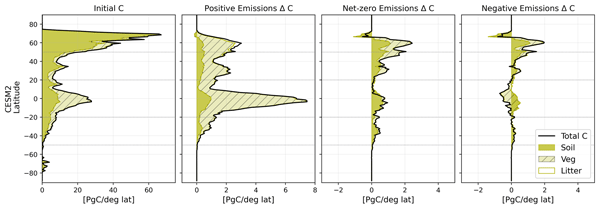
Abigail L. S. Swann, Charles D. Koven, Cristian Proistosecu, Rosie A. Fisher, Benjamin M. Sanderson, Victor Brovkin, Tomohiro Hajima, Chris D. Jones, Nancy Y. Kiang, David M. Lawrence, Spencer Liddicoat, Hannah Liddy, Anastasia Romanou, Roland Séférian, Lori T. Sentman, Norman J. Steinert, Jerry Tjiputra, and Tilo Ziehn
Earth Syst. Dynam., 17, 1237–1275, https://doi.org/10.5194/esd-17-1237-2026, https://doi.org/10.5194/esd-17-1237-2026, 2026
Short summary
Short summary
We analyzed simulations from Earth system models (ESM) with a constant rate of emissions, zero emissions, and negative emissions of CO2 to quantify the response of land carbon sinks. We found that under positive emissions vegetation in the tropics gained carbon. Under zero emissions and negative emissions most ESMs lost carbon from vegetation in the tropics but gained carbon in mid- and high-latitudes, mostly in soils. Our findings imply that tropical carbon is vulnerable under zero emissions.
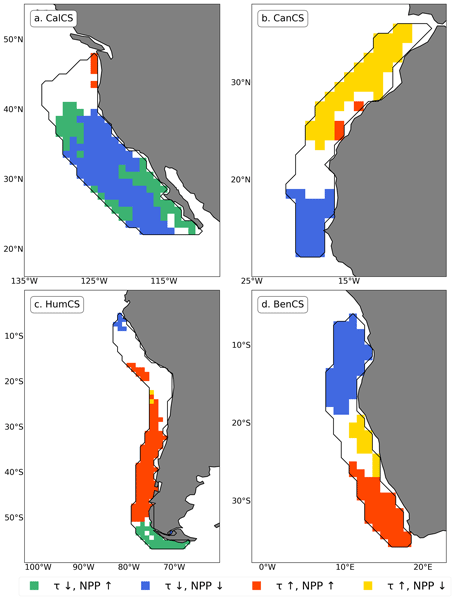
Erica Cioffi, Laurent Bopp, and Lester Kwiatkowski
Biogeosciences, 23, 6073–6093, https://doi.org/10.5194/bg-23-6073-2026, https://doi.org/10.5194/bg-23-6073-2026, 2026
Short summary
Short summary
Eastern Boundary Upwelling Systems disproportionately contribute to global productivity and fisheries. Using CMIP6 Earth System Models, we assess response of phytoplankton productivity to climate change in these regions and to what extent it is explained by changes in wind-driven upwelling. While this process drives productivity decline across 25% of upwelling systems area, wind curl, geostrophic transport, stratification and subsurface nutrients changes are needed to explain response elsewhere.
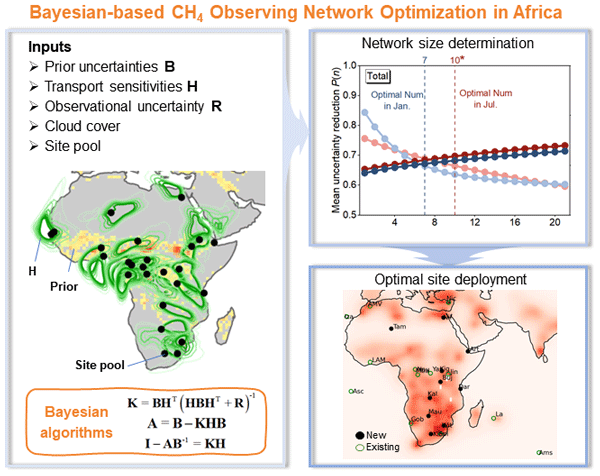
Hui Li, Philippe Ciais, Frédéric Chevallier, Bo Zheng, Paul I. Palmer, Frank Hase, Morgan Lopez, Elsa M. Ordway, Shushi Peng, Danielle Monteverde, Michel Ramonet, Jason M. St. Clair, Le Bienfaiteur Sagang, and Benjamin Poulter
Atmos. Chem. Phys., 26, 11893–11908, https://doi.org/10.5194/acp-26-11893-2026, https://doi.org/10.5194/acp-26-11893-2026, 2026
Short summary
Short summary
We studied how to best place methane monitoring instruments across Africa to better understand where emissions come from. Because observations can overlap in what they detect, adding more sites does not always improve results equally. Using a statistical approach, we identified both the ideal number and locations of sites (ten new sites can reduce emission uncertainty by over 65 % for total African CH4). Our results help guide cost-effective monitoring strategies in regions with limited data.
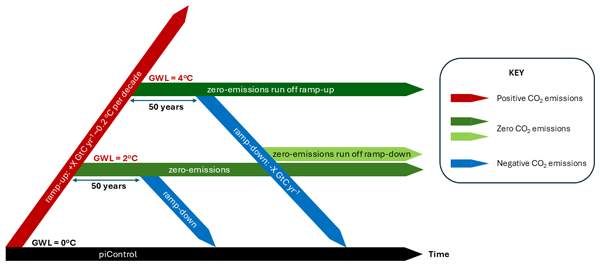
Colin Jones, Isaline Bossert, Donovan P. Dennis, Hazel A. Jeffery, Chris D. Jones, Torben Koenigk, Sina Loriani, Benjamin Sanderson, Roland Séférian, Klaus Wyser, Shuting Yang, Manabu Abe, Sebastian Bathiany, Pascale Braconnot, Victor Brovkin, Friedrich A. Burger, Patrica Cadule, Frederic S. Castruccio, Gokhan Danabasoglu, Andrea Dittus, Jonathan F. Donges, Friederike Fröb, Thomas L. Frölicher, Goran Georgievski, Chuncheng Guo, Aixue Hu, Peter Lawrence, Paul Lerner, José Licón-Saláiz, Bette Otto-Bliesner, Anastasia Romanou, Elena Shevliakova, Yona Silvy, Didier Swingedouw, Jerry Tjiputra, Jeremy Walton, Andy Wiltshire, Ricarda Winkelmann, Richard Wood, Tokuta Yokohata, and Tilo Ziehn
Geosci. Model Dev., 19, 6941–6966, https://doi.org/10.5194/gmd-19-6941-2026, https://doi.org/10.5194/gmd-19-6941-2026, 2026
Short summary
Short summary
We introduce a new Earth system model experiment protocol to help researchers understand how Earth might respond to positive, zero, and negative carbon emissions. This protocol enables different models to be compared following similar warming and cooling rates. Researchers use the models to explore how the Earth reacts to different climate futures, including the risk of tipping points being exceeded and whether changes can be reversed. The results will support improved long-term climate policy.
Léna Champiot-Bayard, Lester Kwiatkowski, and Martin Vancoppenolle
Biogeosciences, 23, 4735–4758, https://doi.org/10.5194/bg-23-4735-2026, https://doi.org/10.5194/bg-23-4735-2026, 2026
Short summary
Short summary
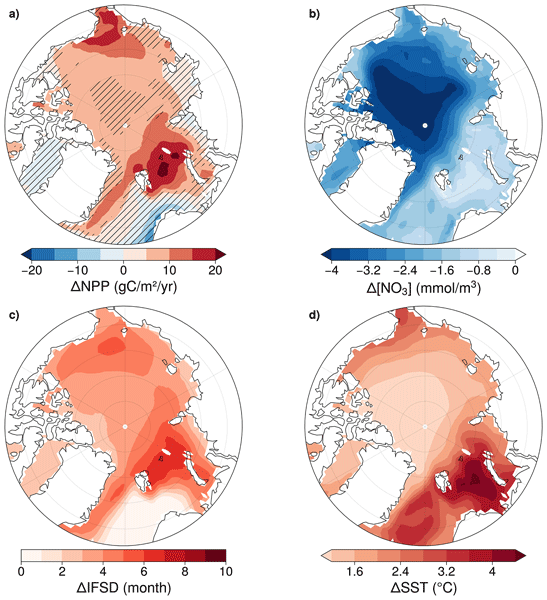
To investigate the future of primary production, we analyzed outputs from several climate models. Changes vary greatly from one region to another: some areas show large increases, while others experience little change or even declines. These differences reflect the balance between water temperature, light availability, and nutrient supply. We also found that the newer generation of climate models projects a much stronger increase than previous models, but with greater uncertainty.
Suki C. K. Wong, Galen A. McKinley, Richard Seager, Tess Wei-Ping Jacobson, Amanda Fay, Özgür Gürses, Nicolas Gruber, Tatiana Ilyina, Tereza Jarnikova, Laure Resplandy, Jörg Schwinger, and Roland Séférian
EGUsphere, https://doi.org/10.5194/egusphere-2026-3104, https://doi.org/10.5194/egusphere-2026-3104, 2026
Short summary
Short summary
The ocean absorbs nearly a third of human-made carbon dioxide, slowing climate change. This uptake varies from decade to decade for reasons we do not fully understand. Using a 66-year ocean carbon dataset, we found that the tropical Pacific and Southern Ocean drive this variability, in step with broader climate patterns across the Pacific. But these patterns cannot fully explain the recent weakening of the Southern Ocean sink, suggesting biological processes may also play an important role.
Benjamin M. Sanderson, Marit Sandstad, Alejandro Romero-Prieto, Stuart Jenkins, Charles Koven, Glen Peters, Roland Séfèrian, Andrew H. MacDougall, Ashwin Seshadri, Victor Brovkin, John Dunne, Abigail L. S. Swann, Torben Koenigk, Rosie A. Fisher, David Hohn, Tatiana Ilyina, Chris D. Jones, Hongmei Li, Peter Lawrence, Spencer Liddicoat, Nadine Mengis, Anastasia Romanou, Lori T. Sentman, Chris Smith, Norman J. Steinert, Jerry Tjiputra, and Tilo Ziehn
EGUsphere, https://doi.org/10.5194/egusphere-2026-1875, https://doi.org/10.5194/egusphere-2026-1875, 2026
Short summary
Short summary
When humanity stops emitting carbon dioxide, will temperatures keep rising, stabilize, or fall? Our study reveals in most models, temperatures remain nearly stable, but this hides a balance between the warming in response to radiation imbalance, and the cooling due to uptake of carbon in the land and ocean. Understanding this balance helps refine how much more CO2 we can safely emit.
Pierre Friedlingstein, Michael O'Sullivan, Matthew W. Jones, Robbie M. Andrew, Dorothee C. E. Bakker, Judith Hauck, Peter Landschützer, Corinne Le Quéré, Hongmei Li, Ingrid T. Luijkx, Glen P. Peters, Wouter Peters, Julia Pongratz, Clemens Schwingshackl, Stephen Sitch, Josep G. Canadell, Philippe Ciais, Kjetil Aas, Simone R. Alin, Peter Anthoni, Leticia Barbero, Nicholas R. Bates, Nicolas Bellouin, Alice Benoit-Cattin, Carla F. Berghoff, Raffaele Bernardello, Laurent Bopp, Ida Bagus Mandhara Brasika, Matthew A. Chamberlain, Naveen Chandra, Frédéric Chevallier, Louise P. Chini, Nathan O. Collier, Thomas H. Colligan, Margot Cronin, Laique M. Djeutchouang, Xinyu Dou, Matt P. Enright, Kazutaka Enyo, Michael Erb, Wiley Evans, Richard A. Feely, Liang Feng, Daniel J. Ford, Adrianna Foster, Filippa Fransner, Thomas Gasser, Marion Gehlen, Thanos Gkritzalis, Jefferson Goncalves De Souza, Giacomo Grassi, Luke Gregor, Nicolas Gruber, Bertrand Guenet, Özgür Gürses, Kirsty Harrington, Ian Harris, Jens Heinke, George C. Hurtt, Yosuke Iida, Tatiana Ilyina, Akihiko Ito, Andrew R. Jacobson, Atul K. Jain, Tereza Jarníková, Annika Jersild, Fei Jiang, Steve D. Jones, Etsushi Kato, Ralph F. Keeling, Kees Klein Goldewijk, Jürgen Knauer, Yawen Kong, Jan Ivar Korsbakken, Charles Koven, Taro Kunimitsu, Xin Lan, Junjie Liu, Zhiqiang Liu, Zhu Liu, Claire Lo Monaco, Lei Ma, Gregg Marland, Patrick C. McGuire, Galen A. McKinley, Joe R. Melton, Natalie Monacci, Erwan Monier, Eric J. Morgan, David R. Munro, Jens D. Müller, Shin-Ichiro Nakaoka, Lorna R. Nayagam, Yosuke Niwa, Tobias Nutzel, Are Olsen, Abdirahman M. Omar, Naiqing Pan, Sudhanshu Pandey, Denis Pierrot, Zhangcai Qin, Pierre Regnier, Gregor Rehder, Laure Resplandy, Alizée Roobaert, Thais M. Rosan, Christian Rödenbeck, Jörg Schwinger, Ingunn Skjelvan, T. Luke Smallman, Victoria Spada, Mohanan G. Sreeush, Qing Sun, Adrienne J. Sutton, Colm Sweeney, Didier Swingedouw, Roland Séférian, Shintaro Takao, Hiroaki Tatebe, Hanqin Tian, Xiangjun Tian, Bronte Tilbrook, Hiroyuki Tsujino, Francesco Tubiello, Erik van Ooijen, Guido R. van der Werf, Sebastiaan J. van de Velde, Anthony P. Walker, Rik Wanninkhof, Xiaojuan Yang, Wenping Yuan, Xu Yue, and Jiye Zeng
Earth Syst. Sci. Data, 18, 3211–3288, https://doi.org/10.5194/essd-18-3211-2026, https://doi.org/10.5194/essd-18-3211-2026, 2026
Short summary
Short summary
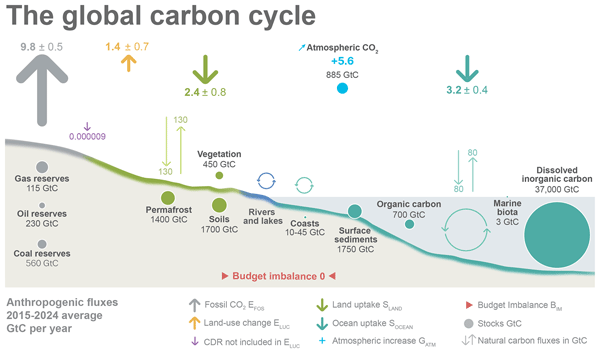
The Global Carbon Budget 2025 describes the methodology, main results, and datasets used to quantify the anthropogenic emissions of carbon dioxide (CO2) and their partitioning among the atmosphere, land ecosystems, and the ocean over the historical period (1750–2025). These living datasets are updated every year to provide the highest transparency and traceability in the reporting of CO2, the key driver of climate change.
Jonathan Rogerson, Alessandro Tagliabue, Agathe Nguyen, Marcello Vichi, Lewis Wrightson, Prima Anugerahanti, Olivier Aumont, and Marion Gehlen
Biogeosciences, 23, 3179–3194, https://doi.org/10.5194/bg-23-3179-2026, https://doi.org/10.5194/bg-23-3179-2026, 2026
Short summary
Short summary
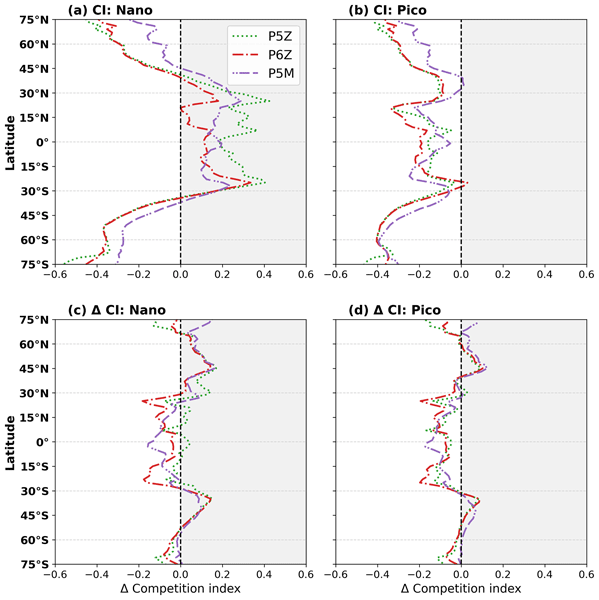
We use five different versions of a biogeochemical model to show that how phytoplankton growth processes are represented strongly shapes projections of future ocean productivity and carbon export. Added model complexity does not have a uniform global effect as some new processes mainly influence specific ocean regions, while others, such as an additional small phytoplankton type, lead to large intramodel differences in future trends and latitudinal patterns of productivity and carbon export.
François-Marie Bréon, Frédéric Chevallier, and Michel Ramonet
EGUsphere, https://doi.org/10.5194/egusphere-2026-1995, https://doi.org/10.5194/egusphere-2026-1995, 2026
Short summary
Short summary
Atmospheric CO2 concentrations show (i) a global trend, (ii) a seasonal cycle that varies with location and altitude and (iii) inter-annual and synoptic variability. Based on a full 4D modelling, this paper proposes a climatological fit that reproduces (i) and (ii). The full modelling and its climatological fit are evaluated against both AirCore CO2 concentration samples and total column from ground based remote sensing. The climatological product provides an estimate of the CO2 concentration.
Isobel M. Parry, Paul D. L. Ritchie, Olivier Boucher, Peter M. Cox, James M. Haywood, Ulrike Niemeier, Roland Séférian, Simone Tilmes, and Daniele Visioni
Earth Syst. Dynam., 17, 387–414, https://doi.org/10.5194/esd-17-387-2026, https://doi.org/10.5194/esd-17-387-2026, 2026
Short summary
Short summary
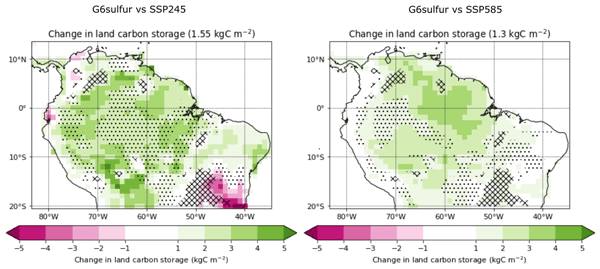
Contrary to some expectations, results from the latest Earth System Models suggest that Solar Radiation Geoengineering could protect the Amazon rainforest from climate-driven dieback. Under Stratospheric Aerosol Injection, carbon storage in Amazonia was projected to increase by a mean of 10.8 % relative to a high CO2 emissions scenario, and even by 8.6% compared to a more conventional medium CO2 emissions scenario.
Nicolas Metzl, Bronte Tilbrook, John Akl, Craig Neill, Alexandra Aymard, Claire Lo Monaco, Gilles Reverdin, Jean-Baptiste Sallée, Aude Barton, Frédéric Chevallier, and Marion Gehlen
EGUsphere, https://doi.org/10.5194/egusphere-2026-1664, https://doi.org/10.5194/egusphere-2026-1664, 2026
Short summary
Short summary
Ocean acidification is explored in the Adélie Land coastal region in East Antarctica. The region is a permanent CO2 sink leading to a positive increase of total CO2 concentrations and to a progressive decrease of pH and aragonite Ωar. The lowest surface Ωar of 1.2 was observed in winter 2024, a critical limit for some marine species such as pteropod. A projection in the future suggests that aragonite saturation state will occur as soon as 2055 in the Adélie Land region.
Mathieu Delteil, Marina Lévy, and Laurent Bopp
Biogeosciences, 23, 2205–2233, https://doi.org/10.5194/bg-23-2205-2026, https://doi.org/10.5194/bg-23-2205-2026, 2026
Short summary
Short summary
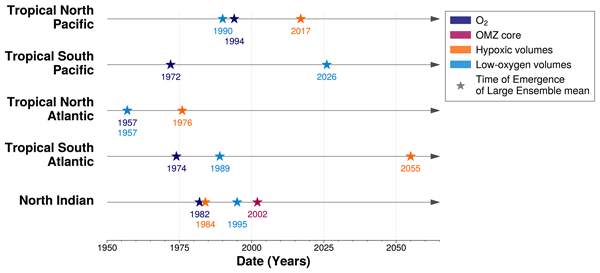
The ocean is losing oxygen due to climate change, threatening ecosystems, especially in naturally low-oxygen areas called Oxygen Minimum Zones (OMZs). Using the IPSL-CM6A-LR Large Ensemble, this study identifies when climate-driven changes in OMZ volumes and regional deoxygenation emerge from natural variability. We highlight hemispheric asymmetries due to ocean ventilation and provide model-based estimates for the timing of detectable OMZ evolution.
Detlef P. Van Vuuren, Brian C. O'Neill, Claudia Tebaldi, Benjamin M. Sanderson, Louise P. Chini, Pierre Friedlingstein, Tomoko Hasegawa, Keywan Riahi, Bala Govindasamy, Nico Bauer, Veronika Eyring, Cheikh M. N. Fall, Katja Frieler, Matthew J. Gidden, Laila K. Gohar, Annika Högner, Andrew D. Jones, Jarmo Kikstra, Andrew King, Reto Knutti, Elmar Kriegler, Peter Lawrence, Chris Lennard, Jason Lowe, Camilla Mathison, Shahbaz Mehmood, Zebedee Nicholls, Luciana F. Prado, Qiang Zhang, Steven K. Rose, Alex C. Ruane, Marit Sandstad, Carl-Friedrich Schleussner, Roland Seferian, Jana Sillmann, Chris Smith, Anna A. Sörensson, Swapna Panickal, Kaoru Tachiiri, Naomi Vaughan, Saritha S. Vishwanathan, Tokuta Yokohata, Marco Zecchetto, and Tilo Ziehn
Geosci. Model Dev., 19, 2627–2656, https://doi.org/10.5194/gmd-19-2627-2026, https://doi.org/10.5194/gmd-19-2627-2026, 2026
Short summary
Short summary
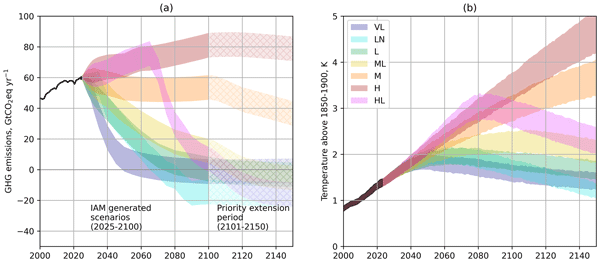
We propose a set of seven plausible 21st century emission scenarios, and their multi-century extensions, that will be used by the international community of climate modeling centers to produce the next generation of climate projections. These projections will support climate, impact and mitigation researchers, provide information to practitioners to address future risks from climate change, and contribute to policymakers’ considerations of the trade-offs among various levels of mitigation.
Isaline Bossert, Roland Séférian, Yeray Santana-Falcón, and Thibault Guinaldo
EGUsphere, https://doi.org/10.5194/egusphere-2026-993, https://doi.org/10.5194/egusphere-2026-993, 2026
Short summary
Short summary
The response of the ocean to net-zero emissions remains poorly understood. Using 300-year net-zero Earth system simulations, we show that sea surface temperature and marine heatwaves continue to reorganize long after emissions stop, with major departures from transient projections, implying underestimated long-term marine ecosystem risks.
Helene A. L. Hollitzer, Laurent Bopp, and Jens Terhaar
EGUsphere, https://doi.org/10.5194/egusphere-2026-683, https://doi.org/10.5194/egusphere-2026-683, 2026
Short summary
Short summary
Due to its vast coastline, the Arctic Ocean receives large amounts of carbon and nutrients from land, yet the impact of these inputs on ocean acidification remains poorly quantified. Using an ocean biogeochemical model, we show that these inputs affect the intensity, vertical structure, and seasonal cycle of acidification. River inputs generally reduce acidification, whereas the coastal erosion intensifies it, emphasizing the value of including these inputs in future Arctic modeling efforts.
Li-Qing Jiang, Amanda Fay, Jens Daniel Müller, Luke Gregor, Alizée Roobaert, Lydia Keppler, Dustin Carroll, Siv K. Lauvset, Tim DeVries, Judith Hauck, Christian Rödenbeck, Nicolas Metzl, Andrea J. Fassbender, Jean-Pierre Gattuso, Peter Landschützer, Rik Wanninkhof, Christopher Sabine, Simone R. Alin, Mario Hoppema, Are Olsen, Matthew P. Humphreys, Kunal Chakraborty, Ana C. Franco, Kumiko Azetsu-Scott, Dorothee C. E. Bakker, Leticia Barbero, Nicholas R. Bates, Nicole Besemer, Henry C. Bittig, Albert E. Boyd, Daniel Broullón, Wei-Jun Cai, Brendan R. Carter, Thi-Tuyet-Trang Chau, Chen-Tung Arthur Chen, Frédéric Cyr, John E. Dore, Ian Enochs, Richard A. Feely, Hernan E. Garcia, Marion Gehlen, Prasanna Kanti Ghoshal, Lucas Gloege, Melchor González-Dávila, Nicolas Gruber, Debby Ianson, Yosuke Iida, Masao Ishii, Apurva Padamnabh Joshi, Esther Kennedy, Alex Kozyr, Nico Lange, Claire Lo Monaco, Derek P. Manzello, Galen A. McKinley, Natalie M. Monacci, Xose A. Padin, Ana M. Palacio-Castro, Fiz F. Pérez, J. Magdalena Santana-Casiano, Jonathan Sharp, Adrienne Sutton, Jim Swift, Toste Tanhua, Maciej Telszewski, Jens Terhaar, Ruben van Hooidonk, Anton Velo, Andrew J. Watson, Angelicque E. White, Zelun Wu, Liang Xue, Hyelim Yoo, Jiye Zeng, and Guorong Zhong
Earth Syst. Sci. Data, 18, 1405–1462, https://doi.org/10.5194/essd-18-1405-2026, https://doi.org/10.5194/essd-18-1405-2026, 2026
Short summary
Short summary
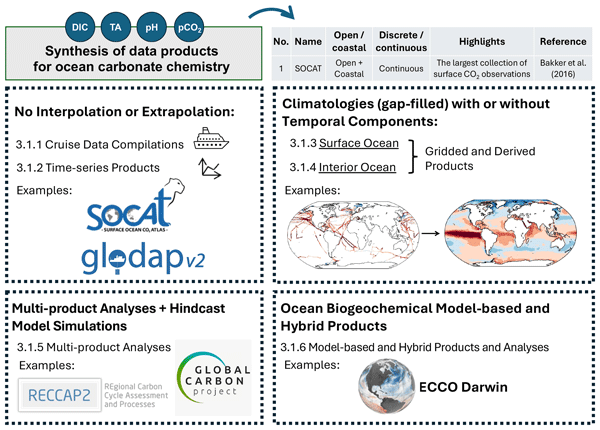
This review article provides an overview of 68 existing ocean carbonate chemistry data products and data product sets, encompassing a broad range of types, including compilations of cruise datasets, gap-filled observational products, model simulations, and more. It is designed to help researchers identify and access the data products that best support their scientific objectives, thereby facilitating progress in understanding the ocean's changing carbonate chemistry.
Alex Nalivaev, Francesco d'Ovidio, Laurent Bopp, Maristella Berta, Louise Rousselet, Clara Azarian, and Stéphane Blain
Biogeosciences, 23, 639–663, https://doi.org/10.5194/bg-23-639-2026, https://doi.org/10.5194/bg-23-639-2026, 2026
Short summary
Short summary
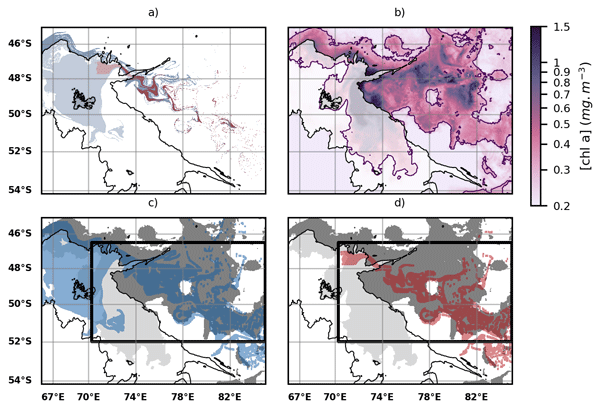
The Kerguelen region hosts a phytoplankton bloom influenced by several iron sources. In particular, glaciers supply iron to the coastal waters. However, the importance of glacial iron for the bloom is not known. Here we calculate iron transport pathways from glaciers to the open ocean using in situ and satellite data, showing that one third of the offshore bloom is reached by glacial iron. These results are important in the context of the melting of the Kerguelen ice cap under climate change.
Benjamin M. Sanderson, Susanne Baur, Carl-Freidrich Schleussner, Glen P. Peters, Shivika Mittal, Marit Sandstad, Steffen Kallbekken, Chris Smith, Sabine Fuss, Bas van Ruijven, Rosie A. Fisher, Joeri Rogelj, Roland Séférian, Bjørn Samset, Norman J. Steinert, Laurent Terray, and Jan Fuglestvedt
EGUsphere, https://doi.org/10.5194/egusphere-2026-28, https://doi.org/10.5194/egusphere-2026-28, 2026
Preprint archived
Short summary
Short summary
Solar Radiation Modification by adding aerosols to the stratosphere could rapidly and temporarily cool the Earth, but this speed creates unprecedented risks. Fast climate responses coupled with political instability create risks of failure to decarbonise, super-rapid climate change, and conflict. Idealized scenarios or conventional modeling tools could lead to systematic ignorance of these risks. We thus introduce a framework outlining what must be represented in future modeling and assessment.
Hui Li, Philippe Ciais, Pramod Kumar, Didier A. Hauglustaine, Frédéric Chevallier, Grégoire Broquet, Dylan B. Millet, Kelley C. Wells, Jinghui Lian, and Bo Zheng
Earth Syst. Sci. Data, 17, 7035–7054, https://doi.org/10.5194/essd-17-7035-2025, https://doi.org/10.5194/essd-17-7035-2025, 2025
Short summary
Short summary
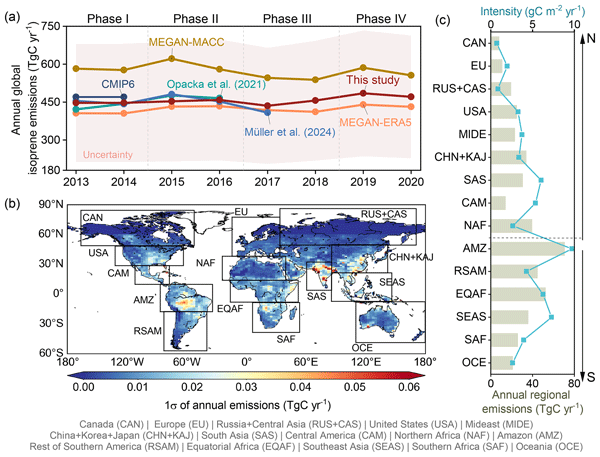
We present the first global, multi-year maps of monthly isoprene emissions (2013–2020) derived from satellite isoprene observations, averaging 456 TgC yr-1. The dataset reveals two emission peaks linked to 2015–2016 El Niño and 2019–2020 extreme heat events, driven mainly by tropical regions such as the Amazon. It highlights the region-specific sensitivity of biogenic isoprene emissions to temperature anomalies, providing new insights into their roles in air quality and climate feedbacks.
Nicolas Metzl, Claire Lo Monaco, Aline Tribollet, Jean-François Ternon, Frédéric Chevallier, and Marion Gehlen
Biogeosciences, 22, 7187–7204, https://doi.org/10.5194/bg-22-7187-2025, https://doi.org/10.5194/bg-22-7187-2025, 2025
Short summary
Short summary
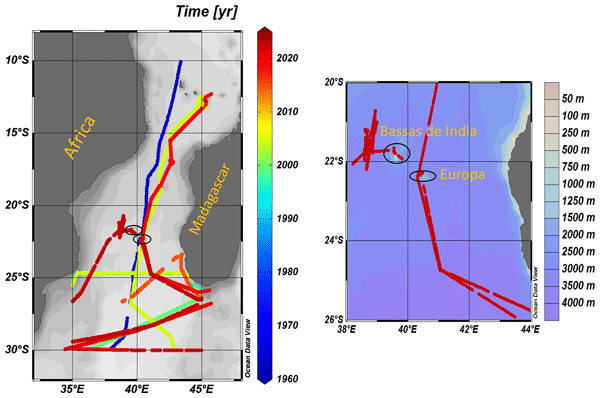
In the Mozambique Channel, observed acceleration of the ocean acidification in the recent decades is mainly driven by anthropogenic CO2 uptake. In this region the aragonite saturation state reached 3.2 in 2025 and could be as low as 3 in the next 10 years with potential impact on marine ecosystem including corals reefs areas.
Nikolina Mileva, Julia Pongratz, Vivek K. Arora, Akihiko Ito, Sebastiaan Luyssaert, Sonali S. McDermid, Paul A. Miller, Daniele Peano, Roland Séférian, Yanwu Zhang, and Wolfgang Buermann
Earth Syst. Dynam., 16, 2137–2160, https://doi.org/10.5194/esd-16-2137-2025, https://doi.org/10.5194/esd-16-2137-2025, 2025
Short summary
Short summary
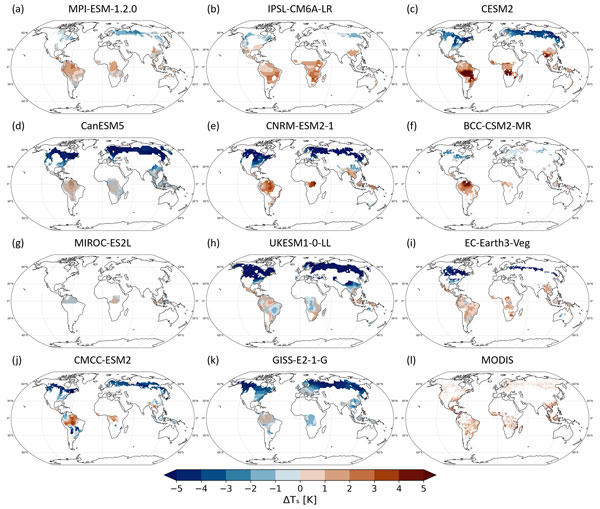
Despite forests being so important for mitigating climate change, there are still uncertainties about how much the changes in forest cover contribute to the cooling/warming of the climate. Climate models and real-world observations often disagree about the magnitude and even the direction of these changes. We constrain climate models scenarios of widespread deforestation with satellite and in-situ data and show that models still have difficulties representing the movement of heat and water.
Victor Brovkin, Benjamin M. Sanderson, Noel G. Brizuela, Tomohiro Hajima, Tatiana Ilyina, Chris D. Jones, Charles Koven, David Lawrence, Peter Lawrence, Hongmei Li, Spencer Liddcoat, Anastasia Romanou, Roland Séférian, Lori T. Sentman, Abigail L. S. Swann, Jerry Tjiputra, Tilo Ziehn, and Alexander J. Winkler
Earth Syst. Dynam., 16, 2021–2034, https://doi.org/10.5194/esd-16-2021-2025, https://doi.org/10.5194/esd-16-2021-2025, 2025
Short summary
Short summary
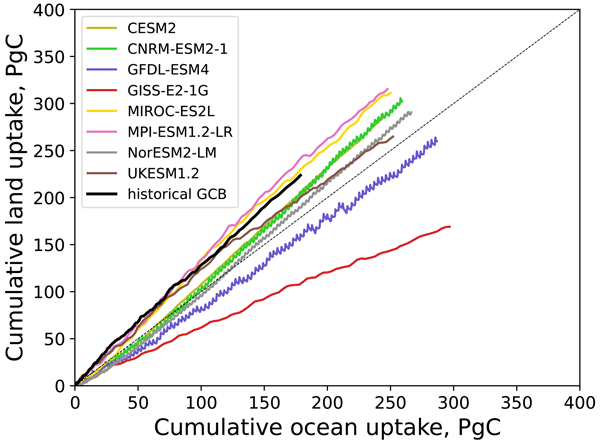
Idealized experiments with Earth system models provide a basis for understanding the response of the carbon cycle to emissions. We show that most models exhibit a quasi-linear relationship between cumulative carbon uptake on land and in the ocean and hypothesize that this relationship does not depend on emission pathways. We reduce the coupled system to only one differential equation, which represents a powerful simplification of the Earth system dynamics as a function of fossil fuel emissions.
Germain Bénard, Marion Gehlen, and Mathieu Vrac
EGUsphere, https://doi.org/10.5194/egusphere-2025-4680, https://doi.org/10.5194/egusphere-2025-4680, 2025
Preprint archived
Short summary
Short summary
Climate change is transforming ocean ecosystem dynamics. We used causality methods to study how the relationships between ocean physics and biogeochemistry will change in the North Atlantic over the next century. By analyzing five different climate models, we discovered that environmental drivers' influence on ocean productivity evolves in complex ways under global warming. One environmental driver can become of major importance while others can become irrelevant.
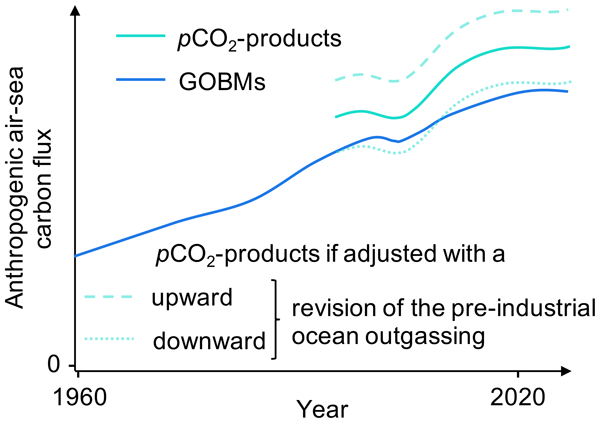
Alban Planchat, Laurent Bopp, and Lester Kwiatkowski
Biogeosciences, 22, 6017–6055, https://doi.org/10.5194/bg-22-6017-2025, https://doi.org/10.5194/bg-22-6017-2025, 2025
Short summary
Short summary
Disparities between observational and model-based estimates of the ocean carbon sink persist, highlighting the need for improved understanding and methodologies to reconcile differences in both magnitude and trends over recent decades. A potential key source of uncertainty lies in the pre-industrial air–sea carbon flux, which is essential for isolating the anthropogenic component from observations. Thus, we take a fresh look at this flux using the alkalinity budget, alongside the carbon budget.
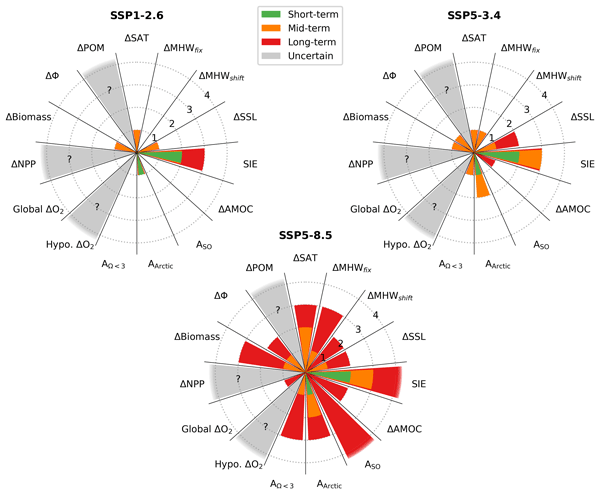
Timothée Bourgeois, Giang T. Tran, Aurich Jeltsch-Thömmes, Jörg Schwinger, Friederike Fröb, Thomas L. Frölicher, Thorsten Blenckner, Olivier Torres, Jean Negrel, David P. Keller, Andreas Oschlies, Laurent Bopp, and Fortunat Joos
Biogeosciences, 22, 5435–5462, https://doi.org/10.5194/bg-22-5435-2025, https://doi.org/10.5194/bg-22-5435-2025, 2025
Short summary
Short summary
Anthropogenic greenhouse gas emissions significantly impact ocean ecosystems through climate change and acidification, leading to either progressive or abrupt changes. This study maps the crossing of physical and ecological limits for various ocean impact metrics under three emission scenarios. Using Earth system models, we identify when these limits are exceeded, highlighting the urgent need for ambitious climate action to safeguard the world's oceans and ecosystems.
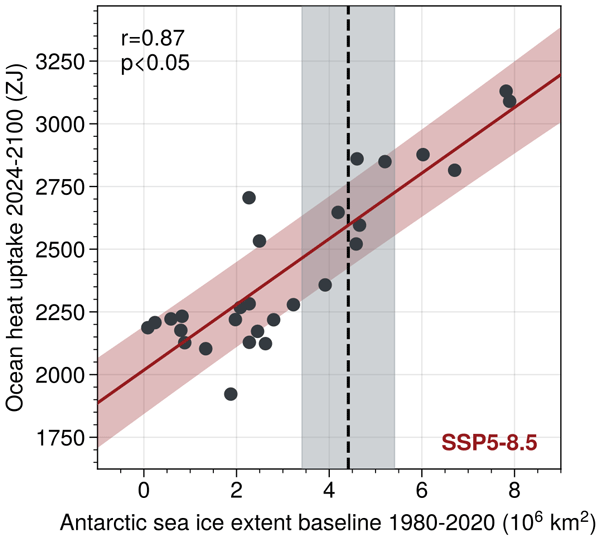
Linus Vogt, Casimir de Lavergne, Jean-Baptiste Sallée, Lester Kwiatkowski, Thomas L. Frölicher, and Jens Terhaar
Earth Syst. Dynam., 16, 1453–1482, https://doi.org/10.5194/esd-16-1453-2025, https://doi.org/10.5194/esd-16-1453-2025, 2025
Short summary
Short summary
Future projections of global ocean heat uptake (OHU) strongly differ between climate models. Here, we reveal an observational constraint on future OHU based on historical Antarctic sea ice extent observations. This emergent constraint is based on a coupling between sea ice, deep- and surface ocean temperatures, and cloud feedback. It implies an upward correction of 2024–2100 global OHU projections by up to 14 % and suggests that previous constraints have underestimated future warming.
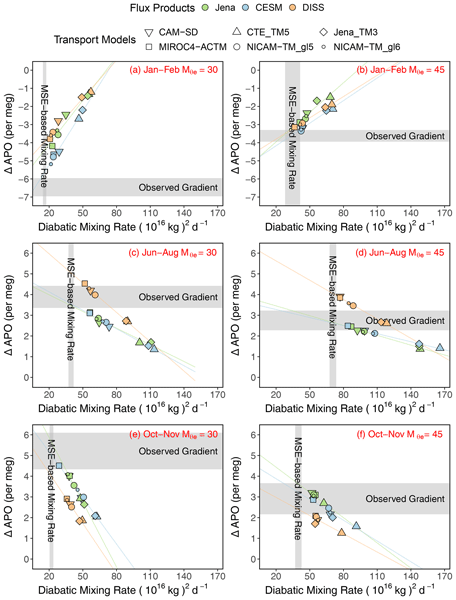
Yuming Jin, Britton B. Stephens, Matthew C. Long, Naveen Chandra, Frédéric Chevallier, Joram J. D. Hooghiem, Ingrid T. Luijkx, Shamil Maksyutov, Eric J. Morgan, Yosuke Niwa, Prabir K. Patra, Christian Rödenbeck, and Jesse Vance
Geosci. Model Dev., 18, 5937–5969, https://doi.org/10.5194/gmd-18-5937-2025, https://doi.org/10.5194/gmd-18-5937-2025, 2025
Short summary
Short summary
We carry out a comprehensive atmospheric transport model (ATM) intercomparison project. This project aims to evaluate errors in ATMs and three air-sea O2 flux products by comparing model simulations with observations collected from surface stations, ships, and aircraft. We also present a model evaluation framework to independently quantify transport-related and flux-related biases that contribute to model-observation discrepancies in atmospheric tracer distributions.
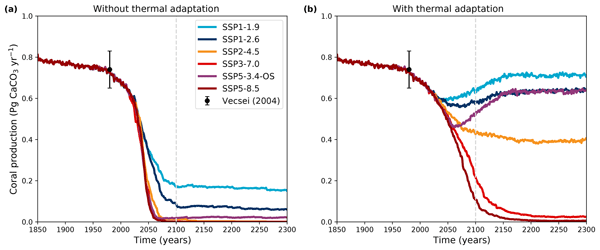
Nathaelle Bouttes, Lester Kwiatkowski, Elodie Bougeot, Manon Berger, Victor Brovkin, and Guy Munhoven
Biogeosciences, 22, 4531–4544, https://doi.org/10.5194/bg-22-4531-2025, https://doi.org/10.5194/bg-22-4531-2025, 2025
Short summary
Short summary
Coral reefs are under threat due to warming and ocean acidification. It is difficult to project future coral reef production due to uncertainties in climate models, socioeconomic scenarios and coral adaptation to warming. Here we have included a coral reef module within a climate model for the first time to evaluate the range of possible futures. We show that coral reef production decreases in most future scenarios, but in some cases coral reef carbonate production can persist.
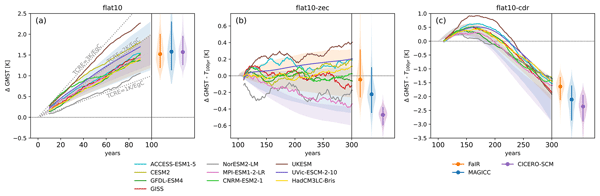
Benjamin M. Sanderson, Victor Brovkin, Rosie A. Fisher, David Hohn, Tatiana Ilyina, Chris D. Jones, Torben Koenigk, Charles Koven, Hongmei Li, David M. Lawrence, Peter Lawrence, Spencer Liddicoat, Andrew H. MacDougall, Nadine Mengis, Zebedee Nicholls, Eleanor O'Rourke, Anastasia Romanou, Marit Sandstad, Jörg Schwinger, Roland Séférian, Lori T. Sentman, Isla R. Simpson, Chris Smith, Norman J. Steinert, Abigail L. S. Swann, Jerry Tjiputra, and Tilo Ziehn
Geosci. Model Dev., 18, 5699–5724, https://doi.org/10.5194/gmd-18-5699-2025, https://doi.org/10.5194/gmd-18-5699-2025, 2025
Short summary
Short summary
This study investigates how climate models warm in response to simplified carbon emissions trajectories, refining the understanding of climate reversibility and commitment. Metrics are defined for warming response to cumulative emissions and for the cessation of emissions or ramp-down to net-zero and net-negative levels. Results indicate that previous concentration-driven experiments may have overstated the Zero Emissions Commitment due to emissions rates exceeding historical levels.
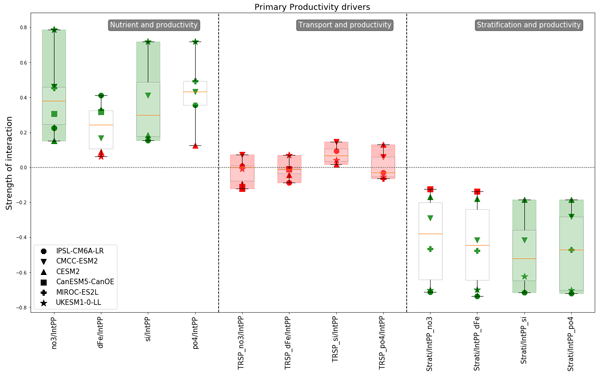
Germain Bénard, Marion Gehlen, and Mathieu Vrac
Earth Syst. Dynam., 16, 1085–1102, https://doi.org/10.5194/esd-16-1085-2025, https://doi.org/10.5194/esd-16-1085-2025, 2025
Short summary
Short summary
We introduce a novel approach to compare Earth system model output using a causality-based approach. The analysis of interactions between atmospheric, oceanic and biogeochemical variables in the North Atlantic subpolar gyre highlights the dynamics of each model. This method reveals potential underlying causes of model differences, offering a tool for enhanced model evaluation and improved understanding of complex Earth system dynamics under past and future climates.
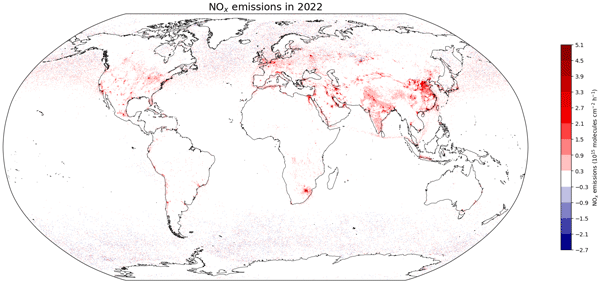
Anthony Rey-Pommier, Alexandre Héraud, Frédéric Chevallier, Philippe Ciais, Theodoros Christoudias, Jonilda Kushta, and Jean Sciare
Earth Syst. Sci. Data, 17, 3329–3351, https://doi.org/10.5194/essd-17-3329-2025, https://doi.org/10.5194/essd-17-3329-2025, 2025
Short summary
Short summary
In this study, we estimate emissions of nitrogen oxides (NOx) in 2022 at high resolution at the global scale, using satellite observations. We provide maps of the emissions and identify several types of sources. Our results are similar to the EDGAR emission inventory. However, differences are found in countries with lower observation densities and lower emissions.
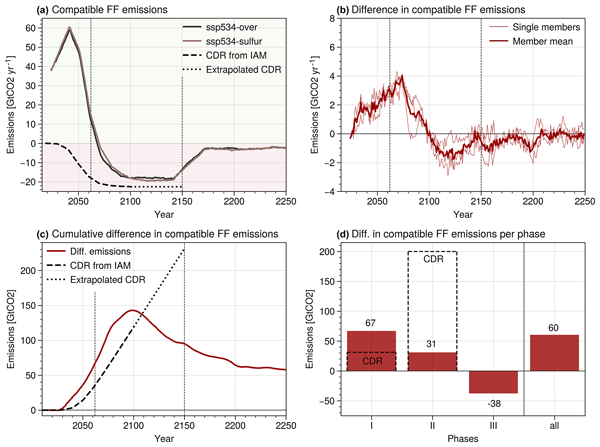
Susanne Baur, Benjamin M. Sanderson, Roland Séférian, and Laurent Terray
Earth Syst. Dynam., 16, 667–681, https://doi.org/10.5194/esd-16-667-2025, https://doi.org/10.5194/esd-16-667-2025, 2025
Short summary
Short summary
Stratospheric aerosol injection (SAI) could be used alongside mitigation to reduce global warming. Previous studies suggest that more atmospheric CO2 is taken up when SAI is deployed. Here, we look at the entire SAI deployment from start to after termination. We show how the initial CO2 uptake benefit, and hence lower mitigation burden, is reduced in later stages of SAI, where the reduction in natural CO2 uptake turns into an additional mitigation burden.
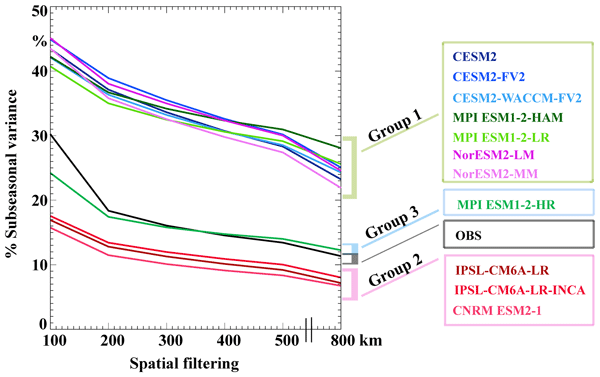
Madhavan Girijakumari Keerthi, Olivier Aumont, Lester Kwiatkowski, and Marina Levy
Biogeosciences, 22, 2163–2180, https://doi.org/10.5194/bg-22-2163-2025, https://doi.org/10.5194/bg-22-2163-2025, 2025
Short summary
Short summary
We assessed how well climate models replicate sub-seasonal changes in ocean chlorophyll observed by satellites. Models struggle to capture these variations accurately. Some overestimate fluctuations and their impact on annual chlorophyll variability, while others underestimate them. The underestimation is likely due to limited model resolution, while the overestimation may come from internal model oscillations.
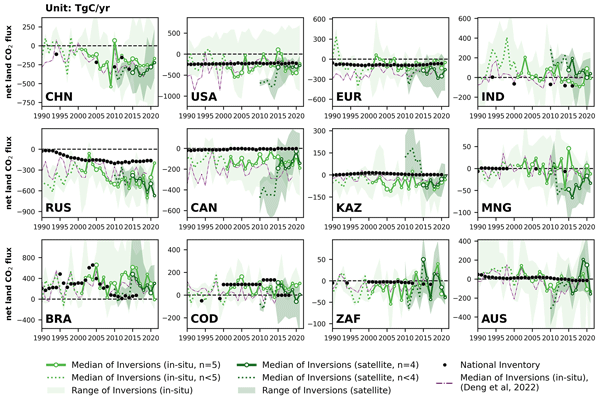
Zhu Deng, Philippe Ciais, Liting Hu, Adrien Martinez, Marielle Saunois, Rona L. Thompson, Kushal Tibrewal, Wouter Peters, Brendan Byrne, Giacomo Grassi, Paul I. Palmer, Ingrid T. Luijkx, Zhu Liu, Junjie Liu, Xuekun Fang, Tengjiao Wang, Hanqin Tian, Katsumasa Tanaka, Ana Bastos, Stephen Sitch, Benjamin Poulter, Clément Albergel, Aki Tsuruta, Shamil Maksyutov, Rajesh Janardanan, Yosuke Niwa, Bo Zheng, Joël Thanwerdas, Dmitry Belikov, Arjo Segers, and Frédéric Chevallier
Earth Syst. Sci. Data, 17, 1121–1152, https://doi.org/10.5194/essd-17-1121-2025, https://doi.org/10.5194/essd-17-1121-2025, 2025
Short summary
Short summary
This study reconciles national greenhouse gas (GHG) inventories with updated atmospheric inversion results to evaluate discrepancies for three principal GHG fluxes at the national level. Compared to our previous study, new satellite-based CO2 inversions were included and an updated mask of managed lands was used, improving agreement for Brazil and Canada. The proposed methodology can be regularly applied as a check to assess the gap between top-down inversions and bottom-up inventories.
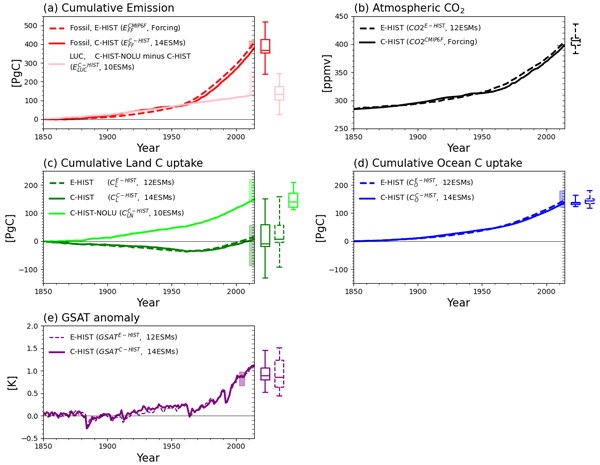
Tomohiro Hajima, Michio Kawamiya, Akihiko Ito, Kaoru Tachiiri, Chris D. Jones, Vivek Arora, Victor Brovkin, Roland Séférian, Spencer Liddicoat, Pierre Friedlingstein, and Elena Shevliakova
Biogeosciences, 22, 1447–1473, https://doi.org/10.5194/bg-22-1447-2025, https://doi.org/10.5194/bg-22-1447-2025, 2025
Short summary
Short summary
This study analyzes atmospheric CO2 concentrations and global carbon budgets simulated by multiple Earth system models, using several types of simulations (CO2 concentration- and emission-driven experiments). We successfully identified problems with regard to the global carbon budget in each model. We also found urgent issues with regard to land use change CO2 emissions that should be solved in the latest generation of models.
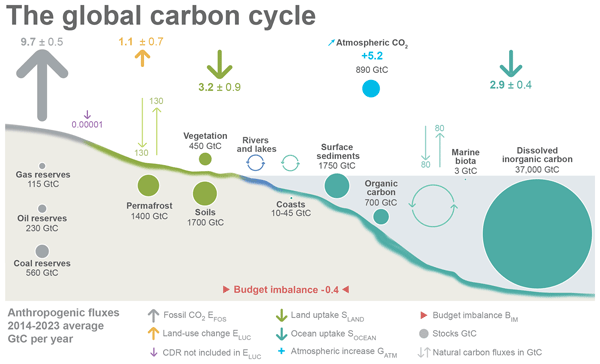
Pierre Friedlingstein, Michael O'Sullivan, Matthew W. Jones, Robbie M. Andrew, Judith Hauck, Peter Landschützer, Corinne Le Quéré, Hongmei Li, Ingrid T. Luijkx, Are Olsen, Glen P. Peters, Wouter Peters, Julia Pongratz, Clemens Schwingshackl, Stephen Sitch, Josep G. Canadell, Philippe Ciais, Robert B. Jackson, Simone R. Alin, Almut Arneth, Vivek Arora, Nicholas R. Bates, Meike Becker, Nicolas Bellouin, Carla F. Berghoff, Henry C. Bittig, Laurent Bopp, Patricia Cadule, Katie Campbell, Matthew A. Chamberlain, Naveen Chandra, Frédéric Chevallier, Louise P. Chini, Thomas Colligan, Jeanne Decayeux, Laique M. Djeutchouang, Xinyu Dou, Carolina Duran Rojas, Kazutaka Enyo, Wiley Evans, Amanda R. Fay, Richard A. Feely, Daniel J. Ford, Adrianna Foster, Thomas Gasser, Marion Gehlen, Thanos Gkritzalis, Giacomo Grassi, Luke Gregor, Nicolas Gruber, Özgür Gürses, Ian Harris, Matthew Hefner, Jens Heinke, George C. Hurtt, Yosuke Iida, Tatiana Ilyina, Andrew R. Jacobson, Atul K. Jain, Tereza Jarníková, Annika Jersild, Fei Jiang, Zhe Jin, Etsushi Kato, Ralph F. Keeling, Kees Klein Goldewijk, Jürgen Knauer, Jan Ivar Korsbakken, Xin Lan, Siv K. Lauvset, Nathalie Lefèvre, Zhu Liu, Junjie Liu, Lei Ma, Shamil Maksyutov, Gregg Marland, Nicolas Mayot, Patrick C. McGuire, Nicolas Metzl, Natalie M. Monacci, Eric J. Morgan, Shin-Ichiro Nakaoka, Craig Neill, Yosuke Niwa, Tobias Nützel, Lea Olivier, Tsuneo Ono, Paul I. Palmer, Denis Pierrot, Zhangcai Qin, Laure Resplandy, Alizée Roobaert, Thais M. Rosan, Christian Rödenbeck, Jörg Schwinger, T. Luke Smallman, Stephen M. Smith, Reinel Sospedra-Alfonso, Tobias Steinhoff, Qing Sun, Adrienne J. Sutton, Roland Séférian, Shintaro Takao, Hiroaki Tatebe, Hanqin Tian, Bronte Tilbrook, Olivier Torres, Etienne Tourigny, Hiroyuki Tsujino, Francesco Tubiello, Guido van der Werf, Rik Wanninkhof, Xuhui Wang, Dongxu Yang, Xiaojuan Yang, Zhen Yu, Wenping Yuan, Xu Yue, Sönke Zaehle, Ning Zeng, and Jiye Zeng
Earth Syst. Sci. Data, 17, 965–1039, https://doi.org/10.5194/essd-17-965-2025, https://doi.org/10.5194/essd-17-965-2025, 2025
Short summary
Short summary
The Global Carbon Budget 2024 describes the methodology, main results, and datasets used to quantify the anthropogenic emissions of carbon dioxide (CO2) and their partitioning among the atmosphere, land ecosystems, and the ocean over the historical period (1750–2024). These living datasets are updated every year to provide the highest transparency and traceability in the reporting of CO2, the key driver of climate change.
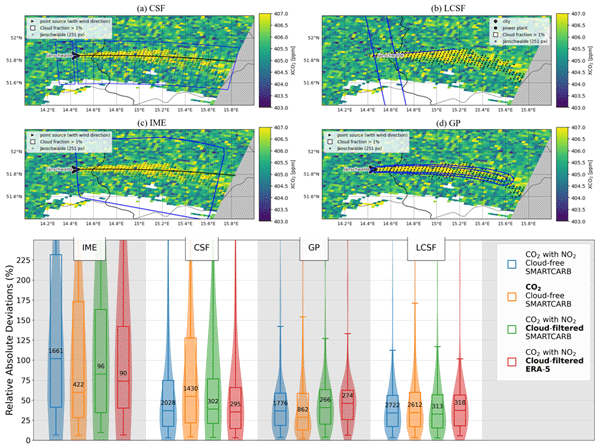
Diego Santaren, Janne Hakkarainen, Gerrit Kuhlmann, Erik Koene, Frédéric Chevallier, Iolanda Ialongo, Hannakaisa Lindqvist, Janne Nurmela, Johanna Tamminen, Laia Amorós, Dominik Brunner, and Grégoire Broquet
Atmos. Meas. Tech., 18, 211–239, https://doi.org/10.5194/amt-18-211-2025, https://doi.org/10.5194/amt-18-211-2025, 2025
Short summary
Short summary
This study evaluates data-driven inversion methods for estimating CO2 emissions from local sources, such as power plants and cities, using meteorological data and XCO2 and NO2 satellite images rather than atmospheric transport modeling. We assess and compare the performance of five different methods using simulations of 1 year of satellite images, taken from the upcoming Copernicus CO2 Monitoring Mission, covering 15 power plants and the city of Berlin, Germany.
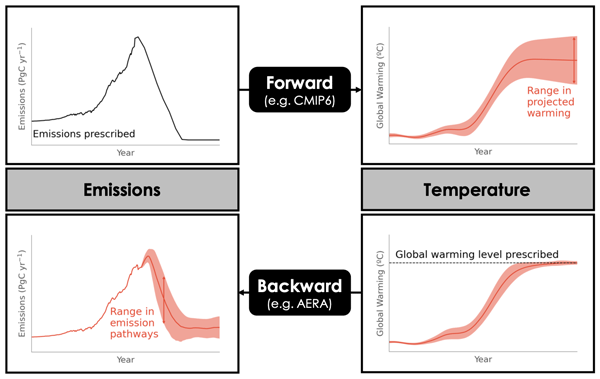
Yona Silvy, Thomas L. Frölicher, Jens Terhaar, Fortunat Joos, Friedrich A. Burger, Fabrice Lacroix, Myles Allen, Raffaele Bernardello, Laurent Bopp, Victor Brovkin, Jonathan R. Buzan, Patricia Cadule, Martin Dix, John Dunne, Pierre Friedlingstein, Goran Georgievski, Tomohiro Hajima, Stuart Jenkins, Michio Kawamiya, Nancy Y. Kiang, Vladimir Lapin, Donghyun Lee, Paul Lerner, Nadine Mengis, Estela A. Monteiro, David Paynter, Glen P. Peters, Anastasia Romanou, Jörg Schwinger, Sarah Sparrow, Eric Stofferahn, Jerry Tjiputra, Etienne Tourigny, and Tilo Ziehn
Earth Syst. Dynam., 15, 1591–1628, https://doi.org/10.5194/esd-15-1591-2024, https://doi.org/10.5194/esd-15-1591-2024, 2024
Short summary
Short summary
The adaptive emission reduction approach is applied with Earth system models to generate temperature stabilization simulations. These simulations provide compatible emission pathways and budgets for a given warming level, uncovering uncertainty ranges previously missing in the Coupled Model Intercomparison Project scenarios. These target-based emission-driven simulations offer a more coherent assessment across models for studying both the carbon cycle and its impacts under climate stabilization.
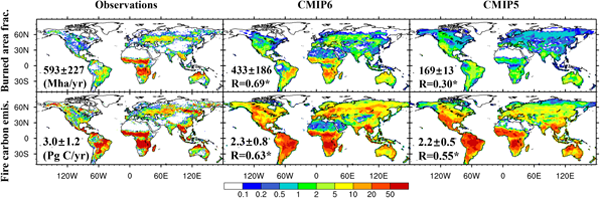
Fang Li, Xiang Song, Sandy P. Harrison, Jennifer R. Marlon, Zhongda Lin, L. Ruby Leung, Jörg Schwinger, Virginie Marécal, Shiyu Wang, Daniel S. Ward, Xiao Dong, Hanna Lee, Lars Nieradzik, Sam S. Rabin, and Roland Séférian
Geosci. Model Dev., 17, 8751–8771, https://doi.org/10.5194/gmd-17-8751-2024, https://doi.org/10.5194/gmd-17-8751-2024, 2024
Short summary
Short summary
This study provides the first comprehensive assessment of historical fire simulations from 19 Earth system models in phase 6 of the Coupled Model Intercomparison Project (CMIP6). Most models reproduce global totals, spatial patterns, seasonality, and regional historical changes well but fail to simulate the recent decline in global burned area and underestimate the fire response to climate variability. CMIP6 simulations address three critical issues of phase-5 models.
Benjamin M. Sanderson, Ben B. B. Booth, John Dunne, Veronika Eyring, Rosie A. Fisher, Pierre Friedlingstein, Matthew J. Gidden, Tomohiro Hajima, Chris D. Jones, Colin G. Jones, Andrew King, Charles D. Koven, David M. Lawrence, Jason Lowe, Nadine Mengis, Glen P. Peters, Joeri Rogelj, Chris Smith, Abigail C. Snyder, Isla R. Simpson, Abigail L. S. Swann, Claudia Tebaldi, Tatiana Ilyina, Carl-Friedrich Schleussner, Roland Séférian, Bjørn H. Samset, Detlef van Vuuren, and Sönke Zaehle
Geosci. Model Dev., 17, 8141–8172, https://doi.org/10.5194/gmd-17-8141-2024, https://doi.org/10.5194/gmd-17-8141-2024, 2024
Short summary
Short summary
We discuss how, in order to provide more relevant guidance for climate policy, coordinated climate experiments should adopt a greater focus on simulations where Earth system models are provided with carbon emissions from fossil fuels together with land use change instructions, rather than past approaches that have largely focused on experiments with prescribed atmospheric carbon dioxide concentrations. We discuss how these goals might be achieved in coordinated climate modeling experiments.

Colin G. Jones, Fanny Adloff, Ben B. B. Booth, Peter M. Cox, Veronika Eyring, Pierre Friedlingstein, Katja Frieler, Helene T. Hewitt, Hazel A. Jeffery, Sylvie Joussaume, Torben Koenigk, Bryan N. Lawrence, Eleanor O'Rourke, Malcolm J. Roberts, Benjamin M. Sanderson, Roland Séférian, Samuel Somot, Pier Luigi Vidale, Detlef van Vuuren, Mario Acosta, Mats Bentsen, Raffaele Bernardello, Richard Betts, Ed Blockley, Julien Boé, Tom Bracegirdle, Pascale Braconnot, Victor Brovkin, Carlo Buontempo, Francisco Doblas-Reyes, Markus Donat, Italo Epicoco, Pete Falloon, Sandro Fiore, Thomas Frölicher, Neven S. Fučkar, Matthew J. Gidden, Helge F. Goessling, Rune Grand Graversen, Silvio Gualdi, José M. Gutiérrez, Tatiana Ilyina, Daniela Jacob, Chris D. Jones, Martin Juckes, Elizabeth Kendon, Erik Kjellström, Reto Knutti, Jason Lowe, Matthew Mizielinski, Paola Nassisi, Michael Obersteiner, Pierre Regnier, Romain Roehrig, David Salas y Mélia, Carl-Friedrich Schleussner, Michael Schulz, Enrico Scoccimarro, Laurent Terray, Hannes Thiemann, Richard A. Wood, Shuting Yang, and Sönke Zaehle
Earth Syst. Dynam., 15, 1319–1351, https://doi.org/10.5194/esd-15-1319-2024, https://doi.org/10.5194/esd-15-1319-2024, 2024
Short summary
Short summary
We propose a number of priority areas for the international climate research community to address over the coming decade. Advances in these areas will both increase our understanding of past and future Earth system change, including the societal and environmental impacts of this change, and deliver significantly improved scientific support to international climate policy, such as future IPCC assessments and the UNFCCC Global Stocktake.
Karina von Schuckmann, Lorena Moreira, Mathilde Cancet, Flora Gues, Emmanuelle Autret, Ali Aydogdu, Lluis Castrillo, Daniele Ciani, Andrea Cipollone, Emanuela Clementi, Gianpiero Cossarini, Alvaro de Pascual-Collar, Vincenzo De Toma, Marion Gehlen, Rianne Giesen, Marie Drevillon, Claudia Fanelli, Kevin Hodges, Simon Jandt-Scheelke, Eric Jansen, Melanie Juza, Ioanna Karagali, Priidik Lagemaa, Vidar Lien, Leonardo Lima, Vladyslav Lyubartsev, Ilja Maljutenko, Simona Masina, Ronan McAdam, Pietro Miraglio, Helen Morrison, Tabea Rebekka Panteleit, Andrea Pisano, Marie-Isabelle Pujol, Urmas Raudsepp, Roshin Raj, Ad Stoffelen, Simon Van Gennip, Pierre Veillard, and Chunxue Yang
State Planet, 4-osr8, 2, https://doi.org/10.5194/sp-4-osr8-2-2024, https://doi.org/10.5194/sp-4-osr8-2-2024, 2024
Karina von Schuckmann, Lorena Moreira, Mathilde Cancet, Flora Gues, Emmanuelle Autret, Jonathan Baker, Clément Bricaud, Romain Bourdalle-Badie, Lluis Castrillo, Lijing Cheng, Frederic Chevallier, Daniele Ciani, Alvaro de Pascual-Collar, Vincenzo De Toma, Marie Drevillon, Claudia Fanelli, Gilles Garric, Marion Gehlen, Rianne Giesen, Kevin Hodges, Doroteaciro Iovino, Simon Jandt-Scheelke, Eric Jansen, Melanie Juza, Ioanna Karagali, Thomas Lavergne, Simona Masina, Ronan McAdam, Audrey Minière, Helen Morrison, Tabea Rebekka Panteleit, Andrea Pisano, Marie-Isabelle Pujol, Ad Stoffelen, Sulian Thual, Simon Van Gennip, Pierre Veillard, Chunxue Yang, and Hao Zuo
State Planet, 4-osr8, 1, https://doi.org/10.5194/sp-4-osr8-1-2024, https://doi.org/10.5194/sp-4-osr8-1-2024, 2024
Ana Maria Roxana Petrescu, Glen P. Peters, Richard Engelen, Sander Houweling, Dominik Brunner, Aki Tsuruta, Bradley Matthews, Prabir K. Patra, Dmitry Belikov, Rona L. Thompson, Lena Höglund-Isaksson, Wenxin Zhang, Arjo J. Segers, Giuseppe Etiope, Giancarlo Ciotoli, Philippe Peylin, Frédéric Chevallier, Tuula Aalto, Robbie M. Andrew, David Bastviken, Antoine Berchet, Grégoire Broquet, Giulia Conchedda, Stijn N. C. Dellaert, Hugo Denier van der Gon, Johannes Gütschow, Jean-Matthieu Haussaire, Ronny Lauerwald, Tiina Markkanen, Jacob C. A. van Peet, Isabelle Pison, Pierre Regnier, Espen Solum, Marko Scholze, Maria Tenkanen, Francesco N. Tubiello, Guido R. van der Werf, and John R. Worden
Earth Syst. Sci. Data, 16, 4325–4350, https://doi.org/10.5194/essd-16-4325-2024, https://doi.org/10.5194/essd-16-4325-2024, 2024
Short summary
Short summary
This study provides an overview of data availability from observation- and inventory-based CH4 emission estimates. It systematically compares them and provides recommendations for robust comparisons, aiming to steadily engage more parties in using observational methods to complement their UNFCCC submissions. Anticipating improvements in atmospheric modelling and observations, future developments need to resolve knowledge gaps in both approaches and to better quantify remaining uncertainty.

Nathaelle Bouttes, Lester Kwiatkowski, Manon Berger, Victor Brovkin, and Guy Munhoven
Geosci. Model Dev., 17, 6513–6528, https://doi.org/10.5194/gmd-17-6513-2024, https://doi.org/10.5194/gmd-17-6513-2024, 2024
Short summary
Short summary
Coral reefs are crucial for biodiversity, but they also play a role in the carbon cycle on long time scales of a few thousand years. To better simulate the future and past evolution of coral reefs and their effect on the global carbon cycle, hence on atmospheric CO2 concentration, it is necessary to include coral reefs within a climate model. Here we describe the inclusion of coral reef carbonate production in a carbon–climate model and its validation in comparison to existing modern data.
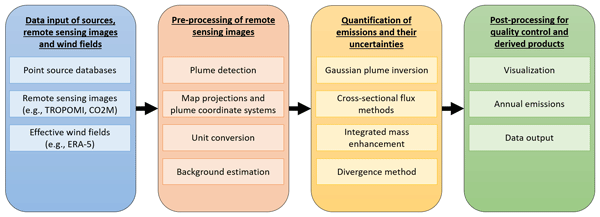
Gerrit Kuhlmann, Erik Koene, Sandro Meier, Diego Santaren, Grégoire Broquet, Frédéric Chevallier, Janne Hakkarainen, Janne Nurmela, Laia Amorós, Johanna Tamminen, and Dominik Brunner
Geosci. Model Dev., 17, 4773–4789, https://doi.org/10.5194/gmd-17-4773-2024, https://doi.org/10.5194/gmd-17-4773-2024, 2024
Short summary
Short summary
We present a Python software library for data-driven emission quantification (ddeq). It can be used to determine the emissions of hot spots (cities, power plants and industry) from remote sensing images using different methods. ddeq can be extended for new datasets and methods, providing a powerful community tool for users and developers. The application of the methods is shown using Jupyter notebooks included in the library.
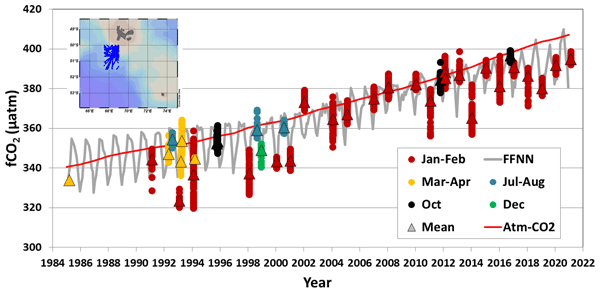
Nicolas Metzl, Claire Lo Monaco, Coraline Leseurre, Céline Ridame, Gilles Reverdin, Thi Tuyet Trang Chau, Frédéric Chevallier, and Marion Gehlen
Ocean Sci., 20, 725–758, https://doi.org/10.5194/os-20-725-2024, https://doi.org/10.5194/os-20-725-2024, 2024
Short summary
Short summary
In the southern Indian Ocean, south of the polar front, an observed increase of sea surface fCO2 and a decrease of pH over 1985–2021 are mainly driven by anthropogenic CO2 uptake, but in the last decade (2010–2020) fCO2 and pH were stable in summer, highlighting the competitive balance between anthropogenic CO2 and primary production. In the water column the increase of anthropogenic CO2 concentrations leads to migration of the aragonite saturation state from 600 m in 1985 up to 400 m in 2021.

Hanqin Tian, Naiqing Pan, Rona L. Thompson, Josep G. Canadell, Parvadha Suntharalingam, Pierre Regnier, Eric A. Davidson, Michael Prather, Philippe Ciais, Marilena Muntean, Shufen Pan, Wilfried Winiwarter, Sönke Zaehle, Feng Zhou, Robert B. Jackson, Hermann W. Bange, Sarah Berthet, Zihao Bian, Daniele Bianchi, Alexander F. Bouwman, Erik T. Buitenhuis, Geoffrey Dutton, Minpeng Hu, Akihiko Ito, Atul K. Jain, Aurich Jeltsch-Thömmes, Fortunat Joos, Sian Kou-Giesbrecht, Paul B. Krummel, Xin Lan, Angela Landolfi, Ronny Lauerwald, Ya Li, Chaoqun Lu, Taylor Maavara, Manfredi Manizza, Dylan B. Millet, Jens Mühle, Prabir K. Patra, Glen P. Peters, Xiaoyu Qin, Peter Raymond, Laure Resplandy, Judith A. Rosentreter, Hao Shi, Qing Sun, Daniele Tonina, Francesco N. Tubiello, Guido R. van der Werf, Nicolas Vuichard, Junjie Wang, Kelley C. Wells, Luke M. Western, Chris Wilson, Jia Yang, Yuanzhi Yao, Yongfa You, and Qing Zhu
Earth Syst. Sci. Data, 16, 2543–2604, https://doi.org/10.5194/essd-16-2543-2024, https://doi.org/10.5194/essd-16-2543-2024, 2024
Short summary
Short summary
Atmospheric concentrations of nitrous oxide (N2O), a greenhouse gas 273 times more potent than carbon dioxide, have increased by 25 % since the preindustrial period, with the highest observed growth rate in 2020 and 2021. This rapid growth rate has primarily been due to a 40 % increase in anthropogenic emissions since 1980. Observed atmospheric N2O concentrations in recent years have exceeded the worst-case climate scenario, underscoring the importance of reducing anthropogenic N2O emissions.
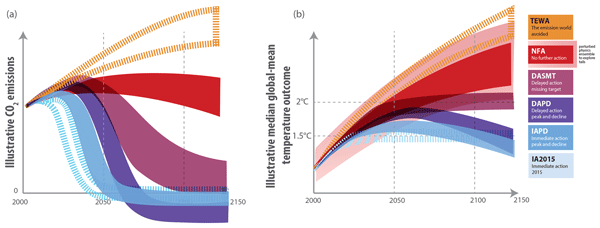
Malte Meinshausen, Carl-Friedrich Schleussner, Kathleen Beyer, Greg Bodeker, Olivier Boucher, Josep G. Canadell, John S. Daniel, Aïda Diongue-Niang, Fatima Driouech, Erich Fischer, Piers Forster, Michael Grose, Gerrit Hansen, Zeke Hausfather, Tatiana Ilyina, Jarmo S. Kikstra, Joyce Kimutai, Andrew D. King, June-Yi Lee, Chris Lennard, Tabea Lissner, Alexander Nauels, Glen P. Peters, Anna Pirani, Gian-Kasper Plattner, Hans Pörtner, Joeri Rogelj, Maisa Rojas, Joyashree Roy, Bjørn H. Samset, Benjamin M. Sanderson, Roland Séférian, Sonia Seneviratne, Christopher J. Smith, Sophie Szopa, Adelle Thomas, Diana Urge-Vorsatz, Guus J. M. Velders, Tokuta Yokohata, Tilo Ziehn, and Zebedee Nicholls
Geosci. Model Dev., 17, 4533–4559, https://doi.org/10.5194/gmd-17-4533-2024, https://doi.org/10.5194/gmd-17-4533-2024, 2024
Short summary
Short summary
The scientific community is considering new scenarios to succeed RCPs and SSPs for the next generation of Earth system model runs to project future climate change. To contribute to that effort, we reflect on relevant policy and scientific research questions and suggest categories for representative emission pathways. These categories are tailored to the Paris Agreement long-term temperature goal, high-risk outcomes in the absence of further climate policy and worlds “that could have been”.
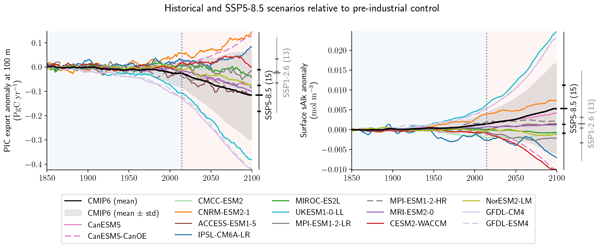
Alban Planchat, Laurent Bopp, Lester Kwiatkowski, and Olivier Torres
Earth Syst. Dynam., 15, 565–588, https://doi.org/10.5194/esd-15-565-2024, https://doi.org/10.5194/esd-15-565-2024, 2024
Short summary
Short summary
Ocean acidification is likely to impact all stages of the ocean carbonate pump. We show divergent responses of CaCO3 export throughout this century in earth system models, with anomalies by 2100 ranging from −74 % to +23 % under a high-emission scenario. While we confirm the limited impact of carbonate pump anomalies on 21st century ocean carbon uptake and acidification, we highlight a potentially abrupt shift in CaCO3 dissolution from deep to subsurface waters beyond 2100.
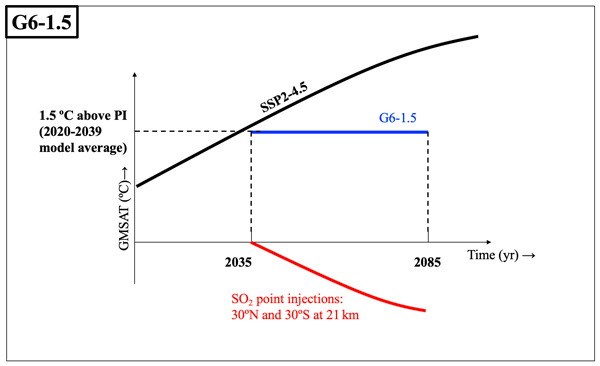
Daniele Visioni, Alan Robock, Jim Haywood, Matthew Henry, Simone Tilmes, Douglas G. MacMartin, Ben Kravitz, Sarah J. Doherty, John Moore, Chris Lennard, Shingo Watanabe, Helene Muri, Ulrike Niemeier, Olivier Boucher, Abu Syed, Temitope S. Egbebiyi, Roland Séférian, and Ilaria Quaglia
Geosci. Model Dev., 17, 2583–2596, https://doi.org/10.5194/gmd-17-2583-2024, https://doi.org/10.5194/gmd-17-2583-2024, 2024
Short summary
Short summary
This paper describes a new experimental protocol for the Geoengineering Model Intercomparison Project (GeoMIP). In it, we describe the details of a new simulation of sunlight reflection using the stratospheric aerosols that climate models are supposed to run, and we explain the reasons behind each choice we made when defining the protocol.
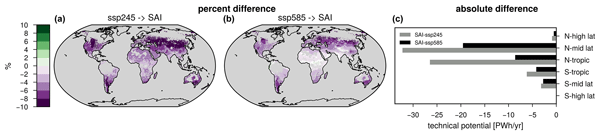
Susanne Baur, Benjamin M. Sanderson, Roland Séférian, and Laurent Terray
Earth Syst. Dynam., 15, 307–322, https://doi.org/10.5194/esd-15-307-2024, https://doi.org/10.5194/esd-15-307-2024, 2024
Short summary
Short summary
Most solar radiation modification (SRM) simulations assume no physical coupling between mitigation and SRM. We analyze the impact of SRM on photovoltaic (PV) and concentrated solar power (CSP) and find that almost all regions have reduced PV and CSP potential compared to a mitigated or unmitigated scenario, especially in the middle and high latitudes. This suggests that SRM could pose challenges for meeting energy demands with solar renewable resources.
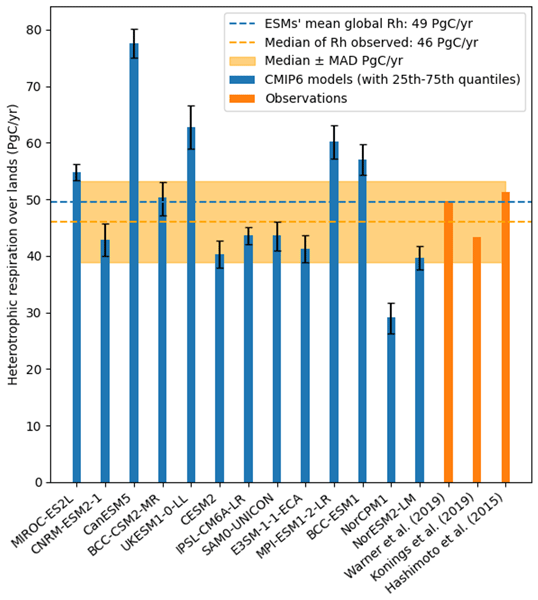
Bertrand Guenet, Jérémie Orliac, Lauric Cécillon, Olivier Torres, Laura Sereni, Philip A. Martin, Pierre Barré, and Laurent Bopp
Biogeosciences, 21, 657–669, https://doi.org/10.5194/bg-21-657-2024, https://doi.org/10.5194/bg-21-657-2024, 2024
Short summary
Short summary
Heterotrophic respiration fluxes are a major flux between surfaces and the atmosphere, but Earth system models do not yet represent them correctly. Here we benchmarked Earth system models against observation-based products, and we identified the important mechanisms that need to be improved in the next-generation Earth system models.
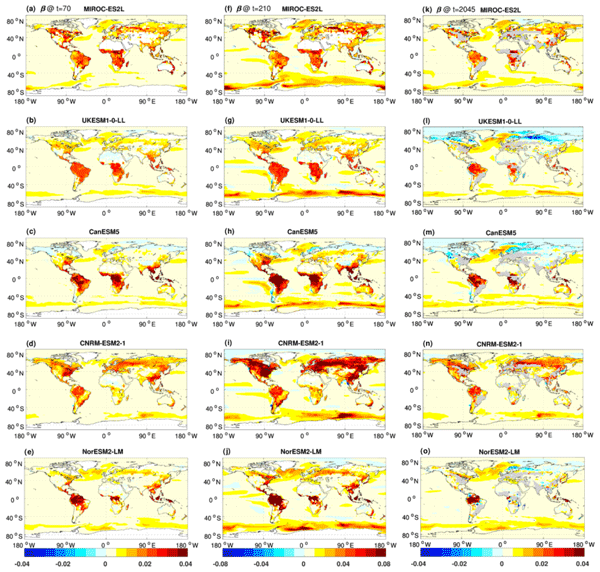
Ali Asaadi, Jörg Schwinger, Hanna Lee, Jerry Tjiputra, Vivek Arora, Roland Séférian, Spencer Liddicoat, Tomohiro Hajima, Yeray Santana-Falcón, and Chris D. Jones
Biogeosciences, 21, 411–435, https://doi.org/10.5194/bg-21-411-2024, https://doi.org/10.5194/bg-21-411-2024, 2024
Short summary
Short summary
Carbon cycle feedback metrics are employed to assess phases of positive and negative CO2 emissions. When emissions become negative, we find that the model disagreement in feedback metrics increases more strongly than expected from the assumption that the uncertainties accumulate linearly with time. The geographical patterns of such metrics over land highlight that differences in response between tropical/subtropical and temperate/boreal ecosystems are a major source of model disagreement.
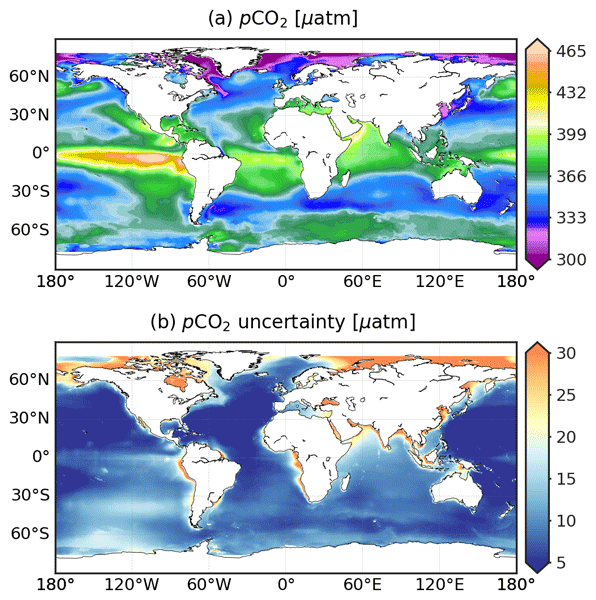
Thi-Tuyet-Trang Chau, Marion Gehlen, Nicolas Metzl, and Frédéric Chevallier
Earth Syst. Sci. Data, 16, 121–160, https://doi.org/10.5194/essd-16-121-2024, https://doi.org/10.5194/essd-16-121-2024, 2024
Short summary
Short summary
CMEMS-LSCE leads as the first global observation-based reconstructions of six carbonate system variables for the years 1985–2021 at monthly and 0.25° resolutions. The high-resolution reconstructions outperform their 1° counterpart in reproducing horizontal and temporal gradients of observations over various oceanic regions to nearshore time series stations. New datasets can be exploited in numerous studies, including monitoring changes in ocean carbon uptake and ocean acidification.
Alizée Dale, Marion Gehlen, Douglas W. R. Wallace, Germain Bénard, Christian Éthé, and Elena Alekseenko
EGUsphere, https://doi.org/10.5194/egusphere-2023-2538, https://doi.org/10.5194/egusphere-2023-2538, 2023
Preprint archived
Short summary
Short summary
Diatom, which is at the base of a productive food chain that supports valuable fisheries, dominates the total primary production of the Labrador Sea (LS). The synthesis of biogenic silica frustules makes them peculiar among phytoplankton but also dependent on dissolved silicate (DSi). Regular oceanographic surveys show declining DSi concentrations since the mid-1990s. With a model-based approach, we show that weakening deep winter convection was the proximate cause of DSi decline in the LS.
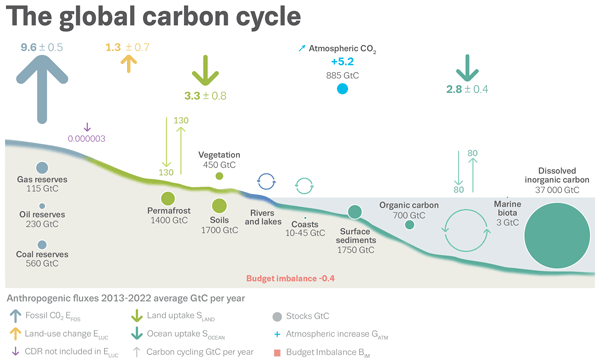
Pierre Friedlingstein, Michael O'Sullivan, Matthew W. Jones, Robbie M. Andrew, Dorothee C. E. Bakker, Judith Hauck, Peter Landschützer, Corinne Le Quéré, Ingrid T. Luijkx, Glen P. Peters, Wouter Peters, Julia Pongratz, Clemens Schwingshackl, Stephen Sitch, Josep G. Canadell, Philippe Ciais, Robert B. Jackson, Simone R. Alin, Peter Anthoni, Leticia Barbero, Nicholas R. Bates, Meike Becker, Nicolas Bellouin, Bertrand Decharme, Laurent Bopp, Ida Bagus Mandhara Brasika, Patricia Cadule, Matthew A. Chamberlain, Naveen Chandra, Thi-Tuyet-Trang Chau, Frédéric Chevallier, Louise P. Chini, Margot Cronin, Xinyu Dou, Kazutaka Enyo, Wiley Evans, Stefanie Falk, Richard A. Feely, Liang Feng, Daniel J. Ford, Thomas Gasser, Josefine Ghattas, Thanos Gkritzalis, Giacomo Grassi, Luke Gregor, Nicolas Gruber, Özgür Gürses, Ian Harris, Matthew Hefner, Jens Heinke, Richard A. Houghton, George C. Hurtt, Yosuke Iida, Tatiana Ilyina, Andrew R. Jacobson, Atul Jain, Tereza Jarníková, Annika Jersild, Fei Jiang, Zhe Jin, Fortunat Joos, Etsushi Kato, Ralph F. Keeling, Daniel Kennedy, Kees Klein Goldewijk, Jürgen Knauer, Jan Ivar Korsbakken, Arne Körtzinger, Xin Lan, Nathalie Lefèvre, Hongmei Li, Junjie Liu, Zhiqiang Liu, Lei Ma, Greg Marland, Nicolas Mayot, Patrick C. McGuire, Galen A. McKinley, Gesa Meyer, Eric J. Morgan, David R. Munro, Shin-Ichiro Nakaoka, Yosuke Niwa, Kevin M. O'Brien, Are Olsen, Abdirahman M. Omar, Tsuneo Ono, Melf Paulsen, Denis Pierrot, Katie Pocock, Benjamin Poulter, Carter M. Powis, Gregor Rehder, Laure Resplandy, Eddy Robertson, Christian Rödenbeck, Thais M. Rosan, Jörg Schwinger, Roland Séférian, T. Luke Smallman, Stephen M. Smith, Reinel Sospedra-Alfonso, Qing Sun, Adrienne J. Sutton, Colm Sweeney, Shintaro Takao, Pieter P. Tans, Hanqin Tian, Bronte Tilbrook, Hiroyuki Tsujino, Francesco Tubiello, Guido R. van der Werf, Erik van Ooijen, Rik Wanninkhof, Michio Watanabe, Cathy Wimart-Rousseau, Dongxu Yang, Xiaojuan Yang, Wenping Yuan, Xu Yue, Sönke Zaehle, Jiye Zeng, and Bo Zheng
Earth Syst. Sci. Data, 15, 5301–5369, https://doi.org/10.5194/essd-15-5301-2023, https://doi.org/10.5194/essd-15-5301-2023, 2023
Short summary
Short summary
The Global Carbon Budget 2023 describes the methodology, main results, and data sets used to quantify the anthropogenic emissions of carbon dioxide (CO2) and their partitioning among the atmosphere, land ecosystems, and the ocean over the historical period (1750–2023). These living datasets are updated every year to provide the highest transparency and traceability in the reporting of CO2, the key driver of climate change.
David T. Ho, Laurent Bopp, Jaime B. Palter, Matthew C. Long, Philip W. Boyd, Griet Neukermans, and Lennart T. Bach
State Planet, 2-oae2023, 12, https://doi.org/10.5194/sp-2-oae2023-12-2023, https://doi.org/10.5194/sp-2-oae2023-12-2023, 2023
Short summary
Short summary
Monitoring, reporting, and verification (MRV) refers to the multistep process to quantify the amount of carbon dioxide removed by a carbon dioxide removal (CDR) activity. Here, we make recommendations for MRV for Ocean Alkalinity Enhancement (OAE) research, arguing that it has an obligation for comprehensiveness, reproducibility, and transparency, as it may become the foundation for assessing large-scale deployment. Both observations and numerical simulations will be needed for MRV.
Ioannis Cheliotis, Thomas Lauvaux, Jinghui Lian, Theodoros Christoudias, George Georgiou, Alba Badia, Frédéric Chevallier, Pramod Kumar, Yathin Kudupaje, Ruixue Lei, and Philippe Ciais
EGUsphere, https://doi.org/10.5194/egusphere-2023-2487, https://doi.org/10.5194/egusphere-2023-2487, 2023
Preprint withdrawn
Short summary
Short summary
A consistent estimation of CO2 emissions is complicated due to the scarcity of CO2 observations. In this study, we showcase the potential to improve the CO2 emissions estimations from the NO2 concentrations based on the NO2-to-CO2 ratio, which should be constant for a source co-emitting NO2 and CO2, by comparing satellite observations with atmospheric chemistry and transport model simulations for NO2 and CO2. Furthermore, we demonstrate the significance of the chemistry in NO2 simulations.
Zoé Lloret, Frédéric Chevallier, Anne Cozic, Marine Remaud, and Yann Meurdesoif
Geosci. Model Dev. Discuss., https://doi.org/10.5194/gmd-2023-140, https://doi.org/10.5194/gmd-2023-140, 2023
Revised manuscript not accepted
Short summary
Short summary
In this study, we evaluate the performance of a new model coupling, ICO, for simulating atmospheric carbon dioxide (CO2) transport. Using an unstructured grid, our model accurately captures seasonal CO2 variations at surface stations. The model exhibits comparable accuracy to a reference configuration and offers advantages in computational speed and storage. This highlights the importance of advanced modeling approaches and high-resolution grids in refining climate models.
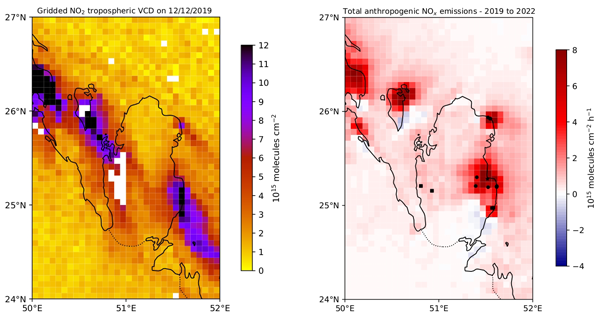
Anthony Rey-Pommier, Frédéric Chevallier, Philippe Ciais, Jonilda Kushta, Theodoros Christoudias, I. Safak Bayram, and Jean Sciare
Atmos. Chem. Phys., 23, 13565–13583, https://doi.org/10.5194/acp-23-13565-2023, https://doi.org/10.5194/acp-23-13565-2023, 2023
Short summary
Short summary
We use four years (2019–2022) of TROPOMI NO2 data to map NOx emissions in Qatar. We estimate average monthly emissions for the country and industrial facilities and derive an emission factor for the power sector. Monthly emissions have a weekly cycle reflecting the social norms in Qatar and an annual cycle consistent with the electricity production by gas-fired power plants. Their mean value is lower than the NOx emissions in global inventories but similar to the emissions reported for 2007.
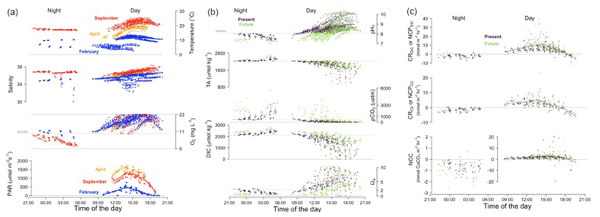
Narimane Dorey, Sophie Martin, and Lester Kwiatkowski
Biogeosciences, 20, 4289–4306, https://doi.org/10.5194/bg-20-4289-2023, https://doi.org/10.5194/bg-20-4289-2023, 2023
Short summary
Short summary
Human CO2 emissions are modifying ocean carbonate chemistry, causing ocean acidification and likely already impacting marine ecosystems. Here, we added CO2 to intertidal pools at the start of emersion to investigate the influence of future ocean acidification on net community production (NCP) and calcification (NCC). By day, adding CO2 fertilized the pools (+20 % NCP). By night, pools experienced net community dissolution, a dissolution that was further increased (+40 %) by the CO2 addition.
Christoph Heinze, Thorsten Blenckner, Peter Brown, Friederike Fröb, Anne Morée, Adrian L. New, Cara Nissen, Stefanie Rynders, Isabel Seguro, Yevgeny Aksenov, Yuri Artioli, Timothée Bourgeois, Friedrich Burger, Jonathan Buzan, B. B. Cael, Veli Çağlar Yumruktepe, Melissa Chierici, Christopher Danek, Ulf Dieckmann, Agneta Fransson, Thomas Frölicher, Giovanni Galli, Marion Gehlen, Aridane G. González, Melchor Gonzalez-Davila, Nicolas Gruber, Örjan Gustafsson, Judith Hauck, Mikko Heino, Stephanie Henson, Jenny Hieronymus, I. Emma Huertas, Fatma Jebri, Aurich Jeltsch-Thömmes, Fortunat Joos, Jaideep Joshi, Stephen Kelly, Nandini Menon, Precious Mongwe, Laurent Oziel, Sólveig Ólafsdottir, Julien Palmieri, Fiz F. Pérez, Rajamohanan Pillai Ranith, Juliano Ramanantsoa, Tilla Roy, Dagmara Rusiecka, J. Magdalena Santana Casiano, Yeray Santana-Falcón, Jörg Schwinger, Roland Séférian, Miriam Seifert, Anna Shchiptsova, Bablu Sinha, Christopher Somes, Reiner Steinfeldt, Dandan Tao, Jerry Tjiputra, Adam Ulfsbo, Christoph Völker, Tsuyoshi Wakamatsu, and Ying Ye
Biogeosciences Discuss., https://doi.org/10.5194/bg-2023-182, https://doi.org/10.5194/bg-2023-182, 2023
Revised manuscript not accepted
Short summary
Short summary
For assessing the consequences of human-induced climate change for the marine realm, it is necessary to not only look at gradual changes but also at abrupt changes of environmental conditions. We summarise abrupt changes in ocean warming, acidification, and oxygen concentration as the key environmental factors for ecosystems. Taking these abrupt changes into account requires greenhouse gas emissions to be reduced to a larger extent than previously thought to limit respective damage.
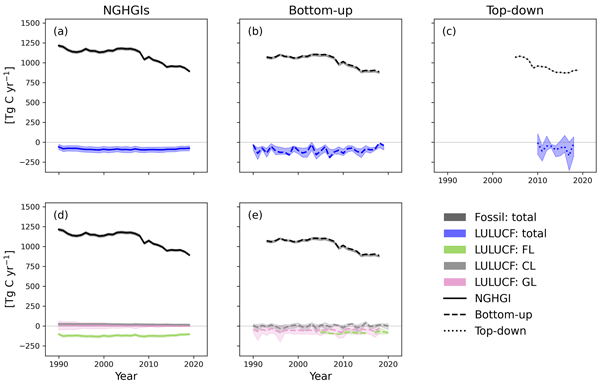
Matthew J. McGrath, Ana Maria Roxana Petrescu, Philippe Peylin, Robbie M. Andrew, Bradley Matthews, Frank Dentener, Juraj Balkovič, Vladislav Bastrikov, Meike Becker, Gregoire Broquet, Philippe Ciais, Audrey Fortems-Cheiney, Raphael Ganzenmüller, Giacomo Grassi, Ian Harris, Matthew Jones, Jürgen Knauer, Matthias Kuhnert, Guillaume Monteil, Saqr Munassar, Paul I. Palmer, Glen P. Peters, Chunjing Qiu, Mart-Jan Schelhaas, Oksana Tarasova, Matteo Vizzarri, Karina Winkler, Gianpaolo Balsamo, Antoine Berchet, Peter Briggs, Patrick Brockmann, Frédéric Chevallier, Giulia Conchedda, Monica Crippa, Stijn N. C. Dellaert, Hugo A. C. Denier van der Gon, Sara Filipek, Pierre Friedlingstein, Richard Fuchs, Michael Gauss, Christoph Gerbig, Diego Guizzardi, Dirk Günther, Richard A. Houghton, Greet Janssens-Maenhout, Ronny Lauerwald, Bas Lerink, Ingrid T. Luijkx, Géraud Moulas, Marilena Muntean, Gert-Jan Nabuurs, Aurélie Paquirissamy, Lucia Perugini, Wouter Peters, Roberto Pilli, Julia Pongratz, Pierre Regnier, Marko Scholze, Yusuf Serengil, Pete Smith, Efisio Solazzo, Rona L. Thompson, Francesco N. Tubiello, Timo Vesala, and Sophia Walther
Earth Syst. Sci. Data, 15, 4295–4370, https://doi.org/10.5194/essd-15-4295-2023, https://doi.org/10.5194/essd-15-4295-2023, 2023
Short summary
Short summary
Accurate estimation of fluxes of carbon dioxide from the land surface is essential for understanding future impacts of greenhouse gas emissions on the climate system. A wide variety of methods currently exist to estimate these sources and sinks. We are continuing work to develop annual comparisons of these diverse methods in order to clarify what they all actually calculate and to resolve apparent disagreement, in addition to highlighting opportunities for increased understanding.
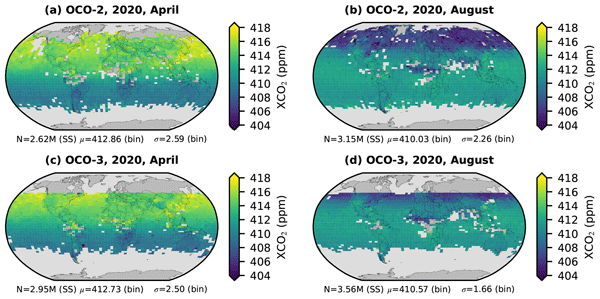
Thomas E. Taylor, Christopher W. O'Dell, David Baker, Carol Bruegge, Albert Chang, Lars Chapsky, Abhishek Chatterjee, Cecilia Cheng, Frédéric Chevallier, David Crisp, Lan Dang, Brian Drouin, Annmarie Eldering, Liang Feng, Brendan Fisher, Dejian Fu, Michael Gunson, Vance Haemmerle, Graziela R. Keller, Matthäus Kiel, Le Kuai, Thomas Kurosu, Alyn Lambert, Joshua Laughner, Richard Lee, Junjie Liu, Lucas Mandrake, Yuliya Marchetti, Gregory McGarragh, Aronne Merrelli, Robert R. Nelson, Greg Osterman, Fabiano Oyafuso, Paul I. Palmer, Vivienne H. Payne, Robert Rosenberg, Peter Somkuti, Gary Spiers, Cathy To, Brad Weir, Paul O. Wennberg, Shanshan Yu, and Jia Zong
Atmos. Meas. Tech., 16, 3173–3209, https://doi.org/10.5194/amt-16-3173-2023, https://doi.org/10.5194/amt-16-3173-2023, 2023
Short summary
Short summary
NASA's Orbiting Carbon Observatory 2 and 3 (OCO-2 and OCO-3, respectively) provide complementary spatiotemporal coverage from a sun-synchronous and precession orbit, respectively. Estimates of total column carbon dioxide (XCO2) derived from the two sensors using the same retrieval algorithm show broad consistency over a 2.5-year overlapping time record. This suggests that data from the two satellites may be used together for scientific analysis.
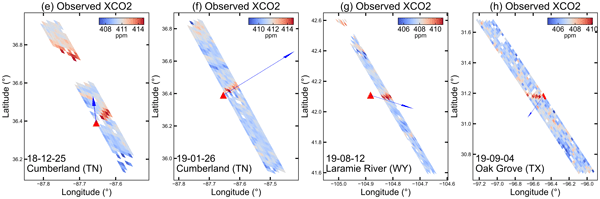
Xiaojuan Lin, Ronald van der A, Jos de Laat, Henk Eskes, Frédéric Chevallier, Philippe Ciais, Zhu Deng, Yuanhao Geng, Xuanren Song, Xiliang Ni, Da Huo, Xinyu Dou, and Zhu Liu
Atmos. Chem. Phys., 23, 6599–6611, https://doi.org/10.5194/acp-23-6599-2023, https://doi.org/10.5194/acp-23-6599-2023, 2023
Short summary
Short summary
Satellite observations provide evidence for CO2 emission signals from isolated power plants. We use these satellite observations to quantify emissions. We found that for power plants with multiple observations, the correlation of estimated and reported emissions is significantly improved compared to a single observation case. This demonstrates that accurate estimation of power plant emissions can be achieved by monitoring from future satellite missions with more frequent observations.
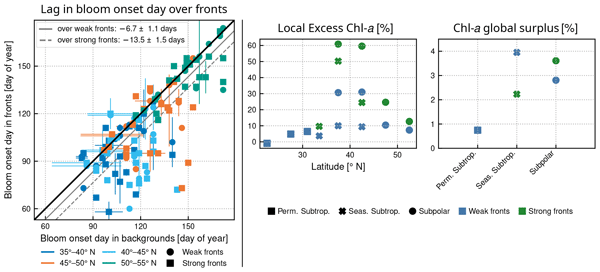
Clément Haëck, Marina Lévy, Inès Mangolte, and Laurent Bopp
Biogeosciences, 20, 1741–1758, https://doi.org/10.5194/bg-20-1741-2023, https://doi.org/10.5194/bg-20-1741-2023, 2023
Short summary
Short summary
Phytoplankton vary in abundance in the ocean over large regions and with the seasons but also because of small-scale heterogeneities in surface temperature, called fronts. Here, using satellite imagery, we found that fronts enhance phytoplankton much more where it is already growing well, but despite large local increases the enhancement for the region is modest (5 %). We also found that blooms start 1 to 2 weeks earlier over fronts. These effects may have implications for ecosystems.
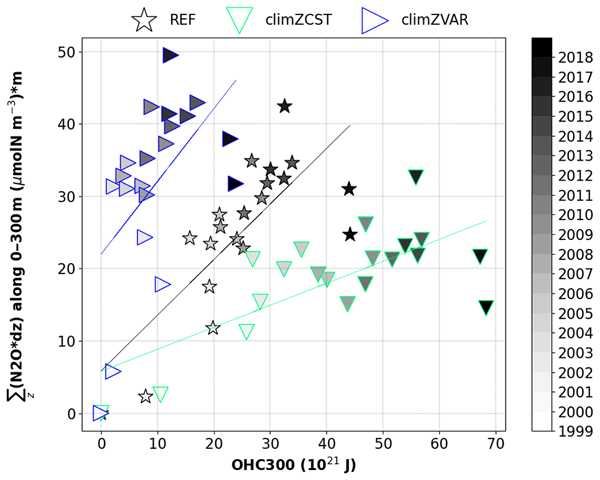
Sarah Berthet, Julien Jouanno, Roland Séférian, Marion Gehlen, and William Llovel
Earth Syst. Dynam., 14, 399–412, https://doi.org/10.5194/esd-14-399-2023, https://doi.org/10.5194/esd-14-399-2023, 2023
Short summary
Short summary
Phytoplankton absorbs the solar radiation entering the ocean surface and contributes to keeping the associated energy in surface waters. This natural effect is either not represented in the ocean component of climate models or its representation is simplified. An incomplete representation of this biophysical interaction affects the way climate models simulate ocean warming, which leads to uncertainties in projections of oceanic emissions of an important greenhouse gas (nitrous oxide).
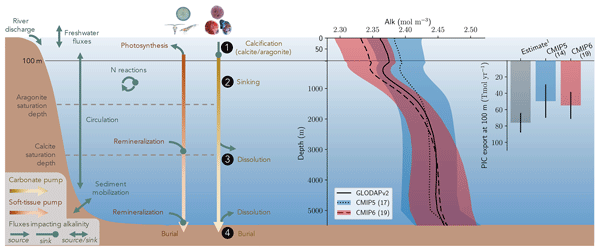
Alban Planchat, Lester Kwiatkowski, Laurent Bopp, Olivier Torres, James R. Christian, Momme Butenschön, Tomas Lovato, Roland Séférian, Matthew A. Chamberlain, Olivier Aumont, Michio Watanabe, Akitomo Yamamoto, Andrew Yool, Tatiana Ilyina, Hiroyuki Tsujino, Kristen M. Krumhardt, Jörg Schwinger, Jerry Tjiputra, John P. Dunne, and Charles Stock
Biogeosciences, 20, 1195–1257, https://doi.org/10.5194/bg-20-1195-2023, https://doi.org/10.5194/bg-20-1195-2023, 2023
Short summary
Short summary
Ocean alkalinity is critical to the uptake of atmospheric carbon and acidification in surface waters. We review the representation of alkalinity and the associated calcium carbonate cycle in Earth system models. While many parameterizations remain present in the latest generation of models, there is a general improvement in the simulated alkalinity distribution. This improvement is related to an increase in the export of biotic calcium carbonate, which closer resembles observations.

Cédric Bacour, Natasha MacBean, Frédéric Chevallier, Sébastien Léonard, Ernest N. Koffi, and Philippe Peylin
Biogeosciences, 20, 1089–1111, https://doi.org/10.5194/bg-20-1089-2023, https://doi.org/10.5194/bg-20-1089-2023, 2023
Short summary
Short summary
The impact of assimilating different dataset combinations on regional to global-scale C budgets is explored with the ORCHIDEE model. Assimilating simultaneously multiple datasets is preferable to optimize the values of the model parameters and avoid model overfitting. The challenges in constraining soil C disequilibrium using atmospheric CO2 data are highlighted for an accurate prediction of the land sink distribution.
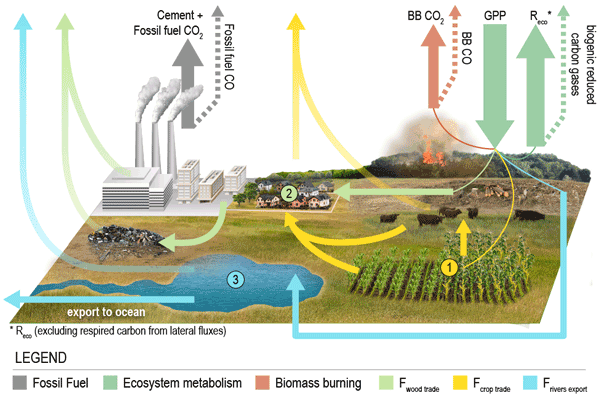
Brendan Byrne, David F. Baker, Sourish Basu, Michael Bertolacci, Kevin W. Bowman, Dustin Carroll, Abhishek Chatterjee, Frédéric Chevallier, Philippe Ciais, Noel Cressie, David Crisp, Sean Crowell, Feng Deng, Zhu Deng, Nicholas M. Deutscher, Manvendra K. Dubey, Sha Feng, Omaira E. García, David W. T. Griffith, Benedikt Herkommer, Lei Hu, Andrew R. Jacobson, Rajesh Janardanan, Sujong Jeong, Matthew S. Johnson, Dylan B. A. Jones, Rigel Kivi, Junjie Liu, Zhiqiang Liu, Shamil Maksyutov, John B. Miller, Scot M. Miller, Isamu Morino, Justus Notholt, Tomohiro Oda, Christopher W. O'Dell, Young-Suk Oh, Hirofumi Ohyama, Prabir K. Patra, Hélène Peiro, Christof Petri, Sajeev Philip, David F. Pollard, Benjamin Poulter, Marine Remaud, Andrew Schuh, Mahesh K. Sha, Kei Shiomi, Kimberly Strong, Colm Sweeney, Yao Té, Hanqin Tian, Voltaire A. Velazco, Mihalis Vrekoussis, Thorsten Warneke, John R. Worden, Debra Wunch, Yuanzhi Yao, Jeongmin Yun, Andrew Zammit-Mangion, and Ning Zeng
Earth Syst. Sci. Data, 15, 963–1004, https://doi.org/10.5194/essd-15-963-2023, https://doi.org/10.5194/essd-15-963-2023, 2023
Short summary
Short summary
Changes in the carbon stocks of terrestrial ecosystems result in emissions and removals of CO2. These can be driven by anthropogenic activities (e.g., deforestation), natural processes (e.g., fires) or in response to rising CO2 (e.g., CO2 fertilization). This paper describes a dataset of CO2 emissions and removals derived from atmospheric CO2 observations. This pilot dataset informs current capabilities and future developments towards top-down monitoring and verification systems.
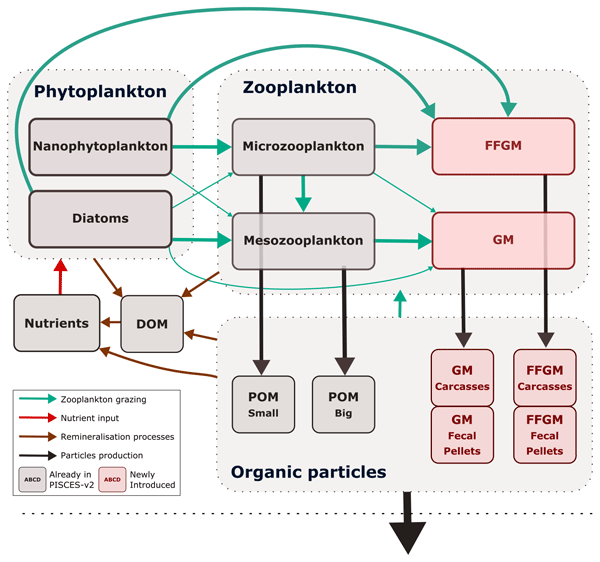
Corentin Clerc, Laurent Bopp, Fabio Benedetti, Meike Vogt, and Olivier Aumont
Biogeosciences, 20, 869–895, https://doi.org/10.5194/bg-20-869-2023, https://doi.org/10.5194/bg-20-869-2023, 2023
Short summary
Short summary
Gelatinous zooplankton play a key role in the ocean carbon cycle. In particular, pelagic tunicates, which feed on a wide size range of prey, produce rapidly sinking detritus. Thus, they efficiently transfer carbon from the surface to the depths. Consequently, we added these organisms to a marine biogeochemical model (PISCES-v2) and evaluated their impact on the global carbon cycle. We found that they contribute significantly to carbon export and that this contribution increases with depth.
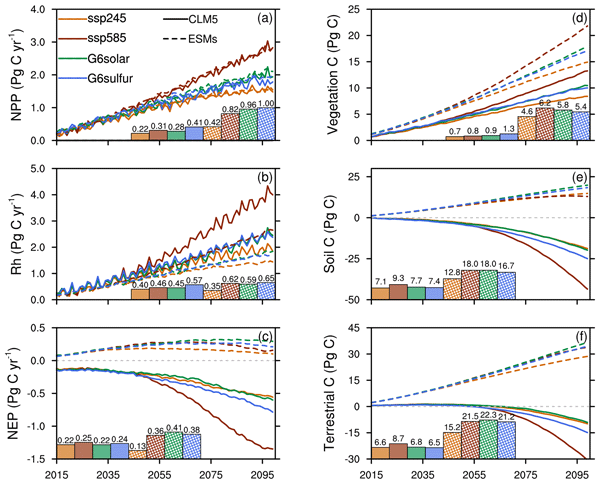
Yangxin Chen, Duoying Ji, Qian Zhang, John C. Moore, Olivier Boucher, Andy Jones, Thibaut Lurton, Michael J. Mills, Ulrike Niemeier, Roland Séférian, and Simone Tilmes
Earth Syst. Dynam., 14, 55–79, https://doi.org/10.5194/esd-14-55-2023, https://doi.org/10.5194/esd-14-55-2023, 2023
Short summary
Short summary
Solar geoengineering has been proposed as a way of counteracting the warming effects of increasing greenhouse gases by reflecting solar radiation. This work shows that solar geoengineering can slow down the northern-high-latitude permafrost degradation but cannot preserve the permafrost ecosystem as that under a climate of the same warming level without solar geoengineering.
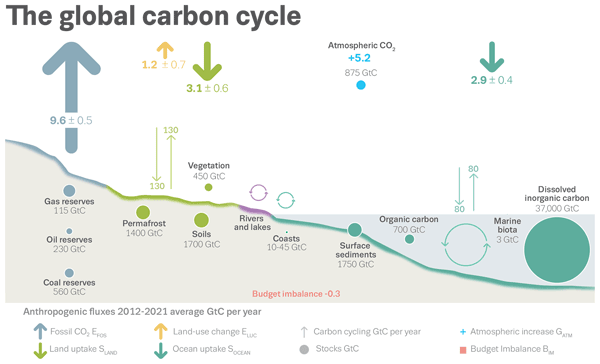
Pierre Friedlingstein, Michael O'Sullivan, Matthew W. Jones, Robbie M. Andrew, Luke Gregor, Judith Hauck, Corinne Le Quéré, Ingrid T. Luijkx, Are Olsen, Glen P. Peters, Wouter Peters, Julia Pongratz, Clemens Schwingshackl, Stephen Sitch, Josep G. Canadell, Philippe Ciais, Robert B. Jackson, Simone R. Alin, Ramdane Alkama, Almut Arneth, Vivek K. Arora, Nicholas R. Bates, Meike Becker, Nicolas Bellouin, Henry C. Bittig, Laurent Bopp, Frédéric Chevallier, Louise P. Chini, Margot Cronin, Wiley Evans, Stefanie Falk, Richard A. Feely, Thomas Gasser, Marion Gehlen, Thanos Gkritzalis, Lucas Gloege, Giacomo Grassi, Nicolas Gruber, Özgür Gürses, Ian Harris, Matthew Hefner, Richard A. Houghton, George C. Hurtt, Yosuke Iida, Tatiana Ilyina, Atul K. Jain, Annika Jersild, Koji Kadono, Etsushi Kato, Daniel Kennedy, Kees Klein Goldewijk, Jürgen Knauer, Jan Ivar Korsbakken, Peter Landschützer, Nathalie Lefèvre, Keith Lindsay, Junjie Liu, Zhu Liu, Gregg Marland, Nicolas Mayot, Matthew J. McGrath, Nicolas Metzl, Natalie M. Monacci, David R. Munro, Shin-Ichiro Nakaoka, Yosuke Niwa, Kevin O'Brien, Tsuneo Ono, Paul I. Palmer, Naiqing Pan, Denis Pierrot, Katie Pocock, Benjamin Poulter, Laure Resplandy, Eddy Robertson, Christian Rödenbeck, Carmen Rodriguez, Thais M. Rosan, Jörg Schwinger, Roland Séférian, Jamie D. Shutler, Ingunn Skjelvan, Tobias Steinhoff, Qing Sun, Adrienne J. Sutton, Colm Sweeney, Shintaro Takao, Toste Tanhua, Pieter P. Tans, Xiangjun Tian, Hanqin Tian, Bronte Tilbrook, Hiroyuki Tsujino, Francesco Tubiello, Guido R. van der Werf, Anthony P. Walker, Rik Wanninkhof, Chris Whitehead, Anna Willstrand Wranne, Rebecca Wright, Wenping Yuan, Chao Yue, Xu Yue, Sönke Zaehle, Jiye Zeng, and Bo Zheng
Earth Syst. Sci. Data, 14, 4811–4900, https://doi.org/10.5194/essd-14-4811-2022, https://doi.org/10.5194/essd-14-4811-2022, 2022
Short summary
Short summary
The Global Carbon Budget 2022 describes the datasets and methodology used to quantify the anthropogenic emissions of carbon dioxide (CO2) and their partitioning among the atmosphere, the land ecosystems, and the ocean. These living datasets are updated every year to provide the highest transparency and traceability in the reporting of CO2, the key driver of climate change.
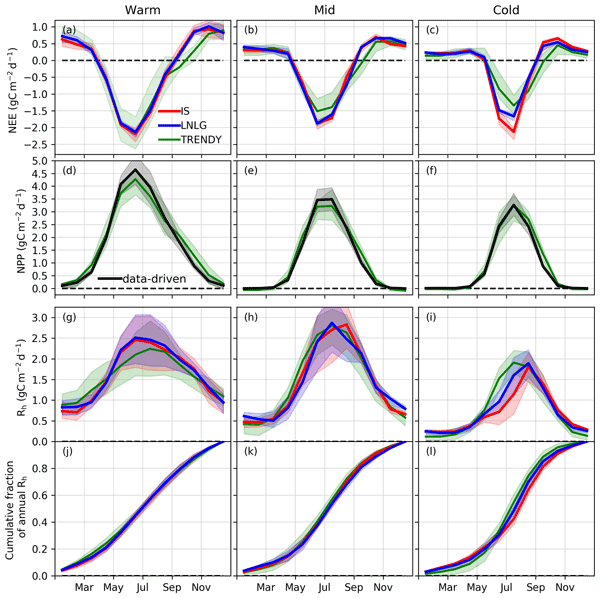
Brendan Byrne, Junjie Liu, Yonghong Yi, Abhishek Chatterjee, Sourish Basu, Rui Cheng, Russell Doughty, Frédéric Chevallier, Kevin W. Bowman, Nicholas C. Parazoo, David Crisp, Xing Li, Jingfeng Xiao, Stephen Sitch, Bertrand Guenet, Feng Deng, Matthew S. Johnson, Sajeev Philip, Patrick C. McGuire, and Charles E. Miller
Biogeosciences, 19, 4779–4799, https://doi.org/10.5194/bg-19-4779-2022, https://doi.org/10.5194/bg-19-4779-2022, 2022
Short summary
Short summary
Plants draw CO2 from the atmosphere during the growing season, while respiration releases CO2 to the atmosphere throughout the year, driving seasonal variations in atmospheric CO2 that can be observed by satellites, such as the Orbiting Carbon Observatory 2 (OCO-2). Using OCO-2 XCO2 data and space-based constraints on plant growth, we show that permafrost-rich northeast Eurasia has a strong seasonal release of CO2 during the autumn, hinting at an unexpectedly large respiration signal from soils.
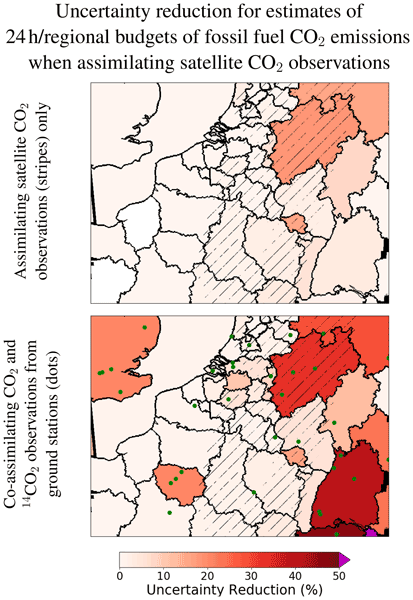
Elise Potier, Grégoire Broquet, Yilong Wang, Diego Santaren, Antoine Berchet, Isabelle Pison, Julia Marshall, Philippe Ciais, François-Marie Bréon, and Frédéric Chevallier
Atmos. Meas. Tech., 15, 5261–5288, https://doi.org/10.5194/amt-15-5261-2022, https://doi.org/10.5194/amt-15-5261-2022, 2022
Short summary
Short summary
Atmospheric inversion at local–regional scales over Europe and pseudo-data assimilation are used to evaluate how CO2 and 14CO2 ground-based measurement networks could complement satellite CO2 imagers to monitor fossil fuel (FF) CO2 emissions. This combination significantly improves precision in the FF emission estimates in areas with a dense network but does not strongly support the separation of the FF from the biogenic signals or the spatio-temporal extrapolation of the satellite information.
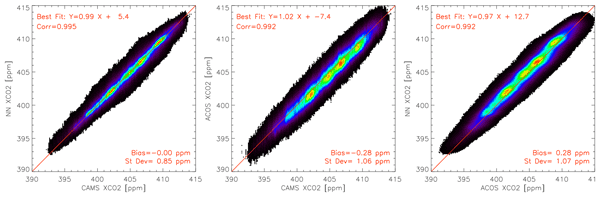
François-Marie Bréon, Leslie David, Pierre Chatelanaz, and Frédéric Chevallier
Atmos. Meas. Tech., 15, 5219–5234, https://doi.org/10.5194/amt-15-5219-2022, https://doi.org/10.5194/amt-15-5219-2022, 2022
Short summary
Short summary
The estimate of atmospheric CO2 from space measurement is difficult. Current methods are based on a detailed description of the atmospheric radiative transfer. These are affected by significant biases and errors and are very computer intensive. Instead we have proposed using a neural network approach. A first attempt led to confusing results. Here we provide an interpretation for these results and describe a new version that leads to high-quality estimates.
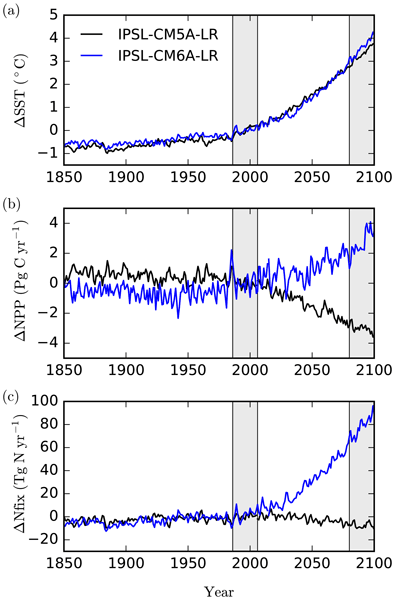
Laurent Bopp, Olivier Aumont, Lester Kwiatkowski, Corentin Clerc, Léonard Dupont, Christian Ethé, Thomas Gorgues, Roland Séférian, and Alessandro Tagliabue
Biogeosciences, 19, 4267–4285, https://doi.org/10.5194/bg-19-4267-2022, https://doi.org/10.5194/bg-19-4267-2022, 2022
Short summary
Short summary
The impact of anthropogenic climate change on the biological production of phytoplankton in the ocean is a cause for concern because its evolution could affect the response of marine ecosystems to climate change. Here, we identify biological N fixation and its response to future climate change as a key process in shaping the future evolution of marine phytoplankton production. Our results show that further study of how this nitrogen fixation responds to environmental change is essential.
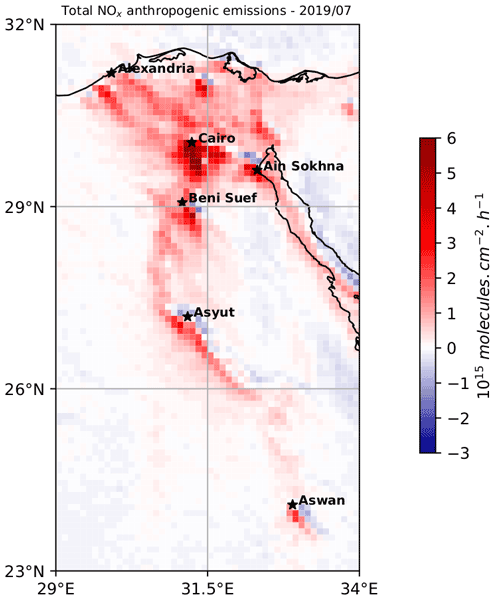
Anthony Rey-Pommier, Frédéric Chevallier, Philippe Ciais, Grégoire Broquet, Theodoros Christoudias, Jonilda Kushta, Didier Hauglustaine, and Jean Sciare
Atmos. Chem. Phys., 22, 11505–11527, https://doi.org/10.5194/acp-22-11505-2022, https://doi.org/10.5194/acp-22-11505-2022, 2022
Short summary
Short summary
Emission inventories for air pollutants can be uncertain in developing countries. In order to overcome these uncertainties, we model nitrogen oxide emissions in Egypt using satellite retrievals. We detect a weekly cycle reflecting Egyptian social norms, an annual cycle consistent with electricity consumption and an activity drop due to the COVID-19 pandemic. However, discrepancies with inventories remain high, illustrating the needs for additional data to improve the potential of our method.
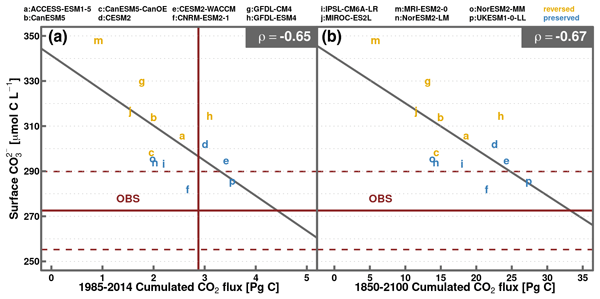
Pradeebane Vaittinada Ayar, Laurent Bopp, Jim R. Christian, Tatiana Ilyina, John P. Krasting, Roland Séférian, Hiroyuki Tsujino, Michio Watanabe, Andrew Yool, and Jerry Tjiputra
Earth Syst. Dynam., 13, 1097–1118, https://doi.org/10.5194/esd-13-1097-2022, https://doi.org/10.5194/esd-13-1097-2022, 2022
Short summary
Short summary
The El Niño–Southern Oscillation is the main driver for the natural variability of global atmospheric CO2. It modulates the CO2 fluxes in the tropical Pacific with anomalous CO2 influx during El Niño and outflux during La Niña. This relationship is projected to reverse by half of Earth system models studied here under the business-as-usual scenario. This study shows models that simulate a positive bias in surface carbonate concentrations simulate a shift in the ENSO–CO2 flux relationship.
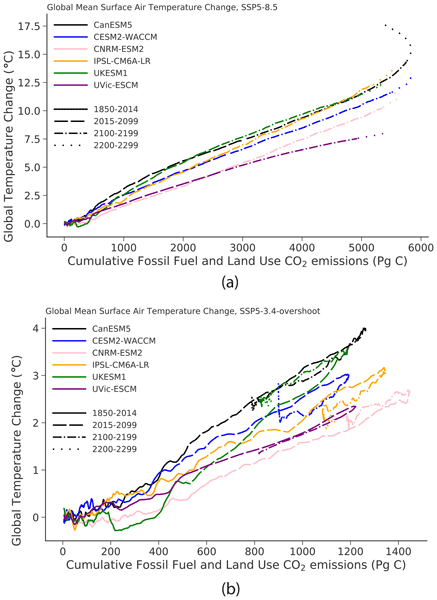
Charles D. Koven, Vivek K. Arora, Patricia Cadule, Rosie A. Fisher, Chris D. Jones, David M. Lawrence, Jared Lewis, Keith Lindsay, Sabine Mathesius, Malte Meinshausen, Michael Mills, Zebedee Nicholls, Benjamin M. Sanderson, Roland Séférian, Neil C. Swart, William R. Wieder, and Kirsten Zickfeld
Earth Syst. Dynam., 13, 885–909, https://doi.org/10.5194/esd-13-885-2022, https://doi.org/10.5194/esd-13-885-2022, 2022
Short summary
Short summary
We explore the long-term dynamics of Earth's climate and carbon cycles under a pair of contrasting scenarios to the year 2300 using six models that include both climate and carbon cycle dynamics. One scenario assumes very high emissions, while the second assumes a peak in emissions, followed by rapid declines to net negative emissions. We show that the models generally agree that warming is roughly proportional to carbon emissions but that many other aspects of the model projections differ.
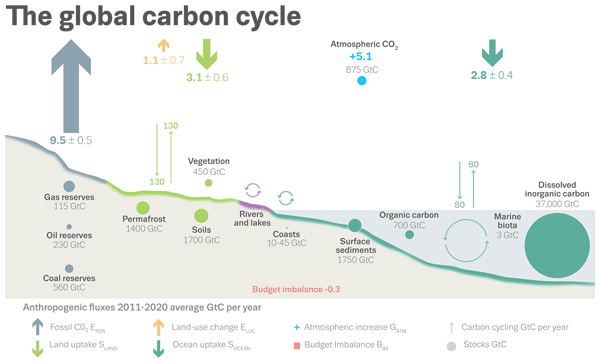
Pierre Friedlingstein, Matthew W. Jones, Michael O'Sullivan, Robbie M. Andrew, Dorothee C. E. Bakker, Judith Hauck, Corinne Le Quéré, Glen P. Peters, Wouter Peters, Julia Pongratz, Stephen Sitch, Josep G. Canadell, Philippe Ciais, Rob B. Jackson, Simone R. Alin, Peter Anthoni, Nicholas R. Bates, Meike Becker, Nicolas Bellouin, Laurent Bopp, Thi Tuyet Trang Chau, Frédéric Chevallier, Louise P. Chini, Margot Cronin, Kim I. Currie, Bertrand Decharme, Laique M. Djeutchouang, Xinyu Dou, Wiley Evans, Richard A. Feely, Liang Feng, Thomas Gasser, Dennis Gilfillan, Thanos Gkritzalis, Giacomo Grassi, Luke Gregor, Nicolas Gruber, Özgür Gürses, Ian Harris, Richard A. Houghton, George C. Hurtt, Yosuke Iida, Tatiana Ilyina, Ingrid T. Luijkx, Atul Jain, Steve D. Jones, Etsushi Kato, Daniel Kennedy, Kees Klein Goldewijk, Jürgen Knauer, Jan Ivar Korsbakken, Arne Körtzinger, Peter Landschützer, Siv K. Lauvset, Nathalie Lefèvre, Sebastian Lienert, Junjie Liu, Gregg Marland, Patrick C. McGuire, Joe R. Melton, David R. Munro, Julia E. M. S. Nabel, Shin-Ichiro Nakaoka, Yosuke Niwa, Tsuneo Ono, Denis Pierrot, Benjamin Poulter, Gregor Rehder, Laure Resplandy, Eddy Robertson, Christian Rödenbeck, Thais M. Rosan, Jörg Schwinger, Clemens Schwingshackl, Roland Séférian, Adrienne J. Sutton, Colm Sweeney, Toste Tanhua, Pieter P. Tans, Hanqin Tian, Bronte Tilbrook, Francesco Tubiello, Guido R. van der Werf, Nicolas Vuichard, Chisato Wada, Rik Wanninkhof, Andrew J. Watson, David Willis, Andrew J. Wiltshire, Wenping Yuan, Chao Yue, Xu Yue, Sönke Zaehle, and Jiye Zeng
Earth Syst. Sci. Data, 14, 1917–2005, https://doi.org/10.5194/essd-14-1917-2022, https://doi.org/10.5194/essd-14-1917-2022, 2022
Short summary
Short summary
The Global Carbon Budget 2021 describes the data sets and methodology used to quantify the emissions of carbon dioxide and their partitioning among the atmosphere, land, and ocean. These living data are updated every year to provide the highest transparency and traceability in the reporting of CO2, the key driver of climate change.
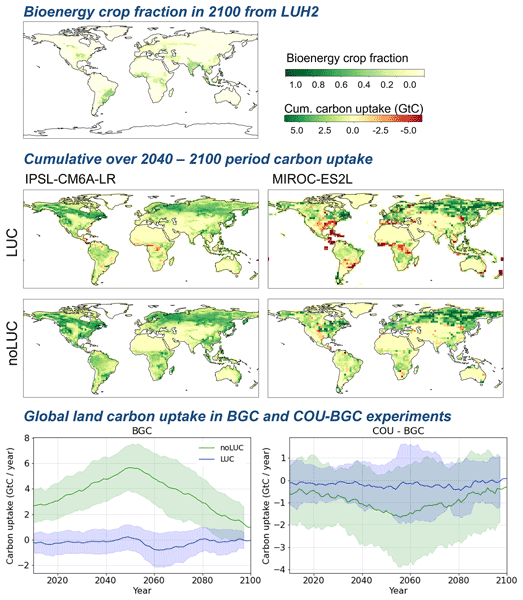
Irina Melnikova, Olivier Boucher, Patricia Cadule, Katsumasa Tanaka, Thomas Gasser, Tomohiro Hajima, Yann Quilcaille, Hideo Shiogama, Roland Séférian, Kaoru Tachiiri, Nicolas Vuichard, Tokuta Yokohata, and Philippe Ciais
Earth Syst. Dynam., 13, 779–794, https://doi.org/10.5194/esd-13-779-2022, https://doi.org/10.5194/esd-13-779-2022, 2022
Short summary
Short summary
The deployment of bioenergy crops for capturing carbon from the atmosphere facilitates global warming mitigation via generating negative CO2 emissions. Here, we explored the consequences of large-scale energy crops deployment on the land carbon cycle. The land-use change for energy crops leads to carbon emissions and loss of future potential increase in carbon uptake by natural ecosystems. This impact should be taken into account by the modeling teams and accounted for in mitigation policies.
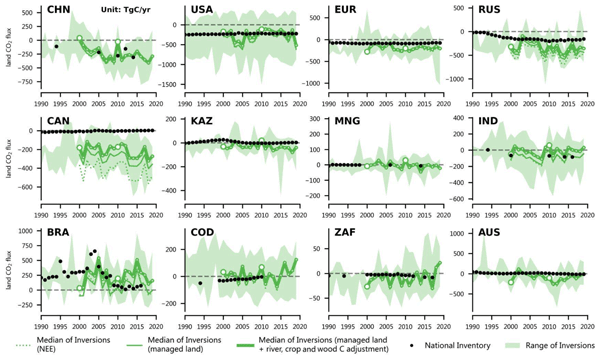
Zhu Deng, Philippe Ciais, Zitely A. Tzompa-Sosa, Marielle Saunois, Chunjing Qiu, Chang Tan, Taochun Sun, Piyu Ke, Yanan Cui, Katsumasa Tanaka, Xin Lin, Rona L. Thompson, Hanqin Tian, Yuanzhi Yao, Yuanyuan Huang, Ronny Lauerwald, Atul K. Jain, Xiaoming Xu, Ana Bastos, Stephen Sitch, Paul I. Palmer, Thomas Lauvaux, Alexandre d'Aspremont, Clément Giron, Antoine Benoit, Benjamin Poulter, Jinfeng Chang, Ana Maria Roxana Petrescu, Steven J. Davis, Zhu Liu, Giacomo Grassi, Clément Albergel, Francesco N. Tubiello, Lucia Perugini, Wouter Peters, and Frédéric Chevallier
Earth Syst. Sci. Data, 14, 1639–1675, https://doi.org/10.5194/essd-14-1639-2022, https://doi.org/10.5194/essd-14-1639-2022, 2022
Short summary
Short summary
In support of the global stocktake of the Paris Agreement on climate change, we proposed a method for reconciling the results of global atmospheric inversions with data from UNFCCC national greenhouse gas inventories (NGHGIs). Here, based on a new global harmonized database that we compiled from the UNFCCC NGHGIs and a comprehensive framework presented in this study to process the results of inversions, we compared their results of carbon dioxide (CO2), methane (CH4), and nitrous oxide (N2O).
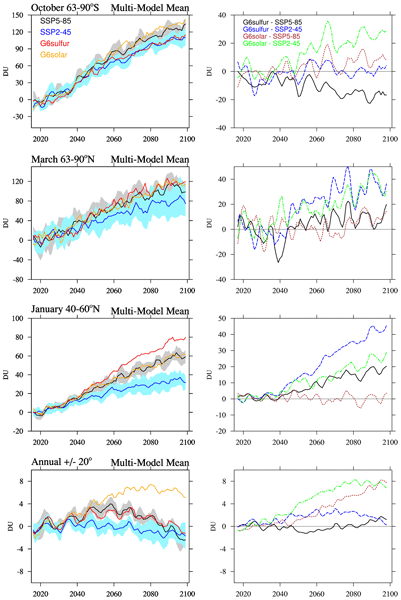
Simone Tilmes, Daniele Visioni, Andy Jones, James Haywood, Roland Séférian, Pierre Nabat, Olivier Boucher, Ewa Monica Bednarz, and Ulrike Niemeier
Atmos. Chem. Phys., 22, 4557–4579, https://doi.org/10.5194/acp-22-4557-2022, https://doi.org/10.5194/acp-22-4557-2022, 2022
Short summary
Short summary
This study assesses the impacts of climate interventions, using stratospheric sulfate aerosol and solar dimming on stratospheric ozone, based on three Earth system models with interactive stratospheric chemistry. The climate interventions have been applied to a high emission (baseline) scenario in order to reach global surface temperatures of a medium emission scenario. We find significant increases and decreases in total column ozone, depending on regions and seasons.
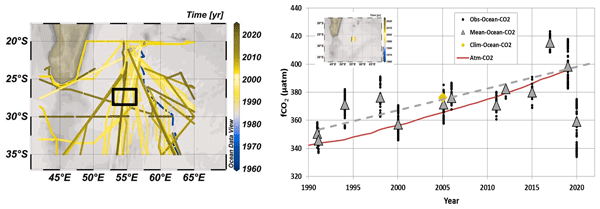
Nicolas Metzl, Claire Lo Monaco, Coraline Leseurre, Céline Ridame, Jonathan Fin, Claude Mignon, Marion Gehlen, and Thi Tuyet Trang Chau
Biogeosciences, 19, 1451–1468, https://doi.org/10.5194/bg-19-1451-2022, https://doi.org/10.5194/bg-19-1451-2022, 2022
Short summary
Short summary
During an oceanographic cruise conducted in January 2020 in the south-western Indian Ocean, we observed very low CO2 concentrations associated with a strong phytoplankton bloom that occurred south-east of Madagascar. This biological event led to a strong regional CO2 ocean sink not previously observed.
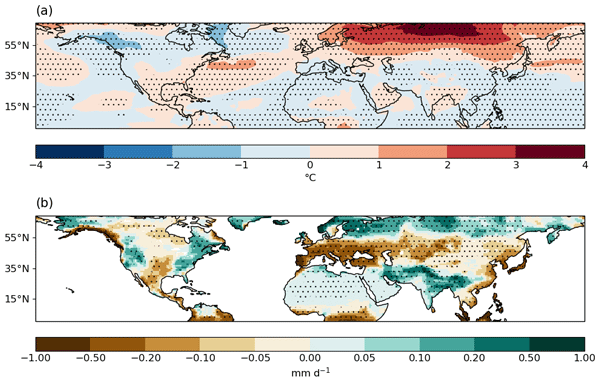
Andy Jones, Jim M. Haywood, Adam A. Scaife, Olivier Boucher, Matthew Henry, Ben Kravitz, Thibaut Lurton, Pierre Nabat, Ulrike Niemeier, Roland Séférian, Simone Tilmes, and Daniele Visioni
Atmos. Chem. Phys., 22, 2999–3016, https://doi.org/10.5194/acp-22-2999-2022, https://doi.org/10.5194/acp-22-2999-2022, 2022
Short summary
Short summary
Simulations by six Earth-system models of geoengineering by introducing sulfuric acid aerosols into the tropical stratosphere are compared. A robust impact on the northern wintertime North Atlantic Oscillation is found, exacerbating precipitation reduction over parts of southern Europe. In contrast, the models show no consistency with regard to impacts on the Quasi-Biennial Oscillation, although results do indicate a risk that the oscillation could become locked into a permanent westerly phase.
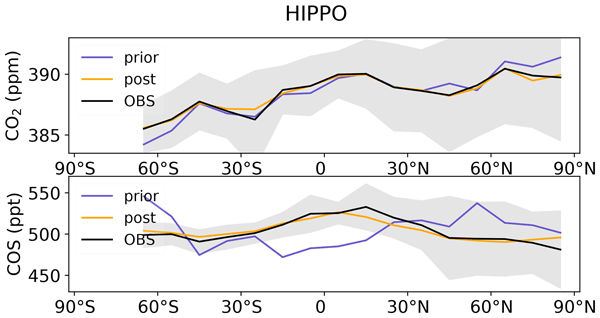
Marine Remaud, Frédéric Chevallier, Fabienne Maignan, Sauveur Belviso, Antoine Berchet, Alexandra Parouffe, Camille Abadie, Cédric Bacour, Sinikka Lennartz, and Philippe Peylin
Atmos. Chem. Phys., 22, 2525–2552, https://doi.org/10.5194/acp-22-2525-2022, https://doi.org/10.5194/acp-22-2525-2022, 2022
Short summary
Short summary
Carbonyl sulfide (COS) has been recognized as a promising indicator of the plant gross primary production (GPP). Here, we assimilate both COS and CO2 measurements into an atmospheric transport model to obtain information on GPP, plant respiration and COS budget. A possible scenario for the period 2008–2019 leads to a global COS biospheric sink of 800 GgS yr−1 and higher oceanic emissions between 400 and 600 GgS yr−1.
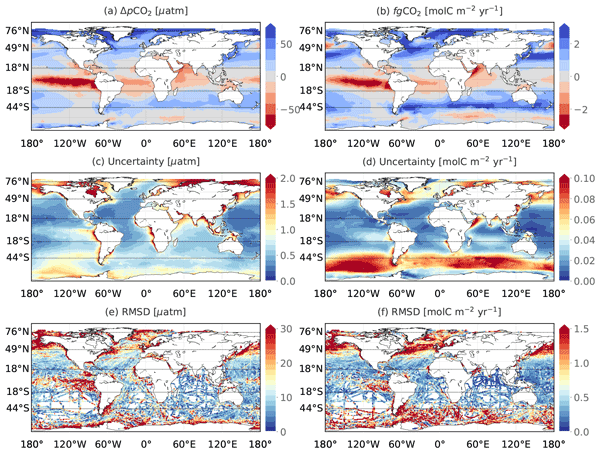
Thi Tuyet Trang Chau, Marion Gehlen, and Frédéric Chevallier
Biogeosciences, 19, 1087–1109, https://doi.org/10.5194/bg-19-1087-2022, https://doi.org/10.5194/bg-19-1087-2022, 2022
Short summary
Short summary
Air–sea CO2 fluxes and associated uncertainty over the open ocean to coastal shelves are estimated with a new ensemble-based reconstruction of pCO2 trained on observation-based data. The regional distribution and seasonality of CO2 sources and sinks are consistent with those suggested in previous studies as well as mechanisms discussed therein. The ensemble-based uncertainty field allows identifying critical regions where improvements in pCO2 and air–sea CO2 flux estimates should be a priority.
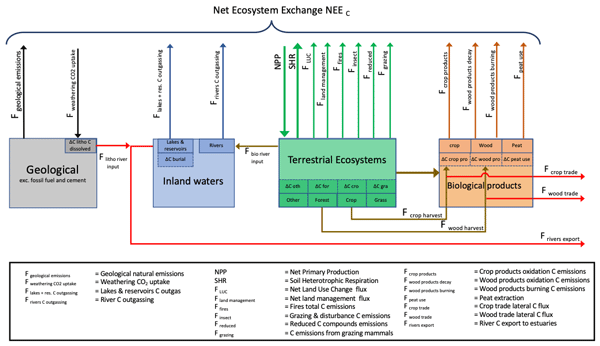
Philippe Ciais, Ana Bastos, Frédéric Chevallier, Ronny Lauerwald, Ben Poulter, Josep G. Canadell, Gustaf Hugelius, Robert B. Jackson, Atul Jain, Matthew Jones, Masayuki Kondo, Ingrid T. Luijkx, Prabir K. Patra, Wouter Peters, Julia Pongratz, Ana Maria Roxana Petrescu, Shilong Piao, Chunjing Qiu, Celso Von Randow, Pierre Regnier, Marielle Saunois, Robert Scholes, Anatoly Shvidenko, Hanqin Tian, Hui Yang, Xuhui Wang, and Bo Zheng
Geosci. Model Dev., 15, 1289–1316, https://doi.org/10.5194/gmd-15-1289-2022, https://doi.org/10.5194/gmd-15-1289-2022, 2022
Short summary
Short summary
The second phase of the Regional Carbon Cycle Assessment and Processes (RECCAP) will provide updated quantification and process understanding of CO2, CH4, and N2O emissions and sinks for ten regions of the globe. In this paper, we give definitions, review different methods, and make recommendations for estimating different components of the total land–atmosphere carbon exchange for each region in a consistent and complete approach.
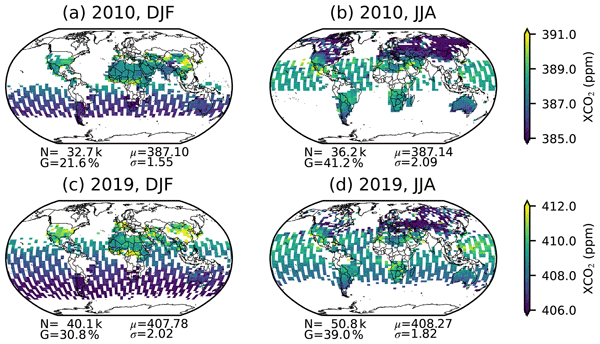
Thomas E. Taylor, Christopher W. O'Dell, David Crisp, Akhiko Kuze, Hannakaisa Lindqvist, Paul O. Wennberg, Abhishek Chatterjee, Michael Gunson, Annmarie Eldering, Brendan Fisher, Matthäus Kiel, Robert R. Nelson, Aronne Merrelli, Greg Osterman, Frédéric Chevallier, Paul I. Palmer, Liang Feng, Nicholas M. Deutscher, Manvendra K. Dubey, Dietrich G. Feist, Omaira E. García, David W. T. Griffith, Frank Hase, Laura T. Iraci, Rigel Kivi, Cheng Liu, Martine De Mazière, Isamu Morino, Justus Notholt, Young-Suk Oh, Hirofumi Ohyama, David F. Pollard, Markus Rettinger, Matthias Schneider, Coleen M. Roehl, Mahesh Kumar Sha, Kei Shiomi, Kimberly Strong, Ralf Sussmann, Yao Té, Voltaire A. Velazco, Mihalis Vrekoussis, Thorsten Warneke, and Debra Wunch
Earth Syst. Sci. Data, 14, 325–360, https://doi.org/10.5194/essd-14-325-2022, https://doi.org/10.5194/essd-14-325-2022, 2022
Short summary
Short summary
We provide an analysis of an 11-year record of atmospheric carbon dioxide (CO2) concentrations derived using an optimal estimation retrieval algorithm on measurements made by the GOSAT satellite. The new product (version 9) shows improvement over the previous version (v7.3) as evaluated against independent estimates of CO2 from ground-based sensors and atmospheric inversion systems. We also compare the new GOSAT CO2 values to collocated estimates from NASA's Orbiting Carbon Observatory-2.
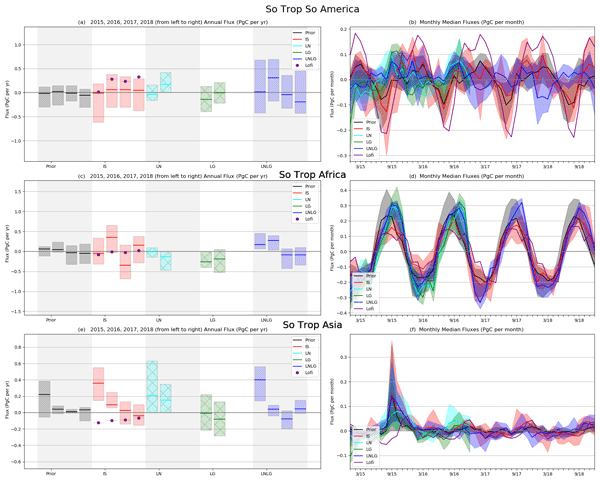
Hélène Peiro, Sean Crowell, Andrew Schuh, David F. Baker, Chris O'Dell, Andrew R. Jacobson, Frédéric Chevallier, Junjie Liu, Annmarie Eldering, David Crisp, Feng Deng, Brad Weir, Sourish Basu, Matthew S. Johnson, Sajeev Philip, and Ian Baker
Atmos. Chem. Phys., 22, 1097–1130, https://doi.org/10.5194/acp-22-1097-2022, https://doi.org/10.5194/acp-22-1097-2022, 2022
Short summary
Short summary
Satellite CO2 observations are constantly improved. We study an ensemble of different atmospheric models (inversions) from 2015 to 2018 using separate ground-based data or two versions of the OCO-2 satellite. Our study aims to determine if different satellite data corrections can yield different estimates of carbon cycle flux. A difference in the carbon budget between the two versions is found over tropical Africa, which seems to show the impact of corrections applied in satellite data.
Cited articles
Aumont, O., Orr, J. C., Monfray, P., Ludwig, W., Amiotte-Suchet, P., and Probst, J.: Riverine-driven interhemispheric transport of carbon, Global Biogeochem. Cy., 15, 393–405, https://doi.org/10.1029/1999GB001238, 2001.
Bakker, D. C. E., Pfeil, B., Landa, C. S., Metzl, N., O'Brien, K. M., Olsen, A., Smith, K., Cosca, C., Harasawa, S., Jones, S. D., Nakaoka, S., Nojiri, Y., Schuster, U., Steinhoff, T., Sweeney, C., Takahashi, T., Tilbrook, B., Wada, C., Wanninkhof, R., Alin, S. R., Balestrini, C. F., Barbero, L., Bates, N. R., Bianchi, A. A., Bonou, F., Boutin, J., Bozec, Y., Burger, E. F., Cai, W.-J., Castle, R. D., Chen, L., Chierici, M., Currie, K., Evans, W., Featherstone, C., Feely, R. A., Fransson, A., Goyet, C., Greenwood, N., Gregor, L., Hankin, S., Hardman-Mountford, N. J., Harlay, J., Hauck, J., Hoppema, M., Humphreys, M. P., Hunt, C. W., Huss, B., Ibánhez, J. S. P., Johannessen, T., Keeling, R., Kitidis, V., Körtzinger, A., Kozyr, A., Krasakopoulou, E., Kuwata, A., Landschützer, P., Lauvset, S. K., Lefèvre, N., Lo Monaco, C., Manke, A., Mathis, J. T., Merlivat, L., Millero, F. J., Monteiro, P. M. S., Munro, D. R., Murata, A., Newberger, T., Omar, A. M., Ono, T., Paterson, K., Pearce, D., Pierrot, D., Robbins, L. L., Saito, S., Salisbury, J., Schlitzer, R., Schneider, B., Schweitzer, R., Sieger, R., Skjelvan, I., Sullivan, K. F., Sutherland, S. C., Sutton, A. J., Tadokoro, K., Telszewski, M., Tuma, M., van Heuven, S. M. A. C., Vandemark, D., Ward, B., Watson, A. J., and Xu, S.: A multi-decade record of high-quality fCO2 data in version 3 of the Surface Ocean CO2 Atlas (SOCAT), Earth Syst. Sci. Data, 8, 383–413, https://doi.org/10.5194/essd-8-383-2016, 2016.
Bates, N. R., Knap, A. H., and Michaels, A. F.: Contribution of hurricanes to local and global estimates of air–sea exchange of CO2, Nature, 395, 58–61, https://doi.org/10.1038/25703, 1998.
Bellenger, H., Bopp, L., Ethé, C., Ho, D., Duvel, J. P., Flavoni, S., Guez, L., Kataoka, T., Perrot, X., Parc, L., and Watanabe, M.: Sensitivity of the Global Ocean Carbon Sink to the Ocean Skin in a Climate Model, J. Geophys. Res.-Oceans, 128, e2022JC019479, https://doi.org/10.1029/2022JC019479, 2023.
Boyer, T. P., Antonov, J. I., Baranova, O. K., Coleman, C., Garcia, H. E., Grodsky, A., Johnson, D. R. Locarnini, R. A., Mishonov, A. V., O'Brien, T. D., Paver, C. R., Reagan, J. R., Seidov, D., Smolyar, I. V., and Zweng, M. M.: World Ocean Database 2013, National Oceanographic Data Center [data set], https://doi.org/10.25607/OBP-1454, 2013.
Bronselaer, B., Winton, M., Russell, J., Sabine, C. L., and Khatiwala, S.: Agreement of CMIP5 Simulated and Observed Ocean Anthropogenic CO2 Uptake, Geophys. Res. Lett., 44, https://doi.org/10.1002/2017GL074435, 2017.
Broullón, D., Pérez, F. F., Velo, A., Hoppema, M., Olsen, A., Takahashi, T., Key, R. M., Tanhua, T., González-Dávila, M., Jeansson, E., Kozyr, A., and van Heuven, S. M. A. C.: A global monthly climatology of total alkalinity: a neural network approach, Earth Syst. Sci. Data, 11, 1109–1127, https://doi.org/10.5194/essd-11-1109-2019, 2019a.
Broullón, D., Pérez, F. F., Velo, A., Hoppema, M., Olsen, A., Takahashi, T., Key, R. M., González-Dávila, M., Tanhua, T., Jeansson, E., Kozyr, A., and Van Heuven, S.: A global monthly climatology of total alkalinity: a neural network approach (2019), Digital.CSIC [data set], https://doi.org/10.20350/digitalCSIC/8644, 2019b.
Carranza, M. M., Long, Matthew. C., Di Luca, A., Fassbender, A. J., Johnson, K. S., Takeshita, Y., Mongwe, P., and Turner, K. E.: Extratropical storms induce carbon outgassing over the Southern Ocean, npj Clim. Atmos. Sci., 7, 106, https://doi.org/10.1038/s41612-024-00657-7, 2024.
Chau, T., Chevallier, F., and Gehlen, M.: Global Analysis of Surface Ocean CO2 Fugacity and Air-Sea Fluxes With Low Latency, Geophys. Res. Lett., 51, e2023GL106670, https://doi.org/10.1029/2023GL106670, 2024.
DeVries, T., Yamamoto, K., Wanninkhof, R., Gruber, N., Hauck, J., Müller, J. D., Bopp, L., Carroll, D., Carter, B., Chau, T., Doney, S. C., Gehlen, M., Gloege, L., Gregor, L., Henson, S., Kim, J. H., Iida, Y., Ilyina, T., Landschützer, P., Le Quéré, C., Munro, D., Nissen, C., Patara, L., Pérez, F. F., Resplandy, L., Rodgers, K. B., Schwinger, J., Séférian, R., Sicardi, V., Terhaar, J., Triñanes, J., Tsujino, H., Watson, A., Yasunaka, S., and Zeng, J.: Magnitude, Trends, and Variability of the Global Ocean Carbon Sink From 1985 to 2018, Global Biogeochem. Cy., 37, e2023GB007780, https://doi.org/10.1029/2023GB007780, 2023.
Dombret, J., Bellenger, H., Perrot, X., Parc, L., bopp, . laurent ., Kwiatkowski, L., Séférian, R., Berthet, S., Gehlen, M., Chevallier, F., and Orr, J.: Data-based estimates of ocean carbon uptake biased high from neglect of submonthly atmospheric pressure variability, Zenodo [data set], https://doi.org/10.5281/zenodo.15848192, 2025.
Dong, Y., Bakker, D. C. E., Bell, T. G., Huang, B., Landschützer, P., Liss, P. S., and Yang, M.: Update on the Temperature Corrections of Global Air-Sea CO2 Flux Estimates, Global Biogeochem. Cy., 36, e2022GB007360, https://doi.org/10.1029/2022GB007360, 2022.
Dong, Y., Yang, M., Bell, T. G., Marandino, C. A., and Woolf, D. K.: Asymmetric bubble-mediated gas transfer enhances global ocean CO2 uptake, Nat. Commun., 16, 10595, https://doi.org/10.1038/s41467-025-66652-5, 2025.
Droghei, R., Buongiorno Nardelli, B., and Santoleri, R.: A New Global Sea Surface Salinity and Density Dataset From Multivariate Observations (1993–2016), Front. Mar. Sci., 5, 84, https://doi.org/10.3389/fmars.2018.00084, 2018.
Etcheto, J. and Merlivat, L.: Satellite determination of the carbon dioxide exchange coefficient at the ocean-atmosphere interface: A first step, J. Geophys. Res., 93, 15669–15678, https://doi.org/10.1029/JC093iC12p15669, 1988.
E.U. Copernicus Marine Service Information (CMEMS): Mediterranean Sea – High Resolution Diurnal Subskin Sea Surface Temperature Analysis, Marine Data Store (MDS) [data set], https://doi.org/10.48670/moi-00170, 2023.
Fay, A. R., Gregor, L., Landschützer, P., McKinley, G. A., Gruber, N., Gehlen, M., Iida, Y., Laruelle, G. G., Rödenbeck, C., Roobaert, A., and Zeng, J.: SeaFlux: harmonization of air–sea CO2 fluxes from surface pCO2 data products using a standardized approach, Earth Syst. Sci. Data, 13, 4693–4710, https://doi.org/10.5194/essd-13-4693-2021, 2021.
Ford, D. J., Blannin, J., Watts, J., Watson, A. J., Landschützer, P., Jersild, A., and Shutler, J. D.: A Comprehensive Analysis of Air-Sea CO2 Flux Uncertainties Constructed From Surface Ocean Data Products, Global Biogeochem. Cy., 38, e2024GB008188, https://doi.org/10.1029/2024GB008188, 2024.
Gloege, L. and Eisaman, M. D.: Regional Uncertainty Analysis in the Air–Sea CO2 Flux, Earth and Space Science, 12, e2024EA004032, https://doi.org/10.1029/2024EA004032, 2025.
Gloege, L., Yan, M., Zheng, T., and McKinley, G. A.: Improved Quantification of Ocean Carbon Uptake by Using Machine Learning to Merge Global Models and pCO2 Data, J. Adv. Model. Earth Sy., 14, e2021MS002620, https://doi.org/10.1029/2021MS002620, 2022.
Gregor, L. and Gruber, N.: OceanSODA-ETHZ: A global gridded dataset of the surface ocean carbonate system for seasonal to decadal studies of ocean acidification (v2025) (NCEI Accession 0220059). v2.2, NOAA National Centers for Environmental Information [data set], https://doi.org/10.25921/m5wx-ja34 (last access: 2021), 2020.
Gregor, L. and Gruber, N.: OceanSODA-ETHZ: a global gridded data set of the surface ocean carbonate system for seasonal to decadal studies of ocean acidification, Earth Syst. Sci. Data, 13, 777–808, https://doi.org/10.5194/essd-13-777-2021, 2021.
Gregor, L., Lebehot, A. D., Kok, S., and Scheel Monteiro, P. M.: A comparative assessment of the uncertainties of global surface ocean CO2 estimates using a machine-learning ensemble (CSIR-ML6 version 2019a) – have we hit the wall?, Geosci. Model Dev., 12, 5113–5136, https://doi.org/10.5194/gmd-12-5113-2019, 2019.
Gregor, L., Shutler, J., and Gruber, N.: High-Resolution Variability of the Ocean Carbon Sink, Global Biogeochem. Cy., 38, e2024GB008127, https://doi.org/10.1029/2024GB008127, 2024.
Hauck, J., Zeising, M., Le Quéré, C., Gruber, N., Bakker, D. C. E., Bopp, L., Chau, T. T. T., Gürses, Ö., Ilyina, T., Landschützer, P., Lenton, A., Resplandy, L., Rödenbeck, C., Schwinger, J., and Séférian, R.: Consistency and Challenges in the Ocean Carbon Sink Estimate for the Global Carbon Budget, Front. Mar. Sci., 7, 571720, https://doi.org/10.3389/fmars.2020.571720, 2020.
Hauck, J., Nissen, C., Landschützer, P., Rödenbeck, C., Bushinsky, S., and Olsen, A.: Sparse observations induce large biases in estimates of the global ocean CO2 sink: an ocean model subsampling experiment, Phil. Trans. R. Soc. A., 381, 20220063, https://doi.org/10.1098/rsta.2022.0063, 2023.
Hersbach, H., Bell, B., Berrisford, P., Hirahara, S., Horányi, A., Muñoz-Sabater, J., Nicolas, J., Peubey, C., Radu, R., Schepers, D., Simmons, A., Soci, C., Abdalla, S., Abellan, X., Balsamo, G., Bechtold, P., Biavati, G., Bidlot, J., Bonavita, M., De Chiara, G., Dahlgren, P., Dee, D., Diamantakis, M., Dragani, R., Flemming, J., Forbes, R., Fuentes, M., Geer, A., Haimberger, L., Healy, S., Hogan, R. J., Hólm, E., Janisková, M., Keeley, S., Laloyaux, P., Lopez, P., Lupu, C., Radnoti, G., De Rosnay, P., Rozum, I., Vamborg, F., Villaume, S., and Thépaut, J.: The ERA5 global reanalysis, Q. J. Roy. Meteor. Soc., 146, 1999–2049, https://doi.org/10.1002/qj.3803, 2020.
Hersbach, H., Bell, B., Berrisford, P., Biavati, G., Horányi, A., Muñoz Sabater, J., Nicolas, J., Peubey, C., Radu, R., Rozum, I., Schepers, D., Simmons, A., Soci, C., Dee, D., and Thépaut, J.-N.: ERA5 hourly data on single levels from 1940 to present, Copernicus Climate Change Service (C3S) Climate Data Store (CDS) [data set], https://doi.org/10.24381/cds.adbb2d47, 2023.
Huang, P. and Imberger, J.: Variation of pCO2 in ocean surface water in response to the passage of a hurricane, J. Geophys. Res., 115, 2010JC006185, https://doi.org/10.1029/2010JC006185, 2010.
Iida, Y., Takatani, Y., Kojima, A., and Ishii, M.: Global trends of ocean CO2 sink and ocean acidification: an observation-based reconstruction of surface ocean inorganic carbon variables, J. Oceanogr., 77, 323–358, https://doi.org/10.1007/s10872-020-00571-5, 2021.
Jersild, A. and Landschützer, P.: A Spatially Explicit Uncertainty Analysis of the Air-Sea CO2 Flux From Observations, Geophys. Res. Lett., 51, e2023GL106636, https://doi.org/10.1029/2023GL106636, 2024.
Lan, X., Tans, P., Thoning, K., and NOAA Global Monitoring Laboratory: NOAA Greenhouse Gas Marine Boundary Layer Reference, NOAA [data set], https://doi.org/10.15138/DVNP-F961, 2023.
Landschützer, P., Gruber, N., and Bakker, D. C. E.: Decadal variations and trends of the global ocean carbon sink, Global Biogeochem. Cy., 30, 1396–1417, https://doi.org/10.1002/2015GB005359, 2016.
Lévy, M., Lengaigne, M., Bopp, L., Vincent, E. M., Madec, G., Ethé, C., Kumar, D., and Sarma, V. V. S. S.: Contribution of tropical cyclones to the air-sea CO2 flux: A global view, Global Biogeochem. Cy., 26, 2011GB004145, https://doi.org/10.1029/2011GB004145, 2012.
Naegler, T.: Reconciliation of excess 14C-constrained global CO2 piston velocity estimates, Tellus B, 61, 372, https://doi.org/10.1111/j.1600-0889.2008.00408.x, 2009.
Nicholson, S.-A., Whitt, D. B., Fer, I., Du Plessis, M. D., Lebéhot, A. D., Swart, S., Sutton, A. J., and Monteiro, P. M. S.: Storms drive outgassing of CO2 in the subpolar Southern Ocean, Nat. Commun., 13, 158, https://doi.org/10.1038/s41467-021-27780-w, 2022.
Orr, J. C. and Epitalon, J.-M.: Improved routines to model the ocean carbonate system: mocsy 2.0, Geosci. Model Dev., 8, 485–499, https://doi.org/10.5194/gmd-8-485-2015, 2015.
Parc, L., Bellenger, H., Bopp, L., Perrot, X., and Ho, D. T.: Global ocean carbon uptake enhanced by rainfall, Nat. Geosci., 17, 851–857, https://doi.org/10.1038/s41561-024-01517-y, 2024.
Pérez, F. F., Becker, M., Goris, N., Gehlen, M., López-Mozos, M., Tjiputra, J., Olsen, A., Müller, J. D., Huertas, I. E., Chau, T. T. T., Cainzos, V., Velo, A., Benard, G., Hauck, J., Gruber, N., and Wanninkhof, R.: An Assessment of CO2 Storage and Sea-Air Fluxes for the Atlantic Ocean and Mediterranean Sea Between 1985 and 2018, Global Biogeochem. Cy., 38, e2023GB007862, https://doi.org/10.1029/2023GB007862, 2024.
Planchat, A., Bopp, L., and Kwiatkowski, L.: A fresh look at the pre-industrial air–sea carbon flux using the alkalinity budget, Biogeosciences, 22, 6017–6055, https://doi.org/10.5194/bg-22-6017-2025, 2025.
Regnier, P., Resplandy, L., Najjar, R. G., and Ciais, P.: The land-to-ocean loops of the global carbon cycle, Nature, 603, 401–410, https://doi.org/10.1038/s41586-021-04339-9, 2022.
Resplandy, L., Hogikyan, A., Müller, J. D., Najjar, R. G., Bange, H. W., Bianchi, D., Weber, T., Cai, W. -J., Doney, S. C., Fennel, K., Gehlen, M., Hauck, J., Lacroix, F., Landschützer, P., Le Quéré, C., Roobaert, A., Schwinger, J., Berthet, S., Bopp, L., Chau, T. T. T., Dai, M., Gruber, N., Ilyina, T., Kock, A., Manizza, M., Lachkar, Z., Laruelle, G. G., Liao, E., Lima, I. D., Nissen, C., Rödenbeck, C., Séférian, R., Toyama, K., Tsujino, H., and Regnier, P.: A Synthesis of Global Coastal Ocean Greenhouse Gas Fluxes, Global Biogeochem. Cy., 38, e2023GB007803, https://doi.org/10.1029/2023GB007803, 2024.
Rödenbeck, C., DeVries, T., Hauck, J., Le Quéré, C., and Keeling, R. F.: Data-based estimates of interannual sea–air CO2 flux variations 1957–2020 and their relation to environmental drivers, Biogeosciences, 19, 2627–2652, https://doi.org/10.5194/bg-19-2627-2022, 2022.
Rustogi, P., Resplandy, L., Liao, E., Reichl, B. G., and Deike, L.: Influence of Wave-Induced Variability on Ocean Carbon Uptake, Global Biogeochem. Cy., 39, e2024GB008382, https://doi.org/10.1029/2024GB008382, 2025.
Sarmiento, J. L., Orr, J. C., and Siegenthaler, U.: A perturbation simulation of CO2 uptake in an ocean general circulation model, J. Geophys. Res.-Oceans, 97, 3621–3645, https://doi.org/10.1029/91JC02849, 1992.
Takahashi, T., Sutherland, S. C., Wanninkhof, R., Sweeney, C., Feely, R. A., Chipman, D. W., Hales, B., Friederich, G., Chavez, F., Sabine, C., Watson, A., Bakker, D. C. E., Schuster, U., Metzl, N., Yoshikawa-Inoue, H., Ishii, M., Midorikawa, T., Nojiri, Y., Körtzinger, A., Steinhoff, T., Hoppema, M., Olafsson, J., Arnarson, T. S., Tilbrook, B., Johannessen, T., Olsen, A., Bellerby, R., Wong, C. S., Delille, B., Bates, N. R., and De Baar, H. J. W.: Climatological mean and decadal change in surface ocean pCO2, and net sea–air CO2 flux over the global oceans, Deep-Sea Res. Pt. II, 56, 554–577, https://doi.org/10.1016/j.dsr2.2008.12.009, 2009.
Terhaar, J., Frölicher, T. L., and Joos, F.: Observation-constrained estimates of the global ocean carbon sink from Earth system models, Biogeosciences, 19, 4431–4457, https://doi.org/10.5194/bg-19-4431-2022, 2022.
Terhaar, J., Goris, N., Müller, J. D., DeVries, T., Gruber, N., Hauck, J., Perez, F. F., and Séférian, R.: Assessment of Global Ocean Biogeochemistry Models for Ocean Carbon Sink Estimates in RECCAP2 and Recommendations for Future Studies, J. Adv. Model. Earth Sy., 16, e2023MS003840, https://doi.org/10.1029/2023MS003840, 2024.
Wanninkhof, R.: Relationship between wind speed and gas exchange over the ocean, J. Geophys. Res., 97, 7373–7382, https://doi.org/10.1029/92JC00188, 1992.
Wanninkhof, R.: Relationship between wind speed and gas exchange over the ocean revisited, Limnol. Oceanogr. Meth., 12, 351–362, https://doi.org/10.4319/lom.2014.12.351, 2014.
Watson, A. J., Schuster, U., Shutler, J. D., Holding, T., Ashton, I. G. C., Landschützer, P., Woolf, D. K., and Goddijn-Murphy, L.: Revised estimates of ocean-atmosphere CO2 flux are consistent with ocean carbon inventory, Nat. Commun., 11, 4422, https://doi.org/10.1038/s41467-020-18203-3, 2020.
Weiss, R. F.: Carbon dioxide in water and seawater: the solubility of a non-ideal gas, Mar. Chem., 2, 203–215, https://doi.org/10.1016/0304-4203(74)90015-2, 1974.
Weiss, R. F. and Price, B. A.: Nitrous oxide solubility in water and seawater, Mar. Chem., 8, 347–359, https://doi.org/10.1016/0304-4203(80)90024-9, 1980.
Zeng, J., Iida, Y., Matsunaga, T., and Shirai, T.: Surface ocean CO2 concentration and air-sea flux estimate by machine learning with modelled variable trends, Front. Mar. Sci., 9, 989233, https://doi.org/10.3389/fmars.2022.989233, 2022.
Short summary
Estimates of ocean CO2 uptake based on atmospheric and oceanic observations typically rely on monthly averages, except for wind speed. Thus they neglect effects of shorter-term events such as storms, which are included in models. Here we account for the effect of this shorter-term variability on ocean carbon uptake and find that it is reduced, mainly because storms lower atmospheric pressure. This refinement closes the gap between data-based and model-based estimates by 25 %.
Estimates of ocean CO2 uptake based on atmospheric and oceanic observations typically rely on...


Altmetrics
Final-revised paper
Preprint