Articles | Volume 19, issue 8
https://doi.org/10.5194/bg-19-2171-2022
© Author(s) 2022. This work is distributed under
the Creative Commons Attribution 4.0 License.
https://doi.org/10.5194/bg-19-2171-2022
© Author(s) 2022. This work is distributed under
the Creative Commons Attribution 4.0 License.
Carbon, nitrogen, and phosphorus stoichiometry of organic matter in Swedish forest soils and its relationship with climate, tree species, and soil texture
Department of Soil and Environment, Swedish University of Agricultural Sciences (SLU), Lennart Hjelms väg 9, P.O. Box 7014, 75007 Uppsala, Sweden
Johan Stendahl
Department of Soil and Environment, Swedish University of Agricultural Sciences (SLU), Lennart Hjelms väg 9, P.O. Box 7014, 75007 Uppsala, Sweden
Related authors
Marie Spohn, Carina Josefsson Ortiz, and Carlos A. Sierra
EGUsphere, https://doi.org/10.5194/egusphere-2026-3238, https://doi.org/10.5194/egusphere-2026-3238, 2026
This preprint is open for discussion and under review for Biogeosciences (BG).
Short summary
Short summary
We found that old soil organic matter (SOM) fractions in temperate forests are very nitrogen-rich. A larger proportion of the total organic nitrogen than of the total organic carbon was found in the old SOM fractions suggesting that organic nitrogen compounds decompose on average more slowly than nitrogen-free organic compounds. These results indicate that nitrogen in temperate forests persists for a long period in SOM.
Andrea Scheibe, Carlos A. Sierra, and Marie Spohn
Biogeosciences, 20, 827–838, https://doi.org/10.5194/bg-20-827-2023, https://doi.org/10.5194/bg-20-827-2023, 2023
Short summary
Short summary
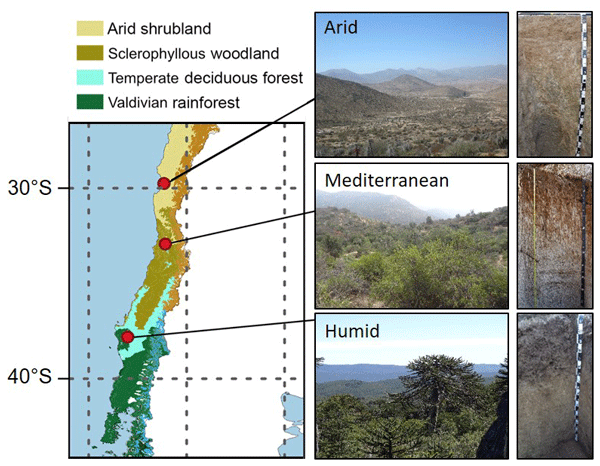
We explored carbon cycling in soils in three climate zones in Chile down to a depth of 6 m, using carbon isotopes. Our results show that microbial activity several meters below the soil surface is mostly fueled by recently fixed carbon and that strong decomposition of soil organic matter only occurs in the upper decimeters of the soils. The study shows that different layers of the critical zone are tightly connected and that processes in the deep soil depend on recently fixed carbon.
Marie Spohn, Carina Josefsson Ortiz, and Carlos A. Sierra
EGUsphere, https://doi.org/10.5194/egusphere-2026-3238, https://doi.org/10.5194/egusphere-2026-3238, 2026
This preprint is open for discussion and under review for Biogeosciences (BG).
Short summary
Short summary
We found that old soil organic matter (SOM) fractions in temperate forests are very nitrogen-rich. A larger proportion of the total organic nitrogen than of the total organic carbon was found in the old SOM fractions suggesting that organic nitrogen compounds decompose on average more slowly than nitrogen-free organic compounds. These results indicate that nitrogen in temperate forests persists for a long period in SOM.
Andrea Scheibe, Carlos A. Sierra, and Marie Spohn
Biogeosciences, 20, 827–838, https://doi.org/10.5194/bg-20-827-2023, https://doi.org/10.5194/bg-20-827-2023, 2023
Short summary
Short summary
We explored carbon cycling in soils in three climate zones in Chile down to a depth of 6 m, using carbon isotopes. Our results show that microbial activity several meters below the soil surface is mostly fueled by recently fixed carbon and that strong decomposition of soil organic matter only occurs in the upper decimeters of the soils. The study shows that different layers of the critical zone are tightly connected and that processes in the deep soil depend on recently fixed carbon.
Anneli M. Ågren, Eliza Maher Hasselquist, Johan Stendahl, Mats B. Nilsson, and Siddhartho S. Paul
SOIL, 8, 733–749, https://doi.org/10.5194/soil-8-733-2022, https://doi.org/10.5194/soil-8-733-2022, 2022
Short summary
Short summary
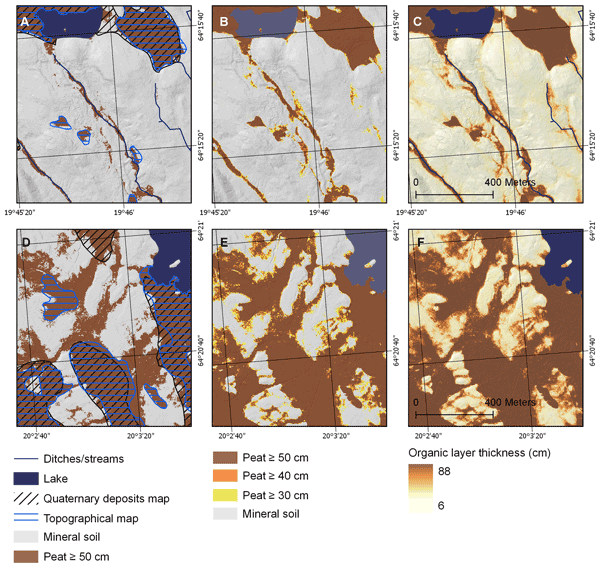
Historically, many peatlands in the boreal region have been drained for timber production. Given the prospects of a drier future due to climate change, wetland restorations are now increasing. Better maps hold the key to insights into restoration targets and land-use management policies, and maps are often the number one decision-support tool. We use an AI-developed soil moisture map based on laser scanning data to illustrate how the mapping of peatlands can be improved across an entire nation.
Cited articles
Afif, E., Barron, V., and Torrent, J.: Organic matter delays but does not prevent phosphate sorption by Cerrado soils from Brazil, Soil Sci., 159, 207–211, 1995.
Akselsson, C., Berg, B., Meentemeyer, V., and Westling, O.: Carbon sequestration rates in organic layers of boreal and temperate forest soils – Sweden as a case study, Global Ecol. Biogeogr., 14, 77–84, 2005.
Akselsson, C., Westling, O., Alveteg, M., Thelin, G., Fransson, A. M., and Hellsten, S.: The influence of N load and harvest intensity on the risk of P limitation in Swedish forest soils, Sci. Total Environ., 404, 284–289, 2008.
Akselsson, C., Karlsson, G. P., Karlsson P. E., and Ahlstrand, J.: Miljöövervakning på Obsytorna 1984–2013, Skogsstyrelsen, 142, 2015.
Bradshaw, C. J. and Warkentin, I. G.: Global estimates of boreal forest carbon stocks and flux, Global Planet. Change, 128, 24–30, 2015.
Braun, S., Thomas, V. F., Quiring, R., and Flückiger, W.: Does nitrogen deposition increase forest production? The role of phosphorus, Environ. Pollut., 158, 2043–2052, 2010.
Callesen, I., Raulund-Rasmussen, K., Westman, C. J., and Tau-Strand, L.: Nitrogen pools and C:N ratios in well-drained Nordic forest soils related to climate and soil texture, Boreal Environ. Res., 12, 681–692, 2007.
Christensen, B. T.: Physical fractionation of soil and structural and functional complexity in organic matter turnover, Eur. J. Soil Sci., 52, 345–353, 2001.
Clarholm, M. and Skyllberg, U.: Translocation of metals by trees and fungi regulates pH, soil organic matter turnover and nitrogen availability in acidic forest soils, Soil Biol. Biochem., 63, 142–153, 2013.
Cools, N., Vesterdal, L., De Vos, B., Vanguelova, E., and Hansen, K.: Tree species is the major factor explaining C:N ratios in European forest soils, Forest Ecol. Manag., 311, 3–16, 2014.
Cotrufo, M. F., Wallenstein, M. D., Boot, C. M., Denef, K., and Paul, E.: The Microbial Efficiency-Matrix Stabilization (MEMS) framework integrates plant litter decomposition with soil organic matter stabilization: do labile plant inputs form stable soil organic matter?, Global Change Biol., 19, 988–995, 2013.
DeLuca, T. H., Zackrisson, O., Nilsson, M. C., and Sellstedt, A.: Quantifying nitrogen-fixation in feather moss carpets of boreal forests, Nature, 419, 917–920, 2002.
DeLuca, T. H., Zackrisson, O., Gundale, M. J., and Nilsson, M. C.: Ecosystem feedbacks and nitrogen fixation in boreal forests, Science, 320, 1181, 2008.
Flückiger, W. and Braun, S.: Nitrogen deposition in Swiss forests and its possible relevance for leaf nutrient status, parasite attacks and soil acidification, Environ. Pollut., 102, 69–76, 1998.
Fransson, A. M. and Jones, D. L.: Phosphatase activity does not limit the microbial use of low molecular weight organic-P substrates in soil, Soil Biol. Biochem., 39, 1213–1217, 2007.
Giesler, R., Högberg, M., and Högberg, P.: Soil chemistry and plants in Fennoscandian boreal forest as exemplified by a local gradient, Ecology, 79, 119–137, 1998.
Giesler, R., Petersson, T., and Högberg, P.: Phosphorus limitation in boreal forests: effects of aluminum and iron accumulation in the humus layer, Ecosystems, 5, 300–314, 2002.
Goodale, C. L. and Aber, J. D.: The long-term effects of land-use history on nitrogen cycling in northern hardwood forests, Ecol. Appl., 11, 253–267, 2001.
Gundale, M. J., Wardle, D. A., and Nilsson, M. C.: Vascular plant removal effects on biological N fixation vary across a boreal forest island gradient, Ecology, 91, 1704–1714, 2010.
Gundale, M. J., Deluca, T. H., and Nordin, A.: Bryophytes attenuate anthropogenic nitrogen inputs in boreal forests, Global Change Biol., 17, 2743–2753, 2011.
Gundale, M. J., Nilsson, M., Bansal, S., and Jäderlund, A.: The interactive effects of temperature and light on biological nitrogen fixation in boreal forests, New Phytol., 194, 453–463, 2012.
Hansson, K., Olsson, B. A., Olsson, M., Johansson, U., and Kleja, D. B.: Differences in soil properties in adjacent stands of Scots pine, Norway spruce and silver birch in SW Sweden, Forest Ecol. Manag., 262, 522–530, 2011.
Hassink, J.: The capacity of soils to preserve organic C and N by their association with clay and silt particles, Plant Soil, 191, 77–87, 1997.
Heuck, C. and Spohn, M.: Carbon, nitrogen and phosphorus net mineralization in organic horizons of temperate forests: stoichiometry and relations to organic matter quality, Biogeochemistry, 131, 229–242, 2016.
Heuck, C., Smolka, G., Whalen, E. D., Frey, S., Gundersen, P., Moldan, F., Fernandez, I. J., and Spohn, M.: Effects of long-term nitrogen addition on phosphorus cycling in organic soil horizons of temperate forests, Biogeochemistry, 141, 167–181, 2018.
Högberg, P., Näsholm, T., Franklin, O., and Högberg, M. N.: Tamm Review: On the nature of the nitrogen limitation to plant growth in Fennoscandian boreal forests, Forest Ecol. Manag., 403, 161–185, 2017.
Högberg, P., Wellbrock, N., Högberg, M. N., Mikaelsson, H., and Stendahl, J.: Large differences in plant nitrogen supply in German and Swedish forests – Implications for management, Forest Ecol. Manag., 482, 118899, https://doi.org/10.1016/j.foreco.2020.118899, 2021.
Hounkpatin, K. O., Stendahl, J., Lundblad, M., and Karltun, E.: Predicting the spatial distribution of soil organic carbon stock in Swedish forests using a group of covariates and site-specific data, Soil, 7, 377–398, 2021.
IUSS Working Group WRB: World Reference Base for Soil Resources 2014, update 2015,
International soil classification system for naming soils and creating legends for soil maps,
World Soil Resources Reports No. 106, FAO, Rome, 2015.
Jonard, M., Fürst, A., Verstraeten, A., Thimonier, A., Timmermann, V., Potočić, N., Waldner, P., Benham, S., Hansen, K., Merilä, P., Ponette, Q., de la Cruz, A.C., Roskams, P., Nicolas, M., Croisé, L., Ingerslev, M., Matteucci, G., Decinti, B., Bascietto, M., and Rautio, P.: Tree mineral nutrition is deteriorating in Europe, Global Change Biol., 21, 418–430, 2015.
Jones, D. L. and Hodge, A.: Biodegradation kinetics and sorption reactions of three differently charged amino acids in soil and their effects on plant organic nitrogen availability, Soil Biol. Biochem., 31, 1331–1342, 1999.
Kleber, M., Sollins, P., and Sutton, R.: A conceptual model of organo-mineral interactions in soils: self-assembly of organic molecular fragments into zonal structures on mineral surfaces, Biogeochemistry, 85, 9–24, 2007.
Kleber, M., Eusterhues, K., Keiluweit, M., Mikutta, C., Mikutta, R., and Nico, P. S.: Mineral–organic associations: formation, properties, and relevance in soil environments, Adv. Agron., 130, 1–140, 2015.
Knicker, H., Fründ, R., and Lüdemann, H. D.: The chemical nature of nitrogen in native soil organic matter, Naturwissenschaften, 80, 219–221, 1993.
Kögel‐Knabner, I., Guggenberger, G., Kleber, M., Kandeler, E., Kalbitz, K., Scheu, S., Eusterhues, K., and Leinweber, P.: Organo-mineral associations in temperate soils: Integrating biology, mineralogy, and organic matter chemistry, J. Plant Nutr. Soil Sc., 171, 61–82, 2008.
Kopittke, P. M., Hernandez-Soriano, M. C., Dalal, R. C., Finn, D., Menzies, N. W., Hoeschen, C., and Mueller, C. W.: Nitrogen-rich microbial products provide new organo-mineral associations for the stabilization of soil organic matter, Global Change Biol., 24, 1762–1770, 2018.
Ladanai, S., Ågren, G. I., and Olsson, B. A.: Relationships between tree and soil properties in Picea abies and Pinus sylvestris forests in Sweden, Ecosystems, 13, 302–316, 2010.
Lagerström, A., Nilsson, M. C., Zackrisson, O., and Wardle, D. A.: Ecosystem input of nitrogen through biological fixation in feather mosses during ecosystem retrogression, Funct. Ecol., 21, 1027–1033, 2007.
Laskowski, R., Berg, B., Johansson, M. B., and McClaugherty, C.: Release pattern for potassium from decomposing forest needle and leaf litter. Long-term decomposition in a Scots pine forest. IX, Can. J. Botany, 73, 2019–2027, 1995.
Lützow, M. V., Kögel-Knabner, I., Ekschmitt, K., Matzner, E., Guggenberger, G., Marschner, B., and Flessa, H.: Stabilization of organic matter in temperate soils: mechanisms and their relevance under different soil conditions – a review, Eur. J. Soil Sci., 57, 426–445, 2006.
Mayer, L. M., Schick, L. L., Hardy, K. R., Wagai, R., and McCarthy, J.: Organic matter in small mesopores in sediments and soils, Geochim. Cosmochim. Ac., 68, 3863–3872, 2004.
McGroddy, M. E., Daufresne, T., and Hedin, L. O.: Scaling of stoichiometry in forests worldwide: Implications of terrestrial redfield-type ratios, Ecology, 85, 2390–2401, 2004.
Miltner, A., Kindler, R., Knicker, H., Richnow, H. H., and Kästner, M.: Fate of microbial biomass-derived amino acids in soil and their contribution to soil organic matter, Org. Geochem., 40, 978–985, 2009.
Moore, T. R., Trofymow, J. A., Prescott, C. E., and Titus, B. D.: Nature and nurture in the dynamics of C, N and P during litter decomposition in Canadian forests, Plant Soil, 339, 163–175, 2011.
Murphy, J. and Riley, J. P.: A modified single solution method for the determination of phosphate in natural waters, Anal. Chim. Acta, 27, 31–36, 1962.
Oades, J. M.: The retention of organic matter in soils, Biogeochemistry, 5, 35–70, 1988.
Olsson, M., Rosén, K., and Melkerud, P. A.: Regional modelling of base cation losses from Swedish forest soils due to whole-tree harvesting, Appl. Geochem., 8, 189–194, 1993.
Osono, T. and Takeda, H.: Potassium, calcium, and magnesium dynamics during litter decomposition in a cool temperate forest, J. Forest Res.-Jpn., 9, 23–31, 2004.
Pansu, M. and Gautheyrou, J.: Handbook of soil analysis: mineralogical, organic and inorganic methods, Springer Science and Business Media, ISBN 1-280-95753-0, 2006.
Parton, W., Silver, W. L., Burke, I. C., Grassens, L., Harmon, M. E., Currie, W. S., King, J., Adair, C., Brandt, L. A., Hart, S. C., and Fasth, B.: Global-scale similarities in nitrogen release patterns during long-term decomposition, Science, 315, 361–364, 2007.
R Core Team: A Language and Environment for Statistical Computing R Foundation for Statistical Computing, Austria, Vienna, 2021.
Ranneby, B., Cruse, T., Hägglund, B., Jonasson, H., and Swärd, J.: Designing a new national forest survey for Sweden, Studia Forestalia Suecica 177, ISBN 91-576-2982-X, 1987.
Rousk, K., Jones, D. L., and DeLuca, T. H.: Moss-cyanobacteria associations as biogenic sources of nitrogen in boreal forest ecosystems, Front. Microbiol., 4, 150, 2013.
Saunders, W. M. H. and Williams, E. G.: Observations on the determination of total organic phosphorus in soils, J. Soil Sci., 6, 254–267, 1955.
Schlesinger, W. H.: Some thoughts on the biogeochemical cycling of potassium in terrestrial ecosystems, Biogeochemistry, 154, 427–432, 2021.
Schneider, M. P. W., Scheel, T., Mikutta, R., Van Hees, P., Kaiser, K., and Kalbitz, K.: Sorptive stabilization of organic matter by amorphous Al hydroxide, Geochim. Cosmochim. Ac., 74, 1606–1619, 2010.
Sorensen, P. L. and Michelsen, A.: Long-term warming and litter addition affects nitrogen fixation in a subarctic heath, Global Change Biol., 17, 528–537, 2011.
Spohn, M.: Increasing the organic carbon stocks in mineral soils sequesters large amounts of phosphorus, Global Change Biol., 26, 4169–4177, 2020a.
Spohn, M.: Phosphorus and carbon in soil particle size fractions: A synthesis, Biogeochemistry, 147, 225–242, 2020b.
Spohn, M. and Chodak, M.: Microbial respiration per unit biomass increases with carbon-to-nutrient ratios in forest soils, Soil Biol. Biochem., 81, 128–133, 2015.
Spohn, M., Novák, T. J., Incze, J., and Giani, L.: Dynamics of soil carbon, nitrogen, and phosphorus in calcareous soils after land-use abandonment – A chronosequence study, Plant Soil, 401, 185–196, 2016.
Staaf, H. and Berg, B.: Accumulation and release of plant nutrients in decomposing Scots pine needle litter. Long-term decomposition in a Scots pine forest II, Can. J. Botany, 60, 1561–1568, 1982.
Stendahl, J., Johansson, M. B., Eriksson, E., Nilsson, Å., and Langvall, O.: Soil organic carbon in Swedish spruce and pine forests–differences in stock levels and regional patterns, Silva Fenn., 44, 5–21, 2010.
Stendahl, J., Berg, B., and Lindahl, B. D.: Manganese availability is negatively associated with carbon storage in northern coniferous forest humus layers, Sci. Reports, 7, 1–6, 2017.
Talkner, U., Meiwes, K. J., Potočić, N., Seletković, I., Cools, N., De Vos, B., and Rautio, P.: Phosphorus nutrition of beech (Fagus sylvatica L.) is decreasing in Europe, Ann. Forest Sci., 72, 919–928, 2015.
Tau-Strand, L., Callesen, I., Dalsgaard, L., and de Wit, H. A.: Carbon and nitrogen stocks in Norwegian forest soils – the importance of soil formation, climate, and vegetation type for organic matter accumulation, Can. J. Forest Res., 46, 1459–1473, 2016.
Tipping, E., Somerville, C. J., and Luster, J.: The stoichiometry of soil organic matter, Biogeochemistry, 130, 117–131, 2016.
Tuyishime, J. M., Adediran, G. A., Olsson, B. A., Spohn, M., Hillier, S., Klysubun, W., and Gustafsson, J. P.: Phosphorus abundance and speciation in acid forest Podzols–Effect of postglacial weathering, Geoderma, 406, 115500, https://doi.org/10.1016/j.geoderma.2021.115500, 2022.
Vejre, H., Callesen, I., Vesterdal, L., and Raulund-Rasmussen, K.: Carbon and nitrogen in Danish forest soils – contents and distribution determined by soil order, Soil Sci. Soc. Am. J., 67, 335–343, 2003.
Vesterdal, L. and Raulund-Rasmussen, K.: Forest floor chemistry under seven tree species along a soil fertility gradient, Can. J. Forest Res., 28, 1636–1647, 1998.
Vesterdal, L., Schmidt, I. K., Callesen, I., Nilsson, L. O., and Gundersen, P.: Carbon and nitrogen in forest floor and mineral soil under six common European tree species, Forest Ecol. Manag., 255, 35–48, 2008.
Williams, E. G. and Saunders, W. M. H.: Distribution of phosphorus in profiles and particle-size fractions of some Scottish soils, J. Soil Sci., 7, 90–109, 1956.
Yu, L., Zanchi, G., Akselsson, C., Wallander, H., and Belyazid, S.: Modeling the forest phosphorus nutrition in a southwestern Swedish forest site, Ecol. Model., 369, 88–100, 2018.
Zackrisson, O.: Influence of forest fires on the North Swedish boreal forest, Oikos, 29, 22–32, 1977.
Zechmeister-Boltenstern, S., Keiblinger, K. M., Mooshammer, M., Peñuelas, J., Richter, A., Sardans, J., and Wanek, W.: The application of ecological stoichiometry to plant–microbial–soil organic matter transformations, Ecol. Monogr., 85, 133–155, 2015.
Short summary
We explored the ratios of carbon (C), nitrogen (N), and phosphorus (P) of organic matter in Swedish forest soils. The N : P ratio of the organic layer was most strongly related to the mean annual temperature, while the C : N ratios of the organic layer and mineral soil were strongly related to tree species even in the subsoil. The organic P concentration in the mineral soil was strongly affected by soil texture, which diminished the effect of tree species on the C to organic P (C : OP) ratio.
We explored the ratios of carbon (C), nitrogen (N), and phosphorus (P) of organic matter in...
Altmetrics
Final-revised paper
Preprint