Articles | Volume 22, issue 4
https://doi.org/10.5194/bg-22-1149-2025
© Author(s) 2025. This work is distributed under
the Creative Commons Attribution 4.0 License.
https://doi.org/10.5194/bg-22-1149-2025
© Author(s) 2025. This work is distributed under
the Creative Commons Attribution 4.0 License.
Eddy covariance evaluation of ecosystem fluxes at a temperate saltmarsh in Victoria, Australia, shows large CO2 uptake

School of Earth, Atmosphere and Environment, Monash University, Clayton, VIC 3800, Australia
Edoardo Daly
Department of Civil Engineering, Monash University, Clayton, VIC 3800, Australia
WMAwater, Brisbane, QLD 4000, Australia
Tivanka Anandappa
School of Earth, Atmosphere and Environment, Monash University, Clayton, VIC 3800, Australia
Eboni-Jane Vienna-Hallam
School of Earth, Atmosphere and Environment, Monash University, Clayton, VIC 3800, Australia
Harriet Robertson
School of Earth, Atmosphere and Environment, Monash University, Clayton, VIC 3800, Australia
Matthew Peck
School of Earth, Atmosphere and Environment, Monash University, Clayton, VIC 3800, Australia
Adrien Guyot
Atmospheric Observations Research Group, The University of Queensland, Brisbane, QLD 4072, Australia
Australian Bureau of Meteorology, Melbourne, VIC, Australia
Related authors
No articles found.
Keirnan Fowler, Murray Peel, Margarita Saft, Tim J. Peterson, Andrew Western, Lawrence Band, Cuan Petheram, Sandra Dharmadi, Kim Seong Tan, Lu Zhang, Patrick Lane, Anthony Kiem, Lucy Marshall, Anne Griebel, Belinda E. Medlyn, Dongryeol Ryu, Giancarlo Bonotto, Conrad Wasko, Anna Ukkola, Clare Stephens, Andrew Frost, Hansini Gardiya Weligamage, Patricia Saco, Hongxing Zheng, Francis Chiew, Edoardo Daly, Glen Walker, R. Willem Vervoort, Justin Hughes, Luca Trotter, Brad Neal, Ian Cartwright, and Rory Nathan
Hydrol. Earth Syst. Sci., 26, 6073–6120, https://doi.org/10.5194/hess-26-6073-2022, https://doi.org/10.5194/hess-26-6073-2022, 2022
Short summary
Short summary
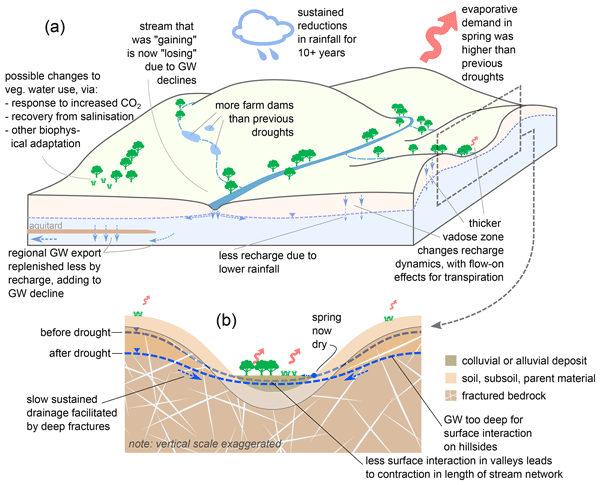
Recently, we have seen multi-year droughts tending to cause shifts in the relationship between rainfall and streamflow. In shifted catchments that have not recovered, an average rainfall year produces less streamflow today than it did pre-drought. We take a multi-disciplinary approach to understand why these shifts occur, focusing on Australia's over-10-year Millennium Drought. We evaluate multiple hypotheses against evidence, with particular focus on the key role of groundwater processes.
Marcela Silva, Ashley M. Matheny, Valentijn R. N. Pauwels, Dimetre Triadis, Justine E. Missik, Gil Bohrer, and Edoardo Daly
Geosci. Model Dev., 15, 2619–2634, https://doi.org/10.5194/gmd-15-2619-2022, https://doi.org/10.5194/gmd-15-2619-2022, 2022
Short summary
Short summary
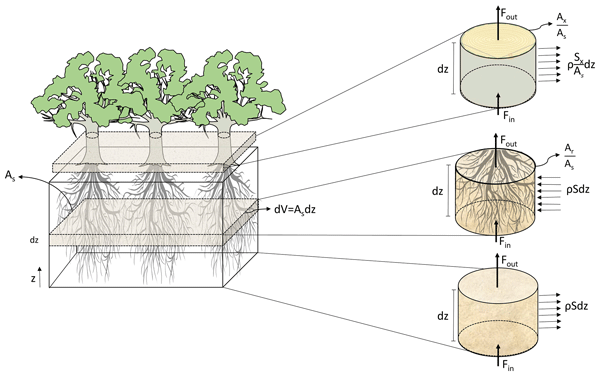
Our study introduces FETCH3, a ready-to-use, open-access model that simulates the water fluxes across the soil, roots, and stem. To test the model capabilities, we tested it against exact solutions and a case study. The model presented considerably small errors when compared to the exact solutions and was able to correctly represent transpiration patterns when compared to experimental data. The results show that FETCH3 can correctly simulate above- and below-ground water transport.
Simone Gelsinari, Valentijn R. N. Pauwels, Edoardo Daly, Jos van Dam, Remko Uijlenhoet, Nicholas Fewster-Young, and Rebecca Doble
Hydrol. Earth Syst. Sci., 25, 2261–2277, https://doi.org/10.5194/hess-25-2261-2021, https://doi.org/10.5194/hess-25-2261-2021, 2021
Short summary
Short summary
Estimates of recharge to groundwater are often driven by biophysical processes occurring in the soil column and, particularly in remote areas, are also always affected by uncertainty. Using data assimilation techniques to merge remotely sensed observations with outputs of numerical models is one way to reduce this uncertainty. Here, we show the benefits of using such a technique with satellite evapotranspiration rates and coupled hydrogeological models applied to a semi-arid site in Australia.
Cited articles
Adam, P.: Saltmarsh Ecology, Cambridge University Press, Cambridge, England, UK, 461 pp., ISBN 10 0521245087 1990.
Adam, P.: Morecambe Bay saltmarshes: 25 years of change, in: British Saltmarshes, Forrest Text, Cardigan, UK, 81–107, 2000.
Adam, P.: Saltmarshes in a time of change, Environ. Conserv., 29, 39–61, https://doi.org/10.1017/S0376892902000048, 2002.
Alongi, D. M.: Carbon balance in salt marsh and mangrove ecosystems: A global synthesis, J. Mar. Sci. Eng., 8, 767, https://doi.org/10.3390/jmse8100767, 2020.
Artigas, F., Shin, J. Y., Hobble, C., Marti-Donati, A., Schäfer, K. V. R., and Pechmann, I.: Long term carbon storage potential and CO2 sink strength of a restored salt marsh in New Jersey, Agric. For. Meteorol., 200, 313–321, https://doi.org/10.1016/j.agrformet.2014.09.012, 2015.
Baldocchi, D. D.: Assessing the eddy covariance technique for evaluating carbon dioxide exchange rates of ecosystems: past, present and future, Glob. Change Biol., 9, 479–492, https://doi.org/10.1046/j.1365-2486.2003.00629.x, 2003.
Barr, A. G., Richardson, A. D., Hollinger, D. Y., Papale, D., Arain, M. A., Black, T. A., Bohrer, G., Dragoni, D., Fischer, M. L., Gu, L., Law, B. E., Margolis, H. A., McCaughey, J. H., Munger, J. W., Oechel, W., and Schaeffer, K.: Use of change-point detection for friction-velocity threshold evaluation in eddy-covariance studies, Agric. For. Meteorol., 171, 31–45, https://doi.org/10.1016/j.agrformet.2012.11.023, 2013.
Bautista, N. E., Gassmann, M. I., and Pérez, C. F.: Gross primary production, ecosystem respiration, and net ecosystem production in a southeastern South American salt marsh, Estuar. Coast, 46, 1923–1937, https://doi.org/10.1007/s12237-023-01224-8, 2023.
Berry, J. and Björkman, O.: Photosynthetic response and adaptation to temperature in higher plants, Ann. Rev. Plant Physiol., 31, 491–543, https://doi.org/10.1146/annurev.pp.31.060180.002423, 1980.
Borges, A. V., Schiettecatte, L.-S., Abril, G., Delille, B., and Gazeau, F.: Carbon dioxide in European coastal waters, Trace Gases Eur. Coast. Zone, 70, 375–387, https://doi.org/10.1016/j.ecss.2006.05.046, 2006.
Cai, W.-J.: Estuarine and coastal ocean carbon paradox: CO2 sinks or sites of terrestrial carbon incineration?, Annu. Rev. Mar. Sci., 3, 123–145, https://doi.org/10.1146/annurev-marine-120709-142723, 2011.
Chen, J., Falk, M., Euskirchen, E., Paw U, K. T., Suchanek, T. H., Ustin, S. L., Bond, B. J., Brosofske, K. D., Phillips, N., and Bi, R.: Biophysical controls of carbon flows in three successional Douglas-fir stands based on eddy-covariance measurements, Tree Physiol., 22, 169–177, https://doi.org/10.1093/treephys/22.2-3.169, 2002.
Chmura, G. L., Anisfeld, S. C., Cahoon, D. R., and Lynch, J. C.: Global carbon sequestration in tidal, saline wetland soils, Glob. Biogeochem. Cycles, 17, 1111, https://doi.org/10.1029/2002GB001917, 2003.
Clarke, P. J. and Jacoby, C. A.: Biomass and above-ground productivity of salt-marsh plants in South-eastern Australia, Aust. J. Mar. Freshw. Res., 45, 1521–1528, 1994.
Drake, B. G.: Photosynthesis of salt marsh species, Aquat. Bot., 34, 167–180, https://doi.org/10.1016/0304-3770(89)90055-7, 1989.
Duarte, C. M.: Reviews and syntheses: Hidden forests, the role of vegetated coastal habitats in the ocean carbon budget, Biogeosciences, 14, 301–310, https://doi.org/10.5194/bg-14-301-2017, 2017.
Erickson, J. E., Peresta, G., Montovan, K. J., and Drake, B. G.: Direct and indirect effects of elevated atmospheric CO2 on net ecosystem production in a Chesapeake Bay tidal wetland, Glob. Change Biol., 19, 3368–3378, 2013.
Fagherazzi, S., Wiberg, P. L., Temmerman, S., Struyf, E., Zhao, Y., and Raymond, P. A.: Fluxes of water, sediments, and biogeochemical compounds in salt marshes, Ecol. Process., 2, 3, https://doi.org/10.1186/2192-1709-2-3, 2013.
Feagin, R. A., Forbrich, I., Huff, T. P., Barr, J. G., Ruiz-Plancarte, J., Fuentes, J. D., Najjar, R. G., Vargas, R., Vázquez-Lule, A., Windham-Myers, L., Kroeger, K. D., Ward, E. J., Moore, G. W., Leclerc, M., Krauss, K. W., Stagg, C. L., Alber, M., Knox, S. H., Schäfer, K. V. R., Bianchi, T. S., Hutchings, J. A., Nahrawi, H., Noormets, A., Mitra, B., Jaimes, A., Hinson, A. L., Bergamaschi, B., King, J. S., and Miao, G.: Tidal wetland gross primary production across the continental United States, 2000–2019, Glob. Biogeochem. Cycles, 34, e2019GB006349, https://doi.org/10.1029/2019GB006349, 2020.
Feher, L. C., Osland, M. J., Griffith, K. T., Grace, J. B., Howard, R. J., Stagg, C. L., Enwright, N. M., Krauss, K. W., Gabler, C. A., Day, R. H., and Rogers, K.: Linear and nonlinear effects of temperature and precipitation on ecosystem properties in tidal saline wetlands, Ecosphere, 8, e01956, https://doi.org/10.1002/ecs2.1956, 2017.
Gedan, K. B., Silliman, B. R., and Bertness, M. D.: Centuries of human-driven change in salt marsh ecosystems, Annu. Rev. Mar. Sci., 1, 117–141, https://doi.org/10.1146/annurev.marine.010908.163930, 2009.
Ghosh, S. and Mishra, D. R.: Analyzing the long-term phenological trends of salt marsh ecosystem across coastal Louisiana, Remote Sens., 9, 1340, https://doi.org/10.3390/rs9121340, 2017.
Giurgevich, J. R. and Dunn, E. L.: A comparative analysis of the CO2 and water vapor responses of two Spartina species from Georgia coastal marshes, Estuar. Coast. Shelf Sci., 12, 561–568, https://doi.org/10.1016/S0302-3524(81)80082-5, 1981.
Hilker, T., Hall, F. G., Coops, N. C., Lyapustin, A., Wang, Y., Nesic, Z., Grant, N., Black, T. A., Wulder, M. A., Kljun, N., Hopkinson, C., and Chasmer, L.: Remote sensing of photosynthetic light-use efficiency across two forested biomes: Spatial scaling, Remote Sens. Environ., 114, 2863–2874, https://doi.org/10.1016/j.rse.2010.07.004, 2010.
Hill, A. C. and Vargas, R.: Methane and carbon dioxide fluxes in a temperate tidal salt marsh: comparisons between plot and ecosystem measurements, J. Geophys. Res.-Biogeo., 127, e2022JG006943, https://doi.org/10.1029/2022JG006943, 2022.
Howe, A. J., Rodríguez, J. F., Spencer, J., MacFarlane, G. R., and Saintilan, N.: Response of estuarine wetlands to reinstatement of tidal flows, Mar. Freshw. Res., 61, 702–713, 2010.
Hughes, C. E., Kalma, J. D., Binning, P., Willgoose, G. R., and Vertzonis, M.: Estimating evapotranspiration for a temperate salt marsh, Newcastle, Australia, Hydrol. Process., 15, 957–975, https://doi.org/10.1002/hyp.189, 2001.
Huxham, M., Whitlock, D., Githaiga, M., and Dencer-Brown, A.: Carbon in the coastal seascape: how interactions between mangrove forests, seagrass meadows and tidal marshes influence carbon storage, Curr. For. Rep., 4, 101–110, https://doi.org/10.1007/s40725-018-0077-4, 2018.
Kathilankal, J. C., Mozdzer, T. J., Fuentes, J. D., D'Odorico, P., McGlathery, K. J., and Zieman, J. C.: Tidal influences on carbon assimilation by a salt marsh, Environ. Res. Lett., 3, 044010, https://doi.org/10.1088/1748-9326/3/4/044010, 2008.
Kljun, N., Calanca, P., Rotach, M. W., and Schmid, H. P.: A simple two-dimensional parameterisation for Flux Footprint Prediction (FFP), Geosci. Model Dev., 8, 3695–3713, https://doi.org/10.5194/gmd-8-3695-2015, 2015.
Krauss, K. W., Lovelock, C. E., Chen, L., Berger, U., Ball, M. C., Reef, R., Peters, R., Bowen, H., Vovides, A. G., Ward, E. J., Wimmler, M., Carr, J., Bunting, P., and Duberstein, J. A.: Mangroves provide blue carbon ecological value at a low freshwater cost, Sci. Rep., 12, 17636, https://doi.org/10.1038/s41598-022-21514-8, 2022.
Lloyd, J. and Taylor, J. A.: On the temperature dependence of soil respiration, Funct. Ecol., 8, 315–323, https://doi.org/10.2307/2389824, 1994.
Lu, W., Xiao, J., Liu, F., Zhang, Y., Liu, C., and Lin, G.: Contrasting ecosystem CO2 fluxes of inland and coastal wetlands: a meta-analysis of eddy covariance data, Glob. Change Biol., 23, 1180–1198, https://doi.org/10.1111/gcb.13424, 2017.
Mayen, J., Polsenaere, P., Lamaud, É., Arnaud, M., Kostyrka, P., Bonnefond, J.-M., Geairon, P., Gernigon, J., Chassagne, R., Lacoue-Labarthe, T., Regaudie de Gioux, A., and Souchu, P.: Atmospheric CO2 exchanges measured by eddy covariance over a temperate salt marsh and influence of environmental controlling factors, Biogeosciences, 21, 993–1016, https://doi.org/10.5194/bg-21-993-2024, 2024.
McLeod, E., Chmura, G. L., Bouillon, S., Salm, R., Björk, M., Duarte, C. M., Lovelock, C. E., Schlesinger, W. H., and Silliman, B. R.: A blueprint for blue carbon: toward an improved understanding of the role of vegetated coastal habitats in sequestering CO2, Front. Ecol. Environ., 9, 552–560, https://doi.org/10.1890/110004, 2011.
Mcowen, C. J., Weatherdon, L. V., Bochove, J.-W. V., Sullivan, E., Blyth, S., Zockler, C., Stanwell-Smith, D., Kingston, N., Martin, C. S., Spalding, M., and Fletcher, S.: A global map of saltmarshes, Biodivers. Data J., 5, e11764, https://doi.org/10.3897/BDJ.5.e11764, 2017.
McVicar, T., Vleeshouwer, J., Van Niel, T., Guerschman, J., and Peña-Arancibia, J. L.: Actual Evapotranspiration for Australia using CMRSET algorithm, Version 1.0, Terrestrial Ecosystem Research Network [data set], https://doi.org/10.25901/gg27-ck96, 2022.
Mitsch, W. J. and Gosselink, J. G.: The value of wetlands: importance of scale and landscape setting, Ecol. Econ., 35, 25–33, https://doi.org/10.1016/S0921-8009(00)00165-8, 2000.
Moffett, K. B., Wolf, A., Berry, J. A., and Gorelick, S. M.: Salt marsh–atmosphere exchange of energy, water vapor, and carbon dioxide: Effects of tidal flooding and biophysical controls, Water Resour. Res., 46, W10525, https://doi.org/10.1029/2009WR009041, 2010.
Nahrawi, H., Leclerc, M. Y., Pennings, S., Zhang, G., Singh, N., and Pahari, R.: Impact of tidal inundation on the net ecosystem exchange in daytime conditions in a salt marsh, Agric. For. Meteorol., 294, 108133, https://doi.org/10.1016/j.agrformet.2020.108133, 2020.
Navarro, A., Young, M., Macreadie, P. I., Nicholson, E., and Ierodiaconou, D.: Mangrove and saltmarsh distribution mapping and land cover change assessment for south-eastern Australia from 1991 to 2015, Remote Sens., 13, 1450, https://doi.org/10.3390/rs13081450, 2021.
Osborne, C. P. and Freckleton, R. P.: Ecological selection pressures for C4 photosynthesis in the grasses, P. Roy. Soc. B, 276, 1753–1760, https://doi.org/10.1098/rspb.2008.1762, 2009.
Otani, S. and Endo, T.: CO2 flux in tidal flats and salt marshes, Blue Carbon Shallow Coast, Ecosyst. Carbon Dyn. Policy Implement., 223–250, 2019.
Owers, C. J., Rogers, K. and Woodroffe, C. D.: Spatial variation of above-ground carbon storage in temperate coastal wetlands, Estuar. Coast. Shelf Sci., 210, 55–67, https://doi.org/10.1016/j.ecss.2018.06.002, 2018.
R Core Team: R: A Language Environment for Statistical Computing, Vienna, Austria, https://www.R-project.org/ (last access: 12 December 2024), 2024.
Reef, R.: Eddy Covariance flux averages from French Island, Figshare [data set], https://doi.org/10.26180/26027005.v1, 2024.
Reents, S., Möller, I., Evans, B. R., Schoutens, K., Jensen, K., Paul, M., Bouma, T. J., Temmerman, S., Lustig, J., Kudella, M., and Nolte, S.: Species-specific and seasonal differences in the resistance of salt-marsh vegetation to wave impact, Front. Mar. Sci., 9, 898080, https://doi.org/10.3389/fmars.2022.898080, 2022.
Rosentreter, J. A., Laruelle, G. G., Bange, H. W., Bianchi, T. S., Busecke, J. J. M., Cai, W. J., Eyre, B. D., Forbich, I., Kwon, E. Y., Maavara, T., Moosdorf, N., Najjar, R. G, Sarma, V. V. S. S., Van Dam, B. and Regnier, P.: Coastal vegetation and estuaries are collectively a greenhouse gas sink, Nat. Clim. Chang., 13, 579–587, https://doi.org/10.1038/s41558-023-01682-9, 2023.
Schäfer, K. V. R., Duman, T., Tomasicchio, K., Tripathee, R., and Sturtevant, C.: Carbon dioxide fluxes of temperate urban wetlands with different restoration history, Agric. For. Meteorol., 275, 223–232, https://doi.org/10.1016/j.agrformet.2019.05.026, 2019.
Seyfferth, A. L., Bothfeld, F., Vargas, R., Stuckey, J. W., Wang, J., Kearns, K., Michael, H. A., Guimond, J., Yu, X., and Sparks, D. L.: Spatial and temporal heterogeneity of geochemical controls on carbon cycling in a tidal salt marsh, Geochim. Cosmochim. Ac., 282, 1–18, 2020.
Shepard, C. C., Crain, C. M., and Beck, M. W.: The protective role of coastal marshes: a systematic review and meta-analysis, PLoS ONE, 6, e27374, https://doi.org/10.1371/journal.pone.0027374, 2011.
Smith, J. A. M., Regan, K., Cooper, N. W., Johnson, L., Olson, E., Green, A., Tash, J., Evers, D. C., and Marra, P. P.: A green wave of saltmarsh productivity predicts the timing of the annual cycle in a long-distance migratory shorebird, Sci. Rep., 10, 20658, https://doi.org/10.1038/s41598-020-77784-7, 2020.
Vázquez-Lule, A. and Vargas, R.: Biophysical drivers of net ecosystem and methane exchange across phenological phases in a tidal salt marsh, Agric. For. Meteorol., 300, 108309, https://doi.org/10.1016/j.agrformet.2020.108309, 2021.
Wang, Z. A., Kroeger, K. D., Ganju, N. K., Gonneea, M. E., and Chu, S. N.: Intertidal salt marshes as an important source of inorganic carbon to the coastal ocean, Limnol. Oceanogr., 61, 1916–1931, https://doi.org/10.1002/lno.10347, 2016.
Ward, N. D., Megonigal, J. P., Bond-Lamberty, B., Bailey, V. L., Butman, D., Canuel, E. A., Diefenderfer, H., Ganju, N. K., Goñi, M. A., and Graham, E. B.: Representing the function and sensitivity of coastal interfaces in Earth system models, Nat. Commun., 11, 2458, https://doi.org/10.1038/s41467-020-16236-2, 2020.
Wei, S., Han, G., Jia, X., Song, W., Chu, X., He, W., Xia, J., and Wu, H.: Tidal effects on ecosystem CO2 exchange at multiple timescales in a salt marsh in the Yellow River Delta, Estuar. Coast. Shelf Sci., 238, 106727, https://doi.org/10.1016/j.ecss.2020.106727, 2020.
Whitfield, A. K.: The role of seagrass meadows, mangrove forests, salt marshes and reed beds as nursery areas and food sources for fishes in estuaries, Rev. Fish Biol. Fish., 27, 75–110, https://doi.org/10.1007/s11160-016-9454-x, 2017.
Xiao, J., Sun, G., Chen, J., Chen, H., Chen, S., Dong, G., Gao, S., Guo, H., Guo, J., Han, S., Kato, T., Li, Y., Lin, G., Lu, W., Ma, M., McNulty, S., Shao, C., Wang, X., Xie, X., Zhang, X., Zhang, Z., Zhao, B., Zhou, G., and Zhou, J.: Carbon fluxes, evapotranspiration, and water use efficiency of terrestrial ecosystems in China, Agric. For. Meteorol., 182–183, 76–90, https://doi.org/10.1016/j.agrformet.2013.08.007, 2013.
Short summary
Studies show that saltmarshes excel at capturing carbon from the atmosphere. In this study, we measured CO2 flux in an Australian temperate saltmarsh on French Island. The temperate saltmarsh exhibited strong seasonality. During the warmer growing season, the saltmarsh absorbed 10.5 g CO2 m−2 on average daily from the atmosphere. Even in winter, when plants were dormant, it continued to be a CO2 sink, albeit a smaller one. Cool temperatures and high cloud cover inhibit carbon sequestration.
Studies show that saltmarshes excel at capturing carbon from the atmosphere. In this study, we...
Altmetrics
Final-revised paper
Preprint