Articles | Volume 20, issue 20
https://doi.org/10.5194/bg-20-4323-2023
© Author(s) 2023. This work is distributed under
the Creative Commons Attribution 4.0 License.
https://doi.org/10.5194/bg-20-4323-2023
© Author(s) 2023. This work is distributed under
the Creative Commons Attribution 4.0 License.
Contribution of the open ocean to the nutrient and phytoplankton inventory in a semi-enclosed coastal sea
Qian Leng
Graduate School of Science and Engineering, Ehime University, 2-5 Bunkyo-cho, Matsuyama, Ehime 790-8577, Japan
Center for Marine Environmental Studies, Ehime University, 2-5 Bunkyo-cho, Matsuyama, Ehime 790-8577, Japan
Junying Zhu
State Key Laboratory of Marine Resource Utilization in South China Sea, Hainan University, Haikou 570228, China
Akihiko Morimoto
Center for Marine Environmental Studies, Ehime University, 2-5 Bunkyo-cho, Matsuyama, Ehime 790-8577, Japan
Related authors
No articles found.
Zhaosen Wu, Xinyu Guo, Jie Shi, Xiaokun Ding, Masatoshi Nakakuni, and Kuninao Tada
EGUsphere, https://doi.org/10.5194/egusphere-2025-6187, https://doi.org/10.5194/egusphere-2025-6187, 2025
This preprint is open for discussion and under review for Biogeosciences (BG).
Short summary
Short summary
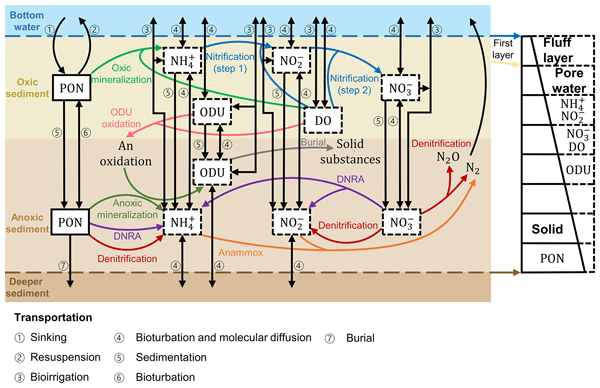
This study reveals how seasonal changes shape the movement of nitrogen between the sediments and the overlying water in a semi-enclosed inland sea. By combining long-term observations with a purpose-built vertical model, we identify the key environmental drivers that control when and how sediments release nitrogen back to the water. These insights fill an important gap in understanding coastal nutrient dynamics and provide essential guidance for managing risks such as coastal eutrophication.
Menghong Dong, Xinyu Guo, Takuya Matsuura, Taichi Tebakari, and Jing Zhang
Biogeosciences, 22, 2383–2402, https://doi.org/10.5194/bg-22-2383-2025, https://doi.org/10.5194/bg-22-2383-2025, 2025
Short summary
Short summary
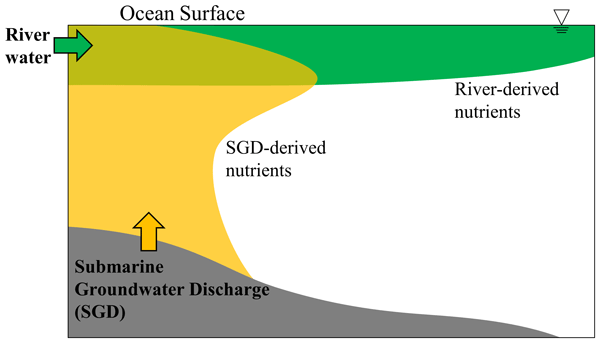
Submarine groundwater discharge (SGD), a common coastal hydrological process that involves submarine inflow of groundwater into the sea, is associated with a large nutrient load. To clarify the distribution of SGD-derived nutrients after release at the bottom of the sea and their contribution to phytoplankton growth in the marine ecosystem, we modeled the SGD process in Toyama Bay using a specialized computer code that can distinguish SGD-derived nutrients from nutrients from other sources.
Menghong Dong and Xinyu Guo
Ocean Sci., 20, 1527–1546, https://doi.org/10.5194/os-20-1527-2024, https://doi.org/10.5194/os-20-1527-2024, 2024
Short summary
Short summary
We employed a gradient-based algorithm to identify the position and intensity of the fronts in a coastal sea using sea surface temperature data, thereby quantifying their variations. Our study provides a comprehensive analysis of these fronts, elucidating their seasonal variability, intra-tidal dynamics, and the influence of winds on the fronts. By capturing the temporal and spatial dynamics of these fronts, our understanding of the complex oceanographic processes within this region is enhanced.
Lei Lin, Hao Liu, Xiaomeng Huang, Qingjun Fu, and Xinyu Guo
Hydrol. Earth Syst. Sci., 26, 5207–5225, https://doi.org/10.5194/hess-26-5207-2022, https://doi.org/10.5194/hess-26-5207-2022, 2022
Short summary
Short summary
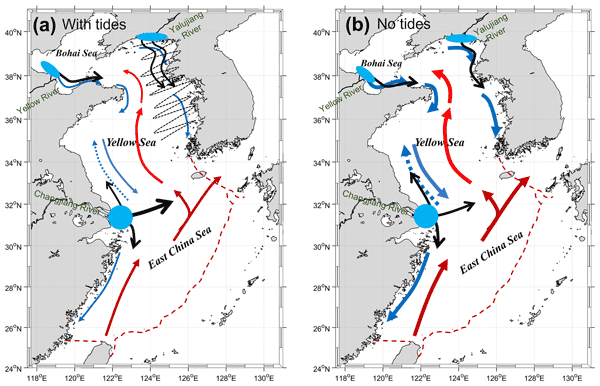
Earth system (climate) model is an important instrument for projecting the global water cycle and climate change, in which tides are commonly excluded due to the much small timescales compared to the climate. However, we found that tides significantly impact the river water transport pathways, transport timescales, and concentrations in shelf seas. Thus, the tidal effect should be carefully considered in earth system models to accurately project the global water and biogeochemical cycle.
Junying Zhu, Jie Shi, and Xinyu Guo
Ocean Sci., 18, 659–673, https://doi.org/10.5194/os-18-659-2022, https://doi.org/10.5194/os-18-659-2022, 2022
Short summary
Short summary
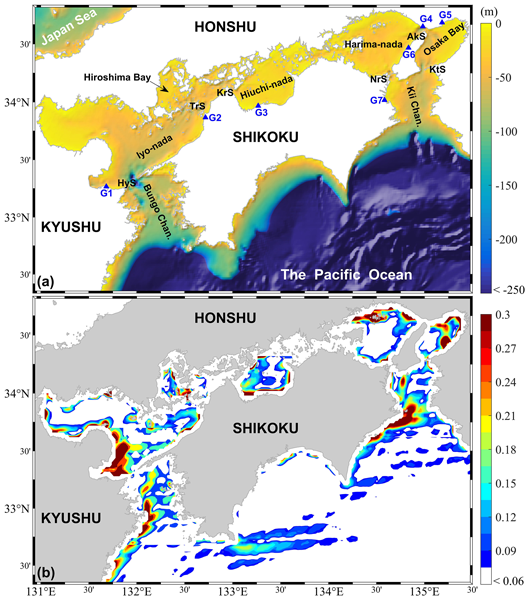
A bottom cold water mass (BCWM) is a widespread physical oceanographic phenomenon among coastal seas. Observations reveal a prominent interannual variation in a BCWM in the Seto Inland Sea during 1994–2015. We found that air–sea heat flux change during the warming season plays an important role in its interannual variation. Comparison with other BCWMs indicates that the size is a key factor for their difference. The findings help understand the response of BCWMs to sea surface forcing change.
Cited articles
Abo, K. and Yamamoto, T.: Oligotrophication and its measures in the Seto Inland Sea, Japan, Bull. Jpn. Fish. Res. Educ. Agency, 49, 21–26, 2019.
Anderson, D. M., Burkholder, J. M., Cochlan, W. P., Glibert, P. M., Gobler, C. J., Heil, C. A., Kudela, R. M., Parsons, M. L., Rensel, J. E. J., Townsend, D. W., Trainer, V. L., and Vargo, G. A.: Harmful algal blooms and eutrophication: Examining linkages from selected coastal regions of the United States, Harmful Algae, 8, 39–53, https://doi.org/10.1016/j.hal.2008.08.017, 2008.
Aoki, K., Shimizu, Y., Yamamoto, T., Yokouchi, K., Kishi, K., Akada, H., and Kurogi, H.: Estimation of inward nutrient flux from offshore into semi-enclosed sea (Tokyo Bay, Japan) based on in-situ data, Estuar. Coast. Shelf Sci., 274, 107930, https://doi.org/10.1016/j.ecss.2022.107930, 2022.
Ariathurai, R. and Krone, R. B.: Mathematical modelling of sediment transport in estuaries, in: Estuarine Processes, Elsevier, 98–106, https://doi.org/10.1016/B978-0-12-751802-2.50015-1, 1977.
Bauer, J. E., Cai, W.-J., Raymond, P. A., Bianchi, T. S., Hopkinson, C. S., and Regnier, P. A. G.: The changing carbon cycle of the coastal ocean, Nature, 504, 61–70, https://doi.org/10.1038/nature12857, 2013.
Blumberg, A. F. and Mellor, G. L.: A description of a three-dimensional coastal ocean circulation model, in: Coastal and Estuarine Sciences, vol. 4, edited by: Heaps, N. S., American Geophysical Union, Washington, D. C., 1–16, https://doi.org/10.1029/CO004, 1987.
Caddy, J.: Marine catchment basin effects versus impacts of fisheries on semi-enclosed seas, ICES J. Mar. Sci., 57, 628–640, https://doi.org/10.1006/jmsc.2000.0739, 2000.
Chang, P.-H., Guo, X., and Takeoka, H.: A numerical study of the seasonal circulation in the Seto Inland Sea, Japan, J. Oceanogr., 65, 721–736, https://doi.org/10.1007/s10872-009-0062-4, 2009.
Fasham, M. J. R., Ducklow, H. W., and McKelvie, S. M.: A nitrogen-based model of plankton dynamics in the oceanic mixed layer, J. Mar. Res., 48, 591–639, https://doi.org/10.1357/002224090784984678, 1990.
Fennel, K., Wilkin, J., Levin, J., Moisan, J., O'Reilly, J., and Haidvogel, D.: Nitrogen cycling in the Middle Atlantic Bight: Results from a three-dimensional model and implications for the North Atlantic nitrogen budget: Global Biogeochem. Cycles, 20, GB3007, https://doi.org/10.1029/2005GB002456, 2006.
Fujiwara, T., Uno, N., Tada, M., Nakatsuji, K., Kasai, A., and Sakamoto, W.: Inflow of nitrogen and phosphorus from the ocean into the Seto Inland Sea, Proc. Coastal Engineering (JSCE), https://doi.org/10.2208/proce1989.44.1061, 1997.
Fujiwara, T., Kobayashi, S., Kunii, M., and Uno, N.: Nitrogen and phosphorus in Seto Inland Sea: Their origin, budget and variability, Bull. Coast. Oceanogr., 43, 129–136, 2006.
Große, F., Fennel, K., and Laurent, A.: Quantifying the Relative Importance of Riverine and Open-Ocean Nitrogen Sources for Hypoxia Formation in the Northern Gulf of Mexico, J. Geophys. Res.-Oceans, 124, 5451–5467, https://doi.org/10.1029/2019JC015230, 2019.
Guo, X., Futamura, A., and Takeoka, H.: Residual currents in a semi-enclosed bay of the Seto Inland Sea, Japan, J. Geophys. Res., 109, C12008, https://doi.org/10.1029/2003JC002203, 2004.
Hashimoto, R., Watai, H., Miyahara, K., Sako, Y., and Yoshida, T.: Spatial and temporal variability of unicellular diazotrophic cyanobacteria in the eastern Seto Inland Sea, Fish Sci., 82, 459–471, https://doi.org/10.1007/s12562-016-0983-y, 2016.
Hayami Y., Usui S., and Takeoka H.: The stock and long term variation in nitrogen and phosphorus in the Seto Inland Sea, Sea Sky, 80, 75–78, https://doi.org/10.32142/engankaiyo.43.2_129, 2004.
Healy, T. and Harada, K.: Definition and physical characteristics of the world's enclosed coastal seas, Mar. Pollut. Bull., 23, 639–644, https://doi.org/10.1016/0025-326X(91)90749-I, 1991.
Jickells, T. D.: Nutrient Biogeochemistry of the Coastal Zone, Science, 281, 217–222, https://doi.org/10.1126/science.281.5374.217, 1998.
Kasai, A., Fujiwara, T., and Tada, M.: Ocean Structure and Nutrient Transport in the Kii Channel, Proc. Coast. Eng., 48, 436–440, https://doi.org/10.2208/proce1989.48.436, 2001.
Kawamiya, M.: Mechanism of offshore nutrient supply in the western Arabian Sea, J. Mar. Res., 59, 675–696, https://doi.org/10.1357/002224001762674890, 2001.
Kishi, M. J., Kashiwai, M., Ware, D. M., Megrey, B. A., Eslinger, D. L., Werner, F. E., Noguchi-Aita, M., Azumaya, T., Fujii, M., Hashimoto, S., Huang, D., Iizumi, H., Ishida, Y., Kang, S., Kantakov, G. A., Kim, H., Komatsu, K., Navrotsky, V. V., Smith, S. L., Tadokoro, K., Tsuda, A., Yamamura, O., Yamanaka, Y., Yokouchi, K., Yoshie, N., Zhang, J., Zuenko, Y. I., and Zvalinsky, V. I.: NEMURO – a lower trophic level model for the North Pacific marine ecosystem, Ecol. Model., 202, 12–25, https://doi.org/10.1016/j.ecolmodel.2006.08.021, 2007.
Kobayashi, S. and Fujiwara, T.: Modeling the long-term variability of shelf water intrusion into the Seto Inland Sea, Japan, J. Mar. Syst., 77, 341–349, https://doi.org/10.1016/j.jmarsys.2008.01.012, 2009.
Lee, Y. S., Seiki, T., Mukai, T., Takimoto, K., and Okada, M.: Limiting nutrients of phytoplankton community in Hiroshima Bay, Japan, Water Res., 30, 1490–1494, 1996.
Leppäkoski, E., Shiganova, T., and Alexandrov, B.: European Enclosed and Semi-enclosed Seas, in: Biological Invasions in Marine Ecosystems, vol. 204, edited by: Rilov, G. and Crooks, J. A., Springer Berlin Heidelberg, Berlin, Heidelberg, 529–547, https://doi.org/10.1007/978-3-540-79236-9_30, 2009.
Mackas, D. L. and Harrison, P. J.: Nitrogenous Nutrient Sources and Sinks in the Juan de Fuca Strait/Strait of Georgia/Puget Sound Estuarine System: Assessing the Potential for Eutrophication, Estuar. Coast. Shelf Sci., 44, 1–21, https://doi.org/10.1006/ecss.1996.0110, 1997.
Ménesguen, A., Cugier, P., and Leblond, I.: A new numerical technique for tracking chemical species in a multi-source, coastal ecosystem, applied to nitrogen causing Ulva blooms in the Bay of Brest (France), Limnol. Oceanogr., 51, 591–601, https://doi.org/10.4319/lo.2006.51.1_part_2.0591, 2006.
Morimoto, A., Dong, M., Kameda, M., Shibakawa, T., Hirai, M., Takejiri, K., Guo, X., and Takeoka, H.: Enhanced Cross-Shelf Exchange Between the Pacific Ocean and the Bungo Channel, Japan Related to a Heavy Rain Event, Front. Mar. Sci., 9, 869285, https://doi.org/10.3389/fmars.2022.869285, 2022.
Nakai, S., Soga, Y., Sekito, S., Umehara, A., Okuda, T., Ohno, M., Nishijima, W., and Asaoka, S.: Historical changes in primary production in the Seto Inland Sea, Japan, after implementing regulations to control the pollutant loads, Water Pol., 20, 855–870, https://doi.org/10.2166/wp.2018.093, 2018.
Nakamura, T., Narita, Y., Kanazawa, K., and Uematsu, M.: Organic Nitrogen of Atmospheric Aerosols in the Coastal Area of Seto Inland Sea, Aerosol Air Qual. Res., 20, 1016–1025, https://doi.org/10.4209/aaqr.2019.12.0658, 2020.
Radtke, H., Lipka, M., Bunke, D., Morys, C., Woelfel, J., Cahill, B., Böttcher, M. E., Forster, S., Leipe, T., Rehder, G., and Neumann, T.: Ecological ReGional Ocean Model with vertically resolved sediments (ERGOM SED 1.0): coupling benthic and pelagic biogeochemistry of the south-western Baltic Sea, Geosci. Model Dev., 12, 275–320, https://doi.org/10.5194/gmd-12-275-2019, 2019.
Soetaert, K., Middelburg, J. J., Herman, P. M., and Buis, K.: On the coupling of benthic and pelagic biogeochemical models, Earth-Sci. Rev., 51, 173–201, 2000.
Statham, P. J.: Nutrients in estuaries – An overview and the potential impacts of climate change, Sci. Total Environ., 434, 213–227, https://doi.org/10.1016/j.scitotenv.2011.09.088, 2012.
Tada, K., Nakajima, M., Yamaguchi, H., Asahi, T., and Ichimi, K.: The Nutrient Dynamics and Bottom Sediment in Coastal Water, Bull. Coast. Oceanogr., 55, 113–124, https://doi.org/10.32142/engankaiyo.55.2_113, 2018.
Takashi, T., Fujiwara, T., Sumitomo, T., and Sakamoto, W.: Prediction of slope water intrusion into the Kii channel in summer, J. Oceanogr., 62, 105–113, https://doi.org/10.1007/s10872-006-0037-7, 2006.
Takeoka, H.: Fundamental concepts of exchange and transport time scales in a coastal sea, Cont. Shelf Res., 3, 311–326, https://doi.org/10.1016/0278-4343(84)90014-1, 1984.
Takeoka, H.: Density stratification in the Seto Inland Sea, Umi Sora, 60, 145–152, 1985.
Timmermann, K., Markager, S., and Gustafsson, K. E.: Streams or open sea? Tracing sources and effects of nutrient loadings in a shallow estuary with a 3D hydrodynamic–ecological model, J. Mar. Syst., 82, 111–121, https://doi.org/10.1016/j.jmarsys.2010.04.008, 2010.
Tomita, A., Nakura, Y., and Ishikawa, T.: New direction for environmental water management, Mar. Pollut. Bull., 102, 323–328, https://doi.org/10.1016/j.marpolbul.2015.07.068, 2016.
Tomita, H., Hihara, T., Kako, S., Kubota, M., and Kutsuwada, K.: An introduction to J-OFURO3, a third-generation Japanese ocean flux data set using remote-sensing observations, J. Oceanogr., 75, 171–194, https://doi.org/10.1007/s10872-018-0493-x, 2019.
Townsend, D. W.: Sources and cycling of nitrogen in the Gulf of Maine, J. Mar. Syst., 16, 283–295, https://doi.org/10.1016/S0924-7963(97)00024-9, 1998.
Vermaat, J. E., McQuatters-Gollop, A., Eleveld, M. A., and Gilbert, A. J.: Past, present and future nutrient loads of the North Sea: Causes and consequences, Estuar. Coast. Shelf Sci., 80, 53–59, https://doi.org/10.1016/j.ecss.2008.07.005, 2008.
Xiu, P. and Chai, F.: Connections between physical, optical and biogeochemical processes in the Pacific Ocean, Prog. Oceanogr., 122, 30–53, https://doi.org/10.1016/j.pocean.2013.11.008, 2014.
Yamamoto, T.: The Seto Inland Sea – eutrophic or oligotrophic?, Mar. Pollut. Bull., 47, 37–42, https://doi.org/10.1016/S0025-326X(02)00416-2, 2003.
Yamamoto, T., Kitamura, T., and Matsuda, O.: Riverine inputs of fresh water, total nitrogen and total phosphorus into the Seto Inland Sea, Journal of the Faculty of Applied Biological Science, Hiroshima University, 35, 81–104, 1996.
Yamamoto, T., Hiraga, N., Takeshita, K., and Hashimoto, T.: An estimation of net ecosystem metabolism and net denitrification of the Seto Inland Sea, Japan, Ecol. Modell., 215, 55–68, https://doi.org/10.1016/j.ecolmodel.2008.02.034, 2008.
Yanagi, T.: Budgets of fresh water, nitrogen and phosphorus in the Seto Inland Sea, Umi-no-Kenkyu, 6, 157–161, 1997.
Yanagi, T. and Ishii, D.: Open Ocean Originated Phosphorus and Nitrogen in the Seto Inland Sea, Japan, J. Oceanogr., 60, 1001–1005, https://doi.org/10.1007/s10872-005-0008-4, 2004.
Zhang, J., Guo, X., and Zhao, L.: Tracing external sources of nutrients in the East China Sea and evaluating their contributions to primary production, Prog. Oceanogr., 176, 102122, https://doi.org/10.1016/j.pocean.2019.102122, 2019.
Zhu, J., Guo, X., Shi, J., and Gao, H.: Dilution characteristics of riverine input contaminants in the Seto Inland Sea, Mar. Pollut. Bull., 141, 91–103, https://doi.org/10.1016/j.marpolbul.2019.02.029, 2019.
Short summary
Using a numerical model, we revealed that a large proportion of nutrients in a semi-enclosed sea (Seto Inland Sea, Japan) comes from the Pacific Ocean and supports about half of the phytoplankton growth in the sea. Such results imply that the human-made management of nutrient load from land needs to consider the presence of oceanic nutrients, which act as a background concentration and are not controlled by human activities.
Using a numerical model, we revealed that a large proportion of nutrients in a semi-enclosed sea...
Altmetrics
Final-revised paper
Preprint