
Articles | Volume 19, issue 7
https://doi.org/10.5194/bg-19-1995-2022
© Author(s) 2022. This work is distributed under
the Creative Commons Attribution 4.0 License.
the Creative Commons Attribution 4.0 License.
https://doi.org/10.5194/bg-19-1995-2022
© Author(s) 2022. This work is distributed under
the Creative Commons Attribution 4.0 License.
the Creative Commons Attribution 4.0 License.
Research article
| 
07 Apr 2022
Research article |
| 07 Apr 2022
| 07 Apr 2022
Main drivers of plant diversity patterns of rubber plantations in the Greater Mekong Subregion
Rubber Research Institute, Chinese Academy of Tropical Agricultural
Sciences, Danzhou, Hainan Province, 571737, PR China
Hainan Danzhou Tropical Agro-ecosystem National Observation and Research Station, Danzhou, Hainan Province, 571737, PR China
Rubber Research Institute, Chinese Academy of Tropical Agricultural
Sciences, Danzhou, Hainan Province, 571737, PR China
Hainan Danzhou Tropical Agro-ecosystem National Observation and Research Station, Danzhou, Hainan Province, 571737, PR China
Chuan Yang
Rubber Research Institute, Chinese Academy of Tropical Agricultural
Sciences, Danzhou, Hainan Province, 571737, PR China
Hainan Danzhou Tropical Agro-ecosystem National Observation and Research Station, Danzhou, Hainan Province, 571737, PR China
Rubber Research Institute, Chinese Academy of Tropical Agricultural
Sciences, Danzhou, Hainan Province, 571737, PR China
Hainan Danzhou Tropical Agro-ecosystem National Observation and Research Station, Danzhou, Hainan Province, 571737, PR China
Zhixiang Wu
Rubber Research Institute, Chinese Academy of Tropical Agricultural
Sciences, Danzhou, Hainan Province, 571737, PR China
Hainan Danzhou Tropical Agro-ecosystem National Observation and Research Station, Danzhou, Hainan Province, 571737, PR China
Xicai Zhang
Rubber Research Institute, Chinese Academy of Tropical Agricultural
Sciences, Danzhou, Hainan Province, 571737, PR China
Hainan Danzhou Tropical Agro-ecosystem National Observation and Research Station, Danzhou, Hainan Province, 571737, PR China
Related authors
Guoyu Lan, Chuan Yang, Zhixiang Wu, Rui Sun, Bangqian Chen, and Xicai Zhang
SOIL, 8, 149–161, https://doi.org/10.5194/soil-8-149-2022, https://doi.org/10.5194/soil-8-149-2022, 2022
Short summary
Short summary
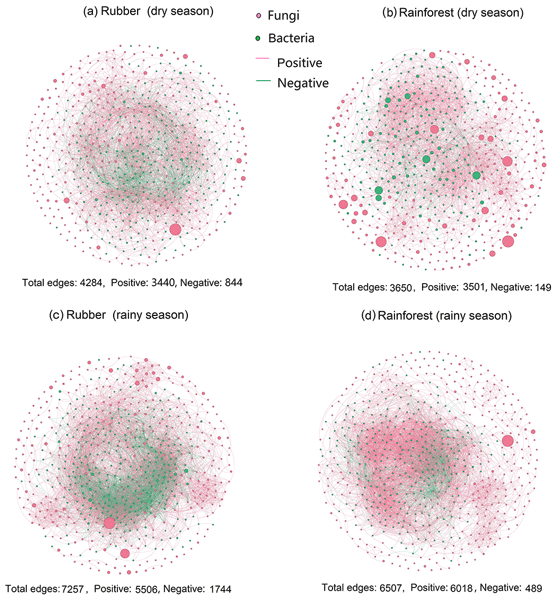
Forest conversion alters both bacterial and fungal soil networks: it reduces bacterial network complexity and enhances fungal network complexity. This is because forest conversion changes the soil pH and other soil properties, which alters the bacterial composition and subsequent network structure. Our study demonstrates the impact of forest conversion on soil network structure, which has important implications for ecosystem functions and the health of soil ecosystems in tropical regions.
Rui Sun, Guoyu Lan, Chuan Yang, Zhixiang Wu, Banqian Chen, and Klaus Fraedrich
Biogeosciences Discuss., https://doi.org/10.5194/bg-2021-303, https://doi.org/10.5194/bg-2021-303, 2021
Manuscript not accepted for further review
Short summary
Short summary
A soil quality index (SQI) based on 21 soil properties was employed to assess soil quality changes from tropical rainforest (TR) to rubber plantations (RP) . The results showed that the SQI of RP decreased by 26.48 % compared to TR, while four investigated soil properties increased. The SQI of both the TR and RP showed significant spatial differences, which, under TR, was more sensitive to seasonal changes than those under RP.
Guoyu Lan, Chuan Yang, Zhixiang Wu, Rui Sun, Bangqian Chen, and Xicai Zhang
SOIL, 8, 149–161, https://doi.org/10.5194/soil-8-149-2022, https://doi.org/10.5194/soil-8-149-2022, 2022
Short summary
Short summary
Forest conversion alters both bacterial and fungal soil networks: it reduces bacterial network complexity and enhances fungal network complexity. This is because forest conversion changes the soil pH and other soil properties, which alters the bacterial composition and subsequent network structure. Our study demonstrates the impact of forest conversion on soil network structure, which has important implications for ecosystem functions and the health of soil ecosystems in tropical regions.
Rui Sun, Guoyu Lan, Chuan Yang, Zhixiang Wu, Banqian Chen, and Klaus Fraedrich
Biogeosciences Discuss., https://doi.org/10.5194/bg-2021-303, https://doi.org/10.5194/bg-2021-303, 2021
Manuscript not accepted for further review
Short summary
Short summary
A soil quality index (SQI) based on 21 soil properties was employed to assess soil quality changes from tropical rainforest (TR) to rubber plantations (RP) . The results showed that the SQI of RP decreased by 26.48 % compared to TR, while four investigated soil properties increased. The SQI of both the TR and RP showed significant spatial differences, which, under TR, was more sensitive to seasonal changes than those under RP.
Cited articles
Abraham, J. and Joseph, P.: A new weed management approach to improve soil
health in a tropical plantation crop, rubber (Hevea brasiliensis), Exp. Agr., 52, 36–50, 2016.
Ahrends, A., Hollingsworth, P. M., Ziegler, A. D., Fox, J. M., Chen, H., Su,
Y., Xu, and J. X.: Current trends of rubber plantation expansion may threaten
biodiversity and livelihoods, Global Environ. Chang., 34, 48–58, 2015.
Aratrakorn, S., Thunhikorn, S., and Donald, P. F.: Changes in bird communities
following conversion of lowland forest to oil palm and rubber plantations in
southern Thailand, Bird Conserv. Int., 16, 71–82, 2006.
Breiman, L.: Random Forests, Mach. Learn., 45, 5–32, 2001.
Cai, Z. Q., Zhang, Y. H., Yang, C., and Wang, S.: Land-use type strongly shapes
community composition, but not always diversity of soil microbes in tropical
China, Catena, 165, 369–380, 2018.
Chandrasekaran, S., Sundarapandian, S. M., Chandrasekar, P., and Swamy, P. S.:
Exotic plant invasions in disturbed and man-modified forest ecosystems in
the Western Ghats of Tamil Nadu. Tropical Forestry Research: Challenges in
the New Millennium, in: Proceedings of the International Symposium, Peechi,
India, 2–4 August 2000, 32–39, 2001.
Chaudhary, A., Burivalova, Z., Koh, L. P., and Hellweg, S.: Impact of forest
management on species richness: Global meta-analysis and economic
trade-offs, Sci. Rep., 6, 23954, https://doi.org/10.1038/srep23954, 2016.
Chaudhuri, P. S., Bhattacharjee, S., Dey, A., Chattopadhyay, S., and Bhattacharya, D.: Impact of age of rubber (Hevea brasiliensis) plantation on earthworm
communities of West Tripura (India), J. Environ. Biol., 34, 59–65, 2013.
Chen, B. Q., Yun, T., Ma, J., Kou, W. L., Li, H. L., Yang, C., Xiao, X. M.,
Zhang, X., Sun, R., Xie, G. S., and Wu, Z. X.: High-Precision stand age data
facilitate the estimation of rubber plantation biomass: A case study of
Hainan Island, China, Remote Sens., 12, 3853, https://doi.org/10.3390/rs12233853, 2020.
Chen, H., Yi, Z. F., Schmidt-Vogt, D., Ahrends, A., Beckschäfer, P.,
Kleinn, C., Ranjitkar, S., and Xu, J. C.: Pushing the Limits: The Pattern and
Dynamics of Rubber Monoculture Expansion in Xishuangbanna, SW China, PLoS
ONE, 11, e0150062, https://doi.org/10.1371/journal.pone.0150062, 2016.
Curtis, J. T. and Mclntosh, R. P.: The interactions of certain analytic and
synthetic phytosociological characters, Ecology, 31, 435–455, 1950.
Curtis, J. T. and Mclntosh, R. P.: An upland forest continuum in the
prairie-forest border region of Wisconsin, Ecology, 32, 476–496, 1951.
Delzeit, R., Zabel, F., Meyer, C., and Václavík, T.: Addressing future
trade-offs between biodiversity and cropland expansion to improve food
security, Reg. Environ. Change, 17, 1429–1441, 2017.
Egli, L., Meyer, C., Scherber, C., Kreft, H., and Tscharntke, T.: Winners and
losers of national and global efforts to reconcile agricultural
intensification and biodiversity conservation, Global Change Biol., 24,
2212–2228, 2018.
Fick, S. E. and Hijmans, R. J.: WorldClim 2: new 1 m spatial resolution climate
surfaces for global land areas, Int. J. Climatol., 37, 4302–4315, https://doi.org/10.1002/joc.5086, 2017.
Fitzherbert, E. B., Struebig, M. J., Morel, A., Danielsen, F., Carsten, A.,
Brühl, Donald, P. F., and Phalan, B.: How will oil palm expansion affect
biodiversity?, Trends Ecol. Evol., 23, 538–545, 2008.
Greig-Smith, P. W.: Use of perches as vantage points during foraging by male
and female Stonechats Saxicola torquata, Behaviour, 86, 215–236, 1983.
Grogan, K., Pflugmacher, D., Hostert, P., Mertz, O., and Fensholt, R.:
Unravelling the link between global rubber price and tropical deforestation
in Cambodia, Nat. Plants, 5, 47–53, 2019.
Han, Z. Q., Liu, T., Wang, T., Liu, H. F., and Li, B. L.: Quantification of water
resource utilization efficiency as the main driver of plant diversity in the
water-limited ecosystems, Ecol. Model., 429, 108974, https://doi.org/10.1016/j.ecolmodel.2020.108974, 2020.
He, P. and Martin, K.: Effects of rubber cultivation on biodiversity in
the Mekong Region, CAB Reviews, 10, 44, https://doi.org/10.1079/PAVSNNR201510044, 2016.
Humphreys, L. R.: The Evolving Science of Grassland Improvemen, Cambridge
University Press, Cambridge, UK, ISBN: 9780511525803, https://doi.org/10.1017/CBO9780511525803, 1997.
Huston, M. A. and DeAngelis. D. L.: Competition and coexistence: the effects of resource transport and supply rates, Am. Nat., 144, 954–977, https://doi.org/10.2307/2463137, 1994.
Hu, Y. H., Sheng D. Y., Xiang Y. Z., Yang Z. J., Xu D. P., Zhang N. N., and Shi L. L.: The Environment, Not Space, Dominantly Structures the Landscape Patterns of the Richness and Composition of the Tropical Understory Vegetation, PLoS ONE, 8, e81308, https://doi.org/10.1371/journal.pone.0081308, 2013.
Kehoe, L., Romero-Muoz, A., Polaina, E., Estes, L., and Kuemmerle, T.:
Biodiversity at risk under future cropland expansion and intensification,
Nat. Ecol. Evol., 1, 1129–1135, 2017.
Kerfahi, D. B. M. T., Dong, K., Go, R., and Adams, J. M.: Rainforest conversion
to rubber plantation may not result in lower soil diversity of bacteria
fungi and nematodes, Microb. Ecol., 72, 359–371, 2016.
Kushwaha, S. P. S. and Tripathi, P. S. R. S.: Population dynamics of Chromolaena
odorata in successional environments following slash and burn agriculture, J.
Appl. Ecol., 18, 529–535, 1981.
Lan, G. Y., Wu, Z. X., and Xie, G. X.: Characteristics of plant species diversity of
rubber plantation in Hainan Island, Biodivers. Sci., 22, 658–666, 2014.
Lan, G. Y., Li, Y. W., Wu, Z. X., and Xie, G. S.: Impact of tropical forest
conversion on soil bacterial diversity in tropical region of China, Eur. J.
Soil Biol., 83, 91–97, 2017a.
Lan, G. Y., Li, Y. W., Wu, Z. X., and Xie, G. S.: Soil bacterial diversity impacted
by conversion of secondary forest to rubber or eucalyptus plantations-A case
study of Hainan Island, South China, Forest Sci., 63, 87–93, 2017b.
Lan, G. Y., Li, Y. W., Jatoi, M. T., Tan, Z. H., Wu, Z. X., and Xie, G. S.: Change in
soil microbial community compositions and diversity following the conversion
of tropical forest to rubber plantations in Xishuangbanan, Southwest China,
Trop. Conserv. Sci., 10, 1–14, 2017c.
Lan, G. Y., Wu, Z. X., Chen, B. Q., and Xie, G. S.: Species diversity in a naturally
managed rubber plantation in Hainan Island, South China, Trop. Conserv.
Sci., 10, 1–7, 2017d.
Lan, G. Y., Wu, Z. X., Sun, R., Yang, C., Chen, B. Q., and Zhang, X.: Tropical
rainforest conversion into rubber plantations results in changes in soil
fungal composition, but underling mechanisms of community assembly remain
unchanged, Geoderma, 375, 114505, https://doi.org/10.1016/j.geoderma.2020.114505, 2020a.
Lan, G. Y., Wu, Z. X., Li, Y. W., and Chen, B. Q.: The drivers of soil bacterial
communities in rubber plantation at local and geographic scales, Arch.
Agron. Soil Sci., 66, 358–369, 2020b.
Lan, G. Y., Wu, Z. X., Sun, R., Yang, C., Chen, B. Q., and Zhang, X. C.: Forest conversion changed the structure and functional process of tropical
forest soil microbiome, Land Degrad. Dev., 32, 613–627, 2021.
Lewis, S. L., Wheeler, C. E., Mitchard, E. T. A., and Koch, A.: Regenerate natural
forests to store carbon, Nature, 568, 25–28, 2019.
Li, H. M., Aide, T., Ma, Y. X., Liu, W. J., and Cao, M.: Demand for rubber is
causing the loss of high diversity rain forest in SW China, Biodivers.
Conserv., 16,1731–1745, 2007.
Linares-Palomino, R. and Alvarez, S. I. P.: Tree community patterns in seasonally
dry tropical forests in the Cerros de Amotape Cordillera, Tumbes, Peru, Forest Ecol. Manag., 209, 261–272, 2005.
Li, S., Zou, F., Zhang, Q., and Sheldon, F. H.: Species richness and guild
composition in rubber plantations compared to secondary forest on Hainan
Island, China, Agroforestry Syst., 87, 1117–28, 2013.
Li, T., Xiong, Q., Luo, P., Zhang, Y., Gu, X., and Lin, B.: Direct and indirect effects of environmental factors, spatial constraints, and functional traits on shaping the plant diversity of montane forests, Ecol. Evol., 10, 557–568, https://doi.org/10.1002/ece3.5931, 2020.
Li, Y. W., Xia, Y. J., Lei, Y. B., Deng, Y., Chen, H., Sha, L. Q., Cao, M., and
Deng, X. B.: Estimating changes in soil organic carbon storage due to land use
changes using a modified calculation method, Iforest, 8, 45–52, 2015.
Mccoy, E. D. and Connor, E. F.: Latitudinal gradients in the species diversity of
north American mammals, Evolution, 34, 193–203, 1980.
Melkonian, R., Moulin, L., Béna, G., Tisseyre, P., Chaintreuil, C.,
Heulin, K., Rezkallah, N., Klonowska, A., Gonzalez, S., Simon, M., Chen, W. M.,
James, E. K., and Laguerre, G.: The geographical patterns of symbiont
diversity in the invasive legume mimosa pudicacan be explained by the competitiveness of its
symbionts and by the host genotype, Environ. Microbiol., 16, 2099–2111,
2014.
Morrison-Whittle, P. and Goddard, M. R.: Quantifying the relative roles of
selective and neutral processes in defining eukaryotic microbial
communities, ISME J., 9, 2003–2011, 2015
Myers, N., Mittermeier, R. A., Mittermeier, C. G., Fonseca, G. A. B. D., and Kent,
J.: Biodiversity hotspots for conservation priorities, Nature, 403,
853–858, 2000.
Nottingham, A., Fierer, N., Turner, B. L., Whitaker, J., Ostle, N. J.,
Mcnamara, N. P., Bardgett, R. D., Leff, J. W., Salinas, N., Silman, M. R.,
Kruuk, L. E. B., and Meir, P.: Temperature drives plant and soil microbial
diversity patterns across an elevation gradient from the Andes to the
Amazon, Ecology, 99, 2455–2466, 2018.
Oksanen, J., Blanchet, F. G., Friendly, M., Kindt, R., Legendre, P., McGlinn,
D., Minchin, P. R., O'Hara, R. B., Simpson, G. L., Solymos, P., Stevens,
M. H. H., Szoecs, E., and Wagner, H.: vegan: Community Ecology, R package, version 2.5–7, https://cran.r-project.org/web/packages/vegan/ (last access: 4 April 2022), 2020.
Paudel, N.: Seasonal variation in phenophases of Mimosa pudica (fabaceae) in grazed pasture
of Barandabhar corridor forest Chitwan, Nepal, Curr. Trends Biomed. Eng.
Biosci., 11, 101–102, https://juniperpublishers.com/ctbeb/pdf/CTBEB.MS.ID.555825.pdf (last access: 4 April 2022), 2018.
Perrigo, A. L., Baldauf, S. L., and Romeralo, M.: Diversity of dictyostelid social
amoebae in high latitude habitats of Northern Sweden, Fungal Divers., 58,
185–198, 2013.
Phommexay, P., Satasook, C., Bates, P., Pearch, M., and Bumrungsri, S.: The
impact of rubber plantations on the diversity and activity of understory
insectivorous bats in southern Thailand, Biodivers. Conserv.,
20, 1441–56, 2011.
R Core Team: A language and environment for statistical computing, R Foundation for Statistical Computing, Vienna, Austria, https://www.R-project.org/, last access: 1 March 2021.
Rohde, K.: Latitudinal gradients in species diversity: The search for the
primary cause, Oikos, 65, 514–527, 1992.
Sabatini, F. M., Burrascano, S., Azzella, M. M., Barbati, A., De Paulis, S.,
Di Santo, D. Facioni, L., Giuliarelli, D., Lombardi, F., Maggi, O.,
Mattioli, W., Parisi, F., Persiani, A., Ravera, S., and Blasi, C.: Herb-layer
diversity and stand structural complexity are weak predictors of
biodiversity in Fagus sylvatica forests, Ecol. Indic., 69, 126–137, 2016.
Schneider, D., Engelhaupt, M., Allen, K., Kurniawan, S., Krashevska, V.,
Heinemann, M., and Scheu, S.: Impact of lowland rainforest transformation on
diversity and composition of soil prokaryotic communities in Sumatra
Indonesia, Front. Microbiol., 6, 296, https://doi.org/10.3389/fmicb.2015.01339, 2015.
Shackelford, G. E., Steward, P. R., German, R. N., Sait, S. M., and Benton, T.
G.: Conservation planning in agricultural landscapes: hotspots of conflict
between agriculture and nature, Divers. Distrib., 21, 357–367, 2014.
Shah, H. A., Huxley, P., Elmes, J., and Murray, K. A.: Agricultural land-uses
consistently exacerbate infectious disease risks in Southeast Asia, Nat.
Commun., 10, 4299, https://doi.org/10.1038/s41467-019-12333-z, 2019.
Singh, D., Slik, J. W. F., Jeon, Y. S., Tomlinson, K. W., Yang, X. D., Wang, J., Kerfahi, D., Porazinska, D. L., and Adams, J. M.: Tropical forest conversion to
rubber plantation affects soil micro and mesofaunal community and
diversity, Sci. Rep., 9, 5893, https://doi.org/10.1038/s41598-019-42333-4, 2019.
Soons, M. B., Hefting, M. M., Dorland, E., Lamers, L. P. M., Versteeg, C., and Bobbink, R.: Nitrogen effects on plant species richness in herbaceous
communities are more widespread and stronger than those of phosphorus, Biol.
Conserv., 212, 390–397, 2017.
Stadler, J., Trefflich, A., Klotz, S., and Brandl, R.: Exotic plant species invade
diversity hot spots: the alien flora of northwestern Kenya, Ecography,
23, 169–176, 2000.
Stohlgren, T. J. , Binkley, D., Chong, G. W., Kalkhan, M. A., Schell, L. D.,
Bull, K. A., Otsuki, Y., Newman, G., Bashkin, M., and Son, Y.: Exotic plant
species invade hot spots of native plant diversity, Ecol. Monogr., 69, 25–46, 1999.
Tripathi, B. M., Kim, M., Singh, D., Lee-Cruz, L., Lai-Hoe, A., Ainuddin, A.
N., and Adams, J. M.: Tropical soil bacterial communities in Malaysia: pH
dominates in the equatorial tropics too, Microb. Ecol., 64, 474–484, 2012.
Warren-Thomas, E. M. , Edwards, D. P. , Bebber, D. P. , Chhang, P., Diment, A.
N., Evans, T. D., Lambrick, F. H., Maxwell, J. F., Nut, M., O'Kelly, H. J., Theilade, I., and Dolman, P. M.: Protecting tropical forests from the rapid
expansion of rubber using carbon payments, Nat. Commun., 9, 911, https://doi.org/10.1038/s41467-018-03287-9, 2018.
Wu, J., Wang, X., Zhong, B., Yang, A., and Liu, Q.: Ecological environment
assessment for Greater Mekong Subregion based on pressure-state-response
framework by remote sensing, Ecol. Indic., 117, 106521, https://doi.org/10.1016/j.ecolind.2020.106521, 2020.
Xiao, C. W., Li, P., Feng, Z. M., Yang, Y. Z., You, Z. L., Yu, M., and Zhang, X. Z.:
Latest 30-m map of mature rubber plantations in Mainland Southeast Asia and
Yunnan province of China: Spatial patterns and geographical characteristics,
Prog. Phys. Geog., 45, 736–756, https://doi.org/10.1177/0309133320983746, 2021.
Xiao, H. F., Tian, Y. H., Zhou, H. P., Ai, X. S., Yang, X. D., and Schaefer, D. A.:
Intensive rubber cultivation degrades soil nematode communities in
Xishuangbanna, southwest China, Soil Biol. Biochem., 76, 161–169, 2014.
Xu, H. W., Liu, Q., Wang, S. Y., Yang, G. S., and Xue, S.: A global meta-analysis of
the impacts of exotic plant species invasion on plant diversity and soil
properties, Sci. Total Environ., 810, 152286, https://doi.org/10.1016/j.scitotenv.2021.152286, 2022.
Xu, J. C.: China's new forests aren't as green as they seem, Nature, 477, 371, https://doi.org/10.1038/477371a, 2011.
Yaseen, S. D.: Prevalence of economically important fungal diseases at
different phenological stages of peanut (Arachis hypogaea L.), pearl millet (Pennisetum glaucum L.) and
sorghum (Sorghum bicolor L.) in sub-zone Hamelmalo, J. Agr. Econ. Dev., 2, 237–245, 2013.
Zabel, F., Delzeit, R., Schneider, J. M., Seppelt, R., Mauser, W., and Václavík, T.: Global impacts of future cropland expansion and
intensification on agricultural markets and biodiversity, Nat. Commun., 10,
2844, https://doi.org/10.1038/s41467-019-10775-z, 2019.
Zhang, J., Fu, B., Stafford-Smith, M., Wang, S., and Zhao, W.: Improve forest
restoration initiatives to meet sustainable development goal, Nat. Ecol.
Evol., 5, 10–13, 2021.
Ziegler, A. D., Fox, J. M., and Xu, J.: The rubber juggernaut, Science, 324, 1024–1025, https://doi.org/10.1126/science.1173833, 2009,
Short summary
Little is known about the impact of rubber plantations on diversity of the Great Mekong Subregion. In this study, we uncovered latitudinal gradients of plant diversity of rubber plantations. Exotic species with high dominance result in loss of plant diversity of rubber plantations. Not all exotic species would reduce plant diversity of rubber plantations. Much more effort should be made to balance agricultural production with conservation goals in this region.
Little is known about the impact of rubber plantations on diversity of the Great Mekong...


Altmetrics
Final-revised paper
Preprint